At the gaming panel of the 2025 Tencent Global Digital Ecosystem Conference, Mr. Lin Zhihong, a technical expert on the Hunyuan large language model, shared Hunyuan’s applications in the gaming industry and unveiled the Hunyuan 3D 3.0 model. Game Teahouse summarized his remarks using Tencent Yuanbao:
The key point is that AI is evolving from a tool for efficiency into a creator of gaming experiences, ultimately leading to a new paradigm of AI-native games.
Here is a summary of the key points from the presentation:
I. New Opportunities in the Integration of Gaming and AI
The development of large language models has reached a commercial inflection point. Their efficient operation, specialization in niche fields (such as art models), and the data flywheel effect can effectively address the gaming industry’s pain points of high costs, long development cycles, and product homogenization. Three major shifts are emerging in the industry:
- The Evolution of AI: From an Outsourced Support Tool to an Essential Creative Tool for Teams.
- Changes in adoption attitudes: shifting from a wait-and-see approach to active exploration and adoption (e.g., DeepSeek transformed China’s AI infrastructure ecosystem in 2025).
- Expanded Scope of Application: AI is now used in over 60% of scenarios within the game development pipeline.
II. High-Value Applications of AI in Gaming
Hunyuan categorizes the value of game AI into three tiers:
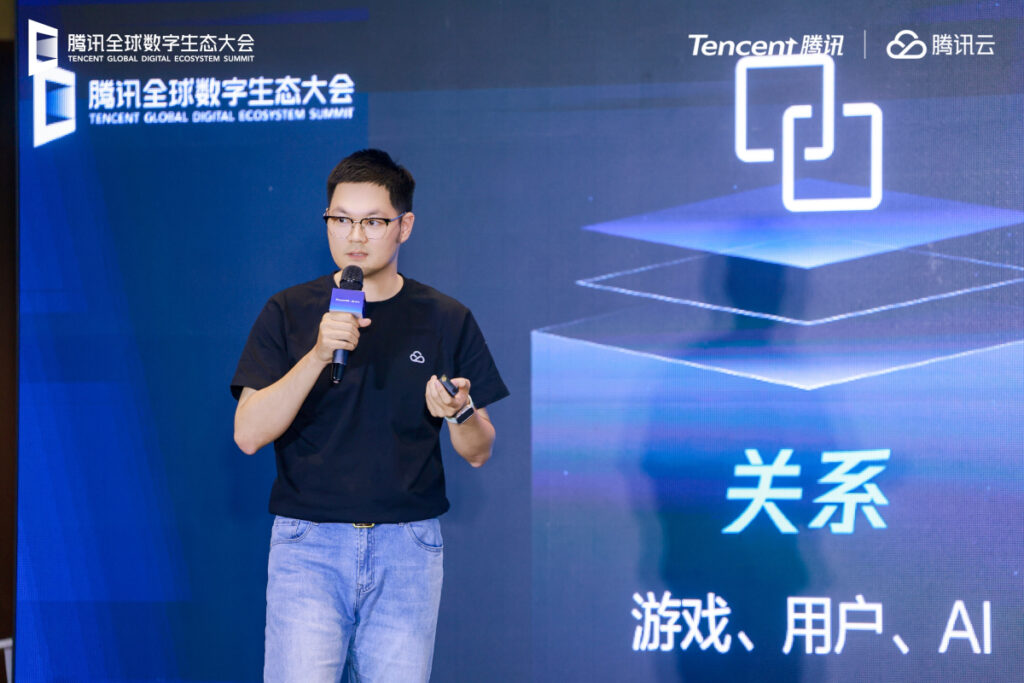
- Relationship (Basics): AI serves as a driver of new technologies (enhancing development and iteration efficiency) and a creator of new interactive experiences (making games more attuned to users and users more immersed).
- Capabilities (Pathways): While the current mainstream applications of AI focus on improving efficiency (in art and coding), future developments should delve deeper into narrative storytelling, dynamic progression, adaptive difficulty, and emotional recognition, transforming AI into a core engine that enhances the gaming experience and delivers a truly unique player experience.
- Trends (Future): AI-native games are the way forward—that is, games designed from the ground up with AI as their core technology, enabling credible game rules, emergent storytelling, and procedurally generated worlds.
III. Practical Applications and Case Studies of the Hun Yuan Large Model
As a fully in-house developed large language model, Tencent Hunyuan boasts six core capabilities, including language modeling and multimodal generation (text, images, video, and 3D), with the goal of becoming an industrial-grade productivity engine for the gaming industry. It has already been deployed in over 15 gaming scenarios, covering modules such as concept design, art asset creation, R&D efficiency, and operations.
1. Artistic Creation
- Key Challenges: Producing high-quality concept art for the transition from 2D to 3D, and generating high-quality models for the transition from 3D to the game engine.
- Platforms and Tools:
- Hunyuan Game Visual Creation Platform 2.0: This update features an improved text-to-image model for games, enhancing instruction adherence, structural representation, and visual appeal. It supports the generation of special effects and UI elements, and introduces LoRA style customization (which allows users to train a unique style using just 10–20 reference images, supporting CG realism, anime, and traditional Chinese styles).
- New Game Video Model: Enhances the efficiency of game animation and visual effects design, and supports "rotation of all objects" for multi-view output.
- Hunyuan 3D Studio: A professional, studio-grade creation platform featuring text-to-3D, image-to-3D, component-based editing, AI-powered automatic topology, texture editing, universal rigging (supporting both humanoid and non-humanoid characters), and an animation library. It has already generated hundreds of thousands of models for UGC scenes in *Yuanmeng Zhi Xing*.
2. Content Creation and Experience Innovation
- New Game Marketing:
- Valorant Mobile launched an AI Account Manager (which identifies high-quality players through multiple rounds of dialogue, with over 50 million interactions) and an AI Reviewer (which evaluates usernames and recommends champions, driving over 100,000 instances of user-generated content).
- Multimodal image-generation marketing campaign: Players create and submit characters, with a participation rate exceeding 90%.
- New Ways to Play Mature Games:
- In collaboration with titles such as *QQ Speed* and *Space Kill*, we have introduced NPC gameplay modes including companion, co-op, mission-based, and player-versus-NPC modes.
- At the core, the platform leverages Hunyuan’s small-scale models, role-playing models, and reasoning models to enhance player engagement and market performance. After integrating Hunyuan, *Space Kill* generated over 7 million AI players, enabling highly lifelike intelligent interactions.
IV. Outlook for the Future
In the future, game AI will evolve from single-modal systems to cross-modal combinations. Hun Yuan is currently developing cutting-edge large-scale game interaction models with the aim of helping the industry create more innovative gameplay and experiences.
Attached is the full text of the speech:
Lin Zhihong: Welcome to the Hunyuan Large Model session. I’m Lin Zhihong from the Hunyuan Large Model team, and I’m delighted to meet you all. We have a lot of content to share with you today,
Today’s presentation is divided into three main sections. First, we’ll explore new opportunities for collaboration between gaming and AI from today’s perspective. Second, we’ll examine the industry through the lens of AI to identify high-value application scenarios for AI in gaming. Third, we’ll share more case studies to highlight Hun Yuan’s specific practices and insights over the past year.
Let’s start by discussing the opportunities presented by the convergence of gaming and AI. I’m sure that over the past two years, amid the surge in the development of large AI models, AI has become a familiar concept to everyone. But how exactly can AI benefit the gaming industry? Today, the pace of development in large AI models is so rapid that it’s often said “a day in the model world is a year in the real world.” How should we view the relationship between AI and our business?
From my perspective, large language models have been around for over two years now, and the pace of model iteration has surpassed our expectations. For example, the striking consistency between the recently released Gemini model, Gini 3, and the Nano Banana model has exceeded many people’s expectations, with the new models completely upending previous products.
From our perspective, there are three core elements driving the development of large language models today. First, large language models have reached a commercial inflection point; not only language models, but even multimodal generation has now reached a commercially viable level. The trend in model development is toward increasing specialization; we will launch models for visual arts and other fields, specifically designed to address specific problems in specific scenarios. At the same time, as models and applications are deployed, they create a powerful data flywheel.This allows us to understand user needs from a generative perspective, enabling models to better understand users. Therefore, from the perspective of large language models, they have become a robust technological foundation that meets the industry’s demands for quality and efficient operation. We also believe these advantages align exceptionally well with the pain points of the gaming industry—high costs, long development cycles, and homogenization—not only enhancing the overall efficiency of game production but also offering opportunities to create new interactive gaming experiences.
Looking back from today’s perspective, we can see three changes in the industry:
First is the evolution of AI tools. AI has transformed from a tool used primarily for outsourcing and support in the past into an essential creative tool in every game art team today.
Second, in terms of willingness, by 2025, DeepSeek will have driven and transformed China’s underlying AI application ecosystem, with many people shifting from a wait-and-see attitude to a desire to explore and apply AI.
Third is the application of AI in the game development pipeline, which covers more than 60% of scenarios. We are delighted to see so many positive signs and changes in the industry. We believe that one of the key reasons everyone has come to this venue today to hear from Hun Yuan is to learn about our perspective on the integration of games and AI, as well as what we are currently working on.
Our thinking on "Games + AI" is structured in three layers, and I’ve listed three key terms for you: relationships, capabilities, and trends.
Today, AI plays two key roles. First, it serves as a driver of new technology, accelerating the development and iteration of games and enabling the creation of better interactions. For users, it creates a new interactive experience. For example, in the promotional video we just saw, AI has been used to create new gameplay mechanics—this is the kind of new experience AI brings.Therefore, we believe that the integration of AI enables games to better understand users, allows users to become more immersed in the games, and makes the games themselves more vivid.
Many people ask: How exactly should game AI be implemented? With large language models evolving so rapidly—and so many models and open-source options available—how should we integrate them into our business?We believe that the mainstream focus of AI today is on improving efficiency. While significant advancements have been made in art and code development, we don’t believe AI is limited to efficiency gains alone. We believe that in the future, AI should establish stronger connections through narrative storytelling, dynamic progression, adaptive difficulty, and even player emotion recognition. AI should become a deeper-level enhancement engine for the gaming industry, enabling everyone to enjoy a unique gaming experience.
In terms of trends, I’m highlighting “AI-native games.” Starting this year, we’ll see a surge in examples of AI-native games, and we’re very excited to see the industry exploring this direction.We believe the trend of AI-native games goes beyond simply adding AI to existing games; rather, it involves using AI as the core technological driver from the very beginning of game design. For example, we believe it can enable the credibility of game rules, the emergence of game narratives, and the sustainable generation of game worlds. Hun Yuan is also continuously developing new AI capabilities in this area to support everyone.
From this perspective, we believe that relationships are the foundation, capabilities are the path, and trends are the future.
As a fully in-house developed large language model by Tencent, Hun Yuan offers six core capabilities: language modeling, multimodal generation, text-image integration, video, and 3D modeling, among others.For game developers, when selecting a game model that suits your business needs, Tencent is an excellent choice. We possess the industry’s most comprehensive, end-to-end, and scenario-rich gaming ecosystem, giving us a deep understanding of the AI capabilities required by both gamers and game developers. Furthermore, with our robust large-model infrastructure capabilities, Hun Yuan aims to serve as an industrial productivity engine for the gaming industry.

Hunyuan has already been implemented in over 15 gaming scenarios. As shown in this diagram, it now covers multiple modules, including game concept design, art asset creation, game development efficiency, and operations. We have also launched several large language models tailored for the gaming industry, as well as AI-powered tools for game development.
We focus on two core areas: game art production and game content creation.
Next, I’d like to share with you in detail how we approach and implement our work in the fields of art and content creation.
First, we can see that in the field of art creation, what does the gaming industry demand the most? It places extremely high demands on style, aesthetics, and texture.When developing AI for game art creation, our approach is to integrate with the industry’s established production pipelines for commercial assets. We focus on addressing two key pain points: first, the transition from 2D to 3D—specifically, how to produce higher-quality concept art; and second, the transition from 3D to the game engine—specifically, how to produce higher-quality models.
That is why we have launched two AI-powered platform products: the Hun Yuan Game Visual Creation Platform and the Hun Yuan 3D Engine Creation Platform. These are designed to help users improve efficiency, experiment, and validate AI implementations, and we cover six core categories, including characters, props, and environments. In the 2D creation module, we have independently developed large-scale image generation models, video generation models, and real-time image generation models specifically for games, which better meet the content quality requirements of the gaming industry.At the same time, we have launched an AIGC visual creation pipeline based on our proprietary large models. As shown in the example above, taking a key game character as an illustration, our pipeline covers the entire process—from concept design and character color schemes to multi-variant adjustments and character enhancement—ultimately outputting high-quality multi-angle visuals that help users accelerate their proof-of-concept development.
Today, we are thrilled to announce the launch of the Hun Yuan Game Visual Platform 2.0, which introduces both new models and new applications. First, regarding our large-scale game image generation model, this updated version offers significant improvements over the previous 1.0 model in terms of instruction following, structural representation, and visual aesthetics. It is the industry’s first model to achieve text-to-image generation for games. We have also added support for special effects and high-quality UI generation.At the same time, as we iterated on our overall game capabilities and pipeline, we recognized that addressing style customization was a priority, as style serves as the starting point for all AI applications. With this release, we are officially introducing the Hun Yuan LoRA customization feature, allowing users to train their own styles with minimal effort. For example, users can now provide just 10 to 20 reference images to Hun Yuan for LoRA style customization, and Hun Yuan will automatically handle data labeling and training.
We have also launched several high-quality styles, including realistic CG, anime-style, and traditional Chinese-style, among other popular options, to help you quickly switch between and validate different styles. We are also excited to introduce the new version of Hun Yuan’s game video models, which support more natural visual expression and accelerate design efficiency for game animations and special effects. Additionally, we have launched the “Rotate All” feature, helping artists quickly validate concept art designs—whether for characters, props, or scenes—and efficiently generate multiple viewports.
Following our presentation on 2D, we also launched Hun Yuan 3D this morning. Hun Yuan 3D continues to lead the industry, and today we are thrilled to introduce Hun Yuan 3D Studio—the first platform to deliver professional-grade artistic creation capabilities.
The Hun Yuan 3D 3.0 model has officially launched on the Hun Yuan Creation Platform. Hun Yuan 3D Studio will also be opening up beta testing access in the coming days. We invite everyone to come and try it out.
Let’s take a look at what Hun Yuan 3D Studio is and how we designed it.
Hunyuan 3D Studio is built on Hunyuan’s proprietary suite of 3D large language models, offering a complete AIGC creation pipeline.As you can see, this AIGC creation pipeline not only covers the traditional 3D asset creation process but also provides multiple editable customization features to enable high-precision modeling. Additionally, we have introduced numerous new capabilities in this iteration, such as component editing, component splitting, automatic topology, and multi-stage control.Many of the requests frequently raised by the industry regarding Hun Yuan 3D in the past have been fully addressed in this version of Hun Yuan 3D Studio.
In the realm of geometric generation, we not only offer mature generation methods such as text-to-3D and image-to-3D, but we have also introduced new capabilities for component decomposition and editing. As shown here, we have demonstrated three use cases: a complex character, a complex prop, and a monster. All of these can be automatically decomposed by AI, and we have opened up highly customizable capabilities.Users can automatically composite, merge, and even re-decompose the results of the decomposition. This represents a major breakthrough, enabling us to efficiently support 3D asset production based on previously monolithic models. In the topology phase, we have also introduced AI-powered automatic topology capabilities to significantly enhance post-editing capabilities for 3D assets.
In terms of AI-powered automatic topology generation, we support the automatic creation of adaptive surfaces, triangular faces, tetrahedral faces, and more, meeting the requirements of game modeling. For text-to-image generation, we also offer texture editing capabilities: you can modify a model’s textures via text, upload a reference image to change the overall texture style, and fine-tune texture styles and PPR materials to ensure your models align with your game’s quality standards. We have also implemented universal skeleton binding through our algorithms—a highly essential capability. Beyond human-like characters, we support non-human characters as well, including frogs, deer, and bat-like birds. This is achieved through a proprietary universal skeleton binding and skinning algorithm developed by Hun Yuan AI, ensuring precise skeletal binding.Game developers have numerous requirements regarding animation. To address this, we’ve launched a library of nearly 50 game-ready animations, enabling one-click skeleton binding and one-click animation playback. Beyond professional-grade art production, Hun Yuan 3D is also making inroads into the UGC space. We’ve officially launched the UGC scene for *Yuan Meng Zhi Xing*. Let’s take a look at the *Yuan Meng* case study.
As you can see, this example features a scene created entirely within Hun Yuan 3D, with a wide variety of gameplay elements layered on top. We’ve found that AIGC’s generative capabilities can better unleash creators’ creativity. Furthermore, since the launch of *Yuan Meng Zhi Xing*, Hun Yuan 3D has now generated hundreds of thousands of AI-generated models. Up until now, we’ve primarily discussed artistic creation capabilities,
In addition to visual arts, Hun Yuan is also collaborating with several Tencent games to explore new gaming experiences, and will soon introduce content creation capabilities related to language models.
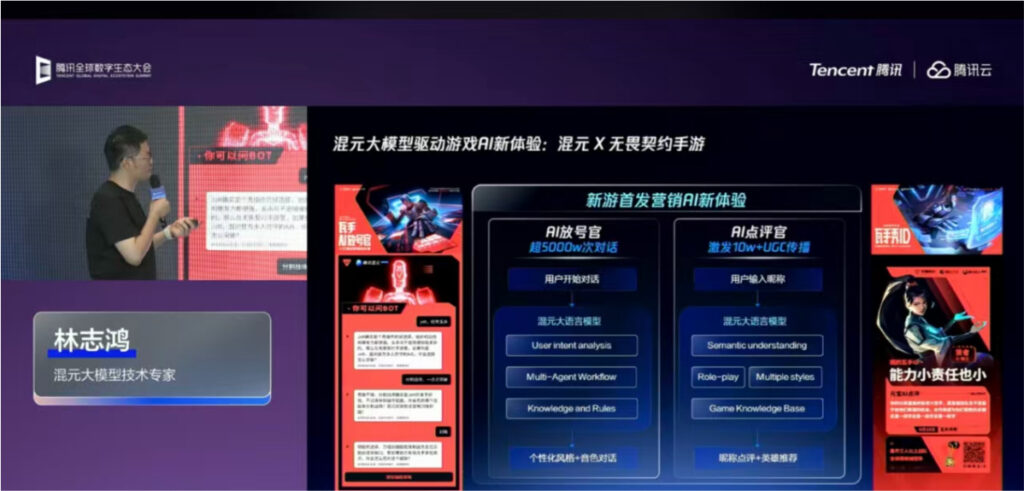
Taking new game launches as an example, we’ve set two new benchmarks for AI marketing with the recent high-profile release of *Valorant Mobile*. During the game’s early testing phase, we rolled out an AI Account Allocator and an AI Reviewer. What scenarios do these serve? The Account Allocator is easy to understand—what sets it apart from previous approaches? It identifies high-quality players through multiple rounds of dialogue with users.We’ve observed that players not only claim their accounts here but also enjoy chatting with the AI, with over 50 million interactions recorded.
The "AI Reviewer" feature was primarily designed to facilitate the early registration of usernames. We observed that the AI could analyze a user’s nickname to provide personalized recommendations for suitable hero characters and roles. This generated over 100,000 pieces of user-generated content (UGC), which played a highly effective role in building momentum for the game’s pre-launch phase. For another new game, we leveraged multimodal capabilities to create a marketing campaign centered on AI-generated imagery. Players could use AI to create their own game characters, submit them, and engage in social interactions. Players generated over a thousand characters, and the game’s participation rate exceeded 90%. The positive word-of-mouth generated by this campaign was also a significant boost for the new game.
In addition, we are constantly exploring new gameplay mechanics for established games. Today, it is widely recognized within the industry that NPC scenarios offer a high degree of certainty. We have collaborated with *QQ Speed* and *Space Kill* to launch multiple NPC-based gameplay modes, including companion-based, co-op, mission-based, and player-versus-NPC modes. These represent a crucial aspect of NPC applications in modern game AI.Underpinning these features are Hunyuan’s small-to-medium-sized models, Hunyuan role-playing models, and Hunyuan reasoning models. Together, they create a new player experience, driving player retention and market growth through these innovative gameplay mechanics.
Looking to the future from today’s perspective, I believe there is tremendous potential in the convergence of gaming and AI. For instance, we are transitioning from single-modal language systems to core, foundational AI capabilities that integrate multiple modalities. We also believe that, in terms of technological pathways, the Hun Yuan Large Model will provide exponential growth in support for the gaming industry. We are currently developing cutting-edge large models for game interaction, and we hope that these advanced game models will help everyone create even more innovative gameplay and experiences. Finally, I invite everyone to visit the Hunyuan Large Model official website to experience the series of models and products mentioned today. Hunyuan looks forward to partnering with the industry to innovate and grow together, jointly creating new games for the AI era. Thank you all.
原创文章,作者:gallonwang,禁止转载:https://youxichaguan.com/en/archives/194564