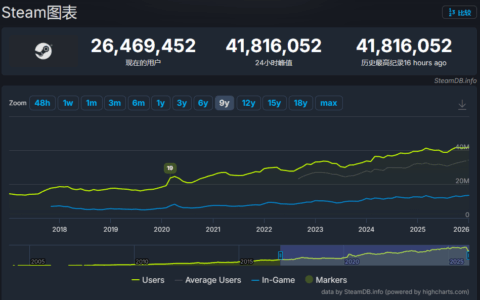
According to data from SteamDB, the total number of games released on Steam last year reached a new high.We’ve also heard many complaints that it’s becoming increasingly difficult for games to be discovered by players. For indie developers, this isn’t just a technical issue—such as Steam’s algorithms or exposure opportunities like the New Releases event—but also a statistical problem: a massive number of titles are piling up in every popular genre, competing for players’ limited attention and time.

That's why so many people say the indie game scene is too competitive.
In contrast to this view, over the past year we have observed a trend: in many niche genres that were previously dominated by overseas games and received little attention domestically, domestic indie games are beginning to make their presence felt. These games receive little publicity, but they maintain a steady level of popularity within relevant communities.
Teahouse Jun gathered a group of seasoned indie game developers to discuss this trend. Miyako, the producer of *Song of the Dragon: Food and Adventure*, proposed a useful framework: a game’s sales can be divided into “event-driven” and “preference-driven” categories.Event-driven sales rely on concentrated marketing and promotion to generate a short-term sales surge, while preference-driven sales depend on long-term accumulation. She believes that many indie game genres that appear to be very popular actually rely on event-driven strategies to gain support from a broad user base; their long-term performance is lackluster and therefore not representative.
Drawing on their own experiences, the developers offered some counterintuitive insights: At this juncture of game oversaturation, the market has undergone significant changes, and indie game developers’ strategies for creating games must also evolve. Returning to a preference-driven approach, delving deeply into niche genres, and adopting a long-term perspective are all integral parts of this strategy.
01
Alignment Preferences: Harder Than You Might Think
“When choosing a genre, it’s not about deciding what kind of game you want to make, but rather considering whether your preferences can be accurately matched to the players’”—Miyako, Producer of *Song of the Dragon: Food and Adventure*
Miyako recently released *Song of the Dragon: Food and Adventure*, and its sales have been enough to keep the entire team afloat and allow them to work on their next game.Like most indie games, this title was developed with limited funding and time, so while the final version has its rough edges, it also has some standout moments. However, last year, countless similar games vanished into obscurity on Steam as soon as they were released.
Why *Song of the Dragon: Food and Adventure* achieved its expected sales figures is a complex question, but looking back now, Miyako believes the most important factor was that it tapped into players’ preferences.
She believes that when launching an indie game project, developers should consider player preferences from the very beginning: “When making indie games, we often hear various discussions—should we target overseas or domestic markets? Which genre has the most potential? … In my view, these questions all boil down to one thing: Do you expect this project to suddenly gain widespread attention, or do you want it to be valued by a small but dedicated group of people over the long term?”
For *Song of the Dragon: Food and Adventure*, the answer is the latter. Players’ purchasing behavior in this game is primarily driven by stable preferences.Steam has an increasingly sophisticated system in place that revolves around these preferences. This system operates through genres; as Miyako puts it, “On a distribution platform like Steam, a genre doesn’t indicate what kind of gameplay your game offers, but rather what kind of players your game will be recommended to.”
"Song of the Dragon: Food and Adventure" is a hybrid casual game. It features two systems: a simulation management system and an adventure system with CRPG-style turn-based combat. These two systems cater to user preferences for simulation management and turn-based combat, respectively. The genres are clearly defined, allowing users to quickly determine whether the game aligns with their preferences.Thanks to its unique casual atmosphere, art style, and narrative depth, *Song of the Dragon: Food & Adventure* has struck a chord with the general sim-management audience, as evidenced by its positive reviews.

Conversely, the reason this game’s sales failed to reach new heights was that Miyako’s understanding of the genre did not fully align with the preferences of mainstream users.
During the post-mortem, Miyako also admitted, “Although I’ve played a lot of farm games, looking back now, the parts I enjoy are precisely the ones that hardcore players don’t really care about—I’m a casual player.I prefer the management elements and am not very interested in features that delve too deeply into the inner workings of the farm. As for the storyline, I particularly enjoy epic narratives rather than more everyday, heartwarming stories.”
A developer of a Chinese DBG (deck-building game) who wished to remain anonymous also told Teahouse that upon the game’s release, they discovered a discrepancy between the game and user expectations: “My understanding was that a DBG needs to constantly offer something new, so I planned for new gameplay mechanics to appear after 30 and 50 hours. But after launch, I found that most users expected a 20-hour experience, and the first 10 hours of the game didn’t meet their expectations.”He summed it up by saying: “This is a problem that’s hard to rule out during user testing. Testing can often only ensure that the prototype is fun, but user preferences are more like vague, unspoken rules within the user base.”
In other words, in addition to selecting a category based on user preferences, developers must also consider whether their own preferences align with those of their users. The challenge lies in the fact that user preferences are difficult to quantify and often conflict with the creator’s own preferences. Ultimately, “finding preferences” boils down to “creating content in a category you love while identifying shared preferences between yourself and your users.”
The more popular and mainstream a category is, the harder it is to align with user preferences. In these categories, user preferences have already been repeatedly shaped by the community, so designs that deviate too much from the norm are naturally prone to negative reviews.Miyako believes that aligning with user preferences requires developers to “play more and think more.” However, others have proposed a more counterintuitive approach: since it’s so difficult to align with mainstream categories, why not focus on niche ones instead?
02
Why Is the Window of Opportunity for Niche Categories Opening Now?
“The most important thing is not to make the same kind of games that major mobile game developers and AAA studios are already making”—Han Zhiyu, producer of the “Chaos Galaxy” series
In early 2026, Steam marketing expert Chris Zukowski wrote an article titled “What the Hell Happened in 2025,” in which he attempted to use data to answer the question, “Why did so many seemingly decent indie games on Steam quickly disappear from the public eye?”The article listed the genres most conducive to building long-term sales. Counterintuitively, many genres widely regarded as popular were actually absent from the list.

Chris Zukowski believes that only the most entertaining genres—ones so engaging that players can overlook the graphics and polish—will continue to capture players' attention.
Han Zhiyu, the producer of the Chinese indie game series “Chaos Galaxy,” takes this idea a step further: when identifying a niche, it’s essential to differentiate from the genres that most people are already creating. This is not only to avoid competition but also relates to structural changes in the market.
This story begins in 2024, a year that not only saw explosive growth in the number of games released on Steam but also marked the point at which the growth in the player base reached a tipping point. Prior to this, while the core player base had been growing, its proportion of the total user base had been declining.Designing based on intuition often proved extremely limiting when targeting the mass market; adopting a business-driven mindset and refining games within the framework of mainstream genres was the widely recognized formula for success during this period.
After 2024, the trend began to reverse. As overall player growth stagnated, the proportion of core players began to rise—a sign of market maturity. The gameplay frameworks of the most popular genres have generally matured and solidified. Within this framework, top-tier games win over users through their strong overall quality.Genres such as survival-building, roguelike card games, and survivor games all share this characteristic. Independent developers working in these genres will find that competition is intensely cutthroat, both in terms of quantity and quality.
A developer in the auto-battler genre, who wished to remain anonymous, shared his deep insights. Coming from a major studio, he has always worked on trending genres. Previously, he capitalized on the auto-battler craze and created a game that performed quite well, but sales of his most recent release have been disappointing. He told our reporter: “In the past, players would buy a game just because they saw it had a strong point.In recent years, you simply can’t have any weaknesses that ruin the experience. Players aren’t open to overly radical innovations or hybrid concepts; they want to quickly dive into a familiar experience. But while that sounds simple, in reality, you have to compete with the very best games in the genre in terms of overall quality—you need to meticulously refine the gameplay framework and ensure the art is just as high-quality as anyone else’s…”
Looking back now, he feels that a business-driven project initiation model may not necessarily be suitable for independent game developers working alone. “The growth phase is completely over. Since I didn’t build up a player base, it’s very difficult to enter the market blindly now.”
This is the flip side of a highly mature market—many niche genres have cultivated a stable user base. The gameplay mechanics within these niche subgenres have relatively well-established frameworks, and users’ spending power is sufficient to cover the costs of indie games.Quite a few Chinese developers have found their own niche genres, such as the sandbox colonization and building game *Territory: Farming and Conquest*, which emerged from the simulation genre, and the space mech-themed “Chaos Galaxy” series, which emerged from the grand strategy genre.These are all typical examples of indie games that receive very little marketing but have an extremely stable player base.

The development approach for this niche category differs fundamentally from that of mainstream categories.Based on Han Zhiyu’s experience, personal aesthetic sensibilities play a major role here; when creating games for users in niche segments, “the core gameplay must be strong—everything else is secondary.” In other words, the focus is on design and artistic vision; as long as developers satisfy their own vision, they will satisfy the core players.
03
How Can Niche Categories Survive and Grow?
“Marketing and promotion come at a cost, and the revenue isn’t enough to cover it.” — Producer of *Territory: Farming and Conquest*
Many niche genres have historically been dominated by overseas developers, which actually works to the advantage of domestic indie games. Today’s players seek emotional fulfillment from games and are not afraid to express their preferences for specific genres.As a game similar to *Rimworld*, *Territory: Farming and Conquest* has successfully tapped into users’ emotional connection to this genre through open communication between the producer and the community, earning the community’s favor.
The producer of *Territory: Farming and Conquest* privately told Teahouse that, for a niche genre like theirs, revenue isn’t enough to cover marketing and promotion costs. Furthermore, marketing for this type of game yields limited growth among casual users and often only serves to attract the corresponding core user base.But they found another path—*Territory: Farming and Conquest* had extremely limited marketing and promotion, and its sales came largely from developers driving core players, who in turn attracted more casual players. This is the basic survival model for niche genres: relying not on marketing and promotion, but on the community.
Beyond simply surviving, the longer-term question is how to grow.
Take the “Chaos Galaxy” series as an example: this series has a very loyal following among overseas players, who enjoy its *Super Robot Wars*-style turn-based combat, storylines set in a unique universe, and space mecha elements.Han Zhiyu’s upcoming title, *Chaos Corps*, does not feature grand-scale strategy; instead, while retaining turn-based combat, it emphasizes resource management and features semi-open, linear levels.Nevertheless, the new game is still set within the “Chaos Galaxy” universe; although the gameplay differs from its predecessor, most of the settings and art style remain consistent with the previous titles.

According to wishlist data, *Chaos Corps* has not lost its existing user base due to the change in genre; on the contrary, it has attracted a group of new users who may be more interested in turn-based games than grand strategy titles.
This is the result of gradually expanding the boundaries of a niche category—based on an understanding of the target audience’s preferences and built on long-term experience in that category—to attract more users. New users will also broaden their own preferences, ultimately expanding the user base for the entire niche category.
We can see this trajectory in many indie game series that have been around for years. Take, for example, the Chinese indie grand strategy series “Divine Realm”—this series has been in continuous development for several generations and features a fully realized fictional universe.When *Realm of the Gods 3* was released, developer Bingdong simultaneously began work on the spin-off series *Conquest of the Land of Bliss*, which focuses on sandbox gameplay and bridges the gap between grand strategy enthusiasts and sandbox fans. From the developer’s personal perspective, this was also driven by a creative passion to flesh out the entire world.
Conclusion
3%
According to statistics from overseas Steam marketing professionals, Steam released 20,282 games in 2025, with 608 of them having accumulated over 1,000 reviews to date—nearly 3% of the total—marking the highest figure in the past four years.Most of these games are indie titles, meaning that the proportion of indie games with long-term sales has increased.

Today, “indie games” have become a very broad and complex concept, with the top tier reaching the level of AAA titles. With the arrival of a new wave of AI, it’s foreseeable that the number of games released on Steam will double. During this period, many games on Steam that have gone unnoticed aren’t necessarily of poor quality—it’s simply that users haven’t seen them.
However, the market we see has two sides. Looking at the hottest side, this market seems to offer few opportunities.Yet beyond the vast general user base, distinct user groups with stable aesthetic tastes have already formed. While these groups aren’t large enough to support major games, they are sufficient to sustain a few individuals or even a small team. As an independent developer, once you’ve set aside uncertainty and certain commercial considerations, the best way to ensure your work is seen is to pinpoint the preferences that align with both yourself and your target audience.
In this market, there are always a few who set the trends, especially now that the wave of domestically produced games sold under a buyout model is growing stronger. However, taking root and enduring like the bedrock beneath the waves—that may be the key to survival for independent game developers in the future.
原创文章,作者:游茶妹儿,禁止转载:https://youxichaguan.com/en/archives/216306