It wasn’t until Lei Lu, founder of the PanZhi resale platform, revealed that their annual turnover last year had surpassed the tens of billions mark that I began to form a somewhat clear and precise understanding of the overall scale of the domestic game account trading market.
Prior to this, the limited perspective offered by media coverage had led me to view the “game industry” as a flat model consisting of “development, publishing, and other suppliers”; as a result, I had also hastily equated “account trading” with unsystematic, individual transactions.
Lei Lu acknowledged that during the “primitive era” of account trading—that is, at least before 2018, when the industry began to move toward standardization—while such transactions between players and between players and gaming studios were already widespread, they mostly took place in relatively private settings like Tieba and QQ groups, so it was indeed difficult to call it an industry.
At that time, although some early portals handled a portion of the trading volume, they essentially only acted as information intermediaries; at best, they provided a place to post orders, and virtually no one guaranteed the security of the transactions.
This has led to many problems, such as a surge in scammers and frequent account recovery incidents; for example, the proliferation of bot farms and the rampant use of hacked accounts.
Every player—whether a seller or a buyer—has to take a gamble on whether the other party is a scammer; account security is practically a non-issue.
As a seasoned MMO player, Lei Lu was particularly fond of Tencent’s flagship MMO at the time, *Tianya Mingyue Dao*, during his college years. After being scammed several times while purchasing game accounts, he decided to take his case to the authorities in person and posted his experience on Tieba. Before long, his posts gained significant traction on the platform.
This made him realize that there is an objective need for “guarantees” in account trading.
So, in 2017, in response to this need, Lei Lu founded Panzhi Resale.
Interestingly, when discussing his entrepreneurial philosophy, Lei Lu repeatedly cited Lianjia as a point of comparison. Founded in 2001, Lianjia also entered a second-hand housing market characterized by a lack of transparency, high transaction risks, and a mix of reputable and unscrupulous operators.
Lianjia’s approach is to build user trust through standardized processes and after-sales guarantees. Lei Lu happened to be interning at Lianjia during his time at university, and this experience provided him with the most direct inspiration: both real estate and game accounts are non-standardized products, and both parties in the transaction face severe information asymmetry—each requiring someone to step in and guarantee the security of the transaction.
"Pan Zhi" is the result of this line of thinking.
Now, Lei Lu has told me that the total transaction volume of the entire game account market—where Pan Zhi operates—has reached around 80 billion, and it continues to grow.
During that time—from 2017 to 2026, a span of nearly a decade—PanZhi evolved from a team of four into a massive enterprise with over 2,000 employees, covering more than 1,000 games and serving 40 million users.
On March 30, Lei Lu returned to his alma mater, Sanduozhai Middle School in Zigong, Sichuan, and donated 1 million yuan to establish the “Million Dream Scholarship.”

I took this opportunity to visit Sanduozhai in Zigong, where I spoke with him in person. He recounted the process of PanZhi’s founding and growth as accurately as possible, without shying away from sensitive topics such as relationships with manufacturers, the gray market, and the industry’s ceiling.
The following is the full text of the conversation, which has been edited for readability.
01
Getting Started
Game Teahouse: When PanZhi first started in 2017, there were only four of you, and initially you worked on just one game, *Tianya Mingyue Dao*. What made you think that “account trading” could be a legitimate business?
Lei Lu: It’s actually pretty simple—I was just scammed.
When I was in college, I saved up a few months' living expenses to buy a "Tian Dao" account, but after playing for 15 days, the original owner reclaimed it, and the platform did absolutely nothing about it.
Later, since I was always playing games, I realized that buying accounts was cheaper and more cost-effective than leveling them up myself, so I started buying them frequently. But after buying so many, I realized that no one in the entire industry takes responsibility—if something goes wrong, there’s no one to turn to.
At the time, I was interning at Lianjia, handling the sale of pre-owned homes. Lianjia’s after-sales service was excellent, so I thought to myself: Isn’t buying and selling a house essentially the same as buying and selling a game account? Why couldn’t I create a secure platform for trading game accounts? So I started by launching it on a small server for *Tian Dao*, with the slogan, “If there’s a problem, I’ll compensate you.”
Game Teahouse: Back then, there were no apps or websites—did you start out on QQ Space?
Lei Lu: Right, it's similar to posting on Moments these days. I post my account information on my Qzone page, and both buyers and sellers contact me through QQ.
Later, I added two or three thousand friends on QQ, and my QQ Space was so full every day that I couldn’t fit anything else in. Eventually, the traffic got so heavy that they shut down my account. So I decided I needed to build a website. I drew a prototype in Excel myself, found a contractor, and paid 5,000 yuan to have the site built, and everyone started trading on it.
Game Teahouse: What Happened Between Building a Website on My Own and Officially Registering a Company?
Lei Lu: The company was incorporated in 2018, but I had already been very active on Tieba before that.
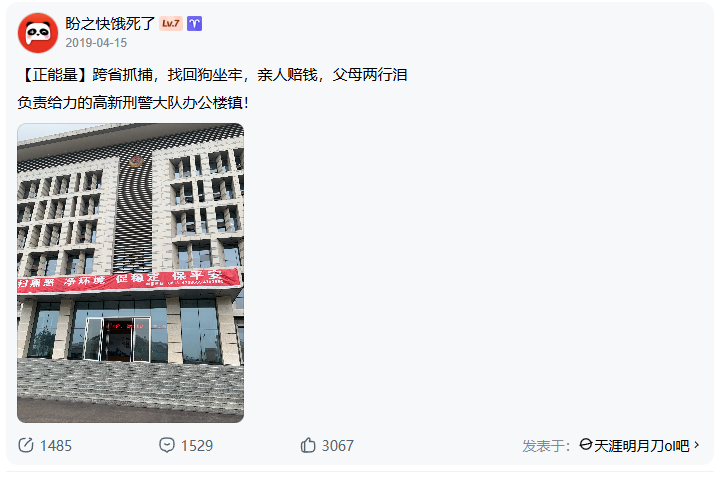
What I did was write down the full details of each scammer’s case—including the police report and the investigation process—and post them on the forum.
Netizens started following the updates, and when they ran into difficulties in defending their rights, they pooled their ideas to find solutions.
Once, a scammer swindled over 10,000 yuan. I documented and tracked the entire process, and in the end, I actually got him sent to jail. At the time, over 100,000 people were reading that post. The traffic skyrocketed overnight. From that point on, I knew this could be a big business.
Game Teahouse: But the barrier to entry for account trading is so low—people are doing it everywhere, from QQ groups to Xianyu to Tieba. What gives PanZhi the edge to stand out?
Lei Lu: I think there are two things.
First, we really spare no expense in cracking down on scammers. The "Hope of Light" rights protection team now has more than 200 members. If you dare to scam us, we’ll call the police and pursue the matter to the very end—and we mean it.
Second, we share these real-life cases with our users. Other platforms may also claim, “We’re very secure,” but what makes them so secure? They can’t explain it clearly. We go through each case one by one: what contracts we’ve signed, how many lawyers we have, how many on-site visits we’ve made, and how many times we’ve filed police reports. Users see concrete actions and results.

Pan Zhi's Case Receipt Display Corner
Game Teahouse: But you could have just kept running your private domain back then—with no regulatory pressure or compliance costs. Why did you insist on going the official route?
Lei Lu: Because I really want to change this industry.
Back in 2017, the concept of after-sales service didn’t exist in the industry. I just felt that if I could change that, users would definitely appreciate it.
And that’s exactly how it is—every time we launch a new service or standard, users give it a thumbs-up and recommend it to their friends. It’s not that I set out to build something big from the start; rather, as you transform the industry, the user base naturally grows larger and larger.
Game Teahouse: In the early days, you used to go after scammers yourself—flying to their city to report them to the police and track them down. Was that expensive?
Lei Lu: Very high. Back in the Tieba days, a single case might cost 20,000 to 30,000 yuan—covering airfare, lodging, and running around to various police stations. Later, as the process became more formalized, the total cost of a single rights protection case actually skyrocketed to around 100,000 yuan. To be honest, the cost of catching a scammer far exceeds the profit from that account transaction.
Game Teahouse: So, essentially, they're spending money to build a good reputation.
Lei Lu: Yes, we’re building our reputation, but it’s worth it. We’ve been cracking down on scammers for eight years, and the results are tangible. In the past, perhaps two out of every 10 accounts were maliciously recovered; now, it’s only about five to eight out of every 100. Scammers know that PanZhi will pursue them to the end, so many of them don’t dare to come here anymore.
02
We are not enemies with the manufacturers
Game Teahouse: Almost all game developers include a prohibition on account trading in their user agreements, but your core business is built on this very demand. How do you view the relationship between your company and these developers?
Lei Lu: I think it’s definitely not a confrontational relationship, at the very least. It’s actually quite easy to understand why developers prohibit account trading—in the early days, the market was just too chaotic, and players who got scammed would constantly go to the developers to complain. The developers could only say, “We’ve prohibited this all along; it’s not our problem.”
But now that there are specialized platforms that can help players resolve disputes, it actually saves developers a lot of trouble.
Plus, if you look at it the other way around, when players know they can recoup a portion of their 100,000 yuan in spending when they quit the game, they’re actually more willing to pay. If they can’t get a single penny back, many people’s willingness to pay will decrease, because everyone manages their expectations.
So, within reasonable limits, I believe that account trading and game developers actually have a collaborative relationship—not an adversarial one.
Game Teahouse: Has any developer ever approached you directly to discuss this issue in a serious manner?
Lei Lu: We’ve had discussions, but they weren’t confrontational.
It basically comes down to two things.
One is the protection of minors; the publisher enforces this very strictly, and we also completely prohibit transactions involving minors—on this point, our stance is fully aligned with the publisher’s.
Another type is the "initial account"—the kind generated in bulk by script-based cheats—which the developer explicitly opposes. We weren’t aware of this at the time, so we offered them for a while, but as soon as we found out, we immediately removed them from our platform and banned them.
But when it comes to "finished accounts"—the ones players have spent real money on and genuinely want to cash out—no developer has ever come forward to say they shouldn't be sold.
Game Teahouse: So do you think account trading platforms, to some extent, fulfill a role that game developers find inconvenient to handle but that players actually need?
Lei Lu: You could look at it that way. Players have always had a need to quit a game and cash out to recoup their investments, but it’s virtually impossible for developers to create an “exit channel” on their own—because doing so would essentially be encouraging player churn. So by enabling the circulation of players’ virtual assets, we’re actually lowering the barrier to entry for new players in a sense.
For example, let’s say you want to play *Genshin Impact* right now. For a game like this—one that’s been around for a long time, or what you might call a “content-driven game”—starting a character from scratch is actually a huge burden for players. Most players simply don’t have the time, but if they buy an existing account, they can quickly experience the latest content, which might even prompt them to make in-game purchases. The logic behind this is very straightforward.
Game Teahouse: So, does Pan Zhi buy and stockpile game accounts herself?
Lei Lu: No. All our accounts come from users. Of course, there are also some third-party studios that buy and sell accounts on our platform; they help players who are eager to cash out get their money quickly, but they are not our employees—they are independent service providers. All transactions follow our platform’s contracts and procedures.
It’s the same principle as Lianjia: Lianjia doesn’t build houses, and we don’t create accounts or hoard inventory. If no transaction takes place, those accounts have nothing to do with us.
This is also our approach to risk management—we focus on building platforms rather than holding heavy assets.
Game Teahouse: Game developers are getting stricter and stricter about account security these days, implementing facial recognition, device locks, and two-factor authentication. Is this a hurdle for you?
Lei Lu: The transaction process has definitely become more complicated, and the account transfer process takes longer; in some cases, it’s not even possible to transfer an account at all. But on the other hand, account security has improved, which is exactly what we want to see.
The more robust the security system is, the harder it is to maliciously recover an account, which actually gives buyers greater peace of mind. We are also keeping pace with technological advancements—for example, VR account verification and cloud-based account verification, which allow buyers to check an account’s status without logging into the game—and we are continuing to invest in exploring fully automated transaction processes.
Game Teahouse: I’d like to ask a rather pointed question: Does the existence of account trading platforms objectively fuel gray-market activities such as account theft and bulk account farming?
Lei Lu: We take this issue very seriously ourselves. That’s why PanZhi has developed a comprehensive risk control system. The Zigong Cybersecurity Department visits our company every month to provide guidance and help us improve our ability to identify and block black and gray market activities. We have a very close partnership with the public security authorities, and the Zigong Cybersecurity Department officially became involved in 2024.
Therefore, scripted accounts, accounts created using third-party tools, and accounts of unknown origin will not pass our platform's review process.
Game Teahouse: From the company’s perspective, how would you define PanZhi’s role in the industry?
Lei Lu: We are a subsidiary in the gaming industry—specifically, the gaming services sector. We don’t develop games ourselves, but we make the gaming experience better and safer for players—just as Lianjia doesn’t build houses, but it makes buying a home a more reliable process.
03
New Business Models in the Industry
Game Teahouse: Pan Zhi, your team now has over 2,000 members. What is the breakdown of roles like?
Lei Lu: There are actually only a few major divisions. The rights protection team consists of over 200 people and specializes in combating malicious recovery attempts and various types of fraud; the customer service team has 400 to 500 people who handle daily transaction inquiries, reviews, and after-sales support;The content team consists of more than 20 people who manage official accounts and share case studies; and then there’s R&D, which develops AI, valuation models, and risk control systems.
Game Teahouse: A 200-person rights advocacy team, full-time account appraisers—do you consider these to be emerging job roles?
Lei Lu: Absolutely. This type of position likely didn’t exist at all in the gaming industry before. Indirect evidence of this is that we simply couldn’t find qualified candidates on the open market—we’ve trained all of these employees ourselves.Take account valuation streamers, for example. Our company has dozens of streamers who specialize in providing account valuations and live-streaming explanations for users. This might have been unheard of in the gaming industry in the past, but within our business model, it’s an essential requirement.

Game Teahouse: What about the technical side? You mentioned that you’re investing in AI research and development—what exactly is PanZhi hoping to achieve with this AI development?
Lei Lu: It's mainly about customer service and account valuation.
We invested significant resources in AI research and development last year, and our current AI customer service system—Panzhi—is one that we developed and deployed ourselves. If we didn’t use AI and automation at all, our customer service team would need 3,000 people to handle our current volume of business; thanks to AI, we’ve been able to reduce that number to 400 or 500.
We’ve also fully integrated large AI models into our account valuation process. We train these models using the platform’s massive volume of real transaction data; with every transaction, the valuation model becomes a little more accurate.
It may come as a bit of a surprise to some, but in fact, PanZhi invests tens of millions annually in R&D, and we also collaborate with ByteDance on cloud services.
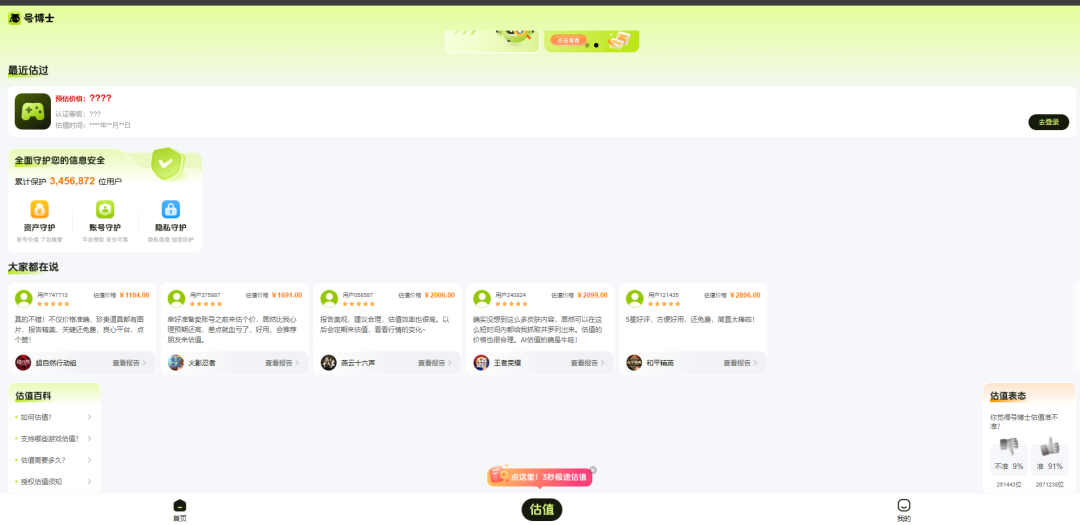
Game Teahouse: Speaking of valuations, I recall that you have a valuation platform called “Dr. Account.” To be honest, who really has the final say when it comes to pricing game accounts?
Lei Lu: One prerequisite is that Pan Zhi has no authority to set prices.
In fact, account prices are set by the sellers themselves and determined by market forces. Whether it’s our system or the prices quoted by our valuation specialists, these figures are merely for reference—and they’re based on actual transaction data.
In the past, we relied solely on manual efforts, with customer service representatives who understood games making judgments based on their experience—which sometimes wasn’t entirely convincing. But now that we’ve fully transitioned to large AI models, at least our recommendations are instantly aligned with market conditions.
In our view, there are several key factors that influence the price of game accounts: the popularity of the game itself—this is the most significant factor; then there’s the timing—prices generally rise during summer break and the Chinese New Year; and finally, game updates—when popular characters or gear are released, the prices of related accounts tend to go up.
Of course, the quantity and quality of in-game virtual assets are also important indicators, though this varies from game to game.
Game Teahouse: PanZhi’s headquarters are in Zigong and Chengdu, not in Beijing, Shanghai, Guangzhou, or Shenzhen. In your opinion, does Sichuan have any obvious locational disadvantages?
Lei Lu: Customer service and basic operations positions are absolutely fine; we can cover both Zigong and Chengdu.
Where we have a weakness is in high-end technical talent, particularly in the field of AI—this is something that really requires looking in Beijing, Shanghai, and Guangzhou, and we’re already making moves in that direction. However, account trading itself is a business that isn’t particularly constrained by geography; if it can be done in Zigong, it can be done anywhere. Ultimately, it all comes down to the team and the service system.
Game Teahouse: In the past, MMOs were the most in-demand genre. What about now?
Lei Lu: Speaking specifically of PanZhi, transactions on our platform are still primarily focused on MMOs—after all, we got our start with *Tian Dao*. Players tend to spend heavily on these types of games, often shelling out hundreds of thousands or even millions, so the cost-effectiveness of buying accounts is quite obvious.
Next are multiplayer competitive games, such as battle royale and MOBA titles, and anime-themed games also see significant trading volume.
Furthermore, our user base skews toward an older demographic—players with greater spending power—which is why PanZhi’s GMV and average order value were the highest in the industry last year.
04
Legitimacy is the prerequisite for everything.
Game Teahouse: Let’s talk about the refund guarantee. Malicious claims are what buyers fear most. It seems you’ve partnered with Ping An Property & Casualty Insurance—how exactly does this partnership work?
Lei Lu: First and foremost, our partnership with Ping An is for compliance purposes.
Strictly speaking, if the platform were to make this “full reimbursement” promise on its own, it would constitute an insurance activity. However, since we do not hold an insurance license, partnering with a major insurance company like Ping An ensures our operations remain compliant while also building user trust.
Here's how it works: If the account you purchased is maliciously recovered and we are unable to recover it for you within 7 days, we will issue a full refund.
Game Teahouse: What Is the Success Rate of Recovering Funds?
Lei Lu: Currently, out of every 100 accounts that have been maliciously recovered, we are able to recover more than 90. For those we cannot recover, the insurance will cover the loss.
Game Teahouse: What exactly is the process for recovering it?
Lei Lu: The process involves a phased escalation. First, our after-sales customer service team contacts the seller to discuss the matter. If the seller refuses to cooperate, we follow up with a cease-and-desist letter; if they still refuse to cooperate, we take the matter to court. We’re not afraid of court summonses—that’s when we dispatch our field team.
Our on-site teams consist of two to three people each time. Upon arriving at the location, they immediately go to the local police station to file a report and report the incident. We locate the parties involved through legal channels—we don’t send a bunch of burly men to their homes to intimidate them. We follow legal procedures strictly.
Game Teahouse: Do the costs associated with debt collection and insurance account for a significant portion of your revenue?
Lei Lu: It accounts for roughly 15 to 20 percent of our revenue. To be honest, that’s not low. As I said before, this is the core of our service—if you don’t invest in security, why should users trust you?
Game Teahouse: Speaking of “real-life events,” you’ve used this type of content to build a following of over 1 million on Bilibili and over 3 million on Douyin—the numbers are staggering and clearly outpace your competitors. How did you pull this off?
Lei Lu: To put it simply, it’s about showing people real-life cases on camera.
PianZhi was indeed the first to do this—after all, that’s how we got our start. Back in the Tieba days, we wrote live text updates, and later, when short videos took off, we switched to video. Essentially, we’ve always been doing the same thing.
There are some high-profile cases involving the recovery of assets from remote areas or even overseas, which naturally generate a lot of buzz and have strong viral potential—so why not take advantage of them?

The recent case of a streamer having their account suspended is the latest hit on PanZhi’s content channel.
Game Teahouse: Is this a deliberate content strategy, or is it simply a natural outcome?
Lei Lu: Both.
On the one hand, these cases need to be followed up on—we’re working on them whether we film them or not; on the other hand, we do realize that we can’t catch every scammer. While we’re cracking down on them, we also need to educate the public—so that more people know what constitutes a safe transaction and what to do if they encounter a scammer.
Little by little, user perception is established in this way. People may just be curious for now, but if they ever decide to buy or sell an account, Pan Zhi will definitely be the first name that comes to mind.
So, in fact, we’ve done almost no paid user acquisition over the past few years; user growth has been driven entirely by content and word of mouth.

Game Teahouse: Virtual property has long been a legal gray area. When you first went to report the incident to the police in person, how did they react? Did they think it didn’t even qualify as property?
Lei Lu: It was indeed very difficult when we first pushed for this. The courts had no relevant precedents, and the police didn’t know how to classify it. But our reasoning was that as long as there is a genuine transaction contract and actual financial transactions, it constitutes a property transaction protected by law.
Pan Zhi’s case regarding the protection of her account rights was one of the first to prompt the courts to issue a formal ruling on virtual property transactions. Once this first precedent was established, the process became much smoother, as courts and police departments across the country could directly refer to it when handling similar cases.
Nowadays, it’s not just accounts—game items and virtual currency can also be appraised for market value by assessment agencies recognized by public security, procuratorial, and judicial authorities, and their value is pegged to the renminbi. It did indeed take us several years to make this a reality.
Game Teahouse: Have you ever considered that the strong support PanZhi has received from the Zigong government might be related to the fact that Zigong’s industrial base is relatively weak? In a city with a more concentrated internet industry, you might not receive the same level of attention.
Lei Lu: I hadn’t really thought about that. But you have a point—many of our initiatives, such as our collaboration with public security agencies and efforts to advance legal precedents, would indeed be very difficult to move forward without cooperation at the government level.
Conclusion: There is still a lot of room for growth in the account trading market.
Game Teahouse: How big do you think the game account trading market is right now?
Lei Lu: According to the data we have, the total market size is approximately 80 billion.
Game Teahouse: What is Pan Zhi's current DAU?
Lei Lu: About 1.5 million.
Game Teahouse: Do you think this market has reached its ceiling?
Lei Lu: Not by a long shot. Think about it: right now, only a small number of players know that accounts can be bought and sold or are familiar with PanZhi, but there are already 679 million gamers in China—so there’s enormous potential here.
Game Teahouse: Aside from account trading, do you think there’s a possibility for new business models to emerge?
Lei Lu: Our strategy this year is to expand from simply trading accounts to the entire gaming services market.
The PanZhi Community is about to launch. This platform focuses on social networking and matchmaking for gamers, as well as PanZhi gaming companions, esports tournaments, and MCN agencies—all of which are already in the works.
Our core philosophy has never changed: to ensure players can have fun safely. Buying an account is one way to have fun, playing with others is another, and trading in-game items is yet another.
Game Teahouse: One last question—to be honest, where did the name “Pan Zhi” come from?
Lei Lu: It’s simply a hope. We hope that one day, there will be no more scammers in the entire account trading industry. That is what we hope for most of all; when that day finally comes, our dream will come true.
原创文章,作者:游茶妹儿,禁止转载:https://youxichaguan.com/en/archives/216132