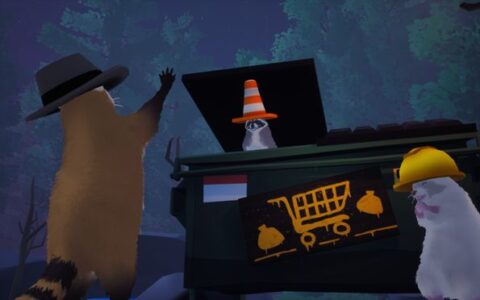
In December, the competition in the life simulation sector really heated up.
*Star-Painted Friends: Sunny Days* wrapped up its first beta test on the 14th, *Grain by Grain: Lilliput* announced on the 18th that global pre-registrations had surpassed 5 million, and *Star Cuckoo Valley* just concluded its “Liveability Test” on the 1st. With these three leading developers engaging in a flurry of competition in less than a month, the 2025 life simulation battle is in full swing.
But when we actually got into the first beta test of *Star-Painted Friends: Sunny Day*, we discovered that the approach NetEase Leihuo UX took this time was completely different from that of the other two companies.
After all, in 2025—when the life simulation genre is heating up like crazy—being able to play the NetEase card early on is a win-win no matter how you look at it…
But just a few days after *Star-Painted Friends: Sunny Day* wrapped up its first beta test on December 14, *Grainy’s Lilliput*, developed by Tencent’s Silver Heart Studio, suddenly announced on the 18th that global pre-registrations had surpassed 5 million;
Looking back even further, we find that another game by Teahouse Games—*Star Cuckoo Valley*—which also failed to secure a testing slot, had already concluded its first beta test, dubbed the “Liveable Test,” on December 1.
In 2025, this three-way clash has turned the entire life simulation arena into a high-stakes battle.
Tencent focuses on the emotional intensity of the microcosm, while miHoYo is betting on a breakthrough through strong social interaction in its 12-player multiplayer mode.
NetEase Leihuo UX, however, chose a different approach: rather than competing on polish, it used cube-shaped planets, space exploration, and party games to build a platform with limitless expansion potential.
Behind this differentiation strategy lie the three companies’ differing assessments of the life simulation genre. While everyone else was focusing on refining their own small plots of land, NetEase chose to redefine the boundaries of that “land.”
On top of that, there are space exploration games, party games, UGC simulators… As I played through the demo, I gradually came to realize something.
What NetEase is aiming for this time may not be a "Animal Crossing-like" game at all, but rather a game that uses a life simulation shell to encase a rich and diverse core.
Since the level of detail in farming and rural life simulations may not yet be sufficient, NetEase has opted to focus on gameplay expansion instead. In this 2025 life simulation showdown, the company has carved out a unique niche for itself.
01
NetEase's Three Differentiating Choices: Cube, Universe, and Dual Gameplay Modes
- Let's start with the cube-shaped planet.
Traditional life simulation games take place in a two-dimensional space: an island, a field, or a village. Content updates can only involve replacing old elements with new ones, and players’ sunk costs depreciate with each version update.
The hexagonal planet design in *Star Painting: Sunny Days* directly breaks this deadlock.By collecting 【Miracle Cubes】 to clean up polluted gray zones, and through a modular assembly mechanism and an expandable plane system, when the planet expands from 1x1x1 to 2x2x2, the original six faces are fully preserved, while the 18 newly added faces become a new creative space.
This means you don’t have to tear down the agricultural zone you built on Side A, the commercial district on Side B can continue to operate, and the newly unlocked Side C can be developed into a resort beach. Content updates have shifted to an additive approach, completely breaking through the ceiling on long-term operations.
- Next is space exploration.
The game's universe isn't just visual window dressing. When you board a spaceship to explore other planets, you'll discover that each planet is a standalone content pack: puzzle-filled ruins on the Lava Planet, rare resources on the Frozen Planet, and NPC trading posts on the Eco Planet.
The “Scanner” mechanic further reinforces this logic: See a bridge? Scan it, and you’ve got the blueprint. See an NPC’s outfit? Scan it, and you can make it yourself back home. Exploration is no longer just about socializing and visiting others; it has become the core driving force behind obtaining building blueprints and unlocking new gameplay features.
This design shifts the focus of the life simulation from “in-depth exploration of fixed scenarios” to “open-world exploration,” leaving plenty of room for future updates.
This allows each subsequent update to the game to introduce new planet types, rather than modifying existing content—a departure from the incremental updates built on existing foundations, such as the major 3.0 update for *Animal Crossing*.
Unlike *Animal Crossing*, which has a core loop of paying off a mortgage, and unlike *Stardew Valley*, which has the time pressure of “having to complete XX tasks in the first year,” this game is more like being given a set of tools and then being free to play however you want—do whatever you like.
- Next is the dual-gameplay approach.
Over 120 official mini-games and a UGC editor make up the third pillar of *Star Art Friends: Sunny Day*. However, unlike *Egg Party*, which put all its eggs in the basket of party-style competition, NetEase has taken a more restrained approach this time.
In the first beta version, the Tea House Team focused on life simulation, with the party serving merely as a diversion for players to “jump in for a quick game when they’re tired.” This is precisely the lesson NetEase learned from *Egg Party*: high-frequency social competition can quickly lead to player burnout.
"Star Art: Sunny Days" uses life simulation to build a core player base and party games to drive social engagement. The resource-sharing design ensures both types of players get what they need: farming players scan to obtain blueprints, while party players use rewards to develop their planets.
The advantage of this structure is its resilience: even if the party mode underperforms at a certain stage, the life simulation core remains solid; and even if players grow tired of the farming content, the party mode can still provide a fresh experience.
But will these two gameplay modes end up operating as “two separate entities” in the future? This is the core issue NetEase must address after the open beta.
(Some of the mini-games are assigned at random)
- Why was it the middle-platform team that came up with this innovation?
"Star Painting: Sunny Days" was developed by the LeiHuo UX User Experience Center, and its role as a middle platform is no coincidence.
Why can’t the vertical studios at major game companies achieve cross-genre integration? Because SLG teams are accustomed to being data-driven, MMO teams are accustomed to being social-driven, and life simulation teams are accustomed to being content-driven—each team is locked into its own path dependence.
The value of the middle platform, however, lies precisely in the fact that it has dabbled in a little bit of everything: by working on *Eternal Return*, it gained an understanding of action game mechanics; by working on *Nishuihan*, it gained insight into social design in MMOs; and by working on casual games, it learned how to lower the barrier to entry. This “omnivorous” approach gives them a distinct advantage when it comes to blending genres.
Even more crucial is the accumulation of methodological expertise. LeiHuo UX has delivered over 30 presentations at GDC and supported countless internal projects at NetEase, encountering more pitfalls than the average team ever does. This enables them to avoid the mistakes new teams often make: excessive social pressure, inflated metrics, and overly lengthy onboarding processes.
The case of the console version of *Eternal Return* illustrates this point even more clearly: it took just 160 days to go from scratch to a fully optimized console release. This level of execution will be a huge advantage in the game’s long-term operation.
As for the “global accessibility” of the design—which features the Little Dragon character and a plush, textured art style—as well as the ambition to collaborate with more than 20 local cultural and tourism initiatives, all of these efforts point toward a single goal: to use a “container” mindset to push the boundaries of life simulation into the global market and the cultural and tourism industries.
02
The 2025 Life Simulation Showdown: Eight Companies' Different Bets
If we’re talking about the “pioneer” of this life simulation battle, Xindong Network’s *Xindong Town* was the first to break through.With 30 million downloads, the TapTap Game of the Year award, and helping Xindong Network turn a profit for the first time in 2024, these figures are impressive enough, and the game’s strategy is clear: casual building and management combined with random matching of 12 neighbors.
Every time you log in, the system assigns you 11 new neighbors, quickly increasing your chances of meeting new friends.
This "fluid social interaction" design is clever; it avoids the problem of "stagnant social circles" found in traditional life simulation games.
But this raises a question: Can a 21-day rotation for the gacha pool continue to drive players to spend? Once the novelty of the cosmetic items wears off, will players still be willing to spend money to “be the coolest kid in town”?
There is no answer to this question yet, but the success of *Heartwarming Town* at least proves that the life simulation genre is not a pipe dream; the key lies in how to sustain long-term operations.
For example, Tencent’s *Lili’s Lilliput* centers on the concept of a “microscopic world.”
5-centimeter-tall characters, a desk setting, 1.5 million words of NPC dialogue, and an independent memory system for residents—all of these design elements point to a single key concept: emotional depth.
An alarm clock turned into a rocking chair, a milk carton turned into a house, and headphone cords turned into a swing—these unexpected uses of familiar objects have indeed generated impressive numbers, with 5 million pre-registrations worldwide. Topping the charts on TapTap with 400,000 pre-registrations is certainly eye-catching.
But don’t forget that behind these numbers lies the omnichannel resource support provided by Tencent’s portfolio of products.
The real test will come in 2026, once the game launches, when we’ll see if players are willing to continue paying for 1.5 million characters of dialogue.
Mihoyo’s *Star Cuckoo Valley*, on the other hand, took a different approach: moving away from the anime-style aesthetic and focusing on strong social features.
With its chibi-style art, 12-player online multiplayer, NPC perception and memory system, and the Galaxy Market social hub, it’s clear from the current content that miHoYo is truly committed to creating a product “for all ages.”
Although, during the early stages of the project’s unveiling, sources familiar with the matter revealed that the game was likely prioritized higher within miHoYo than *Honkai Impact* and *Zero Zone*, as it embodies the company’s strategic goal of “breaking out of the anime and manga niche.”
But just how difficult is this transition? A look at miHoYo’s past successes will tell you.
The success of *Genshin Impact* and *Honkai Impact 3rd* essentially comes from expanding the player base within the anime and manga community.
Meanwhile, *Star Cuckoo Valley* must appeal to players who aren’t drawn to “anime-style aesthetics.”
- Other Players: To Each Their Own
Although Qutang Technology’s *Mimimaha* benefited from the reputation of its former *Moore Manor* producer and rose to No. 1 on the Apple and Android free charts on its first day of release, its performance after launch was lackluster. Furthermore, judging by Qutang’s subsequent massive layoffs, the “nostalgia card” isn’t enough in the life simulation genre.
Pop Mart’s “Dream Home” has the advantage of being based on an established IP, but it remains to be seen whether the depth of its gameplay can sustain long-term operations—after all, there’s a ceiling on spending on virtual decorations.
"Palia," published by Xishanju, takes a hybrid approach combining MMO and life simulation elements. Its 295% funding goal on Kickstarter and 400,000 Steam wishlists demonstrate that there is demand for this genre in overseas markets. However, whether it can succeed in the domestic market will depend on the quality of its localization.
NetEase also has its own game, *Journey Through the Mountains and Seas*, which was first unveiled in August 2024. After receiving its publishing license in April of this year, there have been no further updates, indicating that even major companies are still testing the waters and making adjustments in this sector.
"Star Sand Island" by the independent studio SEED LAB also follows a buy-to-play model. It exceeded its crowdfunding goal by 300%, garnered over 400,000 wishlists, and ranked first in popularity during the Steam New Releases Festival—proving that high-quality single-player life simulation games have a market both domestically and internationally.
The fairy-tale-style life simulation game (similar to *Animal Crossing* and *Sky: Children of the Light*) developed by Mutong’s Guangzhou studio has not yet been announced, but considering that Mutong established a Shenzhen studio in 2020 to develop *Farm Life Vlogger* before disbanding it, this latest entry into the market signals the company’s continued optimism about the genre.
Meanwhile, *Little Forest Life*, developed by Shengqu and published by Tencent, is the most tragic example: the Chinese version launched in 2021 and shut down in 2024; the international version launched in 2020, shut down in 2022, and relaunched in 2025, though its future remains uncertain. Even the Studio Ghibli-inspired art style couldn’t save it from operational failure.
Lilith’s *Life Party* serves as another cautionary tale: the project stalled, the team was downsized, and the original producer was let go. This case illustrates that when a product’s positioning is unclear, its core gameplay is undefined, and its monetization strategy is vague, even the resources of a major studio can’t save it.
- Who is doing addition, and who is doing multiplication?
What will the market landscape for life simulation games look like in 2025–2026?
Drawing on international experience: In Japan, *Animal Crossing* dominates the market, while in Europe and the U.S., a variety of games—such as *The Sims* and *Stardew Valley*—coexist. The Chinese market is more likely to follow the European and American model, for three reasons:
First, the user base is more diverse. Anime fans, casual entertainment enthusiasts, and hardcore gamers each have their own preferences, making it difficult for a single product to appeal to all of them.
Second, the major companies’ differentiation strategies have already taken shape. Tencent is betting on emotional depth, miHoYo on strong social features, and NetEase on container innovation—none of these approaches involve direct head-to-head competition.
Third, life simulation games are not inherently a highly social genre. Unlike MOBA or battle royale games, which have clear network effects, users are more likely to switch between different products, and the market is more prone to segmentation and coexistence.
However, Tea House Jun estimates that only 3 or 4 of them are likely to survive in the end.
The criteria are simple: whoever can retain their core users in the first year and close the commercialization loop in the second year will secure a spot in this marathon.
Upon comparison, Tea House will find that most developers are simply adding features to the existing life simulation framework (more refined graphics, stronger social elements), while NetEase is multiplying them (cubes × universe × parties × UGC).
The advantage of the container-based approach is that it offers ample room for growth; with each version update, new planet types, party modes, and UGC templates can be added, rather than modifying existing content. This scalability is unmatched by traditional life simulation games.
But the drawbacks are also clear: the foundation still needs time to solidify. While Tencent, miHoYo, and Xindong are all targeting “core life simulation players,” who is NetEase targeting? Open-world gamers? Party game players? Or casual, all-around players who “want to try a little bit of everything”?
This lack of a clear focus may be the biggest risk for *Star-Painted Friends: Sunny Day*. Because when you try to please everyone, you may end up pleasing no one.
03
"Star-Painted Friends on a Sunny Day": Three Unresolved Questions
The initial test data provided some preliminary answers.
Statistics on player behavior released by Xiaohongshu’s official account show that 14,067 Arons of various appearances laid 2.58 million floor tiles, cleaned up 1.03 million contaminated plots, and crossed planetary borders 210,000 times.These figures point to genuine engagement rather than mere number-padding to complete tasks.
The key data point is this: most players focus primarily on the life simulation aspect, while the party mode serves merely as a diversion they turn to “when they’re tired.” This demonstrates that NetEase has a clear strategy for its dual-gameplay approach, using the life simulation to build a core user base and the party mode to drive social engagement.
However, the high quality of the initial test content cannot mask three core issues:
- First, will a space-themed storyline make core users feel disconnected?
The mainstream aesthetic among life simulation gamers has always been idyllic: the islands in *Animal Crossing*, the farms in *Stardew Valley*, and the gardens in *Heartwarming Town*—all of which share a sense of “down-to-earth” charm.
But do the cube-shaped planets, space exploration, and sci-fi elements in *Star-Painted Friends: Sunny Day* run counter to this aesthetic consensus?
Feedback from international players at the Cologne Expo and TGS was indeed positive, but that was due to the novelty of playing the game in person. When hardcore gamers actually have to spend hundreds of hours living in this universe, will Little Dragon’s adorably ugly appearance, the game’s plush, fuzzy art style, and the abstract concept of block-shaped planets continue to provide a soothing experience?
We won't know the answer to this question until we see the retention data after the open beta.
- Second, won't the dual gameplay approach lead to an awkward situation where neither is explored in depth?
The initial test has revealed a potential issue: engagement with the party-themed content is significantly lower than with the farming-themed content. Casual players with limited time are more likely to play only the half they enjoy and ignore the other half entirely.
"Resource Sharing" (scanning blueprints) is a clever design, but is it compelling enough? If players who focus on farming discover they can obtain all blueprints without joining a party, and party players find they can develop their planets without farming, the synergy between the two playstyles will be significantly diminished.
The success of *Animal Crossing* lies in the fact that all of its systems revolve around island-building. *Star Painters: Sunny Days*, on the other hand, currently feels more like two parallel games bundled together; while the framework is robust, the extent to which the core elements are integrated remains to be seen through future updates.
More importantly, there’s the issue of monetization: two distinct gameplay styles mean two separate monetization models. Party players might pay for social features (room decorations, emote animations), while farming players would pay for building blueprints. Maintaining two separate monetization systems simultaneously would result in higher operational costs and greater risks associated with trial and error.
- Third, can the UGC ecosystem fill the void left after official content has been consumed?
120+ official mini-games may sound like a lot, but for a long-term product, they could be exhausted in just half a year. At that point, the UGC ecosystem must take over; otherwise, the “Party Mode” will run out of content to play.
How many serious creators can the “Make a Game in 1 Minute” editor attract? The success of *Egg Party*’s Dream Workshop rests on a three-pronged approach: lowering the barrier to entry, offering sufficient depth, and providing incentive mechanisms. Excellent maps can fetch astronomical prices, and top creators can earn millions per month.
Whether "Star Drawing Friends: Sunny Day" can replicate this model depends on three key factors: revenue-sharing ratios, traffic support, and copyright protection. Officials have said they will hold a creative contest, but these core policies have not yet been announced.
If the UGC ecosystem fails to take off, the “party mode” will become a short-lived trend that peaks right at the start, unable to sustain the long-term value of container innovation.
Conclusion: NetEase’s Farming Experiment
Between 2025 and 2026, at least eight life simulation games from major publishers are set to be released one after another. The market has shifted from “exploring a blue ocean” to “fierce competition in a red ocean.”
Tencent is betting on emotional depth, miHoYo on strong social features, and Xindong on first-mover advantage. NetEase, however, is taking an even more aggressive approach: the ultimate goal of life simulation games isn’t polish, but the platform itself.
If this bet pays off, the “cubic planet + space exploration + dual gameplay” model pioneered by *Star Paint: Sunny Days* will set a new industry standard, proving that life simulation games can break free from the “idyllic” aesthetic framework and become a gateway to an infinitely expandable digital world.
If the bet backfires, it will serve as a cautionary tale of “overambitious goals and lackluster execution,” proving that players have never sought grand narratives, but rather the certainty that comes from meticulously cultivating their own small plot of land.
The core elements of exploration and farming in the first beta version are solid, but the weaknesses in party features and UGC remain evident. This suggests that NetEase LeiHuo UX has at least gotten half of it right, proving the feasibility of container-based innovation; however, the other half—the integration of dual gameplay modes and the closed-loop monetization model—needs to be validated with a larger user sample after the open beta.
The real test won't be revealed until 2026.
But regardless of the outcome, NetEase Leihuo UX has already demonstrated to the industry that the scope of the life simulation genre is far broader than we ever imagined.
原创文章,作者:游茶妹儿,禁止转载:https://youxichaguan.com/en/archives/213827