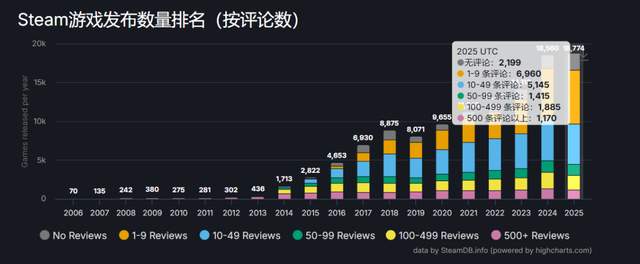
18,774—that’s the number of games released on Steam in 2025, as of December 8.
That seems like a lot, right? That's right—if it takes just 8 hours to beat a game, it would take about 17 years to play through all the new games released in 2025 without stopping or sleeping.
It took Steam nearly eight years to increase the number of new games released annually from four digits to five. In a sense, this figure serves as a metaphor for the growth of the global gaming market. However, if we zoom in and take a closer look at these so-called new games, we’ll discover that the vast majority of them are born in silence and die in obscurity.
According to data from SteamDB, 15,719 games have fewer than 100 reviews, and games with fewer than 10 reviews account for half of this group.
In the vast ocean of digital media, very few games manage to rise to the surface and catch people’s attention. Deep within the currents, far from the major studios and their flagship titles, countless games spend their entire lifetimes without ever catching even a glimmer of light.
If we were to name the biggest dark horse indie game of the year, it would undoubtedly be *Shape of Dreams*. With over a million demo downloads, sales exceeding 100,000 within 24 hours of its official release, and more than 10,000 reviews, any one of these achievements stands out on its own.
When *Shape of Dreams* was first released, Teahouse interviewed Lizard Smoothie, the South Korean development team behind it. They are a relatively young team that was officially founded in 2023. *Shape of Dreams* is Lizard Smoothie’s first commercial release; prior to that, the core members had only led or participated in college projects.
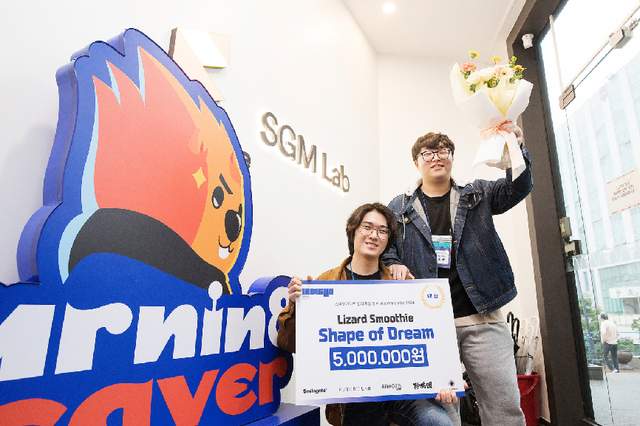
Lizard Smoothie Wins the Indigo 2024 Indie Game Development Award in South Korea
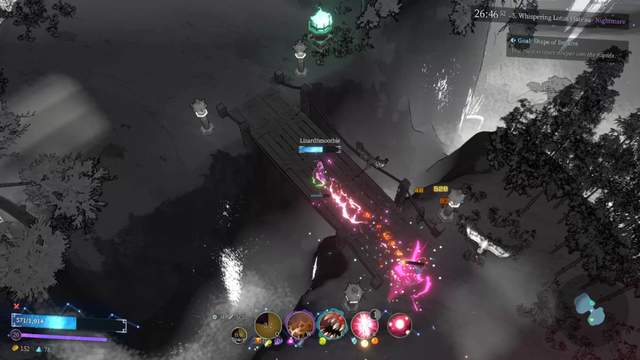
As a debut title, *Shape of Dreams* is undoubtedly one of the lucky ones in the gaming industry in 2025,Of course, this is largely due to its quality—it sets a new standard for the fusion of MOBA and roguelike genres and features design concepts that are ahead of those from major studios, such as WASD movement and highly stylized art.
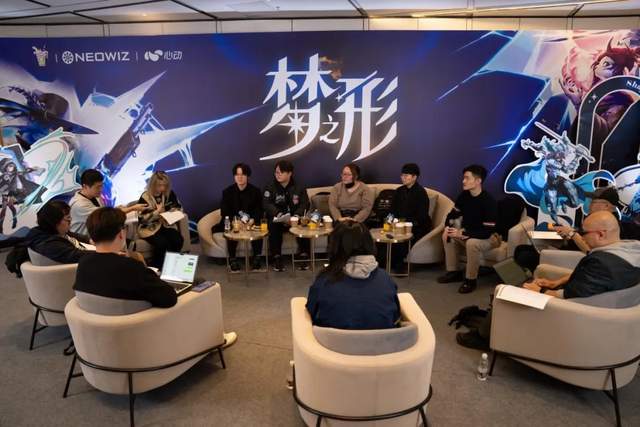
Not long ago, thanks to Xindong’s efforts, the Teahouse finally met the core team behind Lizard Smoothie in person. The Teahouse, along with several media outlets from China, spoke with them about various aspects following the game’s release. During a one-on-one session, we also had a more in-depth discussion with them about their thoughts on the design and development process.
The following is the full text of the conversation, which has been edited for ease of reading:
01
Mechanics, Art, and Gameplay
A=Lizard Smoothie
Q: To help players who haven’t played it yet, if you were to describe the core gameplay experience of *Shape of Dreams*, how would you describe it?
A: In a nutshell, it’s about letting players “wreak havoc” in the game however they please. If players have highly innovative ideas or unique ways of playing, they can try them out to their heart’s content, play however they like, and have fun doing it.
Q: Many people feel that *The Shape of Dreams* captures the true essence of a MOBA. Could the creative team please share their understanding of what constitutes MOBA-style action?
A: First of all, there will definitely be some inspiration drawn from them—MOBA games have their own unique combat style. Based on our experience playing *League of Legends* and *Heroes of the Storm*, we’ve done our best to incorporate the controls from those two games into *Shape of Dreams*.
We’ve worked very hard to incorporate some of the subtle combat mechanics found in MOBA games, such as eliminating attack recovery time or allowing players to attack immediately after pausing. We’ve positioned the game as a MOBA and are developing the project with that in mind.
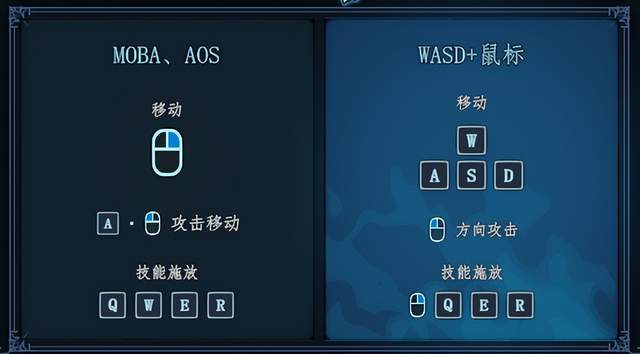
In MOBA games, there are all kinds of abilities, ranging from basic attacks to ultimate moves. We’ve tried to combine these small elements and incorporate Roguelike mechanics, so that players familiar with MOBA games will feel like, “I’ve seen this somewhere before,” in an effort to evoke that sense of familiarity.
Q: Some players have reported that there aren’t enough skill combinations, which reduces the game’s replayability in the mid-to-late game. What are your thoughts on this issue?
A: There are actually a huge number of possible builds in *The Shape of Dreams*, but we also recognize that in the late game, the number of builds and skill combinations players actually use is limited because there are only so many overpowered (OP) builds. So, to maintain both gameplay and replayability, the development team is experimenting with various innovative approaches.
Internal testing is currently underway around the clock, and once testing is complete and a stable system is in place, these features will be implemented in the game.
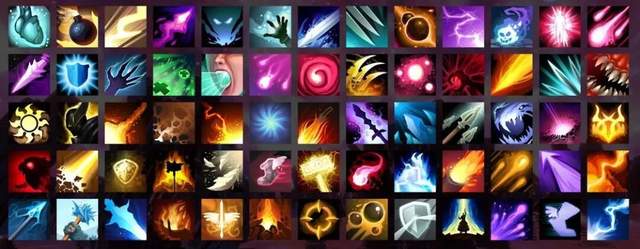
Q: Speaking of gameplay and replayability, how does the team ensure the game balance of *Shape of Dreams* while expanding the freedom of Build combinations?
A: To be honest, we focus more on the fun players experience than on game balance.
Let’s start with the characters. Since *Shape of Dreams* combines MOBA and roguelike elements, we’ve adopted MOBA design principles for our character design. Just as *League of Legends* features different roles such as support, healer, and tank, we’ve designed our characters’ roles and mechanics along these same lines.
However, since the game offers both single-player and multiplayer modes—and the single-player mode must also remain engaging—we won’t be designing a purely healing-focused character. For example, Orena has both healing abilities and combat skills; Nakia can heal as well, and she can also summon a puppy to assist in battle.We’ve deconstructed traditional MOBA characters using Roguelike mechanics and integrated them into *Shape of Dreams*.
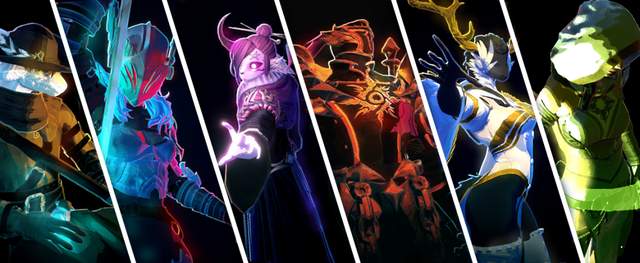
In summary, we aim to cater to the needs of different players—some prefer single-player games, some enjoy playing online with friends, some prefer support roles, and some enjoy dealing damage. *Shape of Dreams* was designed to meet these diverse needs.
During development, we received a lot of feedback from players saying, “I don’t want to use the most balanced character; I want to use the character I like.” So every time we adjust a character, we consider whether those changes will fulfill the players’ expectations.
Through our ongoing efforts, we will make adjustments, but we will absolutely not allow the characters to lose their original distinctiveness—this is the direction we continue to strive toward.
Q: What about the roguelike aspect? It’s actually quite difficult to strike a balance between in-game and out-of-game elements. How did the team approach this issue?
A: To be honest, this is indeed very difficult, and it’s one of the biggest challenges we’ve faced.
Player feedback has been incredibly helpful to us. *Shape of Dreams* underwent a long process of iteration from Early Access to its official release, during which we collected a wealth of feedback from a wide range of users and used it to continuously improve the game.
To be honest, our team isn't made up of professional game designers, so we're especially grateful to the players who enjoy this game—some have written long articles and sent them to us, while others have sent detailed feedback multiple times, and we've learned a great deal from all of it.
Q: Is there any player feedback that particularly stands out to you?
A: One player asked, “This is an online game—why isn’t there any randomness? Why isn’t there WASD control?” That feedback has left a lasting impression on us to this day. Looking back, if it weren’t for that feedback at the time, there wouldn’t be *Shape of Dreams* as we know it today.
Q: Oh? You could say this feedback directly defined the core of the game.
A: Yes, so this model carried over into the official release.
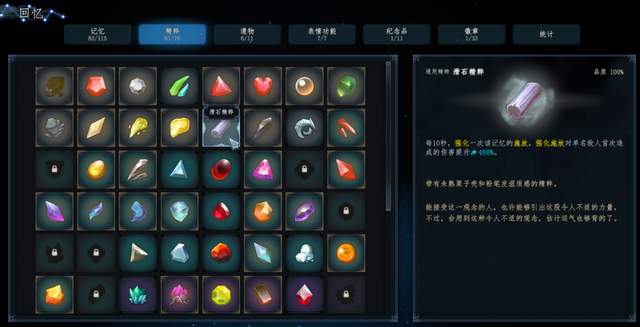
Regarding character progression, our goal in developing the new constellation system was to give players more freedom. In the beta version of the constellation system, players simply finished once they had allocated all their points, which gave the impression that “once I’ve maxed out my points, I’m done.”
With this new system, we hope to give players a variety of growth options.
However, we feel there are many shortcomings in this new system—such as the amount of resources collected and the pace of progression—which we deeply regret. The game was released to players before we had fully addressed these issues, resulting in a less-than-ideal first impression, and we sincerely apologize for this.
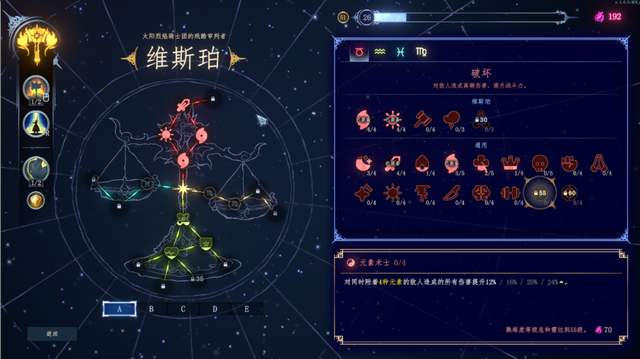
Furthermore, the randomness in previous games was indeed limited to skills and essences. We also received a lot of feedback, so ultimately, we redesigned the overworld into different levels to give players random map selection—which is also part of the balance, I suppose.
Q: Some players aren’t entirely satisfied with the boss design in the game, arguing that while the game lacks ways to improve mobility, the bosses have many wide-area attacks. What are your thoughts on this issue?
A: Our design intent was to provide additional mobility through constellation skills or map essences, but this differs significantly from other games, which has made it difficult for some players to adjust. Our top priority is to ensure players don’t feel uncomfortable, and we’re working to find the right balance. As for the issue of certain characters lacking mobility, we designed these characters to compensate with powerful abilities in other areas.

Q: The low-poly art style in *The Shape of Dreams* is truly impressive. Why did you choose this style?
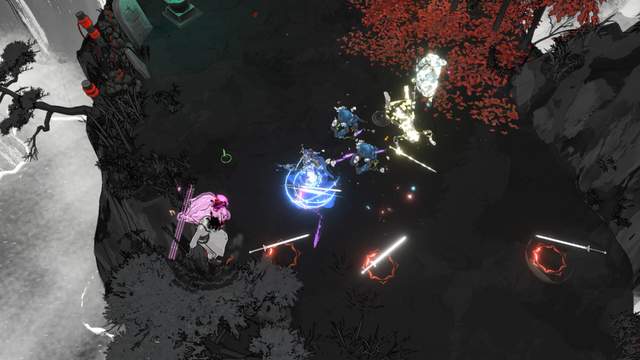
A: During the development of *The Shape of Dreams*, there was no dedicated art team until September of last year; the two lead creators handled all development and design themselves. The current art style was finalized in September of last year.
We chose this style based on user feedback as well; furthermore, this style allows our team to develop the game consistently and present it effectively in-game.
02
Team History and Development Insights
Q: I read in a report that Mr. Jiang Jibiao, one of the lead creators, took a leave of absence from school and retook his exams in order to work on the game. What led you to make that decision?
A: My biggest concern is still employment. When I was faced with that choice, I felt I was getting on in years, and I expected to spend another year working on game development. If I failed, I would find myself in a relatively disadvantaged and precarious position compared to my peers—that’s what worried me the most.
But deep down, I decided that if I didn’t make a choice now, I would never get involved in game development again, and I would live with that regret for the rest of my life. So, at that moment, I made up my mind to start developing games.
Despite these concerns, my parents have always been supportive, and my friends have also supported my decision.
Q: What led the art team to join Lizard Smoothie?
A: When we first saw *The Shape of Dreams*, our art team immediately sensed that this game had tremendous potential. At the same time, the characters in this game have a very distinctive “non-human” quality, which presented significant challenges during the character design process.
After trying out the game, they found that the combat mechanics were flawless and the combat felt great. However, aside from these mechanics, the game’s visual presentation wasn’t quite up to par. They wanted to be the “cherry on top,” and they also saw this as a great opportunity to fully immerse themselves in designing characters with distinct personalities.
So I joined the team.

Q: I’ve heard that you often resolve development disagreements by simply “having a heated argument.” Now that everyone is here, could you share a specific example that left the deepest impression on you or that you still hold a grudge about?
A: Since the art team is in charge of artistic matters, their input on art-related issues naturally carries the most weight. Although there are sometimes disagreements, the other team members respect their opinions very much, so there haven’t been any major conflicts so far.
For example, regarding the character design for the final boss, Primus, he was initially designed as a very slender male figure. At the time, the art director advocated for a character design that exuded power and had a fantastical quality. The other team members fully respected this opinion, and the boss’s current design was ultimately finalized.
Generally speaking, game design is primarily handled by two lead designers. Once, while discussing the design and concept for the final boss, we talked for seven hours—starting in the evening, continuing after work, carrying on at home, and even right before bed. There were a lot of conflicting opinions at the time.
Our team is passionate about the *Shape of Dreams* project, and it is precisely because of this passion that disagreements arise. However, Mr. Jiang has a very gentle disposition, so every time there is a disagreement, we ultimately reach a positive resolution.

Q: Art is usually the biggest drain on time and resources during development. How do you balance artistic quality with resource allocation throughout the development process?
A: Art isn't our top priority. When developing this game, we focused most on its fun and playability, so we struck a balance between art and gameplay.
Until last September, *The Shape of Dreams* had been developed by just two lead creators, and we’d always felt some regret about the art aspect. After two artists joined the team last September, many players commented that the game’s art style was very appealing, and we’re very pleased with that.
Q: From project approval to official launch, how long was the entire development cycle for *The Shape of Dreams*?
A: The entire game took two years and nine months to develop. *Shape of Dreams* started out as just a side project, and we launched the Steam store page during development.
At the time, we hadn’t done any promotion or marketing, but thousands of people were visiting our Steam page every day—and for a while, 80% of them were Chinese players. From that point on, our mindset toward the game changed dramatically, and we felt a much stronger sense of responsibility.
Based on extensive user feedback, we’ve added new characters, refined the art style, and optimized the combat mechanics. It is through this series of iterations that *Shape of Dreams* has evolved into what it is today.
Q: Have you ever encountered obstacles that seemed insurmountable? Have there been any designs that, after much deliberation, you ultimately had to abandon?
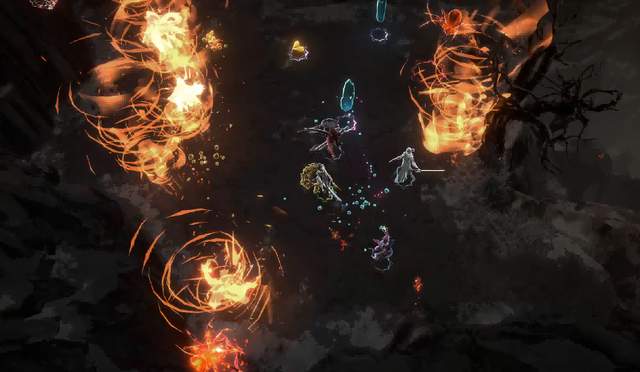
A: Before September of last year, the team didn’t have any full-time artists, and the lead developers didn’t have any specialized knowledge in art, so we developed a system that allows us to create maps quickly. We used Unity’s terrain system tools, which reduced map development time by a factor of 2 to 3.
There were actually quite a few ideas we had to set aside. Our team is small—just two people handling programming and operations—so we had no choice but to let go of many of our ideas.
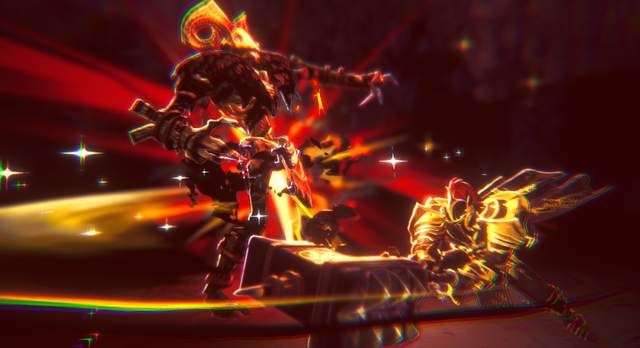
For example, we initially wanted to create a design similar to *Path of Exile*—where a character’s appearance would change when they acquired a new skill, or where skill effects would change accordingly when they obtained a new essence. However, due to practical constraints, we had to abandon these ideas.
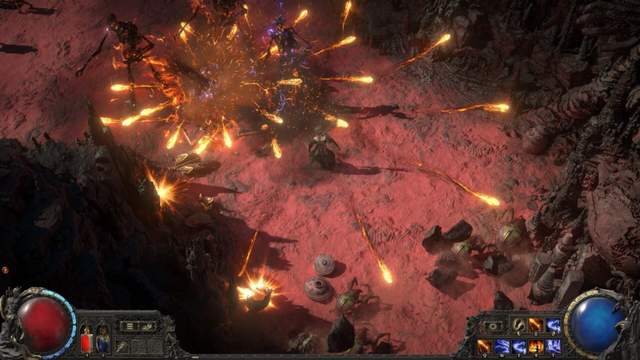
The details in POE's performance are a bit more refined.
Q: Looking back now, if you had more time or resources, what regrets would you want to make up for?
A: The first time I played a game like *Path of Exile*, I was blown away by the visual transformations of the characters. If we’d had the right development tools back then to bring those transformations to life, we would have experimented with all sorts of creative ideas.
Q: Are there any future plans for this section?
A: Actually, most of the content included in this update—released after the official launch—consists of features we were unable to include prior to launch due to technical limitations. We also hope that if players have similar regrets, they can use the MOD customization mode in this update to address those needs.
Q: As a small team of four, how did you manage to create a high-quality game with very limited resources? Do you have any secrets to staying efficient during development?
A: As I mentioned earlier, user feedback has been a huge help to us; second, we really cut back on our sleep to work on this project.
Q: So, how many cups of coffee do you all drink each day? How many hours of sleep do you get on average?
A: Actually, we haven’t kept track of how many cups of coffee we’ve had, but before going live, we stopped counting them altogether—we’ve been drinking coffee nonstop from the moment we clock in until we clock out. Sometimes we drink so much that we just head to a coffee shop together (laughs).
We haven’t kept track of our sleep hours either, but before the launch, we usually averaged six hours of sleep. After the launch, sometimes we’d sleep for half an hour, and other times for six hours. The development team felt like we’d die if we didn’t sleep—we couldn’t pull all-nighters, but we gave up our free time on the weekends.
Q: In recent years, the number of independent developers worldwide has been growing, and many—like you—have small teams and limited resources. What advice do you have for independent developers who want to create similar games?
A: Simply put, it’s very important to find a style you like and to trust your intuition.
Developing games you enjoy can be a powerful source of motivation, which is a major advantage.

Q: Many developers do enjoy the direction they’ve chosen, but sometimes they may get carried away or become overly impressed with themselves. What should you do in such situations?
A: This is actually inevitable. When developers focus on a single game and devote a year, two years, or even longer to it, they’re bound to develop a deeper emotional attachment or obsession—it’s only natural.
So one thing we place great emphasis on is making a conscious effort to view our games from others’ perspectives. We’ve always stressed the importance of listening to user feedback, and we also make a point of having others—whether they’re people we know or complete strangers—try out the games we’ve developed, so we can hear feedback from a third-party perspective. This is absolutely crucial.
Q: There are a lot of roguelike games in the indie scene right now. What are your thoughts on the current state of this genre?
A: The roguelike genre is already quite mature. For many future roguelike games to stand out, they’ll need not only a high level of polish but also uniqueness and creativity to attract players.
03
A Look Back and a Look Ahead
Q: Speaking of which, the demo version of *The Shape of Dreams* has been downloaded over a million times. Does this provide more motivation or more pressure for the rest of the development?
A: To be honest, I feel both motivated and under pressure. To give players who’ve tried the demo a reason to buy the full version, we’ve added a lot of new content, including a brand-new game mode.
Q: After the official launch of *The Shape of Dreams*, its Steam rating temporarily dropped to "Mostly Positive" due to significant changes to the character progression system. How did Lizard Smoothie address this issue?
A: Our original intention in adjusting the progression system was actually to provide players who have been playing the demo with richer content and a whole new experience, but there were indeed some shortcomings in the planning and implementation.
This is also because we lack formal experience with launching a product, and we’re a bit short-staffed—so there are indeed many aspects we didn’t take into account. However, we’ll continue to listen to user feedback and make ongoing improvements, so we ask for your patience and understanding.

Q: As a team of only four people, the game is already quite large, and you’ve also announced a roadmap for next year’s updates. Is the current team size sufficient to support these development plans?
A: First of all, when we were planning the roadmap, we were confident that we would be able to deliver this content consistently, which is why we made the roadmap public.
But in reality, we haven’t had a single day off since the launch, so we’re thinking about expanding our team.
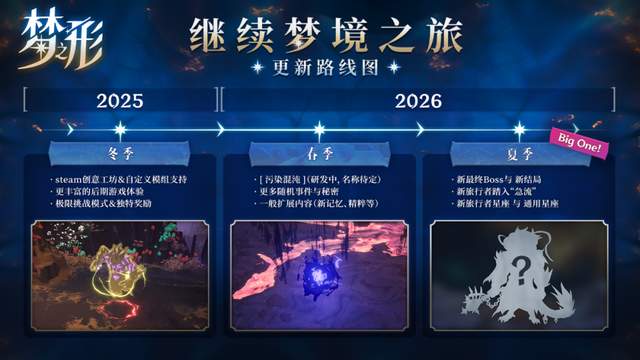
Q: It was previously announced that Steam Workshop support would be added this winter. Once it’s available, what features will be offered to creators?
A: Our goal is to provide players with the most user-friendly tools and features—as long as our development capabilities allow—so they can create mods and custom modes as easily as possible.
After deciding to incorporate a custom MOD system into *Shape of Dreams*, we realized that the MOD community was much larger than we had imagined, so we’ve been working hard to develop the MOD system, learning as we go and showcasing our progress along the way. We also place great importance on the MOD-loving players in the Chinese community.
From our development team’s perspective, the MOD is still in its early stages. For players who enjoy MODs, the tools provided in this update may be quite basic, and the MOD content offered might be a little less than expected, but we’ll continue to improve it.
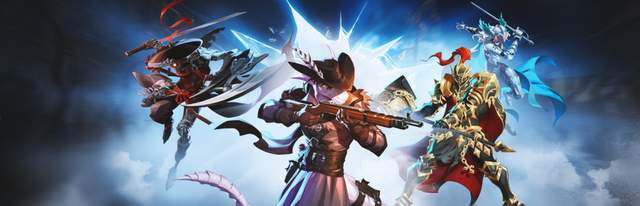
Q: In China, the gaming community has shown tremendous enthusiasm for *Shape of Dreams*, and everyone has been very passionate about it. Is there anything you’d like to say to the Chinese players who love this game?
A: We’ve mentioned this many times before, but we’d like to say it again—thank you very much.
For the development team behind *The Shape of Dreams*, Chinese players hold a very special place in their hearts.
This isn't just empty talk. When we first launched our Steam store page, Chinese players were the first to discover our game; and when we released the demo, Chinese players were the ones who sent us the most feedback.
After the demo was released, many Chinese players visited our Steam page to try it out. At the time, 80% of all players worldwide who played the demo were from China. This statistic, combined with the circumstances at the time, gave the development team tremendous motivation. It was this motivation that enabled us to bring the game to audiences around the world.
Finally, we’d like to say that since the game’s launch, we’ve been reviewing every piece of feedback and listening to every comment. We’ll continue to work hard to improve the game within the limits of our development capabilities.
原创文章,作者:游茶妹儿,禁止转载:https://youxichaguan.com/en/archives/213673