
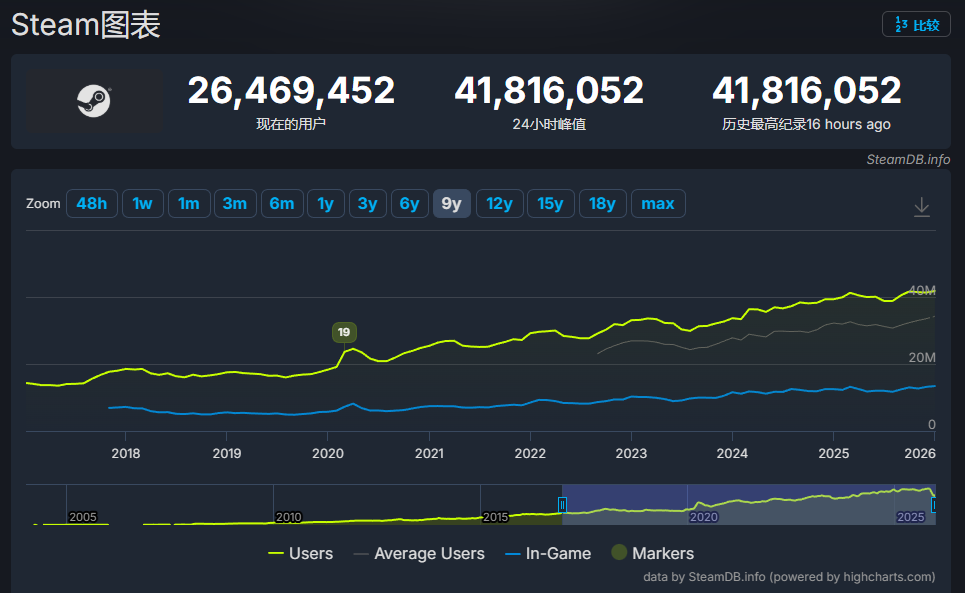
On January 4, 2026, as Steam announced the 2025 Game Awards and the upcoming end of its Winter Sale, the platform’s concurrent user count officially broke the record of 41.6 million set last October, surging to 41.81 million. Excluding users browsing the store or hanging out in the community, the peak number of players actually playing games reached as high as 13.39 million.This new high at the start of the year not only reflects the explosive growth of the PC gaming ecosystem but also marks a remarkable fourfold increase in Steam’s concurrent user count over the past decade, since it first surpassed 10 million in June 2015. As the world’s largest PC gaming platform today, every new peak on Steam reflects the enthusiasm of players and illuminates the entire industry ecosystem.
1. A Look Back at the Moments When Online Viewership Peaked
Steam’s concurrent user count has been steadily climbing since the platform matured in 2012, but the real surge began in November 2017. The release of *PUBG* ignited a craze for battle royale games, attracting a large number of new players who were drawn to its innovative gameplay. They registered accounts and purchased the game. By the end of November, as the game’s concurrent user count reached 3 million, the platform also surpassed the 17 million mark for the first time.marking Steam’s transition from a mainstream single-player game store to a multiplayer competitive gaming platform.
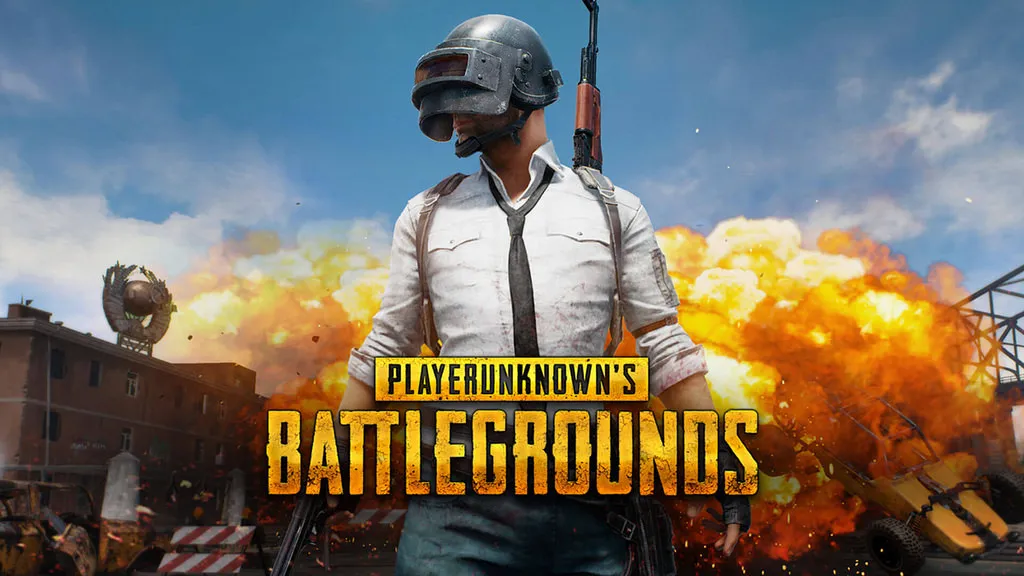
After the hype surrounding "PlayerUnknown's Battlegrounds" (PUBG) began to fade, Steam's concurrent user numbers stabilized between 2018 and 2019. That is, until March 2020, when sudden global lockdowns triggered by the pandemic rendered traditional in-person entertainment unavailable. With people staying home to pass the time, they turned to gaming—I wonder if you all still remember your Animal Crossing islands from back then?However, since PC penetration is far greater than that of consoles, Steam naturally became the go-to choice for home entertainment. Whether it was socializing online with friends they couldn’t meet in person through multiplayer games or immersing themselves in single-player role-playing, these activities drove peak concurrent users to 23.6 million. This not only alleviated the oppressive social atmosphere under lockdown but also laid the foundation for the gaming landscape in the post-pandemic era.
In November 2021, Amazon’s *New World* reached a peak of 910,000 concurrent players upon its launch.The game’s MMO sandbox gameplay features strong social elements, aligning with post-pandemic players’ demand for multiplayer interactive games. Coupled with strong sales during the fall sales event, Steam officially surpassed the 27 million mark at this time, demonstrating that AAA titles and massively popular online games play a crucial role in driving the gaming industry in the post-pandemic era.
In February 2022, the handheld gaming market welcomed the launch of the Steam Deck, which sold out within a minute of pre-orders opening. After a second pre-order period began in July of the same year, supply gradually stabilized. According to statistics, annual shipments reached approximately 1.5 to 2 million units. While this figure falls short of the Nintendo Switch, the Steam Deck has firmly established itself in the PC handheld market, with no other competitor able to rival it.Although the Steam Deck’s impact on online peak numbers wasn’t as immediately apparent as the 950,000 players instantly contributed by the March release of *Elden Ring*, the device’s portability directly boosted daily active users and online playtime. Combined with the launch of *Call of Duty: Modern Warfare 2* and the Autumn Sale, concurrent online players surpassed 31.9 million in November—less than a month after reaching 30 million.

In February 2023, the release of *Hogwarts Legacy* drew in fans of the franchise, including many new users who had just registered on the platform. In March, *Counter-Strike*—long the online game with the highest concurrent player count on Steam—launched a limited beta test for *Counter-Strike 2*. That same month, the game reached a peak of 1.5 million players, and Steam’s concurrent player count once again hit a new high of 33.6 million.On September 28, CS2 made a fresh return. With free data migration and map optimizations, the return of veteran players and the influx of newcomers reignited enthusiasm for the game, successfully maintaining the 33 million mark.
The August 2024 release of *Black Myth: Wukong* stunned gamers worldwide. It broke *Cyberpunk 2077*’s records even during the wishlist phase, and upon its official launch, it reached 2.4 million concurrent players, second only to *PUBG*.For Chinese gamers, who had long been deprived of domestic AAA titles, this game was groundbreaking. Sales exceeding 10 million copies within three days brought a surge of new users to the platform. It’s safe to say that ever since, a new wave of players has downloaded Steam each year after the college entrance exams. Directly driven by *Black Myth: Wukong*, the online peak reached 37 million, and Steam gained renewed exposure in China.

By the end of February 2025, *Monster Hunter: World* had reached 1.38 million concurrent users at launch, thanks to its strong IP and the series’ massive fan base. This helped the platform surpass 40 million concurrent users for the first time in March, reaching 41 million.Subsequently, in October, fueled by the release of *Battlefield 6* and the buzz surrounding the CS2 tournament, concurrent users peaked at 41.6 million. Then, on January 4 of this year, benefiting from the long-tail effect of multiplayer online games and the winter sales event, the figure once again surged to a record-breaking 41.81 million.
2. The driving force behind the surge in online users
Looking back at the growth in Steam's concurrent user count over the past decade, it is clear that this growth has been driven by the release of blockbuster AAA titles, shifting player preferences across different eras, promotional discounts that attracted new players, and advancements in hardware.
Whether it’s *PUBG* single-handedly upgrading domestic internet café facilities, *Black Myth: Wukong* ushering in a new era for domestic games, *Elden Ring* attracting veteran Soulslike fans, or *Monster Hunter* maintaining its popularity thanks to the strength of its IP, these titles have all generated massive buzz and crossed over into mainstream culture, enticing many casual gamers to give them a try."A young person’s first AAA title"—this phrase isn’t just a joke; it’s the core reason why online player numbers keep rising year after year. Whether it’s a high-quality game that resonates with players or a classic that remains highly recommended by countless players even after years have passed, there will always be early adopters who buy it on launch day, as well as latecomers who eventually give it a try.
If you look closely at the timing of each milestone in user growth, the traffic generated by various seasonal sales is also a major factor.whenever people assume user numbers have plateaued or that frequent game discounts will deter purchases, the crashes and lag on Steam on promotion days only prove that countless "wait-and-see" players are still waiting for 90% off. At the same time, it’s the combination of users browsing the community marketplace for games they like, players actively engaged in gameplay, and the influx of users always online due to the Steam Deck launch that collectively pushed concurrent user numbers past their peak.
The 23.6 million concurrent users during the pandemic were driven by external factors, but the user base established during that time has ensured that over 20 million concurrent users have become the norm even after social activities returned to normal following the pandemic.This is also due in part to the appeal of long-standing free-to-play titles on the platform, such as *Dota 2* and *CS:GO*. These games boast extremely high user retention and maintain their popularity nearly year-round thanks to their low barriers to entry and ongoing tournaments. Their inherent social features also attract many potential users who are not interested in single-player games but still choose to register for Steam.
3. The Hidden Chinese Market
Valve released data in 2024 showing that Simplified Chinese users (33.7%) surpassed English-speaking users (33.5%) for the first time, indicating that China had quietly become the dominant force in the PC market.In fact, the trend had already begun to take shape as early as 2017 when *PUBG* exploded in popularity. Unlike the established console gaming market, China lacked a large-scale console user base; instead, it was home to a massive community of online and mobile gamers seeking competitive, fast-paced, and thrilling experiences. *PUBG* perfectly met these criteria, driving a wave of graphics card upgrades and new platform registrations that year, and laying the groundwork for users to enjoy more single-player games in the future.However, due to the absence of Chinese servers on Steam (excluding the Steam China platform) and the large number of "spiritual Argentinians" who bypassed region locks back then, the mainland market—despite being a vast untapped user base—did not attract significant attention.Chinese players also have a particular fondness for FPS games. Whether it’s traditional bomb-defusal shootouts, the later "battle royale" games, or today’s "search, shoot, and retreat" titles, there is a massive base of loyal users. CS:GO also played a significant role in helping Steam break its concurrent user records multiple times. While the classic game boasts a large player base in China, the existence of the Perfect World platform diverted some of these players; nevertheless, the support from Chinese players cannot be overlooked.

The rapid growth of short-form video platforms in China in recent years has also played a significant role in boosting Steam’s popularity."Sekiro" is a highly entertaining game that is frequently the subject of memes. The truth behind the millions of "Sekiro" players is that many are simply casual gamers who, after watching short videos showcasing the game’s flashy moves, prosthetic arms, and intense swordplay, imagine themselves doing the same. While "Sekiro" isn’t the only game to have gone viral through short videos, many "Sekiro"-like titles have become familiar to countless short video users, and a portion of them inevitably convert into actual players.The widespread popularity of *Elden Ring* in China is due not only to its high quality and extensive walkthroughs, but also in part to the base of Souls-series players established by *Sekiro*.
Users of Simplified Chinese must use Simplified Chinese. As the number of Chinese gamers grows, major developers have begun to prioritize the Chinese market, with many AAA titles now supporting Simplified Chinese and even Chinese voiceovers. The days of relying on fan-translated patches—as was common a decade ago—are long gone. This has undoubtedly attracted a large number of new players. In an era where people need tutorial videos just to download legitimate Steam games, asking them to search for fan-translated patches would turn them off right from the start.
If earlier developments merely hinted at the potential of the Chinese market, then last year’s release of *Black Myth: Wukong* was the definitive proof. Sales figures and online player counts don’t lie; even major Western studios—no matter how reluctant they were to acknowledge the rise of the Chinese gaming market—wouldn’t turn down the money. The TGA launched official accounts on major Chinese social media platforms for the first time, and developers began paying close attention to feedback from the Simplified Chinese region.When the *Elden Ring* DLC was first released, its unreasonable difficulty curve initially resulted in a 39% approval rating in the Chinese community. The developer responded by directly releasing a Chinese walkthrough for players. These actions would have been unimaginable to the players who, just a decade ago, were collectively petitioning Nintendo to add Chinese localization to new *Pokémon* titles.
Looking back at all the milestones in Steam’s concurrent user counts, Chinese players have always been deeply involved. The single-player game market has gradually opened up, and with policy support and a steady stream of new domestic single-player titles taking the reins, the “Steam China Era” is poised to take off. The voices of Chinese players will be heard around the world.
原创文章,作者:gallonlabs,禁止转载:https://youxichaguan.com/en/archives/195245

![[Jialun Says] Why Have Indie Games Suddenly Become So Popular?](https://youxichaguan.com/wp-content/uploads/2017/04/14933692323005-1-480x300.png)