April 2026 marks an exceptionally busy release window for the gaming industry, with major publishers all gearing up to launch their latest titles. This month is a real treat for gamers—every day brings a new game to dive into, one after another, making for a truly delightful experience.
Amid the intense competition among top-tier titles in April, Bio Games made a surprise announcement: its game *Sketch! Color World* will enter open beta on all platforms on April 28. This mobile 2D game, which focuses on idle gameplay and vertical-screen swiping mechanics, has garnered over six million pre-registrations across all platforms.Prior to launch, it held an 8.7 rating on TapTap and a 9.5 rating on Bilibili, ranking second on the new game pre-registration charts. On the day of its release, it topped the App Store Free Chart, TapTap’s Trending Chart, and Bilibili’s Popularity Chart—securing the number one spot on all three. Breaking through the competition, it has carved out its own niche in the market.

*Scribble! Color World* was developed by Brain Bomb, a studio under Bao Games. Although the entire project team—including both development and publishing staff—consists of fewer than 100 people, they deliberately steered clear of the current mainstream “open-world” trend. Instead, they adopted the self-deprecating tagline “Goddesses Scribble, Shoot, and Go Wild: The Ultimate Side-Scrolling Game,” declaring their intention to “do away with the typical indie game vibe” and create a lightweight game truly suited for slacking off and casual play.
Judging by current market feedback, *Sketch! Color World* has indeed achieved remarkable success thanks to its casual gameplay, generous rewards, and unique art style. In an era where players are trapped in a cycle of endless grinding and microtransactions, how can developers carve out a distinctive path in what appears to be an already saturated market?
01
An Experiment in “Anti-Grand World”
*Scribble! Color World* was officially greenlit in March 2025, but the incubation period leading up to that lasted nearly a year and was primarily devoted to preliminary research on gameplay direction. The game is being developed by “Brain Splatter Studio,” a subsidiary of Bao Games. In fact, just from the studio’s name alone, we can sense the team’s intention to create a product that breaks the mold.
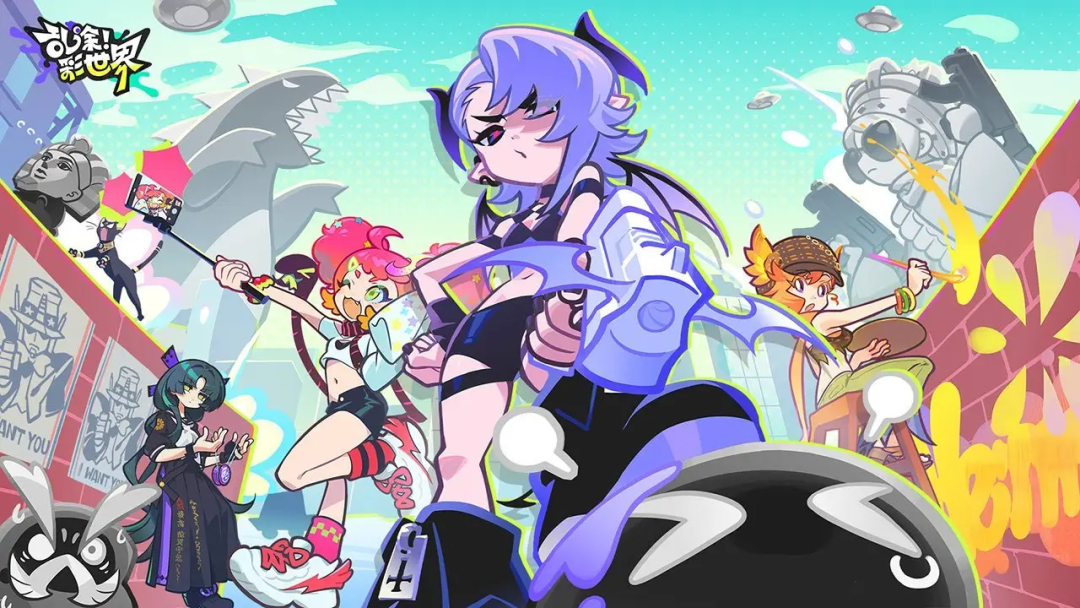
On June 10, 2025, the game’s first promotional video was released on Bilibili, where it quickly surpassed two million views.In the initial trailer, many players noted the familiar “Strapless Angel” aesthetic, and “Sketch! Color World” indeed adopts an American UPA style, using slightly exaggerated deformations and dynamic perspective to express movement in a more emotional way. This “outwardly expressive” emotion perfectly aligns with “Sketch! Color World”’s free-spirited game positioning, which aims to avoid trapping players in complex daily activities.At the same time, the game’s distinctive art style made a deep impression on users from the very beginning.
From an industry perspective, the creation of this product can be described as “going against the grain.” In recent years, the mainstream narrative in the anime-style gaming sector has tended to be quite heavy, and behind this rich content, players are left with a host of cumbersome “aftereffects”: repetitive daily routines, grinding through dungeons over and over to unlock achievements, and even “open worlds” that cannot be fully explored without consulting walkthroughs.
In a conversation between the project team and Game Tuo, they revealed a key statistic: internal user research shows that over 50% of anime-style game players play four or more mobile games every day. This data points to a significant industry trend: players’ time is highly fragmented, their energy is spread thin across multiple activities, and they are gradually growing weary of their main game, which has become a “daily grind” akin to a day job.
The project team concluded that players have limited energy and time, making it impossible for them to immerse themselves in multiple open-world games simultaneously and fully experience them. At the same time, there is a clear gap in market supply—there are very few anime-themed casual games that prioritize short play sessions, stress relief, and a lightweight experience. It was precisely this mismatch between supply and demand that led them to bypass the mainstream trend and position the product as a lightweight offering in the “anime + casual” niche.

02
I found a few games among a sea of memes
“Doodle! Color World” is a vertical-screen bullet hell shooter built around the concept of “color coverage,” with its core gameplay centered on “coloring.” The story takes place in a world where aliens have invaded Earth and drained it of all color. Players control a part-time demon and a hapless deity to form the “Coloring Squad,” using colorful ammunition to restore color to the black-and-white world.
The game features vertical screen, one-stick controls. Characters automatically aim and fire, so players only need to control their movement and unleash special moves at the right moment. Each level consists of multiple distinct zones; players must color all the gray targets within a zone before advancing to the next stage, while also dodging enemy fire. Although auto-aiming reduces the difficulty, the synergies between different classes and colors still require some strategic thinking on the player’s part.
Based on my gameplay experience, each battle lasts between two and three minutes. The main story features levels where the narrative and combat are separated, reducing the monotony players might feel from being stuck in the same type of gameplay.With features like auto-play for leveling up and offline resource accumulation, plus the ability to set most controls to “one-tap” mode, the game is designed as a casual “digital puzzle game” perfect for playing in short bursts, effectively reducing the amount of time players spend on “garbage time.” Additionally, the game includes lightweight social features such as three-player online battles.
The most distinctive aspect of *Sketch! Color World* is undoubtedly its art style and narrative approach.
The game’s art style does not follow the traditional anime cel-shading approach, but instead adopts a fusion of “Japanese pop color-blocking and exaggerated American cartoon designs.”High-saturation colors paired with rough, graffiti-style lines create a visually striking aesthetic. This distinctive artistic language gives the game a strong second-glance appeal, while the vibrant color palette further enhances its energy, attracting a large number of young players.
The narrative style of *Scribble! Color World* aligns more closely with the absurd humor of a screwball road trip comedy. In a sense, “finding a little gameplay amidst a sea of jokes” is the most fitting description of this title. The story unfolds in comic-style panels, incorporating light-hearted Live2D animations, with each chapter taking just two to three minutes to complete. The comic content is lighthearted and entertaining, reflecting the developers’ desire to create a casual experience with minimal text, thereby reducing the reading burden on players.
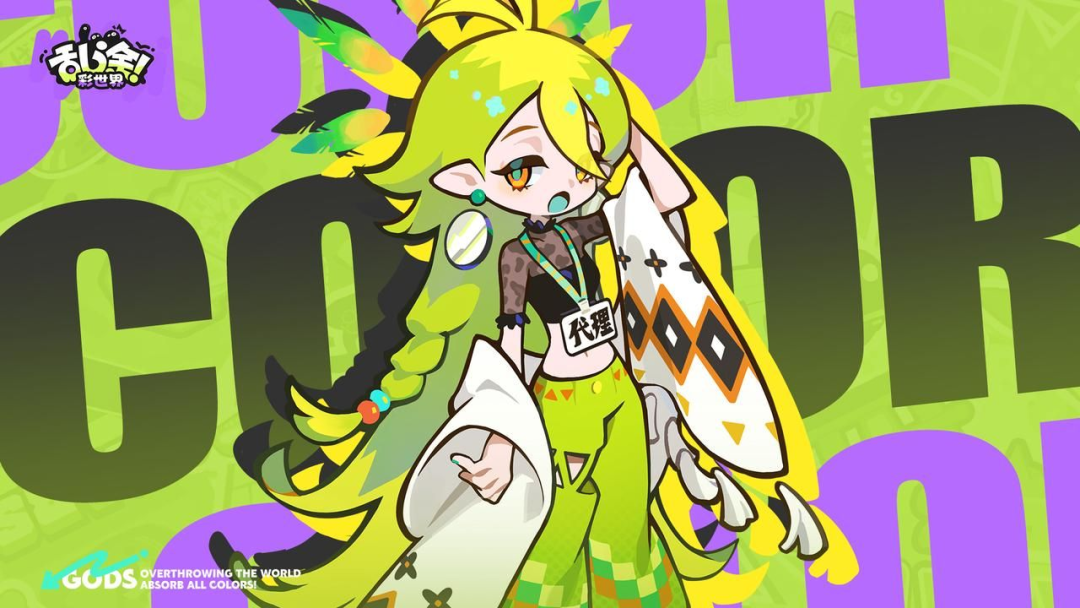
The level and enemy designs are filled with inside jokes that will make you chuckle, such as “Brother Camel” and the rampaging Statue of Liberty.In terms of character design, the development team has taken a subversive approach to deities from various cultures: Cupid has become a pop idol, Amaterasu is the president of a otaku club, and there are wildly imaginative characters like “Stock Market God Odin” and “Cat-Loving Ramses.” By reimagining these deities through a modern lens, the game explores new possibilities for their roles, subtly bridging the gap between the “lofty gods” and the players.
If everything is out of the ordinary, it actually creates a sense of harmony. Among the hundreds of player reviews on TapTap, almost every one highlights players’ fondness for this narrative style: “It’s been a long time since I’ve seen a story this lighthearted, fun, and full of witty moments.” This perfectly resonates with the abstract mental state of today’s young people.
03
Do what you’re supposed to do
The success of *Sketch! Color World* offers a model for course correction in today’s anime game market, which is currently intensely focused on “content and scale.” While most anime games are striving to grow larger and stronger, aiming to win through massive scale and high quality, Bao Games has chosen to create small yet polished products, establishing its brand identity through a distinctive style.
At the same time, there are details beneath the surface of this sample that are worth pondering: While “Big World” games consume the most of players’ time, there is an equally massive gap in the demand for casual gaming. However, this gap has long been overlooked by mainstream developers, to the point where, when a “side-game within a side-game” burst onto the market, it quickly captured this “invisible market.”
“Doodle! Color World” proves that a game’s “lightweight” nature can be reflected not only in its size but also in its emotional value.
The grand themes and tear-jerking moments in the storyline certainly leave a deep impression on players, but they also subtly control players’ “emotional agency.” After enduring a lengthy storyline, most players are bound to feel drained of energy and time, especially when new storylines try to replicate past highlights—this inevitably creates a sense of redundancy, akin to “making a mountain out of a molehill.”Nowadays, many players even feel uncomfortable when there’s no option to skip the story. After all, there will always be those who don’t want to listen to virtual characters preaching after a long, tiring day.
So, “giving players back genuine leisure” has become a new goal.Players can choose for themselves whether to invest their emotions, rather than being swept along by the plot. *Scribble! Color World* is very clear about its positioning: as a “second-choice” game for players, it has clearly opted not to go all out on non-combat segments. Instead, it conveys the main storyline using the simplest language and the most straightforward comic panels, rather than relying entirely on static click-to-dialogue sequences. Rather than forcing players to feel a certain way, the game chooses to share joy through abstract concepts and inside jokes.
At the same time, when it comes to gameplay, players with fragmented free time tend to prefer mindless hack-and-slash or one-click idle games over those that require more strategy or skill. This time spent zoning out and not having to think allows players to relax amidst the overwhelming volume of gaming information.”Sketch! Color World” defines its positioning with three “no”s—”no time, no energy, no thinking”—further emphasizing its gameplay philosophy. This approach has successfully attracted its target audience, delivering just the right emotional value to these players.
For small and medium-sized teams, rather than trying to replicate established genres in a market dominated by giants, it’s better to make the most of specific art assets, IP choices, and emotional expressions. Instead of trying to “educate” players, focus on resonating with them, doing what you do best, and clearly understanding your product’s positioning and target audience. The original purpose of games is relaxation and entertainment—not to make players work just to play. That would clearly be putting the cart before the horse.
Conclusion
Big-budget productions aren’t the only solution for mobile games.
When industrial-scale quality has become virtually accessible to all developers, a unique narrative style and aesthetic system can instead serve as a competitive advantage. We should not measure the value of a casual game solely by traditional metrics such as DAU and ARPU. The value of a successful “casual game” lies not in monopolizing players’ screen time, but in serving as an outlet for emotional release—truly entertaining players.
The future of *Sketch! Color World* remains fraught with challenges. Once the initial bonuses run out and players have obtained all the free Day-0 characters, the game’s appeal as a “side game” may be at risk of being exhausted. As one player commented: “But let’s face it, it’s just a side game—don’t expect it to take up all your gaming time.”
Therefore, can the pace of content production keep up with the rate at which players consume memes? Can the lack of character progression and content in the mid-to-late game be addressed through regular major updates? As a game that operates like a fast-moving consumer good, these are challenges that Bio Games must confront on its long-term journey; the studio needs to constantly create a sense of novelty to retain players who jump in and out during their spare moments.
原创文章,作者:gallonwang,禁止转载:https://youxichaguan.com/en/archives/196120