A one-time purchase combined with token-based payments is the business model currently embraced by most AI game development teams. When applied to the Steam platform, will this model align with players’ long-established habit of making one-time purchases?
"History Simulator: Chongzhen," the first AI game to hit the market, seems to provide an answer.
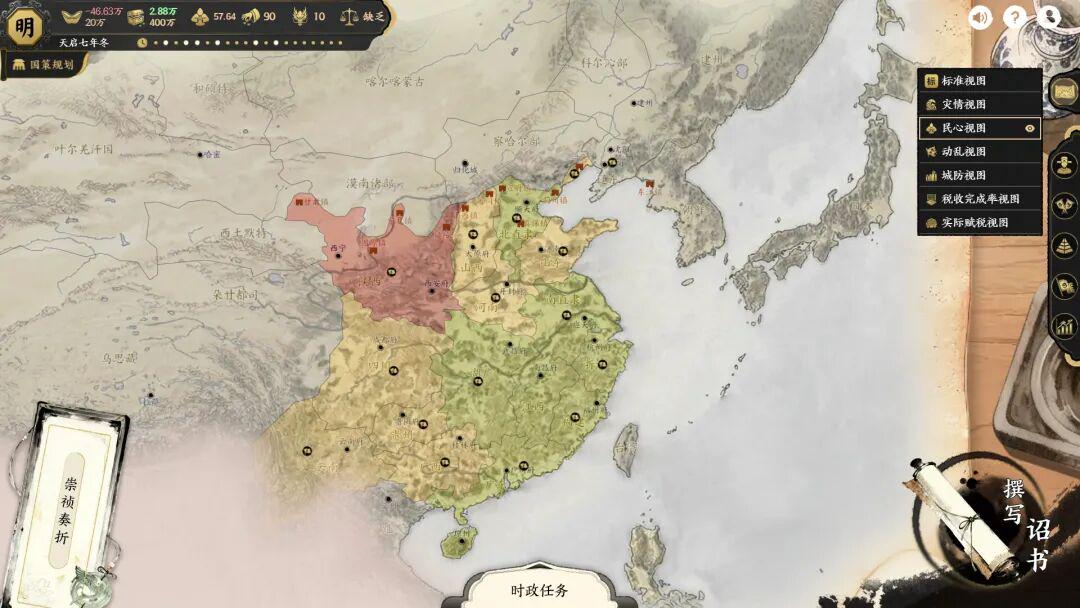
"History Simulator: Chongzhen" was greenlit last September and launched this May. In the game, players take on the role of Emperor Chongzhen of the late Ming Dynasty to save the dynasty from collapse.
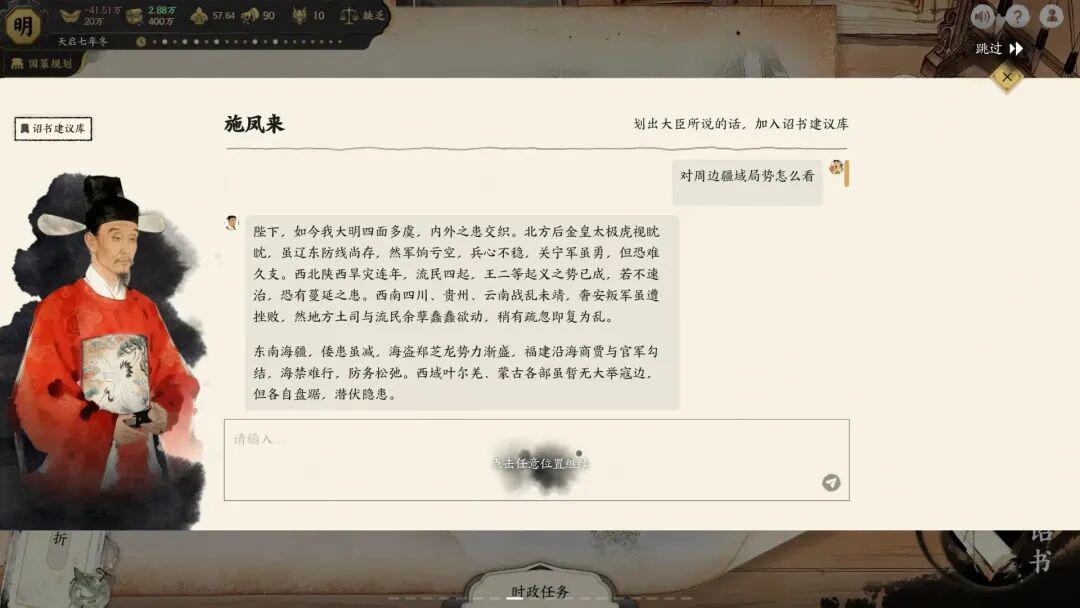
Unlike traditional strategy games, it does not have predetermined, fixed branching paths. The player takes on the role of the emperor, while the AI plays the role of ministers. Each minister has a unique personality that evolves continuously based on the player’s actions. The player issues edicts, and the AI simulates the consequences. The AI’s unpredictability keeps the game full of surprises.
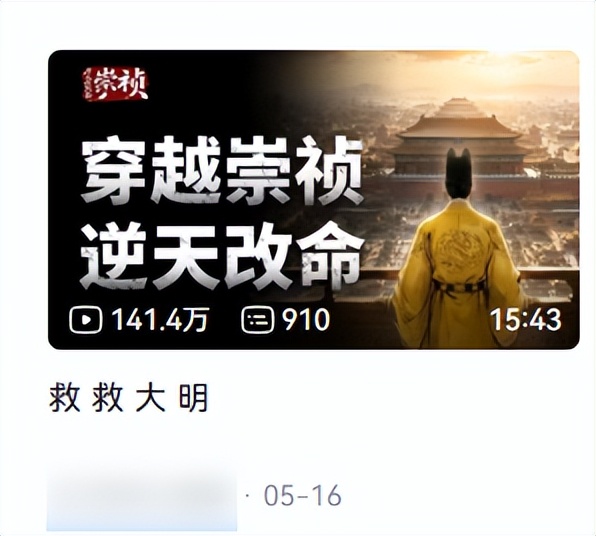
The game’s diverse range of endings has sparked a great deal of discussion. Despite receiving no promotion prior to launch, the game’s popularity skyrocketed after its release. Game review videos on Bilibili have garnered as many as 1 million views. According to the developers, the game’s day-two retention rate reached 75.1%, with an average online duration of about seven hours on non-workdays.
Players eagerly jumped into the game, ready to show off their skills, only to be prompted to pay extra at the most exciting moment. For a game purchased outright for 48 yuan, having to spend more halfway through led to a flood of negative reviews.“Having to pay extra halfway through the game,” “not allowing direct API integration”—the controversy almost exclusively centers on the same issue: the “buy-to-play” business model.
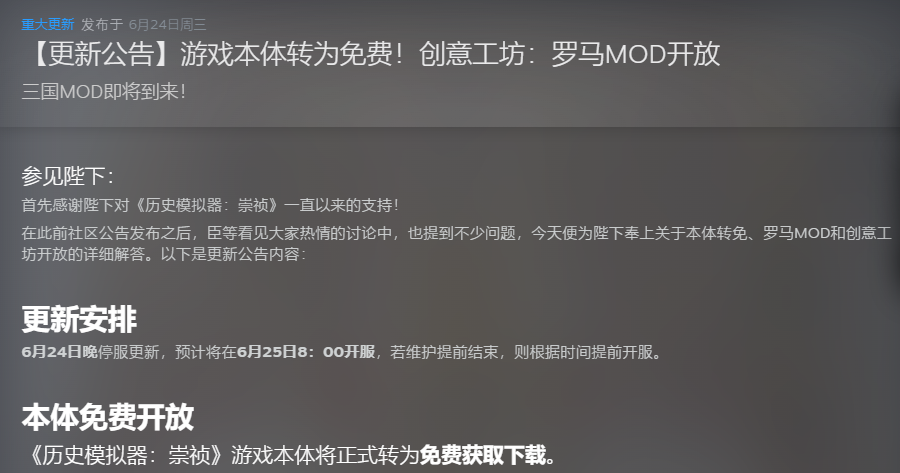
In response to the controversy, the game’s developers subsequently announced that the base game would be free and made the API available to players. While the game remains popular, its reputation has not improved. To this day, the game’s rating on Steam remains “Mixed.”
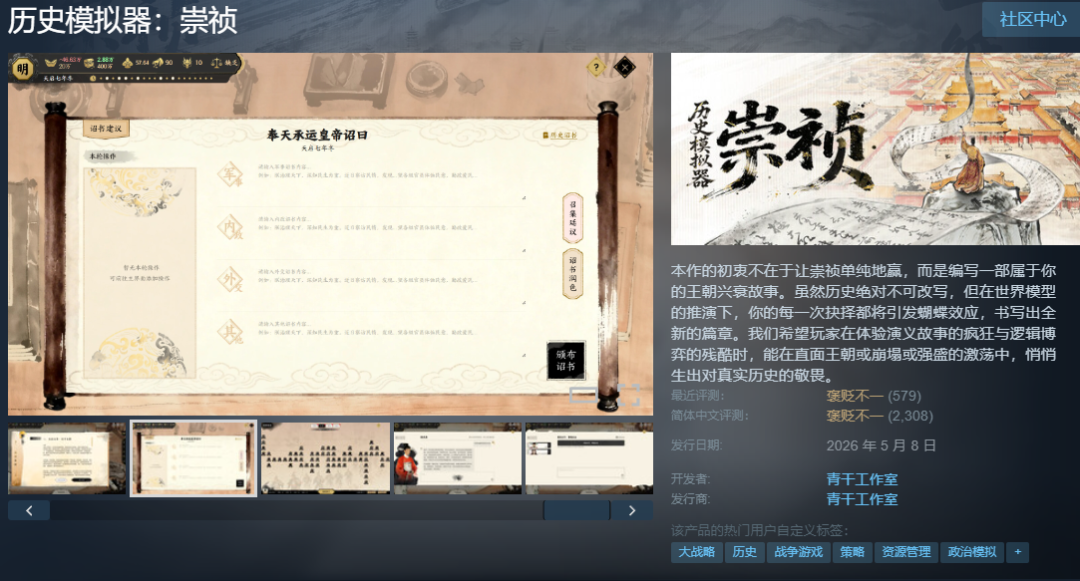
"History Simulator: Chongzhen" has taken an early lead in the historical AI game market, but it also signals that the path toward a combination of one-time purchase and token-based payments still has a long way to go.
This was a somewhat unsuccessful attempt at a "one-time purchase plus token-based microtransactions" business model for an AI game on Steam. However, the game's popularity still gave its creator, Zhuiqing, confidence: as long as people are playing it, that means there is a market for it.
Zhui Qing had long anticipated this outcome. He believes that even if they had opted for a free-to-play model with token-based payments back then, the situation might not have been much better. The root of the problem lies not in the payment model, but in trust: players need to be convinced that you aren’t just out to make a quick buck.
This is something that requires long-term development, both for *History Simulator: Chongzhen* and for the AI gaming market as a whole.
The following is a conversation between the Teahouse and Zhuiqing, presented here in edited form:
01
Popularity and Controversy
Teahouse: You launched the game right away without even releasing a trailer first, which is quite different from how many AI games are typically handled. Why did you move so quickly?
Zhuiqing:
The main reason is simple. On the one hand, our development efficiency is relatively high, so we can finish the game and launch it quickly; on the other hand, since this game consists entirely of text, the promotional videos we create lack visual impact, so they’re bound to fall short. So we decided to skip the promotional video altogether and launch the game directly. Ultimately, players are here to play the game itself, not watch a promotional video, so there’s no need for flashy gimmicks.
Teahouse: So you didn’t have high expectations for this game early on, which is why you didn’t do any promotional activities in advance?
Zhuiqing:
It’s not that our expectations were low. Of course, when making a game, we hope to have as many players as possible, but we don’t have the resources required for a major game launch, so we can’t run a large-scale marketing campaign. We didn’t create a dedicated promotional video, nor did we run any ads; word-of-mouth from players has been our only means of spreading the word. We’re also very grateful to the many streamers who have voluntarily streamed our game.
Teahouse: When the project was first proposed, did you have any expectations regarding market acceptance and financial returns?
Zhuiqing:
Our initial expectations were much lower than the actual performance; the final results far exceeded our estimates. When the game first launched, the day-2 retention rate was 75%, and the average daily playtime on non-workdays was about 7 hours. We had initially based our expectations on the average for typical indie games and thought a day-2 retention rate between 50% and 55% would be quite good.
Teahouse: There were already quite a few similar tools on the market at the time—for example, platforms like Tavern that allow users to directly set up custom role-playing simulations, and many players were even using GPT to create simple historical simulators on their own. The technical barrier to entry for this kind of gameplay doesn’t seem very high. Aren’t you worried that a large number of similar competitors will quickly enter the market and siphon off your users?
Zhuiqing:
In the long run, if no similar competitors emerge right now, our experiment will lose more than half its significance. The more imitators there are, the more it will reinforce players’ confidence in choosing this game genre. And as players’ confidence grows, more and more development teams and capital will flock to this sector, creating a virtuous cycle.From what I understand, at least a dozen companies are keeping a close eye on the “Chongzhen-like” genre, and behind many projects that claim to be “player-made” are actually game companies that have already secured tens of millions of dollars in investment.
So, I believe that their follow-up efforts aren’t about splitting the market, but rather about working together to expand it.
Speaking for myself, rather than worrying about the competition, I’d rather continue to raise the bar for my own work. As I often remind myself, if something created purely out of personal interest is only meant for my own enjoyment, it will likely only score a passing 60 out of 100 when presented to players. But to achieve an 80—a high-quality experience—the attention to detail required is immense.UI interactions, sound feedback, and stability—these seemingly minor details require far more effort than one might imagine to polish to perfection.
Teahouse: You launched your game relatively early and opted for a paid, one-time purchase model on Steam, which drew a lot of criticism from players at the time. Did you anticipate this kind of controversy?
Zhuiqing:
We saw this coming. So we took player feedback into account, made the game free-to-play, and now charge tokens based on playtime.
The truth is, no matter what payment model you choose, there will always be people who complain. If you go with a subscription model, you’ll have to spend a lot of time and effort on billing and calculating resource usage, and players will still think it’s unfair. I actually think the one-time purchase model is more transparent. It’s crystal clear how much you pay and how much content you get.
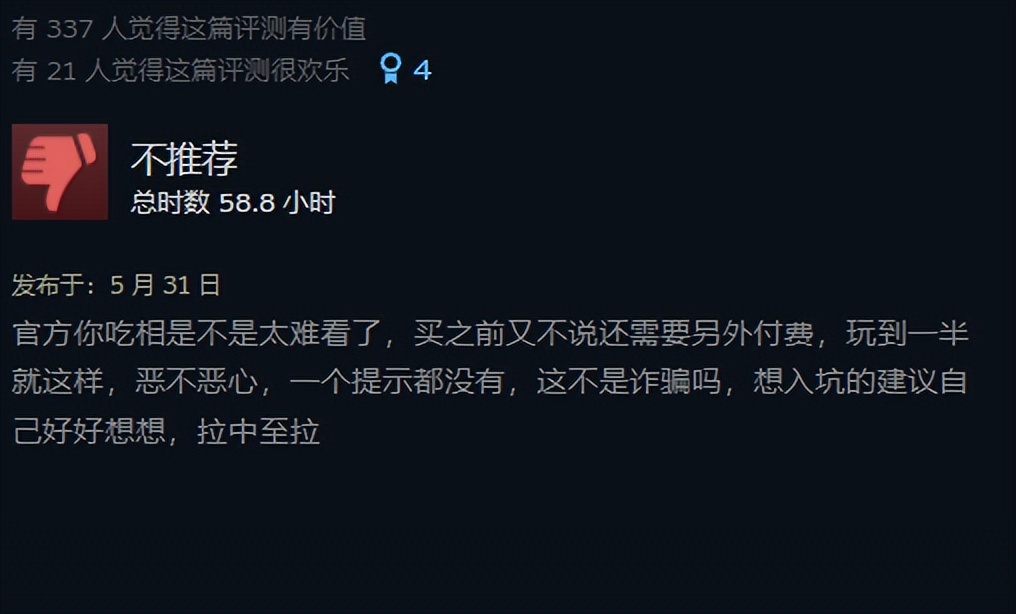
AI games are a brand-new genre, and players need time to get used to how they work. Server costs for traditional games are extremely low, and players don’t have to pay additional resource fees while playing. However, the nature of AI games means that every move consumes tokens, keeping costs high. No matter which payment model is chosen, controversy is inevitable.
How to develop a payment model that is acceptable to both players and developers is a challenge the entire industry is still grappling with. As pioneers in this field, we inevitably have to face the initial backlash. The AI-driven otome game that launched a few days ago adopted a subscription model and was criticized by players just as harshly as we were.
Teahouse: You also made adjustments quickly and opened up a portal for players to connect to the large-model API on their own, but I hear that only about 20% of players have actually connected to it themselves?
Zhuiqing:
That 20% refers only to active users who have at least tried to connect to the game; the actual percentage of players who have consistently connected on their own over the long term is even lower than that.
Teahouse: In other words, the core issue for players isn't whether or not they have permission for open, independent access.
Zhuiqing:
I think the key issue is trust. You have to convince players that the team isn’t just here to make a quick buck and disappear. This requires gradually building trust through countless small details and concrete actions. Players won’t fully trust you just because you’ve opened up an API; a good reputation is built bit by bit through long-term operation.
Teahouse: Do you have any ideas on how to restore trust?
Zhuiqing:
I don't have a quick fix right now either. Building trust is a long process. We're a new studio with a new product, and no matter how much we promise not to disappear, many players will still have reservations. This is something that can only be proven over time.
Teahouse: Currently, the game itself is free, and you’re covering all of the players’ token costs in the early stages. Is this expense a significant burden for you?
Zhuiqing:
It’s certainly not a small amount, but we’re still willing to offer a free trial. Essentially, we want to send a message: we care more about growing our player base than rushing to make money. We hope this game will undergo long-term iterations and grow gradually.
Teahouse: This also means that the more users try out the service, the higher your initial costs will be.
Zhuiqing:
The whole point of making games is to get more players to try your product—isn’t that the core goal? Besides, the free trial isn’t permanent. If players enjoy the game after trying it, they’ll naturally be willing to make a purchase. Currently, our conversion rate remains quite high.
02
A historical simulation game inspired by Model United Nations
Teahouse: As I played through the later stages, I felt incredibly frustrated. No matter how hard I tried, it seemed nearly impossible to turn the tide of the game. That sense of helplessness actually made the experience feel incredibly authentic.I’ve also seen quite a few players share that when they assign tasks to ministers, the ministers agree to them right away, but the stats on the screen don’t change much, and when they press for answers, they’re just fobbed off. The entire process feels remarkably close to the texture of real history. Was this the effect you intended when you first designed the game?
Zhuiqing:
I’m sure you expected this—it’s essentially a historical simulation game.Player behavior can generally be divided into several categories: some completely deviate from the main storyline and dive straight into fantasy settings; others focus solely on driving the Scientific Revolution and the Industrial Revolution; and, as you mentioned, the majority of players diligently follow the political landscape of the late Ming Dynasty, gradually feeling their way forward—which is also the mainstream playstyle we anticipated.
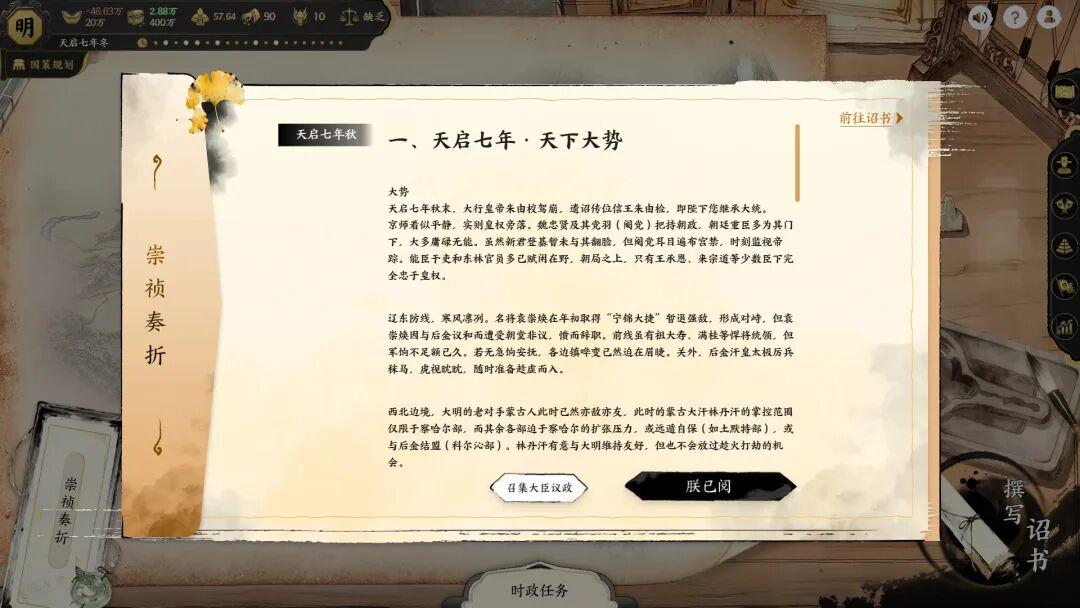
Like most classic time-travel novels on the market, the core appeal of our game lies in how players find a way out of the seemingly hopeless situation in the late Ming Dynasty. The AI has its own independent thought process; it generates corresponding responses based on the game’s progression and the specific commands you issue.
Teahouse: The core gameplay of this game is actually quite streamlined; players simply need to issue edicts and formulate national policies to influence overall statistics, without the complex mechanics found in many strategy games. How was this gameplay framework originally determined?
Zhuiqing:
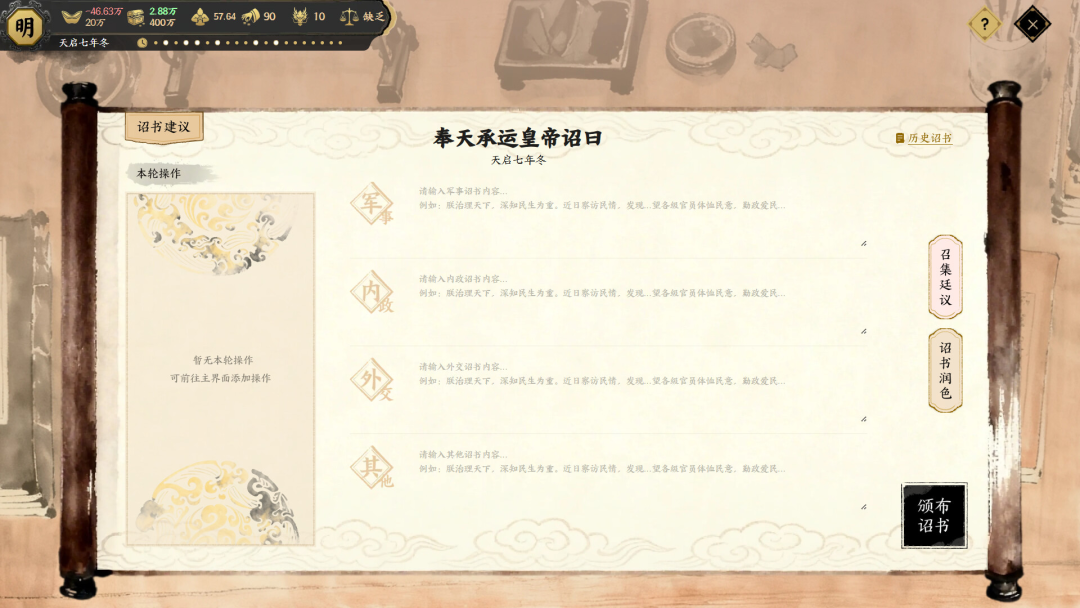
Our entire gameplay logic was initially built entirely around the core concept of the “imperial edict.”The fundamental premise is this: as the Emperor—the center of power in the Great Ming—you issue directives once every quarter, which perfectly aligns with how imperial authority functioned in real history. The dialogue modules with ministers, on the other hand, serve primarily as role-playing elements and provide subtle guidance.
Our game doesn’t have a particularly comprehensive tutorial, and since the game’s historical database is so vast, players often find themselves unsure of the ins and outs of the current situation. Asking ministers for advice effectively provides players with a gentle guiding path—we based our core gameplay design on this logic.
Teahouse: At first, I thought you were planning to make an AI-simulation strategy game that would incorporate all the core mechanics of strategy games, but in the end, you actually focused solely on the edict system as the core mechanic. Was that decided from the very beginning, or did it evolve gradually during development?
Zhuiqing:
We prefer to define this product as a “historical simulation game” rather than a traditional historical management game; its core objective is to accurately recreate the dynamics of power.
The inspiration for this game came from a classic student activity: Model United Nations. I’ve been involved in Model United Nations for a very long time, and I’ve always believed this activity has the potential to be implemented digitally and with AI.
A group of people gather, each playing the role of a head of state or minister from a different country. After discussing the matter, they jointly draft a directive specifying who will carry out which tasks, and then submit this directive to a manually operated simulation center to model the chain reaction it would trigger worldwide.This activity is essentially run entirely by people and follows a logic very similar to that of a tabletop role-playing game (TRPG) session.
When developing this game, we drew inspiration from this concept: the operation of a real-world country essentially relies on written directives to drive various actions, clarify development goals, and communicate the government’s intentions to all levels of the executive branch. Therefore, we chose to use “written edicts” as a medium to recreate this real-world operational logic.
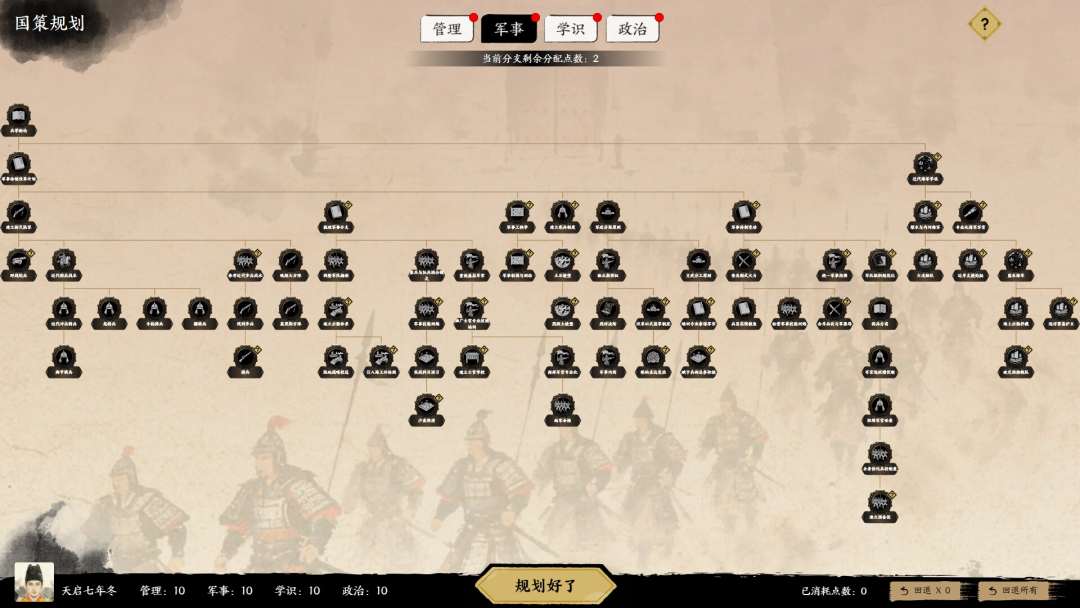
Teahouse: The national policy planning system in the game is very comprehensive, covering various areas of development such as politics and the economy, and each one has a basis in reality. Did you write all of this content yourselves?
Zhuiqing:
We developed the national policy module entirely on our own, incorporating a variety of strategies and development approaches widely recognized as viable in classic time-travel novels. This part was done almost entirely by hand; relying on AI to organize this type of content would be too inefficient and would not meet our quality standards.
Teahouse: Every minister in the game has a fixed behavior pattern that aligns with their historical personality and worldview. Did you create individual character profiles for each NPC?
Zhuiqing:
We’ve individually crafted personality traits and unique tooltips for each NPC. Unlike other games of this genre on the market, these characters’ tooltips change dynamically as the game progresses.For example, if you issue an edict that deeply offends a certain minister, the system will automatically update his dialogue to include new traits such as “This person harbors resentment toward the emperor,” and his subsequent interactions with you will fully reflect this new characterization.
Teahouse: To what extent was AI involved in the entire development process? How did you use AI to help you quickly implement tasks such as writing development documentation, building modules, and generating content?
Zhuiqing:
During our early development phase, the core work was still primarily done by human developers. After all, at the end of last year, AI-generated code still had significant limitations; it wasn’t possible to rely solely on AI to complete large-scale projects the way we can now—it could only provide us with a fair amount of support.
In the first 40 days, we essentially built the entire core gameplay system; the Imperial Edict system and the Minister Interaction system that everyone can see now were all fully implemented during that phase.Once the core gameplay was finalized, we spent a significant amount of time polishing the game’s stability and optimizing the player experience. After all, this game relies heavily on AI interactions, so it places extremely high demands on network stability and server availability; these engineering challenges were the most time-consuming part of the development process.
Teahouse: I heard that the game prototype was already complete in early January 2026?
Zhuiqing:
That's right. We invited a group of players to participate in an internal beta test in early January, and even back then, the game was already very close to the current version in terms of completion.
Teahouse: What feedback did players provide during the closed beta? Did this feedback influence subsequent gameplay adjustments or your assessment of the target audience?
Zhuiqing:
At the time, we invited quite a few KOLs to participate in offline testing, and after the tests were completed, we were essentially certain that the game’s overall framework didn’t need any major changes—just some minor adjustments to certain values.
That time, we gathered a total of eight players for an offline playtest, and the results turned out to be completely different: some players finished all the tasks they could handle in a single afternoon and even believed they could make the Ming Dynasty invincible in just 15 years; others restarted their saves three times in a row that afternoon, only to crash the game quickly each time;still others played until the Great Ming was reduced to the Southern Ming, with the empire split into two. The eight players had several completely different experiences, and that’s when I knew the game’s overall design had basically met the standards.
This is exactly what we expected: rather than confining players to a more or less fixed ending, as in traditional strategy games, it allows each player to have a completely unique experience—and that’s exactly what we wanted.
Teahouse: I heard there’s going to be a major update soon. What new content will be added?
Zhuiqing:
We’ll be rolling out a version update this month. On the one hand, it will significantly improve the accuracy of AI-generated content; on the other hand, we’ll be launching the Creative Workshop feature as soon as possible. When we previously released the Rome-themed mod, we ran into quite a few issues and discovered that the underlying system still needs a lot of adjustments and optimization. The team is currently working hard to iterate and refine the system.
03
Transitioning from Copywriter to AI Game Producer
Teahouse: Your team has also grown from two people to over ten. Did you encounter any insurmountable staffing challenges during that expansion?
Zhuiqing:
During the demo phase, we really were just two people, but as the project progressed, the team naturally grew larger.Our game is significantly more complex than typical small-scale, AI-native games—it’s by no means a simple demo that could be created using AI-generated code. Furthermore, modules such as the payment system and content safety must meet the exact same standards as traditional games, so we had to bring in professionals to get them right.
Teahouse: When did you first start exploring AI?
Zhuiqing:
I’ve been following and working with this technology ever since large language models first emerged, but it wasn’t until 2024 that I actually began working on engineering implementations.
Teahouse: Did these explorations start as a personal interest or as a job requirement?
Zhuiqing:
It’s mostly just my personal interest; there aren’t really any strict requirements. Even now, while everyone talks about applying AI, how to actually implement it and integrate it into business operations depends entirely on each person’s own direction of exploration—there’s simply no uniform standard.
Teahouse: You used to work in copywriting, and many people in similar roles—who had absolutely no prior experience with AI—have also gotten into AI gaming. Do you think both major companies and the industry as a whole are now more supportive of people transitioning from unrelated roles into the AI gaming field?
Zhuiqing:
My personal impression is that the barrier to entry for AI game design and AI product roles is extremely low right now—you hardly need any advanced technical knowledge beforehand. To be honest, based on my own experience, even if you know absolutely nothing about AI, you can easily get up to speed and start doing this kind of work after just half a month of dedicated study.
At this stage, the AI gaming industry hasn’t yet reached a point where systems are complex enough to require years of accumulated industry experience to break into the field; rather, it resembles the early days of the gaming industry, with everyone developing lightweight, simple games.
Creativity is the most crucial competitive advantage today. As long as you have a good idea, you can build a product by enlisting one or two people who understand AI architecture to help set up the underlying infrastructure—or even by using AI code-generation tools on your own.
But I estimate that this low-barrier window will last no more than another six months to a year. Once everyone realizes that AI-native games are a clear market trend, major studios and companies that have secured substantial funding will enter the market en masse, investing significant human and material resources to increase the complexity of the entire system.At that point, entering the field will require substantial industry experience—so now is the perfect time to get started.
04
Anxiety and Regained Confidence
Zhuiqing:
In the past, people often asked me, “Will AI replace everyone’s jobs?”
Teahouse: Do you think it’s still necessary to discuss this issue now? I thought that after spending some time interacting with AI, people would start thinking more about how to collaborate better with it.
Zhuiqing:
People have actually been discussing this for the past two years. The anxiety is real; many people want to find a solution before they’re replaced, so they go home at night and secretly teach themselves about large language models.
Teahouse: Was it like that for you in the beginning, too?
Zhuiqing:
Personally, I’m not that worried about AI because I’ve been keeping a close eye on it. But I don’t think AI leads to technological equality. Now anyone can do it, and everyone’s capabilities are amplified. But human attention is limited, and the market will always focus only on the very best. Even if you’re just a little bit short of the mark, no one will pay you any attention.
Only two groups truly benefit: independent game developers and large companies. For independent developers, tasks that used to require a team of 10 people can now be accomplished by a single person.Large companies also benefit; they can use 100 people to do the work of 1,000, or create things that small teams could never produce. The worst-off may be medium-sized teams, which lack the resources of large companies but still have to support their teams.
Teahouse: Why is it said that there are certain things large companies do that small and medium-sized teams will never be able to replicate?
Zhuiqing:
That’s because many aspects have nothing to do with AI or game development itself. For example, compliance, finance, and payment systems—these aren’t issues that can be resolved simply by using AI to code a game; they require the ability to manage complex engineering projects. In this regard, small teams certainly can’t match the experience and capabilities of large companies. This is a matter of management capability, not purely game development capability.
Teahouse: You tend to think more deeply and deal with anxiety in a more rational way.
Zhuiqing:
I don't feel anxious myself; once I get started on a task, the anxiety goes away.
Teahouse: Did your mindset change after making this game?
Zhuiqing:
Before making this game, I didn’t think things would turn out so well. At first, I really had no idea how the market would react to it. When the final data came in, it was excellent. That’s when I gained enough confidence to say that, at the very least, people can’t ignore me.
原创文章,作者:游茶妹儿,禁止转载:https://youxichaguan.com/en/archives/208371