There are very few new sectors where investors are clamoring to pour money in.
When faced with a brand-new market opportunity, the prevailing attitude among investors is to wait and see, test the waters, and move forward in small, rapid steps. Opportunities that attract massive collective investment, however, typically meet three conditions simultaneously: the technological inflection point is sufficiently clear, and it is only a matter of time before the old order is rewritten;the market is large enough to accommodate the ambitions of multiple competitors simultaneously; and the narrative is imaginative enough to convince investors to keep pouring money in round after round, even before the company turns a profit. Opportunities like this may come along only once every few years.
In the past two years, however, an AI-powered interactive content platform—dubbed the “TikTok of gaming”—has, unusually, managed to bring all three of these elements together.All of this is thanks to the rapid advancement of AI, which has effectively eliminated the basic barriers to game development. Users no longer need to write code, understand game engines, or even have artistic skills—a single natural-language command is enough to generate a playable prototype. For the first time, production tools have shifted from the hands of professional developers to those of every ordinary user.With the content supply side now unlocked, the “scroll-and-play” product model has gained a solid foundation for implementation, opening up significant market potential.
So capital rushed in. Since 2026, there have been new funding announcements in this sector almost every month: Rezona secured four rounds of funding within the first three months of 2026; Loopit’s parent company, Yongyue Intelligence, raised funds three times in a single year, with total funding approaching $100 million;Sekai raised a total of $26 million across its seed and Series A rounds; Aippy secured tens of millions of dollars in its first round, with its post-investment valuation soaring to $250 million; and Astrocade, the earliest entrant, raised a total of $68 million across three rounds from seed to Series B.
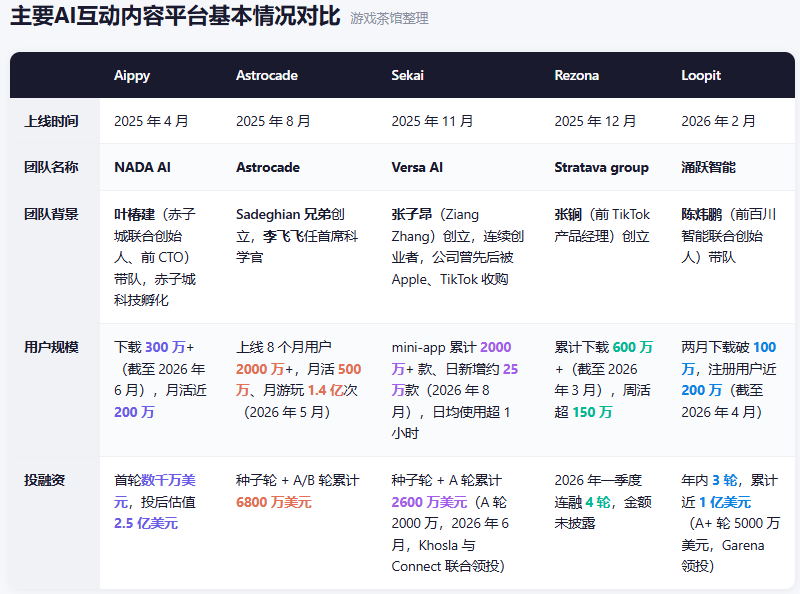
Table created by: WorkBuddy
The collective frenzy of capital has made the outlook for the “AI game generation platform” sector appear exceptionally promising. But beneath the hype, each product makes its own trade-offs in terms of underlying positioning, content direction, and technical approach. To determine which one most closely resembles a “next-generation content platform,” we need to take a closer look at each product individually.
01
What Will the Next-Generation Content Platform Look Like?
The platforms mentioned above have all been labeled by the public as the “gaming version of TikTok” or “a playable Douyin,” a characterization that very clearly summarizes their product formats.
When users open the platform, they can scroll up and down through a familiar single-column feed to refresh the content and immerse themselves in a wide variety of lightweight mini-games and interactive experiences. At the same time, using the platform’s built-in AI creation tools, they can quickly produce new interactive content and publish it on the platform for other users to play and experience.
Although they follow the same approach, there are still some subtle differences among these apps in terms of specific content focus and user experience.
Among several apps, Astrocade is the one that focuses most on the “gaming experience.”Here, users can discover lightweight versions of various popular game genres, such as tower defense, RPGs, survival games, tycoon simulations, and parkour games. For example, *Eat the World*—created by a platform user based on the “black hole devouring” gameplay mechanic—has amassed a total of 3 million plays.
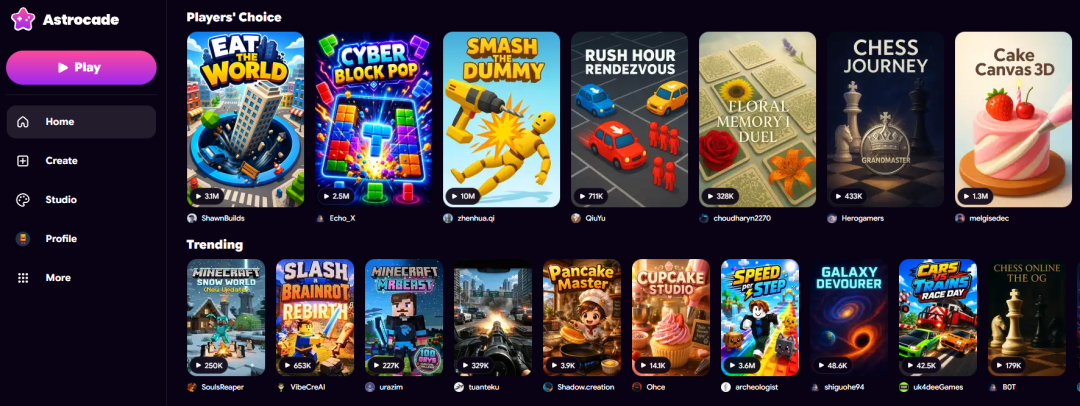
Aippy, Sekai, and Loopit offer a much wider variety of content formats.
In addition to a variety of casual mini-games, Aippy also features a wide range of interactive content, including interactive memes, creative visual art, ASMR sensory experiences, and AR filters;The Sekai platform, meanwhile, has given rise to a large number of “mini-apps” in various formats, including visual novels, personality quizzes, interactive Q&As, prank games, and interactive cards.
Chen Weipeng, the founder of Loopit, has even stated outright in numerous interviews that their goal has never been merely to create a “game platform,” but rather to encourage users to explore the app’s true limits on their own.As a result, the platform’s content spans an extremely broad spectrum—from prank games to real-time multiplayer battles to serious expressions of environmental themes—covering virtually every conceivable form of “interactive” content. The platform officially categorizes this content into seven categories, including “Fantasy,” “Immersion,” “Filters,” “Art,” and “Games,” with “Games” being just one of these subcategories.
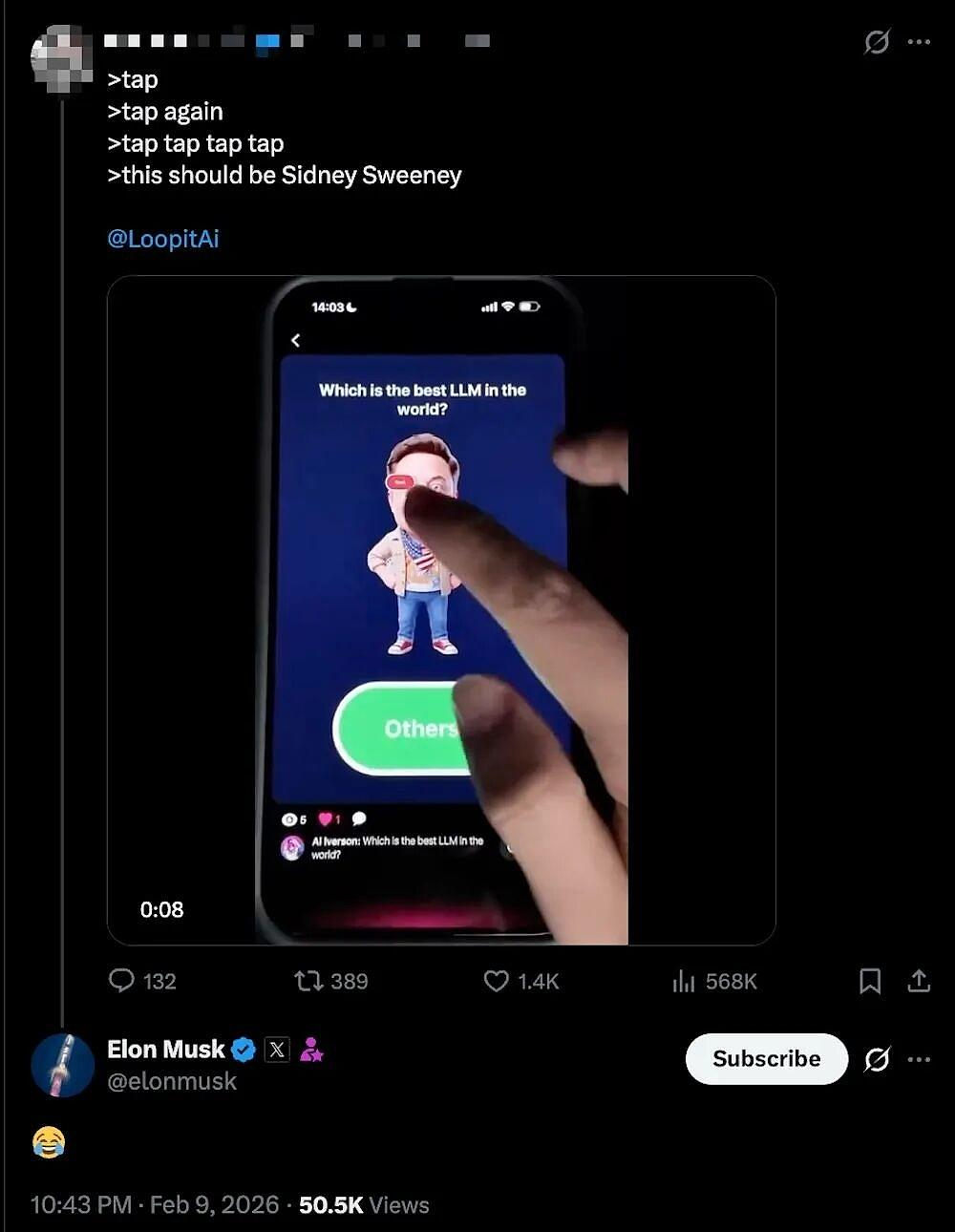
Loopit, Which Musk "Gave the Thumbs-Up To"
Rezona, on the other hand, takes a more specialized approach, narrowing its content strictly to a single theme—memes.The ingenuity of this choice lies in the fact that viral memes come with a built-in shared context: users can mentally fill in the complete background just by hearing a single line. Creators don’t need to build a worldview or narrative logic from scratch; they simply need to set up an interactive framework to trigger laughter;At the same time, viral memes possess extremely strong social virality; after experiencing them, users will actively share them with others, effectively providing a built-in growth engine.
Furthermore, centered around the theme of trending memes, the Rezona platform has spawned a diverse range of interactive formats: these include prank content that can be experienced in just a few seconds—such as answering an AI-generated prank call—as well as interactive short skits with branching choices, and even AR interactions and 3D scene exploration—works that border on casual gaming;What’s even more interesting is that the platform can even accommodate various logical bugs generated by AI, since “memes” and “mishaps” can themselves become selling points.

At the same time, to ensure a steady stream of content for their platforms, several platforms have adopted a UGC approach—that is, they have launched AI-powered content creation tools that allow all users to participate in content creation.
With the help of AI tools, several platforms are able to achieve "creative output through natural language," though there are still significant differences in their actual user experiences.
Among these, Astrocade offers the most “professional-grade” development capabilities, with its most distinctive feature being the three-pane Studio editor: the left pane displays the dialogue and generation history, where users can continuously issue modification commands using natural language; the middle pane is a playable game preview window; and the right pane is the parameter adjustment panel.For ordinary users with no development experience, getting started is very simple: just click “Create” to begin. When inspiration is lacking, users can click the “Inspire Me” button to choose from various game concepts suggested by AI, quickly generating a playable game.
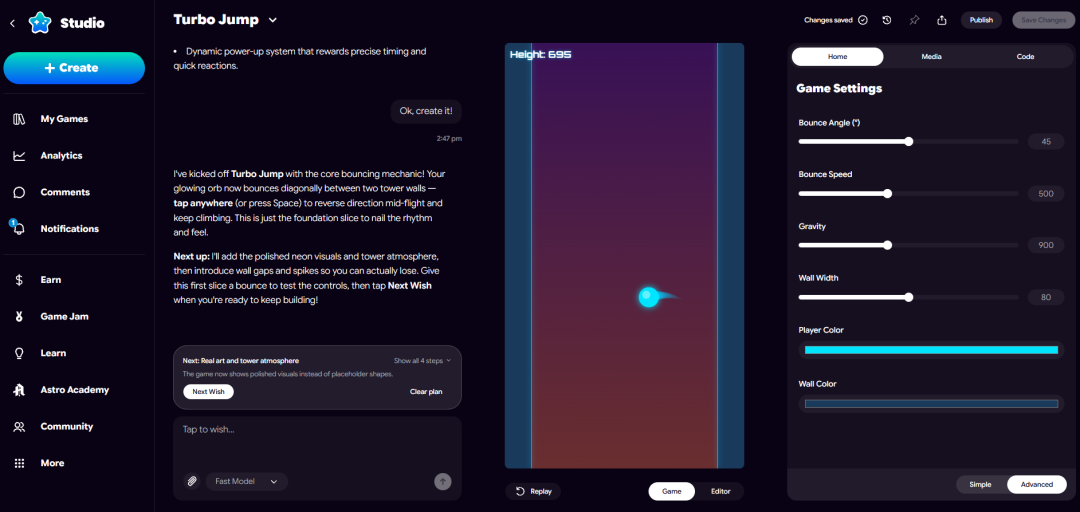
Furthermore, Astrocade is the only platform among several that offers both Simple and Advanced modes in its settings panel.In Simple mode, users can directly adjust various game parameters through a visual control panel; Advanced mode, on the other hand, provides direct access to detailed underlying code, allowing users to modify the code to customize the final presentation of their projects. This also means that professional developers can fully leverage their expertise to create more polished game content.
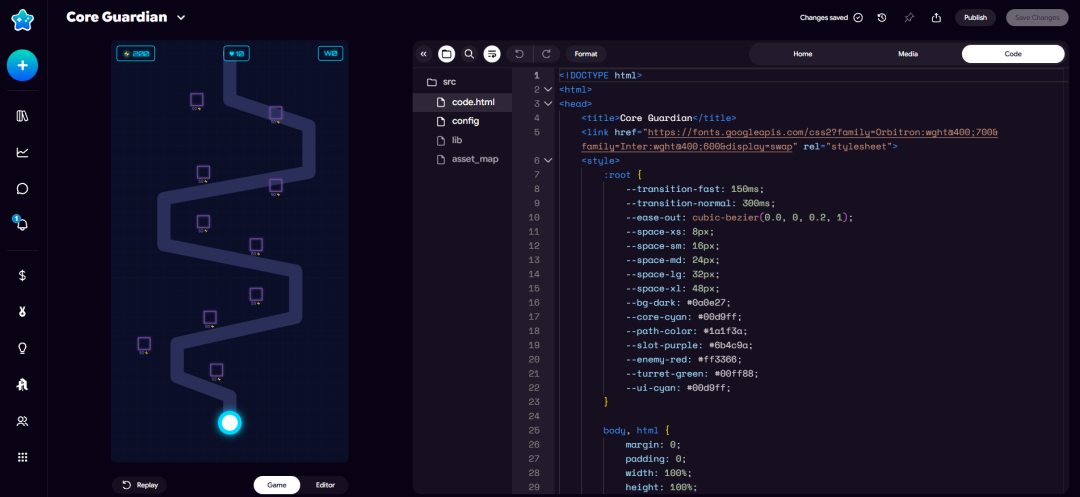
Astrocade Advanced Code Interface
However, the trade-off is that content production is relatively slow. According to Tea House’s tests, creating a simple mini-game typically takes 3 to 5 minutes;For complex projects with multiple levels and basic 3D content, it can take 7 to 10 minutes, and during peak hours when computing power is in short supply, wait times may be even longer.
Rezona’s creation tool takes “simplicity” to the extreme. Users enter the creation page, type in a natural-language description, and after waiting about one minute on average, receive a playable, interactive piece.During this process, the platform uses AI to automatically generate meme-style character art, chibi-style avatars, background music, and UI backgrounds, while also automatically creating basic game rules—such as victory conditions and scoring systems—to ensure the work’s fundamental playability.
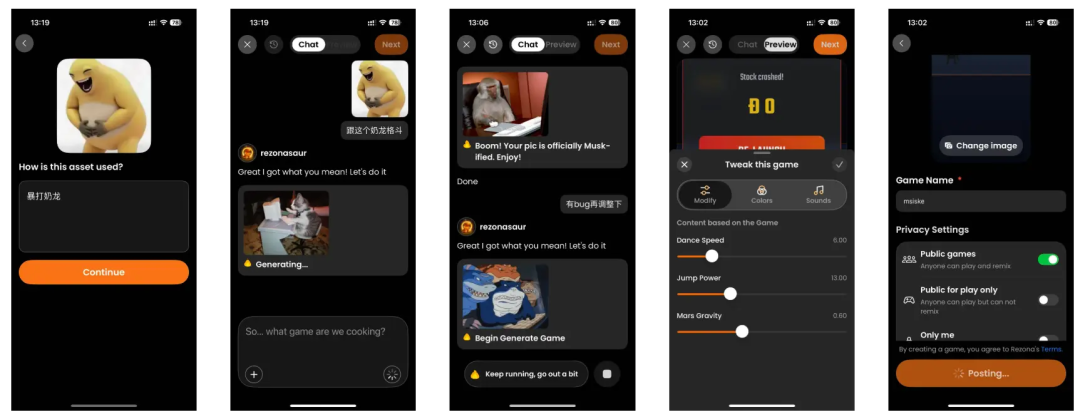
However, its shortcomings are equally glaring: it has the weakest editing capabilities among the five platforms. The lack of a visual parameter panel and support for code editing means users cannot make real-time, localized modifications to the final output. If they want to adjust the results, they must rewrite the prompt and have the AI regenerate the entire output.
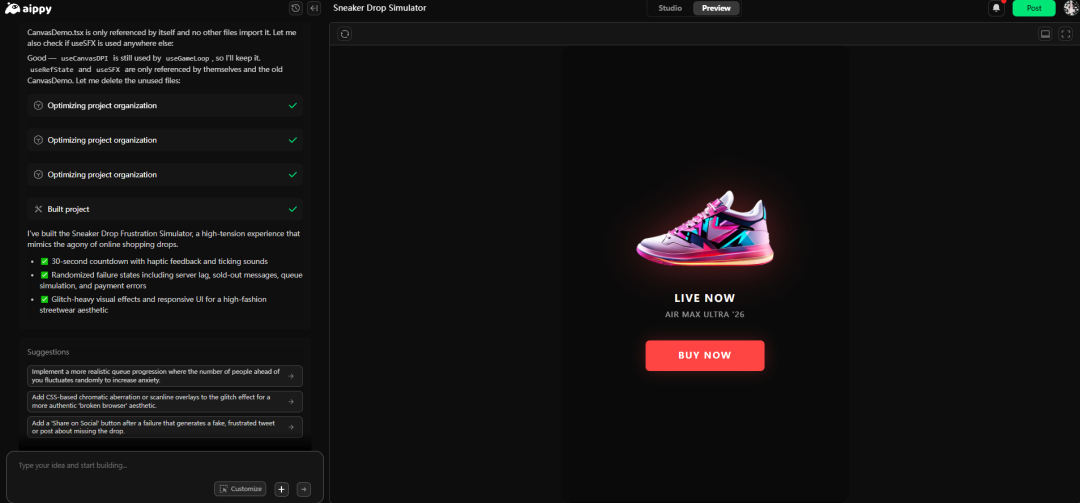
Aippy’s editor falls somewhere in between. Its creation interface features a dual-pane real-time editor structure with input on the left and a preview on the right; users enter creation and modification commands on the left, while the preview pane on the right displays the changes in real time.Although the platform promotes a “natural language + visual editing” creation model, its visual editing capabilities are actually limited. Creation remains primarily driven by natural language, and generation speed is relatively average, with works typically completed in just 3 seconds to 3 minutes.
Loopit’s most distinctive feature is its full utilization of the hardware interaction capabilities of end devices. Creators need only provide a natural language description, and the AI automatically configures sensor logic to access the gyroscope and accelerometer, recognizing the phone’s shaking and tilting motions;Using the microphone, it enables breath-activated and voice-controlled gameplay; it can also access the camera to facilitate air gestures, facial expression recognition, and AR interactions. When interactions extend to the body and the physical world, the possibilities for content will expand exponentially.

Image source: Investment Circle
Objectively speaking, the content currently produced by these platforms is still relatively lightweight; most of it consists of mini-games, prank-based interactions, and meme-based games that can be consumed in a matter of minutes, and it’s still a long way from being a “complete game product.” Even on Astrocade, which markets itself as a platform for “polishing games,” the mainstream content is still primarily 2D casual games.
However, as content formats have shifted from “watching” to “playing,” this hands-on sense of participation has demonstrated an appeal that other content formats struggle to match. The rapid growth in both user base and content volume serves as the most direct evidence: Aippy has surpassed 3 million global downloads, with monthly active users approaching 2 million;Astrocade surpassed 20 million users within 8 months of launch, with monthly play sessions reaching a staggering 140 million; Sekai has produced over 20 million mini-apps to date; Rezona has surpassed 6 million cumulative downloads;Loopit’s global registered user base also reached nearly 2 million within two months.
02
The Final Challenge: Revitalizing the Community Ecosystem
Of course, regardless of a platform’s positioning and infrastructure, it is ultimately the users themselves who determine whether the platform can continue to operate. Furthermore, these platforms’ differing self-identities and content orientations also determine the differences in their target audiences.
Based on interviews and user feedback, Rezona has shown the most significant success in targeting specific user demographics. The platform’s highly specialized meme culture creates a high barrier to entry, resulting in a user base primarily composed of young, heavy internet users who love making memes and pulling pranks.The other platforms cater to a broader general audience. Counterintuitively, both Astrocade and Loopit target young women as their core user base; these users enjoy spending their free time on such apps, taking personality quizzes or participating in interactive Q&A sessions, and then sharing the results with friends,and then, once everyone has finished, they gather to compare results and discuss how accurate they are.
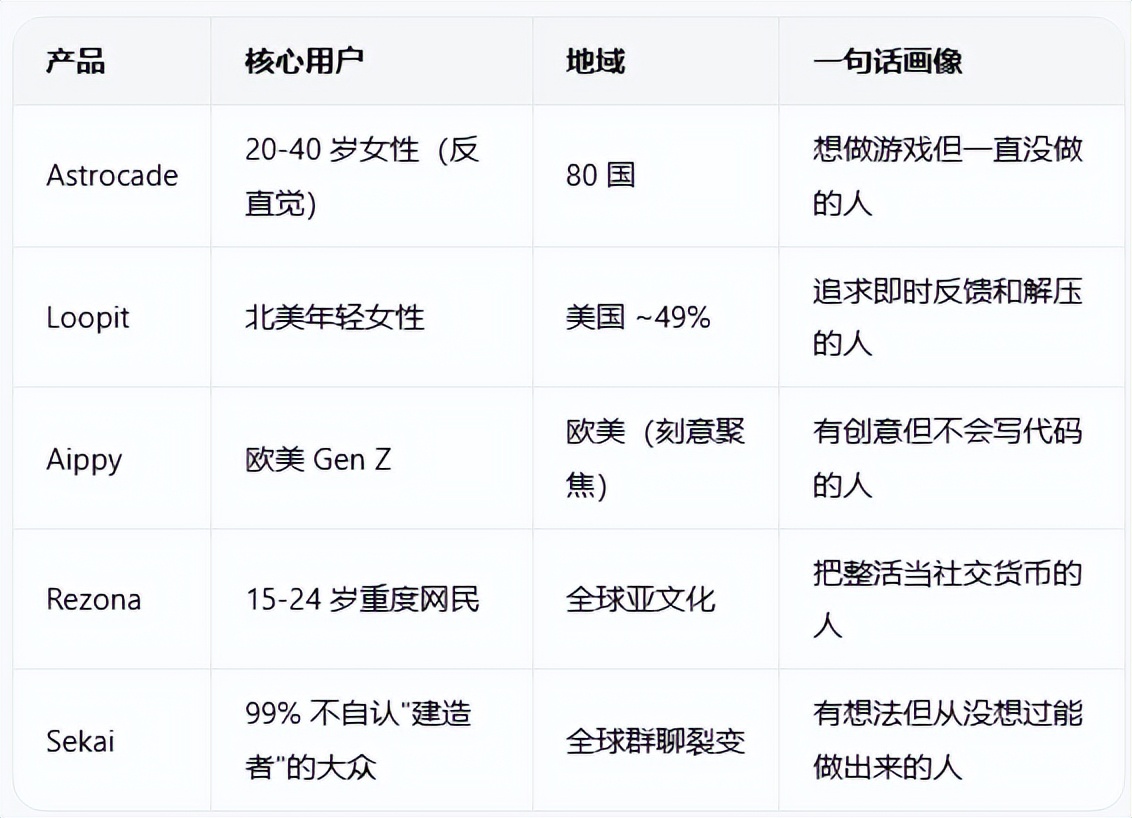
Core User Demographics for Several Platforms; Table created by WorkBuddy
All things considered, none of these five platforms are competing for actual gamers; instead, they’re targeting people who scroll through Instagram, share meme images, exchange memes in group chats, and have ideas but never imagined they could be realized. It’s safe to say that their true competitors have never been Steam or Roblox, but rather TikTok and Instagram.
Therefore, what ultimately determines how far these platforms will go is not merely the strength of their AI-generated content, but whether they can cultivate a genuine community ecosystem.
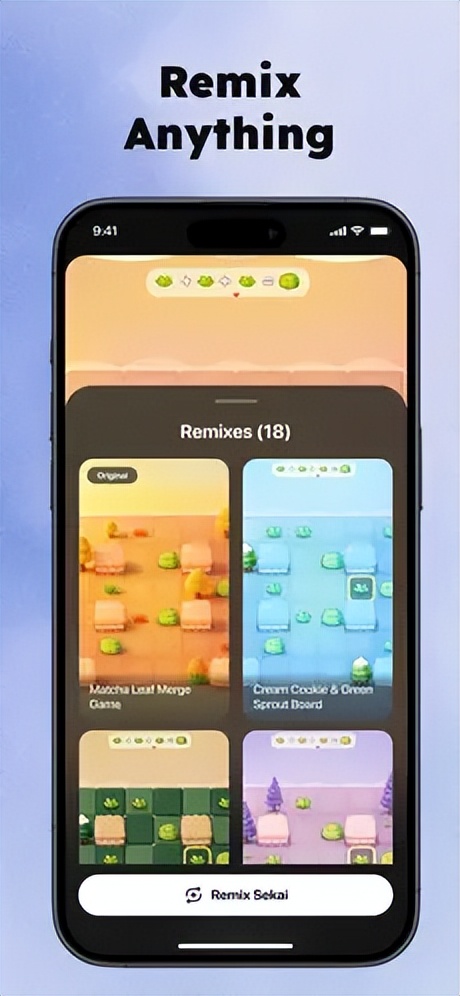
To stimulate community engagement, all five platforms have adopted the same core mechanism: “Remix.”
"Remix" refers to the platform's built-in "one-click remix" feature.When users come across an interactive piece that interests them, they can click the “Remix” button to inherit the original work’s gameplay framework. After entering new creative instructions, they can generate a derivative version and publish it. This lowers the barrier to entry from “conceiving a complete work from scratch” to “modifying someone else’s creative work.”
Driven by the Remix mechanism, a popular piece of content can inspire more users to create, quickly transforming them from one-way content consumers into content creators, who then take turns producing more similar content;If a particular derivative version goes viral again, it, in turn, becomes a new “source,” attracting more users to continue creating derivative works based on it, thereby generating a “person-to-person” diffusion effect. From this perspective, the logic is actually very similar to the “recreate the look” trend that has long been popular on TikTok/Douyin.
The Aippy team believes that the Remix rate is the key metric for measuring whether a community ecosystem can sustain itself, and has designated it as the platform’s North Star metric—rather than the commonly used DAU.According to data previously disclosed by Aippy, approximately 40% of the platform’s content comes from Remixes. Remixes generally receive higher quality ratings than the original works, and the retention rate of Remix users is significantly higher than that of regular users. This demonstrates that the Remix mechanism is indeed highly effective in expanding the platform’s content pool and energizing the community.
Other platforms also place great emphasis on building out their Remix mechanisms. Sekai has made Remix a top-level entry point, allowing players to “make a copy” at the drop of a hat; the Rezona website even goes so far as to describe Remix in the feature overview section with the blunt slogan: “Steal it. Change it. Make it cursed.” (Steal it, change it, and make it go wild).Astrocade has even designed a dedicated “family tree” traceability mechanism for this purpose. Every time a player creates a derivative work, the source of the original is recorded and linked to the original work’s title. This allows players to trace who has modified the game and how many derivative versions have been created.
But content provision is only the first step. Remix has turned casual users into creators, but how can we ensure that those who are capable of creating content are willing to keep doing so? The approaches taken by the five companies can generally be categorized into three strategies.
The first approach is to directly convert creative output into revenue; so far, only Astrocade has successfully implemented this model.The platform has allocated a $10 million creator fund. Creators whose works are officially selected for the Feed’s recommended stream receive a $100 listing bonus, followed by ongoing revenue shares based on “active plays.” Combined with weekly cash prizes from Game Jams, Astrocade has built a comprehensive pathway for creators to “make money through creation.”According to official figures, creators’ cumulative earnings last year exceeded $50,000. Some games developed in just a few days generated over $700 in a single month, while top creators even earned several thousand dollars a month.

Only creators who have reached 100,000 valid plays within 30 days and have published at least 3 works under their account are eligible to participate in revenue sharing.
The second approach is to “buy” content using cash prizes and contracts. Aippy regularly holds content creation contests with cash prizes and signs paid collaboration agreements with creators whose work goes viral; these are one-time incentives, and the content itself does not generate ongoing revenue.
The third approach is to explore an entirely new path. IP created by Sekai creators can be registered on the blockchain, allowing them to collect royalties by granting others permission to use it—“You earn licensing fees when others use your IP”—which is a completely different approach from Astrocade’s model, where “you earn a share of the revenue based on the number of players who play your game.”
Once the question of where the content comes from has been resolved, the next question is how to ensure that more of it is seen.
For all content platforms, algorithmic recommendation is a technical hurdle that must be overcome. This is especially true for UGC platforms: since they advocate that “anyone can create,” they need a distribution system that ensures “anyone can be discovered.”Otherwise, if traffic is disproportionately funneled toward top-tier content—leaving the vast majority of works without exposure—the platform’s creative ecosystem will be rendered impossible.
Currently, Aippy and Astrocade have each made their own attempts at algorithmic recommendations.Aippy follows an "human quality control + engineering-driven traffic distribution" approach: it first uses a quality scoring system to assess content quality, then relies on multiple recommendation pools—operating in parallel through preference-based retrieval, popularity-based retrieval, collaborative filtering, and exploratory retrieval—to determine which users receive which content.
Astrocade, on the other hand, employs an "AI Understanding + Learning-Based Ranking" approach: while shifting the core metric from "click-through rate" to "effective play rate"(Significant Play Rate) to assess user experience, and on the other hand, using AI to directly analyze the content characteristics of new games from their source code. This information, combined with in-depth behavioral data from established games, is fed into a learning-based ranking model that becomes increasingly accurate with each gameplay session to determine content distribution.
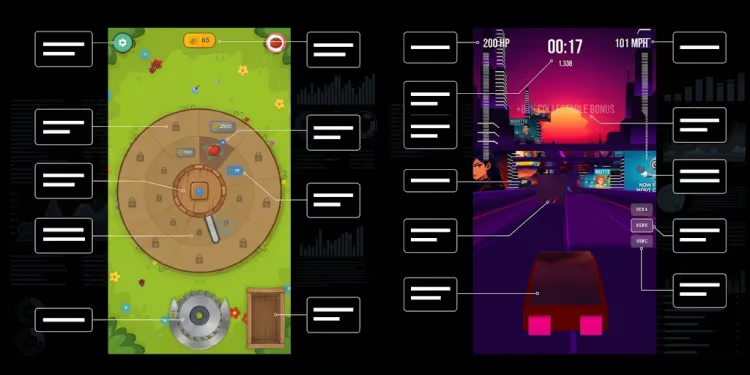
Image source: Astrocade Blog
In addition to being discovered by more users through the platform’s algorithms, most platforms also allow content to be shared outside the app with family and friends. Loopit offers the most comprehensive sharing options: creations can be directly exported as GIFs or videos to be posted on other social media platforms to drive traffic, or users can generate unique links or QR codes so that more people can play them with a single click.Astrocade, Rezona, and Sekai also support the creation of shareable links, allowing users outside the platform to experience the content directly; Aippy, however, is the only platform that offers neither external links nor export functionality, meaning content can only be viewed within the app.
However, none of these platforms currently support the export of standalone game packages. This once again confirms that they are by no means game development tools, but rather content platforms.
This also means that creators here can do more than just create content; more importantly, they can use that content to connect with others.Therefore, in addition to the standard Remix, Feed, and sharing features, Astrocade has also introduced a dedicated “Multiplayer” feature: once a game is created, you can share a link; friends can click on it to join the same game session—whether for head-to-head competition, team challenges, or just playing together. With accompanying leaderboards and social chat,Instead of simply being added to a portfolio, a finished game becomes a social platform that can be launched at any time—making creation a genuine part of social interaction.
03
Answers awaiting verification
BlueRun Ventures, which has invested in Loopit’s parent company, Yongyue Intelligence, once stated in an interview: “Every epoch-making technological innovation reshapes the way humans access information and find joy, and also creates enormous business opportunities.”
From this perspective, the emergence of these AI-powered interactive content platforms is an inevitable product of our times. As AI technology gradually matures, it has elevated the scope of experiences that content platforms can deliver to a new level; “interaction” is no longer limited to “likes” in video comment sections but is now directly embedded within the content itself.This unprecedented experience is more than enough to fuel investors’ vision for the “next-generation content platform,” making it easy to understand why this sector has garnered such widespread interest from investors.
However, it’s still too early to say that these apps have carved out an entirely new market segment. After all, to this day, not a single platform has truly become self-sustaining.
Aippy is the only platform that truly opens up a payment channel to users, but what it sells is still AI-generated quotas, which essentially amounts to recovering computing power costs: According to industry estimates, under current technical solutions, the monthly token consumption cost per active user ranges from approximately $1 to $20.Other monetization models, such as IAA and IAP, are still in the planning and exploration stages.

Aippy's Billing Structure
Several other platforms, including Astrocade, Rezona, and Sekai, have not yet officially launched their commercial operations. Loopit officials have stated outright that they will not begin commercial operations until their user base reaches a critical mass.
When a platform’s revenue comes entirely from investors rather than users, the flip side of this frenzy of “fierce competition for capital” is that all players are crammed onto the same money-burning track, competing to see who can survive until the day their business model pays off.
The outcome of this exploration remains to be seen, but one thing is becoming clear: this sector has no shortage of funding or enthusiasm—what it lacks is a proven “monetization model.” Perhaps whoever is the first to provide this answer will have the opportunity to become the benchmark for the “next-generation content platform.”
Sources:
https://www.astrocade.com/blog/hardest-recommendation-problem-in-tech
http://www.astrocade.com/blog/how-game-creators-are-turning-creativity-into-cash-on-astrocade
https://www1.hkexnews.hk/listedco/listconews/sehk/2026/0722/2026072200334.pdf
https://mp.weixin.qq.com/s/tpGIgh2tIlACNv_x-5STSw
https://new.qq.com/rain/a/20260806A0686C00
https://36kr.com/p/3769178374390535
原创文章,作者:游茶妹儿,禁止转载:https://youxichaguan.com/en/archives/219524