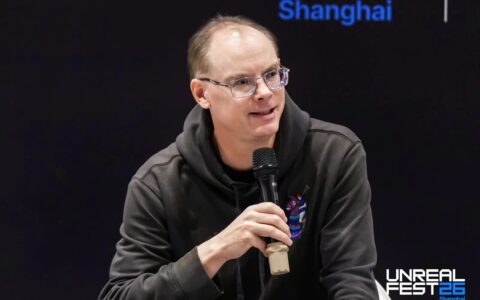
Ohtani Spitzer has made headlines several times in his life.
He is one of the earliest indie game developers in China and also serves as a lecturer at NYU Game Center.He creates videos sharing his insights on game development and digital art, and has over 160,000 followers on Bilibili; in 2020, he used AI to restore century-old Chinese footage, which was shared hundreds of thousands of times and caused such a sensation that it was even covered by CCTV News.Later, in 2023, he and his wife created an indie game demo featuring native AI gameplay titled *AI Yandere Cat Girl Simulator*, which they released on itch.io. In less than a month, it garnered 20 to 30 million views—and went viral once again.

In 2023, just as the potential of AI games was beginning to be recognized and capital was rushing to get a head start, *AI Yandere Cat Girl Simulator* earned Otani 10 million in investment.He used this money to assemble a team, then developed *AI2U: With You Until the End of the World ~ My Yandere Cat Girl AI Girlfriend* (hereinafter referred to as *AI2U*) into a full-fledged game and released it on Steam.

In AI gaming research reports produced by some investment firms, *AI2U* is often cited as a “first-generation hit.” Platforms such as VG Insights estimate that *AI2U* sold approximately 50,000 copies on Steam.Shortly after its release, several friends working in AI research at major companies mentioned *AI2U* to the Teahouse Editor, noting that it was one of the few titles at the time that gave AI a “substantial presence” in the game—a distinction that remains rare even now, in 2026.
The gameplay is somewhat similar to an escape room: you’ve been locked in a room by your yandere girlfriend, and you need to find a way to escape. The difference is that, in addition to searching the room for items, you’ll need to interact with your AI girlfriend to uncover many of the clues.

You can cook with her, play games, and whisper sweet nothings—the large language model allows her to recognize your behavior and speech. As your bond grows stronger, she may open up to you, and her words will hold clues.It could be a little puzzle, a string of codes, or perhaps, once unlocked, you’ll discover a secret room in the house where her deepest, most hidden secrets are kept—depending on the conditions you trigger, each level can lead to a different story ending.
Compared to many games that feature AI as their main selling point, *AI2U*’s flow experience still bears some resemblance to traditional games, with a series of level mechanics, rules, and objectives driving you forward.But you can also sense that the core element linking and driving all of this is still your interaction with your AI girlfriend; without the AI component, the game’s appeal would simply fall apart.
This also reflects the shift in his philosophy over the years as he’s been developing AI games. Otani told Teahouse that, at first, his approach was the same as many others’: “What can we create by simply integrating AI technology into traditional gameplay?” But he now believes that the foundation of “AI + games” is far more complex than that.
“AI doesn’t spell the end of the entire gaming industry; rather, it unleashes the power of imagination,” said Otani. This refers not only to creative imagination but also to imagination regarding game production and content formats.
In addition to continuously refining the EA version of *AI2U* until its official launch, over the past year or so, AlterStaff has used AI to completely reimagine the game development process, making it possible to generate ideas rapidly and validate concepts instantly—a development that has fundamentally reshaped our understanding of the game development pipeline.
At GDC, Otani showed me several of their new demos—ideas that emerged from internal brainstorming sessions—one of which centers on gameplay where players take on the role of a game designer who can “generate games with a single click,” much like in *TapTap Maker*, and then run a game company similar to *Game Development Nation*.Another demo features a micro-horror livestream theme, where players explore a 3D map as a streamer, and real-time comments generated by a large language model steer the game in different directions.

You can try out some demos of AlterStaff at alterstaff.itch.io
These demos all seem to be heading in different directions from *AI2U*, but Otani feels that they all share the same underlying theme: establishing a complex connection between the player and one or more AI characters, and then discovering new sources of gameplay motivation.
The following is a transcript of the conversation between Tea House Guy and Da Gu. (Some content has been edited to enhance the reading experience.)
01
A Multi-Talented Artist Makes a Splash in the World of AI
Game Teahouse: Let’s talk about how it all began.
Otani: Let’s start with my Bilibili channel. My channel is called “Otani’s Game Creation Studio,” and it’s been around for about ten years. I used to be a solo developer, so I basically did everything myself—music, programming, art, and so on.From middle school through college, I’ve been making my own games. Back in 2012, I created a game called *Eddy Zi*, which was one of the earliest indie games in China. At that time, the concept of “indie games” was practically nonexistent in China.I’d post my work on “Independent Planet,” which was an indie game forum in China at the time. Many early indie game developers had their own sections there—people like some of my friends from Yedao Games, as well as the founders of CiGA and WePlay later on. We all got to know each other around that time.
Since I do a little bit of everything, I’ve always wanted to share my development experiences—like what I’ve learned about art and music—so I started a Bilibili channel. I also share stories and trailers related to *Eddy Zi*, so I’ve continued to post content like that ever since.
Game Teahouse: I’ve checked out your channel, and I see you’re always the first to cover technologies like 3D printing, AI music, and AR/VR. Did you get into AI earlier than most people?
Ohtani: It probably has to do with habits I developed growing up. When I first started making Flash games, I was actually interested in everything and was always thinking about combining different things. So, from piano and painting to programming and all kinds of new technologies, I was constantly learning about everything.
I first came across AI around 2019. At the time, I heard that artificial intelligence was a fairly new technology that could significantly boost efficiency in personal development, which sparked my interest in learning about it and creating videos to share my knowledge. Around that time, I started looking into neural networks, large language models, and other related topics.My first foray into AI was image generation—technologies like StyleGAN—exploring what it could generate, such as anime-style female avatars.
These early technologies actually had very limited capabilities. But even back then, I could sense the vast potential they held. So I’ve always been eager to see just how far they’ll be able to expand in the future.I’ve experimented with using AI to compose music, and later, in 2020, I worked on AI-based image restoration, restoring black-and-white images from the Qing Dynasty. That project actually gained quite a bit of attention at the time.
By 2023, I believe the technology had finally matured enough to allow me to truly create what I wanted to—the turning point came when ChatGPT opened its API, enabling me to integrate this capability into game engines like Unity.
While working on *Eddy Purple*, I always loved the feeling of everyone creating content for the game together.*Eddy Purple* is a linear side-scrolling platformer with a fairly limited storyline, but players would draw fan art and write fan fiction for me, then share them on forums. I found that process incredibly interesting—it felt like we were all building the game’s world together. So I’ve been waiting for a technology that could truly bring that feeling into the game itself.
Game Teahouse: And that’s how the idea for *AI2U* came about.
Otani: That’s right. By March 2023, my wife and I had spent three weeks creating the very first demo of *Yandere Cat Girl AI Girlfriend*, which we released on itch.io. It quickly went viral, racking up about 20 to 30 million views within three or four weeks of launch.After that, we officially decided to turn it into a startup project and develop it into a full-fledged game. Starting in July and August of 2023, we began moving forward with the project in earnest.
Game Teahouse: Was the team also gradually put together around this time?
Ohtani: One of the core members of our early team was an old friend I’ve known for over a decade. He worked as a programmer at Microsoft, where he was among the first to encounter technologies like Copilot, and he also had a strong interest in gaming. He later joined our team and was primarily responsible for the server-side components.
Our other members are scattered all over the world, with most working remotely from here in the U.S. Some are former students of mine from New York University; I look among my students for designers and illustrators who are interested in new technologies and methods. In addition, I cast a wide net on various freelance collaboration websites. We currently have sixteen members.
Game Teahouse: Turning a personal hobby into a real business likely involves significant costs and decision-making pressures along the way.
Otani: Back when I was making games on my own, I could do anything I wanted, but the development cycle was very long. For example, it took me two and a half years to make *Eddy Purple*.Now that we’ve reached the AI stage, the technology is very new, and I actually have a lot of ideas I want to bring to life. If I were still working alone on a single project for two or three years, I’d feel like I wouldn’t have enough time to realize many of those ideas. That’s why we need a team at this point—by working together, we can create more fun things much faster.
Plus, when you work alone, it’s easy to get stuck in a rut and spend a long time without making any progress. I also think that having more friends with specialized expertise to help out is actually the best way to bring those ideas to life quickly.
Game Teahouse: What are the typical backgrounds of the other members, and what criteria do you usually use when recruiting?
Otani: Our team members generally have backgrounds in game development and design. Many have majors in fields like game design and programming. For example, our lead designer graduated from the NYU Game Center. That program offers a fairly comprehensive game education, covering programming, art, and design, though it places a greater emphasis on design overall.
When I’m hiring, I place a lot of emphasis on self-motivation. Since AI games are still in their very early stages, everyone is still exploring—it’s impossible to expect people to “really understand AI games” right from the start. What we’re really looking for are people who are willing to delve deeply into things and embrace new ideas.Take our lead 3D artist, for example. She used to do 3D modeling at a home decoration company, but she was really passionate about creating 3D anime-style characters. So we gave her an opportunity to start as a freelancer, where she gradually demonstrated her passion and creative ideas. Now she’s one of our core team members. I think, more often than not, it’s about discovering passionate people like this and bringing them together.
02
Seeing the Storm of Change in "New Tools"
Game Teahouse: The reason I asked the previous question is that many AI game development teams in China place a strong emphasis on technical backgrounds—for example, they insist on hiring people with strong research backgrounds and solid technical skills. You, however, don’t seem to place as much importance on these factors.
Otani: I think when it comes to “how to make good AI games,” everyone is still in the exploratory phase. So what’s really in high demand are creative talents. Of course, we also do foundational model training and develop new technologies, but that’s not our main focus.We’re primarily focused on the application side, so our need for purely research-oriented talent isn’t that great. Plus, as a small company, recruiting AI researchers from Silicon Valley would come with very high salaries, which isn’t really suitable for a game development team like ours.
Game Teahouse: OPC—One Person Company—is all the rage right now. Do you think it’s still necessary to form teams to get things done in the age of AI?
Ohtani: I believe that, ultimately, humans will still be in control of AI. Of course, there’s some talk now that in the future, entire companies might be run by AI agents, but that’s not very realistic at this stage. So while we’ll certainly be using AI extensively ourselves, I think the real key is this: AI should amplify your professional capabilities, not replace you.
In my view, AI is essentially just a tool. It’s just like when I switched from Flash to Unity back in the day. At first, in Flash, I had to write a physics engine with gravity and jumping functionality all by myself—it might have taken me a month. But in Unity, I could just check a few boxes and have the entire physics engine at my disposal. That really blew my mind.So the impact that AI later brought wasn’t, for me, some completely incomprehensible change—it was more like the arrival of a new tool that I could use to create even more fun things.
Game Teahouse: How are you currently using AI?
Otani: Let’s break it down by function. We have a dedicated project initiation team that works very quickly on game design, using tools like Google’s Gemini Studio. When a designer comes up with a gameplay idea, they can produce two or three relatively simple prototypes in just a day or two. This allows us to turn ideas into playable versions very quickly.We then evaluate these ideas, assign them ratings at different levels, and assign them to teams such as the art team for further development.
But when we actually decide to start a project, we revert to a more traditional process and build the framework manually first. We can discuss with the AI how to structure the code and identify the major function blocks, but when it comes to actually writing the framework, that’s still done by humans.
At this stage, it’s not realistic to complete the entire project using Vibe Coding.The entire framework must be designed with maintainability in mind, and only programmers who understand the code can fully grasp exactly what changes the AI has made. However, when it comes to debugging or developing small tools for end-user features—such as creating a special window or implementing effects like freezing or AOE for a specific tower in a tower defense game—these tasks can be handled by the AI.
Overall, our use of AI is mainly focused on the early and mid-stages, where we work on prototype development and exploration. Players are discerning, and we can’t just slap together a hundred games using Vibe Coding and hope that one or two of them will become hits—players demand high-quality content.
Game Teahouse: What about the art?
Ohtani: It’s very similar. We use AI for brainstorming in the early stages. There are several reasons for this. First, AI’s aesthetic sense is still far inferior to that of humans. It can help you generate 10,000 levels and 10,000 storylines, but it can’t tell you which one will truly move players to tears—that judgment still requires a human touch. The same goes for art.
During the early exploration phase, we’ll have the AI quickly generate some rough drafts and mood boards. If we have a new game design idea and want to get a sense of what the final visuals might look like, we can feed it rough Unity screenshots and 2D character concept art, and have the AI generate a scene of a streamer playing the game.Watching the streamer explore the scene and scream in fright—this lets you quickly determine whether the concept’s vibe is just right.
For example, before submitting requirements to our art outsourcing partners, we’ll first feed our 2D objects and character designs into certain tools to generate a 3D rendering that closely resembles the final look.For example, we’ve previously used tools that convert 2D to 3D space. The artists would first draw the 2D scene, and once it was imported, the tool would quickly generate a navigable 3D space, allowing us to verify whether the overall direction was correct.
Technologies like AI 3D still face significant limitations at this stage and are primarily limited to the prototype phase. However, at this year’s GDC, I saw some new technological breakthroughs that may lead to new application scenarios in the future.I’ve also tried AI-generated music composition, but I still believe that truly good music must convey emotion. For example, when I composed the soundtrack for *AI2U*, I tailored the instrumentation to the specific game scenes and visual style—details that AI currently struggles to grasp intuitively and accurately.
Game Teahouse: So, to summarize, are you still primarily relying on AI-generated content to improve efficiency in the early and mid-game phases?
Otani: It’s similar, but not exactly the same. Actually, the more we use AI, the busier we’ve become. I think this isn’t just us—a lot of people feel this way now. That’s because prototype iterations are happening much faster.In the past, it took two or three months to build a prototype, but now we have daily prototype meetings. The planners in charge of prototyping typically present one or two projects almost every day, and we discuss them together, provide feedback, and move forward with the next phase of development.
As a result, everyone came up with more and more ideas, and many of the things we wanted to do were quickly brought to life. So, rather than feeling like things have become “easier,” I actually feel “busier.” It’s actually quite fascinating, and we’re still adjusting to it—we’ll see if a more mature workflow emerges in the future.
Game Teahouse: You’ve mentioned many limitations of AI technology, but you still strongly believe in the potential of AI-native games.
Ohtani: Yes. I think it brings a whole new set of tools to the entire gaming industry, allowing you to create many things that weren’t possible before—even entirely new game genres built from the ground up. That in itself is incredibly exciting.
Game Teahouse: "AI2U" is exactly this kind of new game genre.
Otani: Our perspective has also been evolving. Back in 2023 and 2024, our thinking was still along the lines of, “What can we achieve by integrating AI technology into traditional gameplay?”But later, I realized that this line of thinking was fundamentally flawed. As development progressed, we gradually shifted toward our current approach: rather than writing a bunch of decision rules and state machines to dictate what the AI should do, it’s more like building a stage.
Both players and AI characters are actors. You need to set up the stage and arrange the interactive elements so they can perform all kinds of improvised scenes within it. When it comes to interaction methods, text-based input alone has significant limitations. That’s why we’ve since placed greater emphasis on interaction.For example, after the *AI2U* update last year, one of our most popular features was that if your AI girlfriend really likes you, she’ll come over and hug you on her own. It doesn’t even require text prompts—it triggers whenever the mood is right. You can experience very intimate interactions in a 3D space. This kind of experience has a powerful impact on players.

At first, we might have thought that if we simply placed an AI character in a virtual space, it would naturally make many decisions on its own. But later we realized that we actually needed a “director system.”The biggest challenge here lies in how to set up this stage: determining what the AI characters see and understand, while also keeping costs under control. All of this requires extensive exploration. So the overall development approach is actually quite different from that of traditional games.
Game Teahouse: What Exactly Is the “Director System”?
Ohtani: That’s something we’ve learned along the way. This system combines AI with traditional front-end and back-end technologies; it incorporates both state machines and behavior trees from traditional game AI, as well as large language models.
Its purpose is to let the AI character know what stage the story has reached. You can think of it this way: the AI cat girl always has an earpiece in her ear, and the director in the background tells her in real time where the player is in the story and what she should do next to go along with the player’s actions.
For example, a player might leave the cat girl in the living room while they head to the game room to rummage through boxes and cabinets. The front-end first determines: Can the cat girl see the player right now? If she can’t, that means the player is out of her line of sight, so we switch to the auditory system.The system will determine what sounds the player is making—such as rummaging through boxes or fumbling with keys—and then synthesize this information into a narration-style description, which is sent to the Cat Girl’s “headphones”: “The player is searching for something in the game room; I can hear the sounds of rummaging through boxes and keys clinking…”
Taking the current stage of the game into account—for example, whether the player has obtained the key—should the Cat Girl suspect that the player is trying to escape, or have you two been chatting quite happily, with your relationship entering a more comfortable phase? She’ll use this information to decide her next move on her own.If she doesn’t trust the player, she might sneak up behind them, have the director cut the music, and then, knife in hand and eyes ablaze, demand to know what they’re doing; if she already trusts the player to some extent, she might sit on the living room couch watching TV and call out, “I’ll be waiting here for you—come over when you’re done.”
With this system in place, the character will feel much more intelligent; she won’t just be an AI agent wandering aimlessly through the environment without a goal of her own.
Game Teahouse: So, in your opinion, what is the core appeal of AI games?
Otani: I think the key is still how to truly integrate AI—this core technology—into the gameplay.In the past, we used to think, “If we patch AI onto a traditional gameplay mechanic, can we create something new?” But now I’m more concerned with whether we can create an experience in this era where players don’t just fight bosses, clear levels, and achieve traditional objectives—but instead establish some kind of complex connection with one or more AI characters.
Our core idea is that *AI2U* isn’t just a “game with AI features”—it’s a “game that simply wouldn’t work without AI.” As you explore the environment, you gradually uncover her story, interact with her, and try to persuade her—and in the end, you might even escape together.Throughout this process, you’ll actually develop a deep understanding of your AI girlfriend. In fact, some players have even reported that after chatting with the AI character in the game, they’ve found themselves better able to communicate with others in real life. I think this is what makes the gameplay in *AI2U* so unique. Traditional games lack this kind of unique relationship dynamic.
Game Teahouse: As of 2026, there still isn’t a single AI-native game on the market with truly compelling gameplay. Why do you think that is?
Otani: Essentially, it’s because everyone is still in the exploratory phase—this takes time to mature. In fact, this is often the case with many new technologies when they first emerge. For example, when 3D technology first appeared, people initially just replaced existing 2D content with 3D versions; there weren’t any real breakthroughs in gameplay.But later, with games like *Super Mario 64* or *The Legend of Zelda*, which truly transformed elements like targeting, combat, and movement in 3D space into new gameplay mechanics, people realized that 3D wasn’t just about “looking three-dimensional”—it actually introduced a whole new set of ways to play games.
It’s the same with VR. At first, everyone wanted to create open-world experiences, but they ended up causing severe motion sickness. It wasn’t until later that people gradually realized that various interactions within small spaces were actually better suited for VR. The same goes for touchscreens: initially, they were just digital versions of traditional joysticks, but later games like *Angry Birds* and *Fruit Ninja* truly integrated touchscreen technology with gameplay.I think AI is still at this stage right now; it needs time to find the gameplay paradigm that truly suits it.
Game Teahouse: So, everyone is still waiting for a benchmark.
Otani: Right. Someone needs to set that benchmark first. I hope we can at least serve as a “catalyst” to spark further innovation.We realized fairly early on that combining 3D characters with a 3D environment was really interesting, and after playing, players do say that it’s unlike anything they’ve played before—it can’t simply be categorized as a traditional escape room game. I think this already shows that this direction has the potential to evolve into a new genre.
Game Teahouse: How can we find this benchmark more quickly?
Ohtani: It’s still the same philosophy: don’t just make a “game with AI features”; instead, think of a “game that simply wouldn’t work without AI.”
Traditional games are more like bonsai—they’re exceptionally refined, with predetermined paths and storylines, but the moment you stray from that path, you’ll run into an invisible wall—or nothing at all.AI is more like an environment where things emerge spontaneously—a bit like a forest. But it’s impossible to truly create an infinitely generated open world; the workload would be too immense. So the key lies in determining which elements allow for emergence and which must be predefined. That’s the area developers need to explore.
For example, if you create a fully realized 3D space in *AI2U*, but then the cat girl mentions to the player during a conversation that there’s a basement downstairs—even though there isn’t one in the game—the player will feel very frustrated.That’s not a good implementation. But if you allow for some reasonable creative freedom within the game—for example, if the cat girl can draw with you and actually understand what you’ve drawn; or on the mermaid island in Level 4, when you sit by the campfire with the mermaid and chat, and she tells you stories about her ancestors;or when you’re building a raft or constructing a structure, she watches you work and hands you wood and tools—these are excellent examples. That’s because these are instances of creative freedom that align perfectly with the game’s setting, theme, and art style.
For example, one of our players actually told the Cat Girl, “I know the computer password. Why don’t I know it right now? Because we’ve been reincarnated many times in this virtual world.” At first, the Cat Girl didn’t believe him, but following this line of reasoning, she finally had a moment of realization and blurted out, “Then let’s escape together!”This experience works because the player’s thoughts align seamlessly with the game’s setting, art style, and theme. Striking the right balance here is actually incredibly important.
03
After connecting people with one another, we can create a “connection” between humans and AI
Game Teahouse: Aside from continuing to develop *AI2U*, what have you been focusing on these past few years?
Otani: While we continue to optimize *AI2U* as our main focus, we’ve also been exploring many prototypes, some of which will be incorporated back into *AI2U*.For example, in the area of drawing, we worked on a project called *Nightmare Company*. It’s a multiplayer AI drawing game for three players, with a theme somewhat similar to *Monsters, Inc.*—you play as employees of a company that creates monsters to scare children in their dreams.The system tells you what the child is afraid of—for example, spiders. Each of the three players is responsible for a section of the canvas; you start by sketching a simple outline, then let the AI help you refine and complete the monster. Finally, the child is also an AI that judges just how scary the monster you’ve created really is.

There’s also an undercover player here whose goal isn’t to scare the kids, but to make them laugh.He can see what the kids like—for example, if they love bees but hate spiders—so during voice chats, he’ll try to convince everyone to draw the spiders a bit more yellow, or secretly draw his own part to look like a bee. This kind of gameplay actually involves multimodal recognition.Later, we also applied this technology to *AI2U*; for example, in certain rooms, you can draw alongside a cat girl, and she can see and evaluate your drawings.
For example, we also have a horror game called *Streamphobia*, where players take on the role of a streamer and must interact with their live audience by reading the chat. The audience reacts to your actions and may even assign you tasks. If you don’t listen to them, they’ll influence what happens in the 3D environment—and might even send monsters to scare you.What we want to see is how AI dynamically changes the game content—not just a chat box that has no impact on the game if it’s removed. That’s not what we’re aiming for.

We also created *Launch! Game Development Bureau*. The gameplay is somewhat similar to TapTap Maker, but we integrated the concept of “AI helping you make games” into the game mechanics themselves.In the game, you play as a game designer who’s being manipulated by their boss—you have to meet deadlines, manage projects, and pitch the game to investors and get it listed on platforms. This way, even if the AI-generated game is a bit rough around the edges, it’s no longer a problem. Because that “roughness” itself becomes a source of humor—it actually works in the game’s favor.

We are also exploring some local large-model technologies; for example, the speech recognition in *AI2U* is implemented using a local model that’s about 40 to 50 MB in size.
Game Teahouse: So, in a way, is “AI2U” also something like your “technology platform”?
Otani: You could call it a “semi-platform.” There are some new technologies and gameplay mechanics we want to experiment with—if we feel they align well with the companion experience and don’t interfere with the main storyline, we’ll incorporate them into *AI2U*. On the one hand, it’s a flagship product; on the other hand, it does serve as a platform for some of our prototype experiments.
We’re also working on some new projects right now.Right now, we’re actually trying to further refine the “AI Director System” we developed for *AI2U* to see if we can use it to create a world with a bit more freedom. Of course, it won’t be an infinitely open world, but rather a new project with more reasonable boundaries and greater freedom. We already have some ideas in this direction, and development is underway.
Game Teahouse: If we were to summarize the experience of *AI2U* as “companionship,” do any of your subsequent prototype projects share a more unified central theme?
Ohtani: I don’t think the core of *AI2U* is entirely about emotional companionship. I’d rather describe it as “forming connections.”
In *AI2U*, it’s more about how you connect with a virtual character you didn’t know before—someone from another world—get to know her, and then escape from that world together. Ultimately, whether you develop feelings for her is up to the player to decide.
The new project we’re working on right now is actually centered around “connection.” What kind of gameplay can help players form a more unique connection with these AI entities?Take *Streamphobia*, for example—it’s about your connection with the AI audience in the game; in the drawing game where you scare kids, it’s about your connection with your artwork and the AI child; and in the game development agency simulator, it’s about your connection with your boss and other players. We’ve actually always been revolving around this theme of “connection.”
Game Teahouse: Compared to the period when you were working on *AI2U*, how has your approach to exploration changed?
Ohtani: Our overall approach has actually become clearer. When we work on projects now, we still start by drawing inspiration from everyday life and topics that interest us—we check whether the concept designers are interested and whether we ourselves are interested. Then we take a step back and ask: Does this idea absolutely require AI to work? If so, we’ll move forward with it. As a result, the gameplay styles are quite diverse, covering all kinds of directions.
Game Teahouse: As one of the first producers to pioneer AI-native gameplay, what advice would you give to other developers?
Otani: I don’t think AI will spell the end of the entire gaming industry; rather, it will unleash our imagination. So we need to shift our mindset and stop approaching game development in such a traditional way. Instead, let’s look at it from a different angle and ask, “What can AI make possible?” That’s a question we can all ponder.As for me, we’ll continue to delve deeper into this area in 2026. I think the most important thing is to stay curious and keep creating.
原创文章,作者:游茶妹儿,禁止转载:https://youxichaguan.com/en/archives/215521