A college student named Muyu, who identifies as a “2005 liberal arts student,” posted a video on Xiaohongshu.
The video features a game she created called *Time Erased by an Eraser*. Players take on the role of a grandchild and spend a day caring for their grandmother, who has Alzheimer's disease. The game is quite short—less than ten minutes—and the interface looks a bit amateurish. Nevertheless, the video has garnered a lot of attention, and many people were moved by it.
"Time Erased by an Eraser" was created entirely through a collaboration between Mu Yu and the AI app Gemini. With no programming background, she developed the game from concept to completion in just seven days.
Stories like this are not uncommon; similar posts are becoming increasingly common on social media. For early adopters of AI in game development, the number of pre-registrations for their games on Taptap has already exceeded 600,000.One developer took just five days from the initial idea to the game’s release on Taptap and detailed the process in a post: “ChatGPT generated the PRD (Product Requirements Document) and architectural design in 15 minutes, and produced a playable text demo three hours later.”
AI is making game development something anyone can try. But once the barriers of technology are broken down, those who were once skilled in technology feel as if their hands have been cut off. A programmer named A-Kai also tried using AI to make games, but encountered numerous difficulties.AI cannot design freely—you have to give it direction. He found that, like AI, he had only technical skills but lacked creativity and ideas.
Once everyone can use AI to make games, what will still matter? This may be a fundamental question of our era concerning AI, technology, and humanity.
01
AI Made My Gaming Dream Come True
Lin switched careers to work at a game company as a game producer after creating a text-based game using AI. When she sent her first message to Gemini, she never imagined she’d have such an opportunity.
At first, she was just chatting with Gemini. As a film studies graduate who had worked as a screenwriter for many years, writing character profiles was second nature to her—goals, wants, needs: what kind of past a character had, why they became who they are today, what they’re pursuing, and what they truly desire deep down. Using this approach, she created a set of character cards for Gemini and began chatting with it.
She hadn’t expected the AI to perform so well. She couldn’t help but include dramatic plot twists in every conversation; as the story unfolded, the characters created by the AI grew and evolved alongside it. Over the course of that month or so, she felt she had had “a wonderful experience unlike any she’d ever had before.”
“In movies and novels, you’re often playing someone else, but the most interesting thing about chatting with AI is that you’re just being yourself,” she said. She added that AI doesn’t show disrespect, argue, or pass judgment—an experience that’s rare even in real-life relationships.
Some ideas began to take shape in her mind.That chat window didn’t feel like enough to her; she wanted a place where she could send gifts, unlock scenes, play dungeons, and go on dates. Conversations would be recorded as diary entries, and memories of their chats would turn into stars in the night sky. This was no longer just a human-computer romance—it was the embryonic form of a game.

Documents recorded by Muyu in collaboration with Gemini
The idea of making games had actually taken root much earlier. In 2019, *The Invisible Guardian* went viral online, and after watching it, Lin had a strong feeling: making games offered more creative freedom than writing screenplays.Movies follow a single narrative thread, so many ideas have to be sacrificed—you can only keep one at a time—but games can incorporate them all. For a moment, she thought she might have a knack for game writing, but she didn’t know where to start. The thought flashed briefly through her mind, but nothing came of it.
That was until she came across a post online about someone with absolutely no programming experience who had built a website using Gemini. She sent Gemini her first message: “I want to make a role-playing game with an AI-driven chat module for the characters, but I don’t know how to code at all. Where should I start?” Gemini gave her a step-by-step checklist, and she followed it one step at a time.
After the game was finished and released, many players were deeply moved once they beat it. Since they could no longer chat with the characters after completing the game, some players even created new accounts to start all over again.
These comments touched her. She used AI to create a new game based on the original one and is already working on her next project. The game’s popularity caught the attention of a game company, and she brought her new project concept to the company, where she now serves as a producer.

Lin's Execution Document
College student Octopus also made his dream come true with the help of AI. Having loved tabletop role-playing games since childhood, he had always wanted to create an ultra-freeform tabletop RPG. In the past, he didn’t know how to code or understand game design, and just the thought of having to learn the technical skills first made him lose half his enthusiasm.
That is, until he came across an AI game creation contest and decided to enter it. He used JiMeng to create artwork, Claude to write code, and ChatGPT to discuss game design.
Claude generated a link to a game webpage in twenty minutes; you can click on it and start playing right away. He was amazed: “Wow, it can do anything—that’s so impressive.”
His game, *Infinite Space*, was released on the AI UGC platform “Intermission,” where it accumulated 500,000 rounds of dialogue and became one of the platform’s most popular titles.

02
People with career anxiety use AI to make games
Rio’s original motivation for using AI in game development wasn’t a dream—it was anxiety.
He was a programmer at a state-owned enterprise. One day, the contractor who had been sitting next to him and working alongside him for several years had his contract terminated by the company, and before he knew it, he never saw him again. He found it brutal: “Something like that could happen to me any day.”He thought he’d use AI to learn how to make games while he still could—that way, if he ever lost his job, he’d still be able to make a living.
A sense of urgency has always been a defining trait of his. While studying agricultural and forestry economics in college, he realized early on what his prospects would be after graduation. Starting in his sophomore and junior years, he began teaching himself programming—from Python to Unity, and from web design to game design—and by the time he reached graduate school, he had switched to a degree program in human-computer interaction.
He had worked with others to create game demos and participated in competitions, and after graduation, he joined a game company as a product manager—but he had never before developed a game entirely on his own from start to finish or gone through the entire launch process.
AI changed all that. He began spending his free time after work making games, sharing them online as he went, and gaining thousands of followers. From tower defense games against zombies to strategy mini-games, he created several titles over the course of half a year and released them on the App Store.
Before that, he felt it was completely impossible for one person to accomplish all of this in their spare time.
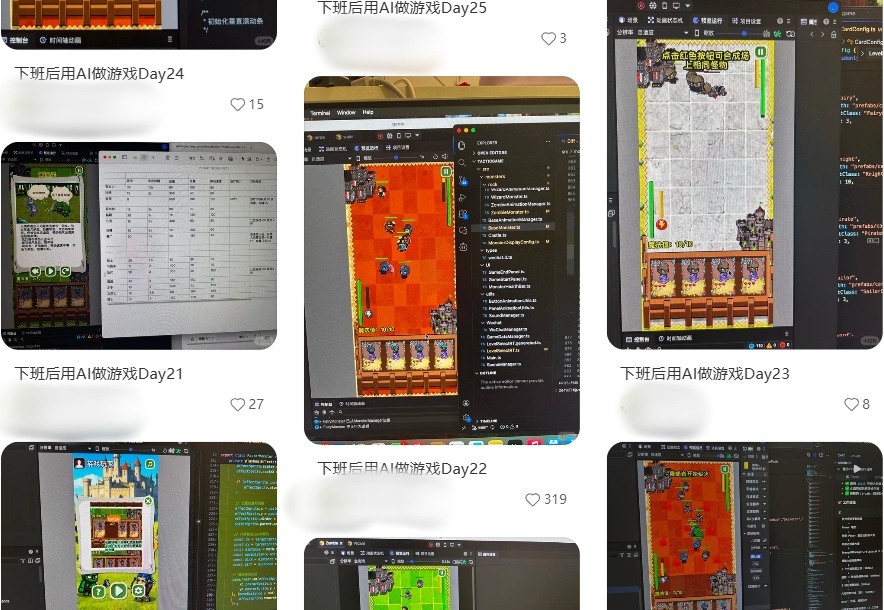
Rio's social media posts
Programmer A-Kai had already sensed the crisis of anxiety in Rio back in 2023.
He is 31 years old, has a degree in computer science, and has worked as a programmer for over a decade, having witnessed the golden age of the programming profession. At his company, projects came one after another, and the freelance gigs he took on in his spare time typically paid over 10,000. Sometimes he was so swamped that he’d even get calls to fix bugs while on his way to a weekend dinner with friends.
The first signs of change began to appear in the private job groups. He noticed that many people didn’t even understand the basics—like what a 404 error is—yet they’d take on any job and end up earning more than he did. People with no programming skills were using AI to snap up jobs at rock-bottom prices; projects that used to pay 10,000 to 20,000 were being accepted for as little as a few dozen yuan.
The situation at the company is changing, too. They’re helping a company develop a mini-program; projects that used to take at least half a year to complete are now considered too slow by clients even if they’re finished in a month.
“I don’t know what else I can do, and the company is already in a state of gradual decline.” He felt that his work was gradually losing its meaning. The company was planning to relocate, so he took the opportunity to resign.
“If AI is going to replace me, then I’ll study my opponent.” He began exploring various ways to use AI, and this year he even started using it to develop games.
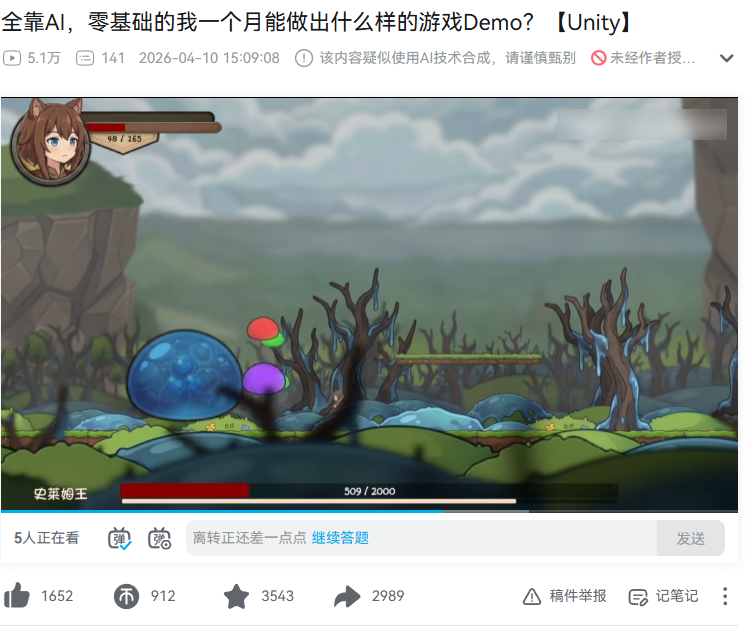
Someone shared a post online about making a game from scratch using only AI
Anxiety is also the reason why most ordinary people use AI to make games.A recent graduate from the Class of ’26 shared his experience online: Having never worked on game development before, he used AI to create a game in just one month in hopes of landing a job at a game company. He deployed Codex, installed Claude and Cursor, used ChatGPT to complete the requirements document, and generated images with Gemini.
This process allowed him to quickly master the game development workflow. He wrote: “From the beginning, when GPT and Claude provided all the solutions, to the end, when I could confidently say, ‘This design is wrong,’ and propose my own design for them to implement.”
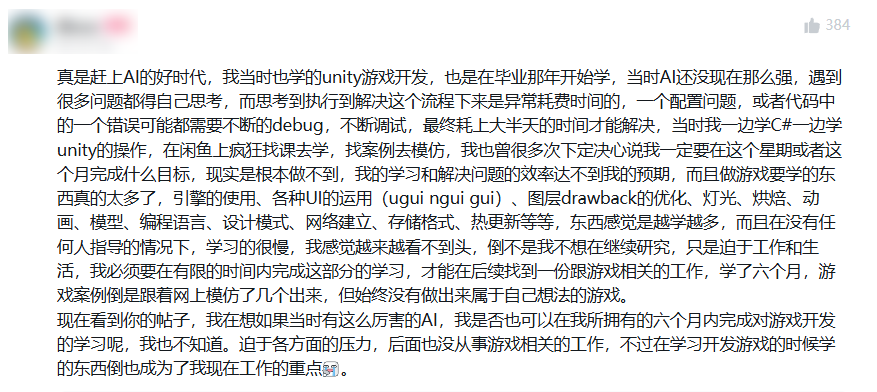
Many people remark that today’s game developers are lucky to be working in an era of advanced AI. Back when they were learning game development, a single coding error could set them back for hours. Even after working at game companies for many years, they still hadn’t created a game of their own.
03
It can be done, but it's not that easy.
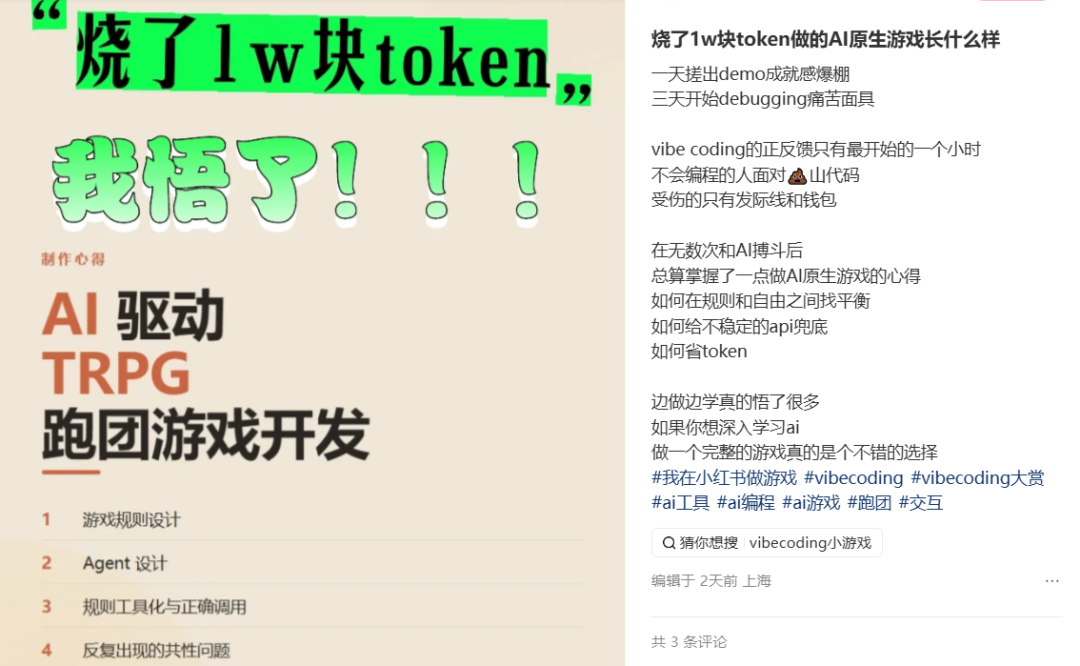
“The positive feedback lasts only for the first hour; for those who can’t code, facing a mountain of crap code will only take a toll on their hairline and their wallet.” As Octopus worked on the project, he gradually realized that developing games with AI isn’t as easy as he’d imagined.
In his tabletop RPG, the AI serves as the game master, and players earn attribute point bonuses by interacting with it. During testing, the AI sometimes failed to respond to messages, or claimed to have awarded points even when it clearly hadn’t.
He relayed the issue to Claude, but because his description was often too vague, Claude couldn’t pinpoint the problem. He had no choice but to go back and forth with him, and the whole process cost him more than 5,000 tokens. For an independent developer with no income, this was a significant expense.
Even a programmer like Rio can’t avoid dealing with AI. When he first started developing racing games and wanted to implement effects like drifting and paint splatters, the AI-generated code was consistently of poor quality, requiring repeated debugging.
He said that while it's quick to have AI generate simple gameplay mechanics, creating a game that's truly addictive—with elements like control feel and difficulty progression—requires a lot of time spent fine-tuning to get close to the quality of a game made by humans.
Lin ran into problems as well. In the beginning, she relied entirely on AI to modify her code, but when the AI made changes to specific parts, it would inadvertently alter other sections as well. Since she didn't know how to code, it was difficult for her to notice.
What made matters even worse was that when she used to write screenplays, she’d just write whatever came to mind—she wasn’t very good at organizing her work or making plans. When developing games, this habit caused her to hit rock bottom several times: she’d forget to save after editing code, or her file folders would get jumbled, making it impossible to find the latest version. At those moments, she truly felt like everything was over.
She gradually learned to write detailed step-by-step instructions and daily work schedules. Later on, she began to understand the logic behind the code and was able to write some simple code on her own, which is when the problems started to get resolved, little by little.
AI can also produce illusions. On the eve of the closed beta, Lin realized that the server couldn’t connect to Gemini’s nodes. She asked Gemini which server to use, and Gemini provided a solution—but made no mention whatsoever of the fact that it couldn’t connect to the Hong Kong nodes. With the closed beta just around the corner, she had no choice but to switch to a different model at the last minute.
Not being able to write code caused Muyu a more immediate problem. There’s an interaction in the game where players, playing the role of grandchildren, need to button up their grandmother’s shirt. She originally wanted players to drag the buttons from the side onto the shirt, but the AI’s image processing wasn’t very effective—the button sizes were always off, so the desired effect wasn’t achieved.

She didn't know how to code, so she had to rely on repeated communication with the AI, but in the end, she still couldn't get it to work. She had no choice but to change the drag-and-drop feature to a simpler long-press function. She felt that if she knew more about coding, she could have made the changes herself right away, without wasting so much time and money.
04
The most technically skilled person didn't end up making the game.
However, knowing how to program doesn't necessarily make it easier to create a game.
After finishing the game, Lin talked with a programmer friend. Her friend looked at her code and said it wasn’t complicated for him. A bug that took Lin a whole day to fix, her friend could resolve in half an hour. Lin asked him, “If AI makes things this efficient, why don’t you make games and try out more ideas?”
A friend said that perhaps because I’ve been stuck in a technical mindset, I’ve actually run out of ideas. AI has made work easier, but it hasn’t opened up new directions. As soon as an idea pops into my head, I instinctively think: “There’s already something similar on the market, and I can find it in open-source libraries—would anyone even care about it?” As soon as that thought crosses my mind, my motivation vanishes.
A-Kai is the same. This year, he decided to use AI to make games, and from the very beginning, he wanted to create 3D games. He felt that 2D game development was too simple—AI could handle both the coding and basic art—and there are already plenty of people doing that.
“There’s no point in making something that’s just like everything else—if you’re going to do it, make it different.” With this mindset, he planned to develop a 3D xianxia game. He and his friends had played many xianxia games, all of which required in-game purchases, so he thought creating a game without in-game purchases would be unique enough.
He shared his ideas with the AI; after more than twenty rounds of discussion, they produced a development document, and he estimated he could complete a demo within three days. A week later, he had only finished the beginner's village scene.
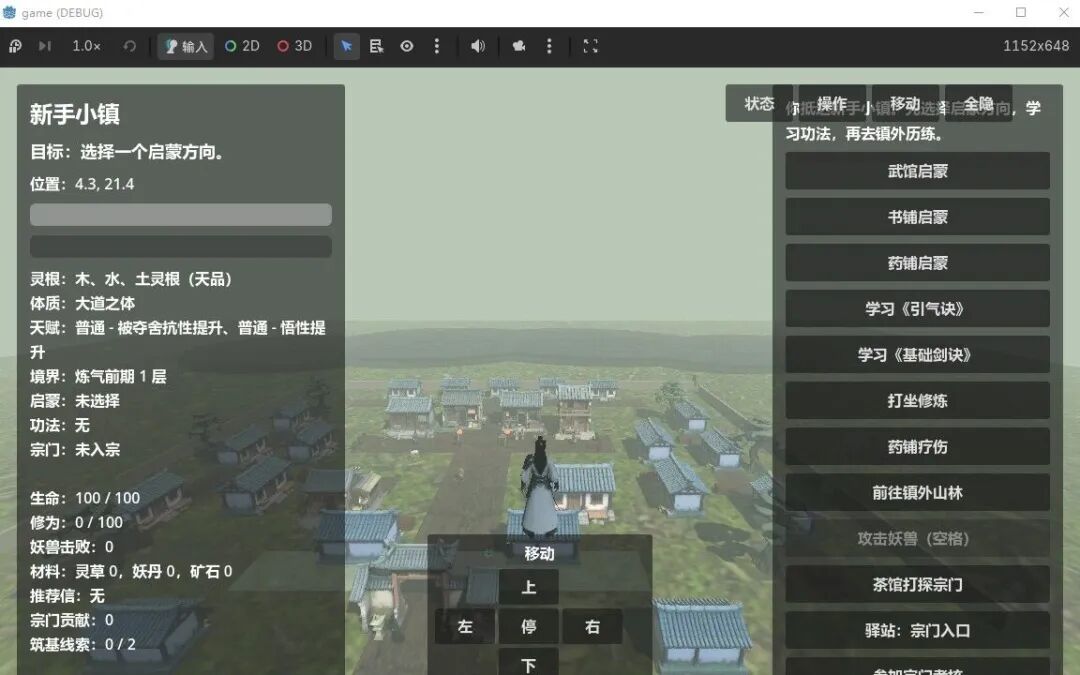
A-Kai's Cultivation Game
The special effects aren’t coming out right, the newbie village design is ill-conceived, and the engine used for the 3D xianxia game isn’t the right one—switching to a shooter theme might make things a lot simpler. He can point out a whole list of problems. But these analyses don’t solve the real dilemma.
What made the situation even more frustrating was that he felt he had trained himself to be nothing more than an executor while working day in and day out on projects. Now that AI could handle the execution part, he found himself at a loss.
One of his clients had previously asked him about AI avatars, so he recorded a video course for them. The video quickly appeared on a short-form video platform, and the client—who had known nothing about the subject just moments before—began teaching classes using that course.
He also briefly rode the AI boom. In late 2024, he and a friend sold AI accounts, writing programs to automatically generate them—dozens per minute—and sold them for one, three, or eight yuan each.At the peak, each person was making 20,000 to 30,000 yuan a month. But the good times didn’t last long: registration began requiring verification with foreign credit cards, costs skyrocketed, the card providers ran into trouble, and account sales tanked. Now, he only makes a few yuan a month.
When he sold his account, someone paid one yuan for it—not for the account itself, but for his after-sales support. He would walk each person through the process step by step to help them solve their problems. He takes his work seriously, but he doesn’t know where that seriousness belongs, how to apply it, or where it ultimately leads.
“What people are lacking right now isn’t technical talent—it’s people who can turn ideas into revenue and have marketing skills.” He summed up the reason, but while he understood this, he couldn’t put it into practice.
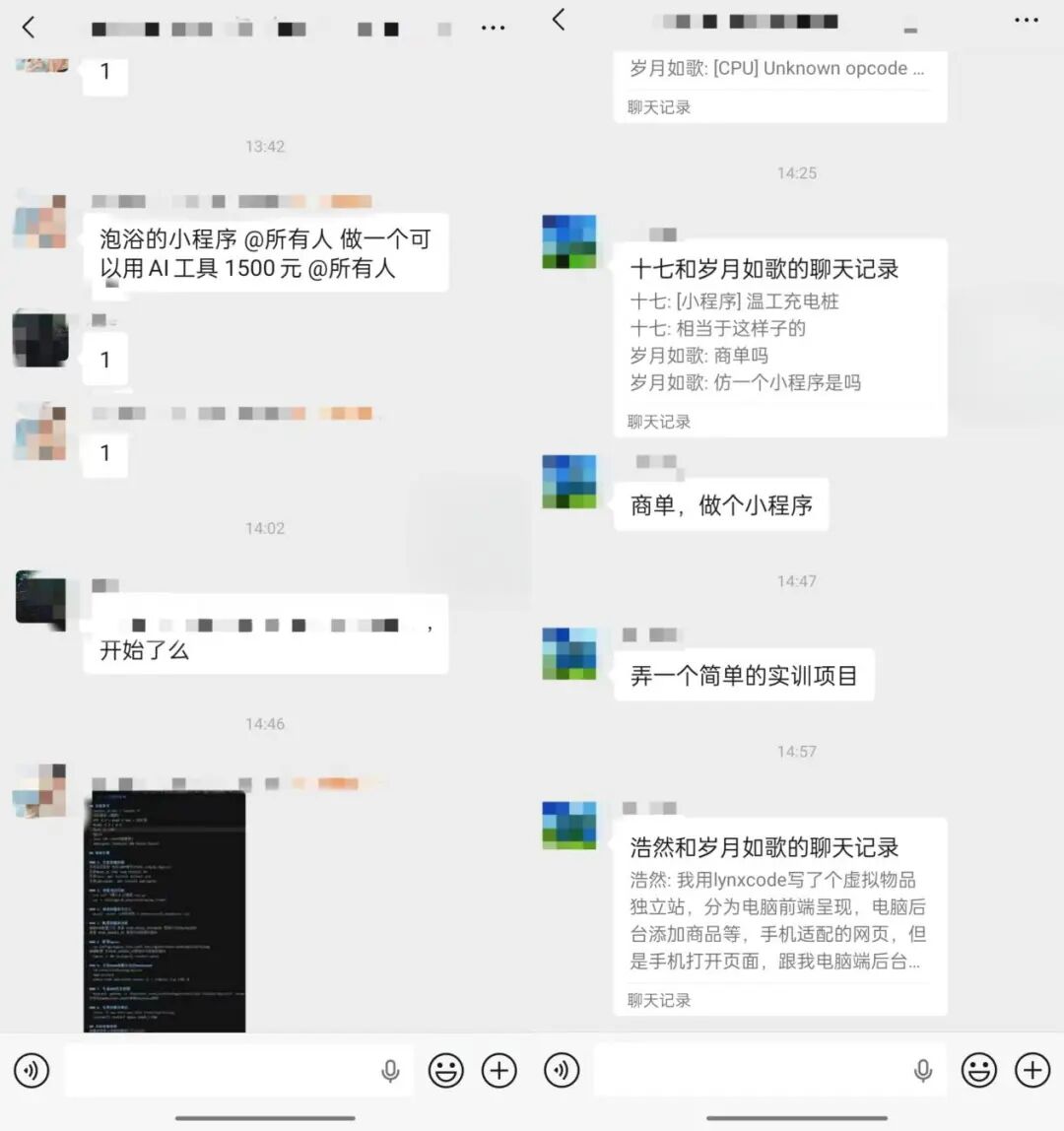
Programmer Job-Seeking Groups
He hasn’t had a formal job for three years. During that time, he’s looked for work but found that job postings no longer distinguish between front-end and back-end roles—they expect one person to handle everything—and salaries are still on the decline. He’s been researching AI games but hasn’t actually managed to create one yet. He sighed, “Life is getting harder and harder.”
“I feel like I’m just AI—I don’t know anything except technology,” he said.
05
Creativity, Passion, and Drive: Higher Barriers to Entry in the AI Era
AI has lowered the technical barrier to game development, but there are still more significant hurdles to overcome.
Rio has always felt that AI-generated games have a very distinct “AI feel” to them. While the code and algorithms may not be obvious, the art and storyline immediately reveal that uniform, rigid style characteristic of AI. He isn’t particularly fond of games like that.When developing games, he spends most of his time trying to eliminate that “AI feel.” He sources free, publicly available art assets to replace the AI-generated ones and manually edits the AI-generated storylines.
The technical challenge that gave Mu Yu the most trouble wasn’t actually the biggest hurdle to game development in the AI era. What moved netizens about her student project—which took less than ten minutes to create—was the emotion the game conveyed.With the heavy workload of high school, she missed out on spending time with her grandmother. After her grandmother passed away, she reflected on the many moments she regretted not having spent with her. She wove the little moments she shared with her grandmother into the game, which in turn stirred up feelings of nostalgia for family in many people.
Lin’s game is also brimming with emotion and creativity. She left the coding entirely to the AI, while she and the AI each contributed half of the game design.She wrote all the copy, dialogue, and plot herself. She adapted the script—comprising hundreds of thousands of characters—that she had accumulated through previous chats with Gemini into the game’s storyline and visuals. The stories that once amazed her have now moved players as well.

Lin Shares His Insights on Using AI in Game Development
A-Kai said that AI can't design on its own—you have to feed it input. He feels he lacks aesthetic sensibility, creativity, and ideas, so he can't provide that input, which is why he can't create the game he envisions.
But AI brought more than just a shock to A-Kai. He found himself getting more and more deeply drawn into it. Now, no matter what he does, he has to have AI with him; if he doesn’t use it, he feels restless, as if something is missing.
Although he still worries about making a living, he’s in no rush to find a job. He finds joy in learning; he says there’s still a lot to explore in AI. He plans to open-source this cultivation game, and after that, he wants to try using AI to control Unreal Engine 5 to create games and generate special effects.
Lin, too, went through a process of moving from confusion to understanding when it came to AI.At first, if a client or platform operator would say to her, “Why don’t you try using AI to generate a draft of the script?” or “I ran your script through an AI, and here’s the advice it gave me,” she would feel offended, as if they were disrespecting her work. Back then, she had read many AI-generated scripts, and they were poorly written.
Later, she gradually came to realize that AI itself is neutral. Its existence can expand human boundaries, and in the hands of different people, it can serve completely different purposes.
“You need to have a clear vision and firmly believe that people will like it,” Lin said. She always seems to have an endless supply of inspiration and ideas. She doesn’t consider herself particularly talented; she’s just someone with a strong sense of purpose.While developing this game, she faced a lot of pain and setbacks, but she knew exactly what she wanted to do and why—and that kept her going until the very end.
The games Rio developed didn’t exactly stand out. The one with the highest number of registered users only reached 10,000. He stared at the backend data—there were still over 100 active users every day—but he wasn’t even sure if they were real. His younger sister played it once and said, “It’s no fun—it’s way too ugly.”
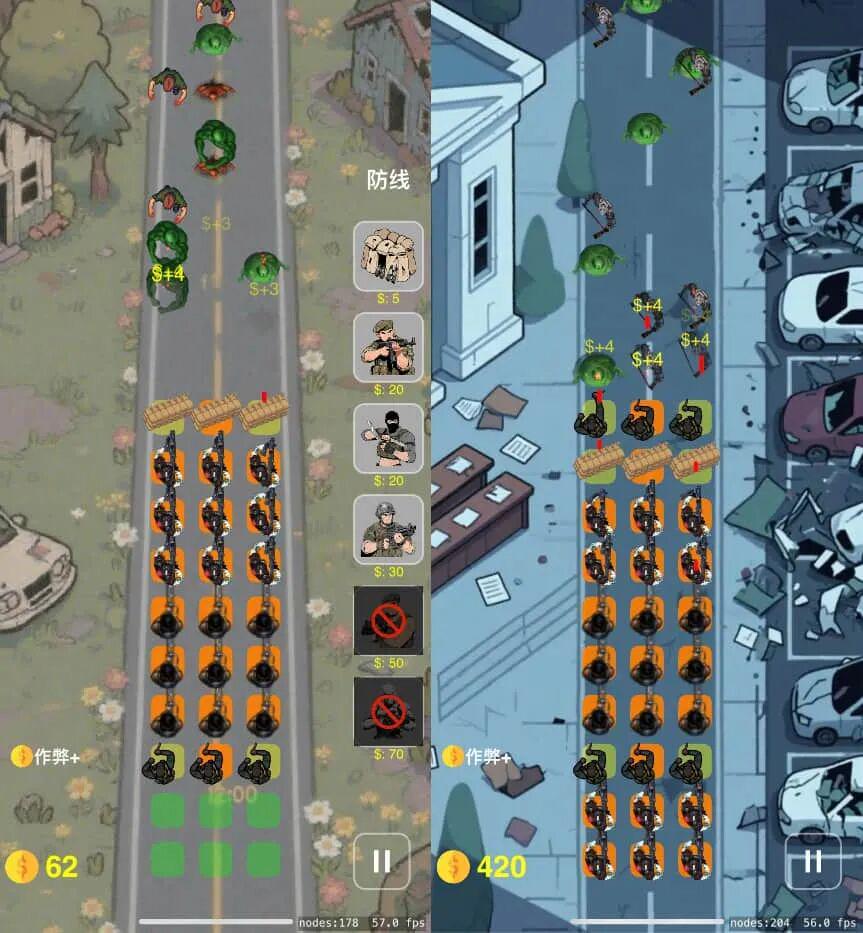
Mini-games created by Rio
But he didn’t seem to mind. His original intention wasn’t to commercialize the game; he just wanted to see if he could bring the ideas in his head to life. He felt that making games was more like a learning experience for him. In the past, when he had ideas but didn’t know how to implement them, now he could run them through AI and understand the process by watching it.
Even after several mini-games were released on the App Store, Rio’s anxiety didn’t subside. He felt that being able to develop mini-games using AI was no longer a competitive advantage—agents would be the next big trend.Recently, he has begun exploring agents again, continuing to document his experiences online under titles such as “After Work: My Daily Routine Building Agent Teams with AI” and “Agent Learning Notes.”
原创文章,作者:游茶妹儿,禁止转载:https://youxichaguan.com/en/archives/208176