
Two twin brothers who didn’t know how to code launched four games in just over three months and transitioned from part-time to full-time developers. This is a real-life example that emerged from TapTap Maker’s beta testing, which has been running for nearly half a year.
The experiences of Jin Haobin and Jin Haozhu are almost a microcosm of the history of UGC developers: They entered the industry in 2020 by creating Warcraft III maps, later started their own business, until NetEase and Blizzard’s “breakup” devastated the ecosystem and the team disbanded.They then shifted their focus to indie games, with the older brother serving as the game designer and the younger brother as the artist. They named their studio “Chutou Miao,” a play on the saying “the bird that sticks its head out gets shot,” but with the added implication that “cats have nine lives.”
Going it alone isn’t easy. Since the two brothers didn’t know how to code, they teamed up with a programmer and had to explain every idea in advance—which took up a huge amount of time just for communication.Music and sound effects were also a major expense. To save anywhere from a few thousand to over ten thousand on custom soundtrack fees, Jin Haobin spent two or three months teaching himself music composition. Looking back now, he says those results “weren’t nearly as good as what AI can produce.”
A turning point came in March of this year. The two brothers came across a video on Bilibili: an AI-powered game creation tool called TapTap that could generate *Minecraft*-style gameplay based on a single sentence. Jin Haobin felt that this tool was something special, but when it came to AI completely replacing programmers in game development, he “honestly didn’t quite believe it.”
Skeptical but curious, he gave it a try in his spare time. The first thing he asked the AI was, “Help me make a game that combines roguelike elements with the 2048 gameplay.” A few hours later, the core gameplay was up and running. This “Roguelike 2048” took just seven days from concept to release.
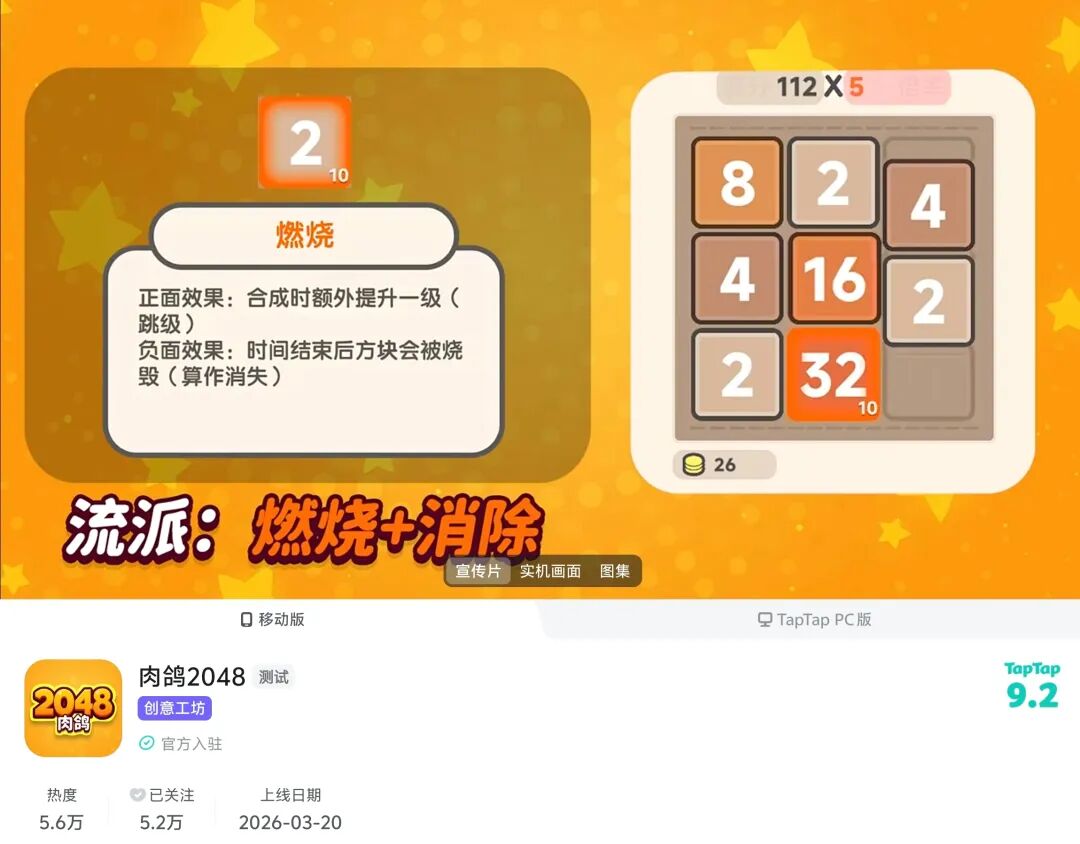
The first game we launched received positive feedback.
However, the AI wasn’t obedient from the start. At first, Jin Haobin gave it instructions, but the results it produced often fell short of expectations. After going through several iterations, he figured out the trick: the AI isn’t afraid of heavy workloads, but it does struggle with vague requirements. For example, when designing an interface, if you clearly specify where each element should go and what size it should be in one go, it usually gets it right on the first try.
What happened next began to exceed expectations time and time again. Their second tower defense game, *The Best Sword in the Village*, took 13 days to develop, and once they received the full amount of ad revenue, it was enough to support the two brothers as they transitioned to full-time development.Their third game, *Journey of Destiny*, took the two of them 50 days to develop. It’s an anime-style card game so polished that many people couldn’t believe it was created using AI.

A 2D card game created by two people in 50 days
A new idle casual game called *The More You Jump, the Richer You Get* was developed in just 10 days. It was originally intended as a "just for fun" entry for a GameJam, but it ended up climbing to third place on the new releases chart.
The four games belong to different genres, and each has a distinct workflow. Most people wouldn’t dare to take on such a wide range of challenges, but they do so intentionally because they learn a lot of new things every time they switch genres. “In fact, we’re developers who started from a very low baseline, but we’re learning very quickly in the age of AI.”

These four games cover a wide range
Since becoming a full-time employee, Jin Haobin’s workday has gone from 8 hours to 14 hours. He says he simply can’t stop: “It’s easy to get into a state of flow when developing AI. The process feels incredibly satisfying—it’s that feeling of having everything under your control.”

Reviews from players who have played for more than 50 hours
Sitting across from the two brothers, Jiang Li wasn’t surprised by this situation. The head of production at TapTap—who got his start in the era of Warcraft III matchmaking platforms—said the team had long observed that “for many creators, the process of making games is, in itself, a fun game.”
In his description, these two brothers are practically the “typical users” the product is targeting: creators with ideas but unable to assemble a team, and who are unfamiliar with software development. “AI can help them handle the practical tasks, while having ideas is what’s truly scarce.”
Explaining your ideas clearly is just as important as having them. Jiang Li noticed in the backend that, over the past six months, a significant portion of the issues reported by creators weren’t actually bugs in the tool, but rather the result of not explaining their requests clearly enough to the AI. Conversely, for those who can break down tasks into detailed steps, there’s almost nothing the AI can’t do.
Finding the best way to collaborate with AI can only be achieved through gradual trial and error on a project-by-project basis—and that’s exactly what Chutou Miao is doing.That’s precisely why, in Jiang Li’s view, the most valuable asset isn’t those four games: “While others might take two or three years to test three or four games, they tested four in just three months. It’s this improvement in their own capabilities that’s truly the most valuable.”
Taking a step back, this is the first paradigm shift Jiang Li has witnessed in all her years in the industry.In the past, all UGC tools followed the same path: they focused on visual programming to lower the barrier to entry for people who didn’t know how to code. DOTA itself emerged from the editors of that era. With the arrival of Coding Agent, the barrier to entry for programming has been brought down to rock bottom.
Now that the barriers to entry have come down, it’s not just the pace of change that has shifted. In the past, production costs were high, so everyone was creating similar gameplay experiences. Today, the cost of trial and error is so low that creators can experiment freely, giving them the confidence to explore gameplay that doesn’t simply follow trends. The homogenization of gameplay that has plagued the industry for years may finally be starting to ease.
At the TapTap Developer Workshop (TDW) on July 26, Choutou Miao Studio and Jiang Li will share their experiences using TapTap to create games. Game Teahouse took this opportunity to chat with them; the following is a transcript of their conversation, which has been edited.
01
From Skepticism to Full-Time Development
Teahouse: What led the two of you to discover TapTap back then? What were your first impressions?
Chutou Miao: We came across a related video on Bilibili where a single phrase generated a game similar to *Minecraft*. It seemed pretty cool at the time—different from other AI-powered mini-game products—so we decided to give it a try. But at first, we were still skeptical: Could AI completely replace programmers in making a game? To be honest, we didn’t really believe it.
Teahouse: Do you remember the first thing you made with it?
Chutou Miao: The first one is “Meat Dove 2048,” which combines the Meat Dove clown cards with the 2048 gameplay.I figured out the core gameplay in just a few hours, and it took 7 days from concept to release. And I wasn’t even working on it full-time—I mainly worked on it after work and in my spare time, putting in about 20 to 30 hours in total.
Teahouse: From the platform’s perspective, how many creators are there who can produce a polished game on their very first try and still receive positive feedback?
Jiang Li: If you count the ones that say “the feedback has been pretty good,” they are indeed in the minority. But among Maker (TapTap Zhizao) users, quite a few are able to create finished products and release them.
Teahouse: When did you decide to do this full-time?
Chutou Miao: After finishing our second game—*The Best Sword in the Village*, which took 13 days to develop—the revenue exceeded our expectations once it went live, so we started thinking about going full-time. We truly went full-time when we began working on our third game, *Journey of Destiny*; that one was quite ambitious, and the two of us spent 50 days on it.
Teahouse: Compared to the traditional way of making games in the past, has your work routine changed significantly?
Outstanding Kitty: I used to be pretty strict about taking weekends off and working 8 hours a day. But ever since I started using TapTap Maker, I’ve basically been working 14 hours a day. With AI development, it’s easy to get into a state of flow—it feels incredibly satisfying while you’re working, like you’re in complete control of everything.
Jiang Li: We’ve also found that, for many creators, the process of making games is, in itself, a lot of fun.
Teahouse: If these games were developed the old-fashioned way, how much effort would it take?
Chutou Miao: First, you’ll need to hire a programmer or find a programming partner, which will increase costs. Second, the development cycle will be at least two to three times longer—collaborating with a programmer inevitably involves time spent communicating. You’ll have to clearly explain your ideas and convince them before they can start working on it. And that’s assuming you already have AI-generated artwork.
Then there are the little things like music and sound effects: Back when we were making indie games, commissioning three or four high-quality background tracks would cost anywhere from a few thousand to over ten thousand yuan. To save that money, I spent two or three months teaching myself music production software—only to realize now that it’s nowhere near as good as what AI can do.
02
Refining the AI while continuously improving ourselves
Teahouse: When you were making your first game, what were the earliest prompts like?
Chutou Miao: I just said one thing: “Make me a game that combines roguelike elements with the 2048 gameplay.” What I got was something that basically worked, but it wasn’t ideal, so we went through many iterations afterward.Later, we learned that we had to provide the AI with precise instructions. For example, when designing an interface, we’d tell it exactly where each element should go and what size it should be—and it would usually get it right on the first try. In the beginning, we’d say things like “a little to the left” or “a little up,” but the results were completely unexpected.
If it's a field I'm not familiar with, I'll first have the AI draft a plan for me. After I review and approve it, I'll have it carry it out. This is much more effective than just telling it to do it in a single sentence.
Teahouse: Do successful creators have similar workflows?
Jiang Li: There isn’t necessarily a single workflow that works for everyone. But there’s one very important point we saw in the experiences of the two speakers just now: as they collaborated with AI, they also evolved themselves—from a time when the AI often didn’t do what they wanted, to figuring out the AI’s limits.Many high-performing professionals document their skills, create convenient commands, and maintain documentation. Some even use Maker to build tools—tools within tools—to steer their workflows toward greater control.
On the other hand, workflow orchestration is difficult to generalize. We initially tried fixed orchestration, but you’ll find that this can weaken an agent’s generalization ability, since it’s inherently an anti-generalization operation.There is certainly universality at the tool level—for example, the UI, 2D scenes, and 3D scenes—but under the broad umbrella of “game development,” there is currently no default workflow worth installing in every Agent. If we focus on a specific genre, however, we might be able to establish more universal elements beyond the tools themselves.
Actually, over the past six months, we’ve made a counterintuitive discovery from the feedback we’ve received from creators: the vast majority of issues aren’t bugs in the engine, but rather stem from AI prompts that aren’t clear enough. Sometimes, when creators convey their own subjective judgments to the AI, they end up misleading it; other times, they simply provide a very vague intent.Conversely, if you can break down the task into detailed, precise steps, there’s almost nothing the AI can’t do; but if someone just says, “Help me make a ‘Black Myth,’” they’ll most likely end up with something that falls short of their expectations.
Teahouse: Has the platform considered providing some general-purpose tools to address common needs?
Jiang Li: We’ve received a lot of requests for UI editors, but many creators don’t necessarily need the kind of UI editor found in traditional professional engines—concepts like anchor points and alignment are completely unfamiliar to a lot of people.We’re developing a more AI-native editor, which is already in closed beta. It addresses the need for fine-tuning: say you want to move a button just a little to the right. When there are many buttons on a panel, it’s hard to describe in words exactly which one to move and by how much.
This editor makes your communication with AI smoother by helping you organize context and articulate your intent, but the AI is still doing the actual work behind the scenes.Its approach is progressive: it only provides you with the corresponding tools when it recognizes that you intend to fine-tune the UI or control a 3D scene—much like a tutorial in a video game, where features are gradually unlocked for those who need them. In the future, we won’t be adding traditional professional tools, but rather visualization tools that help you communicate more effectively with the agent.
Teahouse: Will future plugins follow the same approach—making reusable components available to everyone?
Jiang Li: The significance of plugins lies, first and foremost, in the fact that many people are already building tools based on Maker, but these tools run on the engine’s runtime—which isn’t the most elegant solution. Future plugins will fully open up the engine’s capabilities, including interaction with Agents, making it more elegant for users to build their own tools. Second, as more plugins are developed, there will be value in sharing them.
Teahouse: The four games you two created with Maker cover a very wide range—unlike your previous approach of focusing deeply on a single genre. How did you arrive at this decision?
Chutou Miao: We want to create games in different genres because we can learn a lot through the process.When we were making *Journey of Destiny*, there were many things we’d never done before: it’s a server-based game, and we knew absolutely nothing about servers or server-side code; there’s an asynchronous arena in the game, which I also knew nothing about, so I spent several days analyzing how other games implemented it and then discussed with the AI team what approach to take.
There are countless examples like this. In our most recent game, *The More You Jump, the Richer You Get*, we tried having AI handle 50% of the level design—something we had never done before. Basically, our workflow is a little different for every game.
Teahouse: After using the platform for this period of time, what is the one area you’d most like to see improved?
Chutou Miao: I hope the engine’s performance optimization can be improved. Many developers don’t understand code and have limited knowledge of performance optimization; I, for one, know absolutely nothing about it. A few days ago, I asked Uncle Li for advice, and he helped me figure it out.
Jiang Li: In the future, there may be specialized agents that are better at performance optimization. We will make the capabilities of various sub-agents more specialized and more powerful.
03
What's truly scarce are ideas.
Teahouse: What were your expectations for users when the product first launched?
Jiang Li: When it comes to selecting the target user profile, the first group to rule out should be developers of traditional professional engines like Unity. If they switch to the vibe Coding tool, they’ll find that there are many aspects they can’t control, and it’s difficult to accurately express their ideas with this kind of product.It’s better suited for people who have ideas but can’t assemble a team, are unfamiliar with programming, and haven’t used Coding Agent much. As long as you have an idea, it’s easy to get positive feedback using this tool.
Teahouse: When recruiting early users, what’s the approximate ratio of experienced users to those with absolutely no experience? Is there a difference in retention rates?
Jiang Li: Some of the test users were recruited from the community, so it’s difficult to get an exact count. But looking at the results, the retention rate among industry professionals was significantly lower than that of external independent developers and UGC creators; most industry insiders were just there to try it out.
Teahouse: After six months of testing, what met expectations, and what was disappointing?
Jiang Li: The initial goal of this product was to determine whether people without a full development team or coding skills could complete and release a game; whether the game could receive feedback from real players; and whether creators could continue to iterate on their work. This goal has been validated. Thanks to this product, things that would have been impossible in the past have now become possible.
The downside is that the product’s capabilities aren’t yet strong enough to allow any user to create something good—in other words, the floor isn’t high enough.
Teahouse: How can this section be improved?
Jiang Li: There are many factors contributing to the improvement in the lower bound: the model’s capabilities are advancing, and there have been dramatic improvements in intent recognition, long-term task planning, and task persistence. For example, whereas a model used to be able to handle only 30 minutes’ worth of work with a single instruction, it can now reliably execute long-term tasks equivalent to 5 hours’ worth of work;Additionally, many skilled developers are willing to share their summarization techniques—which are essentially others’ methodologies. We also regularly review high-frequency issues and adjust the model’s constraints to ensure it avoids the boundaries where common errors occur.
Teahouse: What are Maker’s strengths and weaknesses right now?
Chutou Miao: Based on our experience, high-end 3D production is still a bit weak, while 2D is currently quite mature. 3D games that don’t rely heavily on 3D assets are also doing okay.
Jiang Li: 3D is indeed a practical challenge. Large language models still have limited capabilities in 3D space, and it’s difficult to get AI to generate a scene that’s both controllable and editable. This is a common issue with AI-powered game development tools like Vibe Coding, but we’ll be making some progress in the 3D area in the second half of the year.As for 2D, it’s already very user-friendly—essentially, whatever the creator’s limits are, that’s the level of quality Tap Maker can achieve.
Online functionality is actually our strong suit: Maker’s online cloud services are ready to use without the need for deployment or maintenance—a capability that is virtually unique among current AI agent products. Several multiplayer titles are currently in preparation for testing, and we expect to see more and more of these products; multiplayer games tend to have better user retention rates.
Teahouse: There are quite a few AI tools for game development on the market. What makes Maker stand out the most?
Jiang Li: The vast majority of engines on the market are still HTML5-based, but we’re better equipped to develop more demanding games than they are; compared to professional engines like UE and Unity, our AI is much easier to use. Combined with our established cloud services and infrastructure capabilities, you can build games with online play, multiplayer battles, and cloud saves entirely within Maker.
Teahouse: Have there been any breakout hits in the past six months?
Jiang Li: Yes, there are. *Jade Business Simulator*, which has been quite popular on the site, is a bit of a hidden gem; *Journey of Destiny* by the two brothers is pretty good, and I’ve also spent quite a bit of time playing the game from the recent GameJam myself.
Outstanding Cat: That GameJam title called *The More You Jump, the Richer You Get* is an incremental idle game. It took us 10 days to make, and it peaked at No. 3 on the New Releases chart. We didn’t see that coming at all—we originally just wanted to “give it a shot” in the competition, but the numbers ended up surpassing all our previous games.
Teahouse: Is it costly to provide tokens to everyone?
Jiang Li: Very significant. The supply of tokens cannot be unlimited; if it were, waste would be unstoppable. Therefore, tokens must be allocated to the most deserving groups: creators who are committed to making high-quality games, continuously iterating on them, and receiving positive feedback from players, as well as official events like Tap’s specialized GameJam, where tokens are distributed.
In addition, we recently opened up local development. Through Maker’s MCP integration, you can use your own Coding Agent and token to develop Maker games and utilize Maker’s cloud services—there are no barriers to entry.
In the future, we may also launch something similar to Coding Plan on the Cloud Platform. Although the tokens currently provided are sufficient for most users, there are still some users who employ development methods that consume a significant number of tokens. Coding Plan is primarily designed to address the issue that these users currently have no way to obtain tokens. We’ll provide more details on this at an upcoming TDW event.
Teahouse: If you were to prioritize your plans for the future, what are the top few things right now?
Jiang Li: The most important thing is self-improvement in terms of Harness’s capabilities. With users providing more and more data feedback, can we make Harness evolve automatically? That would be a huge advantage for us.
Second, through official efforts, we aim to enable more models to be used efficiently: some very inexpensive models that previously did not perform well for us may become usable through iterative harness testing and targeted optimization, which is highly valuable for reducing token costs and increasing user points.
Third is the focus for the second half of the year: building the infrastructure for 3D capabilities and raising the baseline.
04
AI isn't the problem; even traditional methods can result in bad games.
Teahouse: What was the feedback like after launching a game created with Maker?
Chutou Miao: It’s very fast. In the past, when developing indie games, feedback was very slow—on Steam, you had to accumulate at least 6,000 wishlists before the game went live to get decent exposure. With Tap, however, traffic distribution doesn’t require advance exposure or pre-registration. After passing compliance reviews, the game goes live quickly, allowing you to get immediate feedback and iterate on the version based on player feedback.
Teahouse: What kind of feedback have players in the community been giving about the games created with Maker so far?
Jiang Li: Games like “Like Two Brothers” have quite a following; there are also some that are really poorly made, and users can tell they’re not very good right from the start. With UGC, there will always be people who post content casually, and we allow those posts—but if the data doesn’t speak for itself, the content naturally won’t continue to gain exposure.
Chutou Miao: The feedback we’ve received has been mostly positive, with very few particularly negative comments. Now that we have AI, we can make quick adjustments based on that feedback. When players play the games we make, they’re usually amazed that they were created using AI. But in reality, players don’t really care whether a game was made by AI—what matters to them is whether the game is actually fun to play.
Jiang Li: Yes, so we shouldn’t overemphasize the “AI-generated” label ourselves; we should downplay it. Ultimately, players care about whether a game is fun to play—you can still make a terrible game even using traditional methods. As for how to bring good games to players, that’s TapTap’s core functionality: algorithmic recommendations, combined with our long-standing editor’s picks.
Teahouse: Have there been any differences from expectations in terms of commercialization?
Jiang Li: There is still significant room for creators to generate revenue. Currently, the barrier to entry for integrating ads into mini-games is very low, and many people are already generating revenue, but the highest earnings are concentrated among the top performers—some have earned over 10,000 in ad revenue in a single day. At present, revenue models are still relatively limited, but more diverse partnership opportunities will emerge in the future.
Teahouse: AI has sped up production, but this also leads to the replication of gameplay and the overuse of themes. Will there be measures to encourage originality?
Jiang Li: Complete pirated knockoffs won’t pass review. But “copying” needs to be viewed from two perspectives: malicious copying should be cracked down on, while benign derivative works should actually be encouraged within UGC—MOBA-style gameplay matured through many generations of derivative works, and the same goes for battle royale games.When a game genre undergoes repeated iterations through derivative works, players serve as a source of rapid data feedback, helping creators eliminate incorrect approaches and ultimately converge on a more compelling gameplay experience. Therefore, we need to consider establishing mechanisms for tracing the origins of works and ensuring revenue flows back to the original creators. Once these mechanisms are in place, we’ll have more appropriate ways to encourage derivative works.
Teahouse: Huang Yimeng, CEO of Xindong, has mentioned that he hopes to see some “small sparks”—ideas that are still in their early stages—emerge in the future, with community members contributing their ideas to help bring them to a high level of completion. Are there any examples of this kind of positive collaborative creation happening right now?
Jiang Li: We’re still building the infrastructure. There are several fundamental issues that need to be addressed here: if it’s easy to create derivative works and publish them, the distribution side needs to implement safeguards; authors must grant authorization; and there’s also the issue of traceability and revenue sharing, as mentioned earlier. Only once these mechanisms are in place can we foster a healthy ecosystem for derivative works.We’re preparing for this, but the platform first needs to be able to handle a tenfold—or even a hundredfold—increase in the number of games.
Teahouse: As the number of creators and products increases in the future, will there be challenges with traffic distribution?
Jiang Li: It’s a bit like the chicken-or-the-egg dilemma.I don’t think it will be a problem: as the number of creators increases, so does the volume of content. We’re also constantly raising both the minimum and maximum standards for content, so the absolute number of high-quality works will grow, and the user base is bound to expand. As long as the user base is growing, it’s not a problem—unless creators fail to produce content with consumer value, in which case issues might arise. But as things stand now, it seems we’re still capable of producing high-quality content.
05
When the base is large enough, the tip will emerge on its own.
Teahouse: You’ve seen many generations of UGC. What’s the biggest change brought about by AI?
Jiang Li: First, there’s been a massive shift in the tool paradigm. Previously, UGC tools all focused on one thing: visual programming, with the goal of lowering the barrier to entry. But now that Coding Agent is powerful enough, visual programming has completely lost its purpose—the latest version of UE6 has even decided to remove Blueprints.
The fundamental advantage of UGC over commercial games lies in its rapid iteration and feedback: development cycles are short, user feedback is direct, there’s no need for a publisher, and there are far more opportunities to experiment. AI makes coding faster, asset generation faster, and even learning faster, so its impact on UGC is to significantly accelerate the process.
Teahouse: You two have been involved in UGC since the Warcraft 3 era—what are your thoughts on the changes over the years?
Chutou Miao: In the past, everyone was creating UGC content with very similar gameplay mechanics because those approaches were market-proven and quick to develop. But now, with UGC combined with AI, the cost of trial and error is very low, allowing us to experiment with games that aren’t just following trends—which is very beneficial for the overall UGC ecosystem.
Teahouse: In your experience, in which areas where you previously lacked knowledge has using AI proven to be incredibly efficient?
Outstanding Cat: The most obvious example is code logic. We’ve never studied coding, but when the AI creates games, it goes through a thought process. Sometimes, just by clicking to take a look, we can learn naturally—for example, if I want to change a certain piece of data, I can see where it just made a change and what it changed. It’s a process of learning as we go.
In terms of art, at the company we worked for on Warcraft 3, we specialized in UI design. I had absolutely no background in drawing and couldn’t draw at all, but I knew what elements looked good together and how to maintain a consistent style—AI can completely make up for the need to “draw.”The character art in *Journey of Destiny* was generated entirely by AI; only the UI was designed by us. So my sense is that the demands on lead artists will only continue to rise in the future.
Jiang Li: It’s important to articulate your needs. Moreover, as token costs decline, the line between user-generated content (UGC) and professional games may become increasingly blurred. Many people say that *Journey of Destiny* is a very professional game.
Chutou Miao: Some people even say that we’re developers who came from a major tech company, but in reality, the two of us started from very humble beginnings—we’ve just picked things up very quickly in the age of AI.
Jiang Li: Just think about how quickly they’re improving on their own: While it might take others two or three years to try three or four games, they’ve tried four in just three months. This kind of self-improvement is what’s truly valuable.
Teahouse: Many new genres in the gaming industry have emerged from user-generated content (UGC), with the most famous example being how custom maps for Warcraft III gave rise to DotA. What conditions are needed for a “DotA moment” in the AI era?
Jiang Li: There are enough creators and enough players. To put it simply, the pool of games has grown—and when that pool is large enough, the tip of the pyramid is bound to emerge. So, for now, we need to raise the floor and, in the long term, raise the ceiling, so that the gap between vibe Coding’s games and professional games continues to narrow.
Teahouse: In the Maker developer community, which category catches your eye the most?
Jiang Li: What these people have in common is that they’re all passionate about making games, and AI happens to fill a gap in their capabilities—either their team previously lacked people skilled in coding (and it seems most still do), or they lacked game designers or artists.They are passionate about games and quick learners; after receiving positive feedback along the way, they keep trying, accumulating experience, and drawing conclusions. The process from development to launch is very smooth for Makers, allowing them to quickly gather user feedback and improve with each iteration. Once people enter this cycle, they will generally continue to release products.
Teahouse: On a scale of 1 to 10, how would you rate the current version of TapTap?
Jiang Li: 5 points.
Teahouse: It’s still in the middle stages. What are your long-term goals for it?
Jiang Li: The long-term vision is for the entire Vibe Coding suite to integrate with business engines, but it remains an AI-friendly product that offers a very smooth user experience for agents. Another important point: tools are just tools; our primary focus is on the creator ecosystem, where everyone collaborates to build more plugins, skills, tools, and open-source projects. These are the foundation for building things faster and faster in the future.
More insights will be shared live at the TapTap Developer Salon (TDW) on July 26. At this year’s TDW, Jiang Li and two developers will delve deeper into AI-driven creation, and Huang Yimeng, CEO of Xindong, will deliver a presentation and answer questions live.Guests from projects such as *The Ring*, *Valorant: Source Operation*, *Goose or Duck*, and *Sister’s Tale* will all be in attendance. Click the link below to reserve your spot for the livestream.
原创文章,作者:游茶妹儿,禁止转载:https://youxichaguan.com/en/archives/208367