I never would have thought that a video game press conference would have some strange connection to my very survival.
As far as I can recall, most domestic game launch events are held in conference rooms at upscale hotels, with a row of media representatives in the audience dozing off while listening to the producers on stage speak with passion and fervor.
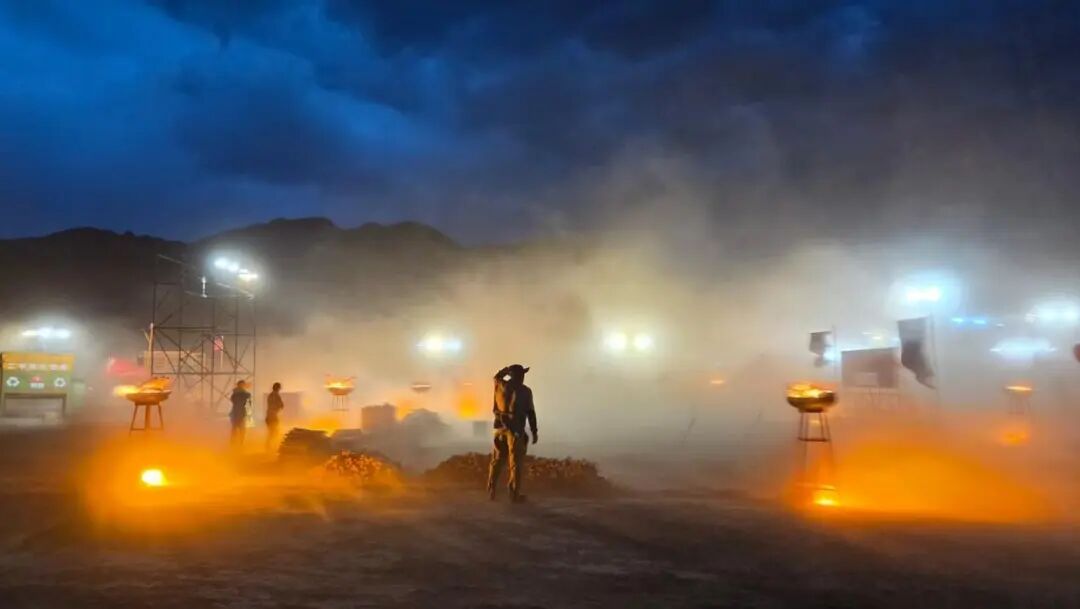
But what you might find hard to imagine is that just a week ago, I was in the barren wasteland of the northwestern desert, experiencing firsthand an “apocalyptic scene” of thunderstorms and sandstorms,with the postmodern rock growl of “Paint a Moon on the Lonely Night Sky” ringing in my ears (I know it’s folk music, but the live performance had an inexplicable rock vibe),while before my eyes, on one side, people were frantically “fleeing,” and on the other, a crowd of apocalyptic revelers was going wild around the band.
I know this scene—with its mix of “death, rock ’n’ roll, the apocalypse, and romanticism”—is a bit too bizarre, but that really was the only way I felt at the time.
I need to clarify that this isn’t a rock concert—it’s the preview event for Tencent’s *Out of Control Evolution*.

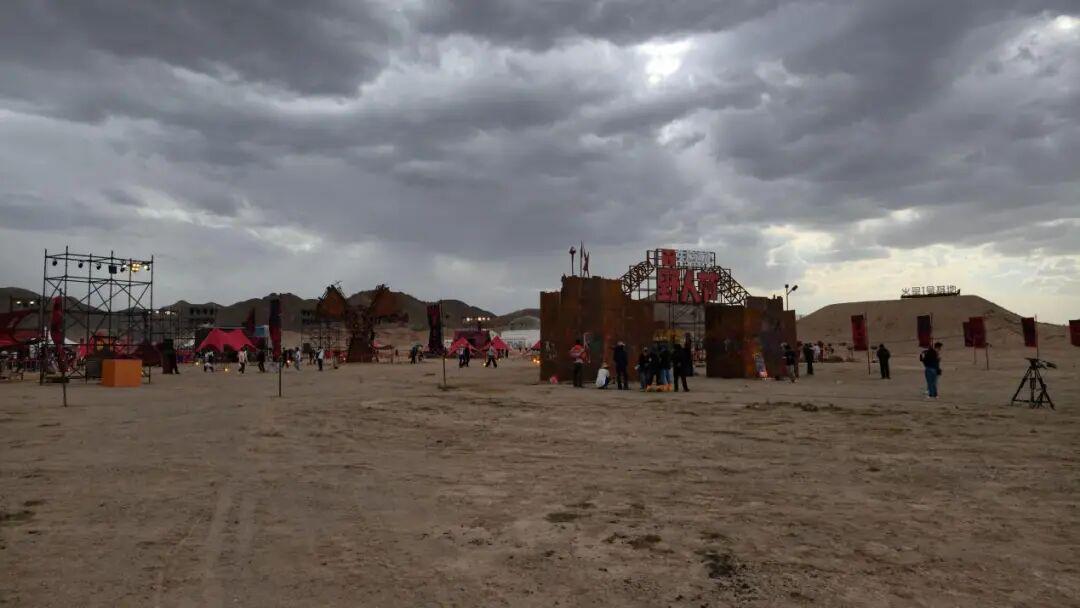
Gansu, Jinchang, Mars Base No. 1. As soon as I stepped off the bus, I was struck by the desolate grandeur of the place.All around me was a barren desert with not a blade of grass in sight; bare, rocky slopes stretched out in every direction as far as the eye could see. To give you an idea of just how desolate it is—the nearest food delivery service is about 20 kilometers away, and even that only delivers flowers.

At first, the press conference seemed fairly normal, but halfway through, dark clouds had gathered overhead and a light drizzle began to fall. Before long,a streak of purple lightning streaked across the distant mountain peaks and struck the ground, and a gale carrying a cloud of yellow sand swept across the entire venue, engulfing everything in its path.
By the time it was over, the situation had spiraled out of control. Yellow sand seemed to have woven a curtain right before our eyes, reducing visibility to less than a meter. The air was thick with a suffocating earthy smell, and the wind, carrying sand and gravel, lashed against our faces like tiny whips.
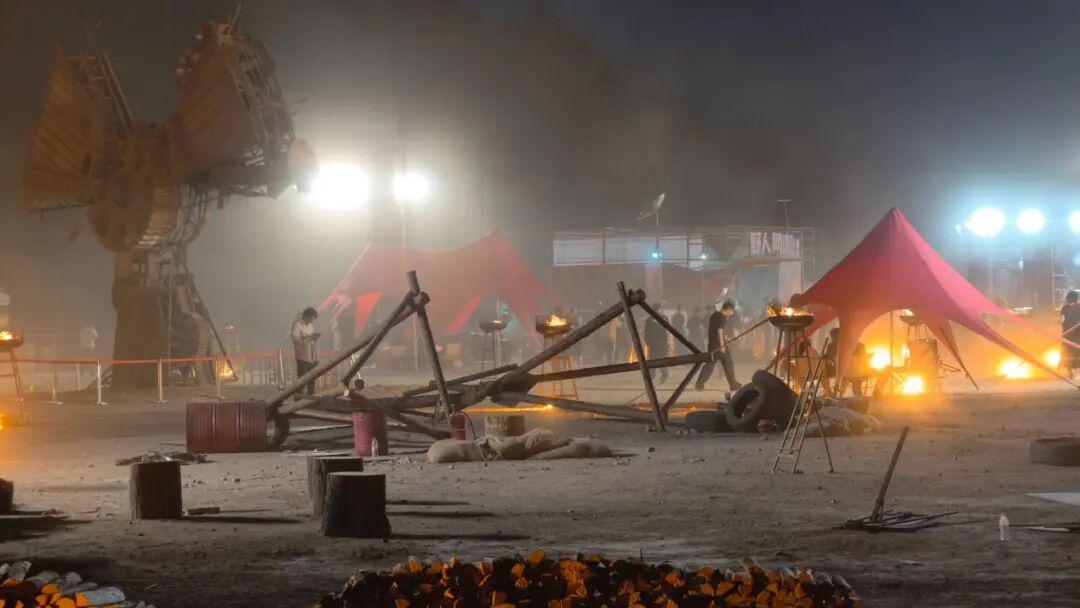
The gale was so strong at that moment that it was impossible to stand steadily; it felt like the heart-pounding rush of a roller coaster plummeting downhill. As I and the other media members struggled to make our way out of the venue, I heard a steady stream of profanity ringing in my ears—that F-word was being hurled almost nonstop.

Looking further into the venue, the oppressive, dense clouds in the distance, the raging sand whipping past before my eyes, the venue submerged in a cloud of dust, and the flickering embers on the ground,and a crowd of revelers under the hazy lights—this absurd yet hyper-realistic composition brought the press conference to a close. I can only say that, true to their roots in hardcore survival games, even their press conference is this wild.
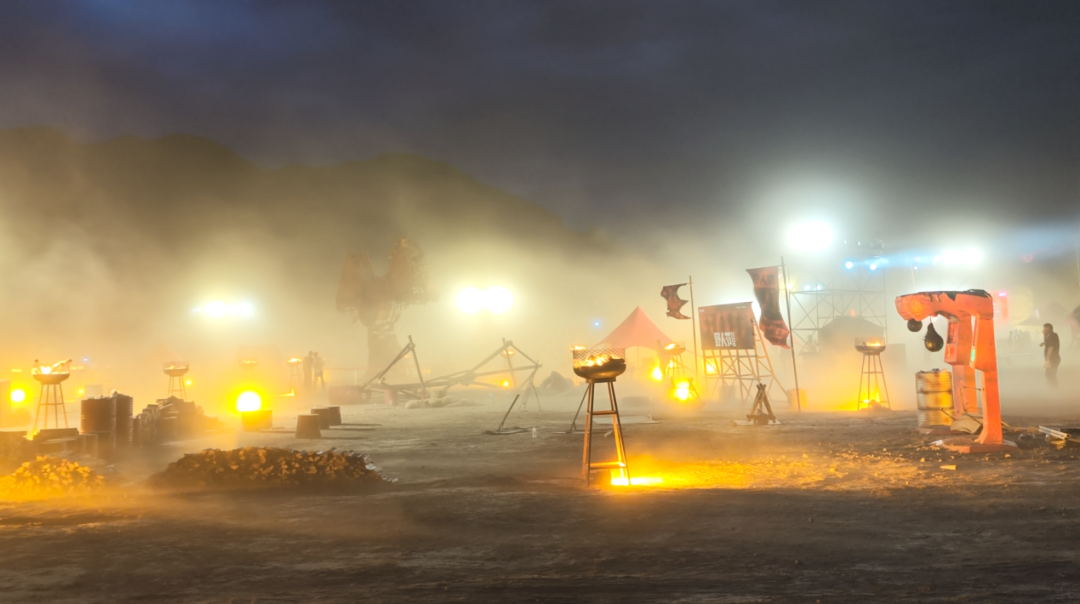
Once we finally got on the bus, many media outlets commented: “It had a very gritty texture in the mouth,” and “Good news: it’s an experience I’ll never forget; bad news: I almost choked to death.”Looking back now, the fact that ticket reservations for this press conference began “actively” two weeks in advance likely took into account the possibility that we in the media might “back down in the face of difficulty” and even consider making a run for it.
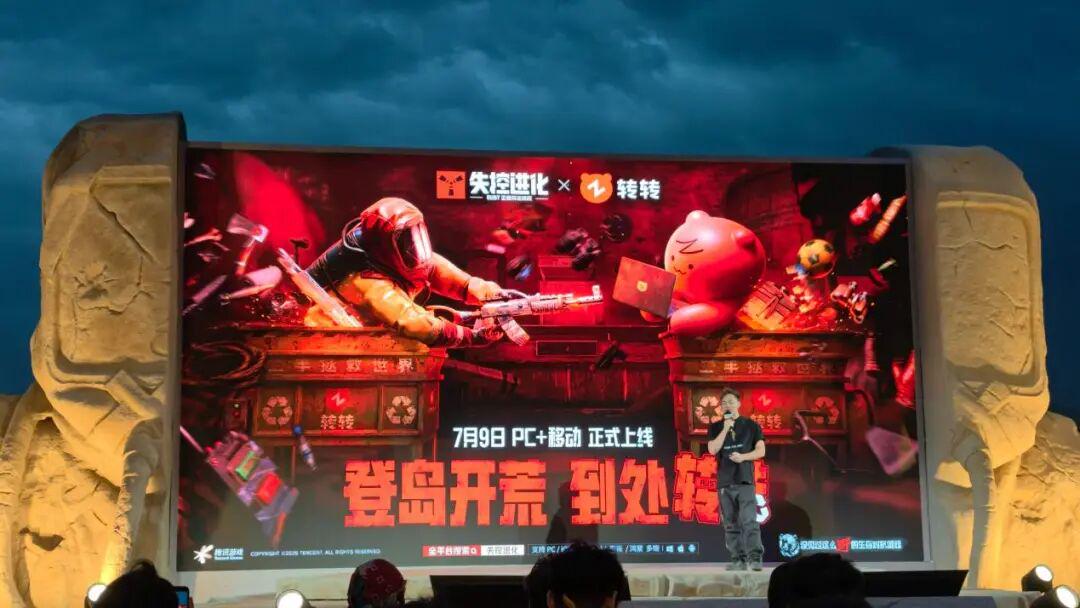
All right, let’s get back to the topic at hand. As of July 9, *Evolution Unleashed* has officially launched. Looking back, that “Wildman Festival” held in the Gobi Desert was really more like the development team giving everyone an early preview of what they wanted to create—an SOC game centered on survival, competition, and long-term strategy.
Seeing this, some of you might be wondering: what kind of game is this that’s generating such a huge buzz?Prior to the press conference, Teahouse joined other media outlets in interviewing Zheng Ming, the lead developer of *Out of Control Evolution*; game designers Yi Ran and Mason; and marketing director Zheng Ruwei, to hear them explain exactly how *Out of Control Evolution* is set to “make waves.”(The following is the interview transcript, which has been slightly edited for readability.)
01
Teahouse: The SOC sector has never really taken off in China. What is the root cause of this? Will the emergence of *Out-of-Control Evolution* change the industry’s market landscape?
Zheng Ruwei (Head of Marketing): Changing the market landscape is definitely our goal. In recent years, bestsellers have emerged across various categories, starting small and growing larger—for example, the “search, strike, and retreat” category has grown from a few million in sales initially to bestsellers in the tens of millions today. Each category likely requires the right timing and the cultivation of its user base.
We have been testing our product since last year, and we recently completed a test involving millions of users; both the number of users recruited and the test data exceeded our expectations.
Second, booking data clearly shows that this genre has attracted more attention compared to two or three years ago. Thanks to the growth of other genres, players transitioning to this survival genre—which may have a slightly higher barrier to entry—will find the transition much smoother.
Third, regarding our goals, as I’ve said before, from our initial investments to the series of ecosystem initiatives and cross-industry content we’re about to announce, as well as our products—which will likely include the most significant launches of the year—it’s clear that we’re making steady progress toward this goal.
Mason (Planner): Rust has been a hit on Steam for quite some time and is a top-tier PvP game in the survival genre, but it hasn’t gained much traction in China. We’ve conducted extensive market research and found that many users aren’t even aware of Rust. There are likely several barriers to entry: First, the Steam platform requires a paid subscription;Second, it requires a relatively stable internet connection, and players may need a VPN to play; third, many of Rust’s official features are closed-off, and the language used in community communication presents yet another barrier. For Chinese players, these three entry barriers are major hurdles to overcome.
So when *Evolution Unleashed* was released in China, we saw that player enthusiasm exceeded our expectations.We didn’t expect such high player enthusiasm at the beginning either. From the initial technical test with 20,000 players, to 200,000 later on, and then to 1 million, the game remained incredibly popular throughout. Some players even accused us of “scarcity marketing,” but to be honest, we really didn’t anticipate having so many players or such high levels of enthusiasm at the time.
Online reservations have now reached 40 million, and these figures clearly demonstrate the immense potential of the market going forward.
Teahouse: What are your thoughts on the growth ceiling of the domestic SOC sector? Can it scale to achieve high DAU, or is it limited to serving a niche audience of core users? How will *Out-of-Control Evolution* position itself in this sector?
Zheng Ruwei (Head of Marketing): The total number of pre-registrations for *Out of Control Evolution* has now surpassed 40 million; just last month, that figure was 32 million.
Setting aside the SOC genre, this pre-registration figure ranks among the highest compared to any new title released in the past two years, so the volume of pre-registrations reflects the high level of anticipation that players and the industry have for this game and this genre.
Therefore, our goal is to establish a strong foothold in the survival-competition genre while exploring more possibilities. Whether it’s core gameplay or collaborating with players to create more imaginative gameplay experiences, we’ll also be introducing UGC-based gameplay features in the future.I don’t think we need to immediately decide whether we’re just another SOC product, nor do we need to compare our scale to any games already on the market—we can approach this product with a more imaginative mindset.
We want to build on the foundation of survival combat and create a genre that better aligns with modern gameplay trends; specifically, this is an open-ended question. The 40 million pre-registrations, today’s event here, and our future investments in the ecosystem will all provide some answers.
Teahouse: What is the most critical issue or hurdle that *Evolution Run Amok* needs to overcome in order to gain acceptance among Chinese players?
Yi Ran (Planner): We’re constantly thinking about this issue. The difference between domestic and international players lies in the different needs they hope to have met.
Overseas players are more focused on the gaming experience itself and whether it provides a strong sense of accomplishment. Domestic players also have these expectations, but in addition, they have two even stronger priorities: first, “What can I get out of it? Can I win?”; and second, “Will I have friends to play with during the process?” Domestic players place greater emphasis on these two aspects.
So, when developing games, our first priority is to reinforce a sense of purpose within the game. Many players today prefer fast-paced experiences, and if the learning curve is too steep, the cost becomes too high for them.
Second, on the social front, we collaborated with our publishing team to implement a number of user-friendly social systems within the game, allowing players to form teams and play together, as well as fostering social interactions with streamers, thereby creating a stronger sense of connection.
Mason (Game Designer): Social interaction is definitely the top priority for us, but it’s not just about creating a social system. Our team has been discussing how to give players more choices. When it comes to matchmaking, we offer both team-based matches and solo play. In different game modes, solo players are well-supported and can enjoy a solid experience.
The second key point is time—specifically, players' gaming time.There are so many players in China, and everyone plays for different amounts of time. We’ve designed different modes specifically to accommodate the varying amounts of time each player has available to play each day. Some players have plenty of free time and can grind non-stop for 24 or 48 hours; others can only play for half an hour to an hour a day, so we’ll also be adding gameplay options tailored for short, sporadic play sessions.
Finally, there’s one more key point: currently in China, not only is the gaming industry thriving, but the live-streaming ecosystem is also developing quite well. We’ve been focusing on user-generated content (UGC), and we hope to eventually foster a win-win relationship between players and the official development team.
02
Teahouse: So how do you strike a balance between maintaining an authentic, hardcore experience and making it accessible to the general public?
Zheng Ming (Head of R&D): I think the 60-day retention rate—or even the 30-day rate—might not be the deciding factor in a game’s success or failure. But the early stages are also crucial. Given that this is such a hardcore game and Rust has virtually no presence in China, it’s vital to figure out how to help players who’ve never experienced this kind of hardcore survival-competition game quickly grasp the core fun of the game and keep playing.
In terms of its core gameplay, our game content will remain unchanged from the original Rust experience. But during the early stages, how can we help new players get started more easily?
First, there are several loops in this game that we need to focus on: the tech-building loop, the house-building loop, and the outpost-exploration and card-drawing loop, among others. Other loops may be more social or peripheral in nature, so we need to develop well-defined gameplay segments that allow players to see the fun in playing this way—rather than losing interest because they don’t understand the game and find it too difficult.
For example, we created the "Raid Mode"—a "slicing" gameplay mode where players face off against each other once they enter. In the future, we’ll also introduce tutorial levels, breaking the game down into individual tutorial stages so players can experience the fun through this "slicing" gameplay.
Second, the game’s core hardcore appeal lies in the fact that many players are killed as soon as they join the match. Most Chinese shooter players don’t have the patience to build things; they want to jump right into intense combat with others. However, when they respawn, they lose all their gear, which is extremely frustrating—unlike in other games, where players might retain all their equipment upon respawning.
So when we launch, we’ll introduce a Safe Zone mode: players are protected within the Safe Zone, while outside of it, the game is in PvP mode. Within the Safe Zone, players can freely engage in the cycle of building, upgrading, farming, socializing, and combat without any pressure. In terms of game modes, we need to provide new players with gameplay options that aren’t so hardcore as to drive them away.
I believe that once they truly understand the game’s core mechanics, if they stop playing in the future, it won’t be because the game isn’t fun, but because they don’t have time right now—I won’t be logging in this week, but as soon as I have some time off, I might log in and play a bit.This player base is quite large; or they might skip the most hardcore challenge mode and opt for the advanced mode instead. If that’s still too difficult, they can try the standard mode, and if that’s still too challenging, they can play the safe zone mode—gradually finding the difficulty level that suits them best. In the future, we’ll also be introducing some PVE modes that are even more casual.
Therefore, the top priority is to serve the core SOC player base, who inherently have a PVP-oriented mindset. Second, we’ll attract players from a broader audience through more casual gameplay.
Teahouse: When carrying out localization, how do you determine whether a specific gameplay element or model can be modified, and to what extent? What are the criteria behind these decisions?
Yi Ran (Game Designer): First and foremost, the most basic approach is to look at data and user research. We game designers make rough assessments, but those assessments are highly inaccurate when compared to big data, so we rely more on data from actual players.During our numerous tests, we made frequent adjustments to the gameplay. We were very bold in adding new event mechanics, and there was even a period when we completely overhauled even the simplest gameplay mechanics. We’re willing to conduct bold tests—the players will give us the answers. That’s the first point.
As for the details—such as whether the drop rate is actually 50% or some other percentage—we can elaborate on that. We have a lot of data tracking in place; for example, we can observe how players behave after certain death points in the live game: do they close the game and leave immediately, or do they stay for 10 minutes, do something, and then leave? These actions directly reflect players’ genuine psychological responses.
It’s possible that a 50% drop rate isn’t the root cause of churn; it’s also possible that as long as players can quickly reclaim their gear or receive positive feedback through other means, they won’t leave.We don’t just make a snap judgment that “a 50% drop rate is too high”; instead, we analyze the specific behaviors that lead to churn in great detail. This is called churn analysis, but churn analysis alone isn’t enough.
Another point is that most players stick around because the game offers both a challenge and positive reinforcement. We also look for moments of satisfaction—for example, whether we can immediately provide a sense of satisfaction after a player dies. If they feel that satisfaction, they’re more likely to stay. This is a very nuanced process, and ultimately, it all comes down to fine-tuning.
Our goal is simple: the user’s flow experience must have its ups and downs—it shouldn’t always be too safe, nor should it constantly be in a negative feedback loop where the user gets crushed. It should be a back-and-forth dynamic that makes the user feel the game is very challenging, but not so much that they can’t keep playing. That’s the goal we’re aiming for.
Teahouse: Last year, the producer said the goal was to reach 1 million DAU first. Now that we’ve reached 40 million pre-registrations, has the goal changed? What are the team’s internal expectations for monthly active users in the first month after launch?
Zheng Ruwei (Head of Marketing): This target has been steadily rising as testing progresses. All I can say is that the preparations for the entire project are definitely not being made with just one million DAU in mind—whether it’s server load capacity, investments in the ecosystem, or all the adjustments we’ve made to attract users at different levels.Whether it’s core users, those who’ve never played survival games, or players who’ve played *Rust* but haven’t tried mobile games—we’ve made extensive adjustments to cater to each of these user groups. So we’re well-prepared, and our preparations certainly aren’t limited to just one million DAU. Of course, the goal is to reach as many users as possible.
Yi Ran (Game Designer): From a product perspective, our long-term roadmap is laid out for the foreseeable future.At this stage, the most critical focus is on our core player base; we must firmly retain them and ensure they view our product as a solid choice. However, our future plans will certainly involve gradually expanding the player base, as the game’s foundation is a sandbox—while its hardcore elements are currently its most dazzling feature, its potential extends far beyond that.
In the future, whether it’s community-based features, UGC-related gameplay, or the official release of more bite-sized gameplay experiences, this combination of elements will gradually attract more players.We firmly believe that “quality speaks for itself”—games that currently appear to have a certain barrier to entry, much like “Search, Attack, Retreat” back in the day—where all items drop upon death and the negative feedback is intense—but the key lies in their scarcity in the market and their potential for growth. We are also prepared for a protracted battle over the next six months, a year, or even longer.
03
Teahouse: As an SOC game, the Rust PC version typically requires a significant amount of time for building and combat, but mobile gamers mostly have only short bursts of free time. How can we balance the needs of these two types of players so that everyone can experience the game’s fun aspects and stick with it?
Zheng Ming (Head of R&D): We’re probably offering a mix of gameplay styles—one that lets hardcore players enjoy truly hardcore challenges, while also providing a way to completely unwind and take a break when you get tired of playing.
In future updates, we'll be adding more "slice-and-dice" gameplay features. The Safe Zone can even function as a home-building simulator, where players can hop in and build whenever they feel like it. Matches in Safe Zone mode also last longer than on other servers, so you can jump in whenever you want.
Take our battle segments, for example: each match lasts only about ten to twenty minutes. Defenders have a base, attackers have turrets, and all the necessary weapons and equipment are provided. Players are automatically matched into matches, so it’s similar to traditional short-duration matches—you can enjoy the fun even during brief moments of free time.
Also, just because you have 10 minutes, half an hour, or an hour of spare time doesn’t mean that’s all the spare time you’ll ever have in your life. During the beta period, our players averaged as much as four hours of online time. When we were developing this game four or five years ago, we never imagined that the average mobile player would spend four hours online.
So the concept of “spare time” might be a myth—there are actually plenty of players who have plenty of time to play. But these players likely have spare moments as well; the question is, when they do have those moments, are they willing to log into our game to experience the content we offer? That’s something we hope to achieve in the future.For example, you build a house—you gather and use a certain amount of materials to complete it—and then when another player is matched with you, they can see how many rocket rounds it takes to destroy your house. We could even create a leaderboard for this. Players wouldn’t necessarily have to stay on the actual server for 3, 7, or 10 days.These are all solutions that allow players to have fun during their spare moments, integrating the game’s core loop into those short periods of time.
Teahouse: Do you have any specific examples to illustrate this?
Zheng Ming (Head of R&D): Let me give you a concrete example. During earlier testing, players in the game spontaneously developed a strategy known as the “Black Slave Strategy.”
Just like the big shots in SLG games, he has plenty of workers at his disposal. People build his houses and gather materials for him; his nightly routine is to build watchtowers outside other players’ doors and then rally his “black slaves” to raid their homes.On the test server’s general chat, you’ll often see posts like “600 scraps for one yuan” or “10,000 sulfur for one yuan.” This is an economic cycle that players have created on their own. We don’t get involved in selling materials or scraps, but it’s a part of the game’s ecosystem—some players enjoy the game this way during their spare time.
Yi Ran (Game Designer): In addition to these bite-sized gameplay elements, we have other strategies up our sleeves. For example, social interaction is key. There’s a certain ecosystem within the game: some players don’t need to play an entire match. In the early-game safe zone, they might play solo or as lone wolves, but later they’ll make friends and form a community.For example, a group of four players teaming up: two or three of them are very dedicated, while the other two are casual players who only need to show up at key moments. They coordinate with their teammates to raid bases or tackle dungeons tonight, logging in for an hour or two in the evening, while their teammates level up during the rest of the time. This kind of ecosystem has now been proven to be widespread in both PC games and our game.
The second point concerns UGC. We have more long-term plans in the works, and when players are short on time, they can enjoy quick-play modes; on weekends and holidays, we’ll offer event-based or UGC-focused gameplay to make the experience more enjoyable for players during those times. This is also part of our planning.
Teahouse: Have you analyzed the user demographics for *Evolution Unleashed*? What are the key differences in gameplay preferences between *Evolution Unleashed* players and international *Rust* players?
Zheng Ruwei (Head of Marketing): I can share some interesting demographics. The most notable trend is occupational diversity—while the majority are typically domestic college students, we have a large number of players from various universities. Going forward, we’ll be visiting many campuses to promote our game through esports clubs and school-wide campaigns.What’s particularly interesting is that our research revealed many down-to-earth professions, such as food delivery riders, couriers, Didi drivers, and security guards. Since they often have fragmented schedules but also plenty of free time, their situations seem quite similar to the “jobs” in our game.
When the release date was set for July 9 on May 27, we launched a recruitment marketing campaign at Tencent’s headquarters, seeking electricians, lumberjacks, miners, and more—which resonated deeply with many people.In real life, there are delivery riders, people who specialize in delivering supplies, and those who work in logistics—which sets this game apart from others. The diverse player base will foster excellent social interaction within the game; once it launches, we expect to see intense discussions, social dynamics, and lively clashes among players.
Additionally, regarding differences between domestic and international markets: First, international players are very envious of China’s excellent internet infrastructure and high-quality devices, as well as the fact that Chinese players generally have better economic conditions and access to superior hardware. Second, in terms of gaming habits, Chinese players are much more competitive—more so than players in Southeast Asia—and tend to prefer player-versus-player (PvP) combat, so we need to ensure fairness in the game.Eastern European players are also highly competitive, but players in Europe and the U.S. may be different—they might prefer exploring open worlds rather than necessarily engaging in gunfights or PvP.
04
Teahouse: *Evolution Unleashed* is scheduled to release new versions in September and November—essentially one major update every two months. Did this update schedule take into account the intense competition in the market?
Zheng Ming (Head of R&D): It will be divided into two phases. The first phase will last about eight to nine months, from launch through the Lunar New Year, followed by the second phase.
In the first phase, although the content doesn’t get consumed too quickly for survival players, there’s still a lot left to do. For example, many outposts haven’t been added yet—including those on the ocean floor and larger-scale launch center outposts—which will offer players a fresh experience.
Second, we’re a combination of gameplay elements—one that can’t be fully realized through planning alone. We’ll need to make gradual adjustments based on player feedback after launch; whatever players are willing to try more, we’ll focus on developing further.
Third, the gameplay ecosystem isn’t entirely healthy at the moment. For example, in 5-day or 7-day servers, some players may be driven out toward the end. For the survivors, while becoming the server’s top player is very rewarding, they’ll find there’s no one left to challenge them—and they’ll realize just how lonely it is to be invincible.Therefore, at this stage, we plan to introduce cross-server features, new ocean servers, and invasion modes in the future. For example, on days 3 and 4, new players will be allowed to invade your server; they’ll be able to obtain corresponding resources, and if you successfully defend your server, you’ll earn corresponding achievements. We hope to amplify the fun through these gameplay features.
In addition, there’s certainly a lot of external competition. Once summer vacation rolls around, it’s a real battle royale, with every company rolling out new products. So, in the updates over the next six months, we’ll be updating all of our existing content.
Teahouse: So, in your opinion, what will the second phase look like?
Zheng Ming (Head of R&D): From an engineering perspective, the PC version launched on July 9th was, in my view, not quite a perfect release. That’s because we only started working on the PC version in March or April of last year—there was no prior planning, and the development timeline was relatively short.However, we still have plans for PC 2.0, and we expect to release a fully realized PC 2.0 version during Season 3. For example, the global illumination system on the PC version could be improved—it’s not that we lack the capability to do so, but simply that we ran out of time.
By then, our core users should feel that our product has a distinct identity—it’s a hardcore survival game that can be played in short bursts, features various IP collaborations, and offers a high-quality PC version. The UGC feature is expected to launch around next year’s Spring Festival, initially focusing on hardcore competitive gameplay before expanding in other directions.
After next year’s Spring Festival, we have some ambitious plans to define a new standard for SOC games—specifically, “what an excellent SOC game should be like.”We believe it should have its own distinct style—a hardcore survival-versus-survival experience—while still being versatile enough to accommodate a wide range of playstyles. Can we capture that “Paloo” vibe within it? Can we turn it into a “playground for survival games”? For me, these are all incredibly rewarding goals. As for what comes after March of next year, that’s mostly speculation for now; we don’t have any concrete plans yet.
Mason (Planner): From a strategic perspective, the first half of last year before the game’s launch was internally defined as the “foundation-building phase,” during which we focused on laying a solid foundation. Starting after the Chinese New Year next year, whether it’s the editor, ongoing original gameplay features, or more IP collaborations, we will enter a very long “gameplay breakthrough phase.”
I’d also like to clear up a common misconception here: we don’t strictly release a new version every two months. It might be sooner or later—it mainly depends on the overall development cycle. When I first spoke with Yiran privately, I hoped we could release updates more frequently—for example, every two weeks.However, there’s a whole process involved—from internal design validation and QA to testing on the test servers—so we eventually settled on the current pace as the best approach. The key is to move quickly in small steps, get completed features out to players as soon as possible, and let them tell us how well we’re doing.
Teahouse: *Evolution Run Amok* is primarily a PvP game, but most Chinese players are accustomed to playing PvE. How does the team view the value of PvE players within the overall ecosystem? Are there any future strategies to convert PvE players into PvP players?
Yi Ran (Game Designer): Actually, there are three types of players, not two: one type is purely PVP, one type is purely PVE, and the third type can do both.
For players who are purely PVE-oriented, we don’t want to force PVP on them. We expect this group of users to eventually be drawn in through UGC or by creating new gameplay experiences using the underlying sandbox framework, rather than by aggressively pushing current competitive gameplay on them.
The group we really want to attract is this middle segment—players who don’t strongly identify as “PvE players” or “PvP players.” What they’re looking for is a survival experience: they care about immersion, and whether the game delivers enough excitement and tension. We’re currently focusing most of our efforts on winning over this group of players.
As for PVP players, our overall retention metrics have already shown that they are quite strong; we’re now focusing more on refining the experience and listening to their feedback to guide future optimizations.
Mason (Game Designer): For the first half of the year, the team still hopes to focus on laying a solid foundation.Whether in terms of technology or gameplay, we’ll definitely be prioritizing PVP. As Yiran mentioned, by the second phase—the “gameplay breakthrough phase”—as our tools become more mature, PVE gameplay may evolve from relatively short or segmented modes into larger-scale modes. That’s something for the future, but for now, we don’t want the team to lose focus.
Yi Ran (Game Designer): The player base for the survival genre is enormous. Perhaps in the past, everyone was playing PVE games because no title had yet found a way to combine “survival and PVP.” Games in this genre, like *Rust*, have been around for 13 years and continue to grow in popularity overseas.
When I first entered this industry, the mainstream mobile gamers were those who played match-three games. Back then, we referred to mobile gamers as “Time Killers”—they were just killing time on their phones.But as the industry has gradually evolved, today’s players have truly come of age within the mobile gaming sector. This is especially true for players who grew up playing games on mobile devices from a young age—they’ve become “Gamers” who view their phones as gaming consoles. We believe these users have even greater potential. As they mature, more players will embrace PVP survival gameplay.
So, in my view, timing is crucial. If *Out of Control Evolution* had been released five or even ten years earlier, the challenges might have been even greater. We’re also very grateful to the pioneers—games like *Search and Destroy* and *PlayerUnknown’s Battlegrounds*—who broke through the barriers of traditional first-person shooters and raised the bar for players.We’re also very grateful for the way they’ve nurtured players; today’s players have a much stronger foundation of knowledge. During testing, we discovered that many players—including teachers—possess exceptional exploratory skills. In the past, they might have been limited to PVE gameplay, but that’s no longer necessarily the case. We look forward to seeing the entire user base grow and unlock even more possibilities.
原创文章,作者:游茶妹儿,禁止转载:https://youxichaguan.com/en/archives/208162