Over the past year, the pace of change in the industry has been nothing short of rapid.
According to statistics from the overseas research firm ATTN Economy, 181,000 new mobile games were launched globally during the six-month period from November 2025 to May 2026. On the iOS platform, the number more than doubled year-over-year, while on Android, it rose by 70 percent.Vibe Coding allows even complete beginners to create playable prototypes, leading to a flood of individual developers entering the market. However, while the barrier to entry has lowered, conditions haven’t necessarily improved. User acquisition costs are rising; according to Heat Engine data, two out of every three new users acquired by mini-games last year were purchased.
Meanwhile, the PC market is rebounding. According to an industry report by the China Game Industry Committee, revenue from domestic client-based games grew by nearly 15% year-over-year last year; global PC game revenue growth also outpaced that of mobile games, with game sales on the Steam platform reaching an all-time high.An increasing number of titles are opting for cross-platform releases; in 2025, 139 games applied for multi-platform publishing licenses, marking a five-year high.
While the barriers to entry are lowering, competition remains as fierce as ever. How exactly can AI help? How do you implement cross-platform solutions? How can you acquire users without paying for traffic? … There are so many questions, and it’s hard to find answers just by working in isolation. Developers need a platform for discussion.
Among the countless conferences and meetings held year-round in China’s gaming industry, the TapTap Developer Workshop (TDW) has always stood out.On the one hand, it serves as a sharing session where developers gather to discuss the choices and challenges they face on their journey in game development; on the other hand, it functions as an annual report session, where TapTap’s management team outlines what they’ve accomplished over the past year, what they plan to do in the coming year, and answers questions from developers.
It is rare in the industry for a platform’s management team to sit down and answer questions. What’s even more remarkable is that they have maintained this approach—one that isn’t just a one-way communication channel, but involves sitting down to listen to developers’ feedback and even their criticisms—for eight years.
Today, TapTap announced the schedule for the 8th TDW and opened registration for the live stream. The event is scheduled to take place in Shanghai on July 26.
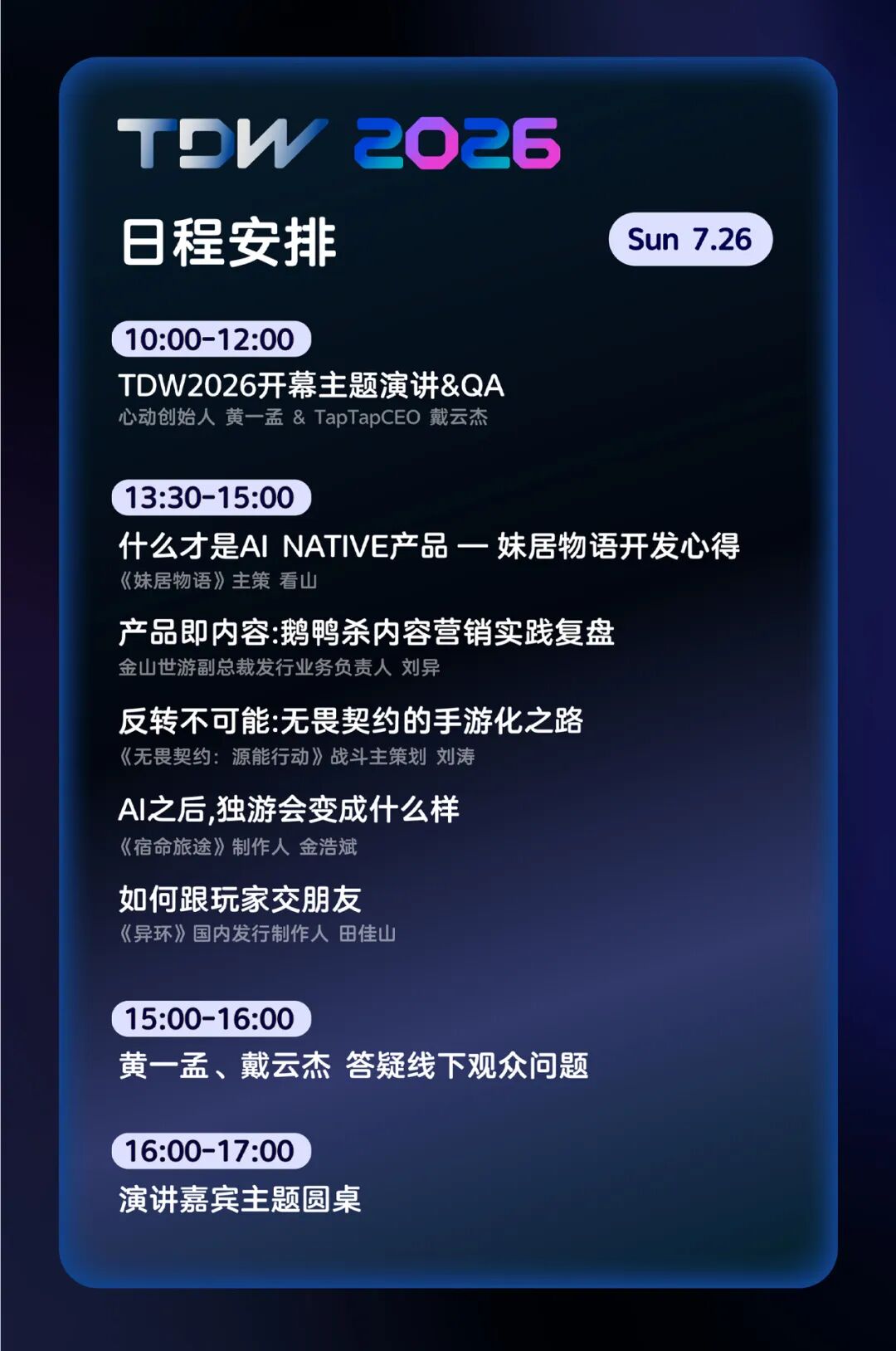
The two-hour morning session was hosted by Huang Yimeng, founder of Xindong, and Dai Yunjie, CEO of TapTap. Half of the time was devoted to presentations, and the other half to answering questions submitted in advance by developers.The afternoon featured six presentations by industry professionals, followed by Huang Yimeng and Dai Yunjie taking the stage once again to spend an hour answering impromptu questions from the audience, with the event concluding with a panel discussion.
This marks the eighth year of TDW. In 2019, the first TDW was held at THE NEST in Shanghai, with an audience of just over a hundred people; Huang Yimeng stood on stage no more than 5 meters from the front row. Eight years later, the event has evolved from a small salon into an annual gathering that attracts tens of thousands of attendees through both in-person sessions and live online streams.
The topics discussed on stage have always been closely aligned with industry trends. At present, a developer salon like this—organized by the platform and centered on “practical insights and Q&A sessions”—is particularly worth paying attention to.
01
What Messages Are Hidden in This Year's List?
TDW has always been very particular about who it invites to take the stage.
At last year’s seventh salon, the lineup of speakers was clearly skewed toward the PC sector, with the head of PC operations at Thunder Games and the producer of *Ghost Valley Eight Deserts* both on the roster—a move that aligned with TapTap’s focus on the PC version. Looking back further, the heads of games such as *Arknights* and *Genshin Impact* have also taken the stage to share their insights.It can be said that the focus of the speaker lineup often reflects industry trends and the platform’s strategic priorities.
One of the highlights of this year’s event is the industry panel discussion scheduled for the afternoon.
The mobile game *Goose and Duck Kill* is a prime example of a breakout success in the market in recent years.Published and operated by Kingsoft World Games, this social deduction game surpassed 10 million new registered users within six days of its launch in January of this year. At a time when user acquisition through paid advertising remains the industry norm, cases like this—where organic growth is driven primarily by social networks and live-streaming content—are rare.
"Valorant: Origin" is a 5v5 competitive FPS co-developed by Riot Games and Tencent’s Photon Studio. Since its launch, it has surpassed 10 million daily active users (DAU), with a combined monthly active user base of over 50 million across PC and mobile platforms. Tencent’s financial report lists it as the most successful mobile game released in 2025.
As China’s first supernatural urban open-world RPG built on the UE5 engine and set to launch this year, *The Strange Ring* distinguishes itself through its supernatural urban setting and diverse city-building mechanics. By launching simultaneously across all platforms—including PC, mobile, Mac, HarmonyOS, and consoles—the game’s multi-platform release strategy has helped it garner positive market feedback since its launch.
In this regard, the TapTap platform has provided significant support. As the first game to be tightly integrated with both the mobile and PC versions of TapTap, *The Ring* has garnered nearly 7 million downloads across both platforms.
Also on the list is a much smaller-scale title called *Sister’s Home Story*. This is an AI-driven casual game: the characters are powered by large language models, possess long-term memory, and their personalities evolve as players interact with them. While it isn’t as well-known as the other titles on the list, it represents one possibility for AI-native games, aligning perfectly with this year’s hottest industry topic.Currently, the game has 560,000 pre-registrations on TapTap and over 1,700 reviews, with many beta testers writing “short essays” of over a thousand characters in the comments section.
Taken together, these presentations cover virtually all the core topics that developers are most concerned about today. The speakers are all front-line professionals, and their discussions focus on actual business initiatives currently underway; for their peers, this offers far greater practical value than purely theoretical methodologies.
Among the lineup, one session deserves special attention: “TapTap Makers.” At last year’s TDW, Huang Yimeng announced a new upgrade for TapTap: not only to “help players discover great games,” but also to “help developers create great games.”
Earlier this year, they launched “TapTap Maker,” an AI-powered game creation tool. The head of TapTap Maker, who is responsible for rolling out this new product, will also attend this year’s TDW, and developers who have created successful products using “TapTap Maker” will take the stage to share their experiences.
02
How many of last year's predictions came true?
At last year’s TDW, Huang Yimeng offered his take on industry trends: AI-powered programming has lowered the barrier to entry for game development to “an astonishingly low level,” yet 99% of people still haven’t taken that first step.
The obstacles are mainly concentrated at “both ends”: on one end, complex development environment configurations hinder getting started; on the other, the cumbersome listing process in traditional app stores slows down release.In the age of AI, a working prototype can be generated in just a few minutes, but getting it listed requires purchasing a developer account, packaging the app, and waiting for review—a process that takes far longer than the actual creation. Therefore, he concluded that the traditional app store model is no longer suited for the era of AI programming.
A year has passed, and the industry’s trajectory has largely confirmed this assessment: “Vibe Coding” has become part of many developers’ daily routines, the barriers to entry have indeed lowered, and the two obstacles he mentioned have consequently become real challenges faced by more creators.
On January 30 of this year, TapTap’s 10th anniversary, the AI game creation tool “TapTap Maker” launched its closed beta, with the tagline “Conversation is creation; completion is publication.” Creators don’t need to set up an environment or write code; they can simply describe their ideas in natural language to generate games and publish them directly to the TapTap community ecosystem.
In the six months following its launch, the product implemented a series of initiatives. At the Shanghai leg of the 24-Hour GameJam in late March, 142 developers submitted 165 games; the official account serialized a developer’s practical guide, publishing 12 installments over three months;On July 2, “TapTap Maker” further expanded its local development mode, allowing creators to integrate mainstream AI programming tools via MCP, develop within their preferred workflows, and then publish their games on the platform.
For TapTap, this is not an isolated effort. As Huang Yimeng put it last year: “We hope not only to ‘help players discover great games,’ but also to ‘help developers create great games.’”
In the first decade after its launch, TapTap primarily focused on helping creators “get noticed”—zero revenue sharing, editor’s picks, and community reviews all served this purpose. In recent years, services such as Campfire Testing, TDS (TapTap Developer Services), and “TapTap Manufacturing” have successively expanded to cover the testing and development phases.From “helping you publish” to “helping you test,” and now to “helping you build,” TapTap’s service chain has essentially covered the entire lifecycle of a game, from development to launch.
Therefore, “TapTap Manufacturing” taking the stage this time is about more than just introducing a new product. It has been a full year since the product was unveiled at the last TDW, and half a year since its launch—so how has it performed, what challenges have arisen, and what’s next? This presentation and the Q&A session that follows will provide a relatively comprehensive in-person update.
Now that the promises made in previous years have been fulfilled, taking a closer look at TDW’s new forward-looking assessments and strategic plans for the future this year will likely provide developers with even more tangible assistance.
03
Developers Talking to Developers
Unlike most platform companies, Xindong has a dual role: it operates TapTap and develops games on its own. As Huang Yimeng put it, “We are game developers ourselves… Many of the challenges people face in day-to-day game publishing are challenges we face as well.”
The identity of a developer predates that of a platform. In 2016, when Huang Yimeng announced the launch of TapTap, he described the situation at the time: when players opened the Android app store, they were inundated with games they didn’t want to play;For developers, the overall environment “made everyone feel utterly hopeless,” and TapTap was conceived out of that very despair—no co-publishing, zero revenue sharing, with income derived solely from advertising.
When it comes to refining its service tools, Xindong also tends to use its in-house development team as “guinea pigs” to test and refine new features. Many of TapTap’s tools and services are first made available to the in-house development team for trial; only after confirming that they solve the problems are they officially rolled out to the industry.
Putting knowledge into practice is often difficult.At previous TDW events, developers have also raised concerns, such as: If the platform trades profit margins for developers’ support, will those promises still hold once the platform grows large enough? When allocating traffic, can the platform treat commercial games with budgets for user acquisition and high-quality indie games with limited budgets equally?These questions cannot be answered in a single sentence. TapTap’s solution is to return once a year to settle accounts face-to-face.
At previous TDW events, Huang Yimeng and TapTap’s management team shared a great deal of concrete data: TapTap keeps the proportion of ad impressions on the homepage below 20%; the top spot on the homepage is always reserved for editor’s picks, and the share of impressions for editor’s picks increased from 7% to 14% between 2024 and 2025;35% of all users on the platform actively search for games, while home page recommendations account for less than 40% of total game distribution…
“We’ve always remained vigilant—we absolutely do not want TapTap to grow into a platform ‘monster’ that becomes estranged from developers and turns its back on them.”Huang Yimeng also said: “I am well aware that when TapTap’s user base and distribution capabilities reach the scale they have today, developers might smile and go along with us even if we made the most unreasonable demands. That is a terrifying prospect, and we will certainly prevent it from happening.”
Given current industry trends, what insights will TapTap share? On July 26, I’ll be tuning in to the livestream.
原创文章,作者:游茶妹儿,禁止转载:https://youxichaguan.com/en/archives/208164