In recent years, competition in the gaming market has become increasingly fierce—not only domestically, but also in the overseas market, where competition has reached new heights.
According to data from Sensor Tower, total downloads of mobile games overseas reached 22.2 billion in the first half of 2026, a 4% decline from the previous quarter.The continued narrowing of user growth potential has directly driven up customer acquisition barriers and advertising costs. Adjust’s “2026 Gaming App Insights Report” clearly states that in 2025, the global cost per install (CPI) for gaming apps rose 30% year-over-year to $0.56,while the cost per thousand impressions (CPM) also rose from $3.63 to $4.34, a 20% year-over-year increase. The pressure from this round of cost increases has carried over into 2026.
In the past, the industry narrative surrounding the global expansion of games was based on a simple consensus: the overseas market is larger, so by bringing high-quality domestic games to the global stage and using user acquisition to attract players, scale can be achieved.
However, with customer acquisition costs continuing to rise, this simplistic and heavy-handed growth model is losing its effectiveness.
In conversations with Teahouse, many companies have mentioned that, rather than investing resources in the battle for traffic, they are now more concerned with how to maximize the effectiveness of every advertising dollar and how to ensure that every user they acquire generates greater returns.
Clearly, the shifting landscape of the global gaming market is forcing industry players to rethink their growth strategies, shifting from simply chasing traffic to focusing on the long-term value of their users.
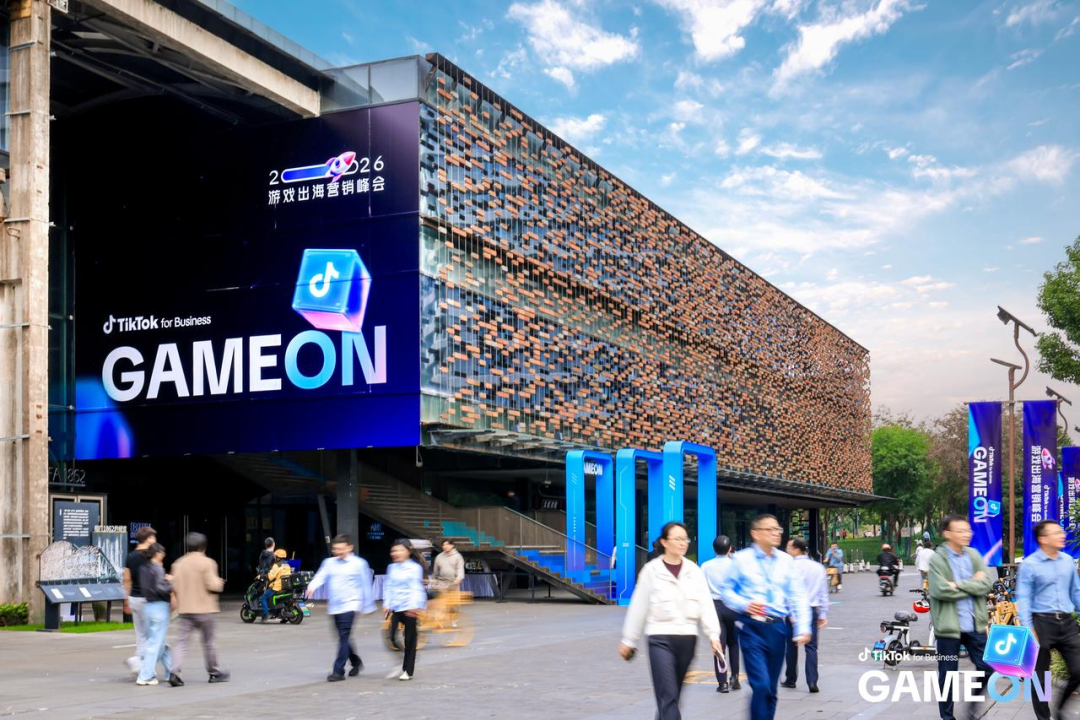
At the recently held “2026 TikTok for Business Global Gaming Marketing Summit,” a full-funnel growth methodology centered on content management, performance optimization, and scientific measurement directly addressed this shift in the industry’s growth logic and charted a course for developers to implement sustainable user engagement strategies.

01
Synergy of Three Forces to Achieve Long-Term Player Retention
When it comes to cultivating long-term user value, the focus ultimately lies with the game’s users—that is, the players. A player’s journey with a game typically involves several stages, including the spark of interest, initial exposure and awareness, downloading and trying the game, long-term engagement, and organic word-of-mouth.
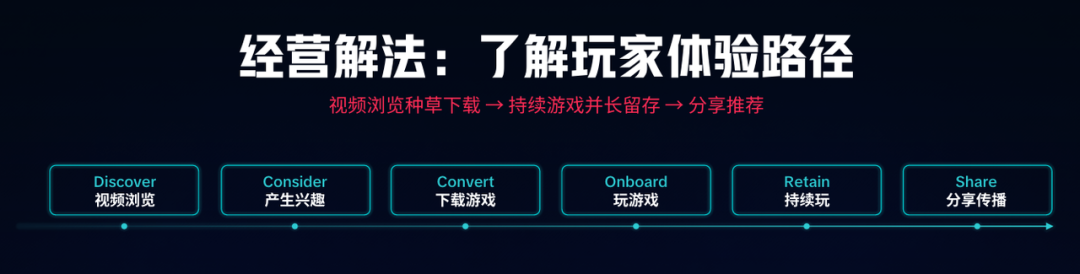
However, the traditional “volume-driven” mindset has largely focused solely on customer acquisition and downloads, neglecting both the initial stage of sparking interest and the ongoing efforts required after a download—such as user retention, deep conversion, repeat visits, and word-of-mouth promotion.As a result, front-end customer acquisition costs continue to rise, while back-end user value remains difficult to realize, causing the growth model to fall into a structural imbalance characterized by “high investment, low retention, and weak compounding effects.”
Therefore, to effectively manage long-term users, the key is to bridge the gaps at both ends of the user journey and maximize the value of each player through a full-funnel management strategy.So, what specific steps should game developers take? Looking at successful cases on the market, while approaches vary widely, they can be summarized as the synergistic interaction of three core capabilities: content management, performance optimization, and scientific measurement.
- Content Management
Among these, content management is the starting point of the entire process.
Today, players have access to an increasingly diverse range of channels to discover games: in addition to traditional advertising, influencer reviews, player-generated content (UGC), live-stream clips, and even a viral gaming meme can serve as gateways for players to learn about a game.
By leveraging this diverse range of content, developers can break free from the limitations of one-way, hard-sell advertising and build a bridge of communication with potential players even before they enter the game, subtly raising awareness and sparking interest in playing.Often, when a short video makes a player think, “This game looks kind of interesting,” the desire to download it has already begun to take root.
The power of content relies on a stable and ample supply. Therefore, many game developers combine TikTok One—TikTok for Business’s integrated influencer creative solutions platform—with the GIP Gaming Partner Program and the “Branded Buzz” trend marketing capabilities to drive creators of varying scales to produce native content, continuously enriching the game’s content matrix and revitalizing the community ecosystem,while leveraging the spread of native content and the momentum of trending topics to generate widespread sharing and discussion within player communities.

These ongoing content marketing efforts will continuously expand the game’s reach, gradually building awareness and fostering goodwill among a broader audience of potential players, and naturally inspiring more users to give the game a try.
- Performance Optimization
If content management is responsible for “shaping players’ first impression of the game and sparking their interest,” then performance optimization addresses the question of “how to get more users to download the game and keep playing it.”
In the past, game marketing campaigns primarily focused on CPI (Cost Per Install) as the key metric, using advertising gimmicks to prioritize users who were highly likely to click and had low conversion barriers, while neglecting the actual fit between the user and the game.While this approach appeared to keep customer acquisition costs under control, the lack of alignment between users and the product led to rapid churn after download. Ultimately, revenue failed to keep pace with user acquisition expenses, forcing developers to continually increase their budgets to purchase new traffic—thus trapping them in a vicious cycle of “spending money to acquire users—user churn—spending more money to acquire users.”
The key to optimizing performance lies in moving beyond a single customer acquisition metric and allocating the advertising budget toward audiences that better align with promotional goals. Implementing this isn’t complicated: by integrating the TikTok SDK, you can now send back richer, more timely data in real time, enabling the advertising model to better understand the target audience.
Based on this, the Target ROAS bidding strategy anchors itself to the ROI targets predefined by the advertiser, helping the system target audiences more precisely: On the one hand, it can use the D0 window to identify high-spending users who generate value on the day of installation and deliver a faster return on investment;on the other hand, the platform is also continuously extending the optimization cycle to help advertisers direct their budgets toward audiences with higher long-term value, thereby achieving value optimization over a longer timeframe.
Only when the users you attract are people who will stay and continue to add value does customer acquisition truly shift from a “cost” to an “investment.”

- Scientific Measurement
Scientific measurement, on the other hand, serves as a “bridge” for continuously building user value.
Another key factor that distinguishes player engagement from traditional advertising is that it is by no means a one-time investment, but rather a long-term endeavor that can be continuously iterated and cycled.To achieve this, scientific measurement is essential. It transforms every step a player takes into actionable data that can be interpreted, evaluated, and reused, enabling developers to clearly understand whether their strategies are effective and identify areas for improvement.
But with user data scattered across content platforms, ad placements, and organic traffic, how can companies piece together a complete picture of player retention?
The TikTok Market Scope marketing data insights platform addresses precisely this issue.It brings content popularity, audience engagement, and campaign performance together in a single dashboard, helping brands gain clarity on the true impact of their marketing efforts, the long-term value of users, and the potential for budget and market growth. The insights derived from these metrics can, in turn, guide content strategy and performance optimization, enabling brands to continuously amplify high-value content and refine their targeting.
In short, metrics are not the end goal of player management, but rather the starting point for optimizing the player management process.
Looking back, content management, performance optimization, and scientific measurement are not three isolated marketing activities, but rather a comprehensive, synergistic system: content management “sparks interest” at the front end, building up players’ interest; performance optimization capitalizes on this interest to precisely drive target users toward conversion;Measurement, in turn, reviews the entire user journey, feeding data insights back into content creation and ad placement to ensure the next round of strategies is well-targeted.
These three elements are closely interlinked and span the entire player journey—from initial exposure and interest to download and deep engagement—together forming a growth funnel centered on the player lifecycle, thereby supporting the game’s path toward more stable and sustainable growth.
02
Tailored Approaches: Customizing Growth Paths for Different Games
At the practical level, business objectives naturally vary depending on the game genre, monetization model, and operational stage. To truly establish a successful growth pipeline that integrates content management, performance optimization, and scientific measurement, it is essential to tailor strategies to the product’s unique characteristics and business needs.
For example, IAP games that rely primarily on in-app purchases for revenue tend to feature more hardcore themes and gameplay, have longer lifecycles, and offer deeper monetization; their primary business objective is usually to “attract more paying users.”
As a result, the hype cycle for these types of games begins earlier,Many games begin producing a steady stream of original content—such as live-action storylines, gameplay demonstrations, and influencer reviews—as early as the pre-registration phase. By laying the groundwork for the game’s world-building, showcasing strategic depth, and providing authentic user feedback, they gradually build players’ understanding of and connection to the game’s system, fostering a willingness to download and a willingness to pay right from the initial engagement stage.After all, only in-depth content can more quickly identify users who are willing to stay and spend money.
The product launch strategy proceeds at a “shallow-to-deep” pace: In the early stages after launch, the focus is on optimizing downloads to achieve a cold start and accumulate installation and new-user behavior signals; during subsequent operations, the optimization goals are gradually shifted toward paid events to increase the overall depth of user spending.While focusing on short-term ROI, developers also extend their observation window to identify highly engaged players with long-term monetization potential, thereby avoiding the risk of missing out on true high-spending users by focusing solely on first-day conversions.
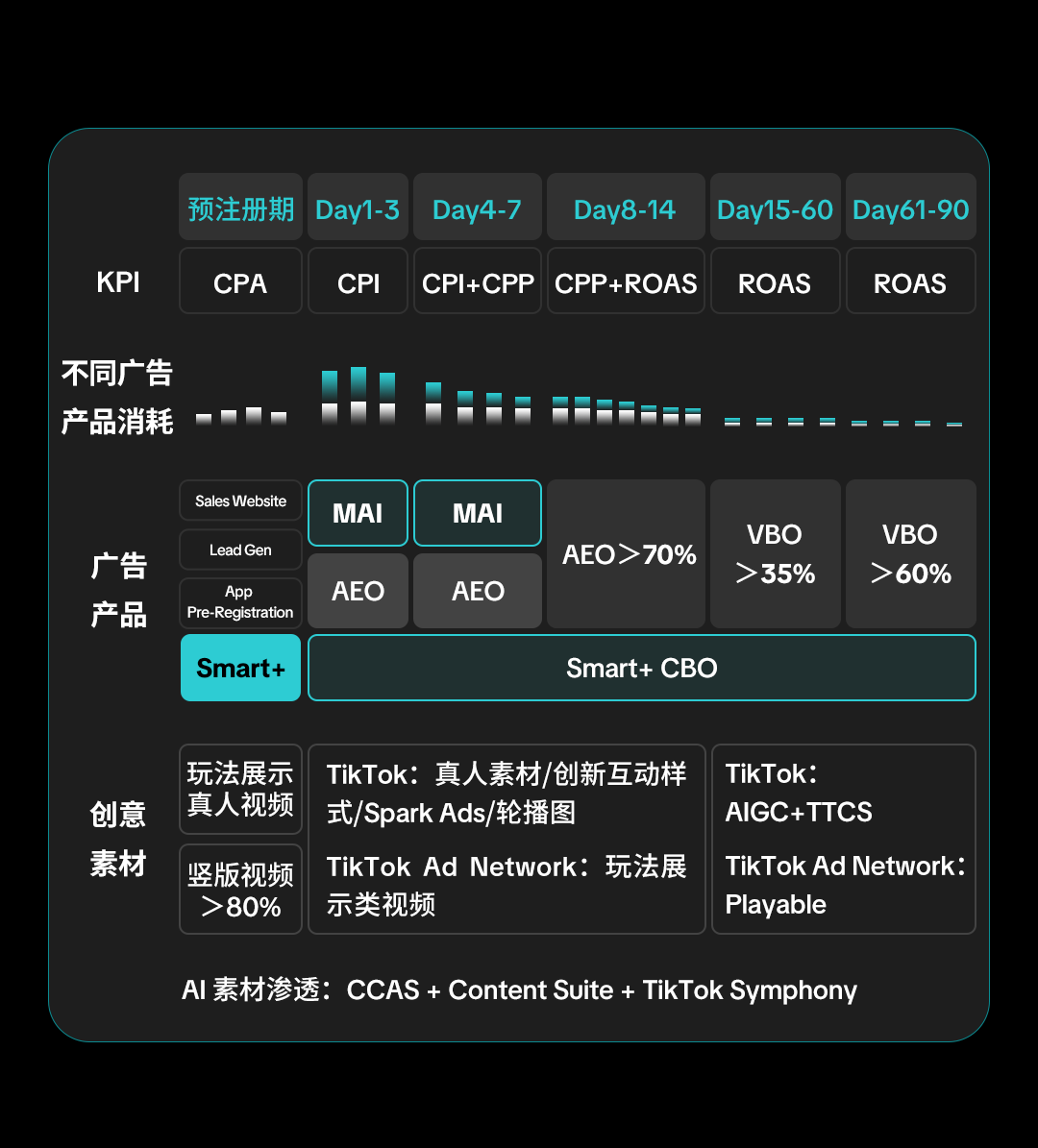
A new SLG game serves as a classic example: the team first used MAI (Download Optimization) to drive download volume; then switched to AEO (Event Optimization) to filter traffic based on new-user behavior events such as registration and completing levels; once there was a sufficient sample size of conversions, they gradually increased the proportion of VBO (Value Optimization), allowing the system to automatically optimize performance based on monetization signals.Ultimately, while ad spend continued to grow, the game achieved a 37% reduction in CPA and an 85% increase in D0 ROAS.
Consequently, the monetization of IAA games relies primarily on advertising revenue, which means their business focus is not on “identifying users with high spending potential,” but rather on identifying users who are willing to view ads and can generate advertising revenue.
Therefore, in terms of content strategy, these types of games place greater emphasis on “short, simple, and fast” approaches, focusing on playable demos, highlights of gameplay, and lightweight AI-generated content. By releasing entertaining content through frequent updates, they quickly drive up clicks and downloads.
Ad campaigns also begin with download optimization, then shift optimization goals in phases, using ad revenue as the benchmark for optimization and allocating the budget to traffic that actually generates ad revenue. For IAA games that aim for long-term operation, the focus is also on evaluating the long-term ad value that users bring, and scaling up traffic continuously while ensuring a controllable return on investment.
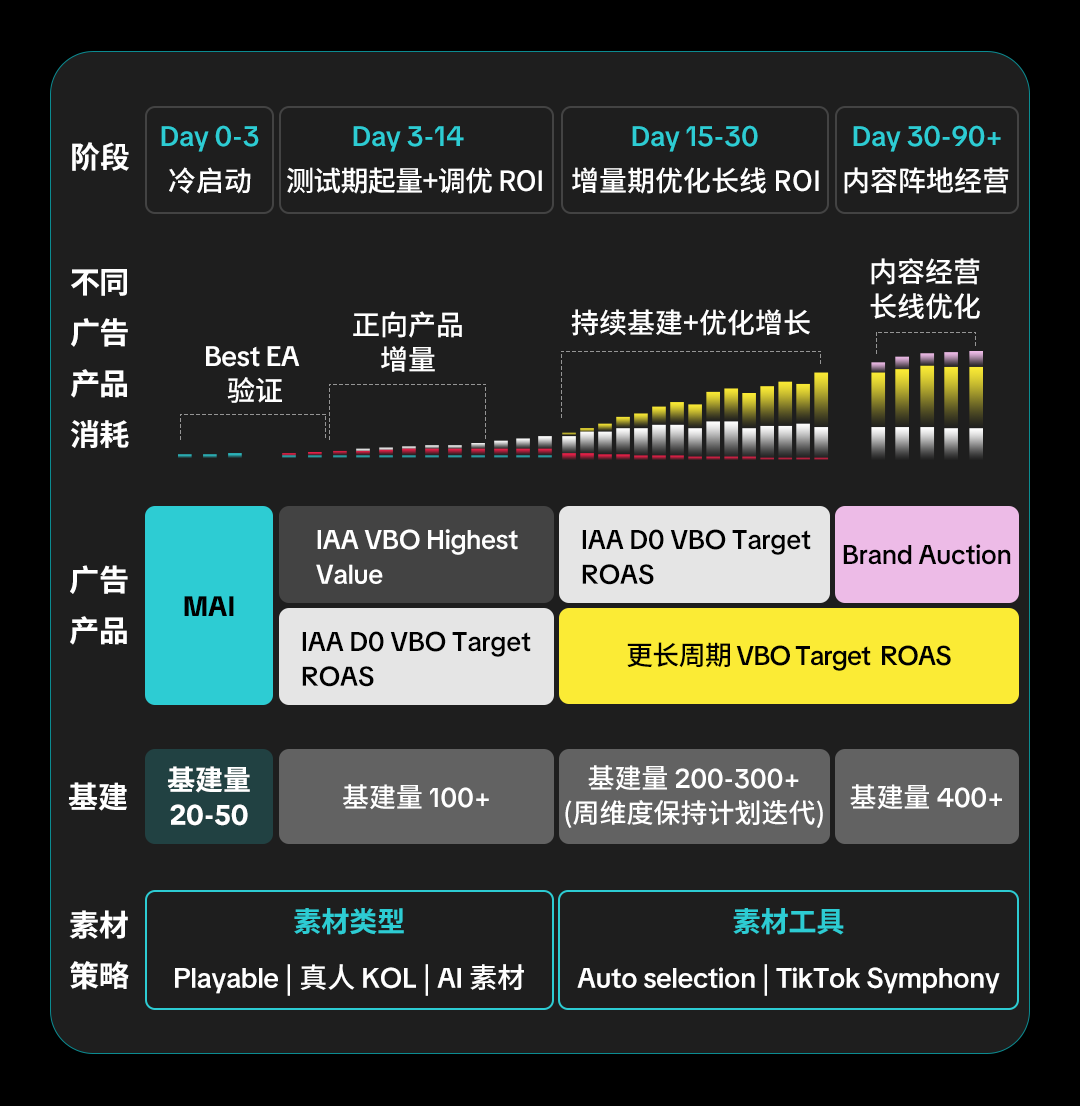
A certain IAA hit campaign used ad monetization signals transmitted in real time via the TikTok SDK to continuously calibrate its model’s ability to identify users with high ad intent. As a result, it not only achieved higher return-on-investment targets but also increased its ad spend by 132%.
03
AI-Powered Solutions to Further Improve Game Operations Efficiency
In the process of running a game, creative content has always been the key driver of growth.
However, as the focus of business operations shifts from one-time customer acquisition to long-term engagement with users, creative output and supply are becoming a new bottleneck for many companies expanding overseas:The scale of creative demand continues to grow, content iteration cycles are becoming increasingly shorter, and the process of screening and collaborating with influencers is particularly cumbersome. A significant amount of manpower is consumed in these stages, yet it remains difficult to meet the demand for high-frequency, diverse content.
Fortunately, the maturity of AI tools today has opened up a more efficient path for the creation and iteration of creative work.
In the creative production process, many game developers have already used TikTok for Business’s Symphony Creative Studio to leverage its extensive capabilities—such as “image-to-video,” “reference image-to-video,” and “text-to-video”—to quickly create ad content from scratch, producing a large volume of creative content tailored to different languages and regions.
Building on this AI-generated raw creative content, the TTAM system can further utilize its AI automation capabilities to generate creative variations and perform intelligent filtering. While automating ad delivery, it eliminates underperforming creatives and scales creative output from 1 to 100, effectively alleviating the widespread issues of insufficient creative production capacity and creative fatigue in the gaming industry.

A certain IAP game leveraged this capability to mass-produce a large volume of first-person perspective and script-based montage content, ultimately achieving a 37% increase in CVR and a 65% decrease in CPA. By lowering customer acquisition costs while driving higher conversions, the game fully demonstrated the practical value of AI in content iteration.
In addition to using AI to boost efficiency, making effective use of influencers’ native content is equally crucial; influencers’ authentic expressions of their experiences are often more persuasive and credible than manufacturers’ “self-promotional” messages.The value of the TikTok One integrated influencer creative solution platform, mentioned earlier, lies in significantly streamlining the process of influencer selection, matching, and content promotion, enabling marketing to move from “finding the right influencers” to “launching the campaign” more quickly and precisely.
Taking a certain IAA puzzle game as an example, the team did not limit itself to the gaming niche but instead collaborated with influencers across broad categories such as family, food, and leisure. By leveraging visually striking native short videos for product placement and traffic generation, they successfully increased the conversion rate (CVR) by 27% and reduced the cost per acquisition (CPA) by 57%.
More importantly, in addition to this high-quality creator content, Content Suite also helps identify high-quality brand-related UGC. Through Content Suite, brands can obtain one-click authorization for native content, which is then curated into Spark Ads creative assets. This streamlines the process from “distribution of high-quality content” to “amplified ad placement,” enabling great content to reach a wider audience and engage more target users.
AI addresses “output” and “efficiency” in content creation, while influencer content provides “trust” and “authenticity.”The two complement each other, continuously supplying creative assets for content management, providing materials that can be tested frequently for performance optimization, and accumulating a sufficiently rich sample of variables for scientific measurement—all of which collectively support overseas game developers in achieving long-term player retention.
END
In summary, as the growth model for games expanding into overseas markets has shifted, the operational needs of game developers have also undergone significant changes: Today, what developers need goes far beyond a single ad slot or a one-time user acquisition opportunity; they require a comprehensive set of operational capabilities that integrates content management, performance optimization, and scientific measurement.
This is why, in the new phase of global game expansion in 2026, TikTok for Business has become a key partner for a large number of game developers expanding overseas. To summarize its recently announced brand positioning: “Watch it. Love it. Want it.”—the platform is integrating player discovery, interest cultivation, and commercial conversion into a single experiential journey.Through this approach, users progress from casually scrolling through short videos to developing an interest, downloading the game to try it out, and ultimately becoming core users with long-term retention—completing the transformation from “stumbling upon” to “staying.” And this is precisely the ultimate goal of long-term player retention.
In the future, as the platform’s content ecosystem and operational tools continue to evolve and improve, this business workflow will undoubtedly become even more refined, providing game developers with more comprehensive support for growth.Teahouse also believes that, amid persistently high CPI and increasingly fierce competition for user acquisition, only teams that move beyond short-term traffic-focused thinking and dedicate themselves to deepening user value will have a better chance of charting a stable and sustainable growth trajectory in the volatile global market.
原创文章,作者:游茶妹儿,禁止转载:https://youxichaguan.com/en/archives/223108