By Wang Peng, Tencent Research Institute
The Paradox of the Age of Acceleration:
When “Your AI” Starts Talking to “My AI”
In 2026, artificial intelligence is undergoing a profound shift in its role: moving beyond the “conversational interaction” of recent years toward “autonomous delivery.”
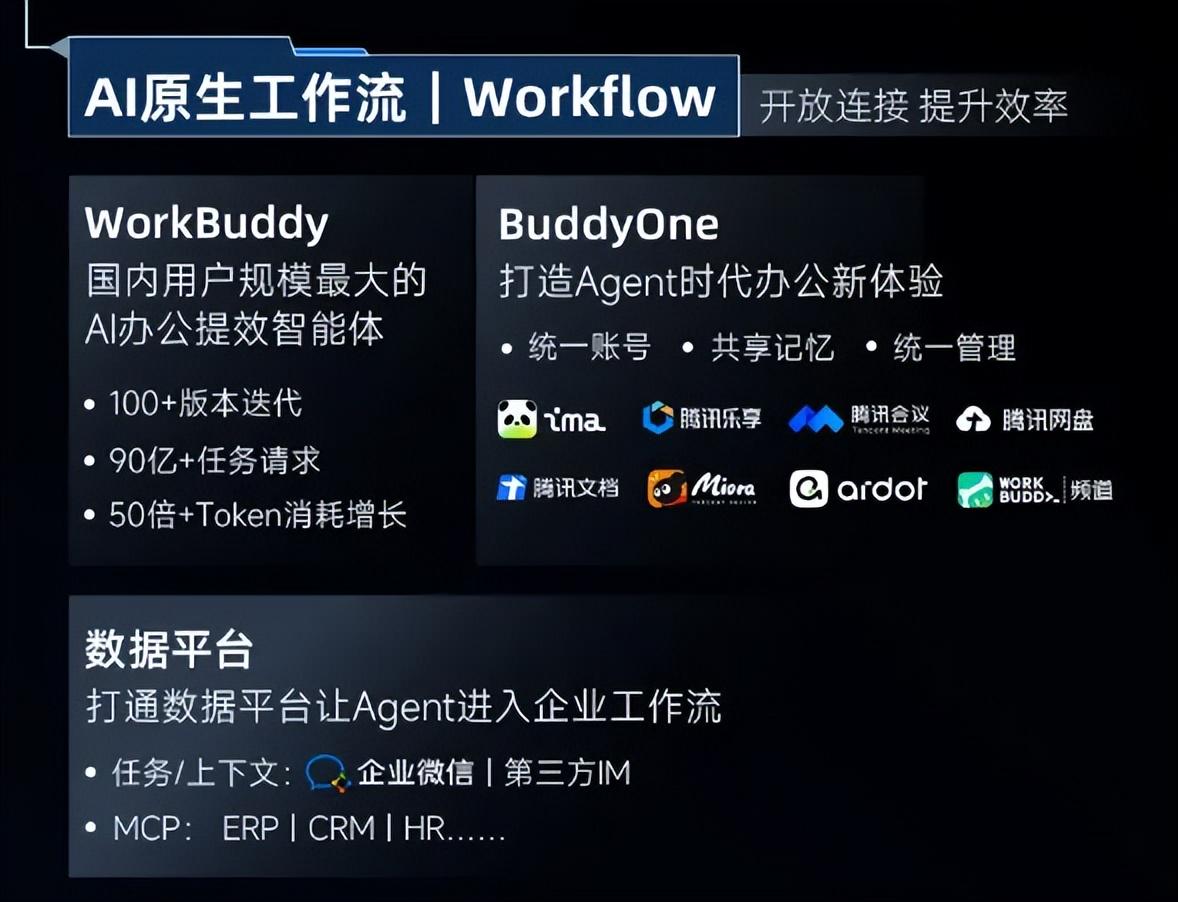
In the past, AI was confined to a dialog box in the sidebar of the screen—you asked, it answered, offering only suggestions for reference. Today, however, AI agents are stepping out of the dialog box and becoming truly embedded in daily workflows.As the AI productivity agent with the largest user base in China, Tencent WorkBuddy—after more than 100 version updates—has processed over 9 billion task requests, driving a more than 50-fold increase in token consumption;According to August desktop data from a third-party AI product ranking, the total monthly active users (MAU) for domestic AI office agents on desktop platforms have reached 33.16 million, with WorkBuddy ranking first overall and accounting for more than one-third of the MAU in this sector.On the front lines of business operations, Mengniu launched 45 “digital employees” through an internal AI innovation competition, reducing the time required for veterinary diagnosis at a single dairy farm from 1.5 days to 2 hours;Shanghai Jahwa has rolled out WorkBuddy at scale across nine departments, reducing the time required to reconcile 60 million lines of logistics invoices—which previously took 4.5–6 person-days per month—to less than 20 minutes.
It is an indisputable fact that single-point workflows have become more efficient. But as we race forward at breakneck speed driven by AI, a subtle form of workplace alienation is quietly taking hold:
In many organizations that have been at the forefront of adopting AI tools, reports and documents are increasingly showing signs of AI influence.Typically, one person uses AI to generate a lengthy 10,000-character document in just a few minutes and sends it to a colleague; the recipient, who doesn’t even have time to read it thoroughly, then uses their own AI to condense the document into three bullet points.
When communication devolves into “your AI talking to my AI,” the volume of information swells several-fold, while the genuine exchange of ideas between people is diluted.
This is precisely the probing question—one that hits the nail on the head—posed at the 2026 Tencent Global Digital Ecosystem Conference: Does a team full of “super individuals” automatically become a “super team”?
The answer is usually not very encouraging: not yet.If departments still rely on lengthy meetings to align their approaches, if different teams keep reinventing the wheel with the same solutions, and if critical insights remain locked away in the minds of a select few—then the faster individual contributors work, the more likely the resulting flood of information will become a burden for the organization to process and filter.While efficiency at the individual level has improved, the friction within the organization has offset the benefits of collective collaboration.
At a time when the entire industry is touting “AI Native,” perhaps what we need most is a dose of “People Native” clarity. As an AI technology company, Tencent has always upheld a clear, compassionate, and fundamental value proposition: “To inspire trust and empower people.”
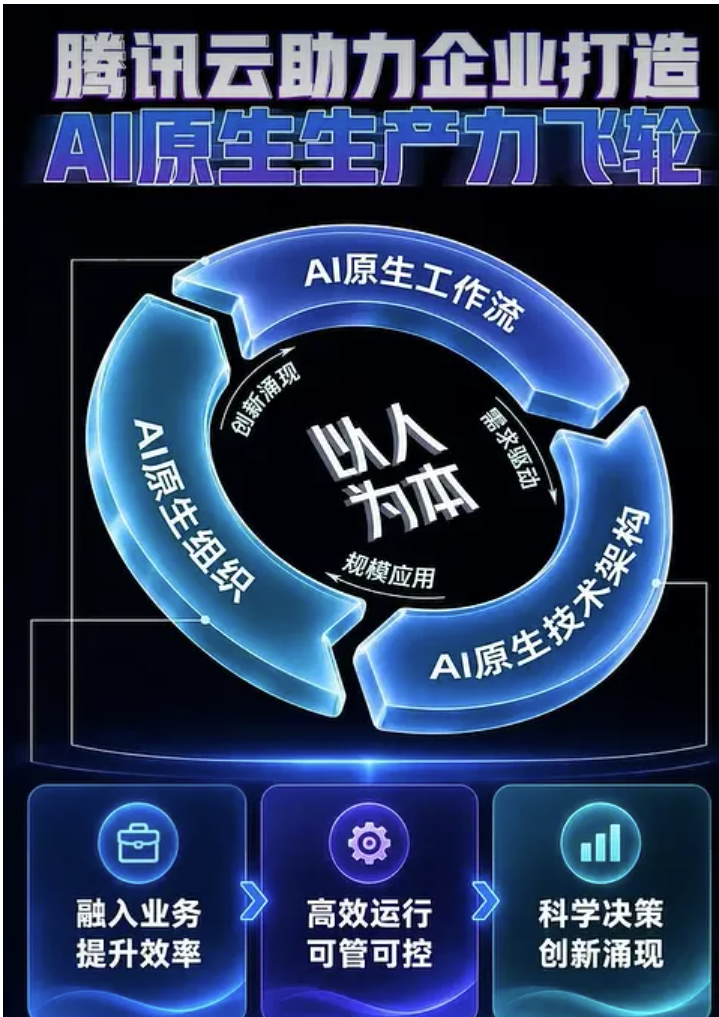
At this year’s Global Digital Ecosystem Conference, this concept was articulated as a framework centered on a “people-first” approach:“AI-Native Productivity Flywheel”—driven by AI-native workflows to boost efficiency, underpinned by AI-native technical architectures to ensure manageability and controllability, and facilitated by AI-native organizations to promote human-machine collaboration and foster innovation.Behind this flywheel lies the profound dialectic of the era of intelligent agents regarding “speed and slowness,” “machines and humans,” and “the individual and the community.”
Reassuring:
Only when the underlying layer is “manageable and controllable,”
Technology Must Move Toward “Widespread Adoption” Within Organizations
Why is it that, within the flywheel of corporate evolution, once a workflow is up and running, the technical architecture must immediately take over to ensure “efficient operation, manageability, and controllability”? Because when AI shifts from “chatting with people” to “performing tasks for people,” the logic underlying trust between humans and machines undergoes a fundamental change.
When generative AI first emerged, people viewed it much like a toddler taking its first steps—it could write poetry and draw pictures, and while it occasionally gave off-topic answers, users found it novel and were extremely tolerant.But when task requests in workflows exploded to the billions, and when AI agents truly entered the core business processes of enterprises—beginning to modify code, reconcile accounts, send notifications, and process approvals on behalf of humans—that tolerance gave way to caution: Could it overstep its authority and access private information it shouldn’t see?And if its logic goes off the rails in the background, who will be held accountable for the consequences?
While speed changes the way we work, it must never compromise engineering and regulatory standards; stability, security, and availability remain non-negotiable long-term assets in the digital age. Without a “manageable and controllable” technical architecture, AI will forever remain confined to small-scale, individual experimentation and will be unable to advance toward enterprise-level “at-scale deployment.”
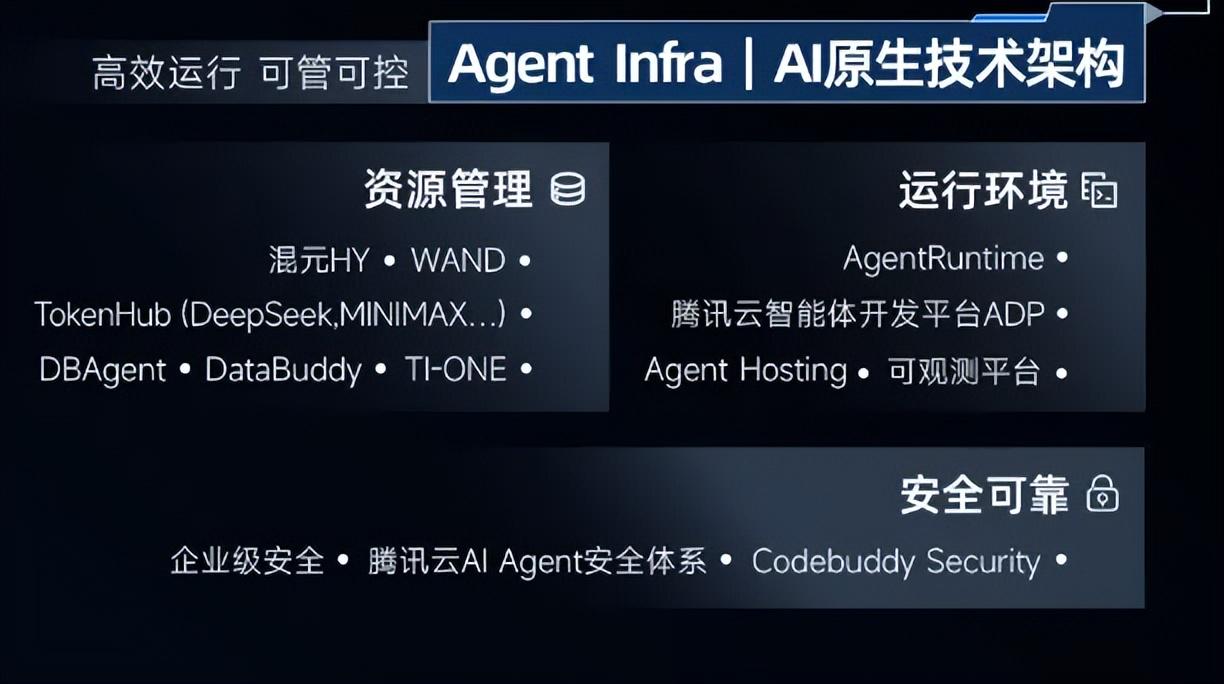
In human society, the reason we dare to entrust a task to a colleague is not because that person will never make a mistake, but because there are clear boundaries, safety-net mechanisms, and transparent communication between us.If we look beyond the technical surface of Tencent’s restructuring of its underlying AI-native technical architecture (Agent Infra), from a humanistic and governance perspective, it actually establishes a threefold institutional contract centered on “peace of mind”:
First, there are well-defined boundaries of authority—“carry out tasks on behalf of others, but never overstep one’s authority.” Blurred boundaries between a person and their agent are the greatest pitfall. Within the security framework and WeCom mechanisms established by Tencent, there is one ironclad rule: an AI agent may execute tasks on behalf of a user, but it never automatically inherits all of the user’s permissions by default.It operates strictly within the scope of authorization granted by “you”—documents you normally cannot view and groups you cannot join remain off-limits to the AI as well; and whenever sensitive actions are involved, such as sending external messages or modifying core configurations, the system must pause and wait for you to provide secondary confirmation via the client.
Second, it provides a safety net for error tolerance—“leaving room for exploration while putting safeguards in place for mistakes.” Whether it’s human innovation or an AI agent’s exploration, neither can proceed without trial and error. Many organizations are hesitant to adopt AI on a large scale because they “cannot afford to make mistakes” in their production systems.To address this, the underlying open-source security sandbox creates an independent “digital workstation” for each intelligent agent, establishing four rigid barriers around computing, networking, data, and credentials—“without interfering with its flexibility, but strictly containing its uncontrollable aspects.”” At the same time, the environment state supports real-time saving and rollback: even if an AI agent takes a wrong turn during experimentation, it can revert to the previous state, choose a different path, and start over—strictly confining the cost of trial and error within the containment barriers.
Third, it is a traceable and transparent process—“opening the black box to make actions traceable.” The unknown is most likely to breed suspicion. Traditional software monitoring only records a single line of error logs, whereas when an AI agent “gives an incorrect answer,” it often does not generate an error.Through an end-to-end observability platform, the agent’s background task execution, knowledge retrieval, and tool invocation trails are fully reconstructed. Only when we can see exactly how it makes decisions step by step and pinpoint where deviations occur can machines cease to be unsettling black boxes.
Ultimately, the essence of “peace of mind” lies in establishing a deep “human-machine feedback loop” in human-machine collaboration—no matter how fast the intelligent system operates, at critical decision-making points, humans must always be able to see, understand, and intervene. The steering wheel and the final “right to brake” will always remain in human hands.
Zooming in on the Individual:
From “using tools to boost efficiency” to “amplifying capabilities,”
Human Autonomy and the “Three Slows”
When the foundational safeguards provide a sense of security, individuals gain the freedom to step back from the minutiae of daily life. But this brings with it another question regarding self-worth: If machines can write faster and calculate more accurately than I can, where exactly does that leave us as human beings?
Not long ago, the workplace discourse was rife with all sorts of anxiety-inducing discussions: some worried about the “collapse of the middle management,” while others debated whether young people were using new tools to replace their more experienced counterparts, or whether the experienced were using their expertise to suppress the younger generation.
However, in real-world industrial practice, we see a completely different answer: Regardless of past experience, background, or age, the true dividing line has never been seniority, but rather who possesses “agency”—who knows how to use an AI-driven mindset to redefine problems and mobilize resources.
Within Tencent’s “people-oriented” value system, AI has never been intended to replace or diminish humans, but rather to shift people’s role from being “data mines” and “cogs in the machine” back to being the “purpose” of the service.This is precisely the core message advocated by the “Human Career Evolution Plan” at this conference: “Amplify Skills, Evolve Careers.”
In AI-native workflows, this amplification of individual capabilities manifests as a clear division of labor between humans and machines: WorkBuddy takes on repetitive, routine tasks such as cross-system operations, organizing meeting minutes, and verifying reports; while humans take a step back to focus on thinking, creativity, problem-solving, questioning, verification, and evaluation.Whether in human resources, administration, law, finance and investment, or content creation, creative design, academic research, and marketing, every professional can summon experts in their field at any time from their dedicated workspace, transforming industry know-how into readily available capability modules, and allowing their digital assistant to increasingly understand their work habits through daily interaction.
As the barriers to “how to execute” are significantly lowered and production itself becomes cheaper, people’s core competitiveness is shifting entirely from the accumulation of external knowledge to the cultivation of internal qualities. In an era where AI accelerates the generation of everything, people need to “slow down” in three specific areas:
First, slow down and hone your “taste.” Ten proposals and a hundred lines of code can be generated in an instant, but which one truly hits the mark?Which architecture truly stands up to scrutiny? AI has raised the baseline for daily output, but the upper limit of work outcomes ultimately depends on human aesthetic intuition, value judgments, and the wisdom to make trade-offs. Whether we can make the right choices and truly do things well ultimately comes down to our sense of taste.
Second, slow down and “use your brain and speak clearly.” The more readily available tools become, the more we must guard against mental laziness.Freeing ourselves from the burden of mechanical formatting isn’t about relinquishing our right to think, but rather about preventing ourselves from being swept away by a dazzling array of new concepts—so we can return to first principles and ask: What real problem does this actually solve? What real value does it create?Eliminate clichés and redundancy, and distill deep thinking into the most sincere and essential insights.
Third, slow down to build “deep interpersonal trust.”AI agents can gather information and generate meeting minutes for you, but in real-world social and business interactions, the chemistry that sparks from face-to-face encounters—and the power of mutual understanding and empathy in complex situations—cannot be directly generated by any algorithm. The more advanced technology becomes, the more precious genuine human connection becomes.
Zooming in on the organization:
Blend into the existing organizational fabric,
Building on Assets and Fostering Innovation Through Human-Machine Collaboration
When an individual’s capabilities are amplified and the underlying security architecture supports large-scale deployment, the flywheel engages in its most critical phase: How can we truly evolve from isolated “AI-native workflows” to collective “AI-native organizations,” breaking free from the vicious cycle of “individual efficiency gains versus organizational inefficiency”?
Over the past few years, many companies’ digital or AI transformations have faltered midway, often because they fell prey to the radical fantasy of “tearing everything down and starting over.” However, from the perspective of organizational sociology, any properly functioning enterprise is an organic entity composed of a complex division of labor, historical tacit understanding, and business inertia.Today, there is no one-size-fits-all “optimal organizational structure for the AI era.” The evolution toward AI-native organizations is bound to be a lengthy process, and no company can afford the cost of “first completely dismantling and rebuilding its existing organizational structure, business processes, and IT systems.”
Therefore, seamlessly integrating “AI-native workflows” with open connectivity into existing organizational structures and business processes is not a stopgap compromise, but rather the most urgent and objective starting point for organizational evolution.Among the digital and intelligent pioneers that Tencent has been tracking over the long term, the approaches adopted by organizations that have truly succeeded are remarkably consistent: they do not touch the organizational structure, do not alter business processes, and do not replace IT systems—instead, they start with the most repetitive tasks and integrate intelligent agents into the entry points employees are most familiar with in their daily work.
This is precisely the sociological logic behind Tencent’s use of WorkBuddy and BuddyOne to connect its office ecosystem: technology should proactively adapt to people’s habits and existing social networks, rather than forcing people to adapt to unfamiliar systems.
The new experience of “unified accounts, shared history, and centralized management” built through BuddyOne, along with the data platform’s integration with WeCom, third-party IM and ERP,CRM, HR, and other systems, these changes naturally weave themselves into the fabric of daily life: within WeCom, WorkBuddy is seamlessly integrated into the contact list, becoming a “digital colleague” in chat windows who can assign tasks at any time; in Tencent Docs, humans and AI collaborate in real time on the same document through “human-AI co-authoring”;in Tencent Meeting, pre-meeting scheduling flows seamlessly into post-meeting recording, transcription, and smart meeting minutes; and it also involves product and R&D personnel going to the front lines of industries such as education, sitting alongside teachers, and helping them refine their lesson preparation processes step by step while integrating system interfaces.
When discussions in WeChat Work group chats, decisions made in meetings, and knowledge accumulated in Tencent Docs, Tencent Lexiang, Tencent Cloud Drive, and IMA are shared within the authorized scope to create a “shared memory,” companies will no longer need to explain the full context to the AI every single time.
And when workflows are truly embedded within an organization, the three-fold, profound evolution of an “AI-native organization” follows naturally:
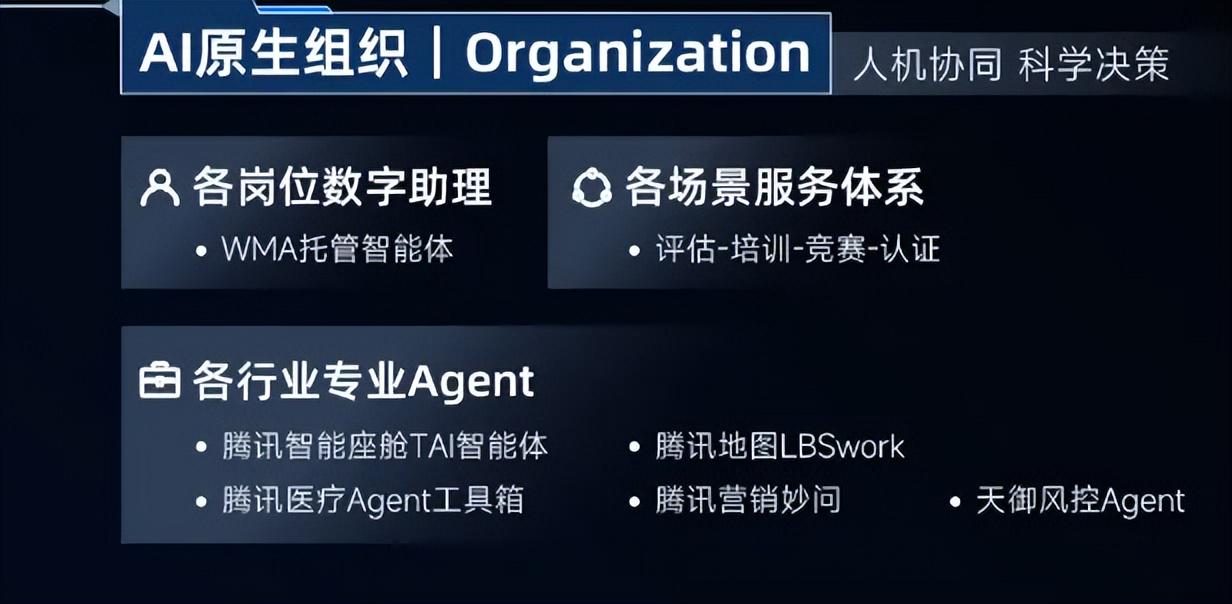
First, we promote human-machine collaboration by ensuring that every role and industry has a specialized partner. From the managed digital assistants (WMA) assigned to each role to industry-specific agents in fields such as healthcare, marketing, risk control, mapping, and smart cockpits, humans in the loop (HITL) provide contextual insight and aesthetic judgment,while multiple artificial intelligence entities in the loop (AITL) collaborate to counteract organizational entropy, assisting managers and frontline staff in making more scientifically sound decisions.
Second, it enriches organizational assets by transforming individual experience into collective memory. Through a comprehensive service system encompassing “assessment—training—competition—certification,” companies can systematically cultivate internal AI talent. At pioneering companies such as Mengniu and Shanghai Jahwa—which have produced dozens of “digital employees” by combining competitions with training—companies have further transformed mature business logic into reusable skills. Combined with the underlying processes of refining, de-identifying, and reviewing individual experiences, this approach turns the effective workflows pioneered by a single trailblazing employee into assets that the entire team can directly reuse—“What one person achieves becomes the starting point for everyone.”
Third, stimulate the emergence of innovation to create a virtuous cycle that feeds back into the workflow. As an organization’s assets grow and the barriers to accessing them decrease, frontline employees—who understand the business best—transform from mere process executors into creators of new tools and workflows.This “emergent innovation” within the organization continuously feeds back into business workflows, driving the entire flywheel cycle to gain momentum and ultimately forging deliverable, verifiable, and sustainable productivity.
People-Centered: Returning to the Essence of “People”
In a long chain of tasks, even minor errors can accumulate as the process progresses. This simple mathematical principle reminds us that the more adept AI becomes at handling deterministic tasks, the more humans must take responsibility for dealing with uncertainty—both in terms of direction and value.
When the AI agent steps outside the dialogue box,the “human-centered” AI-native productivity flywheel showcased by Tencent at the 2026 Global Digital Ecosystem Conference—which “instills confidence” through a highly efficient, manageable, and controllable technical architecture, and “amplifies human potential” through open, connected workflows and human-machine collaborative organizational evolution——ultimately points to a remarkably simple return to basics:
We must ensure that communication does not devolve into a meaningless exchange between machines, but rather returns to sincere interaction between people; we must ensure that technology does not become a source of anxiety hanging over our heads, but rather serves as a foundation that supports the abilities and creativity of ordinary people.
Let machines be machines, and humans be humans. In an era where AI is racing ahead at breakneck speed, may we have the composure to draw on intelligence whenever needed, while also retaining the resilience to slow down, reflect, appreciate, and trust one another. Let us embrace a future that amplifies the human potential with technology we can trust.
原创文章,作者:游茶妹儿,禁止转载:https://youxichaguan.com/en/archives/223096