As the sequel to *Ghost of Tsushima*, winner of the 2020 TGA awards for Best Art Direction and People’s Choice, *Ghost of Mount Yamate* has garnered significant industry attention since its announcement.It is Sucker Punch’s first all-new title since its predecessor sold over 10 million copies worldwide, and is also seen as a significant signal of PlayStation’s first-party return to the path of high-quality single-player games.Following its official release on the PS5 on October 2, 2025, the game quickly garnered critical and commercial acclaim thanks to its combat system centered on “instant weapon switching,” cinematic audiovisual presentation, and a well-balanced pace of exploration.
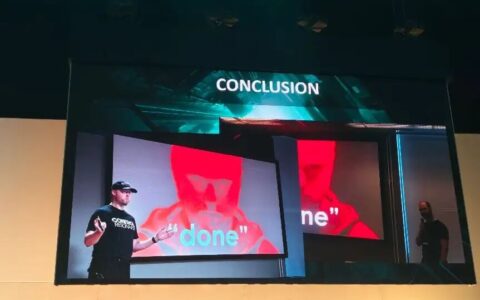
At the recent Gamescom Dev conference, Samuel Holley, Lead Gameplay Engineer and Designer for the game’s development team, gave a detailed presentation on the design philosophy behind the open-world exploration system in *Souls of Mount Sheep’s Hoof*, the challenges encountered during development, and the implementation logic and development experience related to the event card system.The following is a transcript of his presentation, which has been edited and organized.
The Tension Between Player Freedom and the Narrative Experience
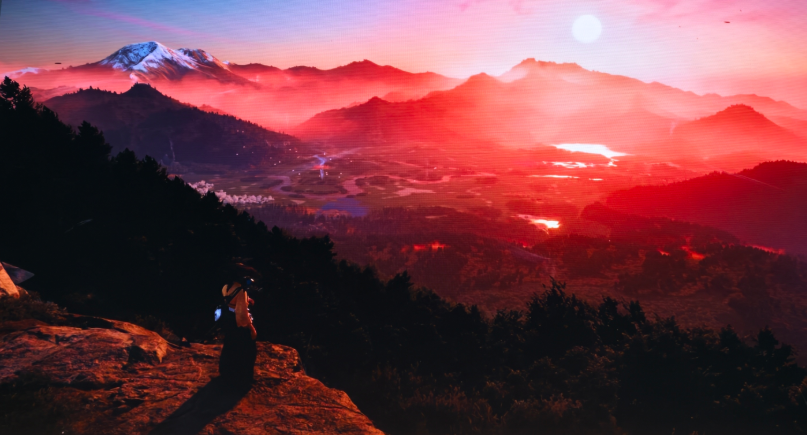
*The Soul of Mount Yotei* tells the story of the protagonist, Atsu, a lone mercenary who returns to her homeland sixteen years after her family was massacred, driven solely by a desire for revenge: to track down and kill every member of the “Yotei Six” (the gang responsible for slaughtering her entire family).But Atsu has no leads, and only vague memories of the homeland where she grew up. Therefore, it falls to the player to explore this vast, untamed wilderness, search for clues to track down the Six of Yotei, and avenge Atsu’s family.
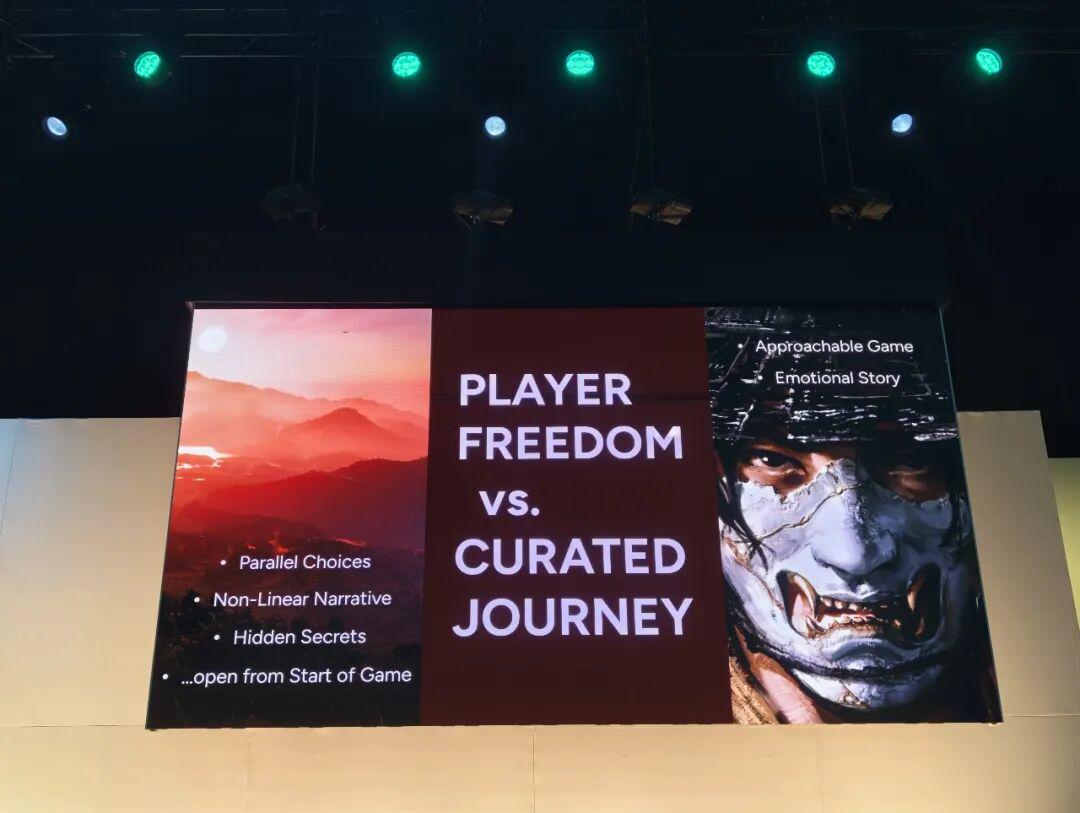
The world we’ve created is filled with parallel choices, hidden corners, and nonlinear narrative paths.From the very start, the entire world is essentially open to players. We want them to roam freely, heading in any direction they choose within this vast open world and playing at their own pace. At the same time, we hope this game will appeal to a broader audience and move players with its core emotional story.
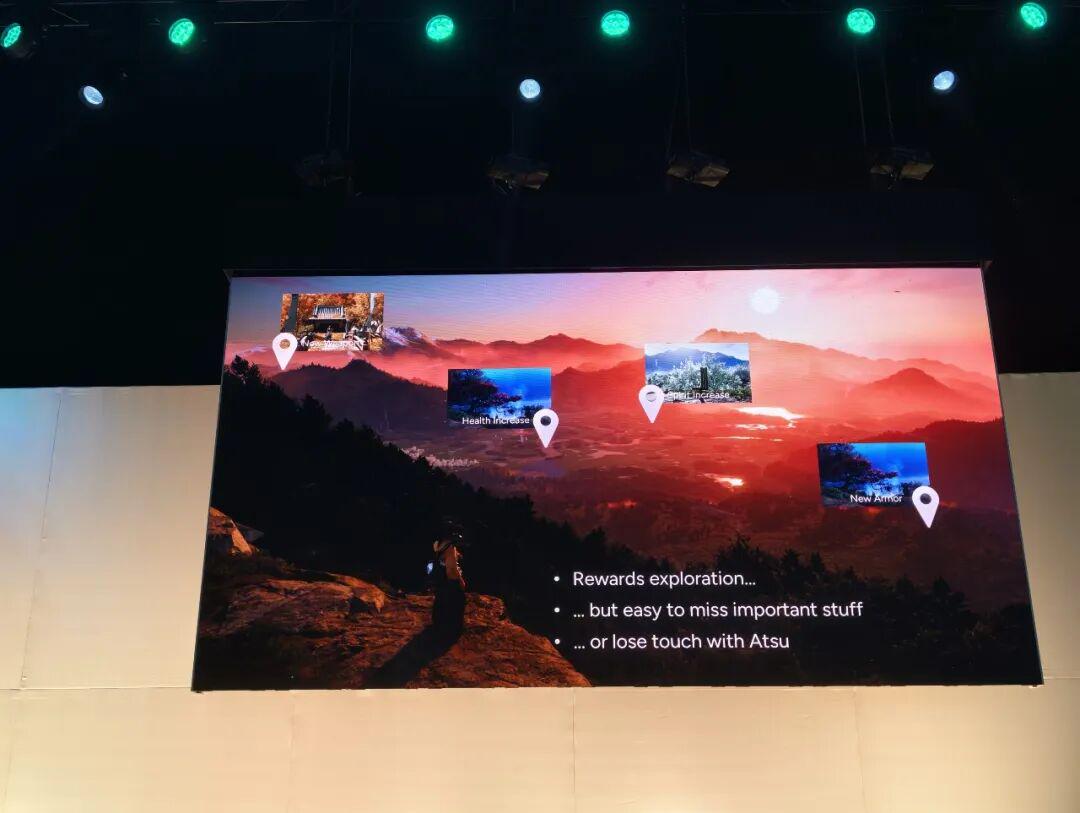
However, player freedom can conflict with the narrative experience.Players who wander aimlessly may lose their way, feel overwhelmed, or even become disconnected from the story. What’s more challenging is that we’ve integrated all in-game progression directly into the world itself: from health and spirit upgrades to unlocking new weapons and character development—everything depends on whether players can find specific locations and complete the content there.Our original intention was to reward exploration and make the world more immersive. However, tying such crucial elements to specific locations in the world means players can easily miss certain content, which can severely impact the gameplay experience.
Feedback from players over the years has confirmed this: players who haven’t obtained new weapons say the combat feels repetitive and boring; those who haven’t found the hot springs that increase their health feel the game is too difficult; and players who haven’t found the wolf den are unable to form a bond with Atsu’s wolf companion—and so on.
Almost everything in the game depends on players discovering the right content at the right time. On the other hand, if you complete all of that content, you’ll end up overlooking the main story and losing sight of Atsu’s journey—which is precisely the heart of this game. This presented a huge challenge for us.
You might be thinking, “Isn’t this a sequel? Didn’t *Ghost of Tsushima* have similar issues?” It certainly did. But in that game, we maintained control by limiting the player’s freedom.Compared to *Souls of Mount Yatei*, *Souls of Tsushima* is more linear, with a narrative structured around the classic three-act format. We divided Tsushima into three regions, and you must progress through the linear main story to unlock each corresponding area—a mature and reliable approach.
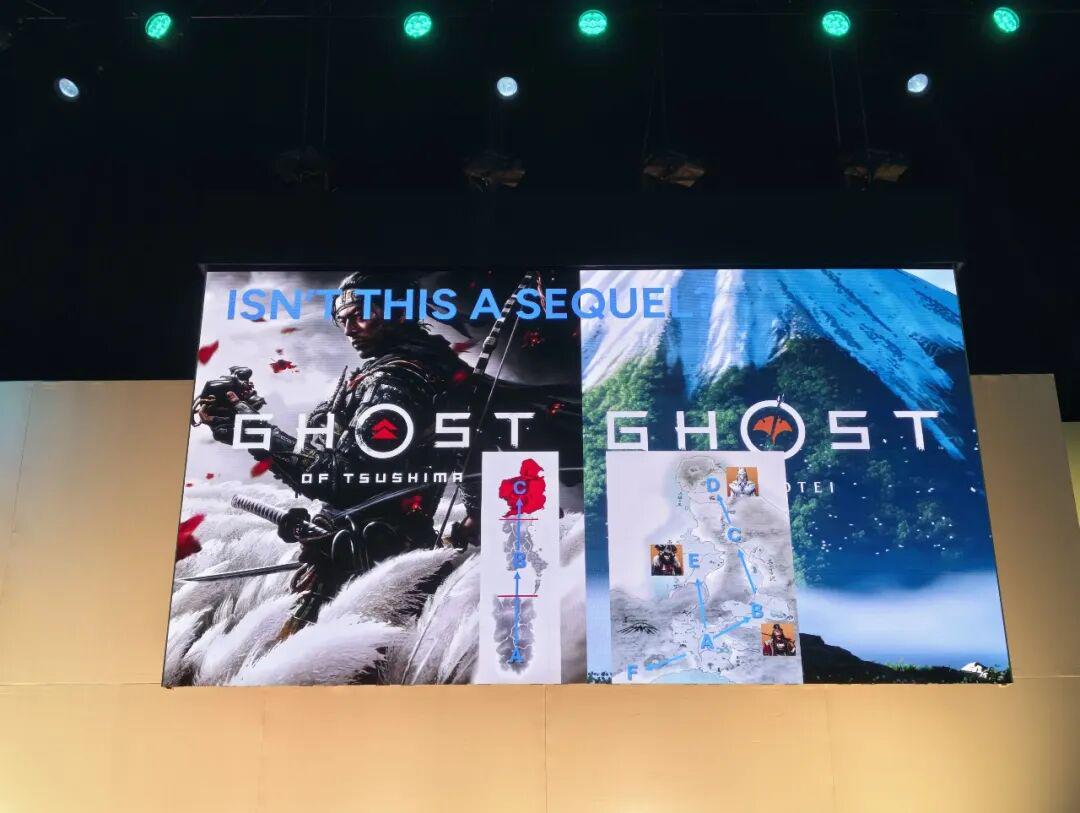
In contrast, *The Soul of Mount Yangtou* features twice as many areas as its predecessor and employs a nonlinear narrative. Thanks to the nature of this nonlinear narrative, you can investigate multiple members of the “Six Bandits of Yangtou” in any order, depending on the direction you’re heading.We’ve only locked access to a small portion of the endgame content; the vast majority of areas above the red line are essentially fully accessible from the start.
Although *Ghost of Tsushima*’s map and structure lean more toward linearity, its open world isn’t a carefully choreographed journey; it primarily relies on visual landmarks, golden birds, foxes, and NPCs calling for help to guide players to content.We still use these tools in the Sheep’s Hoof Mountains, but this system is highly random and depends largely on what you happen to stumble upon along the way.
And the content just keeps piling up. The longer you play, the more quests and markers appear wherever you go—one by one, they’re pinned to the map until it’s eventually covered with icons. It starts to feel like a massive to-do list.At its worst, it can even become overwhelming, actually pushing players to seek out experiences in the wrong way—such as chasing five foxes in a row, purely to check off a task.
In *The Spirit of Mount Yangtou*, we want players to experience a more carefully crafted journey, while also further expanding their freedom—making it broader and more nonlinear than ever before. These two goals are contradictory: we want players to chart their own course—which is the essence of our game—but past experience has shown us that some routes are indeed better than others. This is the major dilemma we face.
Many of us on the team have played the tabletop game *Dungeons & Dragons*. A great Dungeon Master gives players complete freedom while also providing a comfortable, well-crafted adventure.Players are free to go anywhere and make any choice they wish, while the Dungeon Master flexibly adapts the plot based on the players’ actions, guiding the story forward to ensure everyone has a great experience.
*The Spirit of Mount Yangtui* faces this deep-seated design conflict from within. We realized the game needed a “Dungeon Master,” so we created one—a system called the Event Deck, an invisible hand that guides players through their exploration. Just like a skilled Dungeon Master, it adapts a set of linear, predefined scenarios to each player’s nonlinear gameplay path. It gives players ample freedom while ensuring a consistent gameplay experience.
Next, I'll explain the entire mechanism behind event decks.
What Is an Event Deck?
You can think of it as a set of hidden cards underlying the game.As players explore the open world—regardless of where they go or what they interact with—the game draws cards to determine what content will be generated ahead, what dialogue NPCs will say, what notices will appear on the bounty board, whether enemies can be interrogated, and what information they will reveal after interrogation.The system uses this to determine which events to present to the player, which is why it is called the Event Deck.
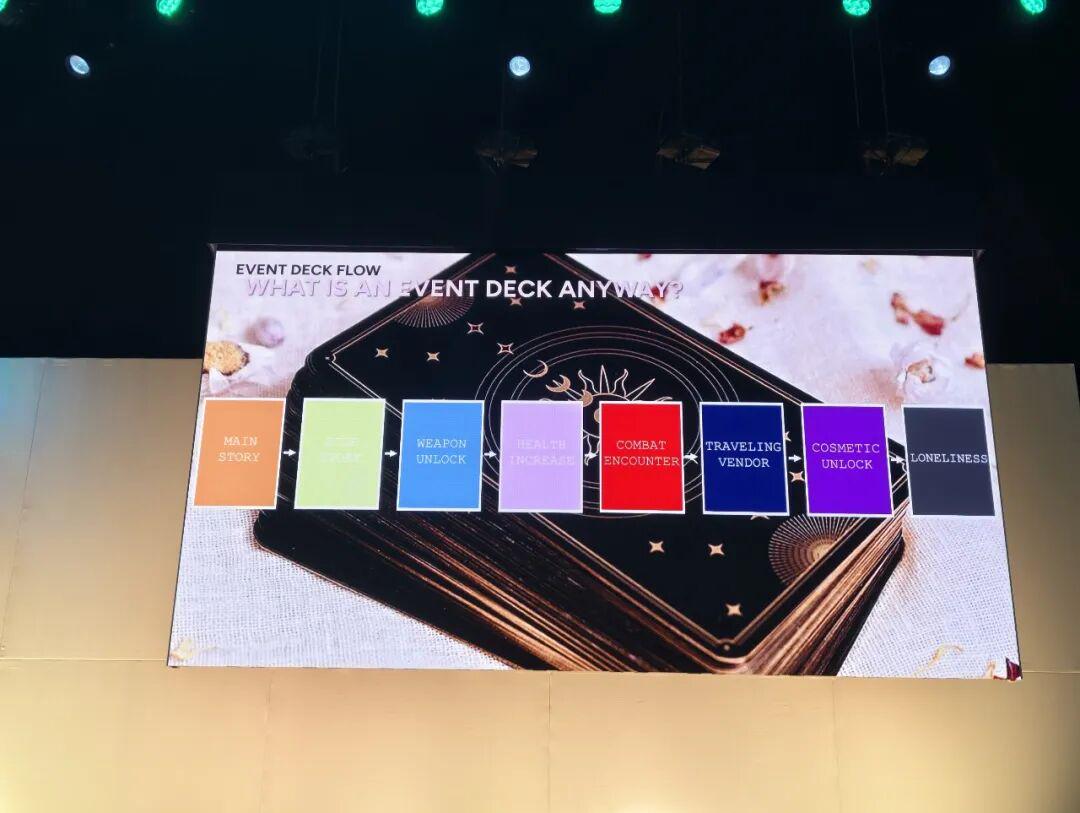
The deck contains individual cards. Each card represents a distinct type of gameplay experience—it could be the main story, in which Atsu seeks revenge against the villain who killed his family; or a side quest, telling the story of ordinary people struggling to survive on the frontier. It also includes functional gameplay elements, such as unlocking new weapons and increasing health points.Cards can encompass every aspect of the game, including different types of content, economic interactions such as those with merchants, social content like building bonds with wolf companions, and even emotional experiences such as “loneliness,” which will be explained in more detail later.
A deck defines an ideal sequence of various experiences; the system strives to provide players with these experiences in this order, and this sequence repeats cyclically.
Note: Cards are abstract labels. A main story card does not refer to a specific quest, such as “Attack the Ghost Tribe’s Castle.” It represents the entire main story experience and is a type of interaction that players can trigger. Multiple instances can be set up for each card type.For example, a deck composition might be: 3 main story cards, 2 health boost cards, 1 side story card, and so on.
The order of the cards is crucial; it forms a linear sequence, much like a script: first do A, then B, then C. Of course, not every player will follow this order exactly, but if players follow this sequence, they’ll have a great experience.The goal of the event deck is to facilitate this ideal flow as much as possible. This isn’t just a metaphor—we actually write the card order directly into text files, and that’s exactly how the deck used in *Soul of Mount Yangtou* is maintained.
So how does this logic work in practice? In the game, certain interactions draw cards from the deck to determine subsequent actions. We refer to these interactive elements as “dealers.”
The game world is filled with card-dealers: ronin drinking at taverns, bulletin boards plastered with notices, enemies begging for mercy, and even players setting up camp to rest—all of these are card-dealers. When players interact with them, the NPC will secretly draw a card to determine what they’ll do next, what they’ll say, which bounty notice will be refreshed—or they may choose not to trigger anything at all. The content generated by a single card-dealer is dynamic: a ronin might provide a clue about the Six Bandits of Yangti to advance the main storyline, or reveal the location of a reclusive master of the gun nearby; drawing the right card might even summon a traveling musician who teaches the player a new song on the spot. The speech bubbles display the dealer’s final dialogue and actions—that is, the generated events.
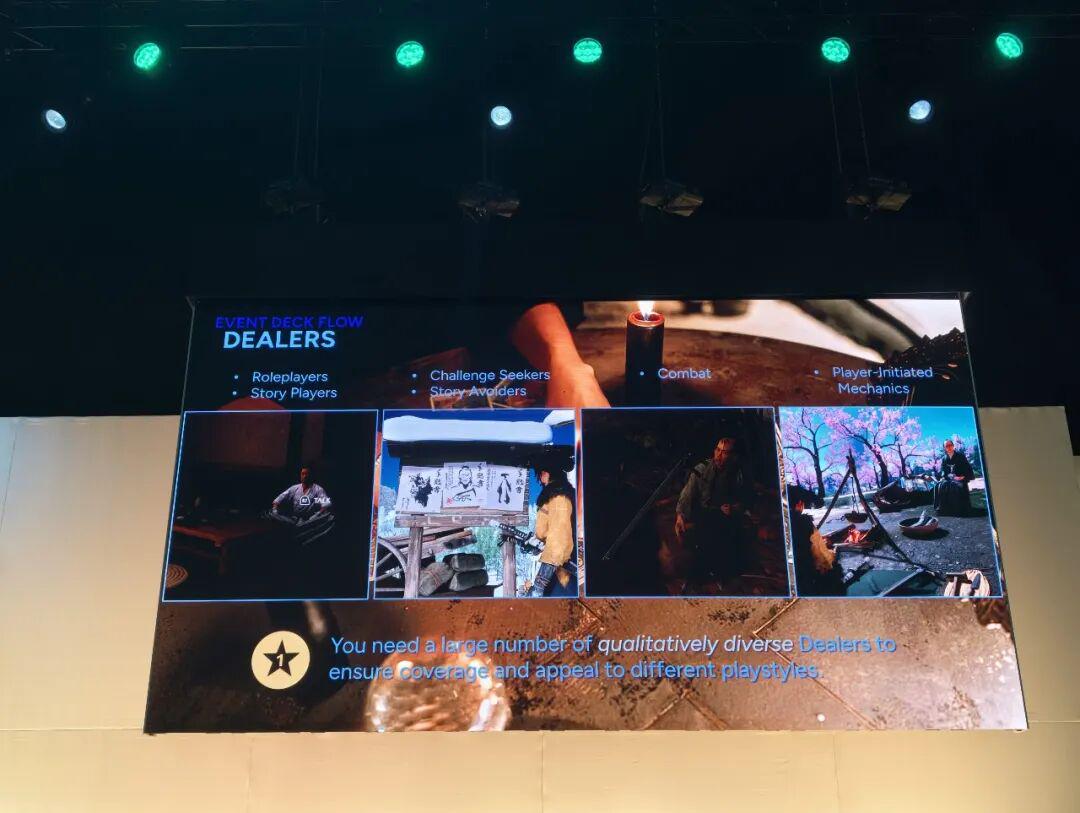
Events fall into two categories. One category consists of hint-based advertisements, which provide players with clues so they can make their own way to nearby customized content locations; the other category consists of instantly delivered content, such as a musician teaching a song on the spot, so players don’t need to travel elsewhere.
Summary of the overall mechanism: Dealers are scattered throughout the world; they draw cards from the event deck to determine what kind of experience to provide to the player, then combine this with the player’s current situation to transform it into a specific, tailored event. The purpose of the event deck is to ensure that no matter which dealer a player encounters along the nonlinear path, various events are delivered in the ideal sequence. These interactions are rich and diverse, catering to different types of players.
Golden Tip #1: Create a Diverse Range of Event Triggers. Players in open-world games have vastly different playstyles. Not everyone enjoys talking to NPCs, not everyone checks the bounty board for quests, and not everyone is in the habit of setting up camp. However, every player will engage in at least some of these activities to a greater or lesser extent. By designing a wide variety of interactions as card dispensers, you can ensure that the event deck reaches players no matter how they choose to play. If you fail to do this, the deck will become stagnant, forced to passively wait for players to trigger a specific interaction before the next card can be drawn.
Let’s look at a simple example—for the sake of simplicity, this event deck contains only 4 cards (there would be many more in an actual game), but it’s enough to illustrate the concept.Suppose a player is exploring the world, arrives at a settlement, and sees a bounty board. The bounty board acts as the dealer; when the player approaches, it draws a card from the event deck—as you can see, the top card is a “Weapon Unlock” card.The bounty board uses this card to determine which bounty notice to generate: Since a “Weapon Unlock” card was drawn, the player sees a wanted poster for Ina, the “Bomb Maker.” She is a potential ally who can craft bombs; finding her will unlock the ability to throw bombs, and the player gains a clue.
Leaving the Bounty Board, the player continues on and speaks with a ronin drinking at an izakaya. The ronin also acts as a card dealer and draws a card that increases health. The ronin points to the steam rising from a distant mountain peak and reveals the location of a hot spring; soaking in the hot spring will increase the player’s maximum health.
The player leaves the settlement, searching for the bomb maker and stumbling upon a hot spring along the way. After obtaining a new weapon and a health boost, the player encounters henchmen of the Six Bandits of Yangti harassing passersby and intervenes to defeat them all. The last enemy falls to his knees and begs for mercy. The interrogation is handled by the Dealer, who draws from the event deck. The next card is a main quest card: Atsu forces the enemy to reveal information about the Six Bandits of Yangtou, and the enemy reveals the location of the villainous fox demon, granting the player a main quest clue.
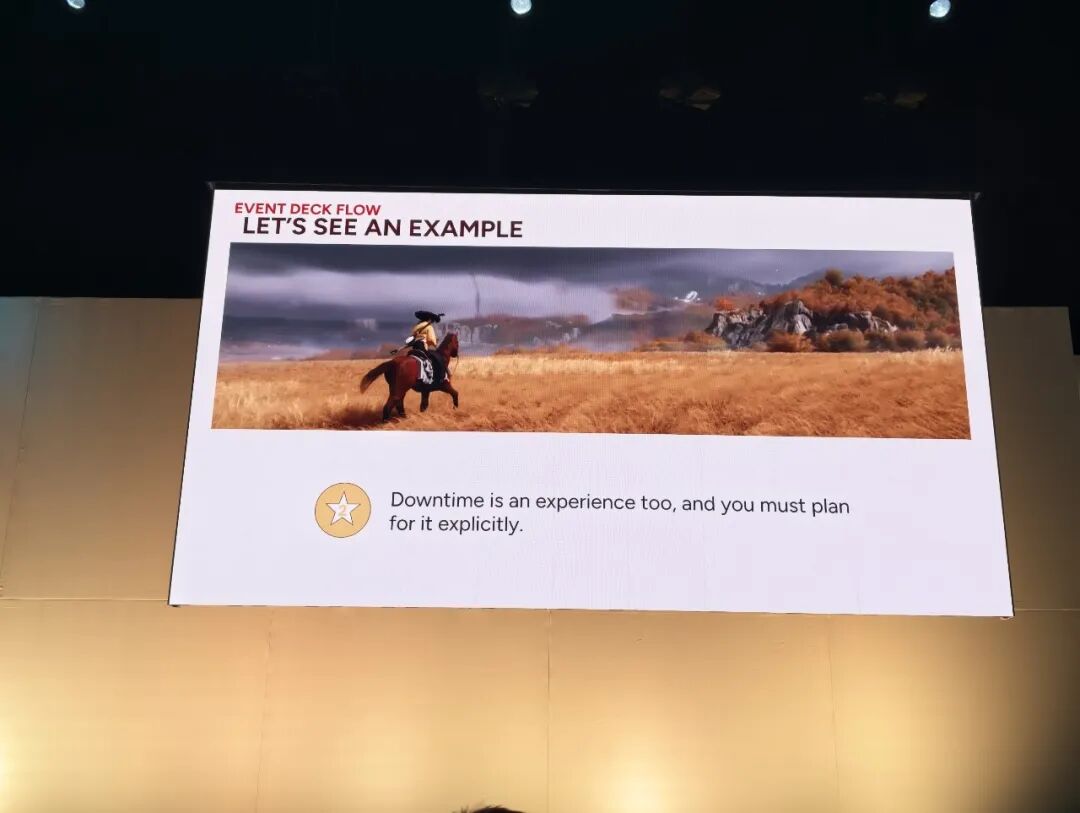
At this point, only one card remains in the deck: the "Loneliness" card. This is a special card, reserved specifically for “doing nothing.” When designing a game, it’s easy to get so caught up in piling on events that you overlook the pauses between them. Without proper control, we’ll repeat the mistakes of our previous game—constantly bombarding players with to-do lists and leaving them no room to breathe.
In *The Spirit of Mount Yangtui*, the loneliness of riding alone on horseback across the vast frontier—with only your horse for company—is a crucial part of the game’s atmosphere and a core emotional experience. If the game is to preserve this experience, it must be incorporated into the card deck.
This brings us to the second golden rule: simply relaxing and letting your mind wander is an experience in itself, and should be included in the event deck.The “Loneliness” card is not resolved through any interaction; it resolves automatically only after the player has spent a period of time alone. When this card becomes the only card in the deck, no card-dealing entities will deal cards to the player—NPCs will not display dialogue prompts, the Bounty Board will not generate new notices, and there will be no visitors at the camp.Once the player has remained away from other humans for a sufficient amount of time, the “Loneliness” card will be removed from the deck. Since this is the last card in our simplified deck, the deck will reset afterward.
Card Priority and Skipping
Resetting does not shuffle the cards or alter their order; the overall sequence remains linear, which is the ideal experience loop we’ve designed. The game already contains a significant amount of uncontrollable randomness, so there’s no need for the deck to introduce additional randomness. However, the order of the cards is not permanently fixed. When certain conditions are met, some cards can be moved directly to the top of the deck.
For example, the “Health Boost” card is normally placed in the middle of the deck. If the system detects that the player’s maximum health is significantly lagging behind their overall progress, the Health Boost card will be marked as “urgent” and moved directly to the top of the deck. After that, no matter where the player goes or which card-dealer they trigger, the system will prioritize pushing the Hot Spring clue to restore their health, thereby preventing a poor player experience.
Suppose it’s time for a Life Enhancement card to take effect, but the player already has one hot spring clue in their hand. We could, of course, push another hot spring, but past testing has shown that doing so is a mistake.
This is the third—and perhaps most important—rule of Golden Management: Providing clues comes at a cost.Providing players with hints involves costs, which should be considered from three perspectives: First, it deprives players of the joy of exploring and discovering things on their own; second, it adds to the burden of their to-do list; and third, we can only provide the same hint once. Hints should only be provided when we determine that the player is willing to receive them.
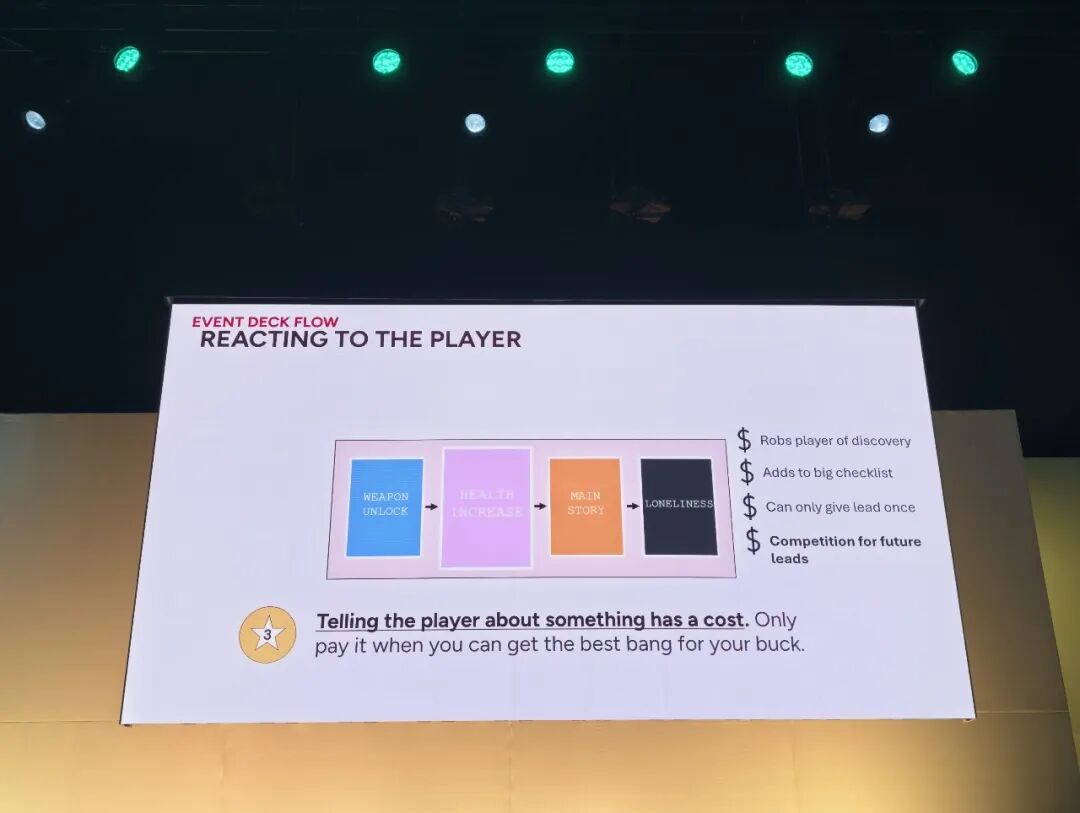
More importantly, a new clue will overshadow the next one. If a player knows only two facts, and we reveal a third—especially when that third fact is of a different nature than the first two—the player is very likely to listen carefully.However, if the player already knows ten things and we present an eleventh—especially if it’s similar in nature—the player will most likely push it to the bottom of the list and ignore it outright, thereby undermining the effectiveness of all subsequent clues.
Therefore, to ensure players take the information seriously, it’s crucial to time the push notifications carefully. This requires restraint; you must weigh the pros and cons each time, and if the cons outweigh the pros, choose not to send the notification. In the scenario described above, you should skip this card and wait until the player has completed the known hot spring or entered a brand-new, unexplored area before pushing content related to health boosts.
This is another similarity between event decks and dungeon masters: they have a linear baseline plan and, during the player’s nonlinear gameplay, seize opportunities to deliver cards in sequence as much as possible. At the same time, they dynamically adapt to the player’s actual situation, skipping unnecessary cards and raising the priority of essential ones.
System Meets System
In addition to the dealer, other game modules also read from the event deck, the most important of which is the random encounter system. This system is used to populate the open world between various content points, generating patrolling enemies, bandits, friendly travelers, and wildlife. It reads the state of the deck to determine which entities to generate. If a combat card is currently at the top of the deck, enemies are spawned; if a “Loneliness” card is drawn, only wildlife is spawned, deliberately creating the desolate, barren atmosphere of the frontier.
In a sense, “System vs. System” is also a card-dealer—and a better one at that, because it can generate more card-dealers (characters to talk to, enemies to interrogate, etc.), and these interactions yield different outcomes based on the content of the next card in the event deck.You must maintain a sufficient number of dealers throughout the game to keep the deck running, and the system-versus-system encounter is one of our best tools for doing so.
A Detailed Guide to the Dealer: Interrogation
The above covers the high-level operational logic of the event deck; now let’s dive into the details. Once a card is drawn, how exactly does the system execute it? How does it decide which dialogue segment to play or which wanted poster to refresh? I’ll use two examples of card draws to illustrate: enemy interrogation and camp visitors.
Let’s start with interrogations. In *The Soul of Mount Yangti*, Atsu engages in combat with numerous enemies, and sometimes triggers scenes where defeated enemies beg for mercy and are interrogated.When an enemy begs for mercy and hints that they possess intelligence about the Six Bandits of Yangti, Atsu will force them to reveal the information after defeating them. This is the interrogation, which is a card-dealing event.
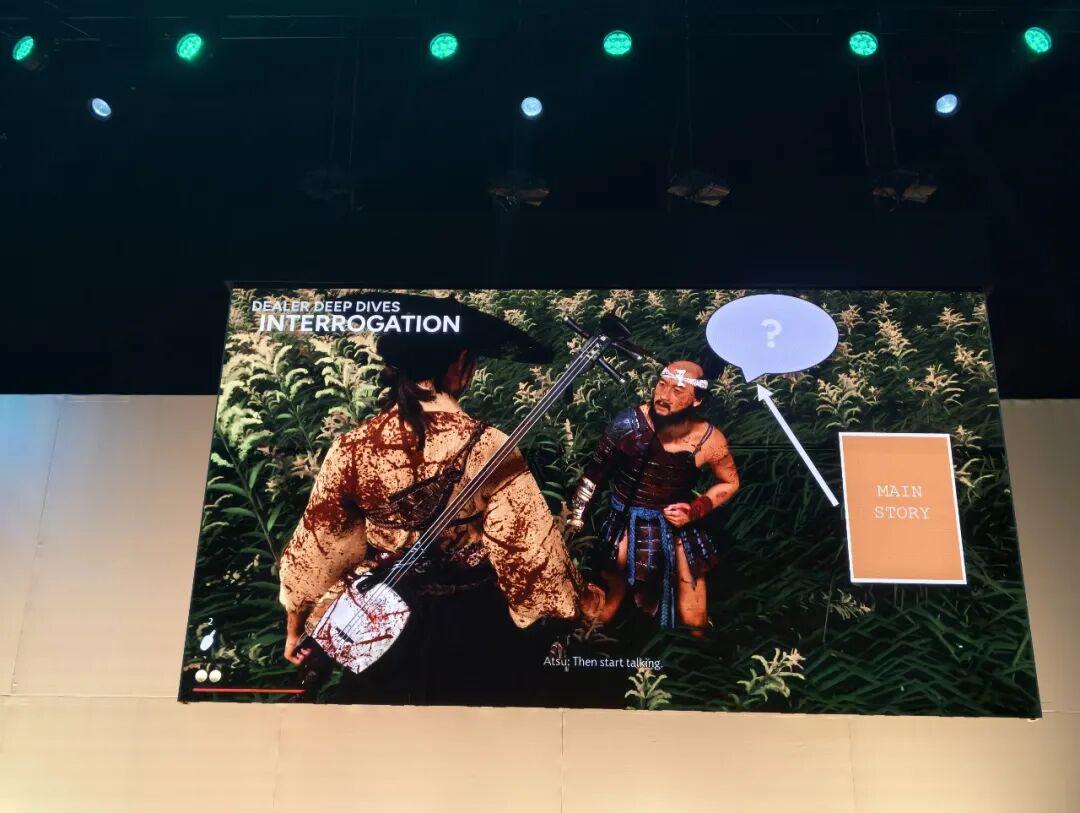
Long before the player arrived, the interrogation system had already drawn a card from the event deck. If the only card drawn at that time was a “Loneliness” card, the interrogation would not have been triggered.Either this group of enemies wouldn’t appear at all, or even if a battle occurred, the enemies would be executed immediately afterward without entering the interrogation phase—leaving players completely unaware of this logic. However, in this instance, the system successfully drew a main storyline card.
Abstract main-plot cards alone are not enough; interrogations also require specific audio, subtitles, and facial animation data. How does the system generate a specific, playable event from an abstract event card? The answer is by reading a large text configuration file, which we call the master list of events. All in-game events are defined here, along with all the parameters the dealer needs to execute each event.
In the Sucker Punch engine, events are treated just like regular objects—they have names and categories. In this case, “event_clue_kitsune_1” represents the first piece of intelligence Atsu obtains about the Fox Demon (one of the villains from the “Six Bandits of Yangti”).The configuration specifies which card this event corresponds to. In this case, it is bound to a main story card, so when that card is triggered, this event will be included in the list of candidates.
There are two types of delivery methods in the configuration: add_talk_delivery (conversation delivery) and add_interrogation_delivery (interrogation delivery). A single piece of intelligence can be delivered through multiple channels. For the same event, players may receive it from different in-game distributors; therefore, multiple delivery schemes must be implemented, with each distributor supporting different delivery types. Dialogue delivery is highly versatile and can be called by a large number of distributors; interrogation delivery has a very specific purpose, but since we are currently in the interrogation process, this option will be selected. Each delivery method contains actual content, with the core being a set of dialogue resources that correspond to all content visible to the player, such as audio, subtitles, and character animations.
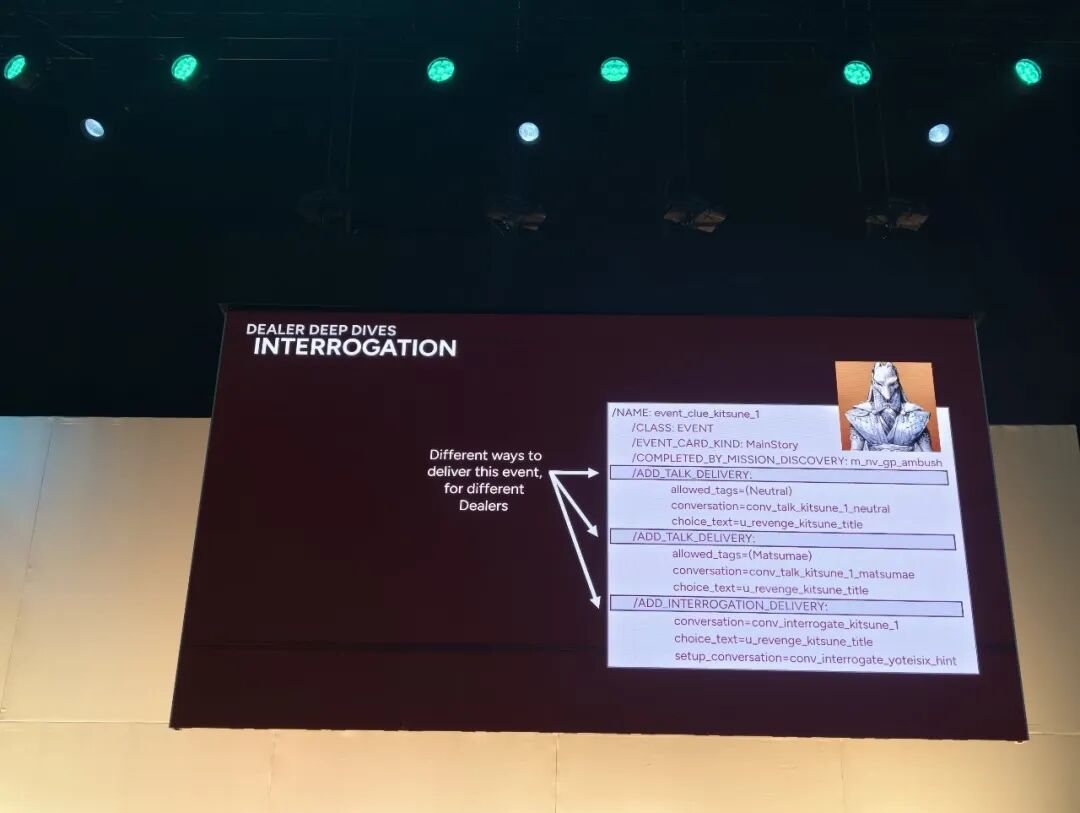
This is just one event in the master event list; there is another main storyline event corresponding to the Ghost from the “Six Bandits of Yangtou.” How does the Dealer determine which event to select from multiple candidate events during an interrogation? When multiple events are active at the same time, the Dealer simply takes the first eligible entry from the list. In other words, just like the event deck itself, the master event list is sorted linearly. We can define an ideal sequence for obtaining intelligence in a linear manner. Under identical conditions, we can ensure that players always receive intelligence related to the fox demon first.
Back to the interrogated enemy:
"I know the fox demon is hiding on the ridge of Shouqu Mountain."
"Tell me how to get there."
"If you go there, you'll disappear just like everyone else."
"Hurry up and tell me."
“Head north along the Lupo River until you reach the edge of the Diolo Wilderness.”
To summarize: When the player begins fighting these enemies, the interrogation system draws a card from the event deck—a “main story” card—and selects an event from the event list that it can convey. Since content to convey has been found, the interrogation proceeds, and the main story advances using the dialogue specified by the selected event.
A Detailed Look at the Card Dealer: Camp Visitors
Now let’s look at another type of dealer. Suppose the player follows the clues obtained during the interrogation and heads north along the river, arriving at the snow-covered entrance to the Shutori Ridge, where the fox demon resides. In *The Spirit of Mount Yangti*, you can set up camp almost anywhere by pressing a button. Most of the time, only Atsu and the horse are at the campsite, but occasionally visitors will stop by and gather around the campfire.
The Camp acts as the dealer. During the transition to a black screen, the Camp draws a card from the Event Deck. Suppose a Weapon Unlock card is drawn; the system then filters the available events from the Event List.There are two candidates for the weapon unlock card: Ina, the Bombsmith, and Hana, the Shuriken Craftsman. Both allies can unlock new weapons and meet the card’s requirements.
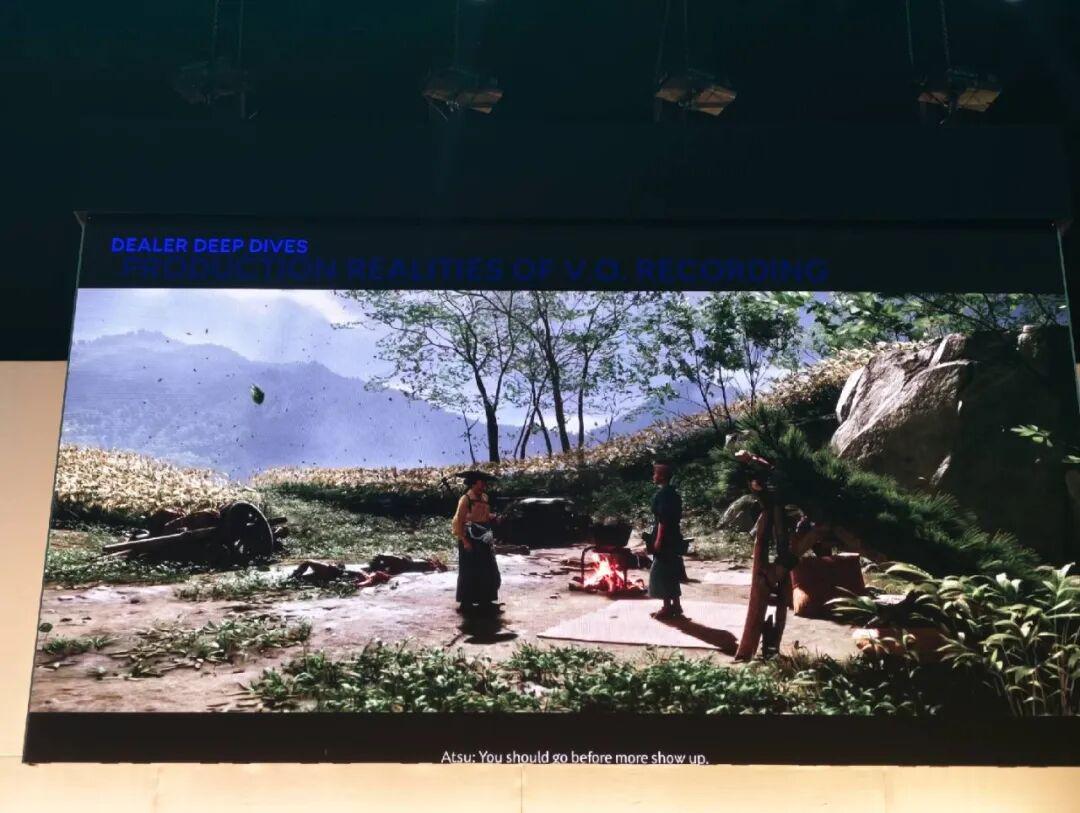
Let’s look at the event configuration properties. Among them is `add_object_delivery` (object delivery), which generates physical objects directly within the scene—such as refreshing notices on the bounty board or spawning secret letters written by the Fox Demon to her subordinates at enemy outposts. However, the camp card dealer does not support object delivery; only dialogue delivery can be used. Dialogue delivery is subject to regional restrictions: Bombsmith Ina is found in the Ishikari Plains, so only local NPCs will mention her. However, Atsu is currently on the snow-covered Tezuri Ridge, and none of Ina’s dialogue delivery events match the current area. That leaves only the kunai craftswoman Hana, who lives on the snow-covered Tori Ridge and has dialogue-based delivery tasks suitable for that area. Consequently, the Camp Dealer selects Hana’s event.
After selecting the event, return to the black screen transition. An NPC needs to be generated to approach Atsu and speak with him. The system reads the dialogue configuration and checks the character identity associated with that audio clip; in this case, the requirement is a Matsumae Domain soldier. Consequently, a Matsumae Domain soldier is generated and sent to the camp.
“Have you heard anything about the six bandits from Yangti?”
“What would you like to know?”
“I’m looking for the fox demon. Do you know anything about him?”
“He’s holed up on the Shouqu Ridge—a place where it’s hard to survive. The guards stationed there report that the fox demon is taking over the farm just like a demon fox. A farmer named Hana is fighting back against him with a kunai.”
That’s how the camp visitor system works. Players manually trigger the camping event, and the system randomly draws a weapon unlock card in the background to generate a Matsumae Domain soldier, who then provides Atsu with a clue about a kunai craftsman nearby.
Camp visitors are extremely valuable to the event card system, which leads us to Golden Tip #4: Setting up camp isn’t tied to any specific location—it can be done anywhere. Moreover, since players must actively press a button to trigger it, this indicates that they are actively engaged with the game at that moment.Sometimes, players may not make it to the specific interaction points we’ve carefully set up; even if they do, they might simply ignore them. However, players can set up camp wherever they go—whether to meet gameplay needs, such as restoring stamina, or to fulfill experiential needs, like playing the shamisen under the starry sky.
We leveraged this high-frequency interaction to keep the event deck running even when other dealers lacked opportunities to trigger it. However, we realized this too late and were unable to create more global interactions of this kind. Ultimately, this led to the entire system becoming overly reliant on camping.If you’ve played this game and felt that camp visitors appeared too frequently, this is why. If we had another chance, we would design more of these location-independent card-dealers.
A Look Back at the Player's Journey
Let’s review the entire gameplay flow: Players freely roam the open world, determining their own path; the system’s encounter manager spawns enemies;After combat, the player interrogates the last enemy to learn the location of the fox demon, advancing the main storyline; following the clues, the player arrives at the foot of Shutori Ridge; the player sets up camp, where a soldier visiting the camp provides information about the kunai craftswoman, Hana. This is a combination of the player’s nonlinear choices and the underlying linear planning.
Consider the following scenarios: After the player obtains a clue through interrogation, they do not immediately head north to find the fox demon, but instead travel west to the Ishikari Plains and set up camp there.In this case, the “Camp Visitor” event will trigger the appearance of Ina, the bomb maker, rather than Hana. However, the overall sequence of the experience remains unchanged: the player obtains main story intelligence through interrogation and unlocks a weapon by setting up camp.
Let’s consider another scenario: The player sets up camp first. At the camp, they draw a main story card, and a visitor immediately reveals the fox demon’s location; they then interrogate the enemy and obtain a clue about the kunai craftsman. The sequence of events remains the same: main story, followed by weapon unlock. Even if the player talks to the town NPC first and then checks the bounty board, the logic remains the same.
How can a single clue (such as information about the fox demon) be delivered through multiple different channels? As we saw earlier in the event configuration, it includes several built-in delivery options. The core message conveyed to players in all options is exactly the same: “Head north to find the fox demon.” However, the way it’s presented varies to suit characters with different roles, ensuring that the players’ immersion in the game world remains intact.
For example, migrating settlers might regard fox demons as evil spirits and warn players not to venture into the northern snowfields, offering clues in a manner consistent with their status as ordinary people. However, it would sound jarring if a Matsumae Domain samurai were to say the exact same thing, since the Matsumae Domain is currently at war with the fox spirit faction, and they know full well that their enemies are ordinary humans, not supernatural beings. Therefore, the configuration includes tags that specify which character backgrounds and personalities are suitable for different dialogue segments.
This approach is costly, but it’s crucial—which brings us to the fifth golden rule: If, in an effort to cut costs, you have all characters use the same set of dialogue templates, or have NPCs repeat information the player already knows, players will instantly see through the system’s predictable logic, resulting in a terrible experience.
Creating a well-designed event deck can enhance the story and world-building, weaving even easily overlooked elements—like random patrol battles—into the narrative. But this requires maintaining immersion, and to be honest, it’s not cheap.
For this single event alone, we need to write four sets of dialogue, each consisting of five lines—a total of 20 lines of text. We could also expand on these variations. If the story is told by a fisherman or a child, entirely new dialogue is required to ensure logical coherence. Writing the dialogue is just the beginning of the workload. All in-game dialogue must be recorded with original voice acting, and multilingual dubbing is also required. Fellow voice actors reading this should be able to sense the pressure of the workload: each set of dialogue × multiple versions × multiple languages × a vast number of events—the volume of recording work is enormous. Not only that, but for certain events—such as this fox demon storyline—each dialogue segment may be recorded by up to six different voice actors.
For example, voice actress Faye Mata plays 16 supporting roles in this game all by herself.These aren’t major characters in the main storyline, but rather supporting characters with their own distinct personalities and subplots: a fisherman who doesn’t side with either the Yangti Six Bandits or the samurai; a refugee girl harboring a secret; a peasant woman kidnapped by bandits; and so on. Faye Mata is undoubtedly one of the game’s unsung heroes.
For the event deck, her value lies in the fact that the event dialogues she recorded can be directly reused for 16 different NPCs. These aren’t temporary characters like camp visitors who spawn, speak their lines, and then disappear—they’re recurring supporting characters with their own side stories.After Atsu has helped them, when she asks them for information, these characters—with whom the player has already established a bond—can provide the clues the event deck currently needs. Since the player has already interacted with this character and heard them speak—often right after completing their exclusive quest dialogue—a system-triggered dynamic event follows immediately. Dynamically generated dialogue must match the character’s personality, and the voice actor must correspond as well. If the text flows awkwardly or the voice actor doesn’t match, the player will immediately notice something amiss.
To achieve this effect, the writing team must strictly standardize the writing conventions for both mission-based dialogue and system-generated dialogue.
Controlling the overall development scope is essentially a math problem, and I’m sure everyone attending this session is eager to see this part: Total number of lines of recorded dialogue = Number of events × Number of dialogues per event × Number of lines per dialogue × Number of voice actors (including actors like Faye who play multiple roles).Once the total dialogue budget is determined, you can adjust the remaining variables to produce a version that’s ready for release.
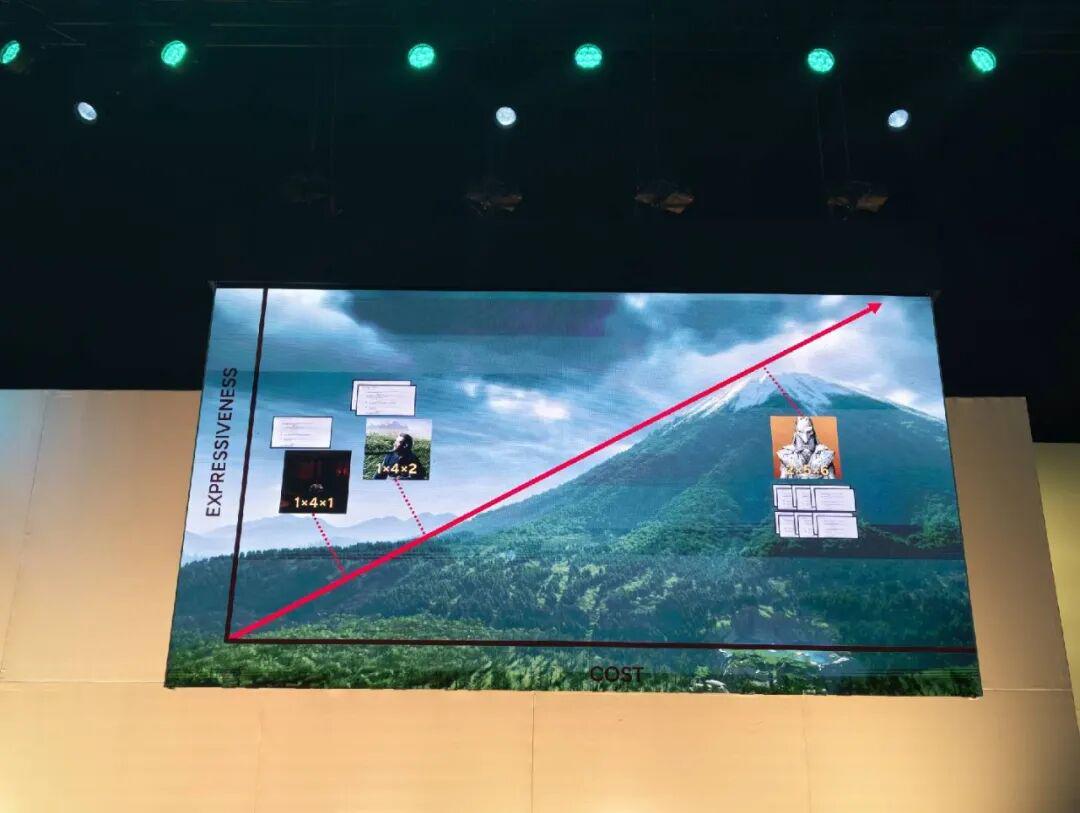
You can think of some of these variables as a “recipe” for creating an event, while others determine how many such events you can produce. If you use a high-cost production approach, the event will be highly reusable and adaptable to a wide range of scenarios, but you won’t be able to produce very many of them.If you use a low-cost approach—writing only one set of dialogue and using just one or two voice actors—you can mass-produce a large number of events, but the scenarios in which they can be used will be very limited.
In *The Soul of Mount Yangtou*, we used the high-cost approach for the most important main storyline events, such as the fox demon clues. However, there are very few such events in the game; they are reserved solely for content that drives Atsu’s revenge storyline, integrating the main narrative into the open world to leverage its high flexibility.The vast majority of events in the game utilize a lower-cost approach, involving just one set of dialogue paired with one or two voice-over tracks.We also employed a number of technical techniques to make these low-cost events more versatile than one might expect. By combining a small number of high-cost events with a large number of low-cost ones, we were able to balance content richness and volume while staying within a manageable budget.
Advantages and Disadvantages of the Deck System
Now that we’ve covered the technical details, let’s discuss the strengths and weaknesses of the event deck system so you can decide whether it’s right for your project.
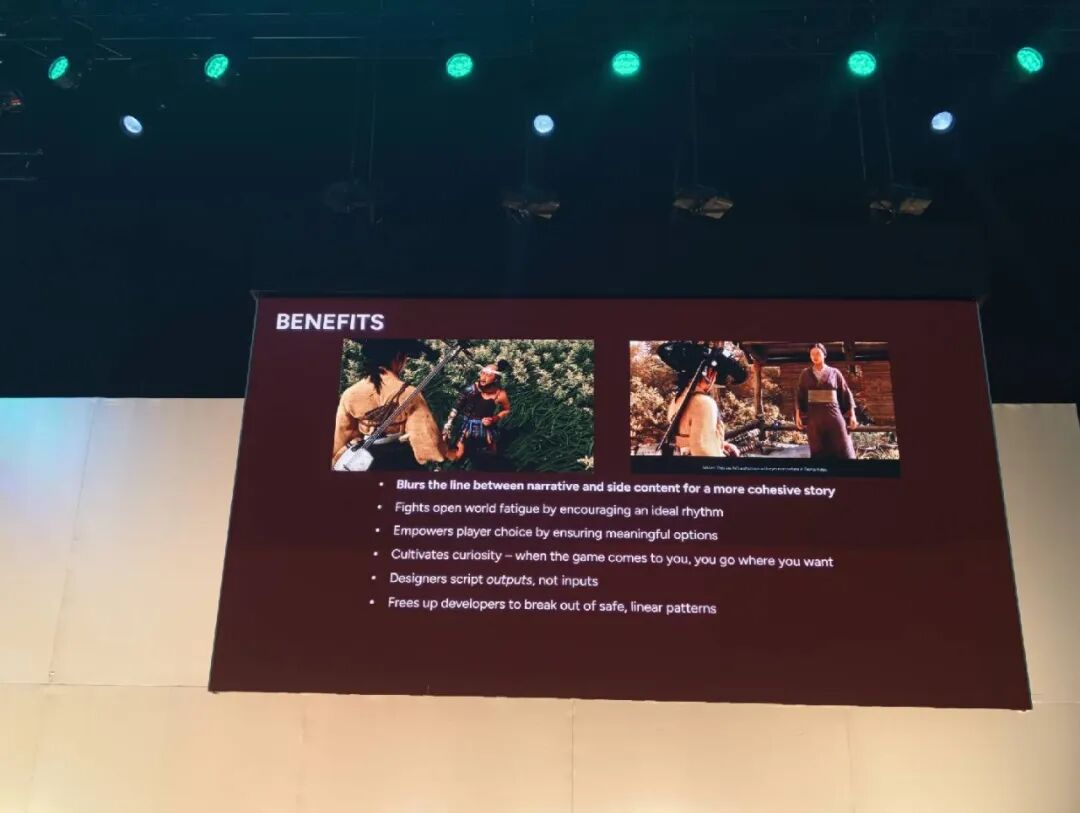
The most obvious benefit is that event decks allow developers to experiment with bolder open-world designs without worrying that players will be overwhelmed by a flood of information, lose their way, or become disconnected from the main storyline.
In addition, there are some less obvious benefits. Designers can directly define the desired effects using language focused on the player experience.Often, development feels like debugging a black box—tweaking probabilities, cooldowns, and range rules, constantly adjusting input parameters in the hope of achieving the desired outcome. But with event decks, it’s different: you define the output, not the input parameters.
Think from the player’s perspective about the ideal gameplay flow, and clearly outline what you want to happen. If you feel players unlock weapons too late, adjust the deck directly; if players are tired of endless random encounters, remove the enemy-related cards and add side-quest cards to shift the balance of the experience;If you want more moments of quiet reflection, add more solitude cards; if you want combat and narrative to alternate, rearrange the cards to shape the pace of the game you envision.When different design goals conflict—for example, if you want players to unlock weapons while also increasing their health—you can take a step back and clearly determine which has higher priority.
A well-tuned event deck can also subtly amplify the significance of a player’s choices. When players trust that the game will deliver the right content to them, they feel free to go wherever they please without the psychological burden of thinking, “I’m playing the wrong game.”
As mentioned earlier, when a player already has a clue about the hot spring, the deck will skip cards that increase health and instead present other content, such as a storyteller recounting the legend of the Undead Samurai.Players are no longer faced with a meaningless choice between two hot springs, but rather a choice between a hot spring that restores health on one side and a legendary tale that unlocks armor on the other. The gameplay benefits and narrative atmosphere of the two are completely different, making the player’s choice truly meaningful.
The flow of the deck also encourages players to cycle through different types of content, switching back and forth between the main story, side quests, mini-games, and legendary tales. We’ve found that this significantly enhances the player experience.Players enjoy chasing and collecting foxes, but they don’t like having to chase five in a row. The deck system has its own built-in rhythm, which prevents a single type of experience from becoming repetitive and tedious, and alleviates the fatigue that comes from completing checklist-style tasks in an open world.
Finally, the event deck makes the entire world feel more vibrant and cohesive, blurring the lines between the main storyline and side quests. Even minor characters—and even enemies that randomly spawn during battles—can provide information related to the main storyline.Everyone Atsu encounters along the way knows about the Six Bandits of Yangti and has their own opinions about them, making Atsu’s story of revenge feel more authentic. What was originally thin filler content is thus given substance, becoming part of a grand world.
It also resolves a classic dilemma in open-world games: while the main story presents urgent objectives, players often find themselves doing unrelated activities like collecting flowers and plants.In the world of Mount Atsu, no matter where you go or what you’re doing, Atsu’s story follows you, making these side activities align with the protagonist’s character logic. Story-oriented players will be eager to experience gameplay elements like combat and camping; gameplay-focused players won’t be locked into a single, linear path and can still engage with the story.
Now that we’ve covered the strengths, let’s talk about the weaknesses. Event decks aren’t a one-size-fits-all solution. First, the procedurally generated card-dealing interactions are well-suited for handling short content that fits within template rules—such as conveying fragmented mini-stories or setting the tone for the game’s world—but they can’t support plot sequences with intense emotional depth or large-scale production values. At least, this game hasn’t managed to achieve that.
Second, the development costs for event decks are very high. A large number of card-dealing devices need to be set up throughout the world, and there’s a great deal of coordination required across various content areas—this must be clearly stated.
Additionally, many events are essentially just clues or hints designed to guide players to specific crafting locations. The system can provide players with a clue about the hot springs, but it cannot guarantee that players will immediately go and complete the corresponding hot springs content—players are entirely free to ignore this clue.Our system is designed to prioritize player freedom, so its approach is gentle guidance rather than forcing players to act according to our expectations. Of course, statistically speaking, there is a strong correlation between the clues pushed by the deck and players’ actual behavior, but it is not 100 percent.The key insights shared in this presentation are intended to maximize this correlation as much as possible; without these design elements, the matching effectiveness would be significantly lower.
Finally, this system makes it easy to become overly reliant on dialogue to deliver events—a pitfall our project fell into. Creating dialogue is costly and requires designing complex script logic to make it sound natural.Even with all this effort, extensive dialogue can still wear players down, and many players will simply skip it altogether. This is where object-based delivery methods—such as the Bounty Board—truly shine, as they don’t rely on dialogue. If we were to rebuild this system, we would devote more effort to developing these object-based delivery methods.
Overall, the advantages of this system outweigh its drawbacks, and most of the issues can be optimized and resolved in future iterations. I look forward to seeing everyone share their more refined versions of similar systems in a few years.
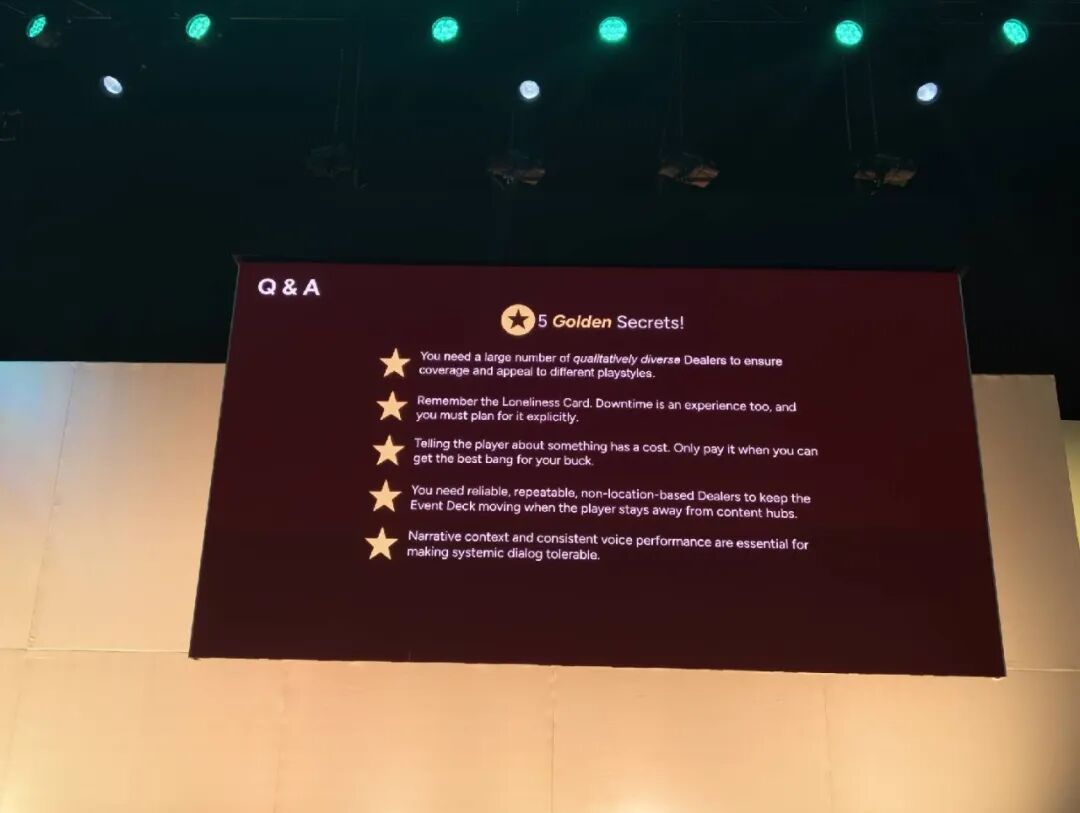
Q&A Session
Q: This system is very complex to implement. I’m curious—how did you decide to go with the event deck approach, and what was the development process like?
A: The event deck wasn’t fully conceived from the start and then implemented. In the early stages of development, this system didn’t even exist.We decided to create a non-linear open world, but early extensive testing revealed that players would only have a good experience if they happened to take the exact right path and happened to pick up the right weapon; if they took a wrong turn, the experience would immediately fall apart. When faced with this situation, many projects resort to heavy hand-holding, forcing players to go to specific locations to ensure a consistent experience.We wanted to find a different solution.
The earliest version of this system only supported the main storyline and generated clues related to the Six Bandits of Yangti.We’ve successfully implemented the core mechanics: an ideal linear narrative sequence that can be delivered through a wide variety of characters in the world, allowing the same piece of intelligence about the fox demon to be provided to players from different sources. The test feedback has been positive, and players are really enjoying the sense of free exploration.
At the same time, the project included other standalone features, such as “Camp Visitors,” which initially had no connection whatsoever to the event card deck. However, as development progressed, we continually encountered new issues—players were having trouble finding the gunmaster and obtaining their second weapon.So we wondered if we could repurpose the system we’d built for the main storyline to deliver gameplay-related clues. We tried integrating the “Camp Visitors” feature, but the two systems interfered with and conflicted with each other.
This is often the case when designing systems for large-scale projects: a bunch of great ideas clash with one another, requiring a great deal of work to make them fit together. Later, we realized that the random encounter system faced the same problem—each module operated in isolation, resulting in a fragmented player experience.We needed to establish a unified logic that defined the player’s next steps and integrate all modules into this framework as much as possible. Building on the proven solutions from the main storyline module, we iterated to develop a complete set of event cards.
Q: From a technical standpoint, I’d like to know how you make trade-offs—which conversations you keep and which you discard—and how you handle the storage demands of these conversations.
A: This is more of a production-level challenge; for a long time, we didn’t have any concrete metrics. During the early prototyping phase, we even used AI-generated voice to run quick tests to verify whether the design was feasible, and then determine which events were worth developing into high-cost, highly flexible versions.We decided early on that the main storyline clues had to use high-cost solutions, but we also knew it would be impossible to produce them in large quantities—the costs would spiral out of control—so we needed to find a compromise. We prioritized starting with the most cost-effective viable options.
For example, with clues related to hot springs, we try to follow the principle of “write once, record once.” This approach works particularly well for camp visitors: we dynamically generate NPCs, and their dialogue is directly matched to pre-recorded content.We also used a little trick for interrogations. Since the order in which players defeat enemies is random, it might seem at first glance that the interrogation feature would require recording multiple sets of voice lines for each enemy type. However, the combat is fast-paced, and it’s hard for players to tell exactly which enemy is speaking.Instead, we simply replace enemy voice lines with recordings associated with the corresponding events. First, through combat encounters, we establish the impression that this enemy has voice lines; after they are defeated, we directly reuse that set of voice lines to save on production costs. Only the events in the main storyline use high-cost production; all others employ low-cost solutions.
Q: If this system were to be redeveloped, what pitfalls should be avoided, and what recommendations would you offer for the planning phase?
A: Some of the shortcomings were already mentioned earlier.
First, create more reusable interactions that aren’t tied to specific locations—that is, actions that players can actively trigger no matter where they are. This is a great design approach. People’s first instinct is often to have NPCs speak up and provide clues, but this method has significant limitations. By designing more flexible triggers, the flow of the deck will be much smoother.
Second, we need to effectively resolve the tension between clues and actual content. In AAA open-world games, there’s an inherent trade-off between procedurally generated content and hand-crafted, fixed-location content. Many events serve only to guide players toward hand-crafted content points, but players often already have their own goals—even if they receive a clue, they may not immediately change their plans.One area I’m particularly interested in is how to better integrate handcrafted premium locations with the calls to action triggered by events. Of course, we shouldn’t disturb players too frequently, but when the system detects that a player’s health is too low—to the point where the game’s difficulty balance would be compromised—we could design stronger calls to action that moderately interrupt the player’s current activities. This is something I’m still exploring.
Q: The event deck aims to provide players with the best possible experience. How do you define what constitutes the best possible experience? While factors like health points associated with hot springs can be quantified, how do you determine the priority between main and side quests?
A: There’s no standard answer that can be summed up in a single sentence. As with most game development, it relies on repeated iteration, testing, and data analysis. We look at the data to see at what point in the game—in terms of hours played—players obtain a particular weapon. In the early stages of an open-world game, players don’t know where to go, and it’s difficult for them to get into the main storyline—that’s why the clue system was created.We set specific metrics—such as the time it takes for a player to encounter the first “Sheep’s Hoof Six” villain—and refine the system around those metrics by adjusting the number of clue providers and card-distributing entities in the world, as well as modifying the relevant rules.Early on, we also used a cooldown mechanism, but we eventually abandoned it entirely in favor of clear sequential logic. Without the event deck, weapon clues and main story clues would belong to two separate systems, making coordination extremely difficult.
The value of an event deck lies in weighing all gameplay experiences against one another within a single logical framework. If you want players to unlock weapons faster, you’ll inevitably limit the exposure of other content—all gameplay experiences are interdependent. An event deck provides a framework for thinking, but it isn’t perfect; you still need to continuously test it, adjust the card order, and go through a process of trial and error.
Q: Why are the camp visitors always portrayed in a positive light? Have you ever considered negative scenarios, such as an attack on the camp?
A: We did consider it. However, the game already features a significant amount of combat content, and many important elements can easily get lost in the vast amount of information within the open world. A camp under attack sounds interesting, but due to limited development resources, our priority at the time was to address the issue of players being unable to find key clues and key gameplay elements.Every new event takes up a slot in the deck, so we had to weigh whether that event offered more value than the other content a camp could provide.We also envisioned some smaller, atmosphere-focused events—such as a fawn visiting the camp—but due to time constraints, we had to prioritize implementing the most essential content. Of course, other teams are entirely free to design features like camp raids, and I’d love to play a game like that myself.
原创文章,作者:游茶妹儿,禁止转载:https://youxichaguan.com/en/archives/219704