Recently, a roguelike coin-pushing game made it onto Steam’s Best Sellers chart. It sold 100,000 copies on its first day of release, reached a peak of 11,500 concurrent players, and climbed as high as fourth place on the Best Sellers chart.

This achievement would be impressive for any indie game, but a glance at the development team’s background reveals an even greater surprise. Raccoon Games, the studio behind this title, consists of just three people—all of whom are 2024 graduates. Wan Shou and Wu Long graduated from the Game Design Department at the Communication University of China, while Zhi Tu earned a bachelor’s degree in computer science before going on to study game design at the University of the Arts London.
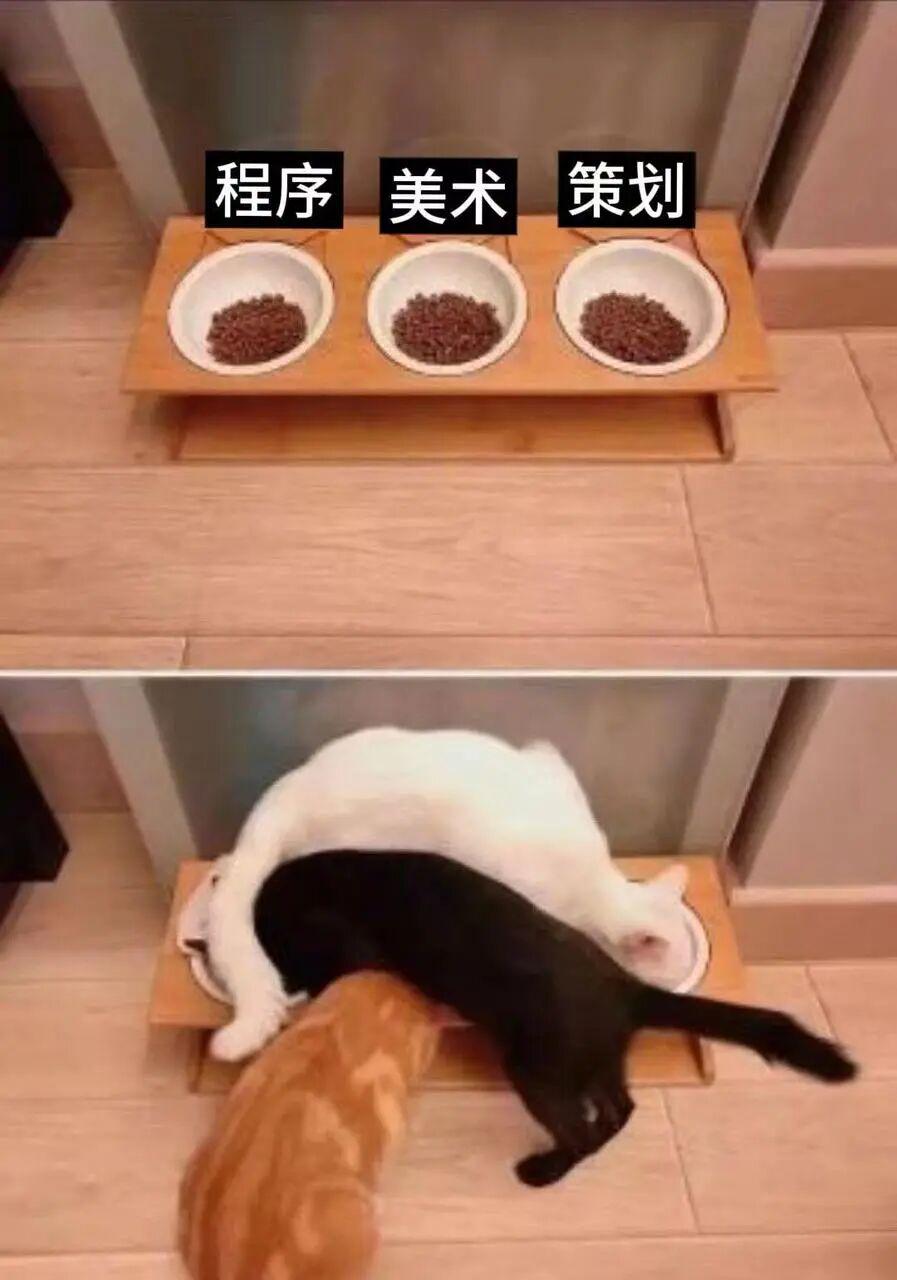
The three of them were nominally a game designer, an artist, and a programmer, but as they worked, the lines between their roles began to blur:Wan Shou handled both visual effects and sound effects; after finishing his coding, Zhi Tu also got involved in game design—many of the token designs were his brainchild; and Wu Long single-handedly took on all the 2D and 3D art for the game, while also contributing a bit to game design. Wan Shou described their final state as “stealing each other’s cat food from their bowls.”
Beyond its development, the publisher of *Raccoon Coin Pusher*—Playstack—is also noteworthy. Readers familiar with indie games will likely recognize this label; they published *The Joker*, which won the 2025 TGA Award for Best Indie Game. This marks Playstack’s first collaboration with a Chinese developer.
As of this writing, the game has garnered over 1,200 reviews on Steam, with 90 percent of them positive. The most frequently used descriptions in the player community are “addictive,” “can’t stop playing,” and “dopamine.”
The game has also performed exceptionally well overseas. Producer Wan Shou told us that of the 400,000 wishlist entries before the game’s launch, the largest share came from the U.S. region.The game has also garnered widespread acclaim from international media; PC Gamer called it “jackpot nirvana,” while GamesRadar described it as a “time-sink.”
“Coin-Pusher Roguelike”—just those five words are enough to give you a rough idea of what this game is like. It combines the physical thrill of an arcade coin pusher with the strategic depth of a roguelike’s layer-by-layer progression. But those five words only scratch the surface; it’s the details that truly make the game so addictive.
The core formula of *Raccoon Coin Pusher* follows the same principle as *Joker Cards*: score × multiplier. However, the medium for calculation has shifted from playing cards to physical tokens on the coin pusher machine that actually collide and roll. The official version features 150 types of tokens, each corresponding to a wide variety of unique interaction mechanics:When Seed Coins encounter Water Drop Coins, a money tree grows; when Bunny Coins collide, they give birth to a litter of baby bunnies; Wolf Coins prey on Bunny Coins; after a wolf eats a bunny, it defecates Poop Coins, which can be used to fertilize Plant Coins…The team even seriously discussed whether “the wolf could eat poop,” but eventually realized it would cause an infinite loop, so they had to abandon the idea.
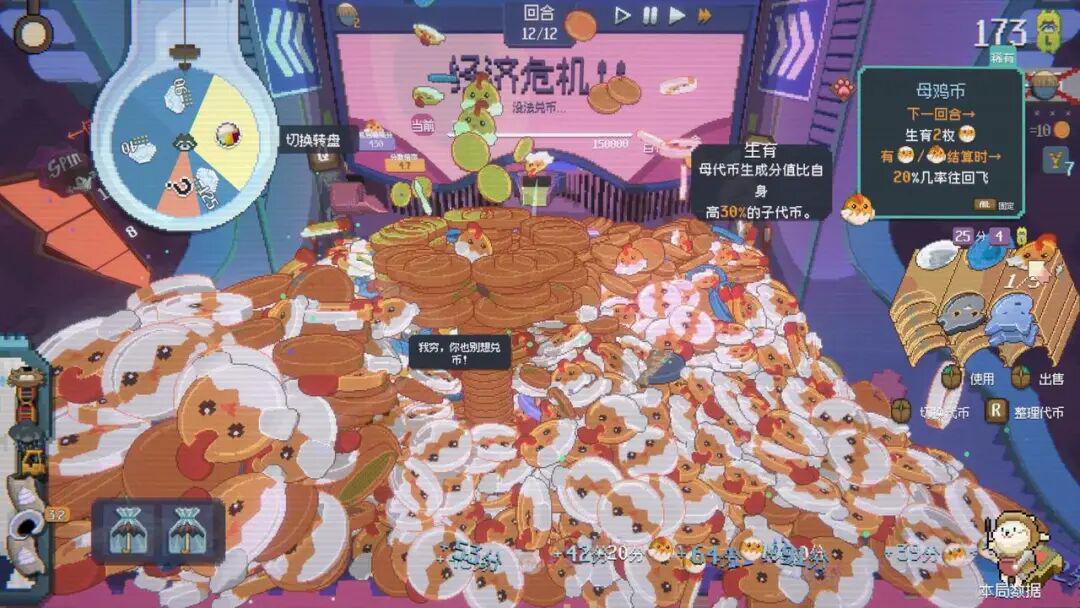
Paper Rabbit developed a modular system for this complex token interaction, breaking down attributes into tags such as "edible," "fertilizing," and "conductive," enabling the design architecture to handle the permutations and combinations of 150 different tokens.
When turning a coin pusher into a video game, there’s one issue you can’t avoid: which elements of the real-life experience should be incorporated, and which should be left out.The sound of coins clattering, the tension as the tower of coins teeters on the brink of collapse, and the moment the jackpot spills out—these elements were kept. But the hidden slots and the weight that feels deceptively light yet is impossible to push—these were left out. Wan Shou’s reasoning is simple: “We’re a single-player game; all we need to do is give players pure joy.”
There’s another kind of experience that offline coin-pushing machines just can’t provide. Anyone who’s ever spent time at a coin-pushing machine in an arcade has probably felt the same urge: the tower of coins is teetering on the edge, but it just won’t fall—you’re so tempted to reach in and give it a couple of shakes. But in *Raccoon Coin Pusher*, you actually can.Not only can you shake the machine, but you can also blow the coin tower apart with bombs, use a black hole to suck an entire section into oblivion, or save up a few frog coins to form a team and jump forward to push the coins. Some players have nicknamed this game the “Dopamine Extractor.”
Behind the success of these three recent college graduates are two key figures.
One is “Kaituoxin,” an investment and incubation brand under Eagle Corner Network.A Kun, Strategic Investment Director at KaituoXin, told us that in mid-2024, Wan Shou and her team’s final-year project, *Mouse Mouse Is Coming*, made a deep impression on KaituoXin—six college students spent more than half a year creating a demo for an animal-themed platformer,The game’s style is somewhat reminiscent of *Super Mario Odyssey*, and it shows considerable potential.
In August 2024, Wan Shou and Wu Long took a prototype of their coin-pushing machine—which had been in development for less than a month—to meet with Kaituo Chip. Their first reaction upon seeing it was one of delight: “The overall framework is excellent.” It took only about a month from the initial prototype review to the confirmation of their investment intent.
When the team began considering publishing options, since the members were players of *The Joker* themselves and drew much of their inspiration from the game, they wanted to first seek Playstack’s input. After Kedaoxin helped facilitate the connection, the two parties quickly reached a preliminary agreement.
Partnering with Playstack brought much more than just the title of “publisher” for *The Joker Card*. Wan Shou said that during discussions with the team about the game’s design, he would write three or four pages of feedback documents and even sketch out UI diagrams by hand. When performance bottlenecks were at their worst, Playstack even brought in an external technical team to help optimize physics performance and pixel rendering shaders.
The first producer to work with them was American, but the team’s English wasn’t very good, so online communication was quite difficult. Later, Playstack hired a Chinese national based in the UK specifically to manage this project, and collaboration became much smoother. The time difference wasn’t really an issue—Huanquan Games starts work at 1:00 p.m., which coincides perfectly with London’s working hours from 4:00 to 5:00 p.m.
That's right. This team starts work at 1:00 p.m. every day and finishes at 7:00 p.m., and they don't work overtime unless absolutely necessary. Their schedule is even healthier than it was when they were working on their final projects.
Three graduates, a year and a half, 400,000 wishlist entries, and 100,000 copies sold on the first day. Before the game’s launch, we sat down with the two lead creators, Wan Shou and Wu Long, to talk about their journey so far. The following is a transcript of that conversation, edited for clarity.
01
A Chat About Inspiration: The Birth of “Coin Pusher Roguelike”
From a chance encounter at an arcade to a flash of inspiration, and then to building a playable prototype in just two or three weeks—the origins of *Raccoon Coin Pusher* were much more spontaneous and impulsive than most people imagine.
Teahouse: I heard that the inspiration for *Raccoon Coin Pusher* came from an experience at an arcade?
Wan Shou: This idea came to me in early 2024, when Wulong took me to an arcade. I’d never played a coin pusher before, and I was really dismissive of them—I thought they were just a boring game for adults where you just watch coins fall.
Wulong: I've been encouraging her to play the whole time.
All Beasts: Later on, I came across a really fun coin-pushing machine that generated a tower of coins and combined match-three gameplay with monster-battling mechanics.On the screen, there were two factions on the left and right, each with a health bar. In addition to coins, the machine featured red, yellow, and blue tokens. If you pushed down three red tokens, the red character would unleash a move to deal damage to the monsters. Defeating monsters rewarded you with a tower of coins. This blend of physical and electronic gameplay suddenly made me realize just how interesting coin-pushing machines can be.
The Coin Tower really blew me away. Once, I hit the jackpot and summoned a Coin Tower that might have held as many as 1,200 coins—it was right there in front of me, and it was truly spectacular.

Teahouse: Just how obsessed were you back then?
Wan Shou: I go about once every two weeks, usually on weekends. Later, I remembered *Tower Unite*, a game I’d played before. In 2021, they released an entire arcade-themed level featuring a coin pusher. You could use the tickets earned from the online coin pusher to redeem in-game cosmetic items, and I ended up getting hooked for three or four hours. Whether it’s in person or online, I find it pretty captivating.
Teahouse: How did the leap in thinking occur—from “coin-pushing machines are fun” to “let’s make a Roguelike game”?
Wan Shou: That was right around the time *The Joker* was released—probably in February or March. I was still obsessed with coin-pushing machines at the time, and a thought suddenly struck me: What if I combined a coin-pushing machine with this kind of deck-building roguelike?
Teahouse: Once you had this idea, how long did it take to bring it to life?
"Ten Thousand Beasts": At first, everyone was busy with their final projects, so we didn’t have time to start working on it until after graduation. We decided to go ahead with it on July 5, and finished the entire prototype around July 31—it took about two or three weeks.
Actually, at first I was working on levels for *Mice Are Coming* at home, but the more I worked on it, the more frustrated I got—there seemed to be no end in sight, and it was definitely a bit tough doing it all by myself. So I decided to build a prototype coin-pushing machine first to see how it would go.It went more smoothly than I expected. By the end of the month, I’d already implemented the basic coin-pushing functionality, the pixel art style, Roguelike mechanics, turn-based gameplay, as well as features like Rabbit Coin upgrades, seed coin dispensers, and bomb coins.

The earliest prototype of "Raccoon Coin Pusher"
Teahouse: Why did you choose a cartoonish pixel art style? Was it for cost reasons?
Ten Thousand Beasts: The most obvious reason is that I really like the pixel art style. But there are also deeper considerations. I researched the coin-pushing games currently on the market and found that they basically fall into two artistic styles:
One style is photorealistic, such as in *Friends Push Old Coins*, which looks incredibly lifelike. But for small teams, this approach is extremely costly, puts an enormous strain on the art team, and comes with significant performance overhead. Furthermore, if you’re developing a roguelike that incorporates a coin-pushing machine, those over-the-top, explosive effects can easily look out of place in a photorealistic art style, resulting in a plastic-looking aesthetic.
Another style is the European and American cartoon-style, which is mainly found in those mobile game slot machines with built-in ads. The machine might only hold about ten coins, and they’re made very large and thick; personally, I find them a bit crude and they have a plastic feel to them.
Later, I realized that the pixel art’s grid-like pattern and grainy texture could effectively compensate for the flat appearance of the coin’s surface, balancing out the shortcomings of both art styles. After settling on pixel art, I chose a raccoon as the main character, hoping to create a cute character.With the raccoon in place, the overall tone was naturally set: small animals and a cute, pixelated atmosphere.
02
A Chat About Design: How the “Dopamine Extractor” Was Created
A coin-pushing machine is, by its very nature, a machine that combines sound, light, and electricity, but turning it into a Roguelike with extremely high feedback density requires addressing a series of trade-offs: Which real-world experiences should be retained, which should be discarded, and which can only be achieved through video games?
Teahouse: Often, dopamine comes from immediate feedback, but in real life, the feedback from coin-push machines is relatively slow—you insert a coin, and it might take a long time before another coin drops out. How did you turn it into a “dopamine extractor” with such intense feedback?
All Beasts: The dopamine rush from coin-pushing machines doesn’t just come from sky-high scores—it’s more about the audio-visual-electronic feedback.Coin-pushing machines are, by their very nature, arcade games packed with sound, light, and action—the clatter of coins colliding, the frenzied flashing when you hit a milestone, the bonus coins, and the towering pile of coins. We once won a tower of over 1,000 coins; seeing it right there in front of you, you’d definitely want to push it down.
Plus, in video games, we can do things we can’t do in real life. For example, shaking the machine—I’ve tried shaking it when I was desperate to get past a tower of coins, but those coin dispensers are mounted so securely that they won’t budge at all.In the game, you have plenty of options: use a black hole to collapse the coin tower, blow it up with an explosion, use items that reduce friction to make it slide right away, or even have several coin frogs jump together to knock the tower over. Allowing players to do things they can’t do in real life is also one way to trigger a dopamine rush.
Teahouse: What are the criteria for deciding between recreating an authentic experience and creating one that didn’t exist before?
Wan Shou: There are definitely trade-offs. For example, arcade coin-pushing machines offer a certain kind of fun—you can take over a machine from the previous player and choose one that already has a tower of coins. But single-player games don’t offer that kind of fun. In this case, we don’t want to carry over the shortcomings of the arcade experience.
For example, offline coin-pushing machines may have hidden slots, so coins get swallowed without you even noticing. Some electronic coin-pushing games on the market also have hidden slots—or even “visible slots”—where the machine has no sides, and points are only scored when the coin is pushed to the front; coins pushed to the sides are lost. The machine then forces you to watch an ad, and only after you’ve watched it do the side walls appear.
We’re a single-player game, and we don’t want to include in-app purchases or in-game ads—we just want to give players pure enjoyment. If we have to give players negative feedback, we should at least let them see it: the “bad coins” are actually there, negatively affecting their machine, and players can accept that. But with hidden penalties, players don’t have any effective strategies to deal with them.
Teahouse: If you had to identify a design fulcrum for the game, what would it be?
Wan Shou: I think it’s really the interactive effects of the tokens themselves. When I showed the demo to a lot of publishers before, they were immediately drawn to the cool visual effects—they’d marvel at them first and then discuss the shortcomings.
Teahouse: Isn’t it pretty challenging to find visual ways to express all the gameplay mechanics that have emerged in *Meat Pigeon*?
Wan Shou: The workload is definitely pretty heavy. The official version has 150 coins. We have to consider visual effects and sound effects for each coin, and there might also be visual effects for interactions between coins. But this process is pretty spontaneous—if we suddenly realize something is missing an effect, we’ll just add one.
Teahouse: How is the interaction between tokens designed?
Ten Thousand Beasts: It all came together step by step. Take planting trees, for example: the prototype already included Water Drop Coins and Seed Coins. Later, when we developed the coating system—which included an “Electrified” coating—Paper Rabbit suggested, “Could we have Water Drop Coins with the Electrified coating conduct electricity to other coins?”Later, we felt it was too monotonous to have only Seed Coins able to plant trees. I suddenly realized that corn itself looks quite a bit like a Coin Tower, so I designed Corn Coins that can grow into Coin Towers. Then I thought of the Bomb Coins in the game—corn plus a bomb equals popcorn.
Take Rabbit Coins, for example. One of the sources of inspiration was a joke from *Donut County*: rabbits are incredibly prolific. So we created a mechanism where Rabbit Coins can produce lots of rabbits.What’s the point of having so many bunnies? Find someone to eat them—so we created Wolf Coins, which led to the development of a predation system. After eating them, do they poop? The poop can be used as fertilizer for Plant Coins. We even discussed whether Wolf Coins could eat the poop, but we abandoned the idea when we realized it would create an infinite loop.
Whenever I design new content, I review the existing props to see if I can create interactions with them.
Teahouse: The later it gets, the more careful we need to be, right?
Wan Shou: Right, some tokens can conflict with each other. For example, there could be issues if a glue token sticks to itself. We even have to think through every possible interaction between all the tokens and the glue tokens.
Paper Rabbit has developed a module system that categorizes token attributes into “can prey on others,” “can be preyed upon,” “can fertilize,” “can be fertilized,” and so on. The underlying code is already in place. Creating a new token mainly involves assigning modules, configuring parameters, and implementing more customized effects specific to that token.
Teahouse: Was there anything during the design process that was particularly difficult to balance or that you struggled with for a long time?
Ten Thousand Beasts: There was a major issue earlier—before the character system was implemented, all the coins were mixed together, and there were just too many of them, making it difficult for players to build the playstyle they wanted.
Later, we introduced a role system. Each role has different weightings for different coins, which helps us fine-tune the balance. When certain coins conflict with one another, we have one role produce those coins while another does not.
Teahouse: The character system helps you sort out experience distribution and build customization.
Wan Shou: That’s right, and it also extends the game’s lifespan to some extent. Players might have gotten bored after just a few rounds, but having characters makes them want to play more. Plus, we’ve designed many systems to be character-specific—for example, the Chemist in the demo unlocks the coating system, and characters in the full version each unlock new content as well.
Previously, features like coatings and custom turntables were all unlocked from the start, which meant players had to process too much information right from the beginning. Later, these features were naturally integrated into the characters—unlocking a new character also unlocked a new system, and players could experience these features with their previous characters as well, greatly increasing replayability.
03
A Journey: From My Senior Thesis to Signing with the Publisher of *The Joker*
Three graduates—at first, they weren’t even sure if they could finish making a game.
Teahouse: How did you two first meet?
Wan Shou: Wulong and I are both in the Game Design Department at the Communication University of China. I major in Game Design (Art and Technology [Digital Entertainment Track]), and she major in Fine Arts (Animation [Game Art Track]).Every semester, the Communication University of China groups students from the game design, art, and programming majors into teams—the legendary “free-for-all.” We met in a class during our junior year and worked together on our senior capstone project in our senior year.
Teahouse: Is your final project *The Mice Are Coming*?
Wan Shou: Right, there were six of us in total. But after graduation, everyone had different goals—some wanted to study abroad, others went to work at big tech companies—so in the end, it was mainly just the two of us who kept going. It was definitely a bit challenging for just the two of us to work on that product category, so we started by rebuilding a prototype of the coin-pushing machine.
Teahouse: How did that other person join?
Wan Shou: Zhi Tu majored in computer science as an undergraduate and later pursued a master’s degree in game design at the University of the Arts London. After Kaituo Chip confirmed its intention to invest, we realized we needed to hire a programmer. A fellow graduate student—who was a senior from two classes prior—shared the job posting in our class chat group, and he saw it and submitted his resume. That was around September or October of 2024.
Teahouse: If you hadn’t been able to secure funding at the time, what were your plans?
Oops: By then, I had already received offers from the schools I applied to—all four had accepted me, and one even offered me a scholarship. If I hadn’t secured the investment, I probably would have gone to study abroad.
Wan Shou: It was a fairly long process for me.I went through the spring and fall recruitment cycles, but in the end, I only landed an offer from a small studio. I seriously considered whether I could take the job first and then work on indie games part-time, but my previous internship experience at a big tech company taught me that after a full day at work, I’d most likely feel too exhausted to do anything else. In the end, I told my boss that I still wanted to make indie games.
The boss was really nice. He said, “No problem. This is a two-way decision anyway. I’m happy for you—it shows how outstanding you are, and that others share our view of you.” He also talked at length about the kinds of challenges one might face when starting a business.
Later, I found another job, but as my start date approached, I was still torn: Could I really accept a life where I worked just for the income while also developing indie games on the side?Deep down, I still hoped to pursue indie gaming more wholeheartedly. After discussing it with my parents—my dad said he’d support me—I finally made up my mind. About four or five days later, I started working on the prototype for the Raccoon Coin Pusher.
Teahouse: At what stage did Kaituoxin approach you?
Wanshou: We met once at the end of 2023, right at the start of my senior year, when they came to campus to give a lecture and check out some projects. We had our first formal discussion about investment in June 2024, after my graduation project exhibition. Later, I built a prototype of the coin-pushing machine to show them, and they immediately scheduled a meeting.
At the time, we discussed issues with the prototype, such as the coin box having only six slots and no expansion system.One teacher even figured out a strategy to generate an infinite supply of Rabbit Coins, scoring incredibly high—I didn’t even realize the prototype could be played that way. They also suggested we focus on the single-player experience, which was a crucial piece of advice. We had originally planned to include multiplayer, but online multiplayer comes with many technical challenges that small teams often can’t handle; otherwise, we might have stubbornly stuck with that approach.
Teahouse: Will the investment be finalized soon?
Wan Shou: That was pretty quick. We saw the prototype in early August and finalized our decision in mid-September—it took about a month.
Teahouse: Aside from funding, what other support has Kaotai Xin provided?
Wanshou: They basically handled everything related to setting up the company—we were fresh out of college and knew absolutely nothing about these things, so they walked us through the entire process. They provided the office space for free and organized many seminars on company operations and key considerations for securing distribution. They introduced us to distributors, helped us connect with content creators to explore promotional opportunities, and even introduced us to our music team.When contracts came in, they also connected us with a reliable legal team to help us understand the terms.
Teahouse: How did you get in touch with Playstack?
Wan Shou: We compiled a list of publishers, and KaotuoXin helped narrow it down to a few, including Playstack. They’ve published *The Joker Card*, which was actually an inspiration for us, so getting in touch with them would definitely be great news. After reaching out, we received a response in about a week.
Teahouse: Are there any challenges associated with cross-border collaboration?
Wan Shou: At first, we were worried about the time difference, but since we start work in the afternoon, they can still log in around 4 or 5 p.m., so it worked out fine. The original publishing producer was American, and since our English wasn’t very good, it was hard to follow the online meetings. Later, Playstack hired a Chinese person as the publishing producer, which made things go much more smoothly.
Teahouse: In what ways has the publisher been most helpful to you?
Ten Thousand Beasts: First is localization. Core terminology and conditional phrases—such as how to express “at the start of the turn”—must be consistent and standardized throughout the entire game; we went through many rounds of revisions to get this right.
Second, suggestions regarding game design. They mentioned that “players have too little sense of control,” so we later added the “sticker” mechanic to the official version—these appear randomly on the push-the-box ramp, and passing over them with enough coins activates their effect.
Third is UI feedback. The artist at Playstack wrote a three- or four-page feedback document and even sketched out interface diagrams by hand. We really didn’t have any experience with UI design. However, they didn’t insist on any specific changes unless there was a serious issue.
04
A Chat About Feedback: The Story Behind 400,000 Wish Lists
From changing a key mechanic based on a beta tester’s comment that it “felt like a jump scare,” to facing accusations of poor performance optimization in the demo, to the calm response when the wishlist count rose from 50,000 to 400,000—behind these numbers lies the journey of a student team growing through genuine feedback.
Teahouse: Was there any particularly useful player feedback during the testing phase?
Ten Thousand Beasts: Before the first reveal, we conducted an internal test where players filled out a very detailed survey. At that time, our turns ended automatically—if no coins dropped and no special events occurred within a few seconds after reaching the target score, the turn would end.One player said they were very confused by the round-ending conditions, and another said the shop page popping up suddenly felt “like a jump scare.”
After analyzing similar games, I found that the timing of their outcomes is highly predictable: in *Joker Cards*, the game ends when all cards have been played and scored; in pinball games, the game ends when all balls have left the screen; and in slot machines, the game ends when the symbols on the reels have finished spinning.But coin-pushing machines have an inherent lag—it can take a long time for a coin to fall after being pushed, and if the player doesn’t interact for over ten seconds, a coin might fall on its own due to gravity.The nature of 3D physics creates a very blurred and intertwined relationship between player actions and outcomes. Combined with the fact that players’ attention is constantly focused on the coins in the machine rather than the scoreboard, they are extremely surprised when the in-game store page pops up automatically.
Later, the game was changed so that players could end their turns on their own. This has many advantages: players can rack up a higher score in a single turn, get rid of all the coins they want to discard before slowly ending the turn, have more flexibility, and feel a greater sense of control.
Teahouse: What was the most challenging part of the whole process for you?
Ten Thousand Beasts: Performance optimization. Both the demo released late last year and the initial reveal had significant performance issues, and we’ve seen quite a few negative reviews regarding performance. As a startup team, we really don’t have much experience in this area, so it’s been a bit disheartening.
However, this year’s demo is looking much more promising. Playstack hired an external team to help us revise the pixel shaders, which resulted in a significant improvement. We’ve also made a lot of physics optimizations ourselves: Paper Rabbit wrote a queuing system to handle resource-intensive events via queues;we implemented a “busy mode”—where all events proceed at a slower pace when there are too many events on the machine; and we also switched to a new physics engine. This demo has already received overwhelmingly positive reviews, and the publisher even told us that a review that had initially criticized the performance has been changed back to a positive one, which makes us very happy.
Teahouse: What is the approximate breakdown of wish list items between domestic and international markets?
All Beasts: Currently, the majority are from the United States and China. The proportion from overseas is still quite large.
We chose Playstack not only because they are the publisher of *Joker Cards*, but also because, as an international publisher, they can help us better expand into overseas markets. We’re at least a bit more familiar with the domestic market, and when it comes to creating videos, we know what kind of inside jokes to include.
Teahouse: Did you ever imagine the game would be this successful?
Wan Shou: I was already really happy when the wish list hit 50,000, but after that, each increase of 100,000 felt a bit more subdued.
Teahouse: You must be under a lot of pressure, right?
Wan Shou: I’m a little nervous. But what makes me happiest is that the game I’ve been working on for almost a year has finally seen the light of day, and it’s received a lot of attention and feedback. I check every day to see if there are any new comments.
Teahouse: What were your expectations when you signed the contract?
Wan Shou: I don’t have high expectations—as long as we break even, that’s enough to make the investment in Kaituo Chip worthwhile. The higher the expectations, the greater the disappointment if they aren’t met, so I don’t want to set the bar too high.
Teahouse: Have you spoken with the developers of *The Joker*?
Wan Shou: Yes, but not much. We mostly just met and exchanged greetings. After that, I didn't dare bother him—I heard he's been feeling pretty anxious lately.
Teahouse: Is this kind of mindset common when playing games?
Wan Shou: Of course there will be. It’s like treating your own game as a work of art and polishing it to perfection. But I think doing your best is enough—everyone has different ideas, tastes, and preferences, so it’s hard to please everyone.
原创文章,作者:游茶妹儿,禁止转载:https://youxichaguan.com/en/archives/216072