In the summer of 2026, horror-themed works garnered significant attention in both the film and television and video game industries.In the film industry, the horror movie *Obsession*, written and directed by YouTube creator Curry Barker, was produced on a low budget of less than $1 million but grossed over $400 million worldwide, becoming Focus Features’ highest-grossing film globally to date;Another film, *Backrooms*, directed by YouTube creator Kane Parsons, also grossed approximately $350 million worldwide.During the same period, the “micro-horror” genre was particularly active in the gaming market: From July to September, domestic companies such as Tencent, NetEase, Giant Network, and miHoYo intensively promoted micro-horror projects and content updates, while a surge of collaborative micro-horror games from overseas emerged, mirroring the popularity of the horror genre in the film and television industry during that time.
01
Major Domestic Companies: From Single Blockbusters to Multi-Pronged Strategies
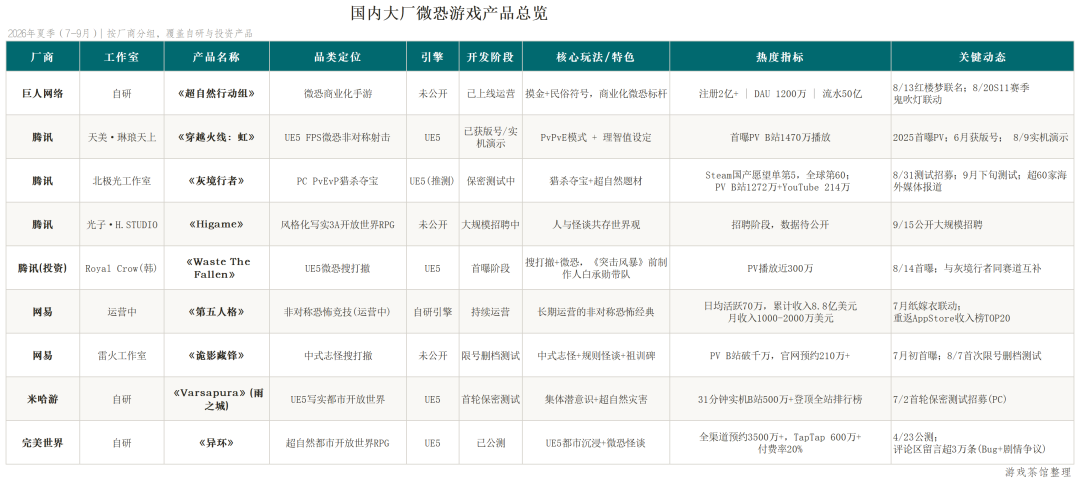
Giants Network’s *Supernatural Task Force* launched in 2025 and became one of the top-performing titles in the “mild horror” genre in 2026. As of the end of the first quarter of 2026, the game had over 200 million registered users and cumulative revenue exceeding 5 billion yuan;On August 24, DAU (daily active users) surpassed 12 million, marking further growth since it first exceeded 10 million in February.Giants Network reported revenue of 4.689 billion yuan for the first half of 2026, a year-over-year increase of 182.08%, and net profit attributable to the parent company of 2.144 billion yuan, a year-over-year increase of 175.96%. According to the company’s interim report, *Supernatural Task Force* continued to generate significant revenue and served as a key driver of this performance growth.
From July through September, the game continued to roll out content updates: on August 13, characters from the *Dream of the Red Chamber* collaboration were released; on August 20, the S11 Magic Box Season went live; and during the summer, the “Yunnan Insect Valley” map—a collaboration with *Ghost Blows Out the Lamp*—was launched.The international version of *TombBusters* has partnered with Garena and plans to enter the Southeast Asian and Latin American markets in Q1 2027.
Tencent is pursuing a multi-pronged strategy in the micro-horror genre.
Developed by Linglang Tian Shang, a studio under the TiMi Studios Group, *CrossFire: Rainbow* is positioned as a first-person, mildly horror-themed, asymmetrical shooter built on Unreal Engine 5. Its first teaser trailer, released in 2025, surpassed 14.7 million views on Bilibili.It received its publishing license in June 2026, and on August 9, the first in-game gameplay demo was released, showcasing the PvPvE mode and the “Sanity Meter” mechanic.
Arctic Light Studio’s *Gray Realm Walker* opened recruitment for its first PC closed beta test on August 31, with the test scheduled for late September.In the Q2 2026 Steam Wishlist rankings for Chinese games, *Wanderer of the Gray Realm* ranked 5th and 60th globally. Its debut trailer has surpassed 12.72 million views on Bilibili and 2.14 million views on YouTube, and the game has been featured in reports by over 60 international media outlets.
On September 15, H.STUDIO, a division of Photon Studios, announced a large-scale recruitment drive for its AAA project *Higame*, described as a “stylized, realistic AAA open-world RPG” set in a world where “humans and ghost stories coexist.”
Based on popularity metrics, these three new “micro-horror” titles from Tencent have already generated considerable anticipation even before their release.
In terms of product types, Tencent’s related projects have expanded into genres such as asymmetric shooters, PvE and PvP treasure-hunting games, and open-world RPGs, demonstrating a multi-pronged strategy.
In addition, *Waste The Fallen*, a UE5-powered micro-horror survival game developed by the South Korean team Royal Crow—backed by Tencent—was first unveiled on August 14, and its promotional video has already garnered nearly 3 million views.Led by Baek Seung-hoon, former producer of *Assault Storm*, the game shares certain similarities with *Gray Walker* in terms of gameplay, further demonstrating that Tencent’s strategy in this genre encompasses both in-house development and investment.
As for NetEase, *Identity V* continues to maintain strong operational momentum.
According to AppMagic estimates, the game had an average of approximately 700,000 daily active players in 2026, with cumulative revenue exceeding $880 million and monthly revenue stabilizing in the range of $10 million to $20 million. In July, the game launched a collaboration with *Paper Bride* and re-entered the Top 20 of the Chinese App Store’s mobile game revenue chart.
Mihoyo’s *Varsapura* is a supernatural urban open-world RPG developed using UE5.Its first-ever 31-minute gameplay trailer surpassed 5 million views on Bilibili and topped the platform’s charts. The first round of closed beta testing, which began on July 2, 2026—limited to PC and with a limited number of spots—still attracted a large number of players.
Perfect World’s *The Strange Ring* is set in a supernatural urban open world and features elements of mildly terrifying urban legends. The game entered open beta on April 23, 2026; prior to launch, pre-registrations across all channels exceeded 35 million, and it garnered over 6 million followers on TapTap.its open beta promotional video on Bilibili garnered over 8 million views, and the first teaser video also surpassed 10 million views. During the third beta test, access codes were resold on second-hand platforms for approximately 500 yuan.A research report released by Qunyi Securities in March cited a third-party assessment stating that the player monetization rate for *The Strange Ring* during its third beta test may have reached around 20%, higher than the 8%–12% average for similar games cited in the report.After the open beta, the game maintained high community engagement thanks to the immersive urban experience of “Haitelo City,” built using Unreal Engine 5. However, it also sparked large-scale player discussions on multiple occasions due to frequent bugs and plot controversies. “During the operational controversy in May caused by the ‘Rabbit Hole’ bug, related comments on social media briefly exceeded 30,000.”
According to Gamma data, actual sales revenue in the domestic gaming market reached 31.098 billion yuan in July.
In addition, Lei Huo Studio’s Chinese-style supernatural action-adventure game *Ghostly Shadows: Hidden Blades* was first unveiled in early July; its promotional video surpassed 10 million views on Bilibili, and the game launched its first limited, data-wipe beta test on August 7, with pre-registrations on the official website exceeding 2.1 million.
02
The Indie and Buy-Out Markets: A Flurry of “Slightly Scary” Titles
From July through September, several “slightly scary” hit games appeared on the Steam platform.
Taking the indie game *Midnight Shift* as an example, it was developed single-handedly by Australian indie developer BunMuen.
The game centers on “supermarket simulation + impostor identification” as its core gameplay. Set in the United States in 1993, players work the night shift at a gas station convenience store, scanning IDs to identify impostors disguised as customers.The game was released on July 22 and entered the Top 10 on Steam’s Global Best-Sellers chart and the Top 6 on the Full-Price Games chart in its first week, briefly topping the China region’s Best-Sellers chart. According to data from third-party platforms, the game generated $3.6 million in revenue within five days, $7.5 million within two weeks, and reached a peak of 37,000 concurrent players.
Major international games like *Dead by Daylight* continue to receive content updates even a decade after their release—with several new chapters scheduled for 2026: Chapter 2 of *Stranger Things* in January, “All-Kill: Comeback” in March (introducing the game’s first city map), the “Friday the 13th” Jason chapter in June, and the community-created “Chorus of Sin” chapter in August. The developers have confirmed that there will be no sequel and will continue to provide long-term content updates for the base game. Additionally, Art the Clown, the serial killer from the horror film series *Killer Clown*, is expected to join the game in November.
Developer Behaviour Interactive confirmed that its total player count has exceeded 70 million, with an average of over 1 million daily players across all platforms, and that the game has consistently ranked in the top 15 on Steam’s best-selling list for nine consecutive years.Following the release of the Jason chapter in June, the game reached a peak of 125,000 concurrent players on Steam and surpassed 250,000 concurrent players across all platforms—both all-time highs; within 24 hours of the chapter’s launch, the game gained over 300,000 new players. Within the asymmetric horror genre, the title has demonstrated a rare trajectory of sustained growth.
Konami’s *Silent Hill: Townfall* is set to launch on September 24, 2026, for PS5 and PC. It is being developed by Screenburn Studios, the team behind *Observation*.A gameplay trailer will be released on August 20, the voice cast will be announced on August 26, and wallpapers will be available for download on September 15. This marks the third consecutive year that a new title in the Silent Hill series will be released during this timeframe (the *Silent Hill 2* Remake in 2024 and *Silent Hill f* in 2025).As of the end of March 2026, the series had sold over 17.1 million copies worldwide.As the third consecutive new release in the series, *Silent Hill f* has surpassed 2 million units shipped worldwide and won three awards at the “Famitsu・Dengeki Game Awards 2025,” including Game of the Year (GOTY), as voted by fans;*Silent Hill 2* Remaster has attracted over 6 million players, laying a solid market foundation for the release of *Small Town Fall*.
03
Trends and Boundaries
The expansion of the “mild horror” genre exhibits two characteristics.
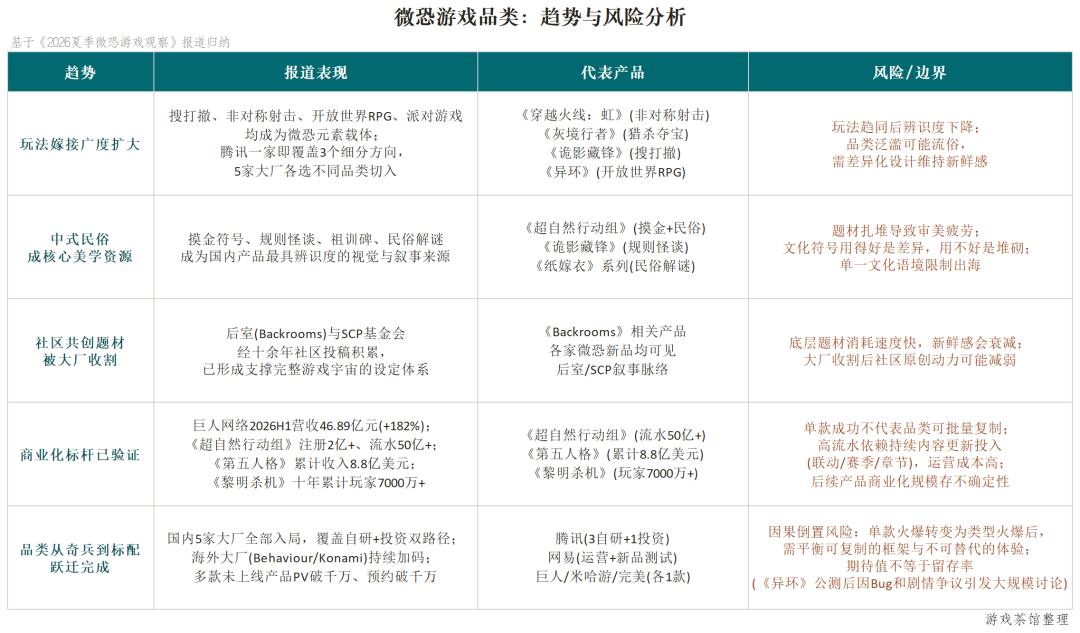
First, horror elements are spreading from a standalone game genre into “gameplay components.”Games like “search-and-destroy,” asymmetric multiplayer, open-world RPGs, co-op, and party games can all serve as vehicles for horror, ghost stories, and supernatural elements. This means that horror no longer necessarily refers to traditional survival horror but can be embedded into different gameplay styles through atmosphere, rules, enemy design, and narrative mechanisms.
Second, Chinese folklore, ghost stories, and rule-based narratives are becoming important resources for localization in some domestic products.The tomb-raiding and folklore symbols in *Supernatural Task Force*, the rule-based ghost stories in *Shadow of the Blade*, and the folklore-based puzzles in the *Paper Wedding Dress* series all attempt to integrate local cultural elements with gameplay mechanics such as exploration, puzzle-solving, and cooperation, each of which has cultivated a stable community of enthusiasts.
The thematic foundation behind this trend is also linked to the development of online co-creation culture in recent years.
As GameLook noted in an analysis published in July: Online collaborative projects such as *Backrooms* and the SCP Foundation have, through years of community-driven creation and secondary dissemination, gradually developed relatively mature worldviews and symbolic systems;For major studios, such themes—which have been disseminated by the community over the long term and have established a stable public perception—also reduce the costs associated with communicating concepts and educating users about new products.
In an analysis article published on GameRes, industry observer Xiu Hu stated: “What makes a ‘surprise hit’ a surprise hit is that it catches people off guard. Once it becomes widespread, it may actually lose its novelty.”GameRes’ industry analysis suggests that the current popularity of the “micro-horror” genre may involve a “reversal of cause and effect”—a single product first gains traction, prompting developers to follow suit and amplify the trend, gradually transforming the success of one title into a genre-wide phenomenon. How to maintain the genre’s freshness and distinctiveness amid large-scale investment is the challenge that must be addressed in the next phase.
Judging by the current number of products and the range of gameplay mechanics available, “mild horror” elements are gradually shifting from being a differentiating selling point for a handful of products to becoming a standard part of more developers’ product pipelines and content operations. However, whether this trend will evolve into a stable subgenre still depends on whether future products can create sufficiently distinctive experiences beyond the framework of replicable gameplay mechanics.
Data sources: Giant Network’s 2026 Mid-Year Report, relevant research reports from Qunyi Securities, official announcements from Konami, PlayStation Blog, Gamma Data, AppMagic, and others; market and industry information compiled from public reports by 17173, 36Kr, GameRes, Jinghe, and others.
原创文章,作者:游茶妹儿,禁止转载:https://youxichaguan.com/en/archives/208571