Over the past two years, the rapid growth of interactive movies and games has been truly remarkable.
In 2023, the breakout success of *Oh No! I’m Surrounded by Beauties!* made more players realize for the first time that video content could also serve as a gaming medium featuring choices, branching paths, and multiple endings. By 2024, more game development teams had entered the market, but issues such as genre homogenization and high production costs also began to surface.
In 2025, the market saw a turning point. *The Emotional Anti-Fraud Simulator* brought emotional dynamics and real-world issues into interactive video, while *The Queen’s Game: A Golden Age* placed courtly history and a female protagonist at the center of a more complex narrative of power.These works demonstrate that interactive films and games no longer rely solely on romance and emotional companionship; their themes are expanding in diverse directions, including suspense, anti-fraud, and history.
At the same time, generative AI has gradually moved from being a behind-the-scenes tool to taking center stage in finished products, playing an active role in the production of scenes, characters, audio, and video. During this period, Steam also began requiring developers to disclose which AI-generated content players were actually consuming. AI has evolved from a traditional “productivity tool” into a widely used production method.
Siming Interactive Film and Game Studio has chosen to enter the market at this juncture. They previously made their public debut with the AI-driven interactive mystery title *Train Ghost Stories: Realm of Illusions*. Subsequently, the studio secured the adaptation rights to the full-length, ancient-style detective story *Beneath the Capital Gates* and is reimagining the original work as a visual adaptation to create a brand-new AI-driven interactive film and game.
This choice has placed the studio at a crossroads in the history of interactive film and gaming. From the short, horror-puzzle experience of *Train Ghost Stories* to the long-form, ancient-style detective story *Beneath the Capital Gates*, they are venturing deeper into the realm of interactive film and gaming.
The following is a transcript of the conversation between Tea House Jun and Mr. Luo Yue. (Some content has been edited to enhance the reading experience.)
01
Encounter
Game Teahouse: Let’s start with the team. Could you briefly introduce your founders and core members?
Luo Yue: I started out in game development, and screenwriting was originally just a hobby of mine. By a stroke of luck, I’ve had the opportunity to participate as a producer or lead screenwriter on projects such as *The Twilight Line*, *Doomed 2*, and the upcoming *The Jade Gambling World*, which is set to begin production soon.
Thanks to my previous experience as both a game producer and a screenwriter, I’m particularly skilled at building the entire pipeline for interactive cinematic games from scratch,I can thoroughly implement and make decisions at every stage. My partner, Lu Yitong, possesses a rare level of aesthetic sensibility across the board that aligns perfectly with mine—we hit it off immediately, which is why we formed our current studio.
The core team members include both veterans from our previous game development projects and a number of new recruits, such as scriptwriters, AI cinematographers, post-production editors, AI artists, and interaction programmers—all of whom have experience developing narrative-driven interactive content or film and television projects.
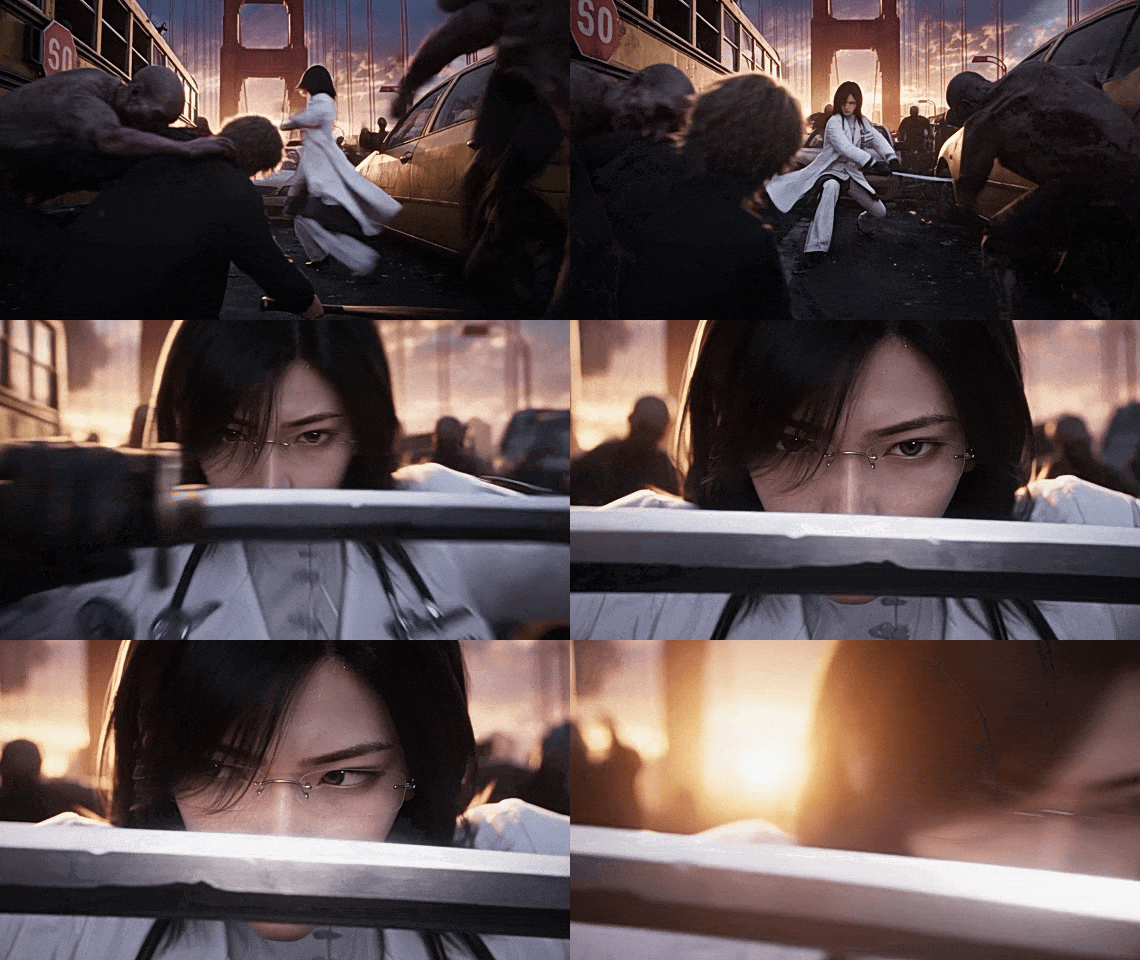
*Under the Gates of Beijing*, *Dawn of the Apocalypse: Bloodline*, and several others currently in development represent my new attempts to bring AI-interactive film-and-game projects to life, building on my experience in traditional live-action film and game production.

Game Teahouse: Are there any interesting stories or experiences behind the founding of your team that you’d like to share with everyone?
Luo Yue: After filming for the film-game project wrapped up, the core creative team stayed in touch regularly—for example, I’d occasionally chat with Zuo Zuo (who played the Second Princess in *It’s All Over*) about scripts and interesting story ideas.When my own gaming business hit a snag, it just so happened that film-and-game adaptations were becoming all the rage. At the same time, actress Zuo Zuo was feeling the impact of AI-generated dramas (though she was actually just taking it easy) and wanted to pivot her career. So I rounded up a few friends and teamed up with her to found the Siming Interactive Film and Game Studio.
When building a team, you actually need to set aside much of your past experience. For example, whether the production team has worked in film and television or has formal training isn’t the top priority; what matters more is their imagination and ability to bring ideas to life regarding the subject matter, cinematography, and the creative process itself, as well as their understanding of new user demographics.High-quality interactive film and game production involves a complex production chain, making cross-departmental collaboration and mutual understanding particularly important. Given the current shortage of talent, we still prefer to focus primarily on internal development.
Game Teahouse: Have you ever received funding from related companies in the past? What is your team’s primary source of funding at the moment?
Luo Yue: The team is backed by one of China’s top film and television companies and has not yet sought external funding.
Game Teahouse: So what games has your team developed in the past?
Luo Yue: Taking advantage of the opportunity to build an editor, we launched the suspenseful AI film-game *Train Ghost Stories: Realm of Illusions* in about a month and a half.
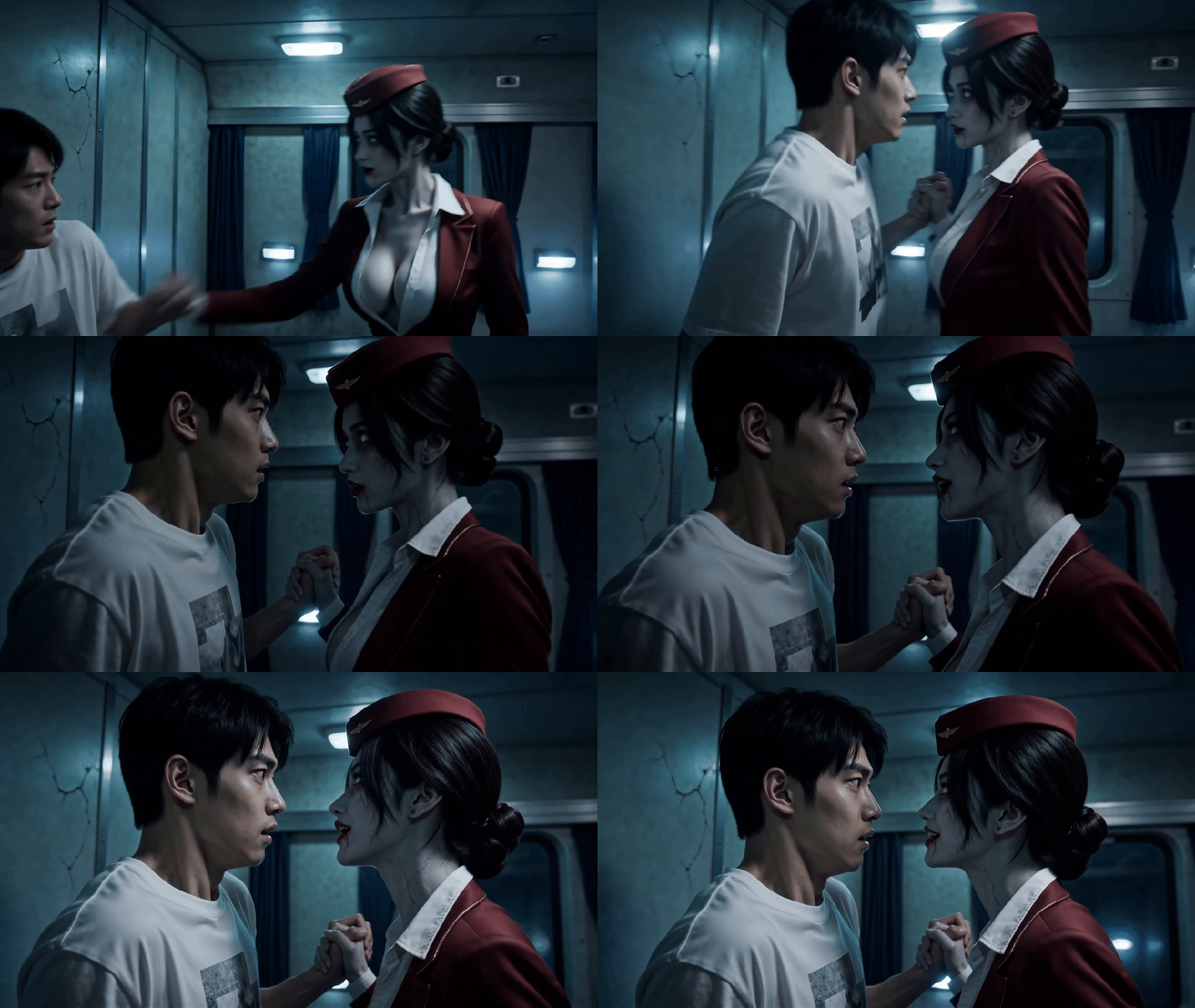
“Train Ghost Stories” places players aboard a mysterious train. Using the “Passenger Survival Rules” as its survival framework, the game involves exploring the environment to gather clues and making strategic decisions at key moments. It features multiple main storylines and hidden endings.
Game Teahouse: I had a general idea about this game before the interview. Do you think developing this game has had any significant impact on your team?
Luo Yue: As a test run, we were prepared for a flood of negative reviews from people who find AI-driven games hard to accept, but we didn’t expect the overall market response to be so positive~
This project demonstrated that the integration of AI with film and gaming is feasible and successfully established the entire pipeline—from project initiation to marketing and distribution—from scratch. Following *Train Ghost Stories*, we have officially entered the production phase for high-quality film-and-game adaptations, including *Beneath the Capital Gates*, *Dawn of the Apocalypse: Bloodborne*and *Master Matchmaker*, as we prepare to further explore the AI-interactive film-and-game market.


02
The Mystery
Game Teahouse: Could you briefly introduce your team’s latest project? What are its core gameplay mechanics and unique features?
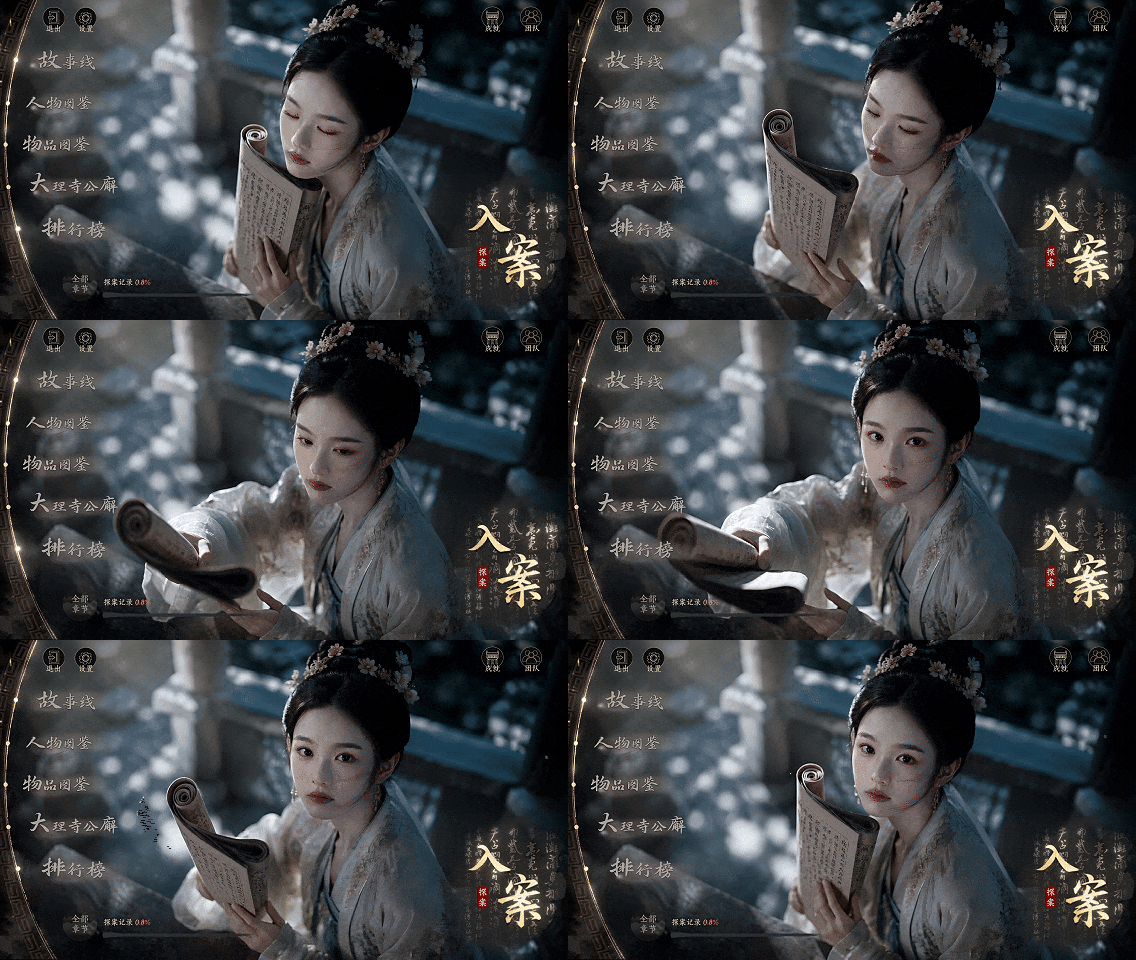
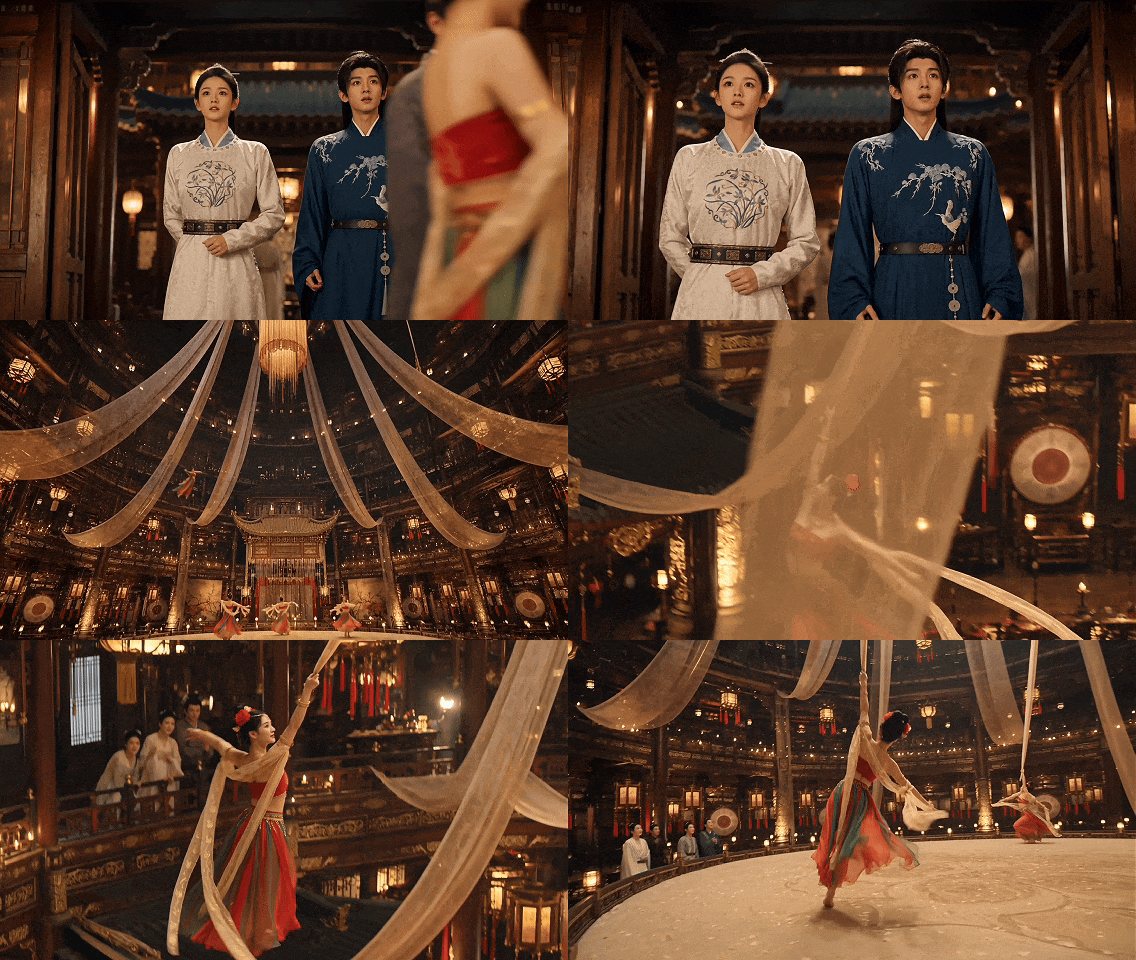
Luo Yue: *Beneath the Capital Gates* is an interactive film-game set in a historical setting that blends mystery and detective work. Players take on the role of “Xie Ning, the clerk,” who, upon arriving at the county magistrate’s office for the first time, stumbles upon a major case involving the magistrate’s mysterious drowning.

The game’s core gameplay revolves around solving mysteries: visiting crime scenes, gathering evidence, questioning suspects, and piecing together clues to uncover the truth behind the murder. The story features branching paths based on the player’s choices, with different decisions unlocking different truths and endings.

Specifically, players can examine crime scenes, interview witnesses on the streets, search for evidence in distinctive ink-wash-style environments, organize case files and transcripts, and engage in a variety of investigative gameplay mechanics, including QTE escape sequences.Players can sift through long-forgotten case files in the county magistrate’s archives to unlock clues from old cases; they can navigate locations such as taverns, apothecaries, Yilan Lane, and the Crown Prince’s Mansion, unravelling the truth amidst conflicting testimonies and fragmented physical evidence.

In terms of the story, the county magistrate’s drowning is just the beginning. As the investigation deepens, a series of old unsolved cases—long attributed to a vengeful ghost—comes to light, revealing one after another the dark secrets of the gentry and the shadowy underbelly of the population.Throughout the investigation, players will encounter numerous characters whose fates are intertwined, and every choice they make will shape those fates.

Later in the story, a mysterious and strange epidemic will sweep through Luan Yang City, forcing the authorities to impose a lockdown. The protagonist’s background has long been intertwined with the many mysteries surrounding Luan Yang. The game features numerous instantly triggered “Bad Ends”; a single wrong decision can immediately bring your investigative journey to an end.By playing through multiple playthroughs, you can adjust your choices and affection levels to unlock all hidden scenes and diverse endings.

Game Teahouse: Compared to the wildly popular romance-themed games on the market, why did you choose this genre?
Luo Yue: Historical-style detective stories naturally offer narrative advantages rooted in Chinese folklore and the mysterious and supernatural. We don’t want to create a pure dating sim or a simple choose-your-own-adventure game; instead, we aim to develop a product with a stronger narrative core.

Game Teahouse: What do you think are the unique features and highlights of *Beneath the Gates of the Capital*?
Luo Yue: *Beneath the Gates of the Capital* has three main characteristics.
First, use AI-generated traditional-style imagery to recreate ancient county towns, crime scenes from ancient times, and the like;
Second, the logic of the clues forms a closed loop, and the reasoning is well-founded;
Third, by weaving in folk legends and eerie tales, it subtly hints at the undercurrents of the times.
This game is adapted from a long-form interactive narrative by the author Coco She Doesn’t Speak. The original work established a comprehensive world-building framework, multi-dimensional character relationships, and a series of case-based story arcs. After obtaining the adaptation rights, the team undertook extensive restructuring and innovative design for visual presentation and gameplay mechanics, while remaining faithful to the original character development and the core plotlines of the cases.
03
Overcoming Difficulties
Game Tea House: Since we’re talking about game development, the topic of challenges during development is inevitable. So, what do you think is the biggest challenge you face during the development process?
Luo Yue: The biggest challenge is striking a balance between the visual atmosphere and the rigor of the detective work.
On the one hand, we must ensure stunning, period-style visuals and an immersive storyline; on the other hand, we cannot sacrifice the plausibility of the deductive reasoning for the sake of cinematic effects. If the clues don’t add up or the testimonies are contradictory, players will feel that the deductive reasoning is pointless.
Game Teahouse: This issue is indeed very important for this genre of film-to-game adaptations. So how did your team overcome it?
Luo Yue: Our approach is to create a lead verification checklist and repeatedly cross-check the logic of witness statements and physical evidence to ensure that every lead has a corresponding entry in the case file.
At the same time, we conduct small-scale testing and adjust the difficulty of the clues based on feedback from the test group. Some clues are buried too deeply, making them hard for players to find; others are too obvious, which takes away from the fun of deduction. Finding the right balance requires constant testing and adjustment.
Game Teahouse: Now that we’ve gotten this far in the discussion, is there any test data about the game you can share at this point?
Luo Yue: We’re currently conducting a small-scale internal test. Testers have given high marks to the ancient-style settings and the atmosphere of folk mystery, and players who enjoy deduction-based games have shown a particularly strong willingness to play again. There’s a high level of anticipation for the multiple endings and plot twists involving various suspects.
We are still optimizing the pacing of the clues based on feedback. During testing, we found that some players prefer the clues to be more direct, while others feel that too many hints detract from the fun of deduction, so we’re still working to find the right balance.
Game Teahouse: Given the current progress of the game’s development, in what areas does your team still need collaboration?
Luo Yue: We are looking for distribution partnerships with social media platforms, collaborations with established IPs, and influencer marketing resources. We welcome distribution partners to reach out to us to discuss collaboration opportunities.
Game Teahouse: Aside from this current game project, what are your team’s plans for the future?
Luo Yue: In the long term, we hope to continue producing high-quality, AI-driven interactive film and game experiences and to build a series of interactive film and game titles based on IPs. Historical-style detective stories are a direction worth exploring in depth, and we want to develop them into a content category that can generate a steady stream of new works.
Of course, our current short-term goal remains to continue refining the storyline and visual quality of *Beneath the Gates of Beijing* and to move forward with the game’s launch.
原创文章,作者:游茶妹儿,禁止转载:https://youxichaguan.com/en/archives/208522