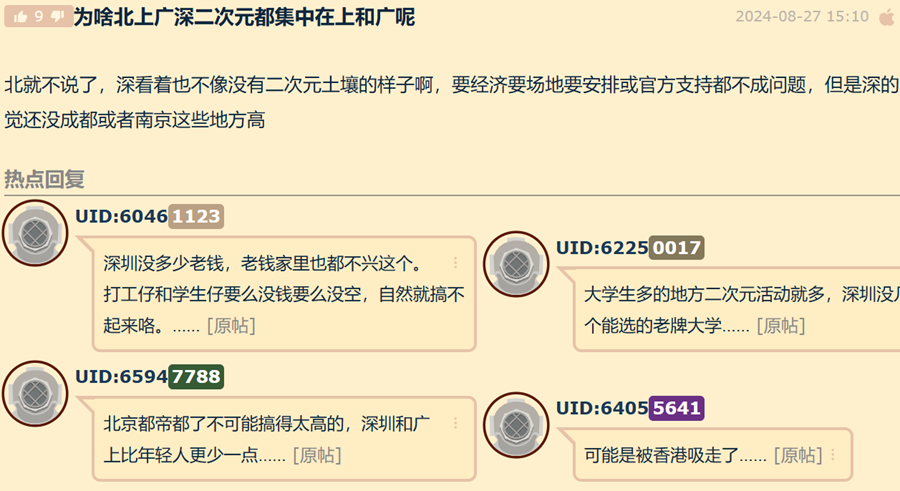
About two years ago, the topic of “which city ranks second in terms of anime and manga culture” could still spark discussions with over a hundred comments across various social media platforms. Some believed Guangzhou was the second-ranked city, while others argued that Chengdu was the true runner-up; there were also those in the middle who felt that Guangzhou and Chengdu were in the same tier, neck and neck with each other.
Looking at the trend data from Xiaohongshu at the time, the "Chi Gu" trend in Guangzhou had over 55 million views, ranking second nationwide. Chengdu was hot on its heels with over 42 million views, so the outcome remained uncertain until the very end.
Two years later, I don’t think there’s much left to discuss on this topic: Guangzhou is the second-largest city.
In recent years, Guangzhou’s anime and manga content industry has experienced explosive growth on both the consumer and industrial sides, and this momentum is here to stay.
Let’s start with consumer spending. According to reports, the 11 major ACG conventions held in Guangzhou during the first half of 2025 attracted 840,000 visitors. Among them, the Firefly Comic Convention generated 170 million yuan in related spending. During this period, Guangzhou was also the top choice for Japanese voice actors’ meet-and-greets and small-scale live performances in China, with the number of events far exceeding that of other cities.When *Zero Zone* held its first FES event outside of Shanghai, it chose the Canton Fair platform—and tickets sold out in 30 seconds. I believe these figures would be difficult for any city other than Shanghai to achieve.
Now let’s look at the industry. Local companies such as Kuro, Shiyue, and Deep Blue Interactive are continuing to expand; titles like *Mingchao* and *Return to the Future: 1999* have already established their brands, and the new title *Wangyue* is poised for release.After leaving his position as the original producer of *Onmyoji*, Jin Tao founded Jiezi Games in Guangzhou and is reportedly set to receive a license from *Onmyoji* to develop a new title.
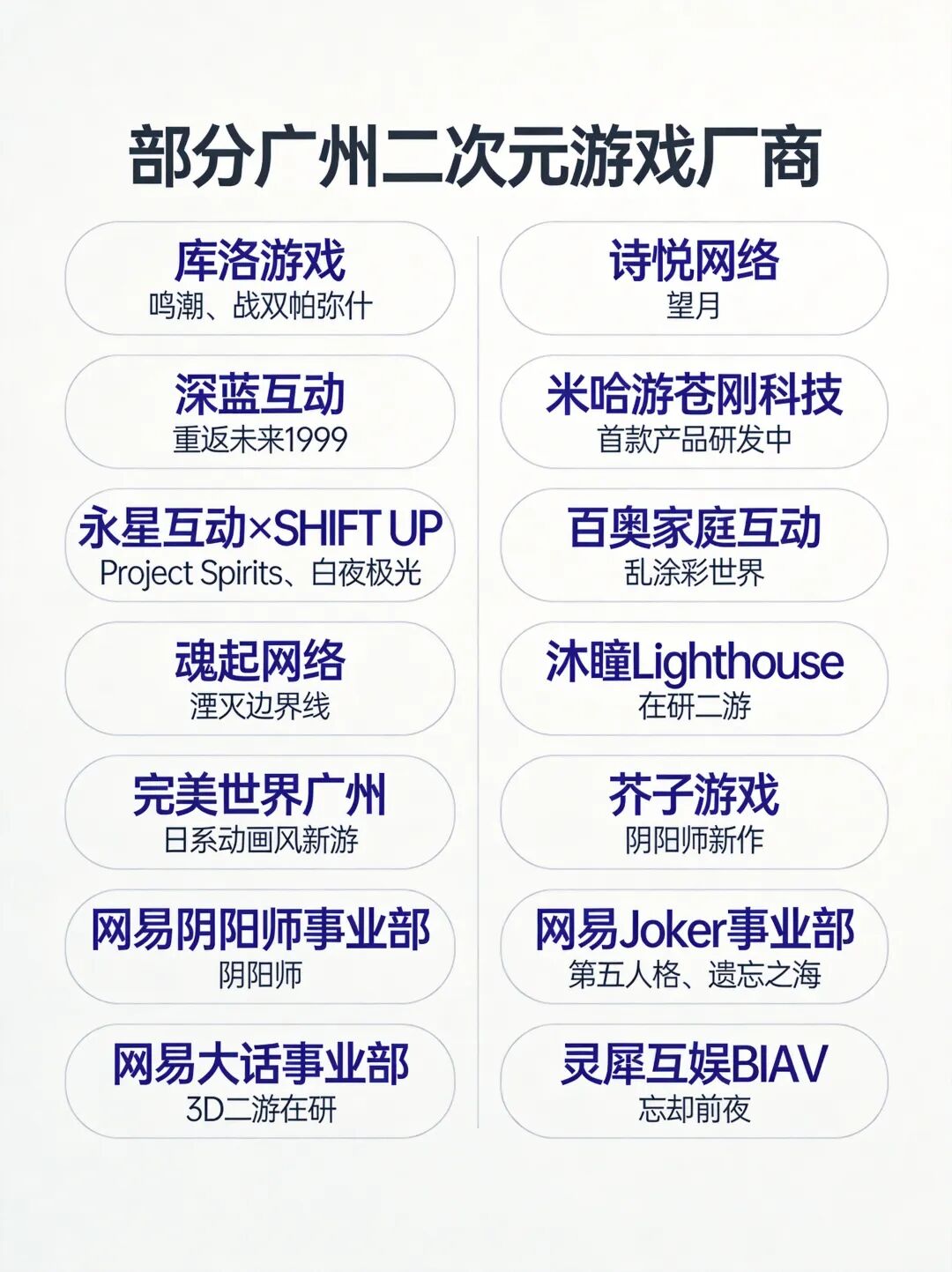
But the most crucial signal still comes from miHoYo.
In June of this year, miHoYo established a wholly-owned subsidiary, Canggang Technology, in Guangzhou—marking the first time in its 15-year history that the company has set up a domestic branch. From the "Absolute FES" event at the end of 2025 to the establishment of a physical company, the transition to taking root in Guangzhou was completed in just half a year.
As IPs created by local studios gain traction and mature, they ultimately enrich a city’s cultural atmosphere. This trajectory is similar to that of Shanghai, except this time it’s happening in Guangzhou. How do these changes feel to the people directly affected?
▍Mi Tu, the game designer who works on the second game while wearing flip-flops
I moved back to Guangzhou from Shanghai for work. To say that the climate and food were the deciding factors would be an exaggeration. But my family is here, so if I had a choice, I’d definitely choose Guangzhou—that’s why I came back as soon as I had the chance.
Before I returned to Guangzhou, I felt that second-tier game developers in Guangzhou generally exhibited a regional tendency toward user acquisition—an ecosystem that, when it comes down to it, has been shaped by its surrounding environment.
Many game developers in Guangzhou come from backgrounds in browser games, reskinned games, and user acquisition-driven products. When I have lunch with them, they talk about LTV and ARPU, and they’re always hounding me for data—they never bring up things like which character is sexier or how a particular plot should be written.
There are only a handful of companies in Guangzhou that specialize in second-tier games, and people jump back and forth between them all the time. You might even run into someone from your old company while out to dinner—sometimes it feels like a small town. If you move from Company A to Company B, there’s a good chance your former coworkers will follow you there next month. But right now, there really aren’t many options for game designers in the second-tier sector—they’re all pretty much the same.
I think the biggest difference in product philosophy between Shanghai and Guangzhou developers is that the Guangzhou side believes more in having one standout feature—as long as the core experience is amazing, that’s all that matters.Shanghai developers, on the other hand, aim for a more well-rounded approach—basically, every aspect needs to meet or exceed a certain standard. Development pace? No need to make fun of each other—it’s the same across the whole industry. Every day when we get to the office, we just hit the ground running and work our butts off.
Living in Guangzhou, much of the industry gossip and news about changing trends comes from secondhand information shared in WeChat groups. It’s not like in Shanghai, where you can hear it firsthand from friends just by going out to dinner.
But when you look at it another way, sometimes it’s actually a good thing.
Over in Shanghai, everyone’s keeping a close eye on what the others are doing, so it’s easy to fall into that “if they do it, I have to do it too” mindset; in Guangzhou, because of the physical distance, there’s a bit of a buffer in information flow, so it’s actually harder to get swept up in that. Just quietly work on your own stuff—if you pull it off, people will naturally take notice; if you don’t, well, nobody really cares, haha.
If I had to describe the experience of working in the adult entertainment industry in Guangzhou in one word, I’d say: “a traveler in flip-flops.” It’s that laid-back, carefree look—but deep down, I’m always trying to catch up with the folks in Shanghai.
▍A Night in Shuo, Where I No Longer Miss Shanghai
I used to work in the gaming industry in Shanghai, and later moved to Guangzhou through a friend's referral to work on an app at an internet company.
Shanghai gives me the impression that it forces people into a cycle of competition—a kind of self-driven internal competition—where anyone who can keep going is considered a workhorse; it has a culture that favors the "mainline" faction.
Overall, the work environment in Guangzhou is fairly relaxed, and managers often talk about “getting off work early.” The company doesn’t force employees to work overtime, but when things get busy, you have to put in the extra hours. I feel that the focus here is on actual work output, and there’s a strong aversion to meaningless overtime. Competition is still fierce, so you need to be competent and adapt to your department’s pace; communication is key.
Actually, at the few companies I’ve worked for in Shanghai, there were very few anime fans—sometimes I was the only one in my team. But at this current company, I’ve already spotted five anime fans, and one colleague even has a lenticular photo album of nude characters from *Love and Deep Space* displayed at their desk.The anime and manga scene in Guangzhou is really great, and there’s a high chance of running into fellow anime and manga fans.
Of course, Shanghai is still way ahead when it comes to live performances, comic conventions, and the like; Shanghai is still the undisputed leader—purchasing power determines strength.
Guangzhou's anime and gaming industry still lags significantly behind Shanghai's, and its products aren't as well-known as those in Shanghai. I don't think Mihoyo's Guangzhou branch will go so far as to poach professionals from Shanghai; it would be good enough if they could just recruit local talent.
Furthermore, a high proportion of user acquisition companies are based in Guangzhou, with firms like 37 Games and Tanwan being the major players. So I think Mihoyo’s move to Guangzhou is more about expanding its footprint and addressing the issue that anime-style content was previously limited to Shanghai. After all, the underlying logic still follows the flow of talent, and the local ecosystem remains very important.
But Guangzhou has way more delicious food than Shanghai. Shanghai has everything, but nothing’s authentic. It’s different with the locals here—they’ve preserved the Guangdong flavor better, and everyone’s pretty particular about food.I’m really craving those traditional Cantonese sweet soups and dim sum—Cantonese people can enjoy them from morning till night, which is just so awesome. The first time I tried dim sum, I was blown away by the extensive menu; I wanted to try everything, so I had to ask a local to pick for me.
So if I ever have the chance to return to the gaming industry, I’d definitely choose Guangzhou—there’s just so much food there, I couldn’t possibly eat it all.
▍Duke’s “Special Forces-Style” Exploration of Guangzhou’s Anime and Manga Scene
This New Year’s Day marked my second trip to Guangzhou, and I went mainly to check out the fireflies.I’d heard for a while that Guangzhou has a strong anime and manga culture, so I took this opportunity to really soak it up for a few days. How can I put it? Before I went, I thought I’d see traces of it everywhere, but as I explored, I realized it’s not actually that obvious outside of convention periods—you really need a local to show you the ropes.
Guangzhou’s anime and manga hotspots are mainly concentrated in three areas, and coincidentally, they’re all underground malls—Anime Star City is considered a “traditional” veteran. Diwang Plaza is a hub for otaku dance; people often gather in the open space on the third basement level to dance there. There’s also Fashion Tianhe, where it’s easy to get lost, but it’s also home to quite a few great shops.
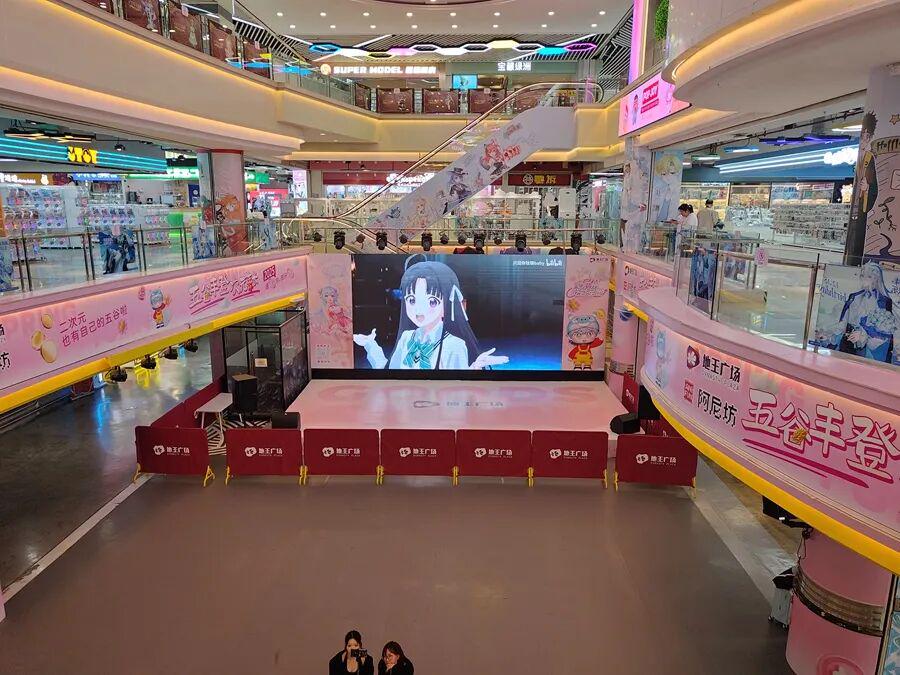
On New Year’s Day, the Yuefa Live event also featured a performance by Diou. Although there weren’t many people in the audience, the atmosphere was electric. The fans in the crowd were absolutely on fire. At the end of the show, the idols stepped off the stage, and everyone formed a circle around them, singing and dancing together—the sense of participation was off the charts.
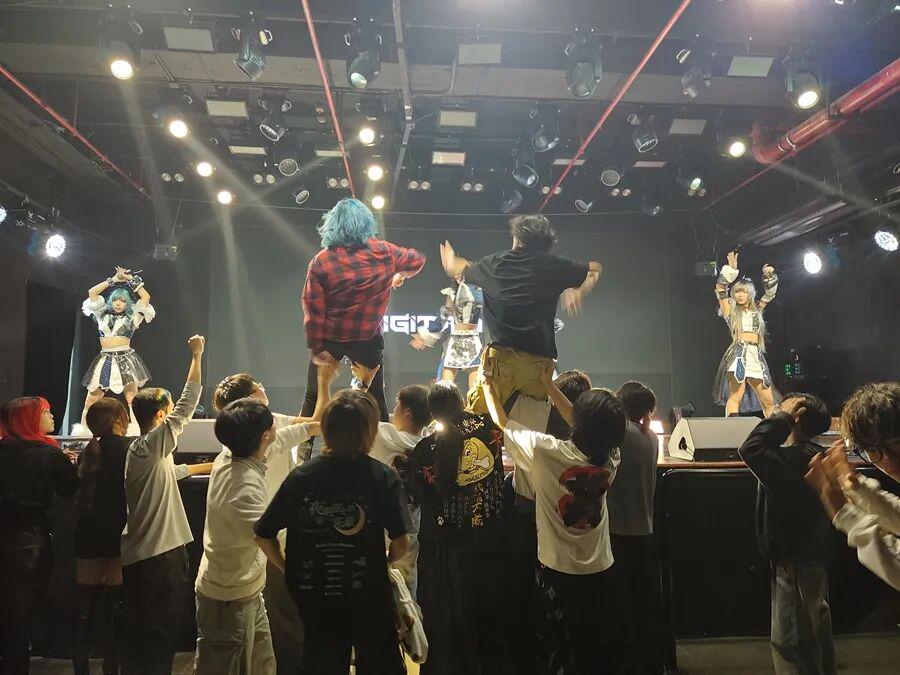
Diou Live
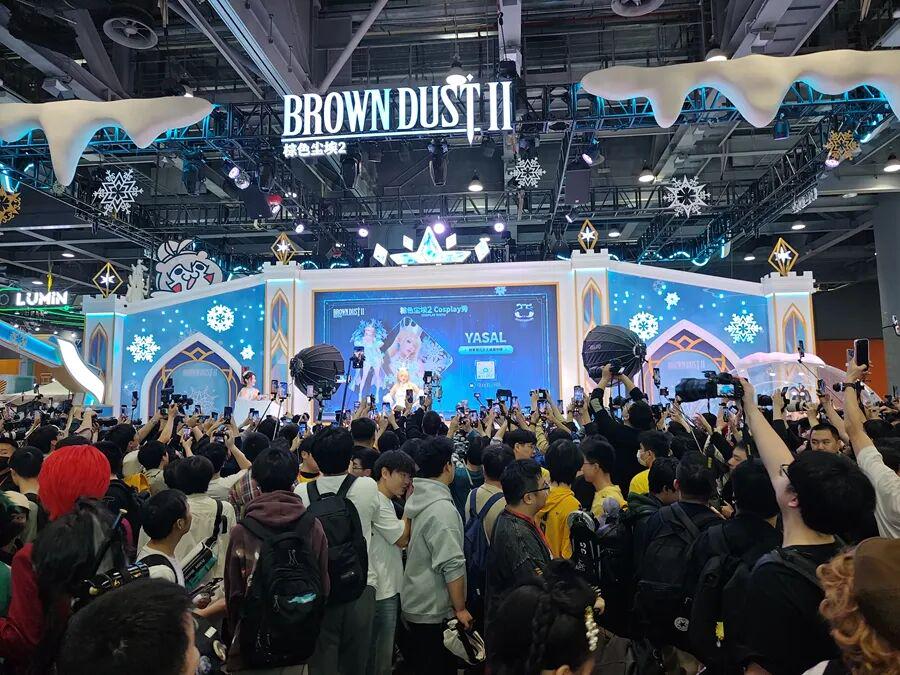
At this year’s New Year’s Day Firefly event, I got the impression that the proportion of cosplayers was significantly higher than at BW.While BW is already a large-scale, comprehensive digital culture and entertainment expo, Firefly feels more like an offline meetup for the anime and manga community. Firefly had plenty of empty booths, but there were still enough people to fill them all—it was incredibly crowded. There’s also a unique outdoor photography culture found nowhere else in the country, with cosplayers and photographers alike gathering outside the venue.
Speaking of the business side of things, I’ve noticed something. Guangzhou’s food is truly tempting, but the climate is a real turn-off. Among the friends I’ve spoken with from the north, quite a few feel that the southernmost they could handle is the Shanghai-Hangzhou area.
For most senior and expert-level positions, it would likely be difficult to accept a relocation from Shanghai to Guangzhou.Kulo even went out of its way to open a Shanghai branch, which continues to grow. So, you’re asking whether companies like Mi Home and Kulo, by establishing branches in Guangzhou, might end up poaching talent from Shanghai? I think, aside from entry-level operational roles where they might be able to pick up some talent, there’s currently no trend of core talent flowing south.
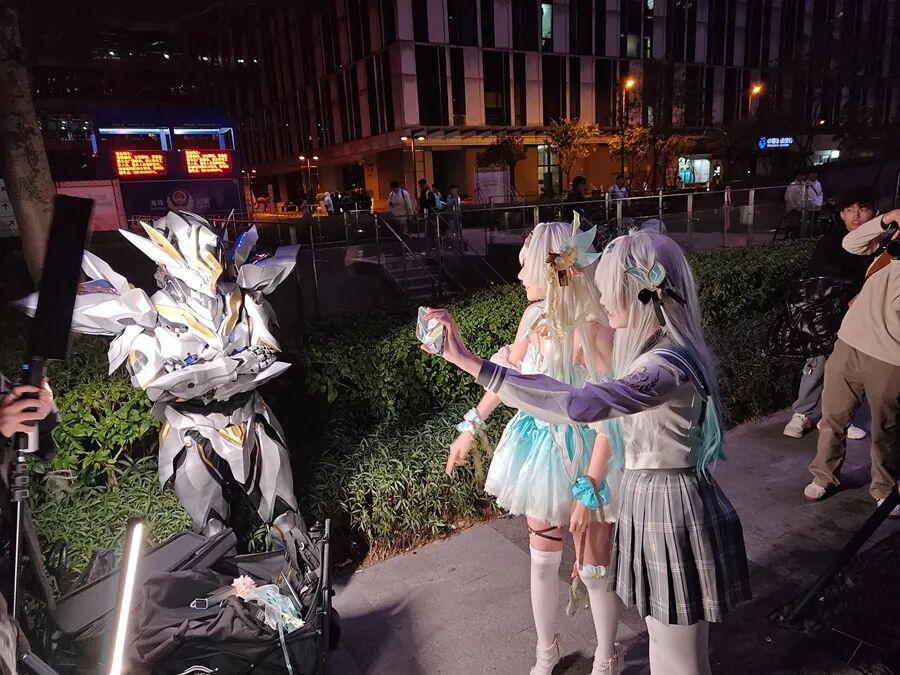
A Night at the Firefly Outdoor Venue
▍Sitting Back and Watching as Companies in Shanghai and Guangzhou Poach Talent from Each Other—Shi Yu
I'm from Guangzhou and grew up there. Later, I moved to Shanghai to work in the secondary game development industry, where I helped build projects from the ground up.
Coming to work in Shanghai actually had little to do with salary and benefits. At the time, the project was just getting started, and opportunities to build a new game from scratch are rare. I also really liked the concept behind our project, so I came without hesitation. After moving to Shanghai, I discovered how convenient it was to travel to Japan to see performances—I could easily make a round trip over the weekend.
I’ve always felt that Guangzhou has a pretty strong anime and manga scene. I started going to comic conventions back in middle school, and the Firefly Comic Convention was already around back then.Back then, the Firefly Convention was mostly made up of individual vendor booths selling merchandise that was either homemade or of unknown origin, and there weren’t any large exhibition booths. As the gaming industry has grown, the Firefly Convention has expanded significantly; more and more game companies are participating, and both its scale and professionalism have improved.
(The first time my phone was stolen was on Firefly.)
I’ve been visiting Anime Star City since middle school, through high school and college, and I still go there often even now that I’m working. The atmosphere has become even more vibrant over the years. In addition to Anime Star City, there are now quite a few fan communities and streets dedicated to anime and manga, and I make a point of checking them out whenever I go home for the holidays.
In the past, everyone thought Guangzhou didn’t have much of a secondary game industry. A few years ago, *War Dual* was pretty much the only game in town, but later *1999* also gained traction, and more and more small and medium-sized studios have been popping up and gradually growing.
Mihoyo is setting up a branch office in Guangzhou, which should attract some professionals from Shanghai to work there. However, Kuro also has a branch office in Shanghai; they started by hiring technical staff, and now they also have positions in publishing and operations. I think the two companies will poach talent from each other.
The gaming industry is a small community, and talent flows freely between companies. When Shanghai-based companies come to Guangzhou, they’re looking to recruit local talent at a lower cost; when Guangzhou-based companies go to Shanghai, they’re poaching highly skilled professionals. In short, both are promoting the flow of talent.
Guangzhou really does offer a lot of opportunities right now, and the cost of living is significantly lower than in Shanghai. If the salary is competitive, and considering my family situation, moving back to Guangzhou would be a good fit for me.
So, what should we eat today?
After a round of conversation, several interviewees all independently came back to the topic of “food.”Although Guangzhou’s anime and manga industry is still catching up, it’s the sweet soups, slow-simmered soups, and dim sum that truly keep people here. Let’s set work aside for a moment—after all, food is the foundation of life, and even those in the anime and manga world need to eat!
原创文章,作者:游茶妹儿,禁止转载:https://youxichaguan.com/en/archives/219848