On the first day after the Qingming Festival holiday, the Teahouse Editor met Ji Ling at Zero Creation Games’ office.
The studio members have just returned from vacation and are back to their regular work.A few cats wander among the desks, randomly curling up to sleep on the laps of a planner or artist—everything remains orderly. Meanwhile, outside the studio, Zero Creation Games’ new historical visual novel, *Lament: Ten Days of the Fallen City* (hereinafter referred to as *Lament*), is facing widespread controversy.
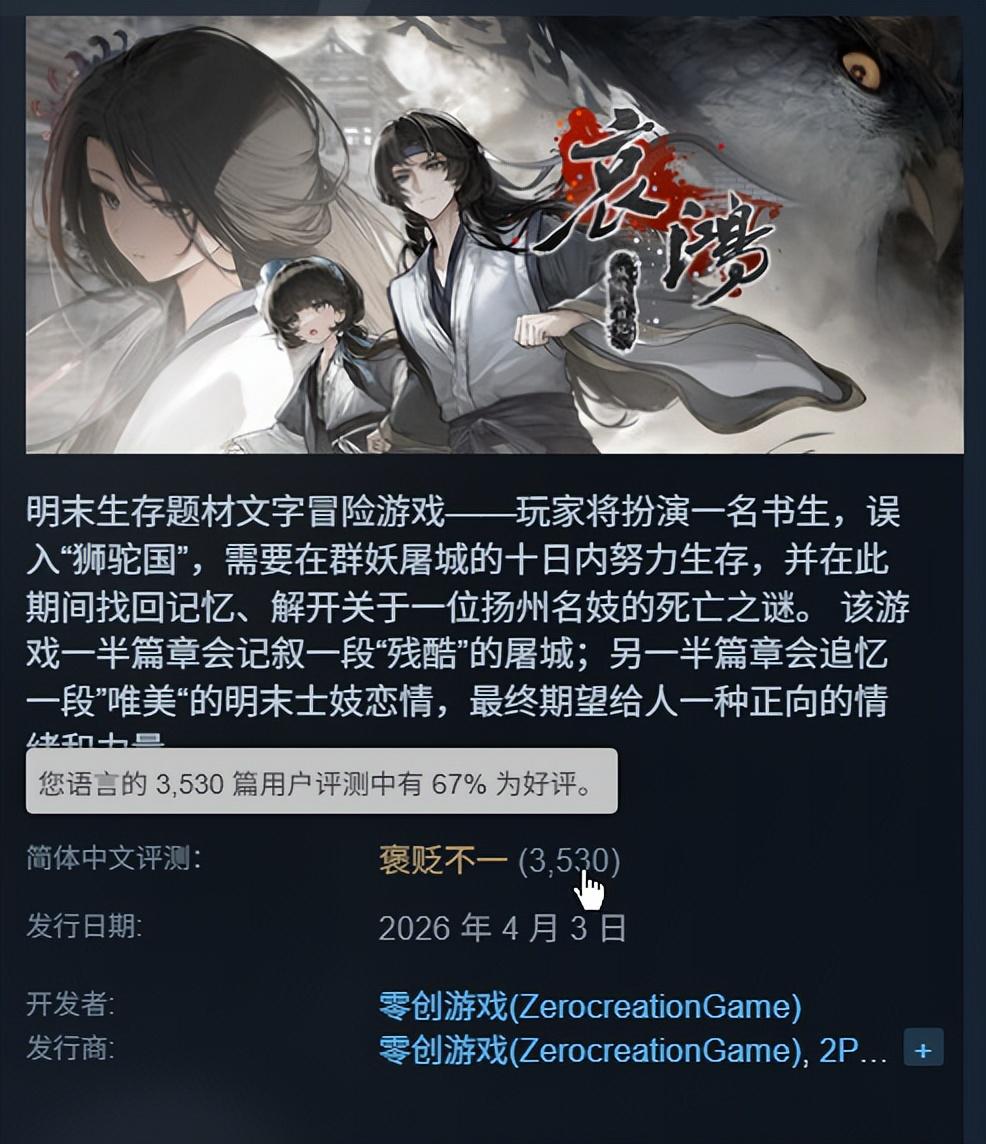
Their previous work, *The Starving: A Thousand-Li Journey at the End of the Ming Dynasty* (hereinafter referred to as *The Starving*), sold over a million copies. Its sequel, *The Wailing*, however, has been mired in controversy since its inception.It began with the game’s setting—against the backdrop of the “Ten Days of Yangzhou,” a massacre that took place during the late Ming Dynasty, the player assumes the role of a scholar engaged in a “romance between a scholar and a courtesan”—with both female protagonists portrayed as women of the night.As the game officially launched, controversial memes derived from snippets of in-game dialogue spread virally across various QQ groups and online communities.
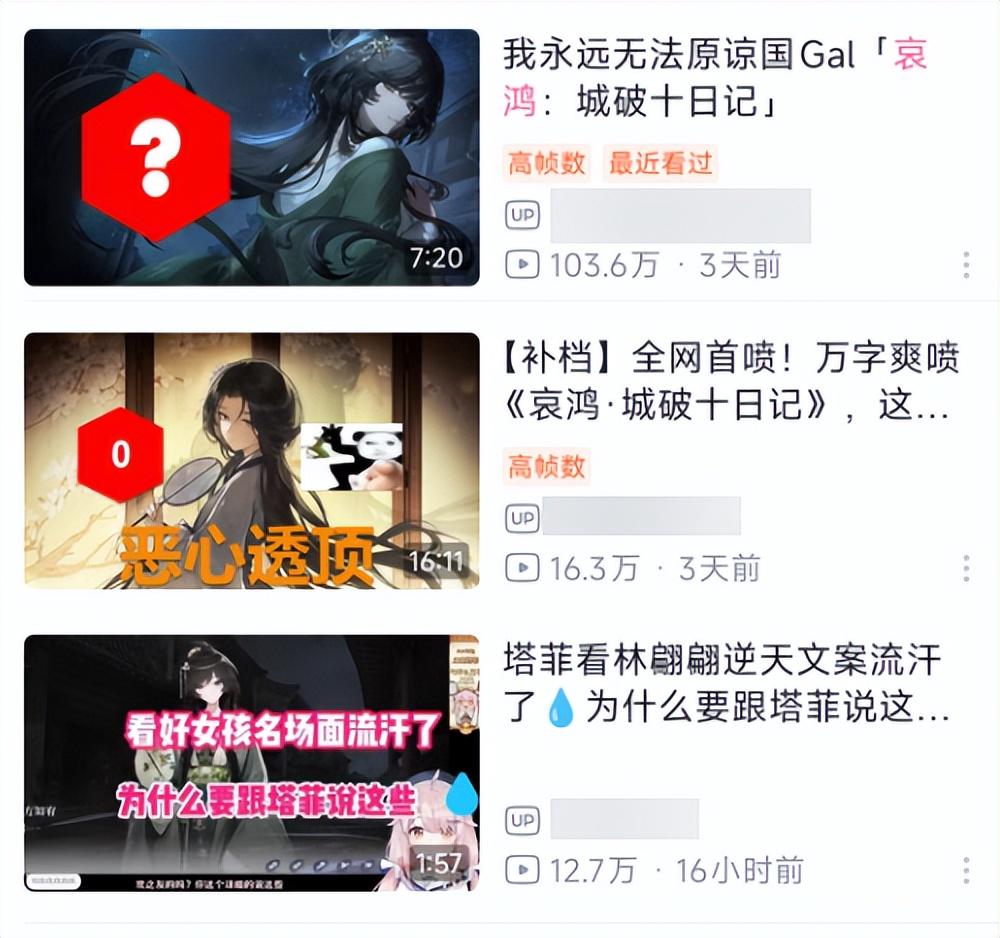
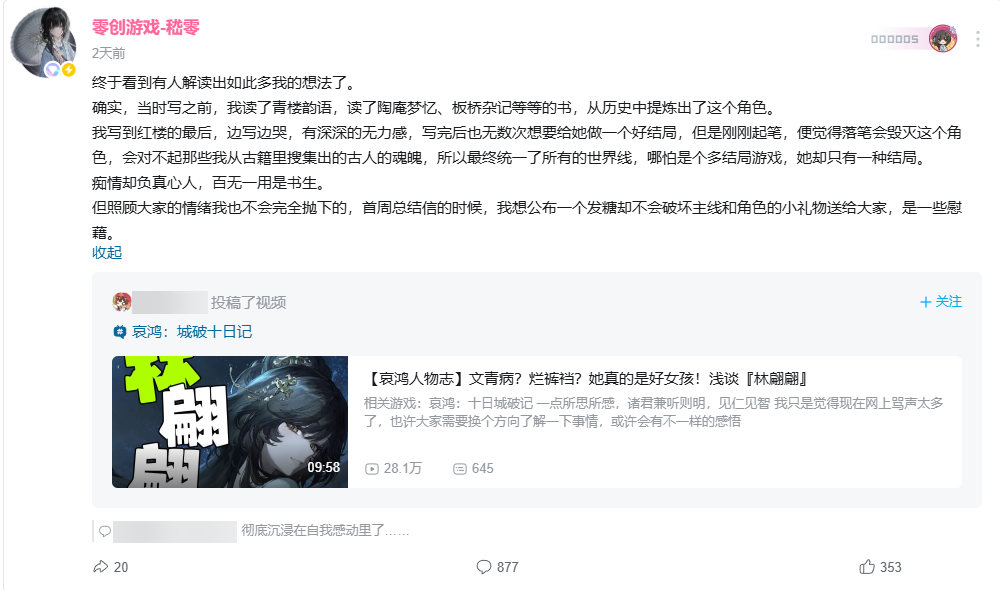
Controversy is nothing new to Ji Ling. When *Starving Souls* was released, its “cannibalism” premise and certain in-game art styles had already sparked considerable debate.He once even stated quite candidly in an interview that such controversies are essential for a small studio to gain recognition and survive. Over the past few days, Ji Ling has been continuously reposting fan-created content and interpretive videos on his personal account. Although each post has received a disproportionate number of hostile comments compared to the number of likes, he has not enabled comment restrictions.
Perhaps out of candor, or perhaps because he doesn’t mind viewing controversy as fuel for online traffic. During our nearly two-hour conversation with Ji Ling, we posed many pointed questions—ranging from the controversial character portrayal of Lin Pianpian to “hipster syndrome”—and he answered nearly all of them.
According to his account, prior to the game’s release, Ji Ling had already anticipated the various chain reactions that *Ai Hong* might trigger. For example, he expected even more intense controversy than that surrounding *E Shu*—though the actual scale of the controversy ultimately fell only slightly short of his expectations;for instance, a potential decline in sales—*Aihong* sold approximately 40,000 copies on its first day, recouping its costs, and current sales have exceeded 80,000 copies, surpassing those of *Eshu* during the same period. However, based on their projections, sales over the next two years are expected to fall somewhat short of *Eshu*’s figures.
But as a creator, even though he knew all this, he still felt he had to create*Aihong*—during the year-long process of writing the screenplay, he gradually developed an overwhelming sense that the backstory arc extending from the second female lead, Lin Pianpian, was an opportunity for expression he absolutely did not want to miss in his lifetime—perhaps a once-in-a-lifetime chance.
Just like a fighting bull, it lowers its head, lowers its horns, and then charges with all its might toward that dangerous red cloth, which is bound to be a trap.
(To ensure a smooth reading experience, some of the Q&A entries have been edited and adjusted.)
01
A Storm That Was Expected
Game Teahouse: How have you been feeling these past couple of days?
Ji Ling: It’s pretty complicated.First of all, sales have been decent—over 80,000 copies so far, with about 40,000 sold on the first day. Seeing players discussing it so passionately definitely gives me mixed feelings. Overall, I feel this work embodies “my own” vision more than *The Starving Dead*, because this one really is more satisfying to write—it’s basically everything I’ve always wanted to write.
Game Teahouse: So compared to *The Starving Dead*, *The Wailing Crowd* leans more toward your personal expression?
Ji Ling: Right, it’s more about the author’s expression. It’s a real thrill to read, but precisely because it’s so thrilling, some players might not like it, while others will love it.
Game Teahouse: After reading a lot of reviews, the negative feedback from players seems to be the prevailing sentiment.
Ji Ling: This game actually has a very powerful emotional impact—in some ways, it’s just as powerful as *The Starving Dead*, if not more so. I’ve watched a lot of livestreams, and in the end, even the streamers end up crying. Many players, even when they give it a bad review, just keep ranting—but that ranting itself actually shows that the game has really touched them.
For me, the process of writing *The Starving Dead* was more like writing a movie script: creating a compelling male lead, a compelling female lead, and a compelling story. At its core, it’s not a love story—it’s about a greater cause. It’s a story of mutual redemption that conveys a positive, uplifting spirit.However, *Aihong* is not a commercial film; it is a niche, art-house production.
If the theme of *The Starving* is “redemption,” then the central theme of *The Wailing* is “letting go.” First of all, the creation of the male protagonist in *The Wailing* is, in itself, a form of self-criticism.I did indeed infuse some of my own traits into the male protagonist. You’ll find that while he appears devoted, he actually embodies indifference; while he seems noble and upright, he actually embodies hypocrisy, arrogance, and cowardice—embodying the sentiment that “a scholar is of no use whatsoever.” This self-criticism is exactly what I was aiming for.At the same time, I’ve written the two female leads to be highly dynamic, developing them in a layered manner through constant contrast. The story has been building up Su Lianyan all along, but by the end, you’ll find that many things take a surprising turn.The male lead appears noble, but in front of Su Lianyan, he is actually a cowardly and indecisive person; Su Lianyan, in front of Lin Pianpian, actually has her own selfishness, and her courage isn’t necessarily pure—sometimes it takes more courage to live than to die.
So, in a sense, Lin Pianpian is the true heart of this game. Both Lin Pianpian and Su Lianyan are greater and more positive characters than the male lead, which makes it easier for players to warm up to them.To put it more ambitiously, it’s more of an attempt on my part to pay homage to *Dream of the Red Chamber* and Osamu Dazai’s *No Longer Human*.
Game Teahouse: Before the game’s release, did you anticipate this kind of pace?
Ji Ling: Yes, there is—it just goes a little further. The way it goes further is that even people who’ve never played the game at all, or “cloud gamers,” can get swept up in it just by seeing meme images, and the impact is greater than I imagined.I feel that in today’s society, when it comes to issues like gender relations and the gender divide, there are already many people capitalizing on these topics to generate traffic and fan the flames. The result is that many people don’t care about the truth—they only care about their stance—and this situation is even more severe than I had imagined.
However, as time goes on, I think *Ai Hong* will eventually be recognized for what it truly is. It certainly won’t receive the same overwhelming acclaim as *E Shu*; it’s destined to be a controversial work, because it’s, after all, a literary film.But I believe that in the future, more people will move beyond superficial discussions—stop criticizing it solely based on the female supporting character’s status—and instead focus on the substance. If anyone really deserves criticism, it’s actually the male lead—and me.
I don’t think the female lead deserves to be criticized. Many people might feel that Su Lianyan pales in comparison to Lin Pianpian, but in reality, she, too, is someone who has been trapped in a cage her entire life. She finally gained a sense of freedom and an opportunity, yet in the end, out of kindness, she left hope for the male lead rather than imposing her will on him.I think she’s a very well-developed character as well; it’s just that Lin Pianpian’s dramatic transformation and the “Dream of the Red Chamber”-style ending are more striking—the character’s emotional intensity is so powerful that Su Lianyan might seem slightly less impressive by comparison, but she’s just as captivating.
Game Teahouse: So you think it’s almost inevitable that this game will get slammed?
Ji Ling: Because I positioned *Ai Hong* as a commercial project—that was indeed my mistake. If I had accepted that it was a niche work, I should have turned it into a novel, found a publisher, and sold it in bookstores. Then it might actually have received rave reviews, because the people who would buy it are precisely those who seek out this kind of content.But I gave it an anime-style art style, brought in many well-known voice actors, and polished the performances, music, and visuals to a high standard—that’s the commercial element I added, and it created a disconnect. So it was only natural that the reception would be mixed.

I’ve always wanted to be like Hideo Kojima—to create deeply personal works on a commercial scale. With this project, I feel like I’ve gotten a little closer to my mentor. None of my previous works have ever been this personal. Maybe once I finish *Ai Hong*, I’ll have no regrets left.It’ll be hard to do this again in the future—after all, I’m still running a company, and we’re just a small studio. Future projects like *Black Nest: The Serpent’s Covenant**Dragon Clan: The Final Journey* (new titles currently in development by Zero Creation; hereinafter referred to as *Black Nest* and *Dragon Clan*), as well as the vast majority of my future works, will never be like *Lament*. As I said before its release, this is the work that best embodies the “Ji Ling style,” and it’s also the one I most wanted to create.
02
“This is a once-in-a-lifetime contrast.”
Game Teahouse: You mentioned earlier that writing *The Starving Dead* went very smoothly—you wrote the script in one go over the course of a little more than two months. This time, however, *The Wailing Crowd* took you a year to write. Where did you run into the most difficulties?
Ji Ling: Because this time, I really wanted to give it my all, and the writing process was very painful. It involved a lot of self-criticism, and I poured a great deal of emotion into it.*The Starving Dead* is more of a technical production—though it certainly has emotional depth—but it’s largely the result of watching a vast number of movies, comics, and video games, which I then blended with my understanding of life and history, “refined” from history itself.
As for *Aihong*, I primarily drew on historical sources and incorporated my own emotions, memories, and experiences to shape the characters. I drew relatively little inspiration from films or novels—or, if I did, it was limited to techniques such as dual narrative structures. At its core, the film is a product of my personal experiences combined with historical records.
Game Teahouse: So, after this past year, how different is the final script for *Ai Hong* from your initial vision?
Ji Ling: It’s pretty big.Lin Pianpian wasn’t actually in the original outline—it only featured the male lead and Su Lianyan. In the end, it had a “Liaozhai” ending: you could choose to say goodbye to her, or spend the rest of your life with her as a ghost or a fantasy, and then write *Liaozhai*. That was basically the story in the original outline.
At that time, the script had little to do with *Dream of the Red Chamber*. Lin Pianpian was merely a minor character who didn’t appear until around Chapter 6. Her role was likely just to illustrate the typical circumstances of the red-light district in Yangzhou.
prostitute

But later on, I began to feel more and more that, since I’d already created a female lead who was a high-class courtesan—one who sold her art but not her body—why couldn’t I write a character with even more impact? If I just kept writing like this, it would be too superficial. I’d always wanted to write a character like this, and I wanted to pour a lot of my emotions into Lin Pianpian.When I was 19, I drew a comic that also featured a character similar to “”, and although I wrote that character quite well at the time, I always felt I hadn’t explored her fully.
Prostitute
Later, as this idea took shape, I pored over historical records and used them to flesh out Lin Pianpian’s character—raising her step by step from a very humble position, having her struggle constantly, and ultimately creating a striking contrast in the ending. That’s exactly what I wanted to achieve.
Game Teahouse: For example, what kinds of historical records?
Ji Ling: To give an example, there’s a description in *Dreams of the Tao An*—near the Twenty-Four Bridges—where women who stood on the street until late every night would pool their money to buy the cheapest lantern, just to light their own way, because the area wasn’t usually lit, and the authorities didn’t patrol there.Zhang Dai wrote that when he passed by there very late at night, the women who hadn’t been chosen were still standing there, but they weren’t crying—instead, they were joking with one another, using humor to mask their disappointment. That sense of everyday life and the raw authenticity of the people is particularly strong, as if ancient times were projected directly before your eyes.
Prostitute
I incorporated this passage into the section set before I met Lin Pianpian. And Lin Pianpian is, in a sense, a distillation of all these people: humble, impoverished—and in ancient times, many truly had no choice; they were born that way, and their ancestors had likely been the same for four or five generations.
Game Teahouse: From the perspective of literary motifs, “romances between scholars and courtesans” is a very ancient theme; traditionally, many depictions of it were actually meant to challenge feudal moral codes. But today’s players have different values—many are more concerned with issues of gender relations.When you were writing this story, did you take player reactions into account? For example, did you use narrative techniques to create an emotional buffer?
Ji Ling: It’s true that we overlooked some of the audience’s feelings. Many people play games to find emotional solace or an outlet for their emotions. But *Ai Hong* offers neither emotional solace nor an outlet; in fact, it’s difficult for players to empathize with the protagonist—and yet I still chose to tell the story in the first person.
Essentially, it’s a matter of incorporating some overly self-critical elements into a commercial work. As I mentioned earlier, if I were to completely abandon commercial packaging and publish a serious literary novel outright, it’s likely no one would read it—so I chose this format, and this is the result.Actually, the simplest way to create an emotional buffer would be to rewrite this work in the third person.
Game Teahouse: Why Didn't They Do It This Way?
Ji Ling: First of all, I’m better at writing in the first person. Second, I didn’t originally plan to include Lin Pianpian, nor did I intend to incorporate so much self-expression.My original plan was to make it a commercial game with a touch of artistry, similar to *The Starving*. After all, *The Starving* has already been played by over a million players, so if this one launches smoothly, it’s sure to be the most profitable.
But as I wrote, I realized that the character of Lin Pianpian could become a particularly powerful and charismatic figure—and that giving her any kind of “happy ending” would completely ruin her.She is, in and of herself, the most compelling presence: back then, she was a lowly outcast despised by everyone, and she would still be despised today; yet she accomplished something that even Jing Ke—whom she’d read about in storybooks—failed to achieve. That contrast is just so cool.
prostitute
So when I realized this design might have an even greater impact than *The Starving Dead*, I knew I had to bring it to life. If I missed this chance, I might never get another opportunity like this in my lifetime. I can continue to create commercial works in the future—many of them—but a design with such extreme contrast might only come my way once in a lifetime, so I had to make it perfect.
Game Teahouse: Looking back, do you think this achieved the desired effect?
Ji Ling: I think we’ve achieved that. It’s just been a few days, so many people are still stuck on the “lower-body” jokes. As time goes on, more and more people will truly immerse themselves in the role.It’s also hard for me to say whether I’ll ever be able to surpass *Ai Hong* in terms of literary quality. It might take at least a few more years of experience before I can create such a dramatic contrast again. To players who are used to my work, they might think I’ve run out of ideas over the next four or five years. That’s because it’ll be very difficult for me to suddenly produce another work like *Ai Hong* again.
Game Teahouse: You just said that you didn’t want to give Lin Pianpian a happy ending. As the creator, what is your relationship with Lin Pianpian?
Ji Ling: There’s far more self-projection in this film than in *The Starving*. There’s a lot of me projected onto Fang Zhiyou; his feelings for Lin Pianpian are, to some extent, my own feelings for her.The male lead visits many brothels but never has a relationship with any of the women there. You could say he’s remaining chaste for the female lead, but it’s more because he looks down on these women from the bottom of his heart—he views them through the lens of the gentry class.
My feelings toward Lin Pianpian are actually pretty hypocritical:I think she’s sincere, beautiful, and a wonderful person, but if you were to actually say, “I’m going to have you marry her,” I might still have some reservations. People can’t help but carry the pain of the past, nor can they avoid bearing the weight of society’s views on certain matters—that’s just the inescapable nature of human convention.
So, in this regard, the male lead and I are pretty much on the same page. I think Lin Pianpian is a very charismatic person who embodies many noble qualities that most people can’t live up to: patriotism, a sense of national duty, loyalty, and ambition—she isn’t even the type to let romance cloud her judgment.The reason she does so much for the male lead is, on the one hand, to repay a debt of gratitude, and on the other, to prove that she’s just as capable as Su Lianyan. She isn’t the kind of character who lets love cloud her judgment; she’s a character I really wanted to create—and one I’ve successfully brought to life.
But at the same time, I feel a sense of hypocrisy and guilt toward her: if someone like her actually existed in real life, I probably wouldn’t end up choosing her to marry—I’d choose a woman more like Su Lianyan. Yet I also feel that Lin Pianpian is truly the kind of person you’d deeply regret missing out on.
Game Teahouse: What about Su Lianyan? Her death didn’t have quite the same immediate impact. Why did you give her ALS as her condition?
Ji Ling: Because I think it’s beautiful. It creates a very strong contrast with this character. She’s been trapped in a cage her whole life, always longing for freedom—wanting to become a female warrior or a female general, wanting to have her own thoughts and her own freedom.But even though she’s done everything to the best of her ability, she ultimately faces the most helpless of outcomes: there’s something wrong with your genes.

So, in a way, this is actually another form of “freedom” for her. Since heaven has given me this body, I will make my own choice through death.For me, ALS is the only solution for her. If it were some more clichéd way of dying—like a tragedy caused by external circumstances—I’d find it too trite; it wouldn’t be what I’m looking for. As for the ALS plot point, I just feel that there’s a strong sense of ironic beauty and fatalism between it and her character.
Game Teahouse: Let me ask a more pointed question: Do you think *Ai Hong* is a manifestation of your “artsy phase”?
Ji Ling: If we go by the current definition circulating online, I suppose that’s pretty much accurate. Because I’m truly focused on creating art and have overlooked the fact that it’s a commercial product. As I mentioned earlier, why don’t I just write serious literature? Why do I feel the need to give it such exquisite packaging and such excellent commercial distribution channels? By that definition, I guess I do have “hipster syndrome.”
But I don’t think this is entirely a bad thing. Through this work, I’ve further tested the limits of my creativity. It’s like refining a poison: I may have failed, but my skills have improved. For me, this work marks the end of a chapter. And there certainly are some people who will enjoy this kind of thing.Some who may have originally looked down on *The Starving* might actually come to appreciate *The Wailing*, because *The Wailing* is a rarer and more challenging creation to produce. Creating a work like this—a true “hipster indulgence”—with a budget twice that of *The Starving* is, from a market perspective, a rare occurrence in and of itself.
Even though people are mostly focusing on the “lower body” jokes right now, I’ve noticed that many communities are also discussing this. Lin Pianpian has already gained a huge following beyond her original fanbase.If a character can evoke such strong emotions in so many people and become a symbol that remains a topic of discussion in the market for a long time, I’m actually satisfied. Even though many people are insulting her right now, maybe at some point, after they’ve actually played the game, they’ll realize, “She really is a good girl”—and that would make me very happy.
What I hate most is when my work comes out and people think it’s mediocre or just follows the crowd, and then they try to comfort me by saying, “It’s a good piece—it just didn’t get enough promotion.”I don’t want that kind of sympathy. Rather than sympathy, I’d much rather be criticized. Because when I’m being criticized, at least someone will step up and say, “You can criticize the author all you want, but this character is really well-developed—she’s truly a great girl.” That way, when both sides get into an argument and it consumes a lot of their energy, it’s actually better for me than being completely ignored.Of course, this poses a risk to the company—there will definitely be a lot of complaints and reports—so this won’t be my long-term strategy. Afterward, I’ll go back to keeping a low profile, gathering feedback, and creating more commercially viable works.
Game Teahouse: You once said through one of your characters, “depicting reality through fiction.” In my view, *The Starving* seems more like “depicting fiction through reality,” while *The Wailing* is more like your own “depicting reality through fiction.” Will you continue to use this approach in your future works?
Ji Ling: Actually, there’s no inherent hierarchy between “real” and “fake.” *The Starving* is also very real—it’s just that it isn’t my own reality, but rather a reality I gathered from films, history, and documents on famine, a reality I crafted myself; *The Wailing* is, on the other hand, more my own reality.But after all, Lingchuang Games is a company, so most of our future works certainly won’t all be based on “my own truth.” Most of our future works will still follow the approach of *The Starving*.
Game Teahouse: How do you view your relationship with players? Do you have a negative opinion of players who don’t understand you?
Ji Ling: I’ll make the games I enjoy. If you happen to feel the same way, then come play my games. At the same time, I regularly try to understand what everyone else likes, so the relationship between me and the players is more like a mutual coming together.In a sense, *The Starving Dead* is a mutual redemption between me and the players: I redeem the players, and the players redeem me.
There have also been some reactions that went beyond what I expected before I posted my work. But I remain optimistic in the long run. Many of the people who are the angriest and most unable to accept it are often just going through a certain phase in their lives. People gradually become more tolerant.I think those who are currently quick to label Lin Pianpian or create meme images at the slightest provocation are actually the ones best suited to play this game ten years from now. Perhaps by then, they’ll have a new perspective. The experience they’ll gain in the future might even be richer than that of the players who are already tolerant and willing to play right now.I highly recommend that they come back and play it later—they’re actually my most valuable players.
As for Lin Pianpian, her fame has already spread far and wide. I think this character will become an icon in the future. In any future product—such as a mobile game or an animated series—whenever a similar character appears, people will likely compare her to Lin Pianpian.If even a small number of people actually play *Ai Hong* and have a great experience, she’ll live on forever. It’s quite possible that, in the long run, this character will outlast even Man Sui—I suppose that’s my own little prediction.
03
Controversy won't be the norm; it's just a "less-than-bad outcome."
Game Teahouse: You mentioned before that you wanted to create a trilogy set in the late Ming Dynasty. Are you currently planning the third installment?
Ji Ling: Yes, there is one. We’ll be announcing it across all platforms around mid- to late May, but it’s not an AVG. I can reveal that, in terms of theme and perspective, it leans a bit more “western.”
Game Teahouse: Since it’s not an AVG, does that mean Zero Creation will shift to other genres after this? Will you continue making AVGs?
Ji Ling: I’ll keep doing this. But an AVG like *Ai Hong*—one that requires such a massive investment and is so artistic—will probably be a one-time thing. The overall ceiling for the AVG market is what it is, while the ceiling for gameplay-focused games is higher—though, of course, the costs are higher as well.
Game Teahouse: From the perspective of a CEO or producer, *Ai Hong* actually doesn’t seem like a product that aligns with standard corporate business logic. Creative impulses have taken precedence over the CEO’s perspective—is this really what Zero Creation Future wants to do?
Ji Ling: I used a portion of the proceeds from *The Starving Dead* to buy back shares, so I do have stronger control over the company now, which gives me more freedom.But what really prompted me to do this was the feeling that if I missed the chance to portray Lin Pianpian, I might never get another opportunity like this in my lifetime. Although theoretically there might be two or three more chances, it’s definitely not the kind of opportunity that comes along in every project. So I decided to go for it on a whim, and I’m willing to accept the outcome as it is.
If I have to say I’m sorry, the first people I’m sorry to are the players who liked us for commercial reasons—I made them feel betrayed, angry, and uncomfortable.Second, I’m sorry to the studio members, because I’ve made them pay the price for my creative impulses. So for the upcoming *Black Nest* and *Dragon Clan*, I’ll keep my creative impulses in check and approach them as projects that better align with the company’s business logic.
Game Teahouse: "Aihong" has pretty much covered everything you wanted to express.
Ji Ling: Pretty much. People are interpreting it based on things I wrote in the past on social media and dating sites.But with *Ai Hong*, it’s not just a few elements that lined up—it’s almost everything, from top to bottom: love suicides, romance between the living and the dead, and many other elements I’d previously said I wanted to write about—I’ve practically covered them all in this single work. So *Ai Hong* really gave me a huge sense of satisfaction.In a sense, the likelihood of me falling back into so-called “artsy-fartsy” tendencies in the future will actually be very low, because the best work—the work I most wanted to create—is already complete. Right here, in this work.
Game Teahouse: Have you analyzed the reasons behind the success of *Starving Souls* and *Wailing Souls*?
Ji Ling: I think it comes down to the right balance of artistic vision combined with exceptional technical execution—art, sound, and performance.We’ve certainly invested heavily in production, and our team has developed a polished, professional style over time—that’s a definite strength. On top of that, we’ve struck a balance between commercial appeal and artistic vision. The problem with *Ai Hong* was that it leaned too heavily toward artistic vision, so it’s naturally difficult for its sales to reach the one-million mark again.
Game Teahouse: When you try out new games, how do you approach the range of genres? What kinds of themes do you tend to explore?
Ji Ling: First and foremost, it must be shareable. *The Black Nest* wasn’t quite as shareable, but the others were relatively good in that regard. Second, it must have substance worth exploring in depth—it can’t just be a gimmick. You can’t draw people in only to have them treat you like a joke or a clown and walk away after watching. It has to be something with depth that people can delve into.
It’s just like *Ai Hong*. A lot of people only look at the meme images and don’t understand the content. For example, some people misinterpret certain plot elements as something particularly vulgar, but in reality, they haven’t grasped the mechanics of how the story spreads or the logic of the text at all. I feel that if players only look at the meme images, they can easily fail to realize what the story is actually about.
Game Teahouse: What if controversies continue to arise in the future?
Ji Ling: Award-winning works. With pieces like “A Lament for the Suffering,” I don’t think controversy is a bad thing—in the end, the focus always comes back to the work itself. But for some works, the less controversy, the better.In any case, the best-case scenario is definitely when positive reviews outweigh negative ones, while the worst-case scenario is when no one cares. This “controversial” middle ground isn’t actually the worst outcome. It’s certainly not something to boast about, but it’s not entirely a bad thing either.
Game Teahouse: You mentioned earlier that you can’t stand mediocrity. So if you end up making more commercial titles in the future—without relying on this kind of self-expression or controversy—how do you hope to ensure your future games aren’t mediocre?
Ji Ling: First, we need to improve our technical capabilities beyond art, sound, and storytelling—especially in terms of gameplay. We’re also cultivating other talent. Take *Black Nest*, for example; while it probably won’t stand out particularly this time around, it will deliver a solid commercial experience for players.At the same time, this is an opportunity to train a second scriptwriter for *Black Nest*—I’ll only handle character design and world-building; I won’t touch a single word of the script, not even the plot outline. Essentially, I’m handing everything over to the new scriptwriter to see how well they can do it. This is also an experiment.
*Dragon Clan* is different. In a sense, I actually feel that *Aihong* proved I’m better suited to work on *Dragon Clan*. I’ll make up for the players’ regrets—while the game will still lean toward a commercial approach overall—but I’ll preserve the essential elements from Jiang Nan’s original work and incorporate more positive endings.My creative intent isn’t to create another character like Lin Pianpian—one who exists solely for dramatic impact—but rather to fill in the gaps. Since I was a reader of *The Dragon Clan* back in high school and felt a deep sense of unresolved longing at the time, I’ll create the story based on what readers truly wanted to see back then. I won’t force my own creative impulses into someone else’s work.
原创文章,作者:游茶妹儿,禁止转载:https://youxichaguan.com/en/archives/216096