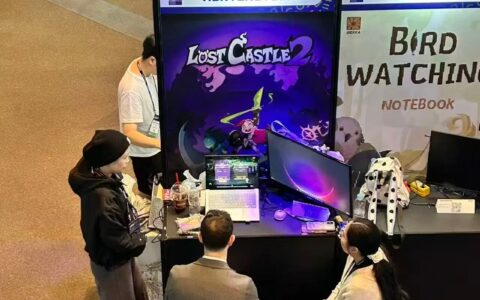
It’s that time of year again—ChinaJoy. Major gaming industry forums and closed-door seminars are taking place one after another in Shanghai. After making the rounds at these events, I found that expanding into overseas markets remains a hot topic in the industry, but the focus of the discussions has fundamentally shifted.
This is closely tied to changes in the global gaming market. SensorTower’s previously released “State of Gaming 2026” report shows that total global mobile game downloads in 2025 declined by 7% year-over-year;Data from Adjust also indicates that in 2025, the cost per install (CPI) for global games rose by 30%, while the cost per click (CPC) increased by 33%.
These figures clearly demonstrate that the global gaming market has fully entered a phase of competition for existing users.With the traffic boom having peaked and customer acquisition costs continuing to rise, the model of relying solely on paid user acquisition is proving ineffective. Instead, the key to success in this new phase lies in whether developers can bypass the competitive red ocean of traditional channels to open up more diverse traffic sources, and whether they can fully leverage the value of traffic to truly boost monetization efficiency.
That’s precisely why, this year, the focus of our discussions has shifted from “how to invest” to “how to tap into opportunities”—tapping into more traffic sources externally and maximizing the monetization potential of every source of traffic internally.
At the Xsolla Connect Global Game Traffic and Marketing Growth Summit held on July 29, Xsolla presented a practical set of strategies to help global game developers address the new growth challenge of “expanding diverse traffic sources and improving monetization efficiency.”
01
Leveraging Influencers to Open New Growth Channels
In an era of competition for existing user bases, influencer marketing is becoming a key strategy for game developers expanding into overseas markets to broaden their traffic reach and build a diversified customer acquisition matrix. Numerous case studies in the gaming industry show that high-quality, co-created content produced by influencers—which engages their followers—often resonates more deeply with users than traditional hard advertising, effectively driving user growth and monetization.
However, the highly fragmented global influencer ecosystem has significantly raised the barrier to entry for influencer marketing. According to Teahouse’s findings, most brands generally encounter the following four major challenges during the actual implementation process: difficulty in accurately identifying suitable creators, difficulty in attributing results across platforms, a lack of unified coordination for large-scale campaigns, and complex compliance and settlement processes.Faced with these multiple obstacles, most brands can only treat influencer marketing as a supplementary source of user acquisition, conducting small-scale pilot campaigns; it is difficult for it to evolve into a stable and reliable channel for driving growth.
As a global leader in the video game e-commerce industry, Xsolla has not only recognized this industry challenge but has also integrated four core capabilities—influencer screening, performance attribution, campaign coordination, and cross-border settlement—into a unified workflow. As a result, the company has launched Xsolla Partner Network, a one-stop platform specifically designed to facilitate influencer and affiliate marketing partnerships.
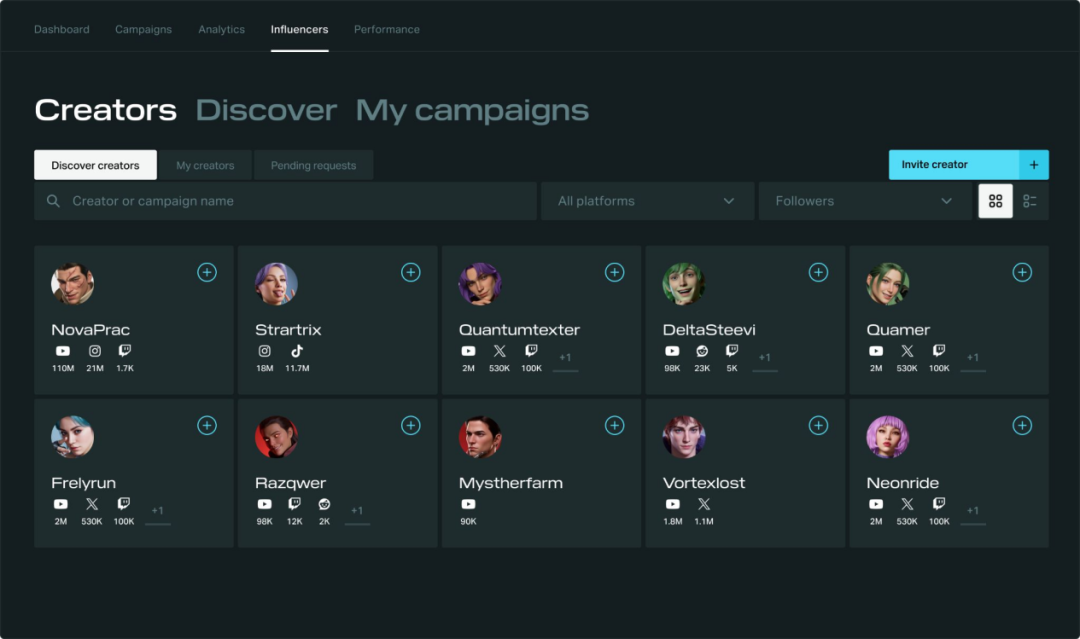
Xsolla Partner Network
During the creator screening phase, Xsolla’s dedicated influencer marketing team can identify and establish business partnerships with a large number of niche influencers based on game genre, target market, and core audience profiles, completely freeing publishers from inefficient independent research and back-and-forth negotiations.
Once the promotion launches, this solution not only generates specialized tracking reports by game category and monitors key metrics—such as broadcast frequency, viewership, and peak concurrent viewers—on platforms like Twitch and YouTube in real time, but also includes the Creator Storefront, an exclusive online store for creators. It provides each partner influencer with a dedicated promotional page and a unique tracking link,allowing fans to place orders without having to navigate to an external site, while data on live stream exposure, watch time, and paid orders is fed back in real time. This makes it immediately clear which creators drive the most traffic and which have the highest conversion rates.
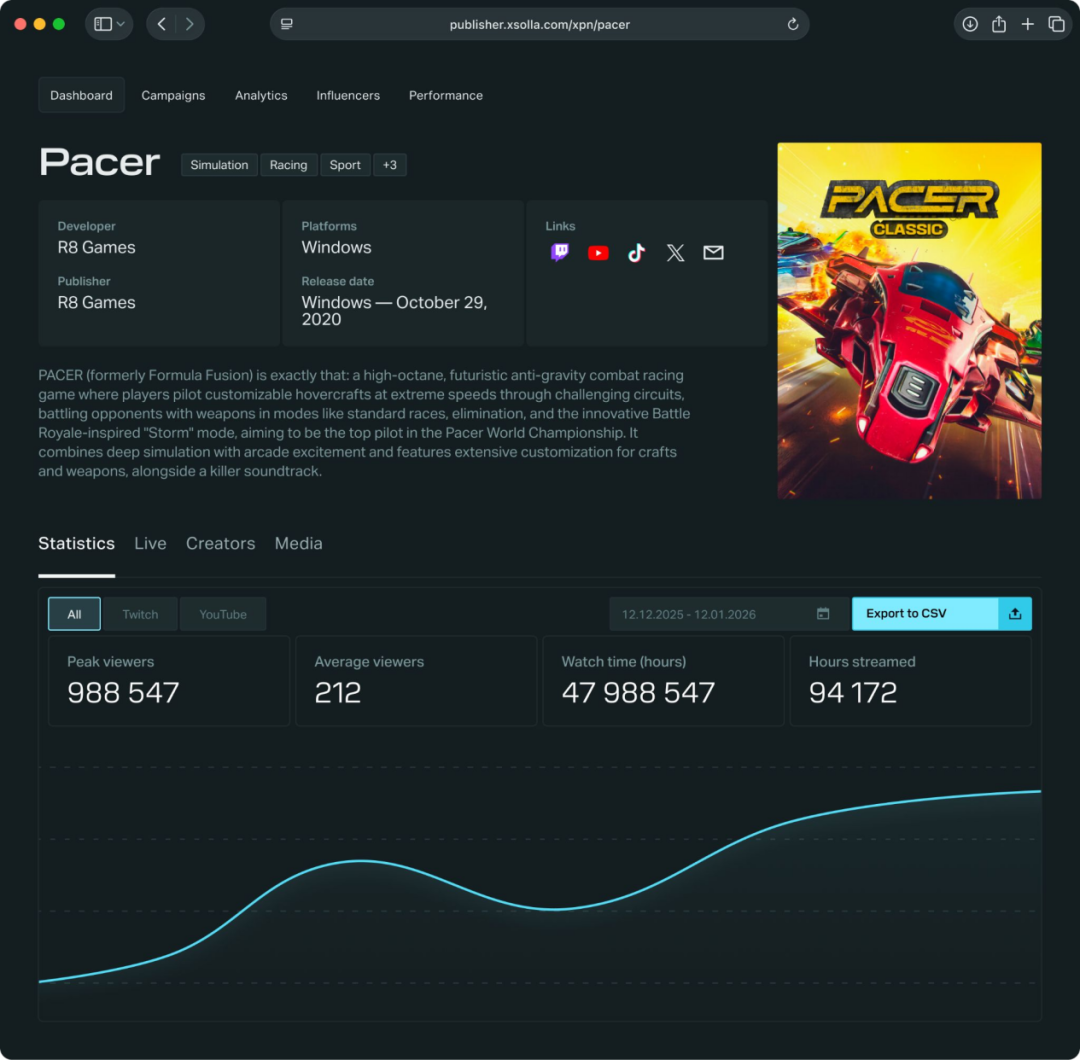
During large-scale promotional campaigns that require the simultaneous management of multiple influencers, brands can also create customized promotional tasks on the platform. By defining campaign durations and revenue-sharing ratios, they can distribute promotional materials, tracking links, and game redemption codes in bulk, while centrally managing the progress and performance metrics of all influencers—significantly reducing the administrative burden associated with coordinating a large number of influencers simultaneously.
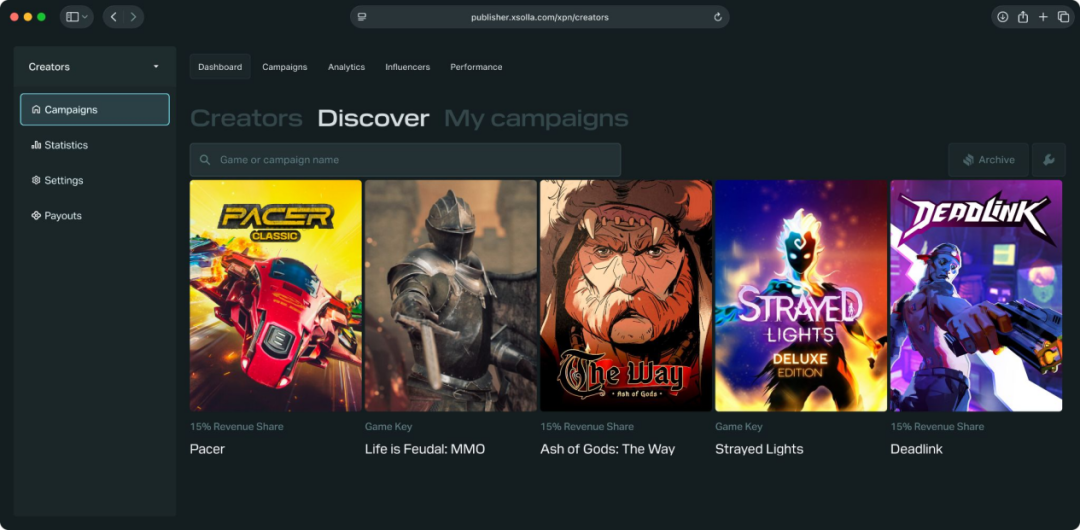
More importantly, when it comes to fee settlement, Xsolla’s influencer marketing program uses a CPS (Cost Per Sale) revenue-sharing model. Brands can launch campaigns without any upfront costs and pay commissions only after influencers generate actual revenue. This minimizes the cost of trial and error while allowing brands to build their influencer marketing network with greater flexibility.At the same time, the most time-consuming aspects of cross-border transactions—global multi-currency commission calculations, cross-border payments, and regional compliance procedures—will all be handled centrally by the platform. With settlement barriers removed, influencers can truly lay the groundwork for sustainable, long-term success through their traffic generation.
Teahouse has learned that, through its intuitive and comprehensive backend interface and end-to-end support capabilities, Xsolla’s influencer marketing platform has helped numerous game developers efficiently set up and scale influencer marketing campaigns, effectively driving new user acquisition and overall revenue growth.For example, during the Early Access launch of the open-world MMO *Pax Dei*, the game team, with the support of Xsolla’s Influencer Marketing, rolled out a comprehensive influencer campaign, conducting a total of 1,291 livestreams with a combined watch time of nearly 600,000 hours.with peak concurrent viewers in live streams exceeding 24,000. In just 15 days, the campaign generated 18,200 game purchases, rapidly raising the game’s profile while building a substantial base of core early adopters.
02
Refined Advertising Monetization: Unlocking the Full Value of Existing Users
Expanding external traffic is only the first step toward growth. Once players start playing the game, figuring out how to fully unlock their commercial potential is also a key challenge for every company expanding overseas looking to break through revenue bottlenecks.
Industry data shows that among all gamers, over 90 percent of active users never make in-app purchases.In an industry environment where user acquisition costs continue to rise globally, the inability to monetize such a massive user base undoubtedly represents a massive waste of resources; however, forcing too many ad-based monetization points into a game will undermine the gaming experience and hinder revenue growth from core players as well as long-term retention.
On one hand, there is a monetization gap stemming from the massive number of non-paying users; on the other, traditional advertising models create a conflict between player retention and revenue. The industry has long lacked a solution that can balance revenue growth with player experience.In response, Xsolla Ads’ monetization and promotion solution offers a unique approach. By combining “unified identity recognition, voluntary value exchange, and advertising with rewards,” it builds a two-sided growth engine that connects player engagement with developer revenue.
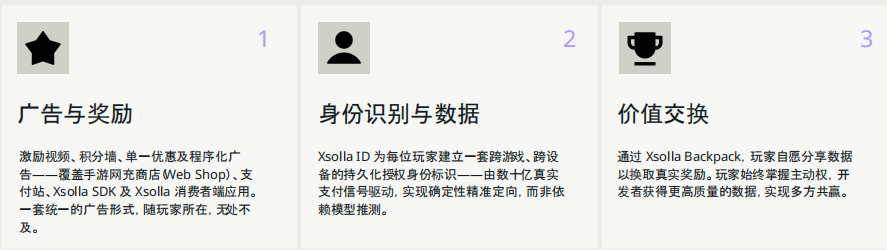
The foundation of the entire system is Xsolla’s proprietary unified identity system: Xsolla ID. This is a unified identity profile that spans multiple devices and games, built by Xsolla over the past 20 years using data from 2.1 billion global players and over $4 billion in authentic payment records—all with the players’ authorization.
Therefore, unlike traditional advertising platforms that rely on algorithmic inferences to generate vague user tags, Xsolla can perform precise audience targeting based on actual in-app purchases and engagement behavior. Within the context of privacy compliance, it maintains stable and reliable data signals, enabling the precise differentiation of free-to-play users,casual players, and high-spending core users, and fully track the entire user journey—from ad engagement and item redemption to in-app purchase conversions—ensuring that every ad campaign is backed by clear, data-driven insights.
Building on this, Xsolla Ads has developed an ad display model driven by player choice: the Offerwall. The Offerwall can be implemented in various scenarios, such as mobile game web shops and in-game apps, allowing for precise targeting of high-quality users who are actively seeking in-game items and rewards in the scenarios where they are most active.
Unlike traditional ads—such as mandatory pop-ups or in-game interruptions—players actively choose whether to participate in all reward wall tasks. By completing tasks such as watching videos, trying out apps, or subscribing to services, users can redeem real rewards—such as in-game currency and limited-edition items—on their own terms. The entire process involves no forced exposure to ads and does not interrupt the main gameplay, thereby eliminating the negative impact of ads on the gaming experience at its source.
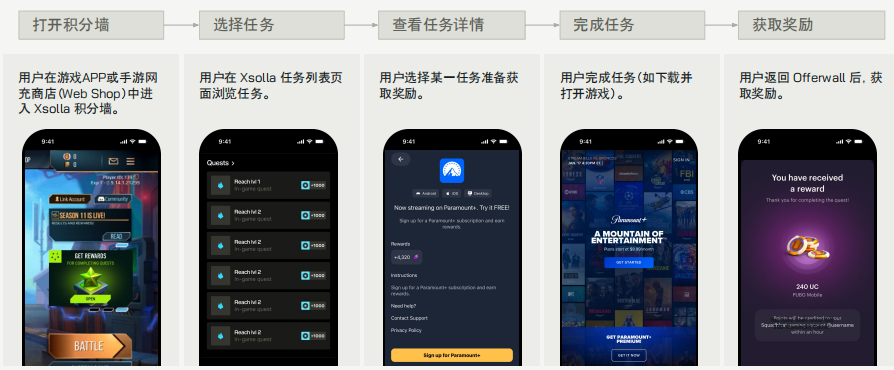
In addition to the full reward wall, Xsolla Ads also offers a "single offer" mode as a supplement. This mode precisely recommends a single high-value task to players at the most opportune moment, allowing players to see the offer at a glance and make decisions more directly. As a result, its conversion rate can even surpass that of the full reward wall.
This “participation-for-rewards” value exchange mechanism can easily drive new user acquisition, reactivate existing users, and monetize the user base.Data shows that 93% of paying players who use reward walls continue to make purchases in the mobile game’s in-app store, which clearly demonstrates that reward walls not only do not divert high-spending players but actually effectively drive incremental value from core players.Furthermore, players who participate in reward walls see their D7–D30 retention rates increase by approximately 40%, and the probability of subsequent in-app purchases rises by 10 to 14 times. This can be said to truly achieve a positive feedback loop among monetization, retention, and spending.
The integration process for the rewards wall is very simple and convenient. It requires no complex coding or high R&D costs and can be easily launched and activated in just a matter of minutes.At the same time, the platform supports various performance-based billing models, including CPI, CPE, MRCPE, and CPC. Combined with industry-leading ad revenue-sharing policies, it can effectively monetize active free-to-play users who previously generated no revenue, opening up a stable source of incremental revenue for games.
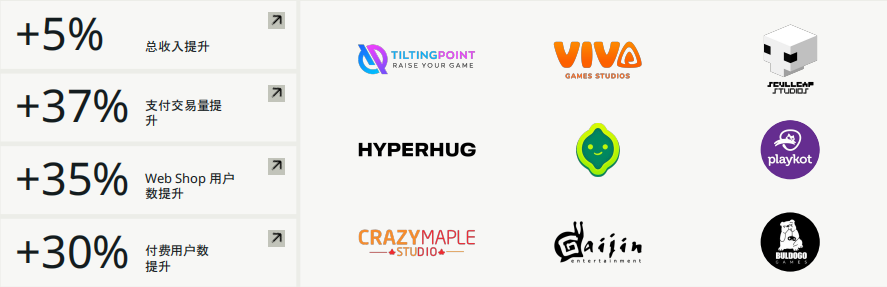
Over the past few years, Xsolla Ads has delivered significant revenue growth for its partners: total revenue increased by 5%, payment transaction volume rose by 37%, the number of Web Shop (mobile game in-app purchase store) users grew by 35%, and the number of paying users increased by 30%.Notably, after Tilting Point integrated a reward wall into the *Star Trek: Timelines* in-game store, the number of in-game store users grew by 30%, and the total number of paying users increased by 8.5%; payment transaction volume rose by 10%, and the in-game store’s total revenue also increased by 5%.
03
A Gathering of Industry Leaders: A Comprehensive Look at New Opportunities for Global Expansion
In addition, the summit brought together senior professionals from leading companies across the entire global gaming industry chain—including RTB House, Tencent Cloud, OEG, Tenjin, and Xiaomi—who shared insights on real-world practical scenarios such as high-quality traffic and advertising, exploring emerging markets (Vietnam), omnichannel monetization, and global distribution.
Jakub Gajewski, Head of New Business for Games at RTB House, delivered a presentation titled “The Core Value of High-Quality Traffic and Data Privacy in the Current Advertising Ecosystem.” He noted that while many advertising teams focus solely on click-through rates and user quality, they often overlook underlying issues such as failed redirects, which continuously erode the overall return on ad spend.To address this challenge, he introduced a proven and practical implementation plan that leverages first-party data to build a retargeting advertising system. While strictly adhering to data privacy compliance standards, this approach helps brands achieve efficient and stable overseas advertising campaigns.
Sally Nguyen, Chief Operating Officer of OEG, focused on the Vietnamese market, providing a detailed overview of key factors such as local players, payment systems, and regulatory compliance, thereby offering clear guidance for companies looking to expand into Southeast Asia’s emerging markets.According to Sally, Vietnam has over 54 million gamers, with mobile game revenue projected to reach $740 million in 2025—a 12% year-over-year increase—making it one of the most robustly growing markets in Southeast Asia.OEG’s one-stop market entry solution comprehensively covers a wide range of services—including compliance agency services, online community operations, esports event organization, and the establishment of offline internet café channels—clearing obstacles for global developers looking to expand into the Vietnamese market.
Kelly Wu, Senior Business Manager of Tencent Cloud’s Hong Kong, Macau, Taiwan, and International Business Division, delivered a presentation titled “Tencent Cloud International: Full-Stack AI Practical Insights—Boosting Efficiency with AI Tools to Reshape the Full Gaming Value Chain in the Asia-Pacific Region.”She explained that Tencent Cloud has built an end-to-end AI solution for the gaming industry based on the TOKEN HUB large-model aggregation platform and centered around the Hun Yuan large model. Leveraging tools such as CodeBuddy, Media AI,Voice AI Agent, ACE Anti-Cheat, and WeTest, the solution empowers the entire gaming lifecycle—from R&D and marketing to player services, security protection, and product testing—helping companies expanding overseas leverage AI to reduce costs, improve efficiency, and build a competitive edge in the Asia-Pacific market.
In addition, Henry Li Mingzhe, Global Head of Growth at Tenjin, focused on new trends in cross-border growth for 2026. He analyzed changes in revenue structures driven by category rotation and hybrid monetization, shared insights on the shift in campaign measurement from CPI to ROAS, and discussed the application of predicted LTV (pLTV) in budget decision-making.Tenjin is a leading global mobile attribution and growth analytics platform, currently serving over 60,000 active games and apps worldwide and monitoring nearly $200 million in monthly ad spend;Chen Guanhong, International Business Manager at Xiaomi’s Business Cooperation Department, provided a detailed analysis of the Xiaomi App Store’s ecosystem advantages. By fully leveraging the strengths of the manufacturer and the enabling capabilities of the operating system, and drawing on Xiaomi’s extensive overseas user base, the company is deeply committed to diversifying business models—including user acquisition and IAP (in-app purchases)—to provide comprehensive business solutions for developer partners and create abundant growth opportunities.
A group of industry partners shared practical, first-hand insights on key aspects of global expansion, explored growth opportunities from various perspectives, and clearly outlined the future direction of the global gaming market amid a competitive landscape dominated by existing players. It is safe to say that this summit combined high-level industry perspectives with actionable guidance and was packed with valuable insights.
Conclusion
As the host of this summit, Xsolla has introduced a growth solution for global expansion that directly addresses core pain points and covers the entire game operations lifecycle.In addition to XPN influencer marketing and Xsolla Ads monetization—which were highlighted earlier—IP licensing services are also a crucial component of this growth ecosystem. The former focuses on monetizing existing users, while the latter addresses the need to “build brand equity” beyond traffic and monetization.
According to reports, Xsolla’s IP licensing service enables domestic game developers to gain direct access to top-tier global entertainment IPs—including Hollywood films and TV shows as well as renowned sports franchises—thereby completely overcoming the challenges associated with traditional IP partnerships, such as limited distribution channels, lengthy review cycles, and cumbersome partnership terms.As a result, developers can leverage high-quality IP partnerships to effectively reduce overseas customer acquisition costs, stimulate player spending, and simultaneously build and consolidate long-term brand equity.
Xsolla’s three core business areas—influencer marketing, advertising, and IP licensing—work in tandem to provide global brands with a standardized, end-to-end growth solution that is actionable and reusable.
By leveraging Xsolla’s influencer marketing to expand the boundaries of diversified traffic growth, utilizing Xsolla Ads for precision operations to revitalize existing users and enhance monetization efficiency, and breaking down collaboration barriers with global top-tier content assets through IP licensing services, Xsolla has fully established a closed-loop growth model for global expansion: “New User Acquisition — revenue growth from existing users — long-term asset accumulation.” This solution systematically addresses the pain points of expensive user acquisition and unstable growth, truly transforming global game expansion from “high-cost trial and error” to “certain growth,” making global operations more hassle-free and stable.
It is worth noting that during this year’s ChinaJoy, teams from Xsolla’s three major business lines have gathered in Shanghai. Developers interested in building a sustainable overseas growth system and enhancing their comprehensive global expansion capabilities can take this opportunity to engage in in-depth face-to-face discussions and explore partnerships, working together to uncover new opportunities for game globalization in a highly competitive market.
原创文章,作者:游茶妹儿,禁止转载:https://youxichaguan.com/en/archives/208479