That sheep is back again.
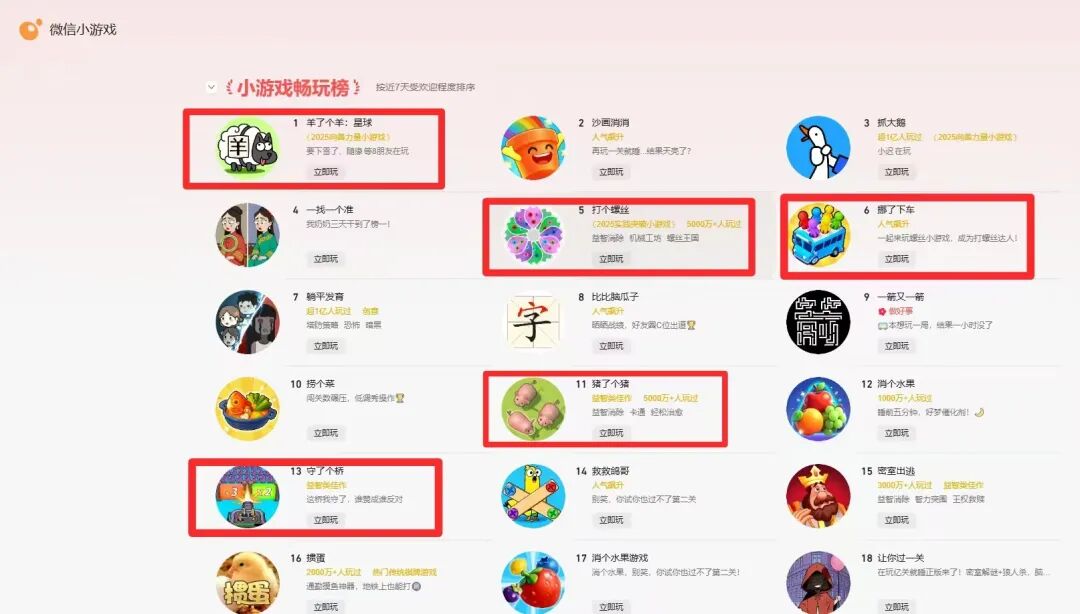
According to the September 2026 WeChat Mini-Games Monthly Rankings released by DataEye and Gravity Engine, *Sheep Sheep: Planet* has reclaimed the top spot on the Most-Played chart.
Looking at the bigger picture, this isn’t the first time it has topped the charts. In February of this year, *Sheep Sheep: Planet* had already held the No. 1 spot on WeChat’s monthly most-played mini-games chart for seven consecutive months. Since then, its winning streak continued until it was finally broken by *Zhao Yun and Adou* in July.From maintaining a consistent lead, to being overtaken by a new release, and then reclaiming the top spot, this sheep has clearly not faded from the market entirely as the initial hype surrounding the original game has subsided.
Why has a casual game—centered on simple match-three gameplay and once thought to have merely capitalized on a passing trend—managed to stay in business for so long?
This year, the WeChat Mini Games Developer Conference has chosen “From Connection to Longevity” as its theme. As the platform begins to focus more on long-term sustainability, *Sheep Sheep: Planet* offers a case study worth examining: the vitality of casual mini-games may not lie solely in creating the next viral hit, but also in how to keep players coming back time and time again.
01
Long-Term Vertical Operations for the Sequel, *Planet*
There’s no denying that the popularity built up by the first installment gave the sequel a natural advantage. The 2022 game *Sheep Sheep* was like a firework that suddenly shot into the sky, lighting up the entire mini-game market in a very short time.
The gameplay isn’t complicated: a few different patterns and seven slots make up a streamlined match-three mechanism. The first level is practically a tutorial, but the second level suddenly ramps up the difficulty.Players enter the game out of curiosity, only to have their competitive spirit ignited by repeated failures. What began as a seemingly simple match-three challenge has thus evolved into a massive nationwide sensation.

Founder Zhang Jiaxu once revealed that the project started with just three people and an initial investment of about 500,000 yuan. They had originally hoped to earn 200,000 yuan per quarter, but the game’s revenue later surpassed 100 million yuan.
This is a truly remarkable success story. What’s most memorable about the original *Yang Le Ge Yang* is that it made the leap from a small game to a nationwide social phenomenon.
But what happens after the sudden surge in popularity?
Once players have become accustomed to the difficulty of the second level, and when both success and failure lose their novelty, the thrill derived solely from the challenge becomes difficult to sustain. The initial buzz surrounding the first installment can propel the product to the top in a short period of time, but it may not be enough to retain users in the long run. As the novelty wears off, the game’s popularity rapidly declines after a month.
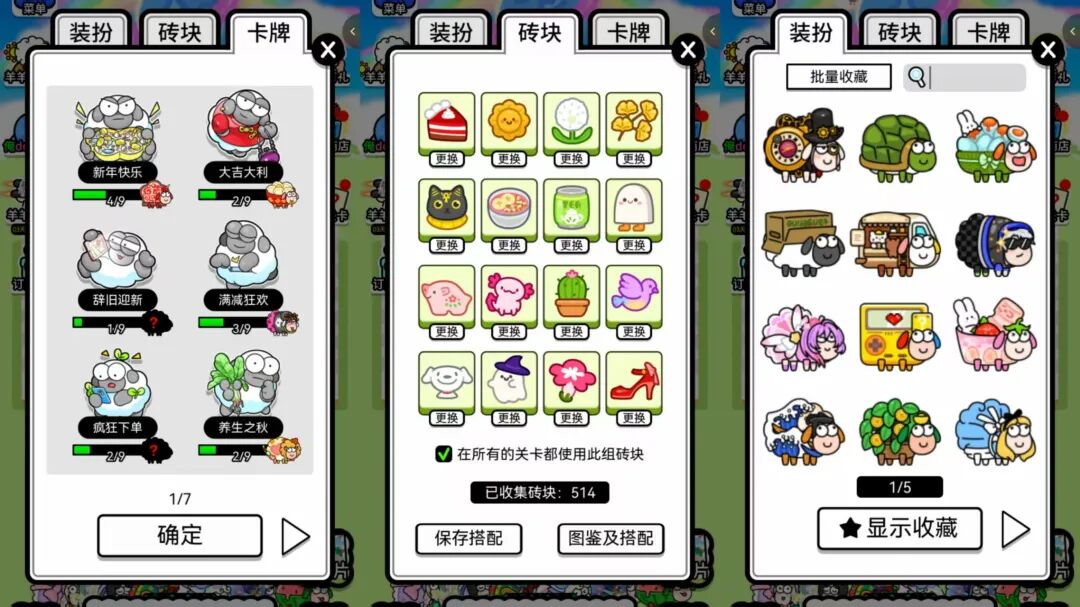
In 2025, the sequel, *Sheep Sheep: Planet*, officially launched.In addition to the classic match-three gameplay, *Planet* introduces systems such as planet building, planet coins, team collaboration, and random skins. It no longer focuses solely on single-game challenges but instead attempts to build a long-term progression and collection system beyond the levels, giving players goals to pursue even after completing a match.
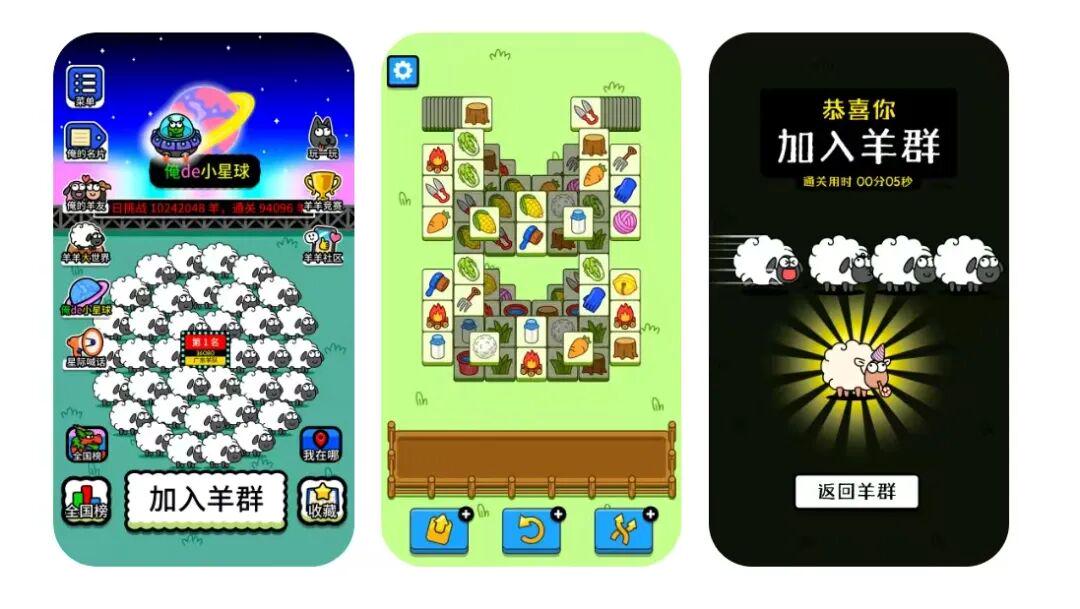
The original game’s experience was more about “trying, failing, sharing, and trying again”; *Planet* extends this cycle to “beating levels, earning resources, completing objectives, participating in events, and advancing your progress.” Players can keep trying to beat a level, or they can return to accumulate resources, collect skins, or advance their planet-building efforts.
In other words, the sequel attempts to transform that fleeting desire to win into a more sustained motivation to play.
These motivations aren’t necessarily all that strong—they might simply be a desire to add something to the planet today, or to unlock a new outfit for the little sheep by clearing a level. But for casual games, the reasons users return don’t have to be grand. When multiple small goals build on one another, there’s a chance that a single, chance opening of the game can gradually turn into a recurring behavior.
At the very least, its current ranking indicates that *Sheep Sheep: Planet* has maintained its market competitiveness for quite some time.Of course, rankings alone cannot directly prove its retention rate or profitability, but from a product design perspective, it is indeed attempting to address the issues left over from the original game: how to ensure that the attention generated by a viral hit isn’t just a fleeting phenomenon, and what keeps players coming back after their first visit.
It’s worth noting that casual games can foster growth beyond the game itself, but this doesn’t mean the system has to become increasingly complex or tasks have to pile up. Players often click in initially because the rules are simple and the game is easy to pick up. If, over the long term, the game ends up becoming a checklist of tasks that must be completed—forcing players to catch up every time they return—the product may actually lose the advantages that made it appealing in the first place.
As Li Qing said at this year’s WeChat Mini Games Developer Conference:
“Long-term success has nothing to do with how complex a product is… The key to long-term success is sustained operation; it doesn’t require a product to be complex. Even casual games can achieve long-term success through effective operation.”
02
Horizontal Radiation: The Buzz Around the Charts
If you take a look around the charts, you’ll see that *Sheep Sheep: Planet* isn’t alone.
Currently, the top 20 on the “Most Played” chart frequently features games such as *Piggy Pig*, *Brick Brick*, *Screw It In*, *Get Out of the Car*, and *Guard the Bridge*. It’s hard to say that their names or gameplay aren’t related to *Sheep Sheep*; while some of these titles have a lifespan of only a few weeks, others manage to remain on the chart steadily for several months.
Source: WeChat Mini Programs
In fact, it’s not hard to see that taking shortcuts with mini-games is not only cost-effective but also yields immediate results. But what’s even more worth noting is that there’s a whole operational strategy behind mini-games.
Memorable names, rules that can be understood in just a few seconds, quick feedback, and a challenging process that sparks curiosity, comparison, and sharing. Users don’t need to spend much time learning about the product before deciding whether to click and give it a try.
This low barrier to entry reduces the cost of trying out a product and makes it easier for it to gain its first foothold through social sharing. However, gameplay mechanics can be replicated, themes can be swapped out, and the charts are constantly changing.
As of May 2026, the number of WeChat Mini-Games developers had exceeded 500,000, with more than 80 percent of them being small and medium-sized teams of fewer than 30 people.In 2025 alone, more than 5,000 developers released products on the Mini Games platform for the first time. As more and more developers compete for users’ limited attention, simply creating a game that “looks somewhat interesting” is no longer enough to secure a lasting competitive advantage.

Source: Taptap
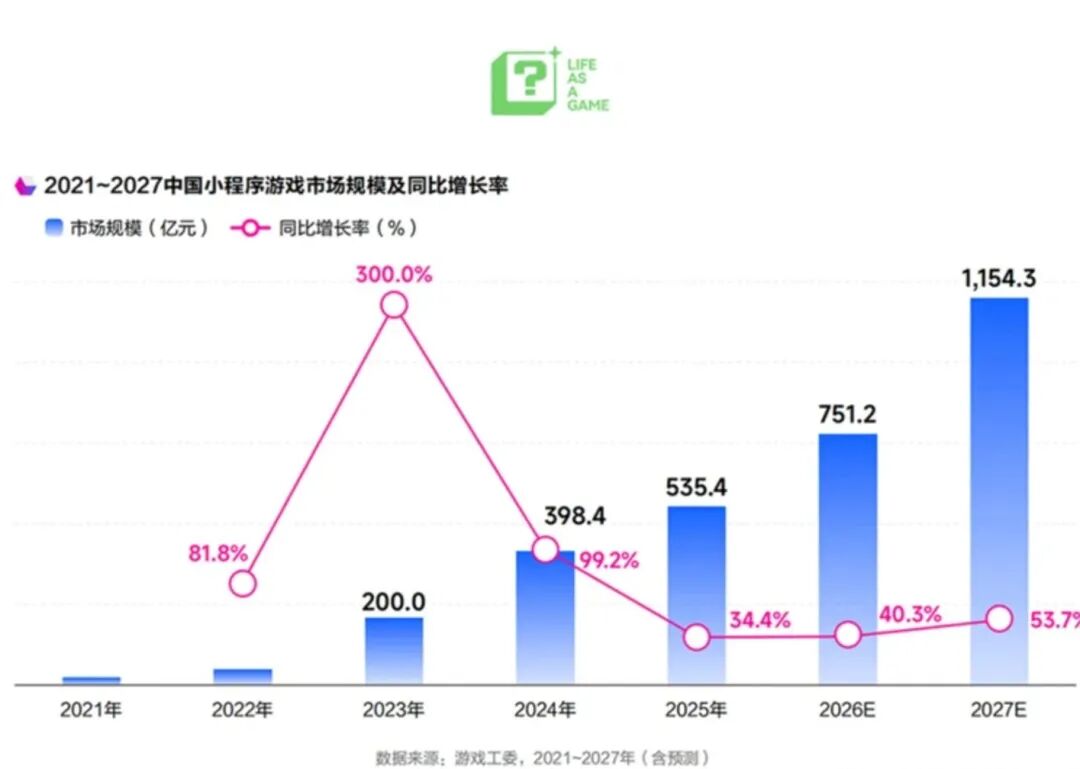
In terms of industry scale, the growth of the mini-game market has also made this competition even more noteworthy. According to relevant industry reports, revenue in the domestic mini-game market reached 53.535 billion yuan in 2025, representing a year-over-year increase of 34.39%;In the first half of 2026, actual market revenue grew further to 36.157 billion yuan, a year-over-year increase of 36.01 percent. Industry insiders predict that this figure could exceed 100 billion yuan by 2027.
Source: QUEST MOBILE
Behind these numbers lies a market with a massive user base, a steadily growing number of participants, and an increasingly mature business model. For small and medium-sized teams, mini-games offer a relatively low-risk environment for product experimentation; for companies that already have established products and R&D capabilities, they are gradually becoming a distribution channel worth investing in.
As the market grows, opportunities naturally increase, but competition intensifies as well. Just because a product successfully acquires its first batch of users through paid user acquisition or social media sharing doesn’t mean it has established a true competitive advantage. The novelty will wear off, user acquisition costs will fluctuate, and new products will continue to emerge. Whether players will open the app again after their initial experience has become another question that must be answered.
03
The Ability of Casual Games to “Be Remembered”
How should we understand the longevity of a casual game?
For some games, long-term engagement means players log in every day, complete quests, make progress, and maintain a steady relationship with the game. But the relationship between casual games and their players is often not quite that close. Some people play for several days in a row, then get busy for half a month; others open the game for a quick round while waiting for a bus, and then, a few days later, return to the game because of some chance occurrence.
This pace isn’t regular, and casual players may not be willing to set aside a fixed schedule for a game, nor will they necessarily remain active all the time. However, for casual games, what matters most is that when a player steps away for a while, the game doesn’t completely disappear from their life; when the next urge to relax strikes, it remains an option that’s easy to remember and worth opening up again.
This is the ability to “be remembered.”
At the 2026 WeChat Mini-Games Developer Conference, WeChat officials revealed that more than 50% of active users proactively access mini-games. This statistic clearly demonstrates that the use of mini-games does not rely solely on ad clicks or external recommendations; proactive access has become an integral part of users’ habits.

Source: Taptap
The reason casual games have the potential to be remembered time and again also has to do with the way they have become part of everyday life: in small, bite-sized chunks.
In its “2025 Mobile Gaming Industry Development Analysis Report,” QuestMobile noted that WeChat Mini-Games and Douyin Mini-Games leverage their platform ecosystems to meet users’ entertainment needs through lightweight, bite-sized experiences.
No download required, no registration required, and no need to remember where you left off last time.Just tap once in WeChat to open and play; you can close it when you’re done—or even if you haven’t finished—with no pressure to complete tasks and no penalties for leaving the game idle. For lightweight, casual games, this low barrier to entry and exit—along with level updates and event schedules—is an integral part of the user experience. It makes mini-games easier to incorporate into everyday life.
Summary
The market’s expectation that mini-games will remain a long-term trend does not mean that user growth has peaked. On the contrary, the massive user base and steadily growing market revenue continue to attract more developers. However, the shift in business priorities is already clear: once a connection with users is established, the focus must shift to how to retain them for the long term.
Back to that sheep.
From the first installment sparking nationwide buzz to *Sheep Sheep: Planet*’s attempt to build long-term engagement, this series offers a product strategy worth noting: while the traffic generated by a viral hit can serve as a starting point, it cannot replace ongoing management.How to control the difficulty of challenges; how to make in-game objectives engaging without adding undue burden; how to strike a balance between ad revenue and user experience; and how to maintain a sense of novelty through continuous updates—long-term operation ultimately hinges on these specific, nuanced decisions.
原创文章,作者:游茶妹儿,禁止转载:https://youxichaguan.com/en/archives/222228