"Zhao Yun and A Dou" is one of the most talked-about dark horses in the 2026 casual game market.
In June of this year, as soon as the game was launched, it immediately topped the WeChat Popularity Chart and Top Games Chart, as well as the Douyin Trending Games Chart and Top-Selling Chart; in the months that followed, its momentum remained strong, and to this day it has held a steady position in the top two on WeChat’s Top Games Chart, demonstrating remarkable market competitiveness.
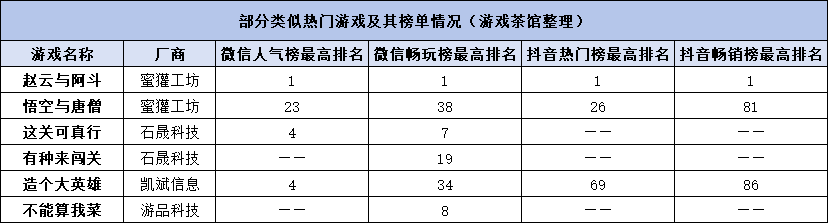
A distinctive feature of the mini-game market is that, following the game’s massive success, a large number of similar products quickly flooded the market. From *Wukong and Tang Seng* to *This Level Is Awesome*, a wave of new “text-based tower defense” games has entered the market one after another; to date, six such titles have successfully climbed to the top of WeChat’s Most Played chart.
Taking *Zhao Yun and A Dou* as their blueprint, these development teams have explored various approaches—including thematic packaging, gameplay iteration, and gameplay integration—and a brand-new “Zhao Yun and A Dou-like” competitive segment has quietly taken shape.
01
2.0: A Fresh Take on Thematic Packaging
Although it is yet another casual game based on the “Three Kingdoms” theme, *Zhao Yun and A Dou* has successfully established highly distinctive features through dual innovations in both its visual art and core gameplay.
In terms of art design, the game employs a minimalist combination of Chinese characters and ink-wash style to present its content, transforming Chinese characters into core visual symbols and character representations. All combat units in the game take the form of Chinese characters: the character for “bow” (弓) draws a bowstring and fires an arrow; the character for “spear” (枪) thrusts a spear; and the character for “sword” (刀) slashes at enemies.This minimalist design not only makes battlefield information clear and intuitive but also achieves low-cost, highly recognizable visual differentiation through the unique aesthetics of Chinese characters.
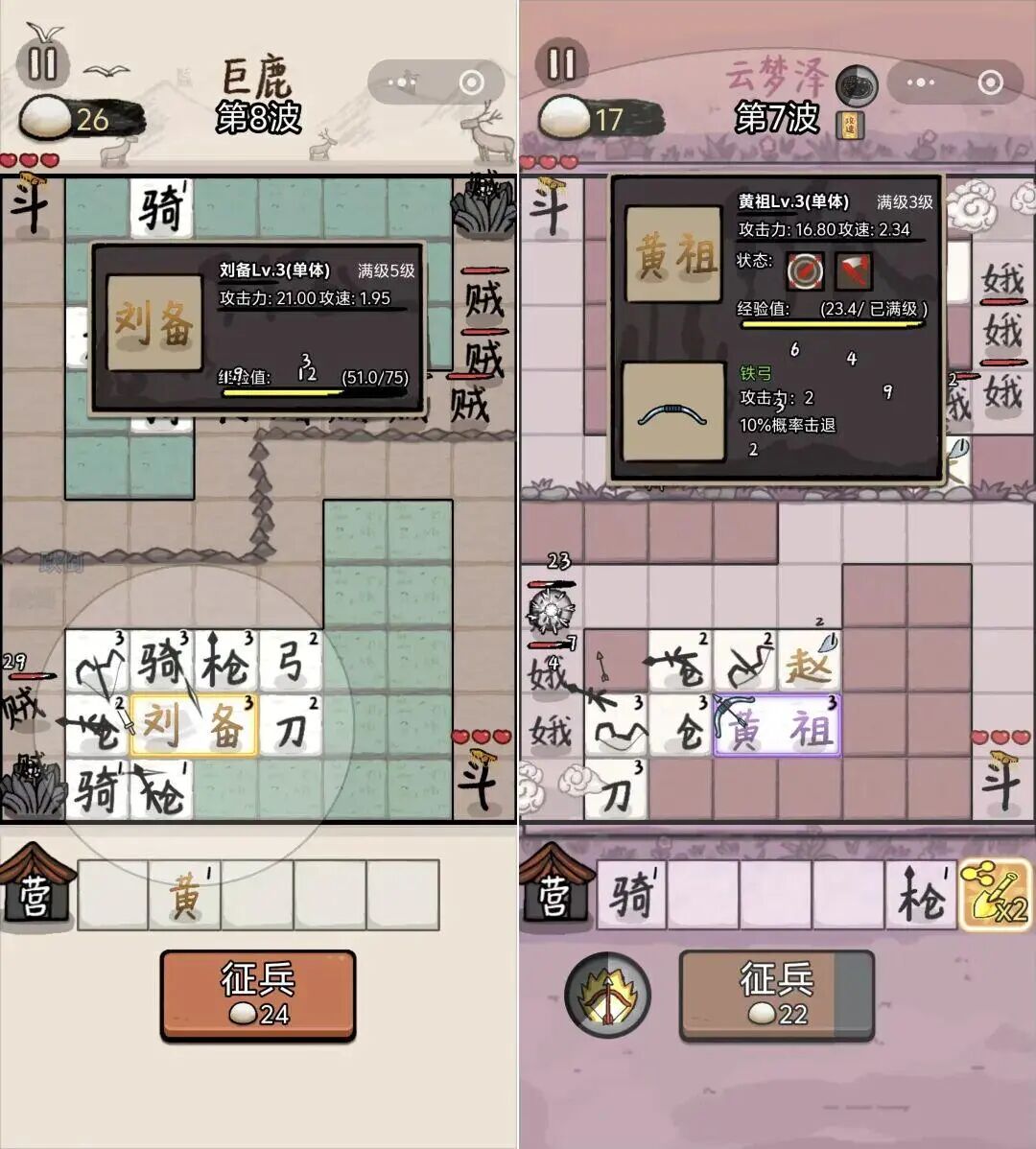
In terms of gameplay, the game takes an inclusive approach, incorporating proven mechanics from various casual genres—such as tower defense and match-3—and combining them with 1v1 symmetrical competition and a word-matching system to unlock heroes, offering players a unique gaming experience.
Once the match begins, the opposing sides are divided between the upper and lower halves of the map. Enemy forces surge forward along fixed routes, advancing directly toward A Dou at the end of the path. The player’s task is to build defenses through recruiting, merging, and deploying troops. Ultimately, the side whose A Dou’s health reaches zero first is declared the loser.
During troop recruitment, in addition to the four standard troop types—"swordsmen, spearmen, archers, and cavalry"—players also have the chance to draw various golden hero nameplates featuring single characters. By collecting all the characters that make up a hero’s full name and placing them on the battlefield in the correct order, players can unlock heroes with stronger combat stats.
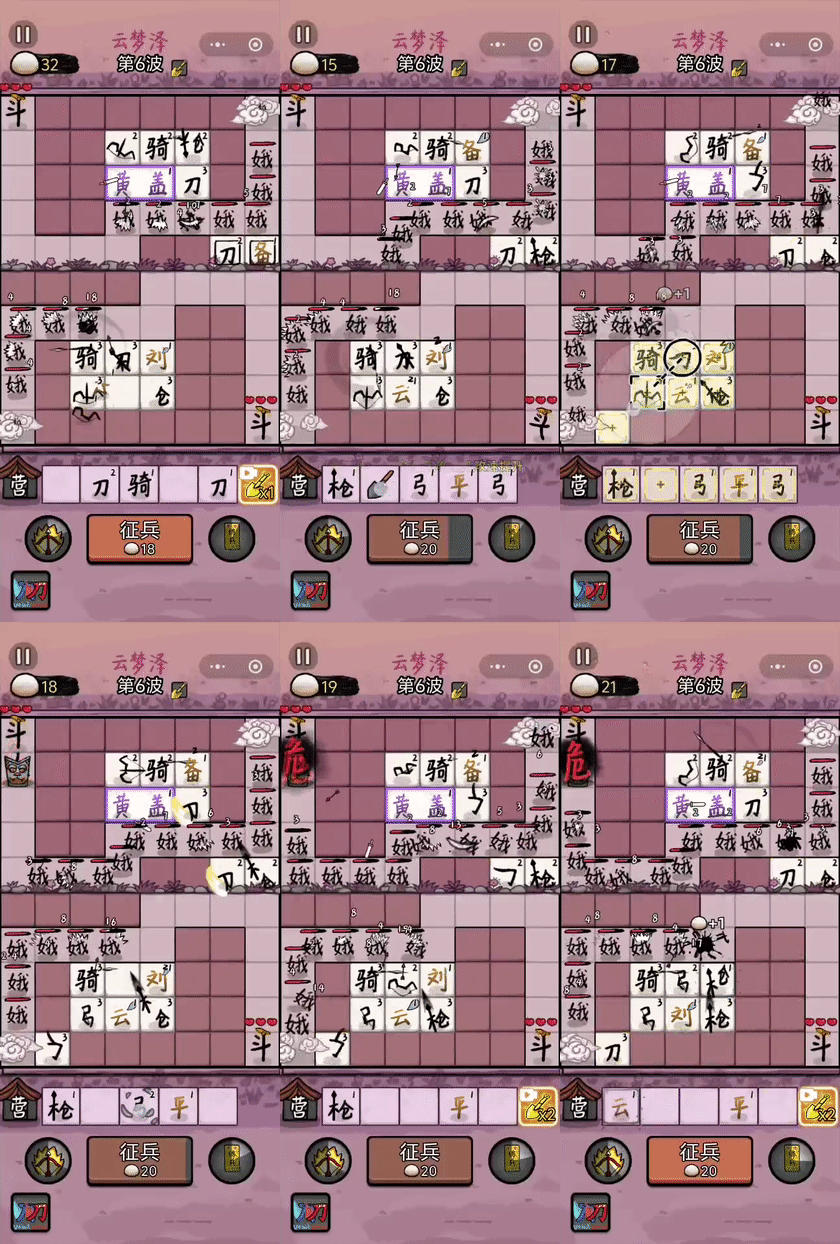
The minimalist ink-wash artwork featuring Chinese characters, combined with intuitive drag-and-drop composition mechanics, significantly lowers the game’s learning curve, allowing new players to quickly grasp the rules and jump right in.However, the game goes beyond a superficial casual experience: hero recruitment involves an element of randomness, which, when combined with unit synthesis, battlefield space management, the strategic trade-offs of card draws, and the intervention of various in-game items, creates a complex interplay of variables that lends the game considerable strategic depth.
As a result, as soon as the game was released, it went viral thanks to its unique visuals and gameplay, climbing to the top of the charts across multiple platforms.
Following the massive success of *Zhao Yun and A Dou*, many development teams quickly followed suit, setting out to recreate this text-based tower defense gameplay. Honey Badger Studio also capitalized on its momentum, choosing the wildly popular national IP *Journey to the West* to rebrand its product and launch a new title in the same genre: *Wukong and Tang Seng*.
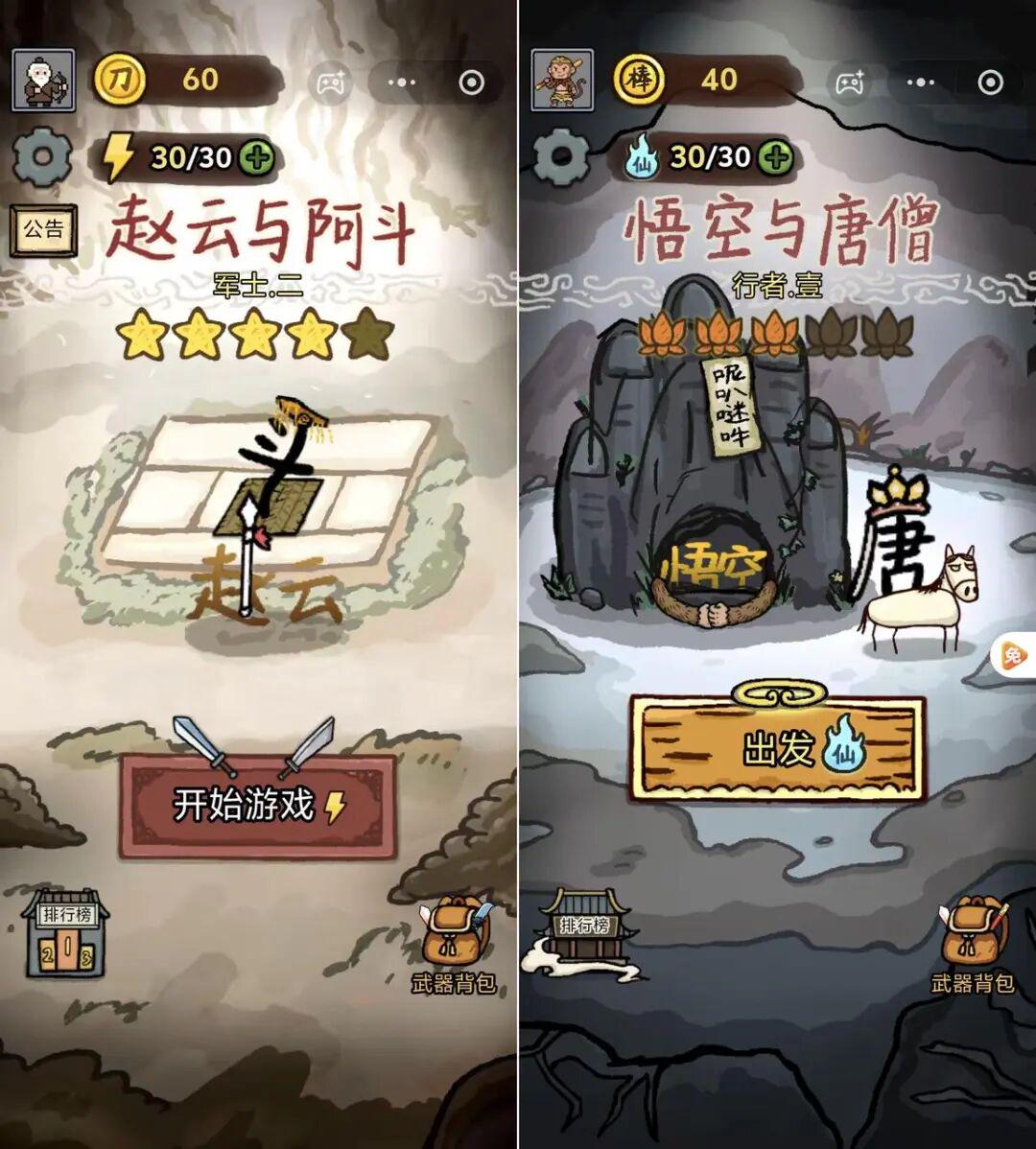
Overall, *Wukong and Tang Seng* largely retains the gameplay framework, content structure, UI design, and even the naming conventions of its predecessor, with only minor adjustments to details—such as changing the criteria for a game loss from “A Dou’s health reaching zero” in the previous game to “Tang Seng being kidnapped by a demon,”using this humorous phrasing to better align with the *Journey to the West* IP’s lore.
For Honey Badger Studio, *Zhao Yun and A Dou*and *Sun Wukong and Tang Seng*—two products in the same genre—running in parallel to drive user acquisition can rapidly boost the team’s market presence in the text-based tower defense genre, spread out the costs of R&D, user acquisition creatives, and version updates, and simultaneously attract a broader user base through different IPs. This allows the team to capitalize on the genre’s window of opportunity and expand its competitive advantage.which is also a very common matrix strategy in the mini-games sector.
In the end, while *Wukong and Tang Seng* didn’t quite measure up to *Zhao Yun and A Dou*, it still delivered solid market results: it peaked at No. 23 on WeChat’s Popularity Chart, No. 38 on the Top Games Chart, and No. 26 on Douyin’s Trending Chart.
02
3.0 Gameplay Iteration and Adjustments
In fact, aside from Honey Badger Studio, many other teams have attempted to break into this entirely new gameplay niche by leveraging art styles or thematic concepts to carve out a share of the market. However, with the top hit titles already securing their positions, these teams have long since missed their chance to gain a foothold in the market.Consequently, more latecomers have begun trying to find a breakthrough through gameplay iterations, and among them, Shenzhen Shisheng Technology has achieved the most notable success.
To date, Shisheng Technology has successfully propelled two games—“This Level Is Really Cool” and “Come on, Take on the Challenge”—into the Top 20 of WeChat Mini Games’ “Most Played” chart, with “This Level Is Really Cool” even peaking at No. 7 on the chart.
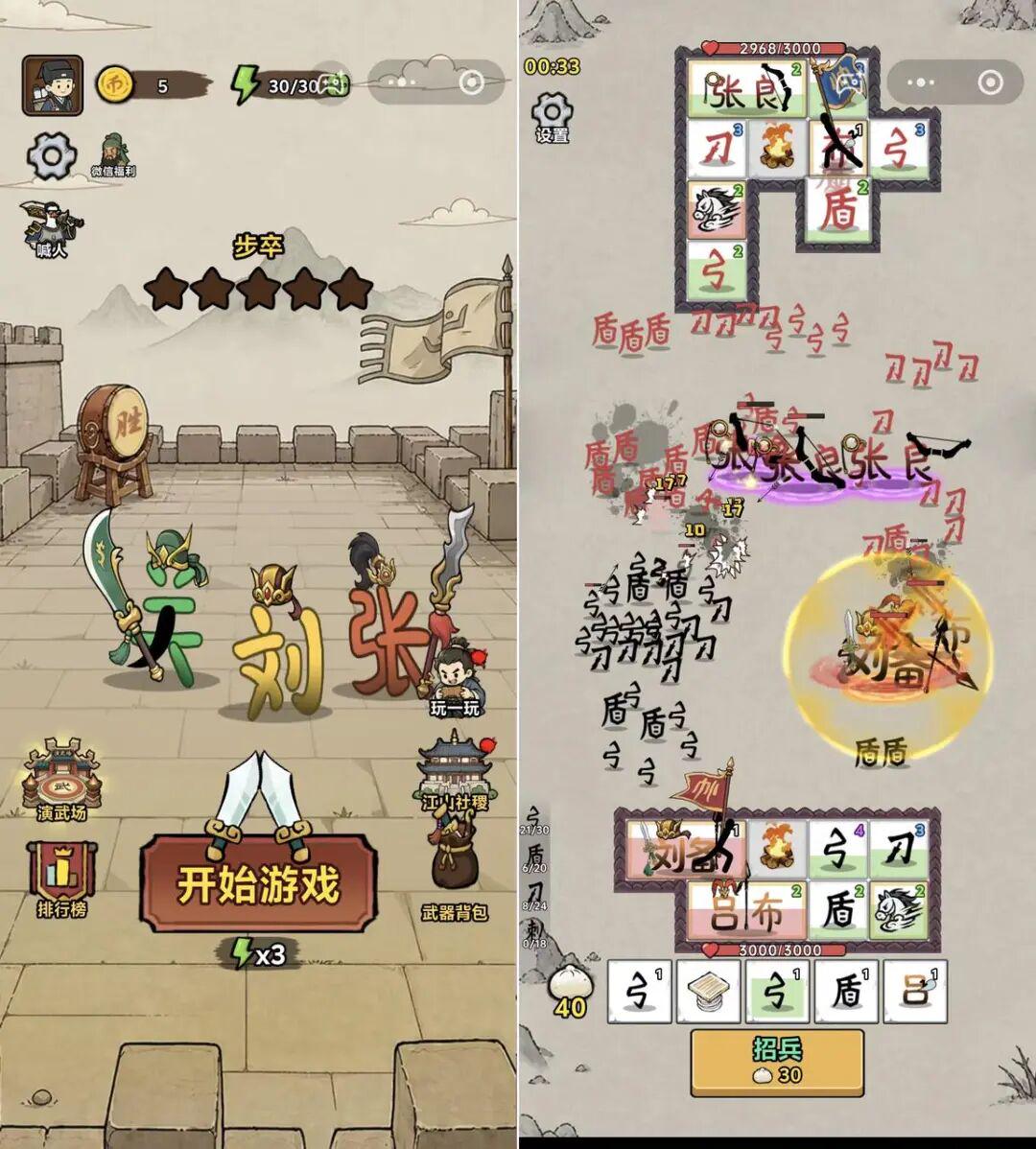
"This Level Is Really Something" also draws on the Three Kingdoms theme, but it breaks away from the classic "Lucky Defense"-style tower defense framework used in "Zhao Yun and A Dou," eliminating third-party monster characters and fixed tower defense paths. The core gameplay has shifted entirely to a PvP (player versus computer) mechanism:Players summon troops to engage the enemy directly in head-on combat, and the rules for determining the outcome of a match are simpler and more straightforward: the first side to have its health reduced to zero is declared the loser.
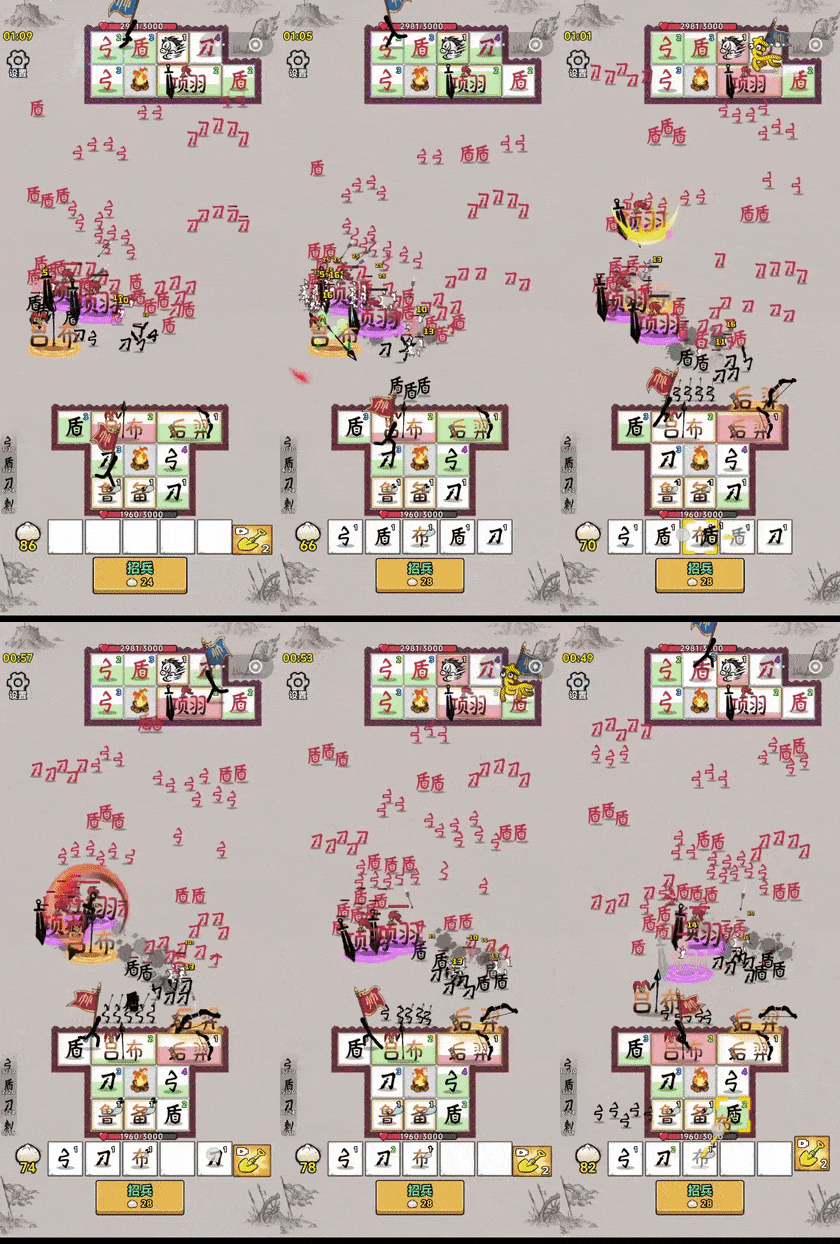
In terms of combat mechanics, *This Level Is Really Something* retains the core appeal of *Zhao Yun and A Dou*: units are summoned through random conscription, and units of the same type can be combined to level up. Players must continuously draw and collect fragments of heroes’ names; only by collecting the full name can they summon a general to join the battle.
However, this installment introduces key innovations to the troop generation and battlefield operations systems. The game introduces a new core unit called the “General,” which continuously moves along fixed paths on the board and automatically deploys troops at corresponding positions as it advances, breaking away from the traditional tower defense logic of the previous game, where units were statically positioned and automatically attacked from their original locations.
In addition, the game has introduced a large number of original buff effects and mechanics: for example, the “Horse” effect increases a unit’s movement speed, while “Double Jump” allows the effect of the next item to trigger twice in a row. These new mechanics further increase the unpredictability of matches and provide players with a wider range of strategic options.
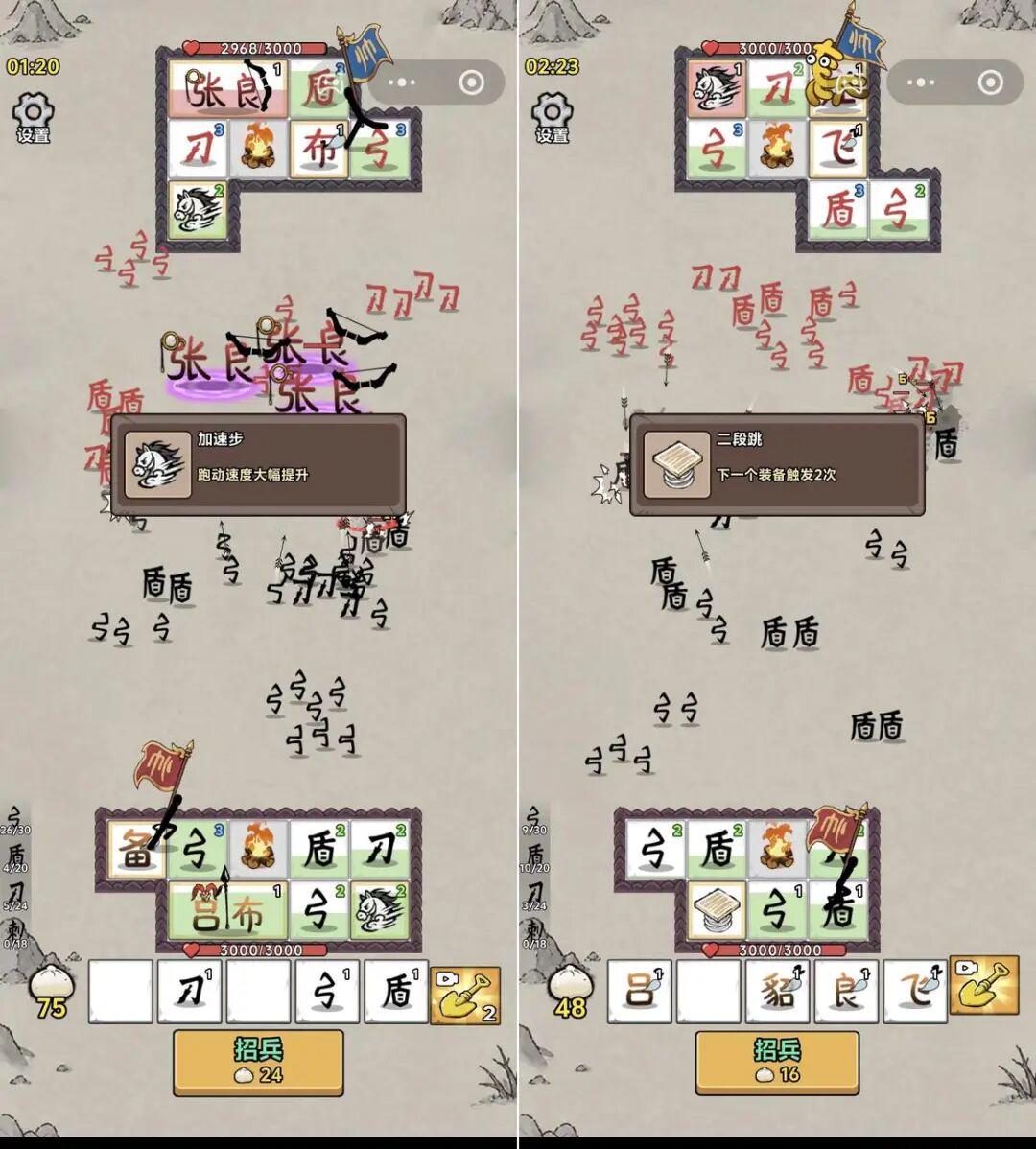
Clearly, *This Level Is Awesome* doesn’t stop at a superficial recreation. While drawing inspiration from the highly recognizable Chinese character art style of its predecessor and retaining popular and entertaining mechanics—such as random summoning and spelling words to summon heroes—the game has further restructured and refined the underlying logic of the entire gameplay system.Through innovative designs such as dynamic “General” units that move across the board and direct 1-on-1 confrontations, the game delivers a completely new gaming experience to players.
Thanks to its innovative and distinctive gameplay, the game managed to break into the top ranks of the "Most Played" chart—even as *Zhao Yun and A Dou* continued to dominate the top spots—and carve out a niche for itself in the tower defense mini-game category.
Once the market validated the viability of this gameplay model, Shisheng Technology quickly launched a new title, *Come on, Take on the Challenge*, with nearly identical content, in an attempt to further solidify its competitive advantage.However, the pace of market saturation proved faster than anticipated, with similar competitors flooding the market one after another. Around the same time, *Create a Superhero*, launched by Xiamen Kaibin Information, successfully climbed to No. 4 on WeChat’s Popularity Chart and No. 34 on the Fun Play Chart by leveraging the same gameplay and content as *This Level Is Really Cool*.
03
4.0 Integration of Other Gameplay Elements
As more and more people have recognized the potential of text-based tower defense games, developers have gradually begun experimenting with innovation across multiple dimensions. Beyond reskins and gameplay iterations, the concept of blending different gameplay styles has also led to the creation of many popular new titles, a prime example being *Don’t Count Me Out* by Changsha Youpin Technology.
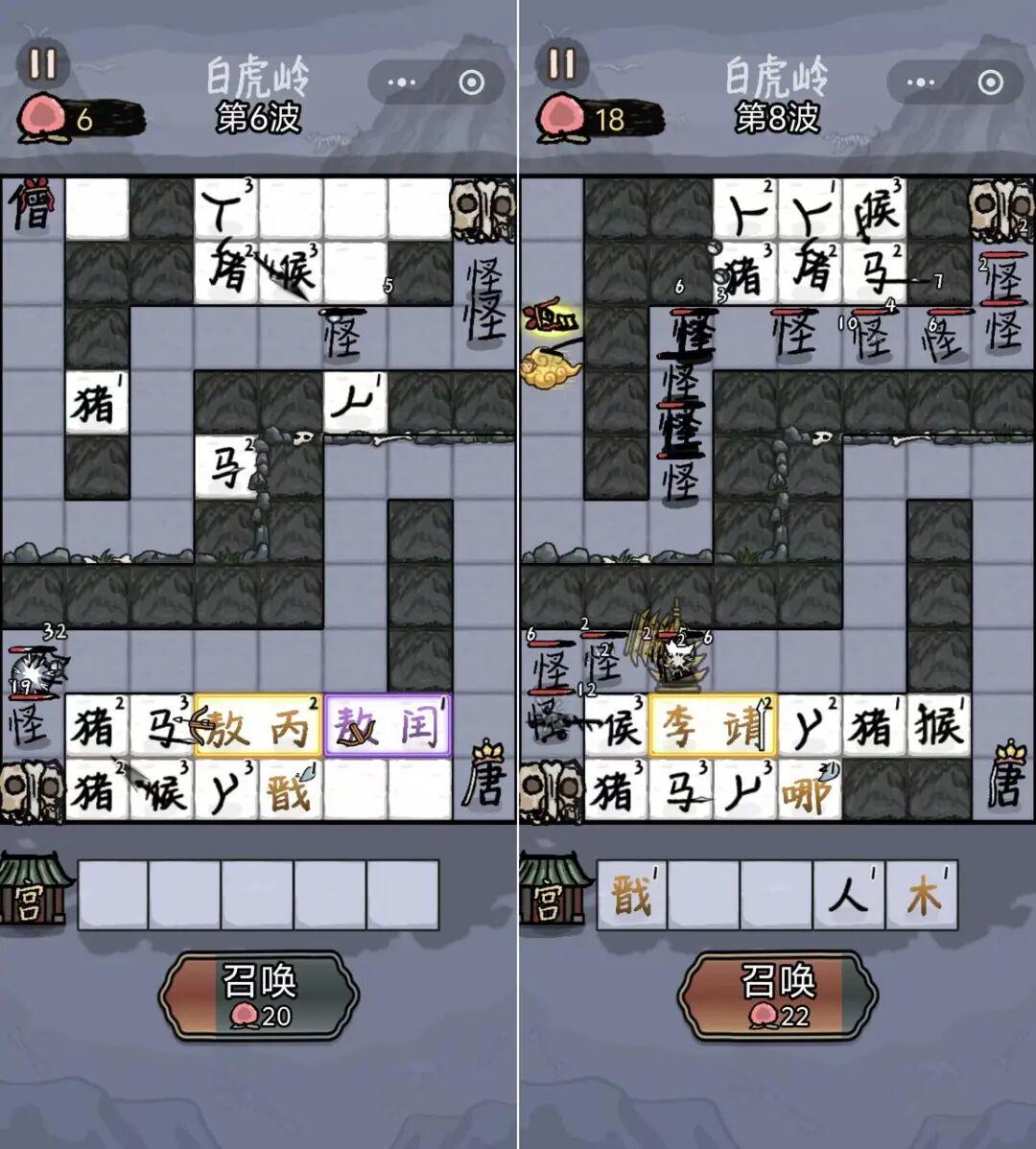
"Not My Thing" is based on the "Journey to the West" IP. Monsters advance along fixed paths enclosed by a grid, and players must accumulate resources to summon and upgrade heroes on the grid, building defenses to protect Tang Seng at the end of the path; once Tang Seng's health drops to zero, the game ends.
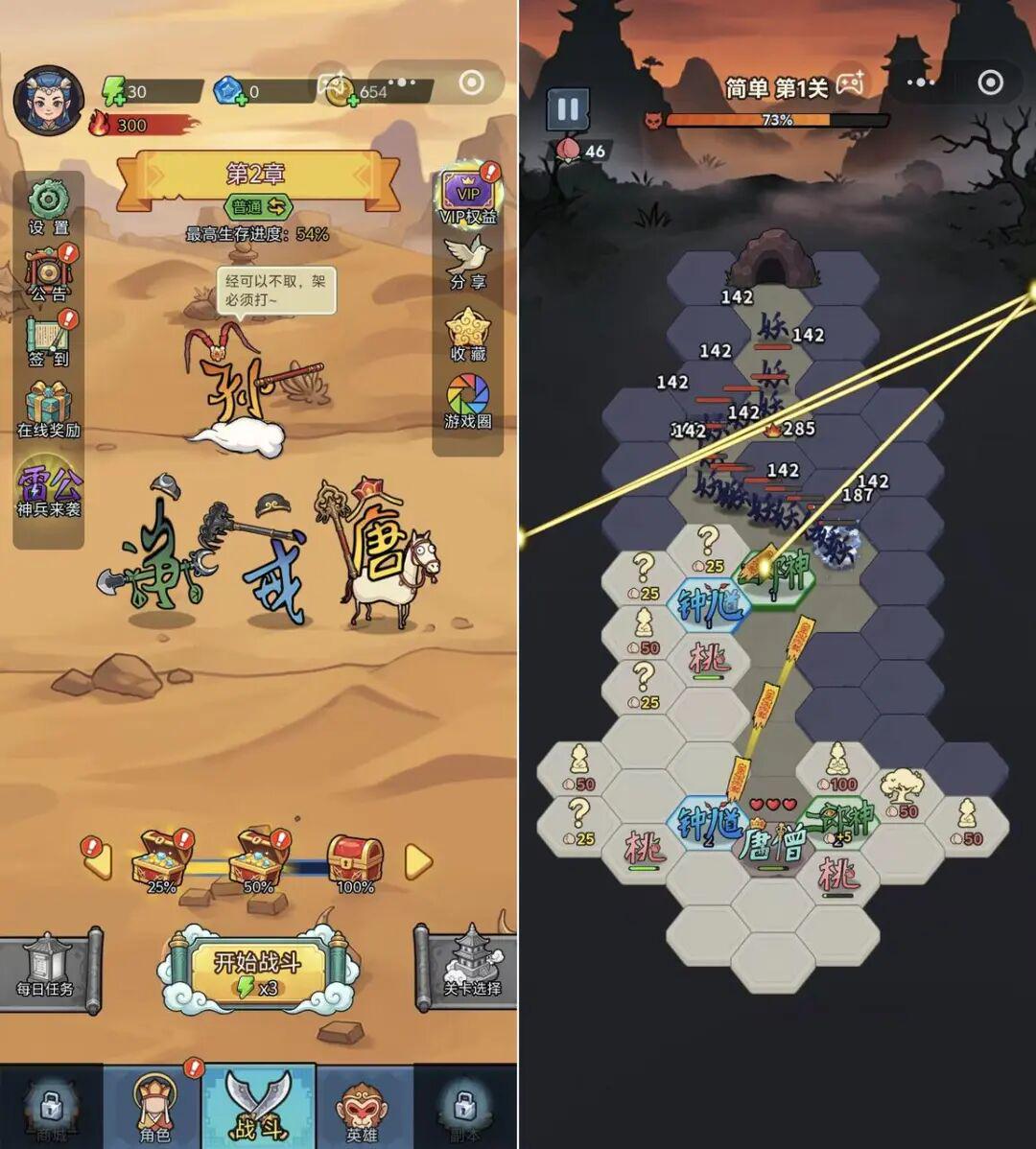
In this game, we can clearly see the influence of two popular titles:It inherits the iconic Chinese character art style of *Zhao Yun and A Dou*, using Chinese characters as the core game units and character models, while retaining the underlying framework of a text-based tower defense game. This approach not only reduces art production costs but also helps the product establish a unique visual identity within the genre.
In terms of gameplay, it draws heavily from *Master of Champa*.The hero summoning mechanism directly adopts the iconic tile-flipping gameplay from *Master of Champa*: players spend the corresponding number of Immortal Peaches (coins) to flip tiles. Some tiles offer relatively fixed rewards: flipping a character tile directly unlocks a new hero, boosting combat power;while revealing a Divine Peach tile generates a Divine Peach tree, accelerating resource production.
On the other hand, the question mark tiles—which have the lowest unlock cost—yield completely random rewards. They may reveal heroes, immortal peach trees, or various roguelike skill modifiers, though there’s also a chance you’ll come away empty-handed.As early as in *Master of Chancheng*, this “blind box” tile-flipping mechanic had already been validated by the market; it effectively amplifies the element of randomness in gameplay, delivering a thrilling experience full of unpredictability to players.
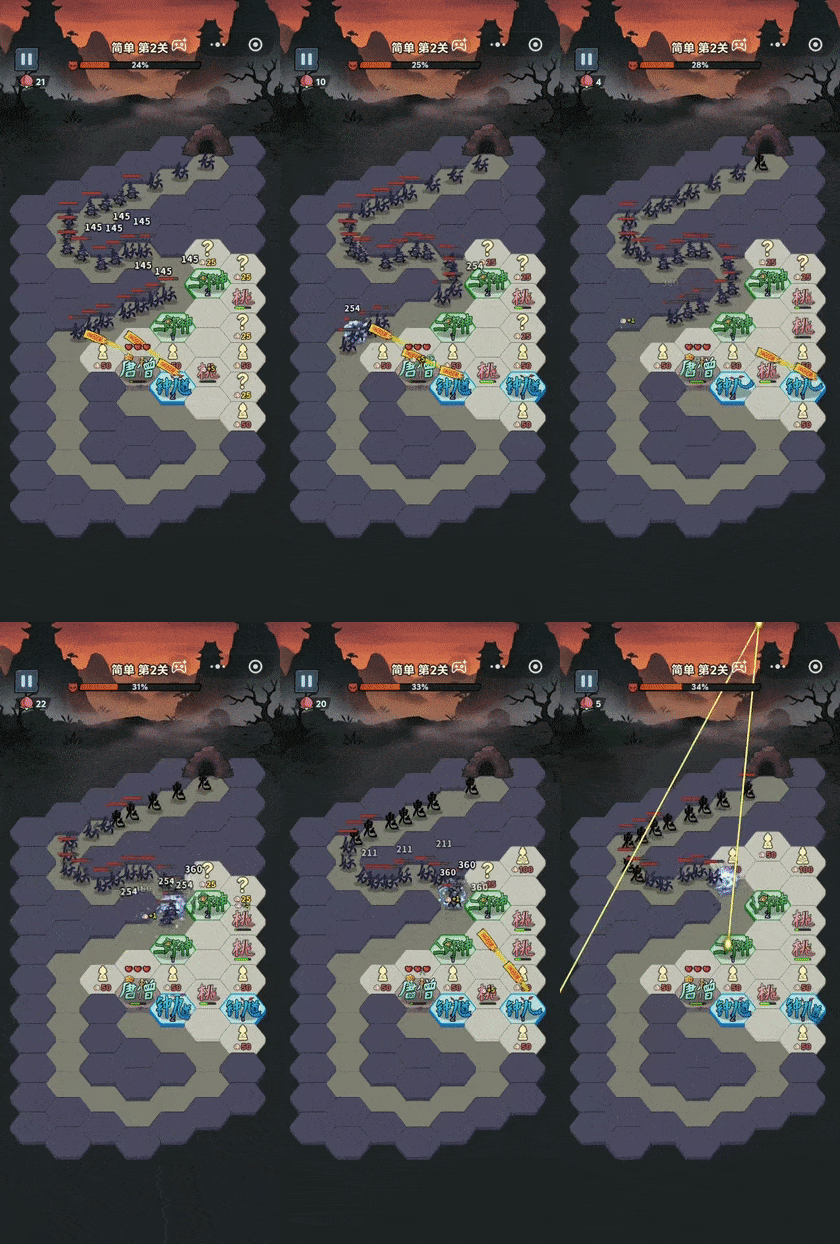
Unlike *Master of Champa*, this game introduces a skill-building system. Heroes unlocked through gameplay can not only be fused in pairs to advance to higher-level heroes;but players also have the chance to trigger corresponding roguelike skill options when opening question mark tiles. Players can freely choose and combine skill sets during matches to evolve their characters in real time. This design not only reduces the likelihood of question mark tiles yielding no rewards but also further enriches the game’s strategic depth.
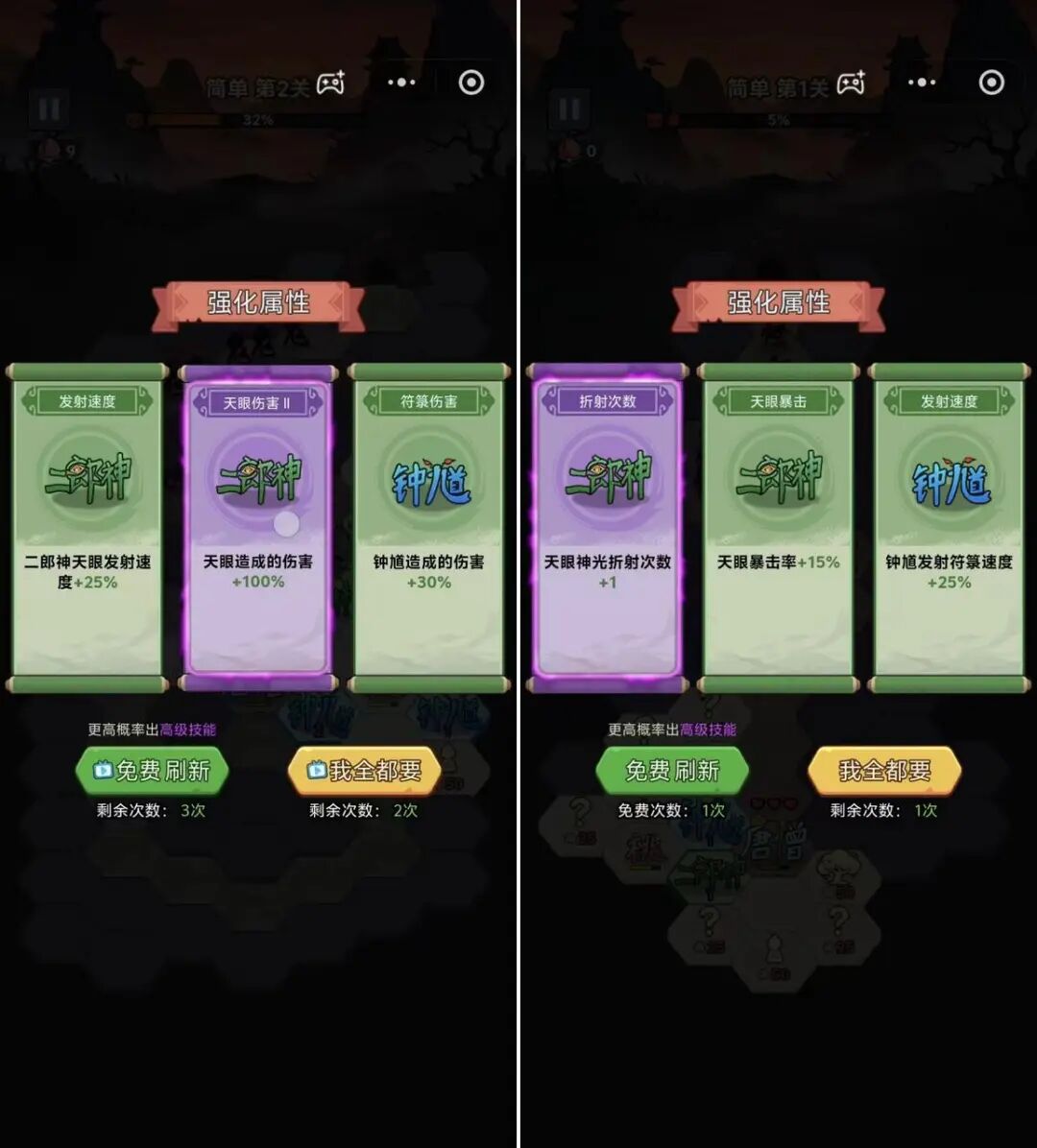
Overall, the design elements in *Don’t Count Me Out* that originate from *Zhao Yun and A Dou* actually make up a very small portion of the game.The game primarily borrows its highly recognizable Chinese character art style and the underlying text-based tower defense framework, while the core gameplay experience draws heavily on the mature “flip-the-tile” blind box mechanics from *Master of Champa*, supplemented by new elements such as hero synthesis and roguelike skill-building.
This approach to cross-category integration also represents a brand-new strategy for breaking through in this market segment. At a time when the text-based tower defense genre is saturated with competitors—and when simply reskinning existing games or making minor gameplay tweaks makes it difficult to stand out—this approach of “reimagining established gameplay” can leverage a unique, hybrid experience to avoid direct head-to-head competition with direct rivals of *Zhao Yun and A Dou*, thereby carving out a new path to capture market share.
That is precisely why *Not My Thing* was able to stand out in the increasingly competitive text-based tower defense genre and secure a spot in the Top 8 of WeChat’s Most Played Chart.
Conclusion
In addition to the many popular titles already featured on the list, numerous developers have been experimenting with different innovations in this genre. For example, *Fearless Three Kingdoms* combines text-based tower defense with “Bullseye-like” gameplay;*Flip Battle* incorporates mahjong elements into a merge-based tower defense framework, replacing the original text-based units with mahjong tiles and using mahjong hand combinations to drive gameplay and combat.
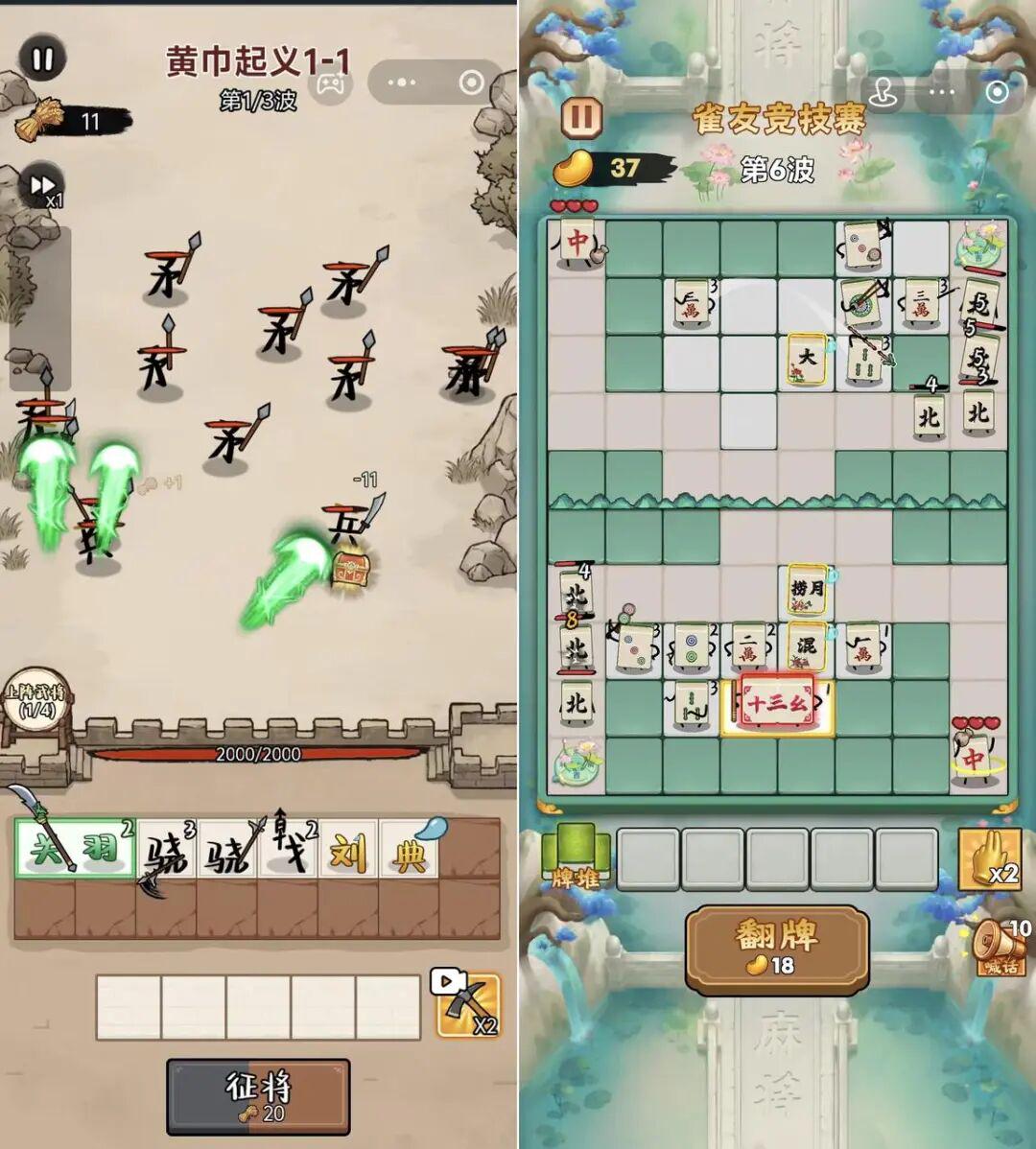
"Fearless Three Kingdoms" and "Card Flip Battle"
It’s clear that the artistic framework and core gameplay mechanics of *Zhao Yun and A Dou* are highly adaptable, leaving ample room for iteration and refinement across the entire genre. As a result, more teams may emerge in the future to build a variety of unique products based on this foundation.
In an interview with Rosky, Li Meiyu, CEO of Honey Badger Studio, mentioned that the core development team for *Zhao Yun and A Dou* consisted of only five or six people, yet the project took a full year to refine. In an era where the casual games sector is endlessly chasing efficiency, being willing to take the time to patiently refine a project and explore creative new ideas is undoubtedly a highly risky endeavor.
However, Honey Badger Studio’s meticulously refined strategy consistently yields impressive market results. In early 2022, their game *Lie Back and Level Up* became an overnight sensation thanks to its “micro-horror” theme and unique tower defense gameplay, turning into a phenomenon that went viral across the internet.Domestic registered users quickly surpassed 300 million, and in the years that followed, the game consistently ranked in the top 10 of WeChat’s most-played mini-games, establishing itself as a long-term benchmark in the IAA mini-game category.
After achieving this success, Honey Badger Studio did not blindly expand its team but instead remained focused on exploring new possibilities for gameplay innovation.Four years later, with *Zhao Yun and A Dou*, they virtually recreated the legendary hit of their early days: Upon launch, the game swept the charts and remained at the top for an extended period, prompting numerous developers to follow suit and imitate it, thereby spawning an entirely new genre of text-based tower defense games.
The mini-game sector has never lacked hit titles; what it lacks are creative works that are carefully crafted with dedication. Although people often say the mini-game market is becoming increasingly competitive, Honey Badger Studio has proven through its actions that there are always opportunities in the mini-game market for teams willing to take the time to refine their gameplay.
原创文章,作者:游茶妹儿,禁止转载:https://youxichaguan.com/en/archives/221786