Recently, Tencent invested in another small company that develops casual games.
In September 2026, Tencent led a Series A funding round (US$25 million) for the Turkish game company Circle Games. This startup, which had been in operation for only two years, had just two games in its portfolio: *Sort Express* and *Jelly Escape*. While *Sort Express* generated over US$1 million in monthly revenue, the figures weren’t particularly impressive.
However, the founders of Circle Games are quite well-connected, all hailing from some of Turkey’s most successful game studios, such as Gram Games (“Merge Dragons”), Good Job Games (“Match Villains”), and Dream Games (“Royal Match”). No wonder Tencent was eager to snap them up.
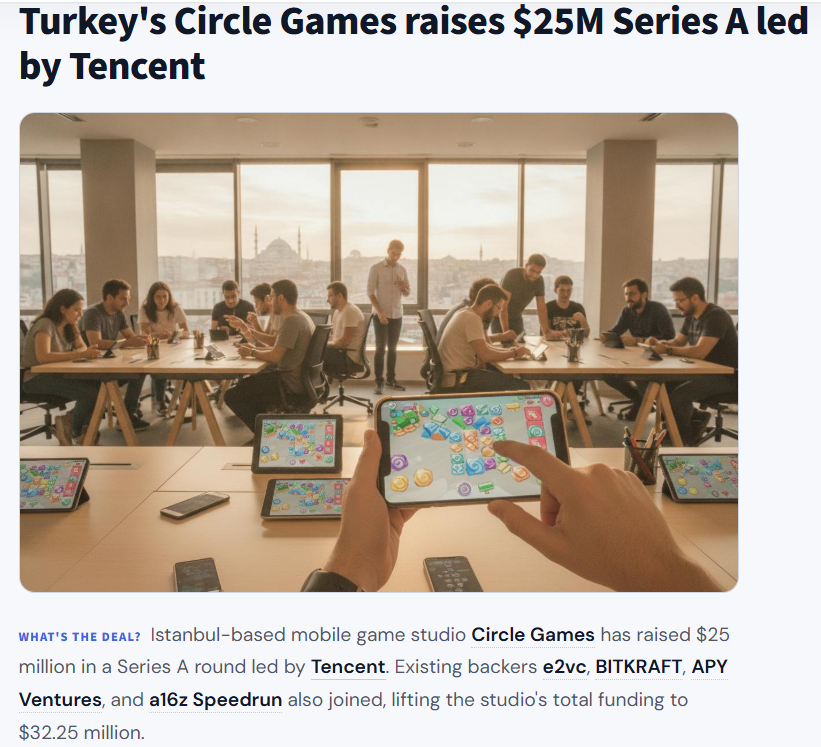
In addition to Tencent, other well-known investment firms such as BITKRAFT and a16z also participated in the funding round.
Flow Games (developer of *Smash Fest!*), another casual game studio based in the same city as Circle Games, has reportedly received investment from Tencent. The two companies can now be considered “distant relatives.”
Istanbul is home to some of the world’s top casual gaming teams; Peak Games, Rollic, and Gram Games were all founded here. It comes as no surprise that Tencent has extended its reach to this city that straddles Europe and Asia.

Constantinople, Home to Top Casual Gaming Teams
The casual gaming sector has been Tencent’s top priority in recent years, and the company has adopted a “cast a wide net” strategy, investing in every promising team. If we were to list all of Tencent’s investments in casual games over the past few years, the list would be much longer than we might imagine.
01
Which casual game teams has Tencent invested in?
As early as the dawn of the mobile gaming boom, Tencent had already developed a strong interest in casual games.
In 2015, Tencent acquired a majority stake in Miniclip, a Swiss casual gaming company.Miniclip went on to become one of the world’s leading casual gaming platforms and served as Tencent’s vanguard in expanding into the overseas casual gaming market. The strategic vision of tech giants often shares certain similarities; that same year, Activision Blizzard spent $5.9 billion to acquire King, the developer of *Candy Crush*.
After Tencent acquired Miniclip, it allowed the company to continue operating independently. Freed from financial pressures, Miniclip achieved rapid growth through mergers and acquisitions.
Before Tencent took the helm, Miniclip had only made a few small acquisitions of IPs and had never acquired a major studio; it was Tencent’s “financial clout” that enabled it to accomplish what it had previously dared not imagine. Miniclip has thus become Tencent’s acquisition machine in the casual gaming sector.
Miniclip’s portfolio of studios has expanded from two prior to the acquisition to 22 by 2026.Top-tier studios such as SYBO (*Subway Surfers*), Easybrain (*sudoku.com*), Lessmore (*Arrows*), FuturLab (*PowerWash Simulator*), and Masomo (*Head Ball 2*) have all been brought under Miniclip’s umbrella.

Arrow Escape
In addition to Miniclip’s efforts, Tencent itself is also making direct moves. In February of this year, it was reported that Tencent was planning to take a stake in Hungry Studio, the developer of *Block Blast!* (which ranked second globally in downloads in 2025);
In July, reports surfaced that Tencent was planning to acquire SuperPlay, the developer of *Dice Dreams*;
In August, it quietly acquired a stake in Happibits, a 17-person startup based in the U.S.
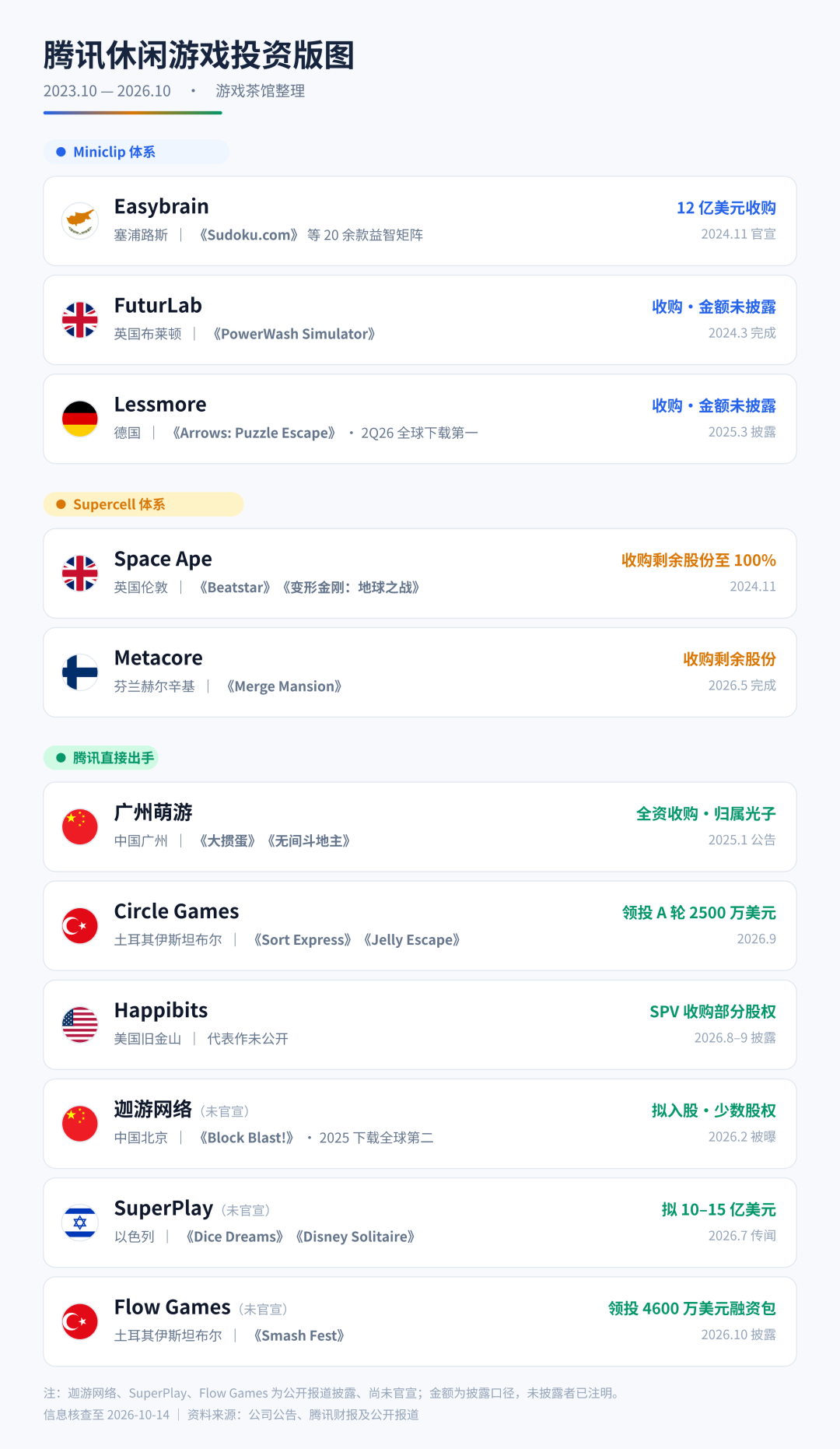
Earlier, at the beginning of last year, Tencent’s Photon Studio Group completed its acquisition of Guangzhou Mengyou.Mengyou had been developing H5 casual and card games for 11 years, and *Wujian Dou Dizhu* was exclusively launched on the QQ Games Hall in its early days. Since Photon’s Joy Studio is currently focusing on card games, bringing this veteran team on board to round out the product portfolio was a natural move.
It’s clear that Tencent is pursuing a dual-track strategy both domestically and internationally, and any casual game developer showing even the slightest promise could end up on its list of potential partners. By identifying the right market segments and casting a wide net once again, Tencent has returned to its familiar playbook.
So, at a time when global gaming capital is collectively pulling back, why is the casual gaming sector still sparking Tencent’s investment enthusiasm?
02
Why Invest in Casual Games?
The casual gaming market is one of the few segments currently experiencing steady growth.
According to data from Mordor Intelligence, the global gaming market has grown by an average of only about 3% annually over the past five years; however, casual games have significantly outperformed the market as a whole. The global online casual gaming market is projected to reach $22.68 billion by 2026, with a compound annual growth rate of 5.41% over the next five years.
If you keep an eye on overseas game charts over the long term, it’s easy to see that more than half of the top 30 highest-grossing mobile games overseas are casual games.
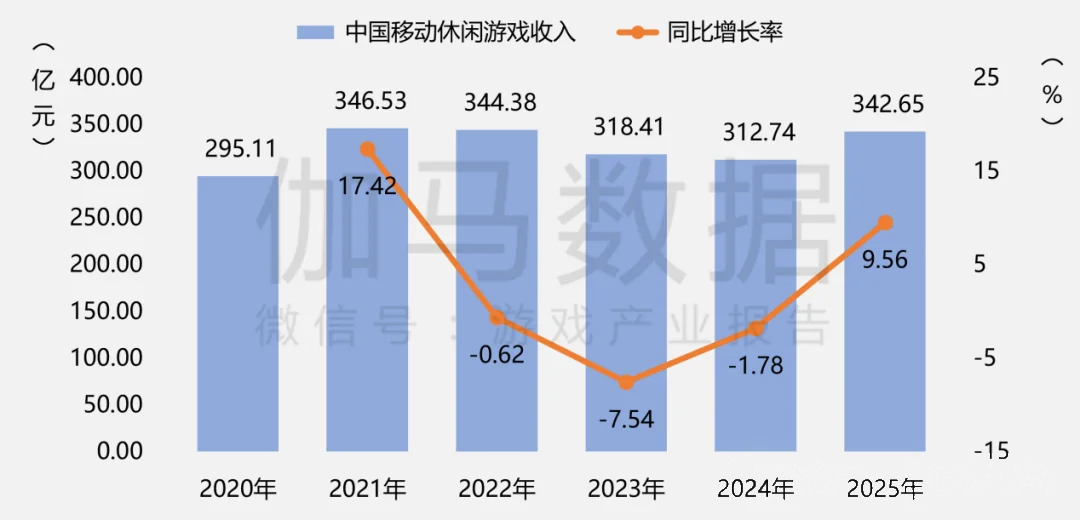
The domestic casual gaming market has also outperformed the broader market in terms of growth.According to the *2025 China Game Industry Report*, revenue from casual mobile games reached 34.265 billion yuan, a year-over-year increase of 9.56%, outperforming the overall gaming market’s growth rate of 7.68%. Given the presence of active markets such as the WeChat Mini Games platform, which boasts 500 million monthly active users, there may still be significant untapped growth potential in the casual gaming sector.
Another major characteristic of the casual gaming market is that a vast number of games are quickly proven to be failures, with only a handful managing to stand out. And the winners are often developed by just a few teams. Therefore, relying on acquisitions instead of in-house development offers better value for money.Miniclip’s $1.2 billion acquisition of Easybrain’s portfolio of more than 20 established titles offers far greater certainty than betting on the next unknown hit.
And this happens to align perfectly with what Tencent does best. Once it identifies a promising sector, it makes multiple investments and pursues a variety of approaches simultaneously—this has always been Tencent’s standard investment strategy. By acquiring a controlling stake in Miniclip, making direct investments in Circle Games and Jiayou, acquiring Mengyou outright, and taking an equity stake in Happibits, Tencent is clearly casting a wide net.
Domestically, Tencent also holds trump cards such as WeChat Mini Games. Within its own ecosystem, Mini Games serve both as advertising channels that drive traffic to other products and as advertisers purchasing user traffic themselves. This “user acquisition flywheel” benefits both the gaming and advertising sectors, and Tencent, as the platform operator, naturally reaps substantial rewards.In the first five months of 2026, ad spend on Mini Games rose by more than 20 percent year-over-year, with IAA games showing the most significant growth. Within Tencent’s ecosystem, the casual gaming sector operates as a closed loop.
Although Tencent has been deeply involved in the casual gaming sector for more than a decade, it had not received much attention until now, mainly because Tencent’s financial reports had downplayed the relevant data.
03
Casual Game Revenue Implied in Tencent's Financial Reports
When reviewing Tencent’s financial reports, it’s difficult to determine Tencent Games’ revenue directly from the reported figures. In fact, Tencent breaks down its casual game revenue into two separate categories: international game revenue and marketing services revenue.
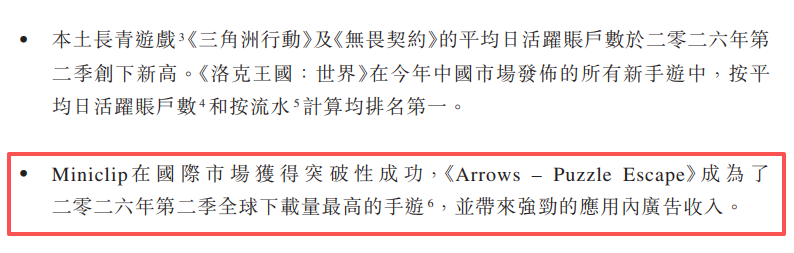
Miniclip is a platform owned by Tencent Holdings and has long been consolidated into the international gaming segment, but for many years, financial reports did not give it a separate mention. It wasn’t until the massive success of *Arrows* that the Q2 2026 earnings report specifically noted for the first time that “Miniclip achieved breakthrough success in international markets.”
However, we can get a glimpse of Miniclip's revenue from its counterparties' documents.
When Miniclip acquired Easybrain in 2024, the seller mentioned in the announcement that Easybrain’s annual revenue was approximately 3.395 billion Swedish kronor (equivalent to 2.3 billion RMB). And this was just one studio—and financial data from more than two years ago.Among Miniclip’s 22 studios, there are cash cows like *8 Ball Pool* that have been operating for over a decade—so one can only imagine the scale of its total revenue.
During this year’s earnings call, Tencent proactively disclosed, albeit indirectly, revenue figures for casual games for the first time: IAA games contributed approximately 2 percentage points to marketing services growth this quarter. Based on this, IAA games generated an incremental revenue of 720 million yuan in the second quarter of this year.
In addition, according to Sensor Tower, Miniclip has 14 games in the U.S. each generating over $1 million in ad revenue. The rapid growth of casual games is not reflected in game revenue figures, but rather in the growth rate of the advertising business.
On the other hand, Tencent’s denominator is simply too large. In 2025, Tencent’s gaming revenue reached 241.6 billion yuan. When outsiders look at Tencent Games, their first impression is often dominated by flagship titles such as *Honor of Kings*, *Peacekeeper Elite*, and *Operation Delta*; the casual gaming segment, which generates revenue in the tens of billions, accounts for only about 10 percent of total gaming revenue.Given this already modest share, when it is further broken down across three categories—games, advertising, and consolidated subsidiaries—no single metric can paint the full picture.
The casual gaming segment is virtually invisible in the financial reports, a result of multiple factors, including its small share of the total and its fragmented nature.
However, the landscape is changing. Casual games have been mentioned repeatedly in the business commentary sections of financial reports. In 2023, *Triple Match 3D* stood out among the highly competitive match-3 games, and its impressive market performance was highlighted in the financial report for that period; it was subsequently singled out by management on three separate occasions.
The 2023 annual report also noted that "total revenue from mini-games grew by more than 50%, making it China's leading casual gaming platform."
By the second quarter of this year, the financial report described Miniclip as a “breakthrough success” for the first time and proactively disclosed IAA’s contribution to growth. As the frequency of mentions has steadily increased and the metrics have become progressively clearer, the significance of casual games is gradually coming to the fore in the financial reports.
Investing is never a smooth ride, and casting a wide net inevitably leads to some failures. After more than a decade of strategic expansion, which of Tencent’s ventures in the casual gaming sector have failed?
Almost none of the companies that received investment from Tencent at the same time as Miniclip in 2015 have managed to succeed.
Glu Mobile was sold to EA, and its operations have since scaled back; Playdots was acquired by Take-Two and subsequently shut down; South Korea’s 4:33 is in the final stages of liquidation, and most employees have left;Pocket Gems now has only one game, *Episode*, in operation, and submitted just three green card applications in the most recent fiscal year, indicating that hiring has essentially come to a standstill.
The same group of players took their shots, but their outcomes were worlds apart.
04
Mergers and acquisitions are happening one after another
Over the past two years, there has been a steady stream of mergers and acquisitions in the casual gaming sector. Tripledot, known for its game *Woodoku*, acquired AppLovin’s gaming business for $800 million; earlier, Zynga spent $1.8 billion to acquire Turkey-based Peak Games and later acquired Rollic as well.
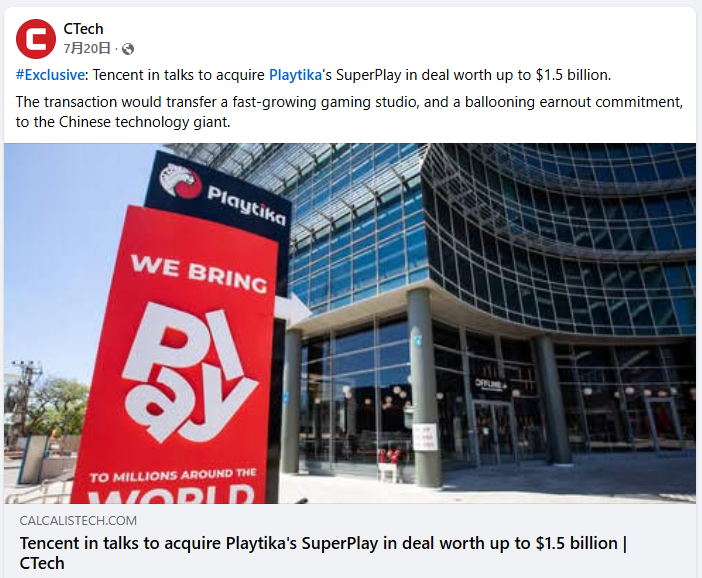
Tencent hasn't slowed down either, and the amount of its individual investments has been rising. According to reports, Tencent is in talks with Playtika, a long-established casual game developer, to acquire its flagship studio, SuperPlay, for between $1 billion and $1.5 billion.
Tencent Continues Its Buying Spree
Tencent’s long-standing, low-key expansion into the casual gaming sector is gradually coming to light. Following the news that “Tencent led an investment in a Turkish startup,” this may be a good opportunity to take a fresh look at Tencent’s strategic moves.
原创文章,作者:游茶妹儿,禁止转载:https://youxichaguan.com/en/archives/221696