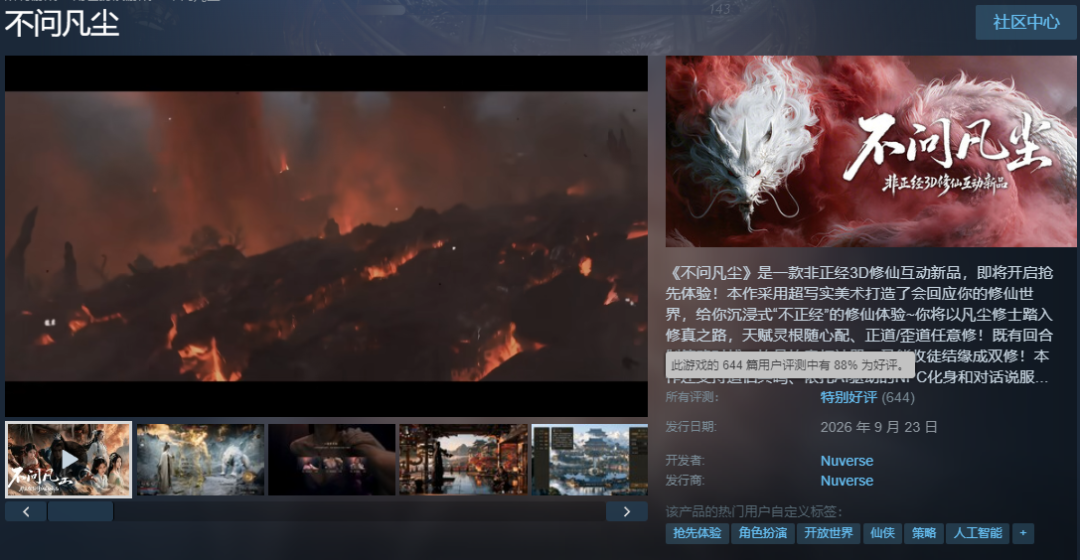
On September 24, Morning and Evening Light-Year’s *Beyond the Mundane* Early Access version launched on Steam.
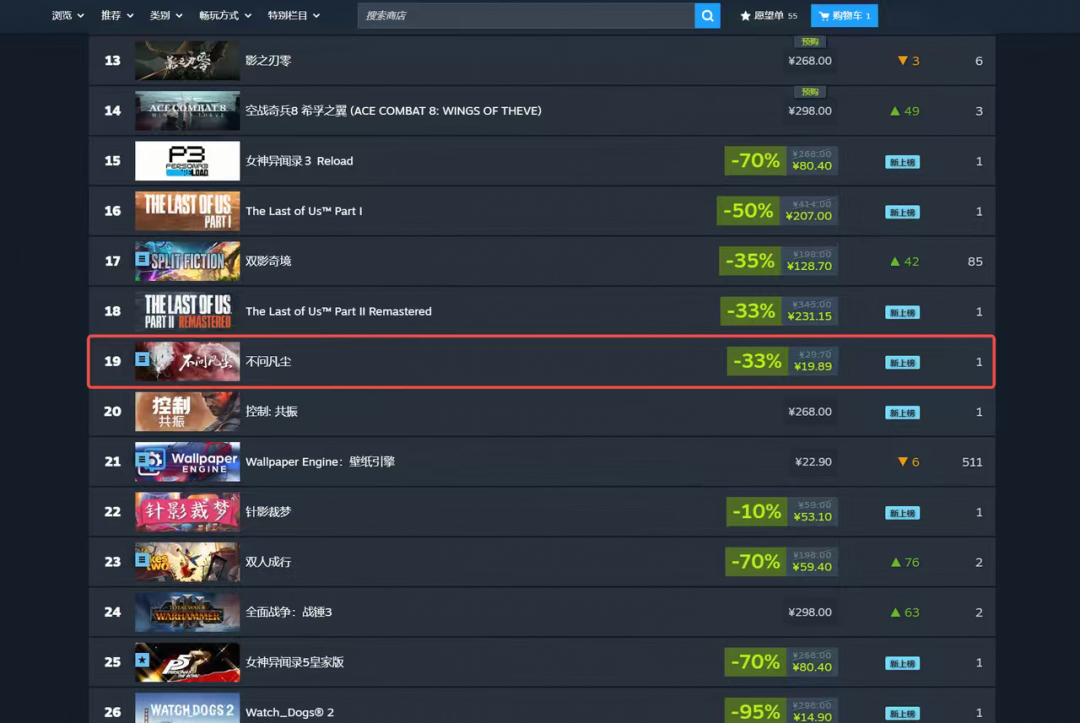
The very next day, *Beyond the Mundane* shot into the top 20 of Steam’s best-selling charts. According to SteamDB, the game reached a peak of 7,206 concurrent players, and as of today, its “Positive” rating remains at 88%. It’s safe to say that among the AI products currently available on Steam, it is one of the few that enjoys both critical acclaim and popularity.
"Beyond the Mundane" was developed by Jiangnan Studio at Zhaoxi Guangnian.It is currently a small team of only about 20 people, though it was initially run by just two people. Since 2023, the project lead, Xin Jie, has experimented with three different games, all of which he scrapped; *Beyond the Mundane* is the one where he felt he had a clear direction and was able to truly move forward with.
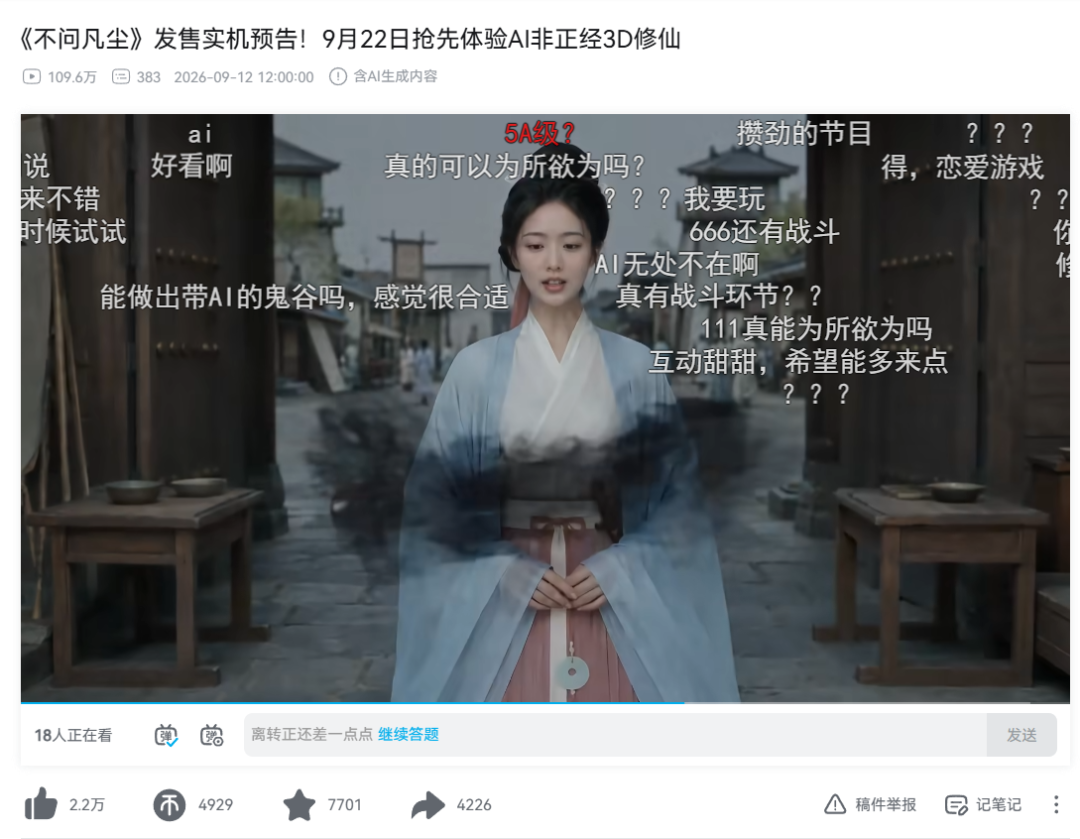
There seemed to be early signs of its popularity. On September 12, the hands-on video and teaser trailer for the game garnered over a million views on Bilibili.
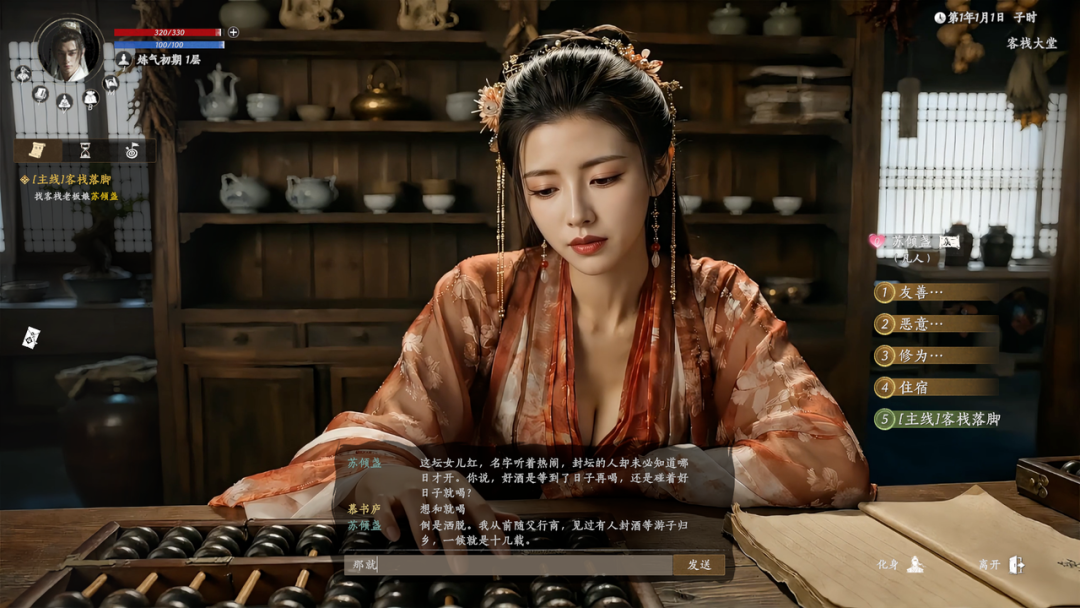
"Beyond the Mundane" is not just an AI-driven interactive video game based solely on choice-based gameplay, but an interactive experience that combines complex mechanics such as character development, adventure, and combat. Developed using AI video models like Seedance, both the characters and scenes feature AI-generated, lifelike visuals;From auctions, alchemy, artifact forging, and martial arts tournaments to forming bonds with NPCs, it includes every element found in traditional cultivation games. While a traditional game of this scale might take one or two years to complete, *Beyond the Mundane* unveiled its first promotional video in May of this year and launched its Steam Early Access version in September.
Shortly after the first promotional video was released, Teahouse asked the *Beyond the Mundane* project team what the game’s competitive advantage was among the many AI games on the market. The team repeatedly emphasized, “We have a clear vision and the courage to forge ahead.” This rapid pace has indeed been the key to their success in carving out a niche in the AI market.
I’ve watched *Beyond the Mundane* at the teahouse twice—once shortly after the release of the latest trailer, and once in June, right after the first trailer was unveiled.
Whether in terms of storyline, combat, or the newbie tutorial, *Beyond the Mundane* has made significant strides since June.The current version features several new NPC storylines, including a character named Dou Bao—whose appearance bears a striking resemblance to a “doubao” (a type of steamed bun). This is a small, thoughtful touch from the development team, and such touches are frequently evident throughout the game. From the project lead’s consistently upbeat tone, you can sense the passion and vitality of the entire team.
"Beyond the Mundane" has a launch price of 19.9 yuan, down from the original price of 29.7 yuan.AI Games has been very cautious with both pricing and launch strategies; previously, *The Chongzhen Simulator* and AI’s otome game were both heavily criticized for monetization issues. The development team, however, did not agonize too much over this decision, largely because AI dialogue is just one of the many gameplay features in *Beyond the Mundane*.
The following is a transcript of the conversation between the teahouse and the *Beyond the Mundane* project team, presented here in edited form:
01
AI-Driven Games with a Focus on Gameplay
Teahouse: I feel like the onboarding in this version is much better than in previous versions.
Project Team: After conducting numerous tests, we discovered that there is a wide range in player skill levels. Therefore, we decided to prioritize the player experience as much as possible and have added a lot of guidance this time. Both combat and alchemy have become more complex, so we’ve taken steps to prevent players from getting lost during gameplay and hope they’ll be able to enjoy our game more smoothly.
Teahouse: It feels like the plot has become more well-rounded. In the beginning, Qian'er was the mentor, but now she’s no longer tied exclusively to the male lead.
Project Team: The previous version featured an experimental storyline, but this version will actually follow a more traditional xianxia (immortal cultivation) approach. We’ve adjusted Qian’er’s character role. After conducting some interviews, we found that players tend to stick to xianxia conventions and prefer that a “younger sister disciple” type of character not be their master.So now we’ve turned her into the player’s life-saving benefactor at the start of the game. She also carries some secrets from the past, which encourages players to actively and gradually unlock her story rather than having her immediately integrated into the tutorial experience. I think this version of the tutorial will be a bit more interesting than the previous one, especially in terms of narrative depth.
Later on, there’s another girl named Nianqiao, whose personality is a bit different from Qian’er’s. You actually end up having a story with her as well. Once you reach an intimacy level of 300, there’s a “Bonding” video that unlocks. We haven’t released that video to the public yet, but it’s definitely a unique feature that our male users should really enjoy.

When Nian Qiao was a child
Teahouse: How many female leads will there be, roughly?
Project Team: There are five female protagonists in this version, and we have filed the relevant patents and copyrights for the main female protagonists.
Teahouse: So, what sets us apart from other AI-powered movies and games on the market?
Project Team: For a game-and-movie hybrid, if you don’t play through the main storyline, there’s no content left. Ninety to ninety-five percent of its content consists of the main storyline; that’s all it has. You have no choice but to sit there and play through both the main and side quests, just like watching a movie.
But for us, I can treat the main storyline as just one option.Even if you don’t play the main storyline, you can still advance to Immortality through other means: for example, by building intimacy with different NPCs to practice dual cultivation and collecting cultivation items; you can also join a sect and take on tasks within it; or you can become a wandering cultivator to earn money and prove your combat prowess at auctions and martial arts tournaments.There’s more than one path leading to the final outcome. This is why I’ve been saying all along that it offers a more free-form cultivation experience: players can choose to follow the main storyline to complete the experience, but they’re also free to explore as they please without sticking to the main questline.
For example, during our previous testing, we came across a very interesting player who loved to steal. He wanted to level up by constantly stealing from others, and after stealing something, he’d turn around and taunt the NPCs.We also have Demon Cultivators and Ghost Cultivators. You can choose to skip the main questline and kill every NPC in the world—the more you kill, the stronger you become; the stronger you become, the more likely you are to break through and ascend to immortality. You can complete your journey in this way.

Teahouse: I noticed an interesting update—the game added a character named “Senior Dou Bao” who looks a lot like Dou Bao. Was this done at the company’s request, or did the studio come up with it on their own?
Project Team: I made that.If you talk to her, there’s also the “Memory Stone.” It’s basically a little in-game reference for players. At the time, I thought we needed an NPC who embodied the vibe of those enigmatic old masters or “sweeping monks” from classic xianxia and wuxia dramas—someone who could guide players in choosing a sect and show them where to begin their path to immortality.
But it was hard to find a character to pull this off. Later, I thought, “Why not Doubao?” Doubao fits this concept perfectly. I believe Doubao is a landmark character and IP in the history of Chinese AI. As a relatively innovative AI game, it’s actually a great fit for us, so I’d like to pay tribute to Doubao here.
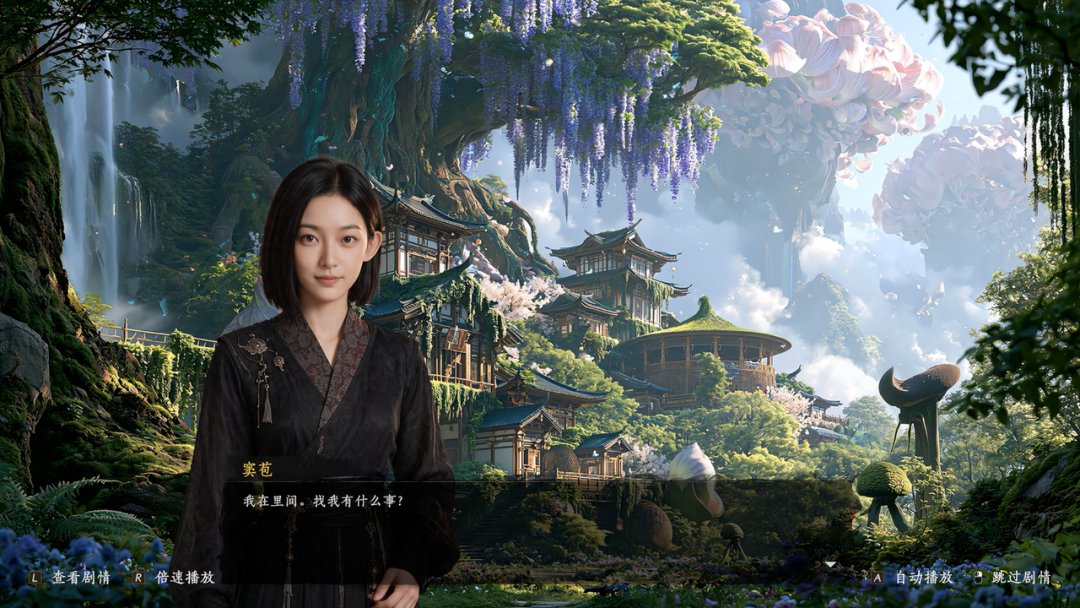
Teahouse: The team also found this matter quite interesting.
Project Team: That’s right. We really wanted to do something fun. This game isn’t meant to be too serious; we eventually chose the slogan “A Lighthearted 3D Cultivation Adventure,” hoping players would find some joy and entertainment along the way.
Teahouse: Your game includes a lot of different gameplay elements—do you think this might dilute the unique features of AI-driven film and television?
Project Team: I don’t feel like this dilutes the experience; I hope it actually enhances this aspect. When players are in the game, it’s not really an experience where they’re just watching videos. If they want to watch videos, they should go to Hongguo Manju, iQIYI, Youku, Tencent Video, or Bilibili—they can just finish watching the video there.I want players to focus more on interactive character development within this game world, and for the results of that development to feed back into their storylines and choices.For example, we have random events with multiple-choice options. You’ll need a certain level of Intelligence or Stamina to select specific options and unlock corresponding choices and endings. Additionally, in terms of story depth and gameplay experience, players need to develop their characters into sufficiently powerful roles before they can advance the main storyline, progress through character development, and unlock new content.
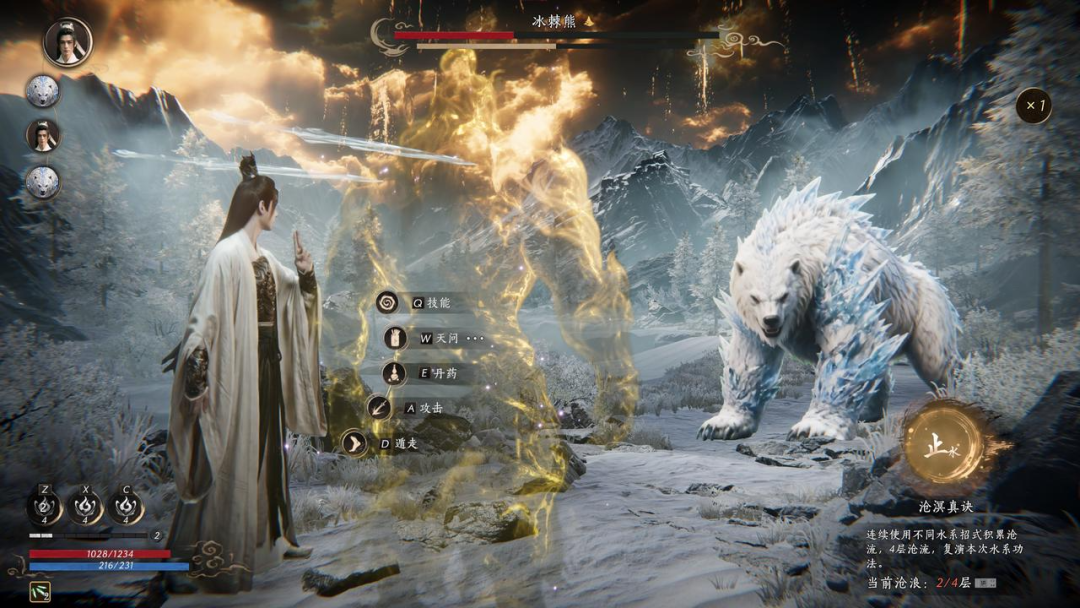
When it comes to AI-driven interactive content, film and television are on the left, and games are on the right. If you add a few choices to a traditional film or TV experience, it remains essentially a film or TV experience; however, we’re more focused on creating engaging interactive experiences for players through the progression mechanics and diverse, complex choices found in games.Take combat, for example: we offer dozens of skills and hundreds of different builds to choose from, and the corresponding visual effects are all rendered using AI-generated video.
Teahouse: As people in our Bilibili comments section have pointed out, our content is probably quite similar to the experience of traditional xianxia games—it seems the only real innovation is in the AI aspect.
Project Team: In terms of gameplay, some aspects are innovative, while others are not. For example, when it comes to the standard cultivation experience, we’ve included all the standard features you’d expect: auctions, alchemy, artifact crafting, martial arts tournaments, cultivation dungeons, cave exploration, and forming bonds with NPCs.I didn’t create any one system that’s particularly unique to revolutionize the player experience, but we’ve actually incorporated innovations into each of these elements that align with our own production model and player experience.
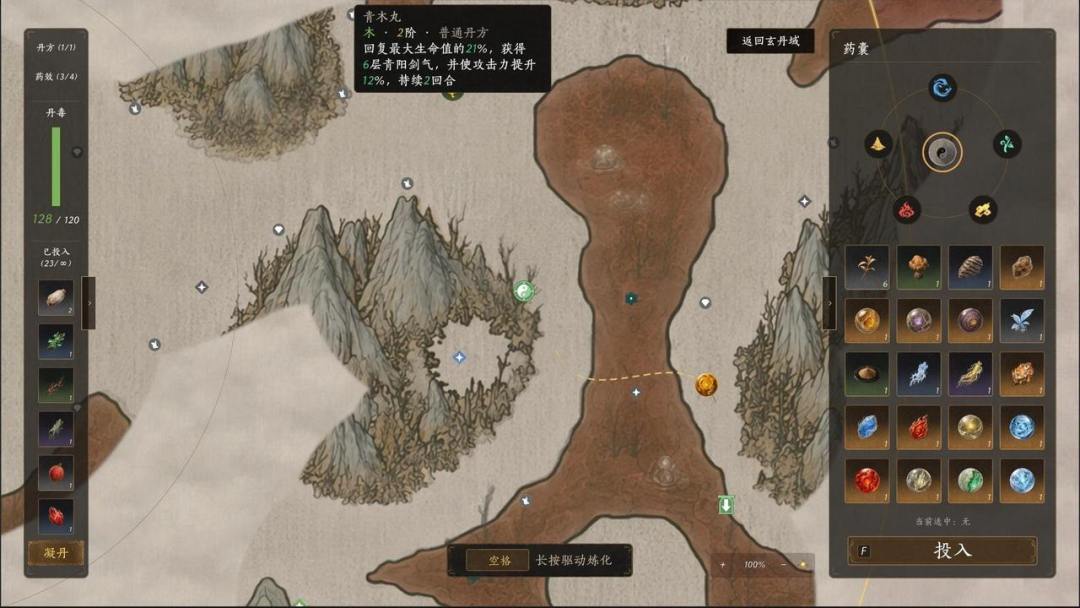
Take alchemy, for example—it requires players to explore and gather resources on their own, search for recipes, and figure out the best approach, which offers a unique experience. As for equipment crafting, we’ve also incorporated elements similar to puzzle-solving and match-three games. This aspect actually differs somewhat from equipment crafting in other games, and we’ve put a lot of thought and innovation into it.
I think a lot of the game’s focus is on details and the overall experience.If players actually play the game, they’ll find that the framework is that of a cultivation game. Our framework—and the free character development system—is based on a cultivation game framework: players can join different sects to pursue various paths of development, kill other players, and build relationships with different NPCs. Building these relationships will have both positive and negative consequences, but the details of the gameplay experience are quite different in many ways.
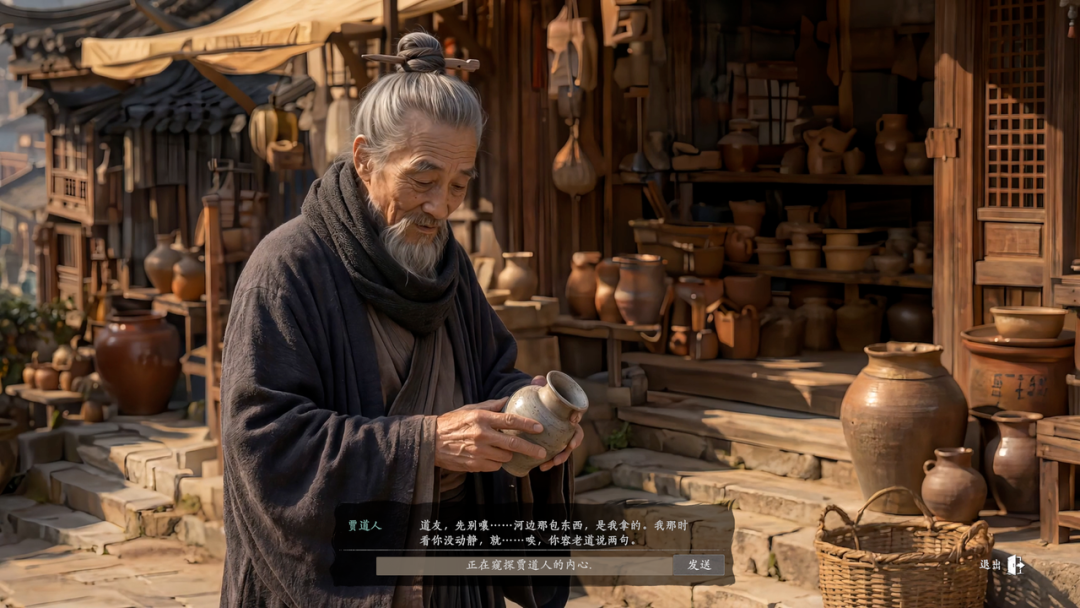
Teahouse: I’ve watched a lot of the storylines, and I’m not sure if it’s because they’re not important, but they’re just covered with text and images—not every scene is animated.
Project Team: We want to make a point: what players really want most during high-intensity gameplay is to complete the game’s objectives and gameplay as quickly as possible, so the story often feels like an interruption at these moments.At this point, players aren’t focused on watching a cutscene or a character’s performance; they’re more likely thinking, “I want to kill this monster as soon as possible” or “I want to gather some materials right away so I can go back and brew potions.” The goal is to make the player’s overall gaming experience as seamless as possible.
The storyline currently plays a major role in the early game, as there are many tutorial elements during this phase. We hope to have some charming NPCs who explain the gameplay to players, including their in-game objectives. However, as the game progresses into the mid-to-late stages, the storyline will increasingly focus on more episodic narratives.We have some non-cutscene, objective-driven story sequences that are presented in a straightforward, flat format, allowing players to explore more freely.
02
“A new model, a new product”
Teahouse: We’re a small team of about 20 people. With so many female protagonists, NPCs, and all kinds of storylines, how did you go about refining it all?
Project Team: There are a few types. One is that AI really does work quickly. Going back to traditional workflows, a team of this size simply couldn’t work that fast—neither film and television teams nor game development teams could get much done—but AI has significantly improved both the quality and speed of this part of the process.
In addition, students—both from within and outside the program—often ask me if I can share some methods they can use to learn. But after talking with everyone, I realized that, in the end, it’s the entire team’s hard work, sweat, and dedication that makes things happen.My current take is that it’s impossible to distill any earth-shattering processes or insights based on this generation of models. For example, there are many things Seedance 2.5 can do that Seedance 2.0 simply couldn’t achieve;and what Seedance 2.0 can do, Seedance 1.5 simply couldn’t achieve. Even if one were to barely cobble together a corresponding workflow, it would still fall far short of the next-generation model in terms of both quality and efficiency.
Right now, it’s essentially “one model generation, one product generation.” The package you’re currently using actually had most of its resources and user experience finalized two months ago, but over the past two weeks to a month, we’ve refreshed nearly all the assets through Seedance 2.5 and improved visuals.I think this is where the development process of today’s AI teams and AI content teams differs significantly from what it used to be.
Teahouse: If the art has to be redone for every version, will that take a long time?
Project Team: It’s actually quite a long process. Since the model is currently undergoing rapid upgrades and iterations, each new generation brings significant improvements in quality. However, as one of the studios that got an early start on this path, we’ve been refining our approach as we go—figuring out the best R&D processes and standards for a product like this.For example, future content will certainly be generated using the latest model, but if the model undergoes another round of iteration, should we update all historical content as well? Discussions like these likely haven’t come up before, but for us, it’s something we’ll have to figure out as we go.

Teahouse: After so many iterations, do you have a relatively fast and efficient workflow for completely replacing the art generated by the previous model?
Project Team: There are some, and there are parts of it, but it’s not possible to do it completely. That’s because some assets and materials still need to be recreated. Essentially, for certain assets—whether they require editing or not—we can use the previous design as a basis and rebuild them around that design. This will reduce design costs, and the process of regenerating the models will definitely be faster than before.However, as things stand now, it’s certainly not possible to use a previous video to have the new model recreate the old video 1:1—we don’t have that capability yet.
Teahouse: While developing this game, what features did we realize we wanted to implement but couldn’t at the time? How did we solve those challenges?
Project Team: For example, in the very early stages, we thought it would be impossible to create combat skill sequences because, at the time, no one had actually used AI to produce truly spectacular live-action combat sequences.This is where everyone really buckled down, sought out the right people to break through the barrier, established the tone for the crucial “0 to 1” video, and actually brought it to life—for example, by setting numerous keyframes and figuring out how to best connect them through video to create a combat sequence.After that, we could follow the same approach to iterate and upgrade, creating even better combat videos.
This also includes the performances of some of the early female leads, whose acting and expressiveness fell far short of expectations. There were many scenes in the previous version that we weren’t really satisfied with. But later on, we realized that, for one thing, as technology improved—for example, with Seedance 2.0, the overall quality improved significantly, and by version 2.5, the visuals became much clearer;and another factor was the team’s ongoing refinement of our workflow to better leverage AI in enhancing the female characters’ performances and creating more emotionally resonant viewing experiences.
03
Why Use EA?
Teahouse: Why are you considering an Early Access release on Steam?
Project Team: Since we’re a relatively small, creative team working on a fairly new content format, we hope to bring some entirely new production paradigms and experiences to the entire gaming industry through this product. However, when undertaking such a project, we must not work in isolation or try to come up with some grand, secret plan—otherwise, we might end up veering off course without even realizing it.
AI content tends to be fairly cyclical, and we hope to gather some feedback from players at this stage.
Actually, before the EA, we had already conducted small-scale user tests within ByteDance, involving a few hundred people; we also held two or three recruitment drives, where players came to test the game—about 10 to 20 players each time. Every time we reviewed the players’ feedback and content, it provided the team with valuable insights and helped shape our direction.
The current version is no longer just a purely experimental product; in terms of content volume and polish, we far surpass other games in their Early Access phases. We’re also fairly confident that this version will provide many players with an enjoyable and exciting experience.
Teahouse: It seems like your announcement included a line saying, “We recommend that players who are on the fence wait for the official release.” So why are some people still pushing players away?
Project Team: My sense is that both we and the players can reach a certain consensus on this matter. After all, “it takes two to tango”—that’s the best way to go. We do have an innovative product—no one else on the market has done this before, and we’re the first to create this kind of experience. Plus, the current content isn’t fully developed yet.So for players who are willing to accept these initial conditions, we can give it a try first, and we’ll continue to update the game to make it better and more complete over time. We also welcome players who choose to join us later. We won’t force anyone—it’s a two-way choice, and we respect the player’s experience.
Teahouse: Why do you think the product is ready to launch at this stage? Were there any key milestones?
Project Team: This milestone actually varies from team to team. Most companies will finalize the core gameplay and experience—and if that experience provides players with a certain amount of engaging playtime that keeps them hooked—then they’re ready to launch the Early Access version.We’re in the same boat—I think this version already covers our core experience. In terms of RPG gameplay, it should be enough for players to experience the elements we find most engaging—collection, character development, progression, and the narrative enjoyment of interacting with different female protagonists. Future versions will focus on enhancing progression and continuously enriching these experiences.
04
19.9 Without a Formula
Teahouse: The current launch price is 19.9, down from the original price of 29.7. How was the price determined back then?
Project Team: There’s no calculation logic—it just can’t be calculated. We’re likely the first game on the market with almost entirely AI-generated content; there’s no historical precedent to draw on, and I’m not sure if players will be willing to pay for AI. Personally, I’m fairly confident, but ultimately, we’ll have to see how players react to it.I actually want to lower the barrier to entry as much as possible so players will give it a try—even though it’s made with AI, it’s still a great game.
Teahouse: Aside from setting the price, have you calculated how many units you’d need to sell to break even?
Project Team: These things can’t be calculated—it’s not a formula. I think when it comes to creating content, a lot of things aren’t formulas.
Teahouse: Will this pricing cover costs? Because you mentioned that the points awarded later on should be enough for everyone to complete the main storyline, and there won’t be any other additional charges—any further spending would likely require a much deeper level of engagement.
Project Team: The costs for this part are still quite low compared to R&D expenses. Based on our previous closed beta testing and analysis, we plan to provide players with a relatively generous amount of tokens, allowing them to engage in various chats and conversations, since dialogue is just a minor gameplay feature in the game.Most of the game’s progression doesn’t actually require using dialogue tokens, but to ensure a satisfying dialogue experience for players, we should provide them with enough tokens to fully complete the relevant sequences and interact and chat with their favorite NPCs.
Teahouse: Pricing is currently based on a buyout model. You just mentioned that the decision was made very quickly—during this pricing process, were any other commercial payment models ruled out?
Project Team: From the very beginning, it was a one-time purchase model. My overall impression is that, as an innovative product, I need to narrow the scope of my innovation. For example, we have a brand-new game engine and have implemented a lot of features and gameplay mechanics using AI—this area already presents a broad scope for innovation and requires significant creative work.For other aspects, I’ll align them as closely as possible with experiences that players have already embraced and completed. For instance, if you’re building an open-world game with a free-form progression loop, you should pursue a relatively mature monetization model on a relatively mature platform.I believe that defining clear boundaries, focusing energy on these areas, and maximizing your strengths as much as possible is what a first product needs to do—rather than leaving all risks and vulnerabilities wide open.
Teahouse: The market isn’t quite mature yet, and people are concerned that the user experience of some AI-generated content might not be that great. What are your thoughts on this?
Project Team: This is a concern players have—a very real one—and what we need to do is exceed their expectations. For example, when it comes to the various sects and open-world environments, we need to make them feel even more like a true cultivation world than players expect;the details of character performances and character models should showcase the AI’s strengths—such as attractive female characters, even more stunning environments, and visually striking combat animations. We must do what we’re supposed to do well; we shouldn’t force players to tell us what they want—instead, we should deliver an experience that exceeds their expectations.
Teahouse: So, as far as ByteDance is concerned, are there internal expectations for breaking even?
Project Team: Of course we have expectations, but as I mentioned earlier, these two things are part of the same discussion: it’s not about keeping score.You mentioned that I hope this product will sell well during its Early Access phase and receive positive feedback from players—that players will appreciate the innovative AI experiences and content. That’s certainly something I’ve always strived to achieve. But more than anything, I’m focused on doing what’s right: when it comes to content, I do my best to provide players with everything I can that will enhance their experience.
Teahouse: The announcement also mentioned that a full version will be released in two quarters. What are the plans for the following two quarters?
Project Team: We’re currently planning new content for each phase: we’ll be expanding the main storyline, introducing new gameplay features, and making some changes to the character progression system. Some of this content is already in development, and we expect to roll it out to players gradually.
原创文章,作者:游茶妹儿,禁止转载:https://youxichaguan.com/en/archives/221066