Since mid-September 2026, there has been a steady stream of reports about layoffs and closures at well-known overseas game studios, with the frequency of these events drawing significant attention. This is no coincidence—when viewed over the course of the entire year of 2026, a major industry contraction, referred to within the industry as “Crash 2.0,” has been steadily spreading.
According to ASGC data, the full-year layoff forecast for early 2026 was 8,025 employees; this figure was revised upward to 14,259 on July 26 and reached a temporary high of 14,666 on August 11. These repeated adjustments to the forecast indicate that there remains significant uncertainty regarding the full-year total.
Mid-September: A Flurry of Layoffs and Studio Closures
In mid-September, news of large-scale layoffs among development teams once again emerged from the overseas gaming industry. On September 16, Alx Preston, founder of Heart Machine—the developer of *Hyper Light Drifter*—confirmed that “nearly all employees” at the studio were forced to leave after a publisher funding their unannounced new title decided to halt the project.Just a few days earlier, *Moss* developer Polyarc had announced the end of its nearly 12-year development journey, while *MindsEye* developer Build a Rocket Boy was reported by multiple media outlets to be undergoing another round of layoffs and entering its final stages.
The following are the major layoffs and closures in the overseas gaming industry from September 1 to September 16, 2026:
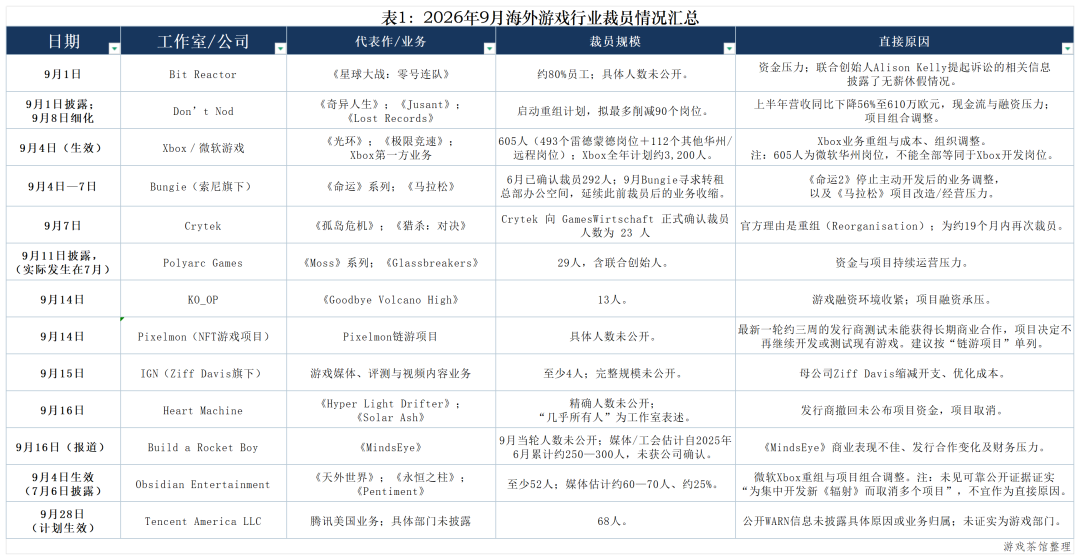
Observations indicate that in mid-September 2026, the gaming industry saw a flurry of reports regarding layoffs and project cutbacks. Based on currently available public information, it is more appropriate to view this as a combination of “the concentrated implementation of previously announced layoff plans, a reassessment of projects’ commercial viability, and a tightening funding environment,” rather than the result of a single cause.
First, the layoff plan resulting from Xbox's previous large-scale restructuring entered its intensive implementation phase in September.
On July 6, Microsoft announced that Xbox plans to cut approximately 3,200 jobs, with about 1,600 of those positions being eliminated immediately and the remaining approximately 1,600 to be phased out over the course of FY2027. The CWA stated that approximately 1,600 employees are expected to be affected in the first phase in early September.
According to California WARN records, the notice date for 52 positions at Obsidian Entertainment was July 6, but the effective date was September 4. Based on this, the layoffs in September were a follow-up to the large-scale restructuring plan announced in July, rather than a new decision made in September.
Second, September marks the end of the quarterly or fiscal cycle for some companies and may serve as a window of opportunity for project reviews and resource reallocation; however, there is currently insufficient evidence to prove that “end-of-quarter reviews” themselves are the direct cause of the high incidence of layoffs in September.
Looking at recent cases, several studios have indeed experienced the cancellation of unannounced projects, interruptions in project funding, or reassessments of commercial viability: Heart Machine underwent significant layoffs after its publisher halted development on an unannounced project it had funded;FuturLab canceled a project—not *PowerWash Simulator*—and laid off seven employees because the projected development costs exceeded expected revenue; KO_OP stated that, unable to secure funding for a new project, it laid off 13 employees to ensure the studio’s survival. It should be noted that the timing and specific circumstances of these events are not entirely the same.
In addition, the tightening gaming financing environment has been a key factor behind layoffs and project cutbacks at some independent studios.
KO_OP publicly stated that the gaming financing landscape has undergone a fundamental shift in recent years and noted that it was unable to secure funding for new projects this time; Heart Machine, meanwhile, was directly affected by the publisher’s decision to halt the project’s development.Industry data also shows that total gaming funding in Europe during the first half of 2026 declined significantly year-over-year, and the number of capital transactions in the gaming sector had previously been steadily decreasing, with funds increasingly concentrated in hot sectors such as AI. More accurately, the gaming industry is facing tighter financing conditions and greater capital concentration, rather than a full-scale retreat by the tech capital market as a whole.
2026 Year in Review: Two Major Waves and Multiple Layoff Trends
In 2026, layoffs and closures in the overseas gaming industry were not concentrated in a single month but occurred in several phases of intense activity, with public reports particularly concentrated in July and mid-September. Additionally, a sustained contraction persisted throughout the year.
First Mid-Term Period: January—Contraction Right at the Start of the Year
As 2026 began, layoffs and closures occurred in rapid succession, continuing the trend seen from 2024 to 2025:
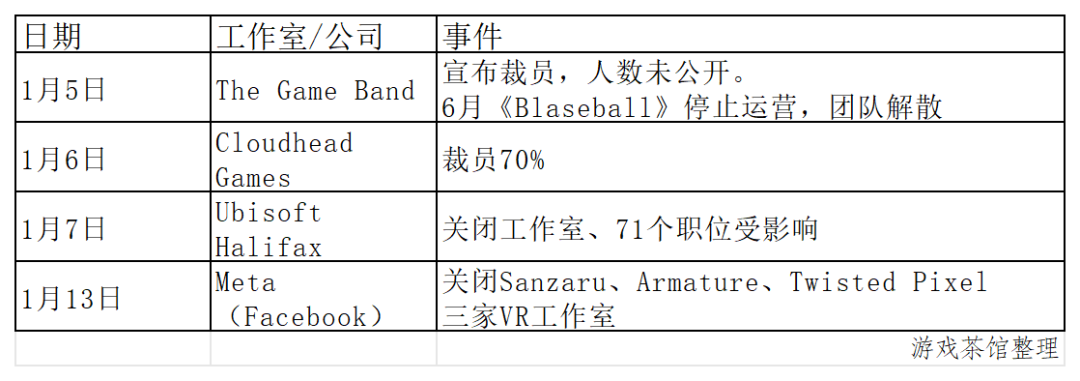
On January 13, Meta shut down three VR studios—Sanzaru Games (developer of *Asgard's Wrath*), Armature Studio, and Twisted Pixel Games—and made it clear that it would shift its investment from the metaverse to wearable devices. This adjustment reflects Meta's reallocation of resources previously concentrated in the metaverse and VR sectors.
Ubisoft Halifax was shut down shortly after a union was formed there, sparking a labor dispute.
Second Mid-Term Phase: February to March—Major Tech Companies Begin to Take Action
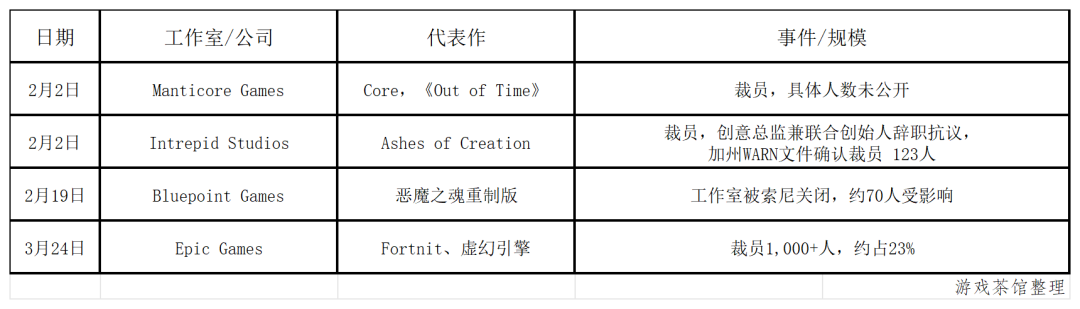
Sony’s closure of Bluepoint Games sent shockwaves through the industry—the studio, known for its high-quality remakes (including *Demon’s Souls Remake* and *God of War III Remastered*), was shut down just a few years after being integrated into Sony’s first-party division.In June, Bungie—an independent subsidiary of Sony—laid off approximately 292 employees after halting active development on *Destiny 2*, while the *Marathon* project underwent significant restructuring.
In March, Epic Games announced layoffs of more than 1,000 employees; media reports estimated this to account for more than 20 percent of the company’s total workforce. The company also announced that it would gradually phase out certain game modes in *Fortnite*.
Phase 3: June through July—The Year’s Largest Wave of Layoffs
June and July 2026 were the months with the largest number of layoffs for the entire year, as several major companies took action simultaneously:
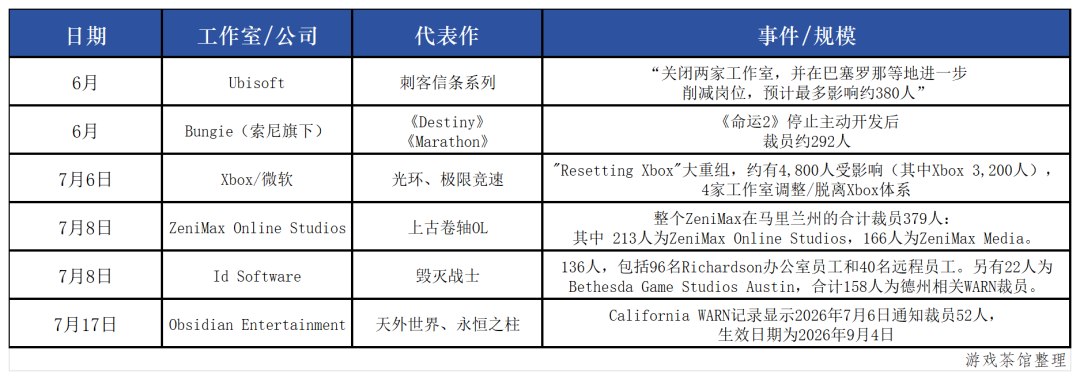
Ubisoft closed its Winnipeg and Belgrade studios in June; the related closures and restructuring plans affected up to approximately 380 jobs. The company also faced the most high-profile labor dispute of 2026—Ubisoft Barcelona employees went on strike from June 30 through July 16.In addition, Ubisoft announced that the release of several major games has been postponed to 2028–2029. Ubisoft’s predicament reflects the multiple pressures facing traditional AAA game developers amid soaring development costs, delays in new releases, and shifting market conditions.
July 6 marked the single day with the largest number of layoffs in the gaming industry in 2026.
Under the leadership of CEO Asha Sharma, Microsoft announced the largest restructuring in Xbox history: Layoffs will be carried out in two phases—the first phase in July affecting 1,600 employees, and the second phase in September affecting approximately 1,600 employees—with the impact extending to well-known studios such as Obsidian, ZeniMax Online Studios, and id Software.Combined with restructuring at five studios, Microsoft Xbox has become the single entity with the largest number of layoffs so far in 2026 and stands as the epicenter of the gaming industry’s upheaval.Among the five affected studios, both Ninja Theory (the *Hellblade* series) and Compulsion Games (*The Lucky Few*) have previously released major titles. Microsoft Xbox is the largest single entity in terms of layoffs so far in 2026.
CEO Asha Sharma admitted in an internal memo that "we're spread too thin." A Guardian report revealed the immense impact the layoffs have had on individual employees: The CWA union, which represents nearly 4,000 Xbox employees in the U.S. and Canada, organized and coordinated protests in multiple North American cities in August.
Reports emerged in June that studios such as Ninja Theory were at risk of closing; on July 6, Xbox finally announced that Ninja Theory would be seeking a new ownership arrangement. An in-depth report by *The Guardian*, titled “I Feel Like I’m in Mourning,” documented the emotional impact of the layoffs on Xbox employees.
Phase 4: August through September—A Series of Aftershocks
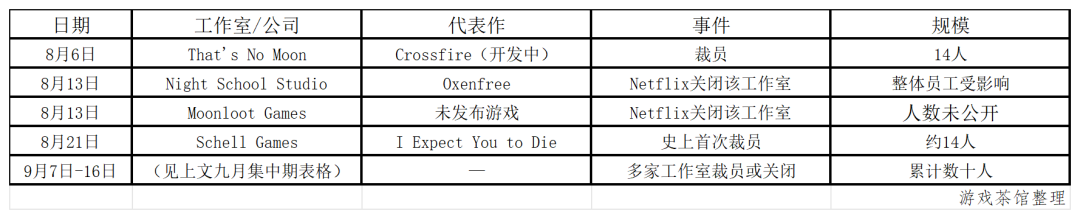
Since entering the gaming business in 2021, Netflix has shut down or sold several in-house game studios, and in August, it closed Night School Studio and Moonloot Games; Next Games currently remains one of its in-house game studios.Next Games in Helsinki is now the only in-house studio remaining, though other internal game teams continue to operate. This series of closures has reignited industry skepticism over whether subscription video services can successfully develop their own games.
Schell Games, founded in 2002, had never laid off employees before; the recent layoff of 14 people is a significant milestone: even a long-established, stable studio that has been in operation for 24 years is no longer safe.
Data Overview: Nearly 60,000 Layoffs Over Five Years
When viewed within the broader cycle since 2022, the scale of layoffs in the gaming industry has fluctuated significantly: reaching a peak for the full year in 2024, declining in 2025, and expected to rise again to a relatively high level in 2026.
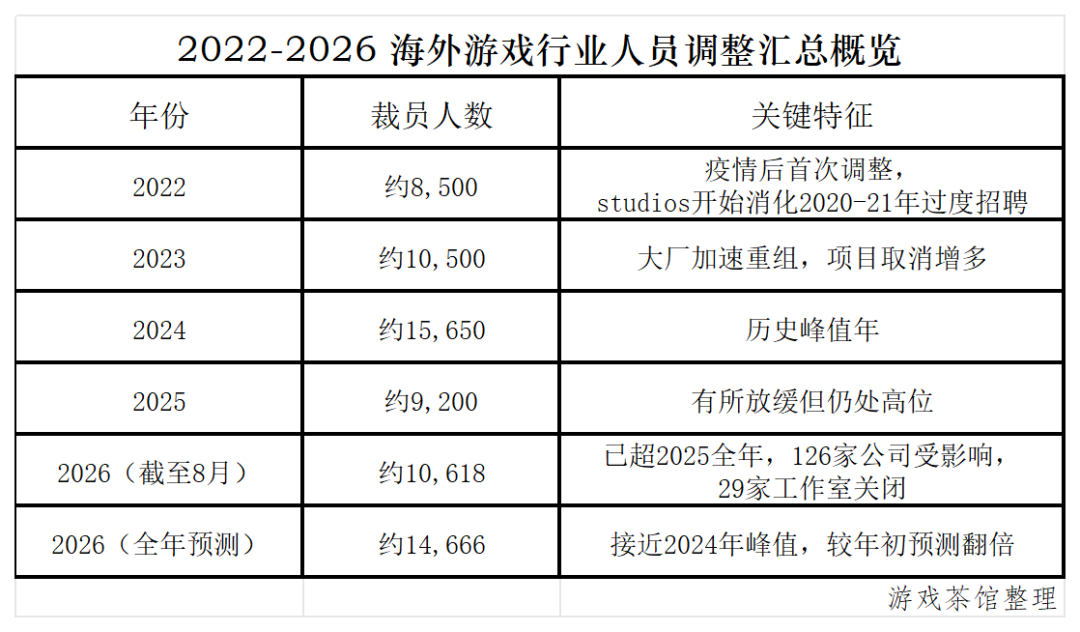
Cumulative layoffs over the five-year period from 2022 to 2026 are expected to reach approximately 58,000.Analyst Amir Satvat’s ASGC layoff tracker shows that the forecast for annual layoffs stood at 8,025 in early 2026, was revised upward to 14,259 by July, and was further revised upward to 14,666 in September—the fact that forecasts continue to be revised upward indicates that the pace of layoffs is exceeding expectations.
According to the GDC 2026 survey, 28% of developers surveyed had experienced layoffs in the past two years, while 33% of U.S. respondents had.
The September 2026 issue of *Edge* discusses the cost, hardware, and employment pressures currently facing the gaming industry under the title “Crash 2.0.”
Epic Games CEO Tim Sweeney called this "the worst period the industry has faced since the 1980s." It is worth noting that this round of layoffs is occurring against the backdrop of continued growth in total global gaming market revenue, reflecting a disconnect between the industry’s overall growth and studio employment; pressures such as development costs, project returns, the funding environment, and platform competition are all present simultaneously.
Conclusion: The contraction continues
As of mid-September 2026, layoffs, studio closures, and project cutbacks in the overseas gaming industry continue.Latest ASGC forecast: Layoffs for the full year of 2026 are projected to total approximately 13,800, down from the 14,666 projected in August, but still significantly higher than the full-year 2025 level. The current adjustments are occurring across multiple sectors, including major publishers, independent studios, and game-related media.
From Microsoft to Ubisoft, from Polyarc to Heart Machine, from Epic Games to Netflix—layoffs are no longer limited to a specific type of company or region, but represent a widespread contraction spanning major companies and independent studios, publishers and developers, as well as the gaming industry and gaming media.
In our view, behind this wave of layoffs, what truly deserves attention—aside from employment—is the question of how to maintain the industry’s vitality and creativity.There are still many people around the world who want to enter the gaming industry but haven’t taken the first step yet. Following the industry’s widespread screening and layoffs, the bar for proving one’s competitiveness has become even higher. What kind of creativity and technical skills are actually needed to break into the gaming industry and stay there? When an industry hub loses a large number of experienced developers, can it still produce fresh and entertaining content as expected?
Data sources: ASGC (Amir Satvat Game Companies) Layoff Tracker, GDC’s *State of the Game Industry 2026*, and publicly available information from Bloomberg, Reuters, The Guardian, GamesIndustry.biz, Game Developer, Kotaku, PC Gamer, GamesRadar, Edge Magazine, and others;Some individual cases are based on relevant company announcements, publicly available employee information, and government labor documents. Statistics are current as of September 17, 2026; specific figures are subject to the latest publicly available information from each source.
原创文章,作者:游茶妹儿,禁止转载:https://youxichaguan.com/en/archives/220994