**This article is approximately 12,000 characters long and takes about 40 minutes to read in its entirety.**
On July 31, shortly before midnight, I stood in the lobby of the conference center in Caohejing—a place my colleagues jokingly refer to as the “[‘Cosmic Game Center’].”Watching the bustling crowd across from me, I found myself lost in thought—the feeling was strangely familiar. The conference center and the park’s Party-Mass Service Center are housed in the same building, which has led to the rather humorous industry joke: “The gaming event has moved to the Party-Mass Service Center again.”
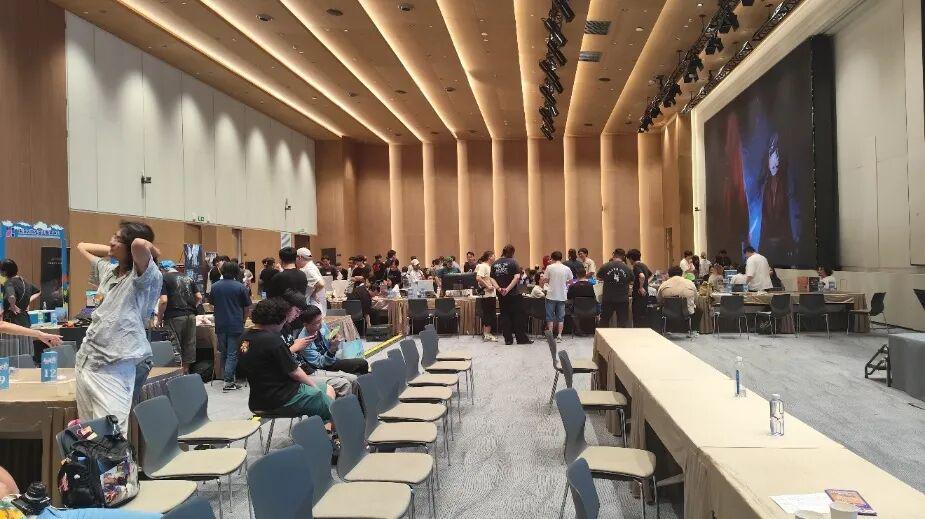
Inside the “Travel Fair” venue, photographed at 11:36 p.m. on July 31
That evening, I wasn’t originally supposed to be able to enter the [“Youji Hui”] venue—because I hadn’t received an invitation in advance, the friends I’d traveled to Shanghai with had gone to other events, and I didn’t have the contact information for any of the partners. As a result, I spent most of the early part of the night chatting with friends outside the venue. By the time I actually got inside, it was already quite late.
But the crowd didn't disperse as quickly as I had expected.
Some people were trying out the games, others were chatting, and still others were gathered around the screen, watching one match end and waiting for the next to begin. Developers and players were interacting face-to-face, and industry peers were exchanging information. That atmosphere made it easy to understand why people are willing to organize events like this time and time again.
I know that feeling all too well.
Two years ago, we organized two indie game expos in Shenyang. Looking back today, I find it hard to give a simple answer as to whether those two events were “worth it.” If we look solely at ticket sales and costs, the answer seems obvious; but if we consider the people, connections, and opportunities they fostered, as well as the lives they ultimately changed, the answer is entirely different.Over the past two years, indie game events across the country have steadily come to my attention. Beijing, Shanghai, Shenzhen, Hangzhou, Guangzhou, Wuhan… university campuses, industrial parks, industry media, and local communities—everyone is doing similar things in their own way. I’ve gradually come to realize that a more important question to ask than “Do indie game events have value?” is:
What keeps a solo travel exhibition afloat?
And—once the curtain falls, what truly remains?
[Cosmic Game Center]: An industry inside joke derived from the 2021 internet meme “Cao County, the Center of the Universe.” Similar phrases include “To see the world, look to China; to see China’s gaming industry, look to Shanghai; to see Shanghai’s gaming industry, look to Caohejing.” It is a playful and informal expression.
[Game Opportunity]: An in-person indie game event co-hosted by CiGA (China Independent Game Alliance) and UGDAP (University Game Development Alliance).
01
In 2024, we managed to pull off an event
Our initial idea to organize an event actually dates back to 2021 or even earlier. At that time, our goal wasn’t even to host an indie game expo.The pandemic pushed many of our plans back by two years, and it wasn’t until late 2023 that we gradually settled on indie games as our focus and decided to start with a small-scale pilot by partnering with a local anime convention.
Early the following year, in early 2024, we participated in two consecutive local anime conventions as exhibitors. Neither event was very large—our booths had about seven or eight tables and featured only a few games. The organizers provided tables and chairs, but we had to handle everything else on our own.Looking back, it felt more like an experiment: to see if casual gamers in Shenyang would be willing to stop and try out unfamiliar indie games, and to see if we ourselves had what it took to actually pull this off.
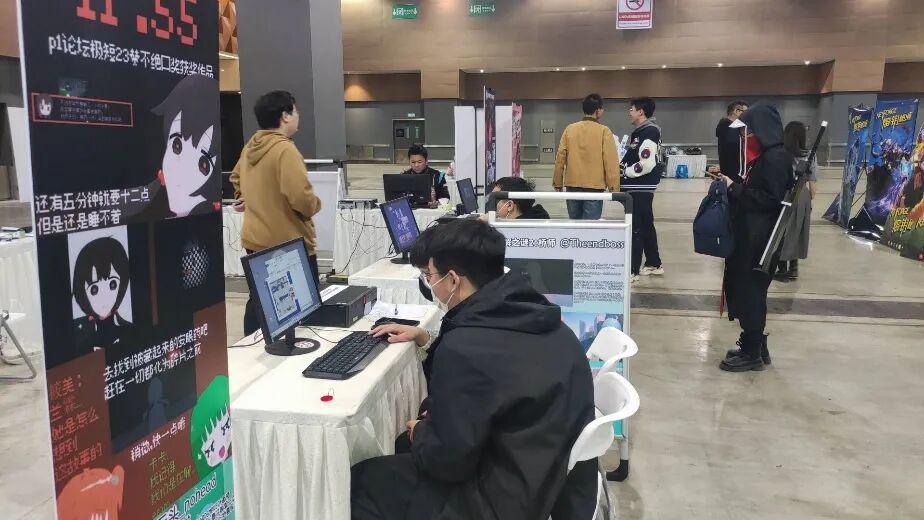
Taken in April 2024 at the Shenyang Shenyuan Game and Anime Fan Convention
After the verification process was complete, we reached out to a larger local anime convention in hopes of further expanding our exhibition. However, for various reasons, we ultimately weren’t able to secure a partnership. That sense of frustration can be agonizing—it keeps you awake at night, unable to sleep.So, after failing to find new partners, we were left with only one simple—yet expensive—option:
Since we can't borrow someone else's venue, let's just rent one ourselves!
The first venue we’d planned to use fell through just before the official signing, so we ultimately gritted our teeth and switched to a large event space at a hotel. It wasn’t until August 2024 that we finally held the long-awaited, truly “independent” indie game expo we’d been hoping for; two months later, in October, we held the second one.
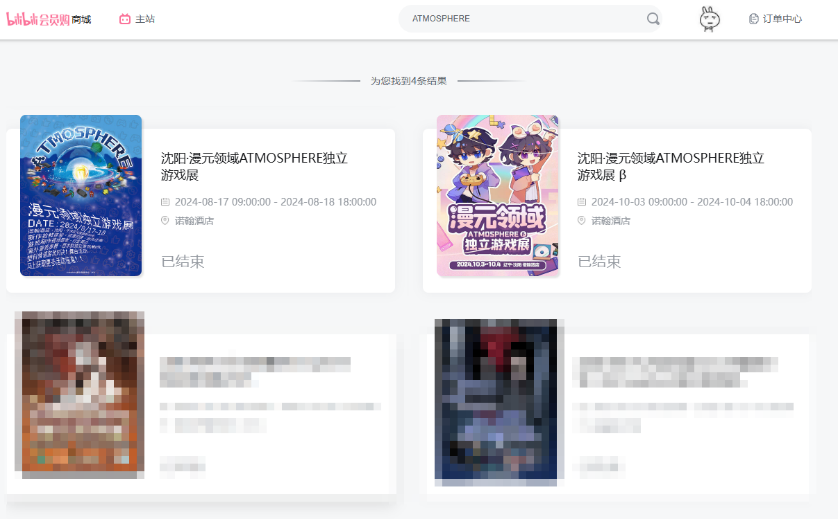
(Looking back now, it seems we were a bit too ambitious when we decided to hold two events back-to-back within two months.)
Based on the information available today, that was certainly not the beginning of offline indie game events in China. Guangzhou already hosted [Only], an indie game event with public ticket sales, in May 2024, and indie game zones had appeared even earlier at comprehensive expos in Wuhan.Even earlier than that, there were [GameJams], developer workshops, and a series of industry community events. However, if we narrow the scope to “indie game exhibitions held in regional cities, at independent venues, with public ticket sales, and aimed at the general gaming public,” our 2024 initiative likely ranked among the earliest of its kind nationwide.This isn’t about competing over “who was first”; it’s simply that there weren’t many ready-made solutions to follow at the time—we had to learn from our own mistakes and forge our own path.
Looking back today, if someone asked me how I would describe myself back then, I think I’d use four words:
Ignorant, fearless.
[Only]: A limited-scope anime and manga exhibition format centered around a single IP, a specific theme, or a single type of content, emphasizing niche-focused interaction and creativity.
[GameJam]: A timed game development challenge in which participants quickly create game prototypes or demos based on a given theme within a set time frame.
02
Many costs have never appeared in the books.
It wasn’t until long after the October 2024 trade show ended that I finally got around to crunching the numbers—the total investment exceeded six figures, while cash revenue that could be directly recouped amounted to less than 30 percent.Venue fees for a single two-day event alone ran into the tens of thousands. These figures speak for themselves, but what truly makes an event a success is, in fact, “people.”
At the time, two members of the core team were working nearly full-time, spending at least eight to twelve hours a day on tasks such as exhibitor recruitment, promotion, operations, and sponsorship, while I was primarily responsible for handling various logistical issues.During the actual exhibition, we rounded up more than a dozen volunteers, and we even managed to drag my two dads all the way from our hometown to help with the overnight setup. We powered through it all.
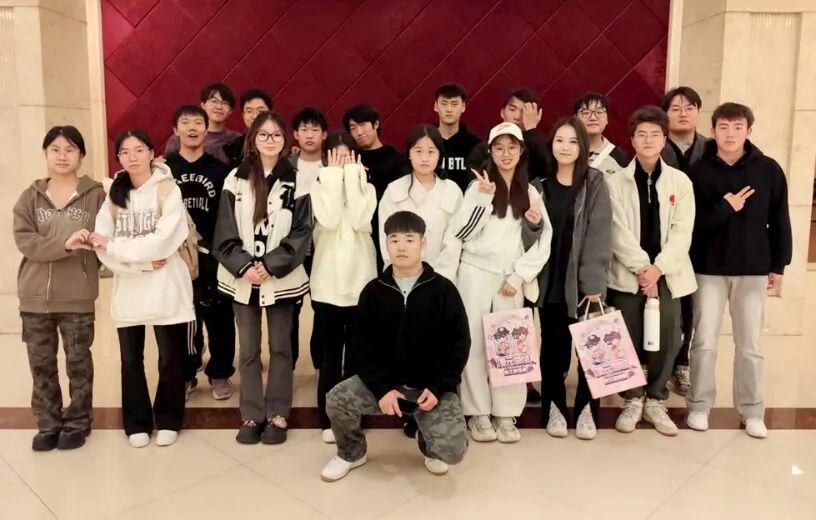
Group photo of volunteers (partial) after the second exhibition
None of these people receive a salary.
This is also the illusion that many small-scale cultural events are most likely to create:
Just because you haven't paid doesn't mean there are no costs.
Conversely, cash outflows cannot simply be equated with ultimate losses—equipment purchased for the trade show can continue to be used afterward, some of the materials used for setup can be reused, and the experience gained from an event does not disappear the day the booth is dismantled.
There’s even a kind of benefit that’s very difficult to quantify in monetary terms. Your resume, your connections, and your credibility—these are the things that determine why people are willing to take your call and listen to what you have to say next.
In industry discussions,
“We want to do one thing”
and
“We did one thing”
These are two completely different sentences.
| But costs and losses are not the same thing.
The returns generated by an event aren’t fully realized on the day it closes. They may continue to pay off years later in the form of relationships, status, industry credibility, and new opportunities. Moreover, the people who bear the initial costs aren’t necessarily the same as those who eventually reap these long-term benefits. This is likely one of the reasons why many collaborative projects ultimately give rise to complex emotions.There is nothing inherently wrong with a startup in its early stages relying on the founders’ unpaid labor and help from friends. Almost all new projects go through this phase. The problem arises only when, by the third or fifth iteration—or even ten years later—the project still relies solely on these means to survive. At that point, “working for the love of it” ceases to be merely a romantic starting point and becomes the very structure of the organization itself.
At least money can be recorded transaction by transaction, but reputation, status, and relationships are much harder to track.
03
Later, I realized that the “Solo Travel Exhibitions” everyone was organizing weren’t actually the same kind.
Having seen a lot over the past couple of years, I’ve become increasingly reluctant to pigeonhole all activities into the same category.
The Guangzhou Indie Game Only event clearly bears the organizational hallmarks of the doujin-only culture.
Projects such as [Wuhan CGF] and [Beijing PG] incorporate indie game content into existing comprehensive trade shows.
The “You Dian Yi Si” event organized by the Shenzhen University Department of Arts and related activities organized by [Beijing Jiuyi] make direct use of campus facilities and student organization resources.
Jike.cn’s “Spread Out and Play” naturally has access to media, developers, and players.
There are also some initiatives that have emerged from local communities, industrial parks, businesses, and even public institutions.
What players might see when they're at the venue could be:
Desks, computers, games, developers.
But the challenge facing the event organizers is not the same at all.
For some events, there is no need to pay market-rate venue fees;
For some events, it is possible to directly utilize the ticketing, security, crowd management, and setup infrastructure already in place at the host venue;
Some events naturally attract media attention, while other local teams have had to handle almost everything on their own from day one.
Therefore, when comparing events, if we focus solely on “how much tickets cost,” “how much booths cost,” and “how many people attended,” we’re likely to draw misleading conclusions. What truly determines whether an event can survive is what resources it draws upon: Where does the venue come from? Where do the players come from? Why do developers attend? Who is responsible for promotion? Who bears the risk?
If this part of the process isn't profitable on its own, how will the costs be covered?
Activities that appear similar on the surface may actually be based on completely different resource structures.
[Wuhan CGF]: Full name: “Wuhan CGF Anime and Gaming Festival.”
[Beijing PG]: Full name: “Beijing·PG Independent Game Expo.”
[Beijing Ninth Art]: Full name: “Beijing Ninth Art Research Society.”
04
Are we seeing more communities, or have they finally become visible?
Over the past two years, it’s easy to get the impression that the number of local indie gaming communities has suddenly increased.
The local community roadshows held during the last two editions of the [“Glimmer · Unity”] event are perhaps one of the most vivid examples. The list of participating cities keeps growing, the number of event names keeps increasing, and new organizers are constantly emerging across the country.
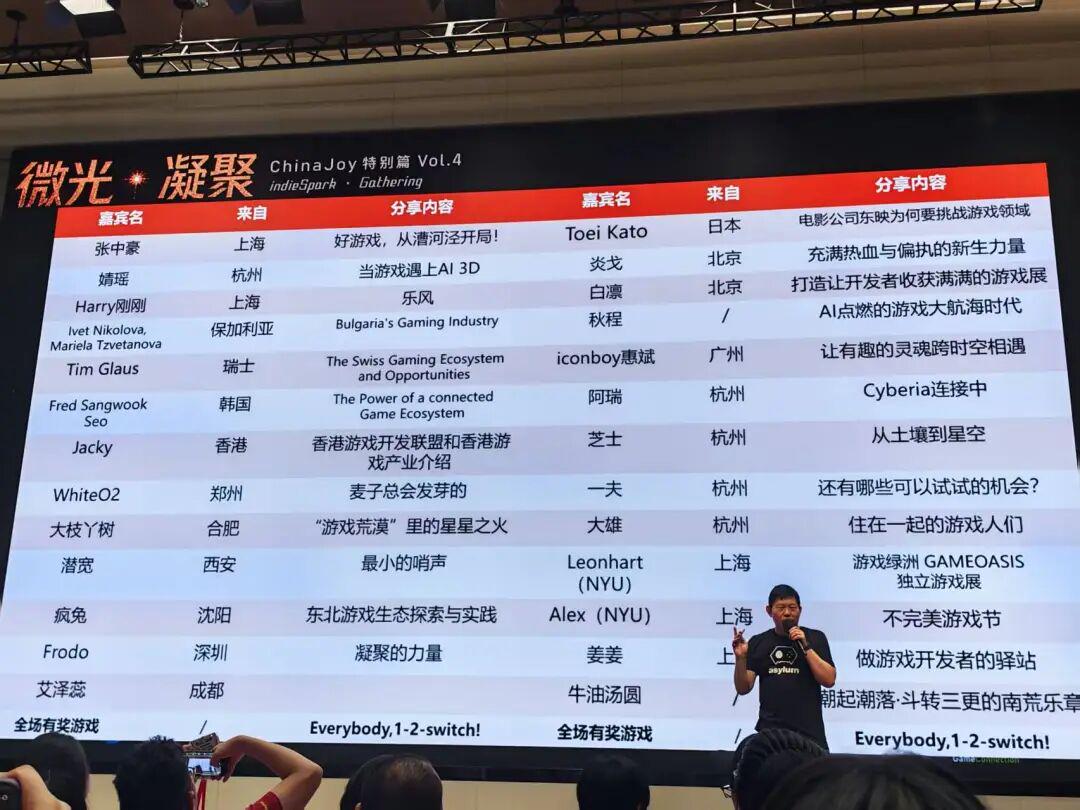
List of Roadshow Participants at the “Glimmer · Unity” Event on the Eve of This Year’s ChinaJoy
But there is a statistical pitfall here.
An increase in the number of event brands, projects, and speakers does not necessarily equate to a year-over-year increase in the number of independent communities.
In many cities, there are already people making games; they just lack a stable, ongoing platform to showcase their work to the public.
So the so-called “growth” may, at least in part, not be a transition from “nothing” to “something,” but rather from:
"Someone Is Here"
become
“Being seen by others.”
These are two completely different processes. A group of people who were once scattered have finally been given a name, formed a community, established regular activities, and gained an identity through which to communicate with the outside world. The transition from “there are people here making games” to “the industry knows there’s a group of people here making games” is precisely the kind of thing that local community activities excel at achieving.
First and foremost, they make people visible.
As for what might happen in the future, that’s another question.
[Glimmer·Convergence]: An in-person industry networking event initiated by Shanghai’s “Light of Independence,” typically held on the eve of major industry events.
05
Is an exhibition really worth it? A lot of the time, it’s impossible to figure out.
From a developer’s perspective, it seems easier to determine whether exhibiting is “worth it” than it is for the organizers.
Booth Fee
Transportation
Accommodations
Materials
How many items were added to wish lists after the show ended?
If you want to get a little more technical, you can also calculate CPW—Cost Per Wishlist—which is the cost incurred for each new [Wishlist] entry.
The formula isn’t complicated, but CPW only becomes truly meaningful when viewed alongside another set of numbers. How much does the game sell for? How many items on a wish list ultimately result in a purchase?Was there a launch discount? How much revenue actually remains after platform commissions? The acceptable CPW is completely different for a game priced at 20–30 yuan versus one priced at over 100 yuan. Therefore, simply knowing “how many wishlist additions resulted from attending a particular trade show” doesn’t tell us whether it was actually worth it.
| Many developers aren't even considering this in their calculations.
What's even more interesting is that many developers in the real world don't even start their calculations here.
I recently interviewed two developers who had completely different experiences at game shows. One of them was Yuzu, a graduate student developer. His team’s project was originally created to enter the [BOOOM Baozao] competition—a rhythm game that blends falling-block gameplay with internet memes.After winning the Best Popularity Award, the team decided to further refine the [Demo] and validate the project through external feedback. Over the past six months, the game has been showcased at the Beijing Nine Arts campus event and the Shanghai Imperfect Games Festival. I asked him if they had set specific goals—such as the number of feedback comments or the number of players who tried the game—before attending these events.
He replied bluntly:
“No.”
Not only were no targets set in advance, but there wasn't even a fixed data-recording system in place beforehand.
His primary reasons for participating in the event are to gain exposure and receive feedback.
Another developer, Feifei, is a completely different story. She is currently working on *Post-Apocalyptic Traveler*, a text-based post-apocalyptic survival game. It is her first official project as a producer and also marks her first time leading a project at an in-person expo.
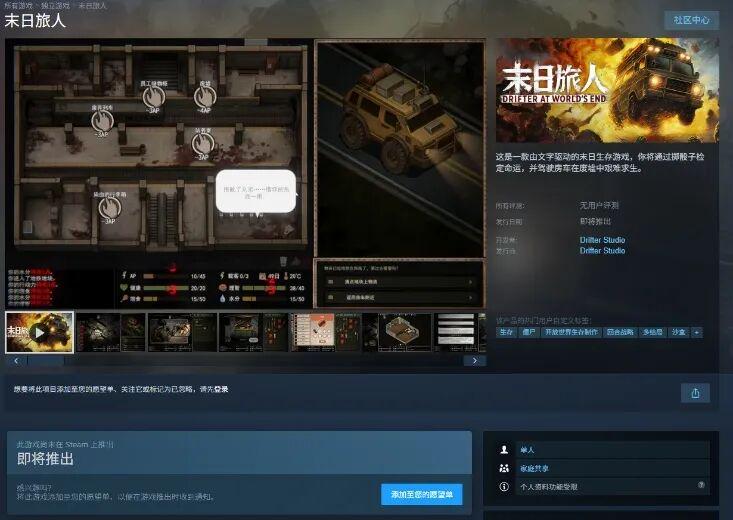
The Steam store page for *Doomsday Traveler*
Before the exhibition, she had clearly hoped that the event would lead to a significant increase in wishlist entries—but the final results fell far short of expectations. In terms of commercial conversion alone, this event clearly cannot be considered a great success.Nevertheless, she still believes the event yielded “significant benefits,” as players at the event helped the development team identify issues that couldn’t be explained by backend data: The game’s original control scheme supported only keyboard input, but during on-site demos, the team noticed that some players naturally tried to use the mouse to interact with the game. Subsequently, the team officially added mouse-click support in the next version.There was also a game mechanic that the development team took for granted, but which players at the event frequently misunderstood; as a result, the team later added a set of more intuitive progress indicators to the game…
| Players might not tell you exactly what the problem is, but they’ll show you by playing the game.
In Feifei’s example above, although the expectation of adding a wish list didn’t pan out, the development team incorporated many unexpected optimization items into their update plan as a result of this in-person exhibition. These changes weren’t the result of players sitting down and telling the developers, “‘I suggest you adjust the user interaction logic…’ On the contrary, many players didn’t say anything at all—they simply paused, hesitated, clicked the wrong button, or repeatedly failed at points where the developers expected them to proceed smoothly. This is precisely why in-person playtests cannot be fully replaced by data reports.
Another minor detail emerged during the same event: a player took out their phone to scan a QR code but gave up because the [Steam] page wasn’t loading properly. Feifei’s solution was to redirect some of the players to a QQ group first, which helped reduce this kind of drop-off.As a result, a situation arises at the event that’s easy to misinterpret: players are enthusiastic, and there are long lines of visitors at the booth—but the number of items added to wishlists doesn’t rise accordingly. The so-called “event conversion rate” is influenced by a series of factors—including the platform, network connectivity, QR codes, user guidance design, user demographics, and many other elements that aren’t actively tracked on-site.
So the question has never been, “Are business metrics meaningful?”
Of course there are. These days, it’s easy to view all developers as a single company from a business analysis perspective. But Yuzu isn’t—at least not yet.
He’s a student looking for an internship; his project is just a demo that’s been updated a few times and is still far from being a mature commercial product. For a developer like him, whether “an exhibition is worth it” isn’t necessarily something that can be answered in terms of sales figures.
Some people want to test gameplay; some hope to meet fellow developers; some are competing; and some just want their work to be played seriously by more strangers… Some even just want to know:
Is there really anyone besides us who likes this thing?
This makes me feel that the so-called “exhibition costs” aren’t as easy to write off on the books as they seem.Yuzu told me that of the two exhibitions they attended, the campus exhibition at Beijing Jiuyi was a free booth, while for the Shanghai Imperfect Game Festival, they paid a modest booth fee and asked local members of their project team to staff the booth, incurring no additional travel or accommodation expenses.If he had to travel to another city specifically to attend an event, he would consider the event’s scale and influence. However, if he was already planning to visit that city, he would also take the opportunity to see if there were any worthwhile local events to attend.
Business trips, vacations, meeting friends, competitions, and publicity—sometimes these things all blend together. That’s why some developers don’t even bother calculating a strict “marketing [ROI]” anymore.
How can we possibly reduce all their value to a single number?
Feifei’s team also spent several thousand yuan to participate in that event. We can easily apply relevant economic formulas to calculate the return on investment (ROI) for participating in an event. Based solely on what we’ve observed so far, the ROI of participating in that trade show—in economic terms—is most likely negative.However, for developers, this does not mean that the subjective value is also negative; whether “an exhibition is worth it” is not necessarily something that can be answered by sales figures alone.
The real question is:
Are we mistakenly treating a single ledger as the whole picture?
[Wishlist]: A personal list of games on the Steam platform that players use to save their favorite titles, receive discount alerts, and manage their purchase plans; it is one of the key metrics developers use to track and evaluate their games after releasing them on the platform.
[BOOOM Baozao]: A sub-brand of the game creation and sharing community developed by Beijing Jike.
[Demo]: A version of a game made available to players before its official release, allowing them to experience some of its content and features; compared to the full version, it may have incomplete content or time restrictions.
[Steam]: The world's largest digital game distribution and social platform, launched by Valve in 2003.
[ROI]: A financial term; an abbreviation for "Return on Investment."
06
Remote exhibition services have kept costs down—but they’ve also cut back on certain things.
丨When Developers Aren't There, What's Left of the Exhibition?
Remote exhibition services are lowering the barrier for developers to participate in local events. Many events no longer require developers to be present in person—organizers provide standardized booths, and developers simply need to package and send their demos, promotional materials, and other relevant resources in advance. On-site, volunteers or staff handle the equipment setup and provide brief introductions.This approach allows for in-person visibility and exposure across multiple cities, without requiring developers or publishers to constantly travel nationwide. If developers are willing, their projects can even be featured simultaneously at in-person events in multiple cities.
The costs are certainly much lower, but the trade-offs are also quite obvious.
Because developers understand best why a particular mechanic in their game was designed the way it was, and they’re better able to discern what a player’s hesitation might signify.
When a player gets stuck here, is it because they don’t know how to play, or is there a problem with the rules? When a player suddenly laughs, is it because the story resonated with them, or because a piece of feedback was handled just right? It’s very difficult for a volunteer who’s just filling in temporarily to fully replace this kind of insight. That’s why I used to easily view remote exhibition support as a simple trade-off: it reduces marginal costs, but it also reduces the depth of the on-site experience.
In the interview, Feifei’s views were very clear:
If she were to participate, she would prefer that the developer be present in person, because she feels that “many things simply can’t be conveyed clearly through secondhand accounts.”
This is very similar to my experience with organizing exhibitions: if the developer isn't there in person, the presentation isn't nearly as effective.
| But things aren't quite that black and white.
Yuzo’s experience actually provides us with a counterexample.
Beijing Jiuyi’s campus exhibition was a proxy event; Youzi himself wasn’t present, but he actually had very positive things to say about the results. Since the organizers provided them with fairly comprehensive player feedback, at least in his view, the value of the event didn’t noticeably diminish due to the developers’ absence. This brings us back to the question: What exactly does a “proxy event” stand in for?
While it’s certainly important for developers to be on-site, if volunteers are only there to help turn on computers, restart the game, or tell players which keys to press, it’s obviously difficult to replace the developers.However, the situation would be entirely different if organizers could arrange for volunteers to try out the demo in advance, train them to understand what the project developers hope to validate, enable them to observe where players get stuck, and allow them to keep structured records of the on-site situation and report back.
A staff member who knows almost nothing about the game can, of course, only be responsible for “making sure the computer doesn’t malfunction.” But a staff member who has actually played the demo, understands its core mechanics, and knows what to look for can definitely take the quality of the demo presentation to a whole new level. So, what was originally a very simple judgment needs to be revised:
Having the developer present is one way to enhance the quality of the event; the organizer’s ability to manage the event is another.
Sometimes, a person’s absence can be made up for by strong execution.
Sometimes, even if people are present, the event may not yield any meaningful results if it is poorly organized.
This experience has also made me increasingly realize that what’s truly scarce at an event may not just be those few square meters of booth space, nor whether or not there’s someone standing at the booth.
Rather, it's whether anyone truly understands what's being presented.
07
What exactly does the term “connection” mean?
At this year’s “Faint Light · Unity” event, I noticed an interesting phenomenon: the same word—connection—kept cropping up in the speeches given by participants from different cities, communities, and event organizers.
Connecting players and developers;
Connecting the local community with the industry;
Connecting schools and businesses;
Connecting people across different cities.
This isn’t a wrong word, of course—I’ve used it countless times myself over the past few years. But precisely because I’ve used it so much, it’s starting to feel a bit trite. As I looked at the ever-growing contact list on my phone, I began to wonder:
Does adding each other on WeChat count as a connection? Does chatting for ten minutes at an event count? Does knowing each other’s names count? What about when you’ve exchanged greetings but haven’t spoken a single word since—does that count?
丨If we break down the concept of “connection”
If we absolutely must break this term down and analyze it, we could perhaps divide it into several stages:
Visibility → Exposure → Connection → Transformation → Consolidation.
First, a person, project, or local community must be known to others before a meeting can take place. After meeting, a genuine relationship can only form if information, trust, and needs continue to accumulate. Whether a relationship is valuable depends on whether it remains effective months or years down the line.
Yuzo told me that he had connected with several publishing staff members while attending the expo and had indeed spoken with them for a while, but in the end, nothing came of it—which wasn’t a particularly surprising outcome.The expo achieved “visibility” and “engagement,” and even began to foster “connections,” but ultimately did not result in a publishing partnership. Why? I’m inclined to believe that, in the end, the issue comes down to the project itself.Perhaps the demo wasn’t polished enough, or maybe the game didn’t demonstrate strong enough commercial potential… This is my assessment, not Yuzu’s exact words. However, at least from this case, it’s clear that whether the project itself is mature, whether the two parties are a good fit, and whether there’s a reason to continue investing resources—these factors are beyond the scope of what a trade show can resolve.
Trade shows can bring projects right to your doorstep, but they can’t walk the final stretch for the projects.
Exposure can create opportunities, but it cannot replace the product.
The same was true for the two indie game expos in 2024. Of course, they didn’t transform Shenyang into a city with a mature gaming industry. But they did change the path we took afterward.GameJam participants, local gaming communities, event organizers, social resources… These connections gradually formed a new network and led to new partnerships. Because we “had actually hosted an event,” when we later reached out to the media, hardware brands, and industry contacts, we no longer had to start by saying:
“We want to do something.”
And it becomes:
“We’ve done that.”
The costs associated with trust represented by these two sentences are completely different, so what an exhibition leaves behind may be far more than just box office revenue—it may leave behind equipment, relationships, experience, reputation,
Even if it’s just to earn the status of “someone others have heard of.”
As a result, I came to believe more and more that trade shows aren’t an ecosystem—they’re more like a snapshot of one.
It makes people and resources that were previously scattered become visible at a specific moment; whether anything continues to flow after this moment of revelation is what determines whether it has created a genuine connection. An exhibition certainly cannot create everything, but it can temporarily bring to light things that were previously hidden in the shadows.
08
In some cities, connectivity is simply more expensive.
On the night of this year’s “Game Fair,” I talked with Ah Shu for quite a while outside the venue.
A Shu previously worked in Shanghai in the fields of industry communities and the indie game ecosystem; he later returned to Chengdu to continue his work in building the indie game ecosystem and game publishing.
That day, he casually remarked:
“There are way too few events in Shanghai—there just aren’t any suitable venues!”
At the time, that statement struck me as counterintuitive. How could Shanghai possibly lack things to do?
Later, I specifically sat down with A Shu for another conversation. What he meant by “shortage” wasn’t actually a physical lack of space. Parks, incubators, government agencies, and public institutions actually have a large amount of available space at their disposal.The real problem is that ordinary community organizers rarely know these venues exist; even if they do, they’re often unsure who to contact or whether they’re eligible to apply. Furthermore, the events themselves may not have the endorsement of relevant government agencies, and even if a deal is struck, there’s no guarantee they’ll be able to use the space on a long-term, stable basis.
Consequently, a clear distinction has emerged between “whether resources are available” and “whether they can be accessed.” Of course, this issue is not unique to Shanghai. Many cities face the problem of a disconnect between public spaces and the actual needs of the community.
丨An Awkward Middle Ground
A Shu also mentioned another often-overlooked middle layer.
For events with a dozen or twenty people, you can hold them at a café or a small meeting room; the costs are usually easier to manage and can even be split evenly among participants. Large-scale events with several hundred people, on the other hand, tend to attract the attention of corporations, government agencies, or major commercial partners because of their significant exposure and promotional value—but it’s the medium-sized events, with anywhere from a few dozen to a hundred or two people, that are truly tricky.
It has grown large enough to require a formal venue, staff, and management, yet it isn’t large enough to offer sponsors impressive exposure figures. Ironically, for developer networking, this might be just the right size. Events that are too large tend to veer toward business networking; while smaller events allow for deeper engagement, they often lack enough peers to cross-validate ideas.An event with a scale of several dozen to a hundred people, on the one hand, allows speakers to discuss truly specific topics, while on the other hand, provides a large enough audience to require speakers to be careful in their remarks.
This creates an interesting mismatch: the event scale best suited to meet industry needs does not necessarily align with the business model that is easiest to establish.It is indeed difficult for such events to break even on their own. However, if they are integrated into a larger flagship event, the outcome may be entirely different: the venue, security, ticketing, and baseline foot traffic are already covered by the overall project; the developer event only needs to cover its own content costs. Thus, something that was originally unfeasible at a single level becomes quite feasible when integrated into a larger resource ecosystem.
丨The existence of resources does not necessarily mean they can circulate
The resources themselves may exist, but the cost of actually getting them to flow is another matter entirely.For now, I’ll refer to this discrepancy as “Ecology Impedance.” After this trip to Shanghai and conversations with several community organizers, I’ve become increasingly convinced that this isn’t a problem unique to any one city, but rather a challenge faced by event organizers in many places.
In a city where developers, publishers, media outlets, universities, and venues already exist and are familiar with one another, the organizers may simply need to bring everyone together in one place—and everything else will fall into place naturally.In other cities, however, you first have to explain to people “what indie games are,” then convince potential partners why anyone would come to see them, then bring developers in from out of town, and finally help local players understand why these unfamiliar games are worth their time… Even for an event with the same 200 to 300 attendees, the level of difficulty involved can be on an entirely different scale.
That’s why I eventually stopped believing that “copying a successful event template will yield the same results.” More often than not, what you’re actually copying is the workflow of a successful event, the exhibitor recruitment plan, the standard talking points, and even the layout of the tables and chairs.
But what others truly rely on are precisely those local relationships and infrastructure that you cannot replicate.
09
Renting a venue on your own isn't necessarily the end of the process.
In 2024, renting an entire venue on my own holds deep symbolic meaning for me.
It was that feeling of “finally being on my own.”
It means I can finally do things exactly the way I want, on my own terms. I don’t have to tie it to other activities, worry about other people’s schedules, or compromise on my home venue plans…
At the time, it was easy to view this situation as a kind of “upgrade,” but now that two years have passed, I’ve actually lost that sense of “determination.” We’ve now returned to our previous model of collaborating with comic conventions, continuing to produce game-related content in the form of “exhibitions within exhibitions” to share our value with gamers and the general public—but I don’t consider this a “step backward.”Under our current collaboration model, the main event organizer primarily covers the fixed costs—such as venue rental, security, cleaning, and basic setup—while we focus our efforts on designing exhibition content, fostering the developer and player ecosystem, and creating on-site interactive experiences. This approach has allowed us to keep the direct costs for a single event within the range of a few thousand yuan.Looking back at 2024, when we organized independent exhibitions, venue costs alone were on an entirely different scale. Beijing PG has long relied on [IJOY] to host independent game exhibitions, and the Wuhan CGF has also featured dedicated independent game zones for several consecutive years. These examples demonstrate, at the very least, that:
An "exhibition within an exhibition" is not necessarily a "preliminary form" of an independent exhibition.
It could very well be a stable product.
Simply owning all the infrastructure does not necessarily mean it is more mature.
Maturity sometimes means exactly this:
Know which things you don't need to recreate from scratch.
丨When resources are limited, is it still possible to treat everyone fairly?
If we continue our analysis, we may encounter a more general issue: differences in approach.
On the surface, many debates seem to be about:
Who Should Get It for Free?
Who should pay?
Should we go big?
Should we commercialize it?
Should we prioritize players or developers?
But if we break down and analyze each specific situation one by one, we’ll find that a great many conflicts ultimately boil down to the same issue:
When resources are limited, who should be given priority?
The budget is limited.
Space is limited.
Developers have limited time.
Audiences have limited attention spans.
Volunteers also have limited energy.
Choosing a better venue might mean forgoing a developer subsidy. Spending more on promotion might come at the expense of the on-site experience. Striving for larger crowds might mean lowering the bar for content quality.Insisting on doing everything in-house means that someone must shoulder a greater burden of invisible labor. Many of these conflicts do not necessarily stem from who is right or wrong, but rather from the fact that, when resources are limited, people choose to prioritize protecting different things.
丨A problem that cannot be solved at one level is not necessarily unsolvable
If a 100-person developer event cannot cover its costs on its own, it can be incorporated into a larger main event. If a content segment cannot generate direct revenue, it can be covered by ticket sales, sponsorship, brand partnerships, or other sources of revenue from the overall project. The key is not that every component must turn a profit.
Rather, it is whether the entire system has the capacity to bring resources back into the system.
[IJOY]: Full name: “IJOY Beijing International Anime and Gaming Festival.”
10
Passion-driven and career-driven approaches are two distinct ways of thinking.
This is also where the concept of “Generating Power for Love” is most easily misunderstood.
Many things start out as hobbies. Organizers are willing to dip into their savings, guests are willing to buy their own tickets, and volunteers are willing to spend their weekends helping out…
What people get in return isn’t necessarily money, but other things—emotional value, social interaction, self-expression, the sense of accomplishment that comes from self-realization… or even just the experience of having someone play their game seriously for the first time.These are all genuine “values.” Therefore, “losing money” can at most indicate that, under specific current circumstances, a financial break-even point wasn’t reached. But what if it’s done out of passion? Then everything makes sense. However, when something transitions from a hobby to a business, the dynamics change. A business doesn’t require every event to turn a profit. What it does require is:
Ultimately, the project must have a way to continuously replenish its resources.
This became increasingly clear to us after we eventually discontinued our original independent exhibition project. It wasn’t that we didn’t want to organize exhibitions at all. Rather, as we gained more experience, we realized that treating “organizing exhibitions” solely as a business makes it difficult to establish a clear business model—at least in our industry.Exhibitions can still exist. But they don’t necessarily have to shoulder the entire profit burden on their own. They can serve as a gateway to a community, a content brand, a platform for university partnerships, a talent discovery channel, or a business networking hub. They can even operate without turning a profit for a long time while continuing to create value for the community, the brand, or other business operations.What truly isn’t sustainable is a situation where every time a project is carried out, it relies solely on the personal funds, time, and emotional investment of the core team members. So perhaps the difference between being driven by a hobby and being driven by a career isn’t simply that one is about money and the other isn’t.
The only difference is this: you need to know why it’s worth spending that money. And—where the money for the next time will come from.
Hobby-driven activities allow for the long-term exchange of personal resources for non-monetary value; career-driven activities, on the other hand, require the gradual establishment of a system for allocating and replenishing resources.
That’s why “generating electricity for love” sounds romantic, yet it still fails to answer one question.
Of course, electricity can be generated.
But if you want to keep doing this,
So who ends up paying the electricity bill?
11
As the number of games increases, people’s attention spans haven’t grown along with them.
A while back, when I was discussing the current state of the industry with a friend who’s been in the business for many years, the topic of a “bubble” came up. His assessment differed somewhat from my initial understanding.This veteran in the industry believes that a “bubble” does exist in the sector. However, he doesn’t think it will necessarily burst suddenly, as it might in financial markets. What truly concerns him is that the pace at which new titles are released is out of sync with the rate of player growth.
According to data from [SteamDB], as of August 2026, the number of new games released on the Steam platform this year has already exceeded 10,000, and more than 4,300 games participated in this year’s [New Releases Festival] in June.At the same time, AI continues to lower the barriers to entry for certain stages of game development. At least at the Shenyang GameJam we organized, while two years ago everyone was still debating “Will AI replace us?”, now the conversation has shifted to “Which AI is more user-friendly?”—and there are virtually no teams left that don’t use AI tools to assist with development.In the last two GameJams, there were no teams that failed to complete their projects by the deadline—in earlier GameJam events, “not finishing” was not uncommon. This is a very limited sample and cannot, on its own, prove that AI is the sole reason. But it at least indirectly corroborates one point:
The barrier to entry for “creating a playable demo” is getting lower and lower.
丨It’s getting easier to create demos, but it’s getting harder to get noticed
The number of articles the media can produce in a day isn’t unlimited; the number of games a streamer can thoroughly play in a month isn’t unlimited; and the same goes for the number of projects a publisher can thoroughly evaluate. As a result, these increasingly scarce resources may begin to shift toward:
Attention, brand recognition, trustworthy recommendations, distribution capabilities, and truly effective feedback.
What happens if the supply of products remains high over the long term, while players still only have 24 hours in a day? The increase in the number of indie game expos should perhaps be understood within this context.More and more titles → Increasingly expensive exposure → Increasingly crowded online stores. As a result, developers need new avenues for showcasing their work. In-person demos, community events, competitions, and expos will become more attractive. But once these events themselves start to proliferate, new problems will arise:
Are we repeatedly inviting the same set of projects? Are we competing for the same group of players? Does every city really need its own indie game expo?
Or could it be that these activities themselves are simply part of the shift of the competition for attention to the offline world in an era of abundant supply?
I don't know.
The current data is insufficient to provide a definitive answer.
But “not knowing” is not something to be ashamed of.
[SteamDB]: An independent, third-party Steam database website used to look up detailed information, price history, discount information, and technical data for games on the Steam platform.
[New Releases Festival]: An official online game promotion event held regularly by Steam, taking place in February, June, and October of each year, with each event lasting approximately 7 days. Players can try out upcoming games and interact with developers, making it a key marketing opportunity for games launching on the platform.
12
After the show ended
Recently, I met a young man from Zhengzhou who is planning to organize gaming events in the area.
He hasn't really broken into the industry yet.
I saw a reflection of myself from two years ago in him—full of enthusiasm as he planned to launch a new venture, with friends in the industry to help him, and a local community slowly coming together around him…
He told me, “I want to organize a gaming expo.”
I looked into his eyes, which were full of sincerity.
Then I told him in no uncertain terms, “Don’t do it.”
The moment those words left my mouth, I regretted them, so I switched gears and began providing him with a more detailed analysis: “If you’re just looking to run through the process at a low cost to see if there’s any local interest, I think that’s perfectly feasible.There are many things you can only learn by doing. But if the goal is to transform the local ecosystem with a single exhibition, build a complete industry network through a single event, or quickly find a stable business model, I suggest proceeding with the utmost caution.Because when local developers, publishers, media, educational institutions, and commercial resources are still insufficient, a so-called ‘local indie game expo’ can easily turn into this: the organizers pay out of their own pockets to bring titles and developers from out of town to the local area, only to showcase them to the local audience…”
This matter is, of course, valuable in and of itself.
The only question is:
What about two days from now?
In 2024, I probably won't think about it this much.
Back then, I probably would have just thought:
Let's just get it done first.
If I were to go back to that point in time today, I would most likely do it all over again. Of course, those two events didn’t suddenly create a mature gaming industry in Shenyang, nor did they achieve the closed-loop business model we had initially envisioned.But without them, I might never have met the people I later encountered, attended the subsequent events, or begun to seriously consider what a “local gaming ecosystem” truly is. That event also changed the career paths of more than one person. That, in itself, is valuable.
It’s just that today I understand this more clearly than I did two years ago:
Value and sustainability are two separate issues.
Bustle and ecology are two separate issues.
Contact and connection are also two separate issues.
Many conflicts that appear to be differences in ideology and stance may ultimately still come down to:
When money, time, manpower, and attention are all limited, who should we prioritize in allocating our resources to?
That night in Shanghai, the crowd eventually dispersed after midnight.
The computer will shut down.
The tables and chairs will be removed.
A 3×3 grid with the caption “Successfully concluded” will appear in Moments.
The real challenges probably didn't begin until the next day.
Of all those contact details we exchanged, how many will ever ring again?
Will the issues observed during field testing actually be included in the next version update?
Will people who meet at an event still recognize each other six months later?
Will those who came together on a whim out of passion still have the money, time, and reason to keep going next year?
The true essence of an exhibition is never limited to just its two busiest days.
But rather in
After the show ended.
This article is primarily based on the author’s firsthand experiences from 2024 to 2026, publicly available information on related events, discussions with peers, and a limited sample set. Large-scale AI tools were used to assist in the compilation process.There has long been a lack of standardized statistics for local indie game events, and different events use inconsistent metrics for counting attendees, booths, and the number of projects. The views expressed by some interviewees in this article represent only their personal experiences and judgments and do not constitute industry-wide statistical conclusions. Due to the limitations of the author’s capabilities, some data could only be cross-checked to the best of my ability; any omissions or errors are welcome to be pointed out.
原创文章,作者:游茶妹儿,禁止转载:https://youxichaguan.com/en/archives/221006