If we were to summarize the high-frequency terms in this year’s game review articles—GaaS, Live Service, LiveOps, LTV, Back-catalog, and Evergreen Franchise—it’s not hard to see that they all point toward a single goal: “long-term operation.”

The buzzword “evergreen games,” as used in the Chinese context, is highly comprehensive. GaaS is a business model, Live Service is a product format, LiveOps refers to day-to-day operational strategies, and “evergreen” represents the ultimate outcome.
During its fourth-quarter 2023 earnings call, Tencent provided its first definition of an “evergreen game”: a game with an average quarterly DAU of 5 million on mobile or 2 million on PC, and total annual revenue exceeding 4 billion RMB.
In the years that followed, this concept was virtually held up as the gold standard. Not only did Tencent repeatedly emphasize the contribution of evergreen games to growth in its financial reports, but the industry—from PC games to mobile games—began to view “evergreen” as the definitive answer, and consequently adjusted its business strategies accordingly.
According to “stereotypes,” the gaming industry is one of the most heavily driven by new product lines and blockbuster hits, focusing on cutting-edge technology and encouraging content innovation. But when internet companies reshaped the standards for gaming using the mindset of internet products, individual titles labeled as “evergreen” gained the magic to “transcend market cycles.”
And if “evergreen” evolves from a product characteristic into an increasingly important business objective, the real transformation of the gaming industry may have only just begun.
01
Market Environment: Evergreen Games for "Essential Needs"
If the R&D costs for an internet product continue to rise, but the user base and revenue ceiling do not increase accordingly, what changes would the company make?
The answer is obvious: find ways to get the same group of users to stay longer and spend more—this is the most familiar phrase in the internet industry: “tapping into existing user value.” Games can also be viewed as a type of “internet product,” and they are increasingly following this path.
An article published by Omdia last year noted that development budgets for modern AAA games approaching or exceeding $200 million have become the norm. According to the latest figures provided by Epic Games CEO Tim Sweeney in September of this year, the total budgets for top-tier AAA projects have climbed to the $250 million to $400 million range. Ten years ago, only a very small number of blockbuster titles had production costs exceeding $100 million.
Advances in hardware are constantly raising the bar for game graphics and content, while the expansion of game scale means greater expenditures on computing power and human resources. As a result, game development has become an increasingly expensive arms race.
Mobile games that aim for “lower costs and a wider audience” also face their own challenges.To stand out in an unprecedentedly fierce battle for attention, the growth rate of user acquisition costs for mobile games has been staggering. According to a 2025 report by Gamma Data, user acquisition costs for the top 100 domestic mobile games by revenue in the first half of 2025 rose by 86.6 percent.
According to a report by the Game Working Committee of the China Audio-Video and Digital Publishing Association, actual sales revenue in the gaming market increased by 7.68% year-over-year that same year, while the user base grew by 1.35% year-over-year.
As costs continue to rise while revenue fails to keep pace, the lifetime value of each individual game must increase. Therefore, evergreen games represent “survival of the fittest” in today’s environment.
This isn’t just a title that game developers see as having a longer lifespan; from the perspective of a publicly traded company, it means a more stable and sustainable business.
Take Take-Two, for example: *GTA V* was released in 2013 and has sold over 230 million copies to date, with players continuing to generate revenue through online content.More than a decade later, Take-Two continues to generate a steady cash flow from the same product and the same IP. In fiscal year 2026, recurring user spending accounted for approximately 78% of Take-Two’s total revenue.
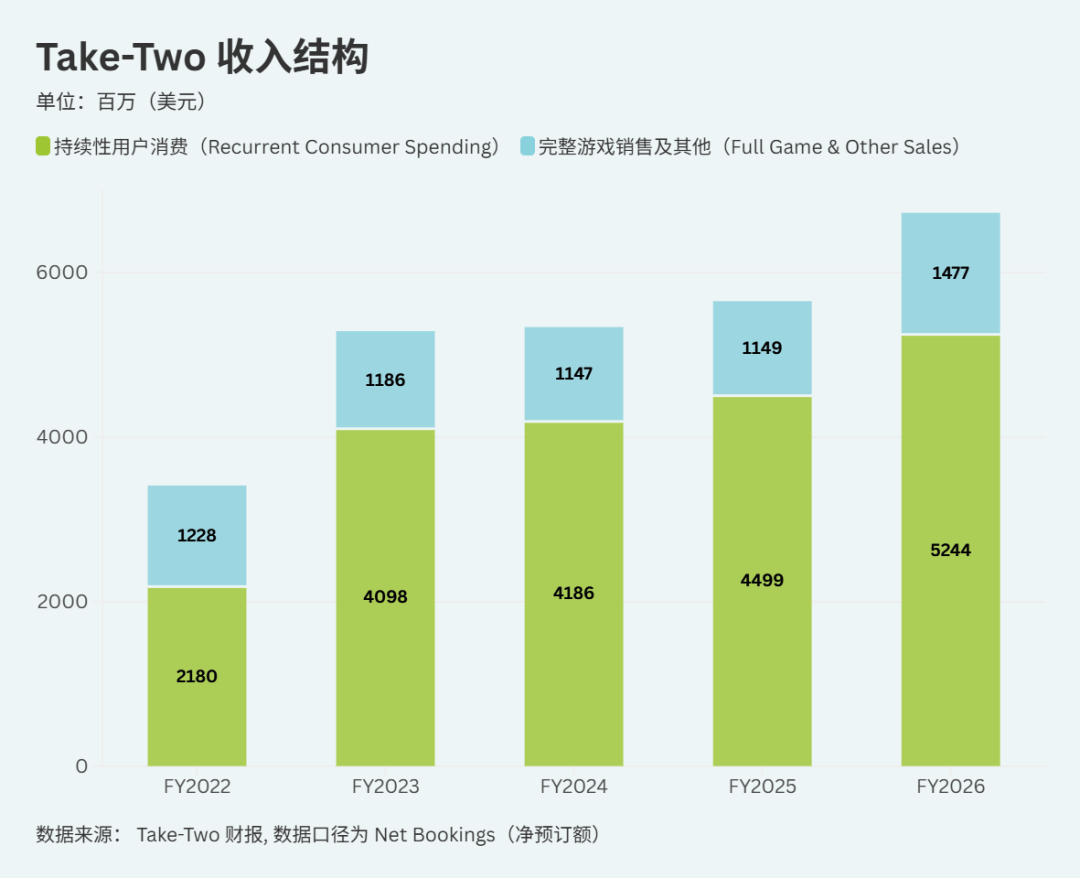
According to media reports, based on documents Take-Two submitted to its shareholders, the company hopes to reduce revenue volatility caused by long release cycles for new titles and maintain long-term, stable growth by increasing in-game recurring revenue streams.
Lower marginal costs and more predictable cash flow. For publicly traded companies that need to continually demonstrate future growth to the market, this revenue structure is clearly more valuable than relying on the short-term surge in revenue following the launch of a single game.
“Changing the valuation logic for game companies”—this is Evergreen Games’ most enticing promise to investors. Just as Take-Two remains in the red for fiscal year 2026, the market is still willing to value it generously. After all, “certainty” is the most reassuring word in the capital markets.
02
However, the market environment is precisely not conducive to the emergence of new “evergreen” companies.
The market environment drives companies to pursue “long-term success,” yet it also makes it difficult to find the right leader for that goal.
In an interview last year, Ma Xiaoyi, Senior Vice President of Tencent, noted that competition in the industry is fierce, and over the past year, there were likely only six games that managed to cross the “evergreen game revenue threshold”: *Zero Zone*, *Mingchao*, *Love & Deep Space*, *Underground 2*, *Black Myth: Wukong*, and *Operation Delta*.
There are approximately 70 products worldwide that meet Tencent’s “Evergreen” criteria—14 of them are internal to Tencent, and 8 are from external portfolio companies. In another interview that same year, he noted that roughly 5 to 6 titles are removed from this list each year, so the number of Evergreen games may not necessarily continue to grow.
This seems closer to a zero-sum game than it used to be.
First, as mentioned earlier, creating a new hit product is already difficult enough. Rising R&D costs, longer development cycles, and intensifying market competition—these practical challenges have been discussed by countless industry professionals.
Furthermore, while becoming a “hit” is just the starting point, “long-term success” requires a game to “remain successful over time” and stay in the game.
This tests the ability to sustain operations after launch. For example, maintaining consistent quality in content updates; encouraging players to continue spending by launching new servers and designing a system to weed out underperforming players; or adding new gameplay features and monetization opportunities within the existing game framework.
In a sense, it carries an even greater element of serendipity than the past practice of “betting on a hit.” For a game to stand the test of time, it must maintain user engagement, foster a vibrant community, continually explore new monetization opportunities, and withstand shifts in player interests and competition from rival titles.
Most importantly, games that have already crossed the threshold of “evergreen” status are raising the bar for newcomers.
Mature, long-running games already have a large user base, a wealth of content, an active community, and in-game assets, and they are constantly updated. They capture players’ time and attention over the long term and demonstrate exceptional user retention.
To give a rough example: a player has a limited amount of time for entertainment each day—2 hours for *Honor of Kings*, 1 hour for *Operation Delta*—so how much time is left for other games? Or, what kind of new game could possibly steal attention away from such “giants”?
In an article published in June of this year, Newzoo wrote that once a mature gaming ecosystem becomes part of players’ daily entertainment routines, it continues to capture their time and attention. At the same time, there are an increasing number of paths to commercial success for a game, including sustained online operations, differentiated multiplayer experiences, and the constant generation of anticipation through major updates.
After pre-orders for *GTA 6* opened in late June, the game became the best-selling console title of June based on pre-order sales alone over a five-day period. *EA Sports College Football 27* garnered significant attention even before its official release in July, and based on pre-order revenue alone, it has already ranked sixth on the console game revenue chart.
A recent report released by market research firm Alinea Analytics shows that Steam's total revenue reached a new record high in the first half of 2026, but new games accounted for only 21% of that revenue, with nearly 80% coming from classic titles that have been available for a long time.
A curious cycle is taking shape: the more important evergreen games become → the more resources are invested in established titles → the stronger these established titles become and the longer their lifecycles → the more players’ time is consumed → the harder it is for new games to become evergreen.
This could exacerbate the already pronounced Matthew Effect in the industry, as it ultimately leads to a self-reinforcing paradox.
03
When Certainty Begins to Transform Game Aesthetics
The gaming industry’s aesthetic preferences are increasingly leaning toward “timeless” designs, and when this trend trickles down to the production side, it generally leads to two possible outcomes.
First, there is a greater emphasis on maintaining “existing assets.”
Once a game joins the ranks of long-running hits, there’s still plenty for the company to do: continue to update content, add new gameplay features and monetization opportunities, develop cross-platform versions, expand into overseas markets, maintain the community, and even create derivative content based on the IP. After all, the commercial value of these IPs has already been proven by the market.
In addition to Take-Two, mentioned earlier, the focus of domestic companies such as NetEase on “evergreen” IPs in recent years has also been clearly evident.This year’s May 20 launch event featured no major new game debuts; the core lineup consisted primarily of long-running titles such as *Fantasy Westward Journey*, *Against the Current*, and *Onmyoji*, with only four unreleased titles making an appearance—most of which were updates to projects announced in previous years.
For an IP like *Fantasy Westward Journey*, which has been in operation for over 20 years, both its strategic importance and the resources allocated to it have increased. Last year, the game introduced the “Free-to-Play Server” as part of an operational overhaul, which yielded record-breaking revenue.
Second, in order to bring new products closer to “proven certainty,” the definition of a new product may become more “conservative.”
The stakes are too high when going from 0 to 1, but companies can avoid starting from scratch. For example, they can focus on sequels to established IPs rather than entirely new ones.Masakazu Sugimori, who worked on the original *Ace Attorney*, shared a thought on Twitter last year: If that game had been released today, it might never have evolved into a series—because nowadays, if the first installment of a new IP doesn’t sell well, it’s often immediately labeled a “failure” and loses any chance to grow.
This trend is also reflected in Ubisoft’s financial reporting; the company has stated on more than one occasion that it intends to shift to a “selective model,” prioritizing revenue generated from its back catalog and long-term operations.
The scope of innovation can be adjusted flexibly; for example, innovation can take place within established product categories rather than in entirely new ones.
Overseas, “annual releases” such as the EA Sports FC series and *Call of Duty* have long served as “cash cows” in the financial reports of major game companies.In China, *Operation Delta*, which draws on established frameworks such as FPS and “search-and-destroy” modes, is perhaps the “minor innovation” we’re most familiar with; it was also added to Tencent’s “evergreen” lineup last year.
Of course, it’s also possible to adapt existing cultural IPs rather than build a world from scratch. Just as developing games based on classic literature and bestsellers has long been a tradition in the history of the gaming industry.
This isn’t just an issue for the gaming industry. As the total number of users and the time they spend online gradually plateau, internet businesses will increasingly rely on deeply engaging their existing user base.Business inherently favors certainty: mature products, established IPs, and proven gameplay mechanics all point to success that has already been validated. Just as the film and television industry has long been producing sequels, stockpiling IPs, and focusing on fan-created content and merchandise.
Therefore, adding a new gameplay feature to an existing IP, opening up new markets for established games, and introducing new monetization opportunities to mature business models is actually a very rational choice.
However, the dual nature of games caters to different needs: business seeks certainty, while content creation requires leaving room for the unknown. Games
New content is, by its very nature, a bet on the unknown until it is validated by the market. It may fail, or it may become the next game-changer. The very essence of innovation lies in not seeking definitive answers. In an already high-pressure creative environment, reducing tolerance for the unknown, failure, and new directions is not necessarily a good thing.
Evergreen games may be one solution to the growth challenges facing the gaming industry, but they may also “narrow the boundaries of innovation” and create new problems.
原创文章,作者:游茶妹儿,禁止转载:https://youxichaguan.com/en/archives/221018