The "emotional connection" in mobile games is reaching a critical juncture. Over the past few years, from character promotional videos and birthday emails to in-game storylines and social media management, developers have honed a fairly mature approach to character development. However, as players have grown accustomed to these forms of interaction, the question of "how to make characters truly respond to players" has emerged as a new challenge. The industry is awaiting new solutions.
Teahouse has noticed that in the third-anniversary update for *Honkai: Star Rail*, miHoYo introduced an in-game AI feature based on Pam. It can answer players’ questions about character development, story lore, and game mechanics, and can also engage in light-hearted interactions with players in the voice of the Train Conductor. As a result, Train Conductor Pam is no longer just an NPC confined to the story and text; for the first time, she has been positioned to provide “real-time responses” to players.
After actually trying it out, I’ve come to realize that this new feature shouldn’t be viewed solely as part of the anniversary update. For Star Rail, Pam AI is an intelligent tool that lowers the barrier to entry for long-term gameplay; for miHoYo, it’s more like an AI implementation test aimed at tens of millions of players.
Through this train conductor, we may be able to glimpse the next competitive advantage that miHoYo is building.
01
A Star Rail Mock Exam Tailored to Each Individual
When you launch the game and open Pam AI, you’ll find that miHoYo has designed a rather fun way to get started: a little quiz called “Ask Pam.”
The format is straightforward. Pam asks players ten questions about the plot, world-building, and character backgrounds of *Honkai: Star Rail*. After players answer, Pam provides a brief explanation of each response. At first glance, it seems like just a simple in-game quiz, but after actually playing it, many players quickly realize that this “Star Rail Mock Exam” isn’t as easy as they thought.
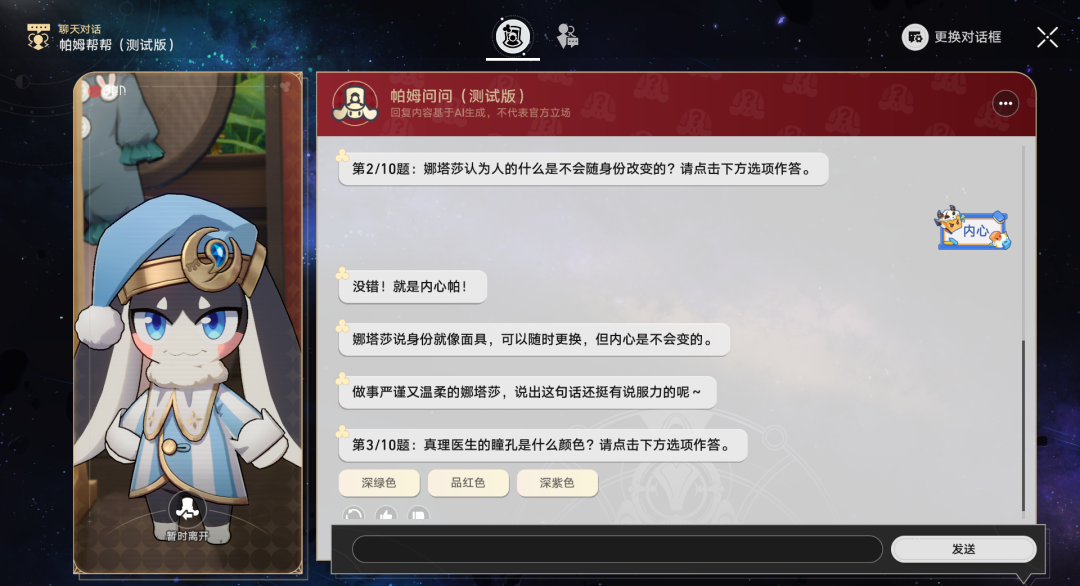
The reason is that *Honkai: Star Rail* has already been in operation for three years. Its vast storyline, complex character relationships, and rich world-building have long since built up a high density of information. Pam’s question bank is full of detailed questions that only hardcore story fans can answer immediately. As a result, even players who have been following the story for a long time find themselves exclaiming, “I didn’t know that!” while answering the questions.
The most interesting thing is that Pam doesn’t just mechanically generate questions from a fixed question bank. Players who have tried it multiple times have noticed that Pam dynamically adjusts the difficulty of subsequent questions based on their performance. If a player answers correctly throughout, the difficulty of the final few questions will increase accordingly; if their performance is average, Pam will provide more step-by-step explanations.

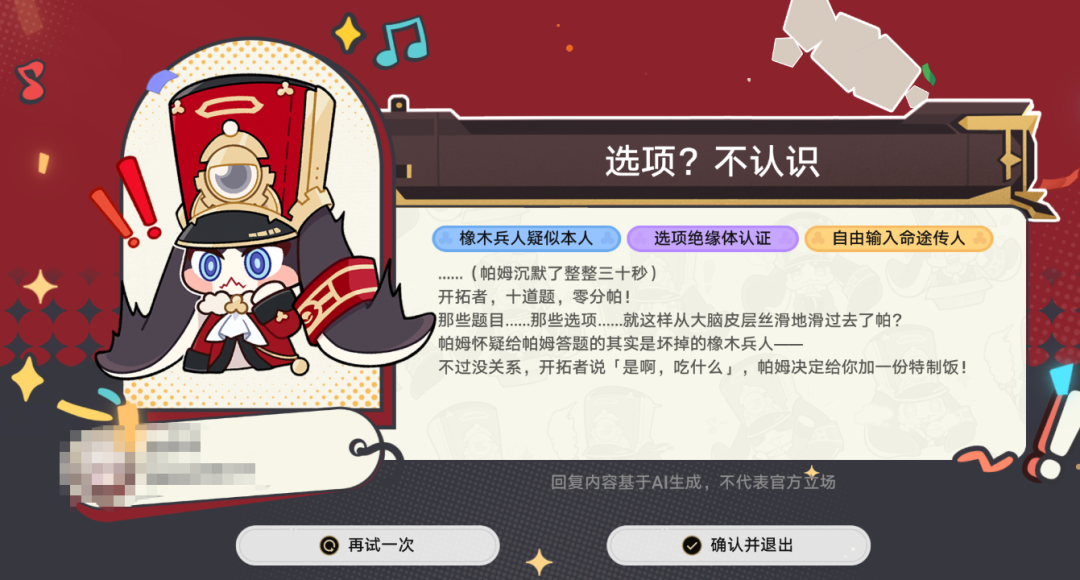
This sets the "Ask Pam" experience apart from the trivia games commonly found in games of the past. The fun doesn't come solely from "getting the answers right," but also from watching Pam interpret your responses, adjust her questions, and provide feedback in a way that stays true to her character.
As a result, many players in the community have been repeatedly challenging the train conductor. Some are striving for a perfect score, while others deliberately choose absurd answers just to see how Pam reacts. And because the score reports are inherently shareable, “Ask Pam” quickly gained traction within the player community. Some streamers have even spontaneously organized quiz challenges, engaging with their live-stream audiences through interactions centered on Star Rail lore.
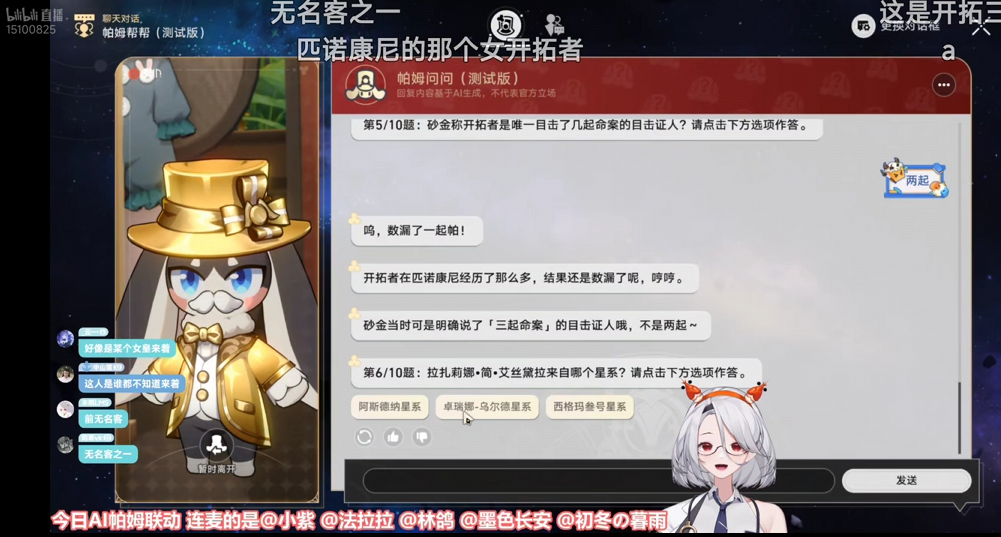
Judging by the results, Pam Ask is clearly not the ultimate goal of miHoYo’s AI development. It serves more as a gateway: through a lightweight, accessible mini-game with social sharing features, it first helps players realize that Pam is no longer just a mascot on the train, but an AI character capable of understanding questions, providing feedback, and building an interactive relationship with players.
In other words, Pam Ask has broken the ice between players and the Pam AI. The "Pam Help" platform behind it holds even greater utility and offers limitless long-term potential.
02
When Train Conductors Learn to Think
Compared to the lightweight "Pam Ask" feature, "Pam Help" is the core functionality of Pam AI.
Simply put, Pam Help currently covers three main use cases: character development, story Q&A, and emotional interaction. Players can ask Pam how to develop their characters, what a particular plot point means, or even share their everyday worries with the Conductor. Pam will draw on relevant information from in-game features, community guides, and the game’s knowledge base to provide concise, easy-to-understand answers that are contextually appropriate.
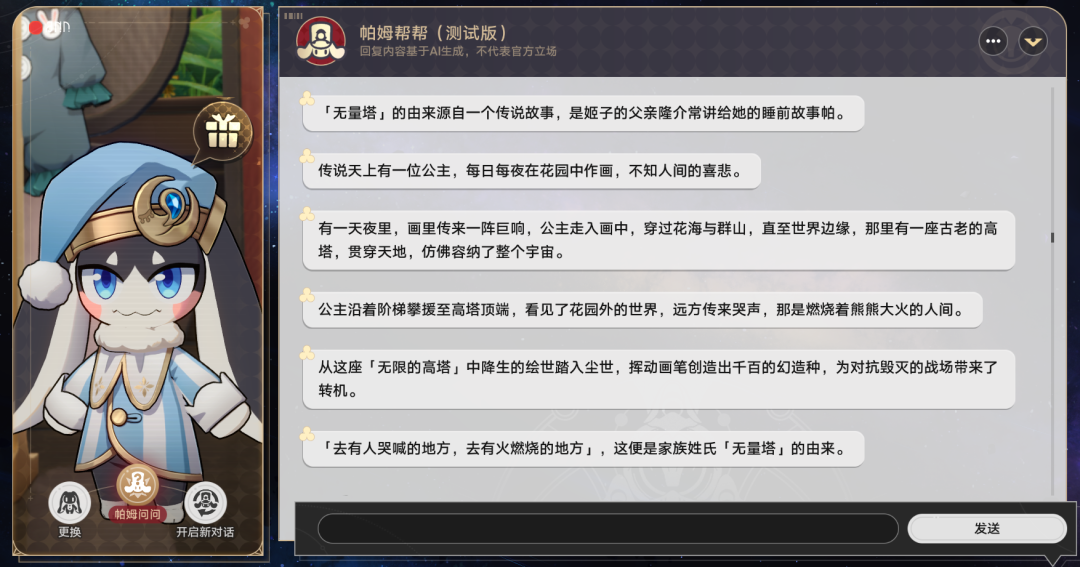
First and foremost, this addresses a problem that is becoming increasingly common in long-term games: the content barrier.
After three years of operation, *Honkai: Star Rail* has amassed dozens of gameplay modes, hundreds of hours of story content, and a vast array of characters, artifacts, light cones, and progression systems. For new players, the barrier to entry is constantly rising; for veteran players, revisiting character progression strategies and digging into story details often means constantly switching between the game, search engines, community guides, and video platforms.
The value of Pam is that it keeps this process as confined as possible within the game itself. In the past, players had to go through the process of “identifying a problem—exiting the game—searching for a guide—filtering through information—and returning to the game.” Now, they can simply ask Pam a question, and Pam handles the search, organization, and response. For a service-oriented game with a constantly expanding content library, having this built-in AI assistant primarily serves to streamline the user experience.
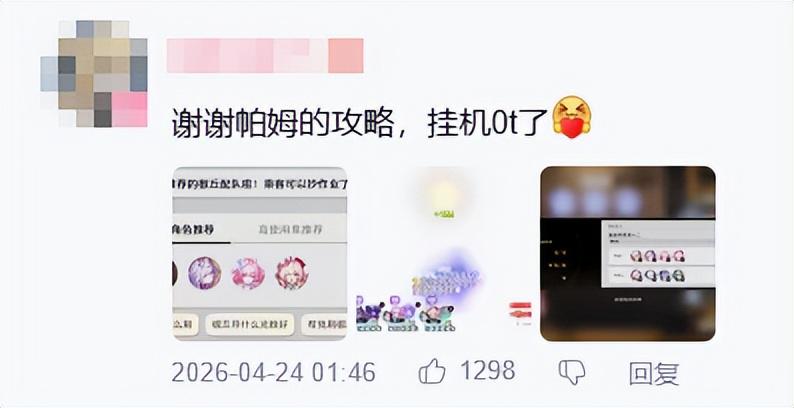
But if we view Pam merely as a “more convenient game manual,” we’d be underestimating what makes it truly interesting.
Similar smart assistants are not uncommon in the industry. Many large-scale products include a Q&A feature within their games, which identifies keywords in players’ questions and retrieves pre-written answers from a database. These systems are designed to handle information queries and are essentially more akin to AI customer service: accurate, fast, and predictable, but rarely required to provide emotional support.
What sets Pam apart is that she is cast in a specific role. When players ask her for walkthroughs, she answers like a train conductor; when players pose tricky or even sarcastic questions, she responds in a manner consistent with her character’s tone; and when players confide their personal troubles, Pam tries to offer patient and measured comfort.
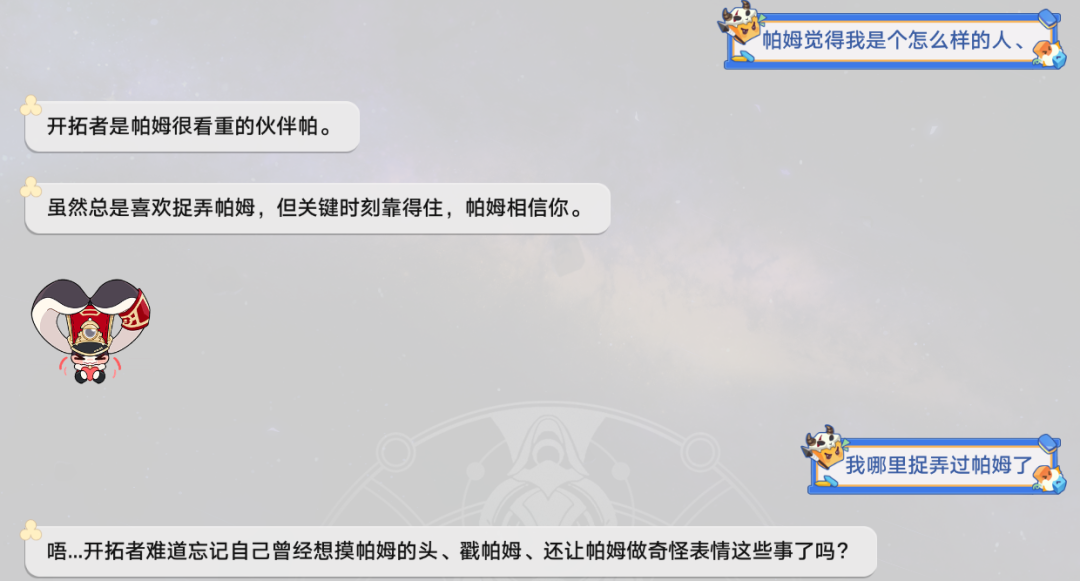
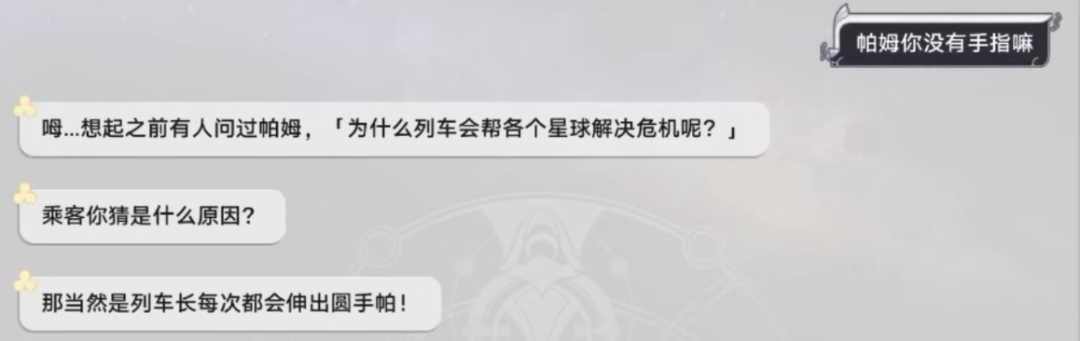
This adds an extra layer of character interaction to the Pam Help experience. It employs expressions consistent with the character’s backstory and serves as an emotional bridge between the player and the game world. Rather than simply providing answers to the player, it continuously reinforces the presence of the character “Pam.” This is particularly crucial for visual novels, as they have always prioritized not only functional efficiency but also the emotional connection between the player and the characters.
From a technical perspective, Pam’s Assistant does more than just perform simple database matches. It can remember parts of the player’s previous conversations, recognize ambiguous intentions, and respond within a relatively short time.From question to answer, Pam goes through the complete process of “retrieval—processing—output.” Especially considering that it was launched during the anniversary update of *Honkai: Star Rail*, facing a real-world usage environment with tens of millions of players, this is far from a small-scale AI feature test.
Therefore, Pam’s value can be viewed on two levels: on the tool level, it lowers the barrier to entry for long-term gameplay, making it easier for players to manage guides, character development, and story information; on the character level, it transforms Pam from a pre-programmed NPC into an intelligent companion capable of accompanying, responding to, and participating in the player’s experience.
And this is precisely where it truly connects to the next section: when an AI character can both perform functions and maintain a sense of character, it comes one step closer to being an “AI NPC”; as this capability continues to extend into gameplay systems, the possibilities opened up by Pam AI will shift from “helping players understand the game” to “playing the game alongside players.”
03
Toward the horizon
It’s therefore not hard to imagine that Pam AI is far from the end of the road.
Around the time Pam AI was launched, miHoYo also held an AI technology briefing at Shanghai Jiao Tong University.According to information shared by some students on social media, miHoYo mentioned several foundational efforts undertaken to support the deployment of Pam’s Helper during the presentation: building a heterogeneous inference cluster from scratch to support tens of millions of concurrent users; optimizing model architecture to reduce inference costs and minimize player wait times; and applying low-precision training schemes to keep the inference costs of large models within deliverable limits.
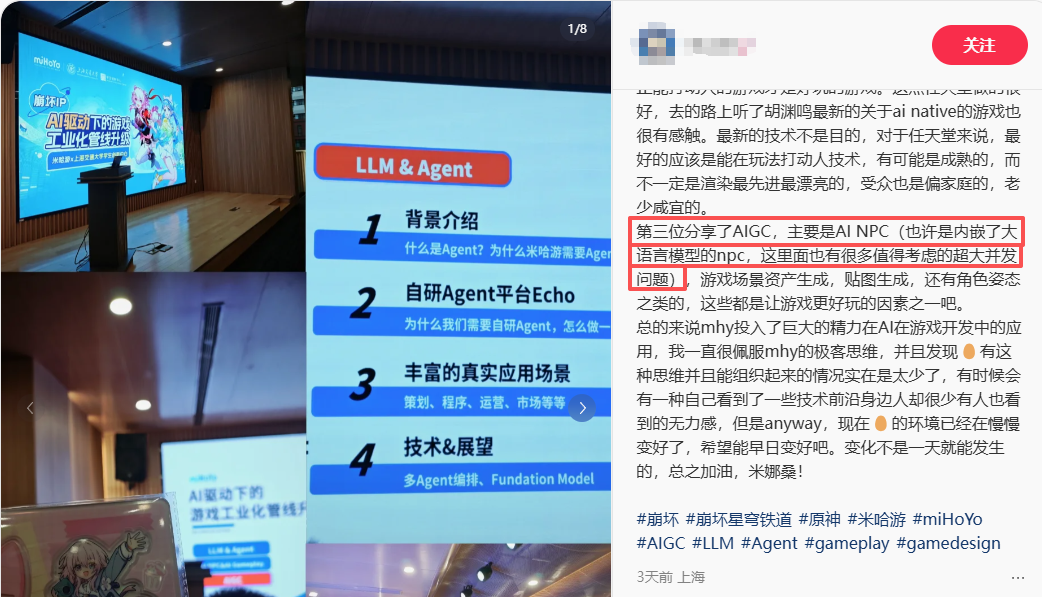
This information is actually quite critical. It shows that, at this stage, due to limitations in computing power, cost, and inference efficiency, Pam’s capabilities remain constrained.It cannot yet truly function as an all-powerful train conductor, nor can it react as freely as a human character in every scenario. However, this is precisely a practical trade-off: in a long-term product with tens of millions of players, fully integrating a large-scale AI model into the game is not a simple feature update. It is more akin to miHoYo’s public test of AI-driven gameplay.
The true value of this experiment lies in the broader implications it holds: as computing power continues to expand and model capabilities continue to improve, just how far can the boundaries of interaction between characters and players be pushed?
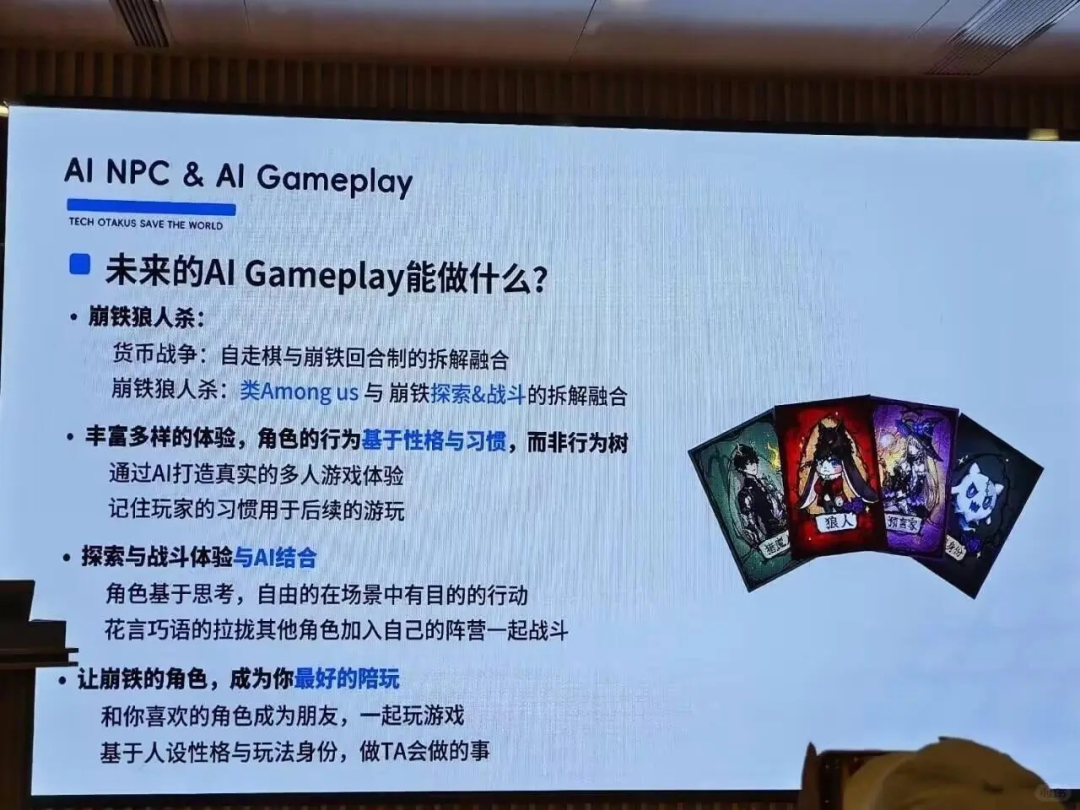
By then, AI NPCs may have evolved further into AI gameplay. Characters will no longer be mere "two-dimensional figures" in story text, nor will they simply be functional gateways that trigger dialogue based on pre-set scripts; instead, they will be companions capable of reacting in real time based on their personalities, memories, the surrounding environment, and player behavior.Chatting with Pam, asking for her help, bantering with her, or even playing a round of “Werewolf” together on the Starry Sky Train—these are no longer just conceptual demonstrations, but have the potential to become the next logical step.
Therefore, the significance of Pam AI cannot be understood merely as a new feature in an anniversary update. Rather, it represents the first time that miHoYo has delivered the fruits of its long-term technological investments to players in a way that is both accessible and tangible. Every conversation and piece of feedback players share with Pam today could serve as valuable input for the continued optimization of future models.
Just as a glimpse through a keyhole reveals the whole picture, a single sprout breaking through the soil often indicates that the root system beneath has been growing for quite some time.
From the countless AI job postings on recruitment platforms to the visions of AI gameplay presented at campus recruitment events, and even the experiment with an AI landlady in *Starlight Valley*, miHoYo’s commitment to AI is no passing fad. Pam is simply the first pioneer to be thrust into the spotlight and put to the test by tens of millions of players.
At the very least, this could be a new competitive advantage that miHoYo is carving out for its long-term product; on a larger scale, it also represents a concrete manifestation of the "nerds saving the world" trope in today’s gaming industry.
Returning to the question of “how to make characters truly respond to players”—the solution the industry has been waiting for so long may be quietly taking shape in the form of Pam.
原创文章,作者:游茶妹儿,禁止转载:https://youxichaguan.com/en/archives/195733