I’m sure many of you are like me: you have no background in programming or development experience, but you often dream of creating your own game.
I never expected my dream to come true so quickly.
On January 30, TapTap officially unveiled “TapTap Maker”—an “AI game creation agent.” During a live stream, company founder Huang Yimeng created several playable games from scratch without writing a single line of code.
Prior to that, I was invited to participate in the closed beta for “TapTap Maker” and spent a few hours creating a platformer with 10 levels. I barely left the chat window throughout the entire process, and I was even able to publish the game on the TapTap platform with a single click.
This isn’t a joke, nor is it some AI gimmick that “generates template content with a single click.” I’m talking about a complete game with core mechanics, a difficulty curve, and the ability to be played from start to finish—and while it’s short and rough around the edges, it truly deserves to be called “a game.”
In the lead-up to the live stream, Huang Yimeng shared a metaphor on social media: making games is like blacksmithing—on an assembly line, a single part requires ten production steps and ten workers; but a true craftsman can forge a fine sword with just one person and a single hammer.
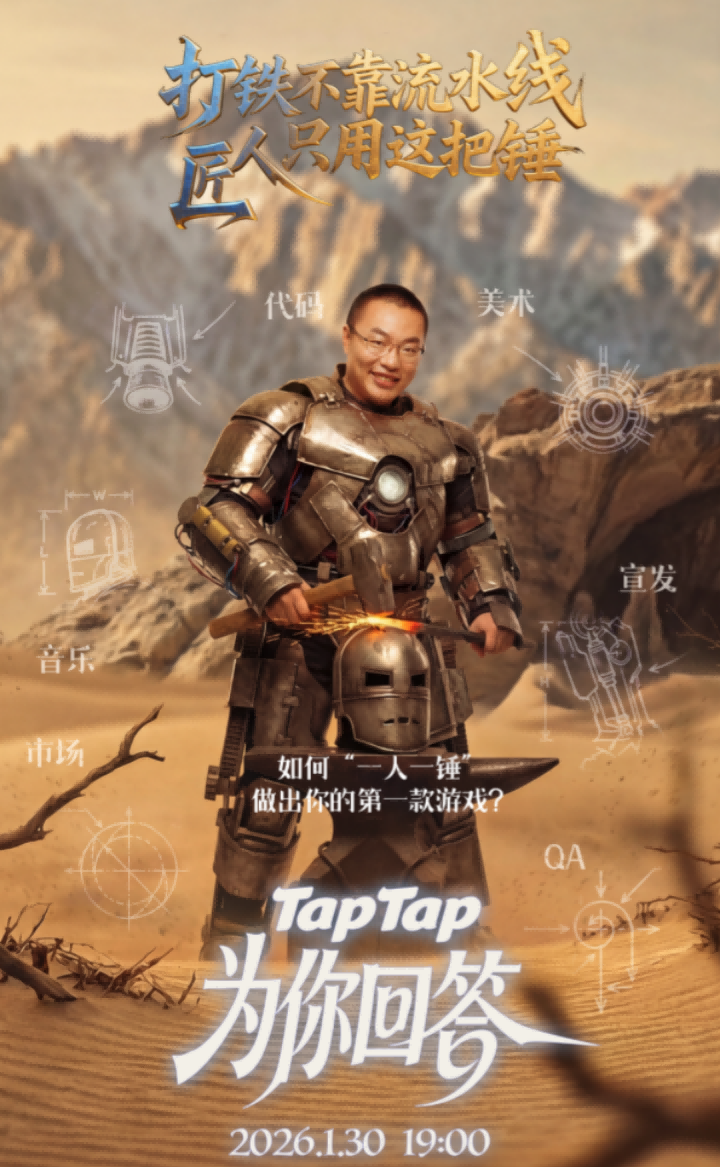
Code, art, music, testing, release… Can all these "steps" be handled by a single tool?
This hammer is exactly what TapTap is trying to become.
01
In just a few hours, from a single sentence to a game
To be honest, the moment I opened TapTap, my mind went blank.
This is probably how most ordinary people really feel about "making games"—it’s not that they have no ideas at all, but rather that those ideas are too vague and scattered, making it impossible to know where to start when trying to piece them together into a concrete, actionable plan.
So I decided to test the waters first: “What kind of games are you best at?”
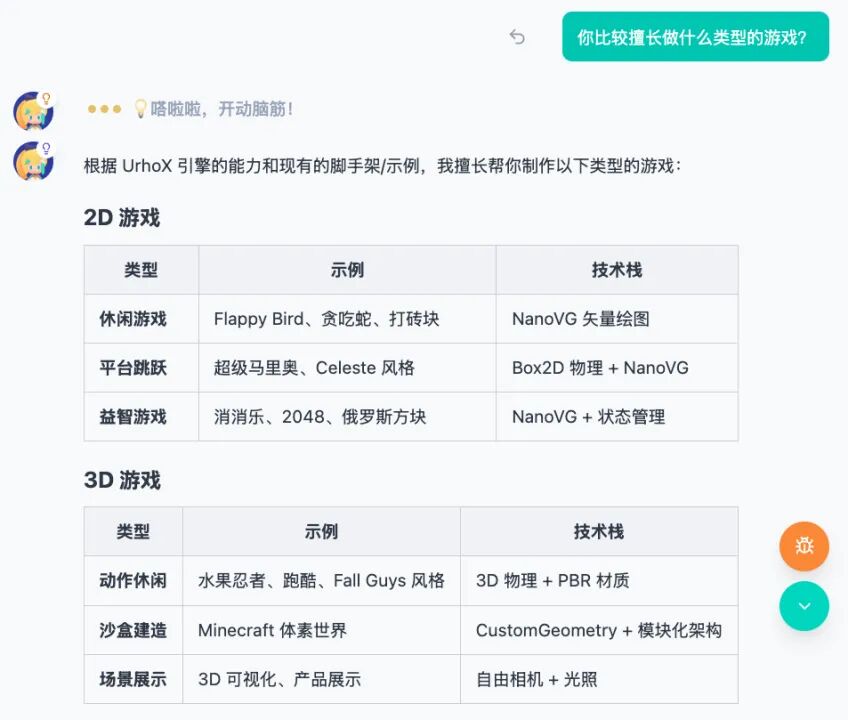
The AI gave me a list: casual games, platformers, sandbox builders, visual experiences… Then it passed the buck back to me: “So instead of asking me what I’m good at, tell me: what kind of game do you want to make? Even a vague idea will do.”
After giving it some thought, I made my first request: “Create a pixel-art platformer based on the *Heart-Pounding Company* theme, with some unique gameplay mechanics (such as gravity reversal, time rewind, cooperative clones, wall-bouncing, etc.)”
The AI’s response took me by surprise. Instead of jumping straight into generating code, it paused to analyze the situation briefly before calmly pouring cold water on the idea: “The four mechanisms you mentioned are all interesting, but cramming them all together would make the code too cluttered. I suggest selecting one or two core mechanisms and exploring them in depth.”
It then proactively offered a solution: the core mechanic is called “Telepathy”—pressing the R key leaves behind a “shadow” that replicates the player’s movements from the previous 5 seconds; both the player and the shadow must stand on two switches simultaneously to open the door. The auxiliary mechanic is Gravity Reversal—pressing the W key reverses the direction of gravity, but the shadow remains unaffected and continues moving along its original path.

It also provides three options to choose from.
“Sounds good. Let’s go with this plan.” As soon as I typed that, the AI sprang into action.
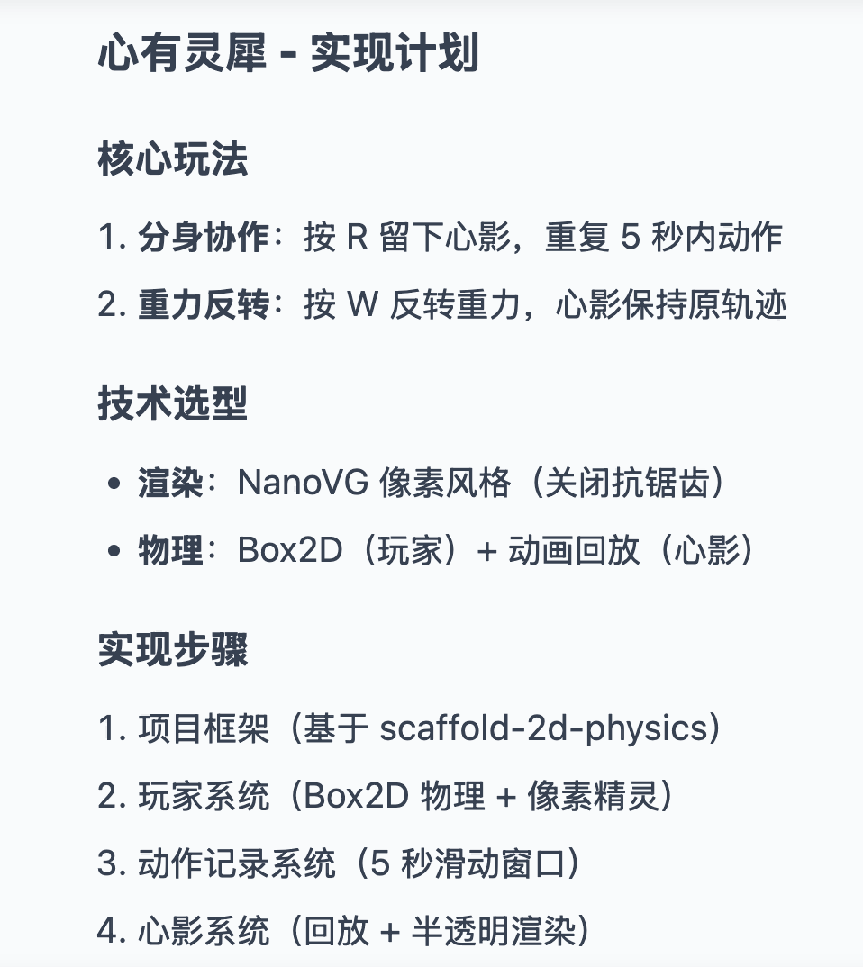
A few minutes later, the first working demo appeared in the preview window.
But getting the demo to run is just the first step; the real test—and what truly impressed me—is the debugging and iteration that follow: it doesn’t just generate cookie-cutter gameplay templates with a single click, but uses natural language interaction (in other words, plain English) to collaborate with users in exploring ideas and bringing them to life.
Once the demo was built, the issues quickly became apparent. The most glaring one was that players could use anti-gravity to fly straight up to the ceiling, go around the top of the door, and reach the finish line without having to solve any puzzles at all. This wasn’t just a simple coding bug; it was a flaw in the level design.
In the dialogue box, I described the issue: “Activating the Heart Shadow to open the door is not essential for completing the level, as players can use anti-gravity to bypass the door and reach the finish line directly. This indicates a conflict in the game’s core design.”
The AI's solution was to redesign the level: seal off the upper area with a ceiling to completely block any possibility of bypassing it. However, this overcorrection created a new problem—after sealing the ceiling, the second level became impossible to complete.
After several rounds of this “identify the problem—describe the problem—fix it—verify” cycle, I gradually got the hang of collaborating with the AI. It really does understand vague concepts like “playability” and can adjust switch positions and verify mechanism interactions accordingly. After three rounds of iterations, all three levels could be successfully completed.
After a few rounds of back-and-forth, I discovered a better way to collaborate: instead of having the AI “generate ideas directly and then letting me pick out the flaws,” we decided to “discuss first, then execute.” For example, when discussing Level 4, the AI analyzed the pros and cons of each design direction, and in the end, we jointly settled on the “platform jumping + heart shadow” combination.
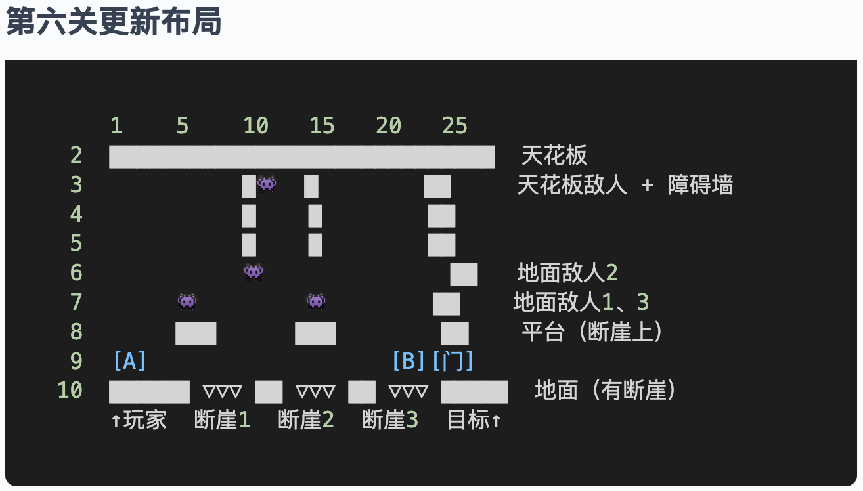
When introducing the enemy system in Level 6, the AI suggested starting with a "first encounter with enemies" level as a tutorial, then gradually adding more complex challenges—this is a very standard approach to level design, and the AI proposed it on its own; it was even able to provide a schematic of the level before implementation.
After several hours of iteration, the final version includes 10 levels, ranging in difficulty from “Heartshadow Beginner” to “Ultimate Trial.” The AI also generated 8-bit-style background music, sound effects, collectibles, and a scoring system for me—and even created the game icon and promotional copy.
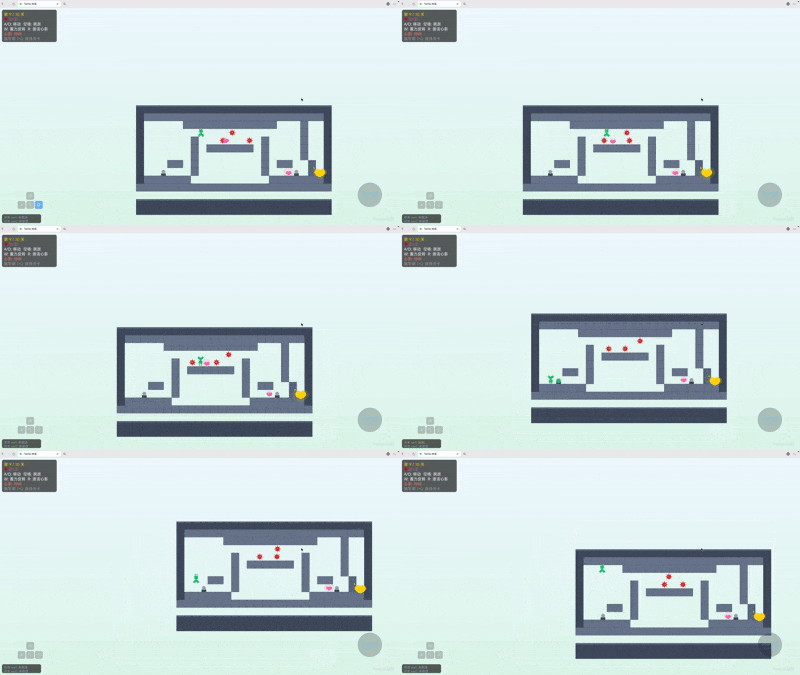
Throughout the entire process, I didn’t write a single line of code or open a single editor.
Of course, the experience isn’t perfect. Currently, TapTap is better suited for 2D casual games, and the creativity of level design still relies heavily on human input; some iterations require multiple rounds of feedback to be finalized. But it has indeed significantly shortened the path from “idea” to “playable demo”—and even the path from “no idea” to “playable demo” has been shortened.
02
Founder's Live Demo: Building a 'Minecraft' Game from Scratch
If my experience was merely a personal anecdote from a beginner, then last night’s livestream served as a more convincing public validation.
Huang Yimeng set himself a challenging goal: to create a Minecraft-style sandbox game on the spot. He typed “Make me a Minecraft” into the chat box, and the AI got to work. A few minutes later, the basic version was complete: a pixel-art 3D world where the character could run and jump, and place and remove blocks.
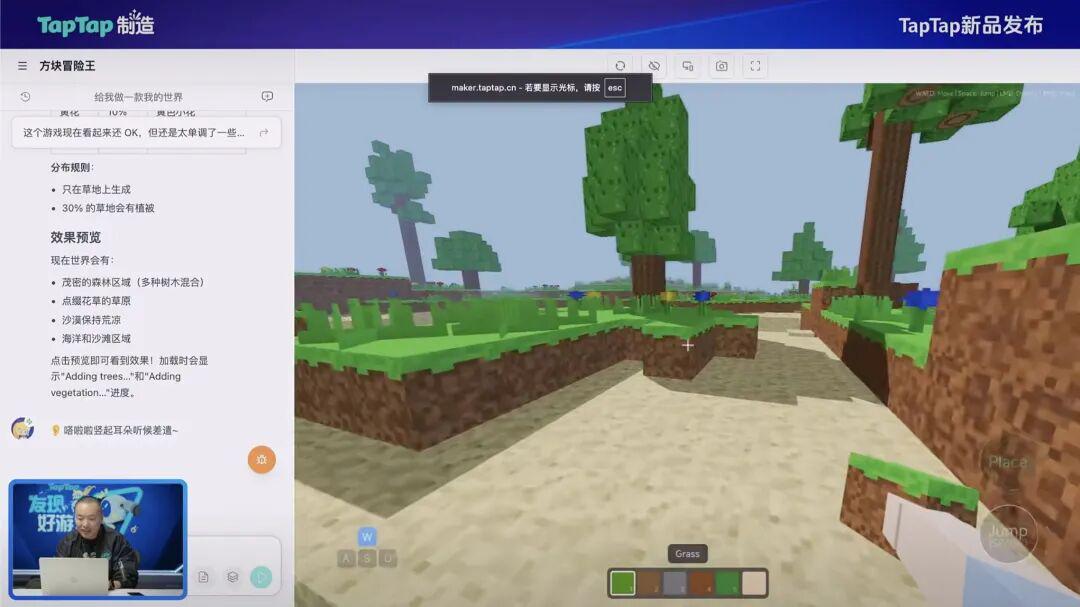
But that was just the beginning. Huang Yimeng continued to make requests: “This world looks okay, but it’s still too monotonous. Could you make it more vibrant? For example, add some trees and some grass.” The AI quickly finished the task, and the results were impressive.
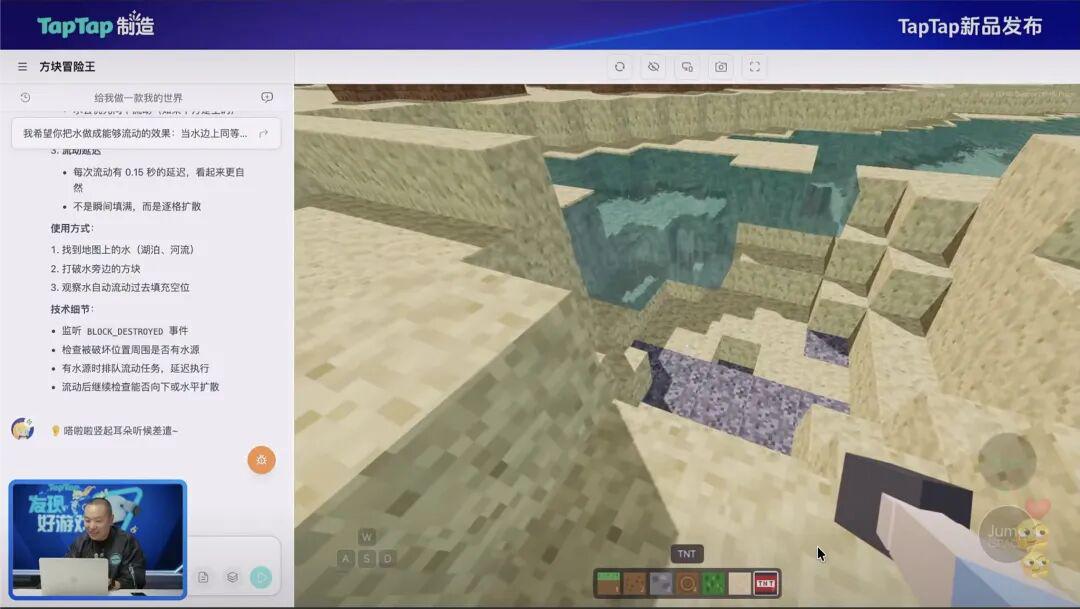
Next came a more complex request: “Create a TNT prop for me. It needs to be able to explode, and when it does, the blocks should have particle effects and sparks flying everywhere. The screen should also shake to convey the power of the TNT.”
He made a point of emphasizing that this TNT implementation wasn’t created using pre-set module combinations, but was instead “hand-coded” by AI at the code level. This means there are no limitations—it isn’t constrained by parameters set by the editor—and anything you can imagine can be implemented through code.
The most entertaining moment of the livestream came from the audience comments. When a viewer asked, “Can water flow?” Huang Yimeng took up the challenge on the spot: “I want you to make the water flow so that when the bricks at the same height along the water’s edge are broken, the water can flow down to the same level.”
The AI successfully implemented this feature. However, a bug was discovered during testing: water would flow when the blocks were struck by hand, but not when they were blown up with explosives. Huang Yimeng simply described the issue in natural language, and after reviewing it, the AI fixed the problem and even created a "waterfall" effect.
Finally, he suggested, “Make this game network-enabled and multiplayer-compatible.” This was a significant change, as features like the water flow and TNT explosives that had been implemented earlier all required network-synchronized rendering. Once the AI was complete, he and his colleagues logged into the game and were able to move around and place bombs simultaneously—the transition from single-player to multiplayer was as simple as that.
During the livestream, Huang Yimeng repeatedly emphasized one key feature: games developed by TapTap are inherently designed for cross-platform release—whether on PC, mobile, or tablet—and are perfectly optimized for both landscape and portrait orientations.
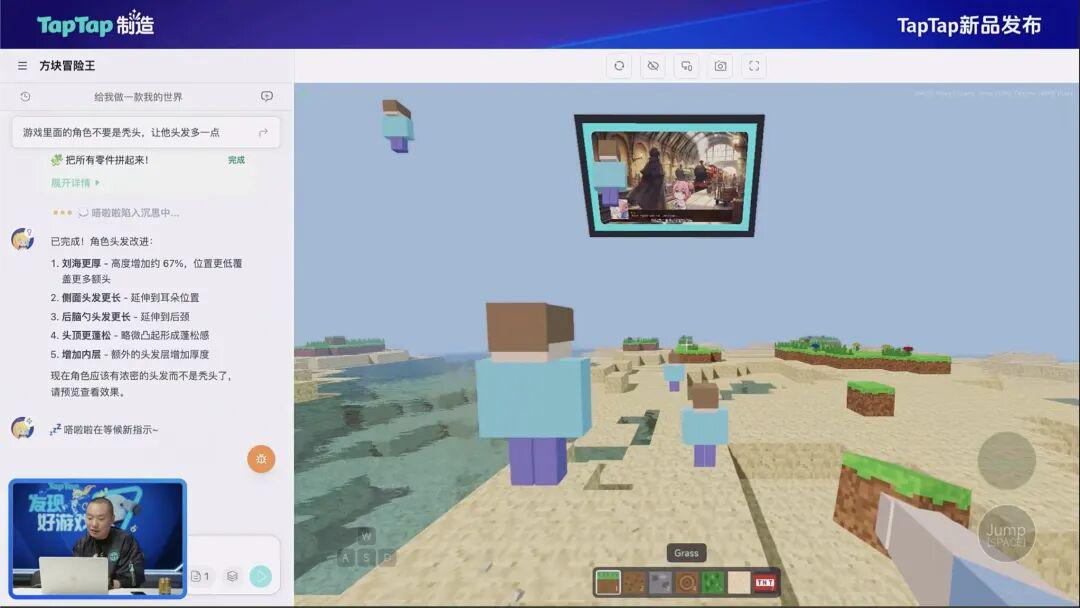
“Xindong has developed so many games over the years, and as the boss, I’ve always wanted a game that works across all platforms and supports both landscape and portrait modes—but the first game like that was actually one I made myself,” he joked. “In the past, if you asked a programmer to make a game like that, they’d definitely give you a hard time. But today, I just asked the AI, and it got the job done without complaint—just a simple ‘OK’ was all it took.”
The livestream didn’t go entirely smoothly—there were several instances where error messages had to be copied and pasted for the AI to fix them. But Huang Yimeng took it in stride: “The fact that there were so many issues just proves that it’s authentic.”
In addition to *Minecraft*, the livestream also showcased other projects he had previously created using TapTap:a Snake game upgraded from 2D to 3D multiplayer online mode; a space battleship Roguelike game with nearly 50,000 lines of code; and a text-based adventure game capable of “one-click style switching”—transitioning from anime-style to traditional Chinese ink-wash art, including regenerating all character portraits and backgrounds and pairing the new Chinese-style characters with appropriate voice acting—all with just a single command.
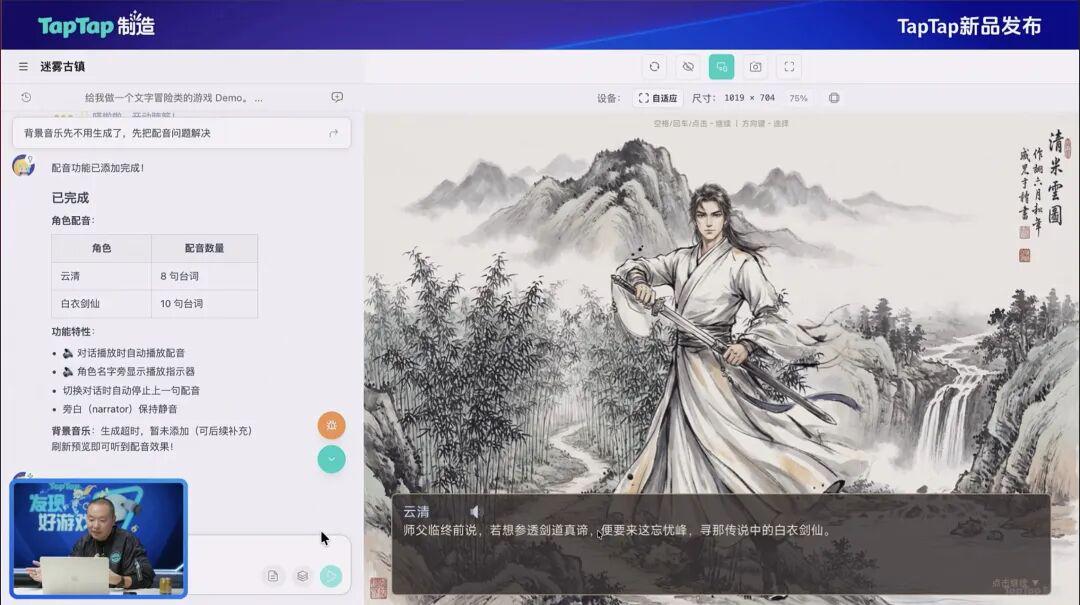
He remarked that in traditional game development, completely overhauling all the art assets is a grueling process, but in the era of AI agents, creators can build the game first and then, in the future, achieve a dramatic improvement in the art quality overnight.
03
Why TapTap? Why now?
Now that we’ve discussed the gameplay experience and the live demo, let’s take a look at the product logic behind TapTap.
From a technical architecture perspective, this system consists of three layers: the top layer is an AI agent capable of understanding natural language, responsible for receiving requests and breaking down tasks; the middle layer is the “AI Native Engine,” which is based on Xindong’s proprietary Spark Engine; and the bottom layer integrates with TapTap’s developer service (TDS), which includes ready-to-use modules such as account login, online multiplayer, cloud saves, and leaderboards.

Why develop our own engine? Because Unity and Unreal are fundamentally designed for humans—their graphical interfaces actually become obstacles for AI. While drag-and-drop operations may seem to lower the barrier to entry, they actually confine functionality within a predefined framework. TapTap chose to abandon graphical interfaces in favor of a purely code-driven engine, which is more transparent and controllable for AI.
But what really sets TapTap Maker apart from other AI programming tools is its deep integration with TDS.
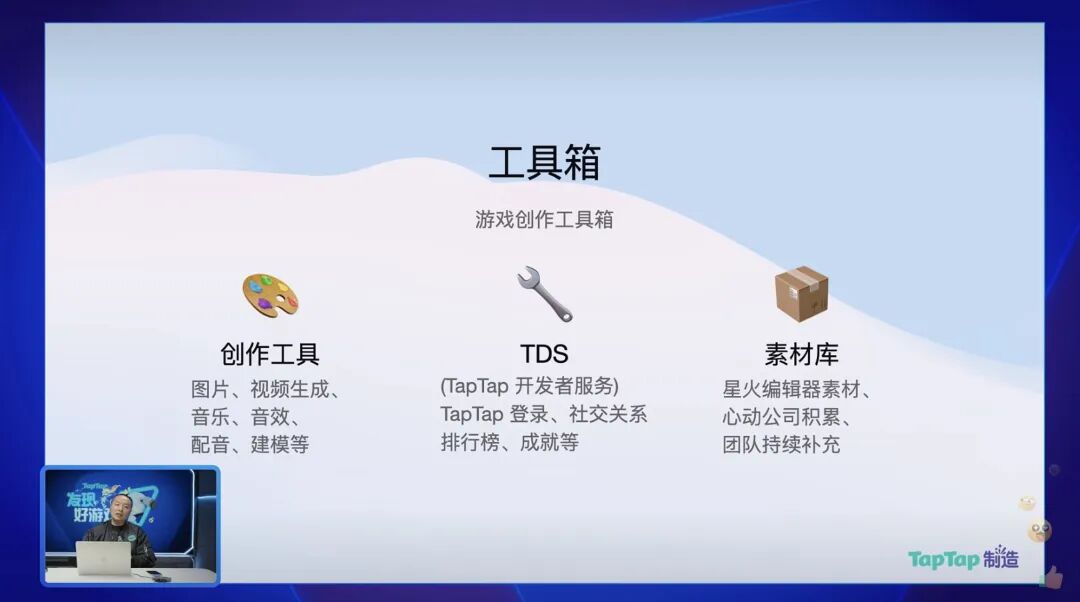
Over the past few years, TapTap has invested significant resources in developer services—including login, account management, compliance, social features, leaderboards, and achievements—with the goal of preventing developers from reinventing the wheel. However, the reality is that even with comprehensive SDKs and documentation, the integration process remains a hurdle for creators without a technical background.
TapTap has changed the game. AI agents have learned how to integrate with all services, so creators no longer need to worry about the technical details. The infrastructure TapTap has built up over the years has found a new way to shine in the AI era—shifting from “providing tools for you to integrate yourself” to “AI doing the integration for you.”
This integration represents a unique strength of TapTap. While there are plenty of AI coding tools on the market, they typically address only a single aspect of the process. For example, Cursor focuses on code editing, Gemini is a general-purpose AI, and Replit is a cloud-hosting platform—each addresses only one link in the chain, rather than the entire game development workflow.
TapTap Studio offers an end-to-end solution—creation, testing, and release are all completed within the same environment. With just one click to publish, you can enter an ecosystem with players and reviews.
At a deeper level, the integration of TapTap’s platform with its community creates a flywheel for creator growth. The core asset TapTap has built up over the past decade is not traffic, but a community of players who possess discernment when it comes to games and are willing to provide honest feedback. What new creators need is not indiscriminate download numbers, but constructive feedback that helps them improve.
During the livestream, Huang Yimeng emphasized, “It’s very important for a game to receive positive feedback from discerning players.”
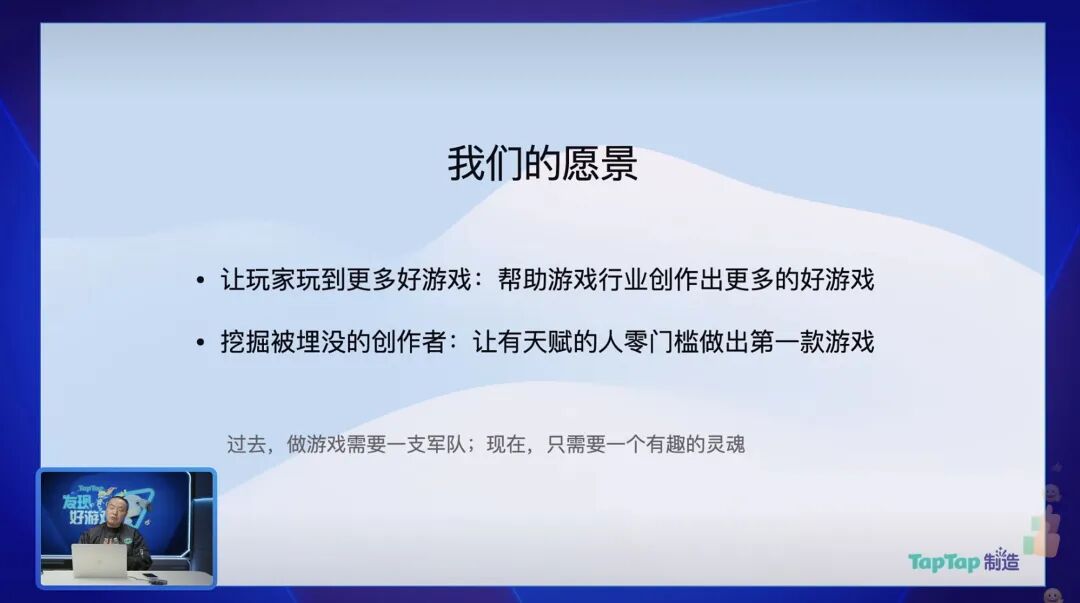
He also offered a clear-eyed assessment of the limits of AI: “Today’s AI is highly capable in terms of programming, but its ‘game sense’ remains weak—much like a student who has read every book on the subject but has never actually played a game. The core value of creators has not been replaced; ‘you must know what kind of game I want to make and what makes it good.’”
In terms of its business model, TapTap has chosen a different path. At a time when AI tools typically rely on subscription fees, Huang Yimeng has made it clear that he has no intention of “selling the shovel.” The logic is simple: for the past decade, TapTap’s goal has been not to compete with developers for profits, but to build a sustainable ecosystem. TapTap Make serves as the fulcrum for driving the flywheel, rather than a standalone profit-generating product.
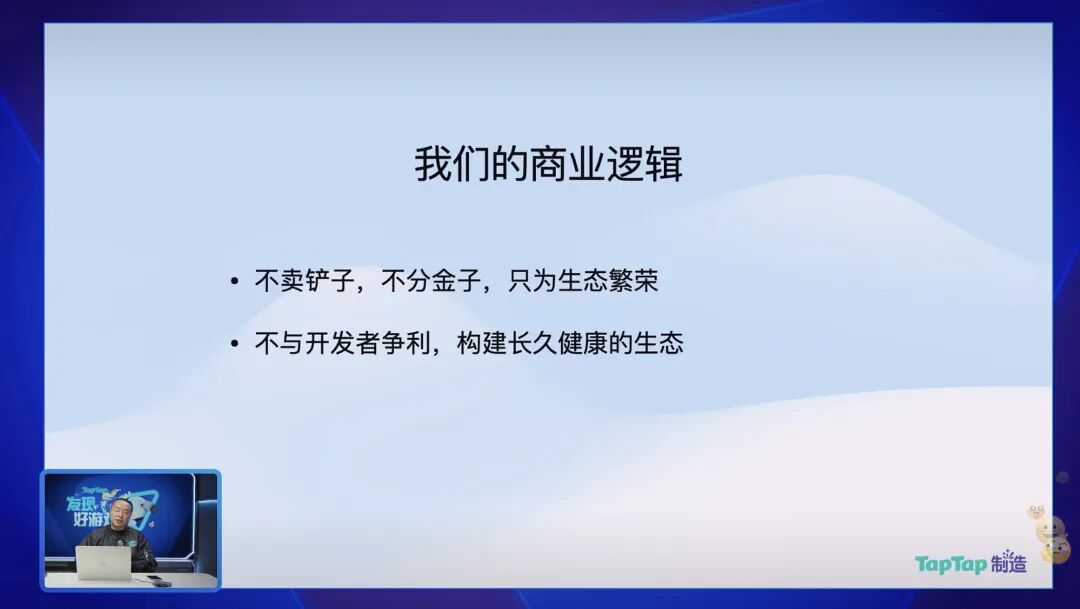
From this perspective, TapTap’s ambitions extend far beyond simply “using AI to make games.” It aims to redefine TapTap’s role: moving from a downstream platform for “discovering great games” to an upstream platform that “helps great games come to life”—using AI to lower barriers to entry, leveraging services to shorten development cycles, and fostering growth through its community.
This is a story that only TapTap can tell.
Conclusion
After finishing this article, I opened TapTap Maker again. Before this, “making a game” required serious preparation—learning game engines, learning to code, sourcing assets, and setting up a development environment. Now it’s become something that can happen at any moment; the barrier to entry is so low it almost feels unreal.
Of course, TapTap is still far from perfect. While the tools address productivity issues, taste, creativity, and the ability to judge what is “fun” still come from people themselves.
At the end of his livestream, Huang Yimeng said something that I think serves as a perfect conclusion to this article: “Learning in and of itself isn’t fun, but creating is. All our learning is ultimately for the sake of creation, and the most important thing is receiving positive feedback during the creative process. On a platform like TapTap Maker, you can start making your own game with just a single line of code and share it with friends with a single link. I believe this is the best era yet for future game creators.”
TapTap Maker aims to be the tool that empowers anyone to create their own game—just like a blacksmith forging a piece of work with a single hammer. While it can’t help you create a AAA title just yet, it does allow someone with absolutely no technical background to build a playable, shareable game—one that can even be published—in just a few hours.
The greatest significance of this lies in unlocking the creativity that has been held back by technical barriers, and reviving the dreams of game development that have been crushed by the "shackles of having to be a jack-of-all-trades."
原创文章,作者:游茶妹儿,禁止转载:https://youxichaguan.com/en/archives/195420