On April 23, *The Ring*, the first urban open-world MMORPG, officially launched its open beta. As Perfect World’s (hereinafter referred to as “Perfect World”) flagship title, developed with great dedication, the first day of the open beta brought a host of intricate operational tasks. At Perfect World’s offices in Beijing and Suzhou, every employee was rushing about, stretched thin, and working tirelessly to address the various unexpected issues that arose following the launch.
In Shenzhen, thousands of miles away, Bin Kai—an employee at a major tech company and a shareholder in Perfect World—was also feeling uneasy due to the open beta launch of *The Strange Ring*. With a sense of foreboding, Bin Kai opened his stock trading app and, upon seeing the green numbers flashing across the screen, couldn’t help but gasp.
After the market opened at 9:30 a.m. that day, Perfect World’s stock price began to plummet unchecked, with the decline rapidly widening to 7% as it headed straight for the daily limit-down.
In just half an hour, Bin Kai—who had been sitting on a small paper profit before the market opened—suddenly found himself down nearly 10%. His mind was in turmoil; even the air he breathed felt like it was burning his throat. He slammed his clenched right fist against his thigh, his voice filled with regret: “Damn it, I got greedy this time!”
On the day of the open beta, *Eccentric Ring* failed to make it into the Top 5 of the App Store’s China Top Grossing chart, and disappointment quickly spread through Perfect World’s stock community. On the second trading day, Perfect World’s stock price plummeted to the daily limit down, leaving Bin Kai speechless.
The recent open beta of *Ether Ring* has amplified volatility in Perfect World’s stock price, making it a hot topic of discussion among industry professionals in major gaming communities. Bin Kai is just one example of the many industry professionals who invest in gaming stocks.
Perhaps due to the path dependence stemming from their work, when gaming industry professionals venture into the stock market, they instinctively start by looking at gaming stocks. Tencent, NetEase, JiBit, 37 Interactive Entertainment, and Century Huatong… These familiar gaming stocks are all common fixtures in the portfolios of industry insiders. Game Tea House has also found that not only do industry professionals prefer trading gaming stocks, but even publicly listed game companies are investing in gaming stocks on the secondary market.
Compared to clueless "amateur" retail investors in the stock market, game industry professionals have a natural advantage: they understand games better, can objectively assess their quality, and have easier access to first-hand market data.
With such an "insider's advantage," trading in gaming stocks must be a surefire way to make money… right?
01
Buying at the bottom and getting stuck vs. cutting losses
If he hadn’t seen his direct supervisor invest heavily in NVIDIA and ultimately achieve financial freedom with his own eyes, Bin Kai might still view the stock market as a giant casino.
Inspired by his leaders’ example, Binkai cautiously entered the A-share market with the goal of “forced savings.” At first, he only bought mutual funds—whatever Alipay recommended, he bought, completely clueless about the process. “If I’m going to lose money, I want to lose it with a clear understanding!” Once he’d made up his mind, Binkai plunged into the A-share market.
As a newcomer to the stock market still enjoying the "newbie grace period," Bin Kai relied on his intuition to pick Hengdian Film & Television. At the time, *Flying Life 3*, a film primarily produced by Hengdian Film & Television, had claimed the top spot at the box office during the Spring Festival season, and the stock surged steadily after the market reopened following the holiday. The steadily rising profit figures prompted Bin Kai to sell at the peak. When he calculated his returns, they turned out to be over 50%.
Coinciding with the launch of the third beta test for *The Strange Ring* after the Lunar New Year, the game received positive feedback from the community, driving Perfect World’s stock price to hit the daily limit up for three consecutive days. This strong momentum successfully attracted Binkai, who was looking to convert his cash holdings into stocks.
As someone in the gaming industry, Bin Kai had naturally heard of *The Ring* and knew that the game was carrying high expectations from Perfect World. He watched the livestream of *The Ring*’s third beta test closely and found the open-world gameplay to be quite solid. In his view, open-world city games with an anime aesthetic have enormous potential; if the social mechanics of *GTA Online* were integrated into *The Ring*, it would undoubtedly raise the game’s ceiling significantly.
Bin Kai then added Perfect to his watchlist and began buying shares on dips as the stock price fell below 19 yuan.
With the open beta of *The Ring* approaching, Perfect World’s stock price has generally been on a downward trend. Meanwhile, on social media, many Perfect World investors firmly believe the stock is undervalued. Citing data from unknown sources, they insist that *The Ring*’s beta test results have been phenomenal and assert that revenue from the open beta will inevitably exceed expectations.
However, Bin Kai was far from optimistic; a growing sense of foreboding was taking hold of him. “They say the stock market is driven by expectations—could it be that Perfect has already priced in the good news?”
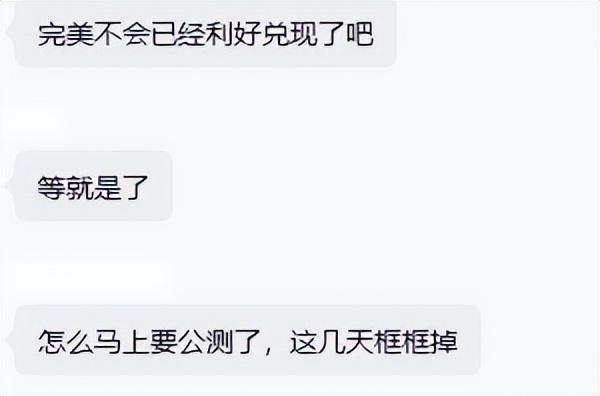
Before the open beta, Bin Kai nervously voiced his concerns
He sold off part of his position while his Perfect World shares were still showing paper gains. But deep down, he still believed that Perfect World’s stock price would rise after the launch of *The Ring*. Little did he expect that Perfect World’s stock would continue to plummet after the open beta of *The Ring*, leaving Bin Kai completely stuck with his losses.
Fortunately, the paper loss was only around 20%, so it didn’t deal a serious blow to his finances, and Bin Kai remained in good spirits: “I’ll just think of it as spending money on *The Strange Ring*.”
Just as Bin Kai was stuck holding his shares and waiting to recoup his losses, another game developer, Xudong, bought Perfect World stock on the eve of the open beta for *The Ring*, only to quickly cut his losses and exit the market after the beta launch.
Xu Dong told Game Teahouse that he bought the stock because Perfect World had dropped significantly before the game’s launch, and he believed there was an opportunity for a rebound.
After acquiring shares in Perfect, Xu Dong told his former colleague at Perfect about it. The colleague exclaimed in surprise, “Even our boss doesn’t have as much faith in Perfect as you do!”
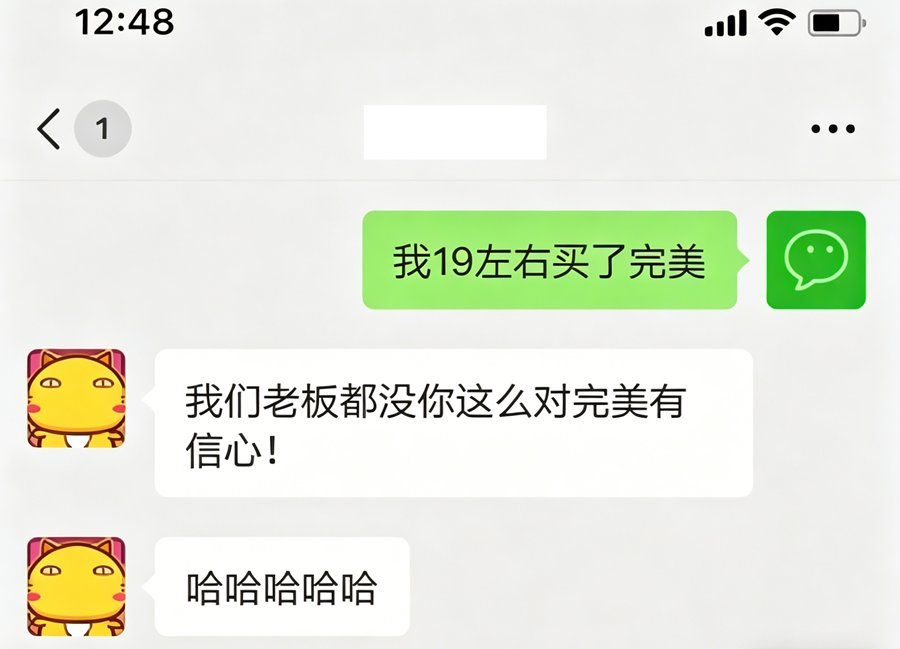
The subsequent performance of *Heterocycle* and Perfect World’s stock price certainly did little to bolster Xu Dong’s confidence.
During the first weekend of the open beta, Xudong gave *The Ring of Strangeness* a thorough playthrough. He felt that the gameplay experience bore some resemblance to the developer’s previous title, *Arknights*; while the visual art was undoubtedly top-notch, the character designs lacked distinctiveness and the storyline was riddled with plot holes. Overall, the game was playable but fell far short of his expectations.
What shook Xu Dong even more was his keen observation that "The Strange Ring" was gradually scaling back its spending on user acquisition. He decided he could no longer hold onto Perfect, which was on a downward trajectory; cutting his losses and exiting the market seemed like the wise move. "Thank goodness I got out in time—I only lost 10%."

Xu Dong took a loss
02
When good news is fully priced in, it becomes bad news; when bad news is fully priced in, it becomes good news.
Prior to the open beta launch of *Etheria*, market expectations for the game were extremely optimistic. Securities firms were even more forthright in their research reports, boldly projecting that the game’s first-year revenue could reach 4 to 5 billion yuan. This optimism was quietly factored into Perfect World’s stock price in the run-up to the launch, translating into a premium.
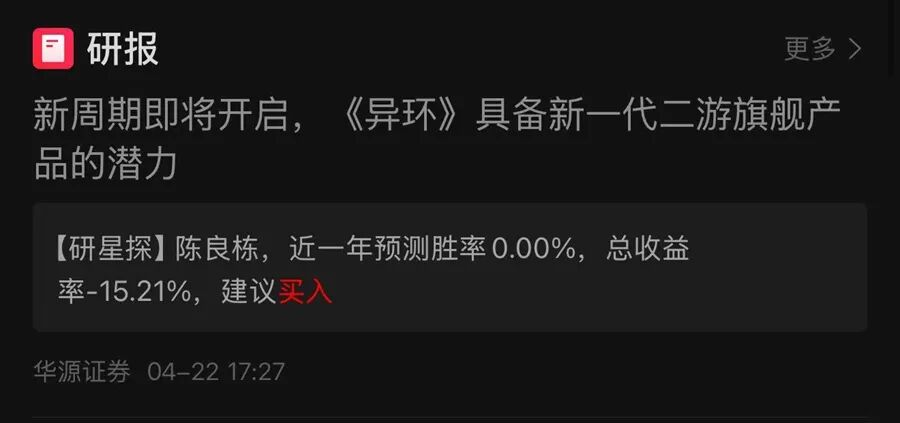
As Bin Kai summarized in his lessons learned, stock trading is driven by expectations; the peak of optimism often marks the beginning of a stock price correction, while, conversely, the depths of pessimism can actually be the starting point for a stock price surge.
Xiao Gu, who works in business development at a major tech company, has experienced this firsthand. The substantial profits he made from Century Huatong were a direct result of the market reaction to the "bad news being priced in."
In 2020, Century Huatong—which at the time still derived half of its revenue from the auto parts business—finally completed its acquisition of the long-established game developer Shengqu Games. This high-profile capital operation left a deep impression on Xiao Gu. He began to take an interest in Century Huatong.
It’s now 2023. Gu, who frequently checks overseas game charts, noticed that a new SLG game called *Whiteout Survival* kept climbing to the top of the global charts. Upon further inquiry, he discovered that the game’s developer is none other than DianDian Interactive, a subsidiary of Century Huatong.
At the time, Century Huatong was mired in trouble: it was under investigation by the China Securities Regulatory Commission for false disclosures, and had suffered a massive loss of 6.6 billion yuan the previous year, prompting institutional investors to rush to sell their shares. The company’s stock price remained depressed, hovering around 4 yuan for an extended period.
Just as everyone was scrambling to distance themselves from Century Huatong, a thought crossed Xiao Gu’s mind: “Maybe this is an opportunity.” His years of industry experience allowed him to rise above the market’s pessimism and form his own independent perspective:
- The overseas performance data for *Whiteout Survival* is traceable and difficult to falsify. Furthermore, revenue for SLG games typically doesn’t take off until about a year after launch, and at that time, the stock price had not yet reflected these forward-looking expectations;
- Tencent, the major outside shareholder, has consistently supported the company and has been increasing its stake in Century Huatong in stages;
- After a prolonged decline, Century Huatong's stock price has already factored in most of the risk;
- Through his work, Gu discovered that DianDian Interactive, despite specializing in "SLG+X" games, has a well-established methodology and the ability to consistently create hit titles.
With that in mind, he began buying shares of Century Huatong at around 4 yuan. The rest, as they say, is history. *Whiteout Survival* became a phenomenal hit in the strategy game genre, and *Kingshot* followed suit with its own success, driving explosive growth in Century Huatong’s profits. The company’s stock price skyrocketed, multiplying several times over.

In a post-mortem analysis, Gu admitted that his ability to correctly predict Shiji Huatong’s turnaround was largely due to his background in the gaming industry. He had taken notice of *Whiteout Survival* earlier than retail investors outside the industry and had a better understanding of the SLG business model and operational rhythm. At the same time, his industry connections gave him a deeper insight into the DianDian Interactive team, which strengthened his confidence in holding the stock.
However, industry professionals sometimes miss out on opportunities because they are too close to the situation.
A former Shengqu employee told Game Teahouse that after the company was placed under ST (stock risk warning), he had considered buying at a low price. However, because he was well aware of some of Shengqu’s shortcomings and lacked knowledge of its sister company, DianDian Interactive, he ultimately decided against making the purchase.
In his view, most publicly listed domestic game companies are mid-sized firms whose products rely heavily on user acquisition, and the stability and authenticity of their performance may not stand the test of time. “Among my friends in the industry, only Tencent is held; we generally steer clear of other gaming stocks.”
03
Listed game companies are also keen to invest in game stocks
While game industry professionals who invest in gaming stocks are still constrained by the limits of their personal information and inevitably find themselves groping in the dark, game developers with access to industry resources have a crystal-clear view of the market when investing in gaming stocks.
In fact, game developers are among the leading investors in gaming stocks and have reaped substantial returns.
According to 37 Interactive Entertainment’s annual report, the company has invested in game companies such as Zenyou Technology (pre-IPO investment), Xindong (pre-IPO investment), SNK, and Molin Co.
As of last year, 37 Interactive Entertainment still held stakes in Zenyou Technology and Xindong. These two equity investments yielded impressive returns for 37 Interactive Entertainment: its 18 million yuan investment in Zenyou Technology’s IPO cornerstone placement ultimately generated nearly double the initial investment, while its 25.52 million yuan investment in Xindong returned more than 3.5 times the original investment.
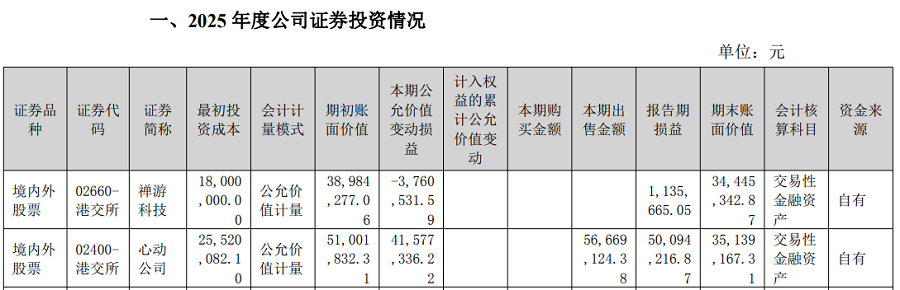
Investments in Zen Tour and Heartbeat have yielded substantial returns for 37 Interactive Entertainment
In 2023, a consortium comprising Kaiying Network and Tanwan Games successfully acquired 80 million shares of Century Huatong through a judicial auction. At the same time, Tanwan Games separately acquired another 80 million shares. Subsequently, in 2024 and 2025, Kaiying further increased its stake in Century Huatong on the secondary market, spending 499 million yuan and 600 million yuan, respectively.
Currently, both Kaiying Network and Tanwan Games rank among the top ten shareholders of Century Huatong. Kaiying’s equity holdings alone have a book value of 3.157 billion yuan.
It is worth noting that Tanwan Games is also a skilled stock trader. Last year, Tanwan briefly held shares in Starry Glory, which it subsequently sold off this year, exiting the ranks of the top ten shareholders. The fact that Tanwan Games saw its net profit surge by 3,445% last year despite a 25% plunge in revenue was, to some extent, attributable to a “significant increase in investment income” generated by its stock trading activities.
Of course, many game companies still choose to establish deep, long-term partnerships with upstream and downstream companies through strategic investments, aiming for collaborative growth rather than focusing solely on short-term financial returns.
04
Stock price fluctuations are a tug-of-war between sentiment and expectations
Ahead of the May Day holiday, Perfect World revealed that *Epic Ring* generated over 100 million yuan in revenue on its first day of global launch, with all key metrics outperforming *Arknights* during the same period, thereby bolstering investor confidence. Perfect World’s stock price has risen significantly over the past two days.
However, the uncertainty surrounding profitability in the gaming industry has always been a major challenge, and even the management of publicly traded companies is unable to make accurate predictions about their long-term earnings. During an earnings briefing, JiBit CEO Lu Hongyan stated bluntly that there is no way to determine whether the company can achieve stable growth, which is why he does not invest in the stock market.
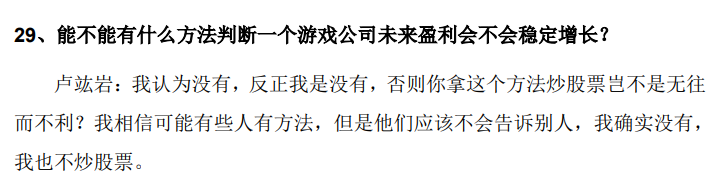
As insiders at the heart of the industry, gaming professionals are certainly better positioned to spot emerging new games early on and have a clearer understanding of listed companies’ actual business performance than the general public. However, stock price fluctuations are influenced by the interplay of market sentiment and capital expectations. In this regard, gaming professionals do not necessarily have an advantage over ordinary investors.
原创文章,作者:游茶妹儿,禁止转载:https://youxichaguan.com/en/archives/195743