“2026 will be a year of intense competition.” This statement by Sun Weiming, head of domestic publishing for 37 Games, on ByteDance’s “Anli Mini-Games” video podcast captures the true state of the mini-games sector.
Over the past four years, the mini-game market has surged from 5 billion in 2022 to 53.5 billion by 2025—a more than tenfold increase—and to this day, its growth rate continues to far outpace that of the broader gaming industry. However, as the numbers have skyrocketed, the rules of competition have been quietly rewritten.In video podcasts, developers behind several hit mini-games have reached the same conclusion: the mini-game market has long since moved beyond the “blue ocean” phase; the crude strategy of buying user traffic is becoming ineffective; and systematic management is the new key to growth.
In Sun Weiming’s view, while mini-games have also experienced a period of rapid growth, their window of opportunity has been shorter than that of traditional mobile games. As competition for user acquisition in the mini-game sector matures, content management, gameplay innovation, and refined operations have become the three core competencies that all developers must develop.
William, founder of Hangzhou Tongqu Technology, also believes that it’s becoming increasingly rare to create a hit product based solely on a standout idea, as was the case in the past. Today, success depends on the overall strength of the entire team—product development, advertising, operations, and monetization. If any one of these areas falls short, it will be difficult to sustain long-term success.
The shift from “isolated breakthroughs” to “systematic operations” is the most significant change in the mini-game market in 2026. Amid this transformation, one platform is becoming the choice of an increasing number of teams: Douyin.
According to information disclosed at the 2026 ByteDance Mini-Games Industry Ecosystem Development Forum, in the first half of 2026, Douyin Mini-Games saw a 130% year-over-year increase in DAU, a 60% rise in the number of developers joining the platform, and a 96% increase in the number of games released.More and more players are getting used to discovering and playing mini-games here; more and more teams are shifting their business focus to this platform. For them, Douyin Mini-Games is no longer an optional part of their business strategy, but a must-have for driving growth.
Why is Douyin the one leading this round of industry transformation? Teahouse found some clues in this podcast conversation.
“For Fun Mini-Games, You’ve Got to Check Out TikTok” Video Podcast
01
A vibrant content ecosystem is fertile ground for creating viral hits.
Unlike traditional channels, which only provide traffic distribution capabilities, the core competitive advantage of Douyin Mini-Games stems from the platform’s inherent, vibrant content ecosystem.This ecosystem gives developers an unprecedented “front-row seat,” allowing them to observe in real time what users are discussing, which topics are gaining traction, and what sentiments are spreading—and to use these insights to identify promising ideas for new game projects.
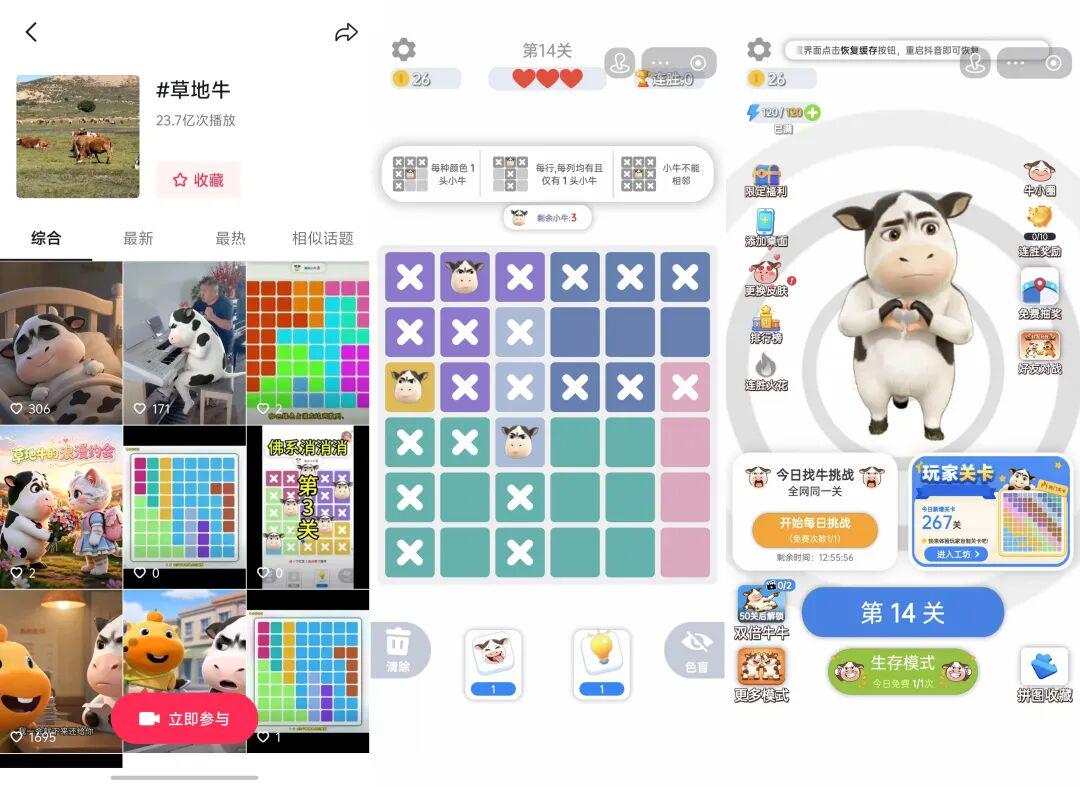
The hit game *Buddhist-Style Match-3* is the best example. Chen Zhimin, founder of Xiamen Xing Shang Network, mentioned that the creative inspiration for this game came from the “Grassland Cow” phenomenon that went viral across the internet.At the time, the “Grassland Cow” trend had already surpassed 2 billion views on Douyin. The team keenly capitalized on this trend, blending the viral meme elements with Sudoku-style puzzle gameplay to refine and launch this product.
The incorporation of viral internet memes not only allows the game to quickly capture users’ attention and seize the initiative in viral spread, but also lowers the psychological barrier for players to understand the gameplay, thereby continuously attracting more casual users to give it a try.This approach was ultimately fully validated by the data. After its launch in February of this year, *Buddhist-Style Match-3* quickly took the market by storm, with cumulative registered users surpassing 40 million, peak DAU exceeding 2 million, and the game topping Douyin’s mini-game popularity chart—a position it held for an entire month.
This is not an isolated case. Mia, the head of content operations for Douyin mini-games, has observed that more and more developers are now actively seeking inspiration for new projects from trending topics online: for example, a mini-game inspired by the viral meme “The Flying Fox of the Snowy Mountains and the Soy-Braised Duck” quickly surpassed 1 billion views for related topics after its launch;the bead craft trend that took the internet by storm has also been adapted by developers into a 3D match-three mini-game.
The logic behind how trending topics give rise to viral hits applies not only to fleeting online memes but also to collective emotions deeply rooted in the public’s psyche, which can likewise give birth to phenomenon-level works.
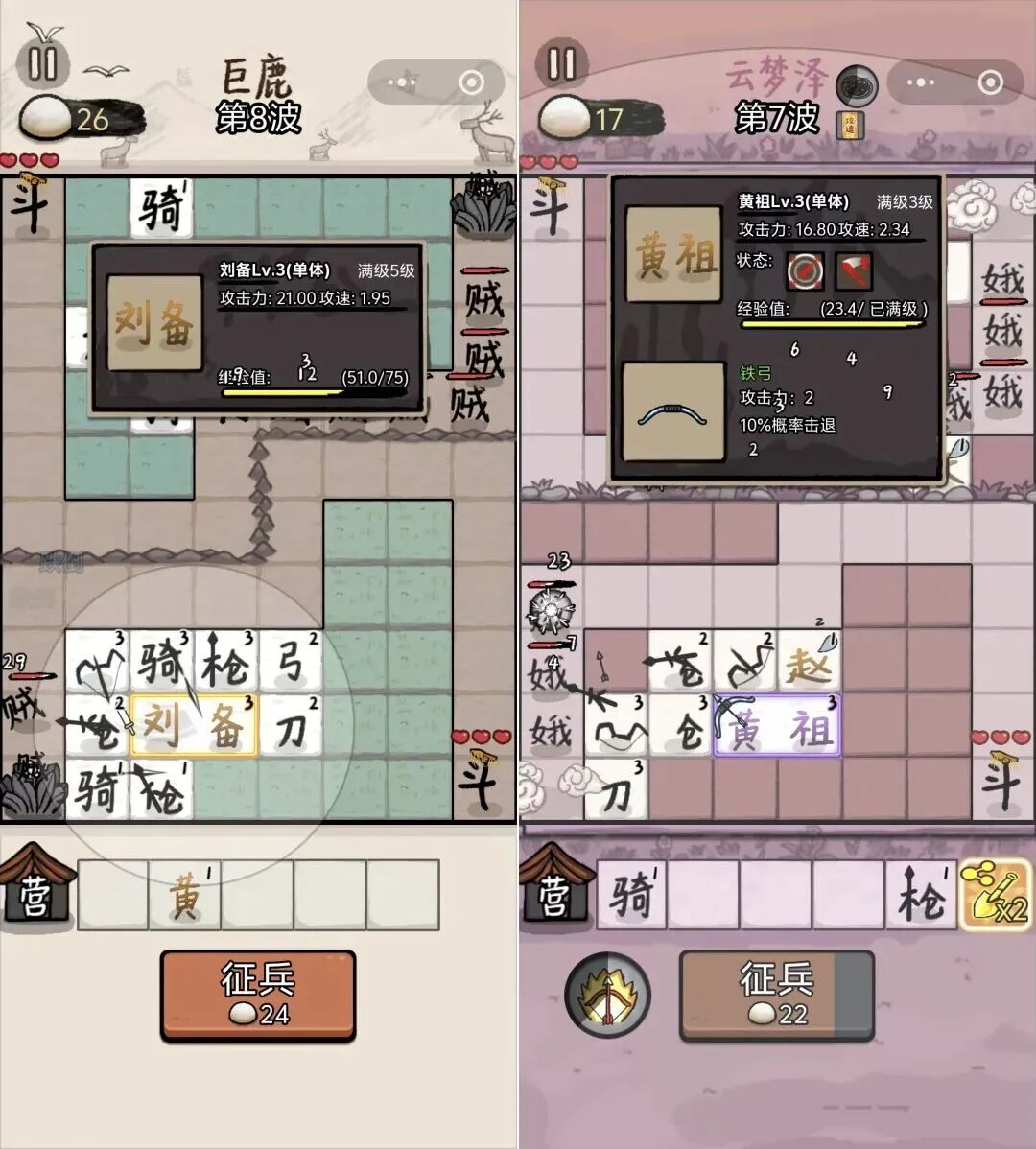
The Chinese character tower defense game that has recently gone viral taps into users’ shared knowledge—such as the stories of the Three Kingdoms and Chinese characters—to evoke a sense of cultural resonance among the public.Meanwhile, *Lie Flat and Level Up*, which went viral in earlier years, tapped into the shared childhood emotions of an entire generation: the feeling of rushing into bed at night and slamming the door shut, as if that alone provided a sense of security. By combining this instinctive emotion with tower defense gameplay, the game quickly resonated with players.
In addition, there are many lightweight SLG games centered on ocean and deserted island survival themes that tap into people’s instinctive desire to survive in dire situations: drifting alone at sea, gathering supplies from scratch, and building shelters to ward off danger.This fundamental sense of survival is highly universal and does not fade quickly, making it well-suited for creating long-term strategy mini-games.
Wei Meng, Head of Mini-Game Industry Operations at ByteDance’s Juyang Engine, summarized: “Generally speaking, fleeting trends can serve as a pipeline for developing casual IAA products, while long-standing public sentiment is better suited as a barometer for long-term products.” Moreover, Douyin’s vibrant content ecosystem generates a steady stream of trending topics and meme culture, enabling real-time capture of public sentiment and providing a uniquely fertile creative ground for mini-games.”
To keep the content ecosystem vibrant and dynamic, the ongoing contributions of creators are, of course, indispensable.Currently, Douyin Mini-Games has attracted an average of 100,000 active creators per day. These influencers, along with many ordinary gamers, are constantly producing a wide variety of fan-created content. With an efficiency that far exceeds the capabilities of game developers, they are enriching the game’s content ecosystem and continuously accelerating the spread of mini-games.
Leveraging the platform’s thriving creator ecosystem, the “Mini-Game Publisher Program” has further paved the way for the “content-as-publishing” model. Small and medium-sized teams can now use this program to tap into a vast pool of influencer resources at no cost through the CPS revenue-sharing model, enabling them to conduct product testing and achieve a cold start, and then scale up their operations in line with their advertising needs.
Therefore, whether at key milestones in product promotion or in day-to-day, long-term marketing efforts, as long as mini-game developers make effective use of Douyin’s unique content ecosystem and its explosive reach, they can efficiently drive user growth and raise the revenue ceiling for their products.
02
Diversified Business Strategies Accelerate Growth Across the Board
Built on a vibrant content ecosystem, what makes the Douyin Mini-Games platform even more appealing is its comprehensive combination of “content + live streaming + social features + AI.” It breaks away from the mini-games industry’s previous reliance on user acquisition through in-feed ads, offering developers more diverse and effective growth pathways.
The content DNA rooted in the Douyin platform is, in itself, an effective lever for driving game growth—especially high-quality game content, which can subtly convey a game’s selling points through narrative storytelling, player walkthroughs, and gameplay reviews.According to Wei Meng, the platform takes high-quality game content into account; games that stand out due to the quality of their content and active user engagement will also receive more recommendations.
Another noteworthy statistic is that “there is very little overlap between the users reached by Douyin live streams and those targeted by short-video ad campaigns.” This means that mini-game developers can tap into additional users beyond short videos by leveraging live streams to provide intuitive gameplay demonstrations and immersive interactions;Screen recording clips can also be re-edited and repurposed, feeding back into the short video content library and creating a cycle of content reuse.
In the first half of this year, the scale of Douyin live-streaming advertising increased sevenfold year-over-year, the average daily number of live-streaming hosts rose by 107%, and the number of games that experimented with live-streaming grew by 25%. This shows that live-streaming is becoming a standard growth strategy for casual game developers.
In addition to consuming short videos and live-streaming content, Douyin also serves as a social hub for a large number of users. Data shows that the number of daily active users in Douyin’s chat feature has now surpassed the 300 million mark. The combination of this vibrant social ecosystem and Douyin’s rich content ecosystem not only drives more viral traffic to games but has also given rise to a variety of innovative marketing strategies.
For example, a certain female-oriented management game launched a campaign where players could “grow virtual flowers in the game to redeem real flowers,” which sparked a large number of user-generated creations that bridged the gap between the game and the real world. Players posted photos of the real flowers they received and shared their garden designs; ultimately, this organic sharing among players drove sustained viral growth, pushing the game’s topic views to over 3.6 billion.
Another example is the platform’s original IP, “Little Fireman.” This IP, which is quite popular among young people, has surpassed 100 million daily active users, and integrating it deeply with mini-games can effectively boost game engagement and monetization performance.Previously, after a collaboration with Little Fireman, *Super Egg-Laying Duck* saw an 88% increase in revenue within the first three days.

Mia revealed that social features on the platform—such as user sharing, group chats, and the “Little Fire” icon—now account for more than 20% of users who discover mini-games across different scenarios. As a result, whether a product has the potential for social virality has become a key consideration for many development teams during the project planning phase.
Within Douyin’s mini-game business ecosystem, there is another new growth factor that cannot be overlooked: AI.
Today, AI can significantly shorten the production cycles for art and code, lowering the barriers for small teams to experiment and bring their creative ideas to life; it can also empower content creation, enabling the efficient and cost-effective production of distinctive promotional materials.The platform’s suite of AI tools—such as Xiaoyunqu and Seedance—is perfectly positioned to help more developers jump on the AI bandwagon, quickly bring more creative ideas to life, and experiment with cutting-edge marketing approaches like AI-generated anime content and collaborations with AI celebrities.
In summary, from content marketing and social virality to AI-powered features, every new capability unlocked by Douyin Mini-Games opens up entirely new growth opportunities for developers.
03
A Systematic, Closed-Loop Business Model That Fully Realizes Commercial Value
A vibrant content ecosystem can spark new project ideas, and diverse strategies can expand the boundaries of growth. However, when it comes down to the fundamentals of business, all companies must ultimately face the hard reality: Can this model generate revenue? Can it achieve long-term profitability? A set of platform data from the podcasting industry provides a clear answer.
First, let’s look at the overall market. In the first half of 2026, Douyin’s mini-games platform experienced rapid growth: DAU increased by 130% year-over-year, the number of registered developers rose by 60%, the number of games released grew by 96%, and revenue surged by 140% year-over-year.This means that Douyin Mini Games’ ever-growing user base is simultaneously translating into tangible commercial returns.
As the Douyin mini-games ecosystem continues to thrive, ByteDance’s systematic marketing capabilities also provide solid support for the growth of mini-games.UBMax Pro, an automation tool at the project level, elevates campaign control granularity to the project level. Combined with automated creative exploration capabilities, it helps developers reduce ad creation time by 25% and increase ad volume by 20%.A 30-day long-term ROI bidding strategy, combined with a cross-platform management approach, can further increase 30-day ROI by approximately 25%, ensuring that every penny of a developer’s advertising budget is spent more accurately and yields greater returns.
If Juyou Engine’s advertising tools help brands “improve efficiency,” then the content management capabilities and diverse traffic channels provided by the Douyin Mini Games platform help brands “expand revenue streams.” Together, these two elements form the cornerstone of Douyin Mini Games’ rapid growth.
For companies seeking long-term growth, the “full-funnel” business model mentioned by Wei Meng in the podcast offers a clear solution:By using mini-games to screen casual users and then guiding them to the app for a deeper experience—with data sharing and complementary experiences across both platforms—game LTV can be increased by more than 20%, transforming the “explosive power” of traffic into the product’s “long-term momentum.”
Epilogue
In retrospect, the reason Douyin Mini-Games has been able to further raise the growth ceiling for mini-games is precisely because, at this new stage of industry development, it has accurately addressed the need for systematic management—a new competitive imperative.
Leveraging Douyin’s unique content ecosystem and ByteDance’s systematic marketing capabilities, the platform integrates creative insights, content distribution, intelligent ad placement, and long-term operations to build a comprehensive, omnichannel business system that provides developers with a complete and actionable roadmap for implementation.
Developers can draw inspiration for new projects from Douyin’s trending topics and trends, use the content ecosystem to achieve a low-cost launch, leverage live streaming and social features to drive net growth, and then use Juyi’s advertising tools and cross-platform marketing strategies to transform short-term momentum into quantifiable long-term returns.
For the first time, the fertile ground for creativity, the path to growth, and operational certainty have come together to form a closed-loop system on a single platform.
As “content-driven growth” has evolved from a mere possibility into a replicable business model, Douyin Mini-Games have not only addressed developers’ pressing need to find new sources of growth but have also ushered in a new chapter that will drive the entire industry from a “traffic competition” toward a “win-win ecosystem.”
原创文章,作者:gameteahouse,禁止转载:https://youxichaguan.com/en/archives/208279