
Players who experienced the 2020 launch of *Cyberpunk 2077* likely still remember those days filled with a mix of anger, mockery, sarcasm, and widespread uproar.
On one hand, there were the sky-high expectations built up over years of marketing by CDPR—the media was almost unanimously positive leading up to release, and the game’s Metacritic launch average was as high as 91;on the other hand, there was the complete collapse that greeted players as they eagerly dove into the game: cars getting stuck in the ground, pedestrians on the streets reduced to low-poly models, and texture errors and loading bugs plaguing the entire gameplay experience. Scene loading errors even gave rise to the “Black Dream” meme, which players still talk about to this day.
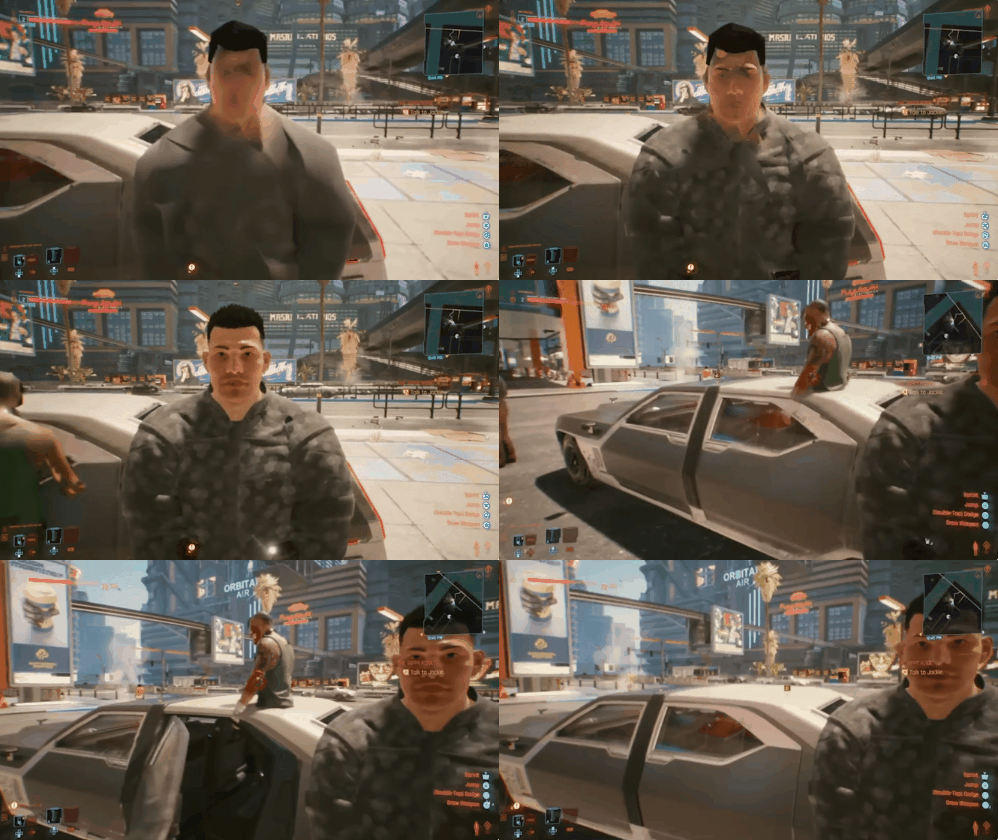
This dramatic fall from the heights to the depths is a moment worthy of note in the history of gaming. After earning the nickname “Polish Donkey” through The Witcher series, CDPR’s reputation—built up over many years—was severely called into question that day by both players and various stakeholders in the industry.Even the platforms weighed in: Xbox announced a full refund policy, while Sony went so far as to pull the plug, completely removing the digital version of *Cyberpunk 2077* from its store.
It was CDPR Co-CEO Michal Nowakowski who received that call from Sony. To this day, he still considers it one of the darkest moments of his career—and indeed, of his entire life.But in an interview yesterday with Deconstructor of Fun, he candidly took responsibility: While there has been a lot of speculation from the outside, the root of the problem lies entirely within the company—it’s not the investors’ fault, nor the engine’s, nor the pressure from players’ expectations. It all comes down to the development process they built themselves and the overly optimistic project timeline.
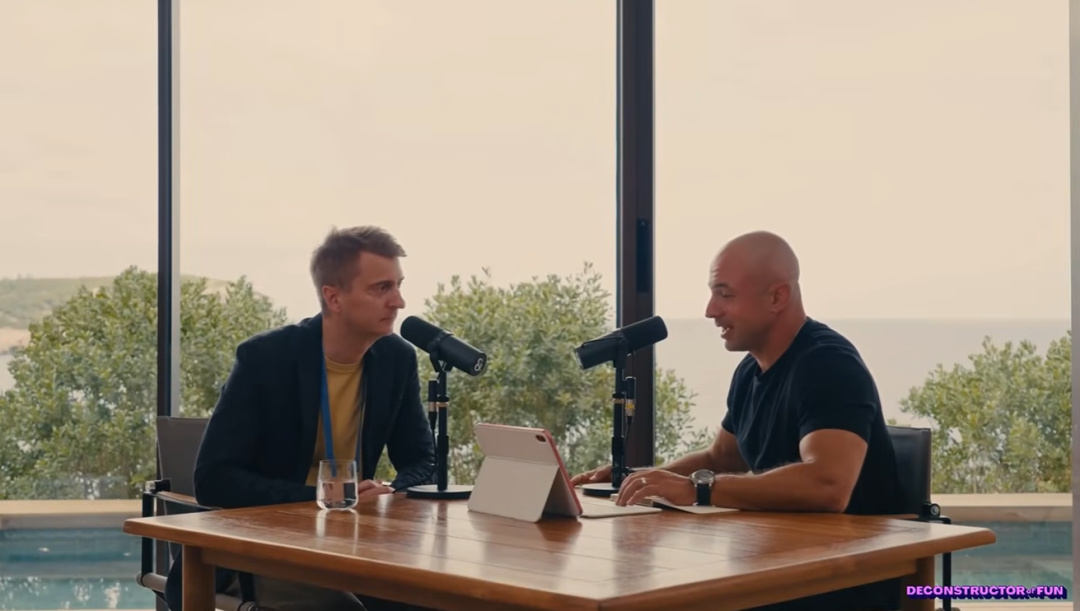
On the left is CDPR Co-CEO Michal Nowakowski
As the person at the very center of the storm, he addressed nearly every issue. He also discussed how the team dealt with the failure afterward and worked to salvage the game’s subsequent sales;how they improved their processes, continued to refine the product, and gradually rebuilt trust—until the remastered version of *The Witcher 3* and its new DLC once again drew cheers from the entire audience at Gamescom—which is perhaps the part most worth remembering. Below is Teahouse Editor’s compilation and translation of this interview.
01
“Prologue”
Michal Nowakowski joined CD Projekt more than 20 years ago, in 2005, and is now the company’s co-CEO.In December 2020, he was in charge of business development and investor relations—which meant he was the one who took the call when Sony removed *Cyberpunk 2077* from the PlayStation Store.It was 1 a.m. He recalls that time as one of the worst three weeks of his life. Not the worst of his career—the worst of his life.
I had expected to hear a story of redemption. Instead, what I got was a precise analysis of the following questions: Why did a studio that had previously done an excellent job with three games end up botching its fourth? Why are most of the popular explanations wrong? And what exactly makes Poland’s game development ecosystem perhaps the best in the European Union?
02
The popular belief is wrong
Three years after one of the worst game launches in industry history, *Cyberpunk 2077* has sold 25 million copies and even won a major award.
Let’s start with the explanation that comes to everyone’s mind. CD Projekt is listed on the Warsaw Stock Exchange, and the market had long taken “Cyberpunk” for granted; the game shipped 13 million copies within ten days, only to be subsequently removed from first-party stores.The stock price has fallen by about 75% from its peak. The most obvious conclusion is that pressure from the public market forced the release of a game that wasn’t yet finished.
Nowakowski categorically denied this claim. “A lot of people say that investors forced us to go public,” he told me, “but that’s simply not true.”His argument was that the board had full flexibility to postpone the IPO date, and that investors were rational—they wanted a job well done, not one done early. Nor did he point the finger at anyone else. “We shouldn’t have pressed that IPO button in the first place.”
The “pressure theory” is very convenient. It allows management to portray itself as a victim of the shareholders. He is reluctant to accept this explanation, and I believe him, because what he has chosen to blame instead is even harder to admit.
Starting in March 2020, Poland went into a full lockdown. Working in offices was effectively prohibited. Hundreds of developers relied on Slack and video calls to complete one of the most complex open-world games in history.
And the price he paid for this was precisely the most important point he made on his podcast: After the game was released, some people came forward and said they had known about this or that issue all along, but it seemed that no one could see the bigger picture.
“It seems no one really sees the big picture. Because of the lockdown, everyone is working remotely for the first time. Everyone sees only scattered fragments. No one has stepped forward to say, ‘In this movie, we are the Titanic, so don’t do that. We’re heading straight for an iceberg.'”
This is the root cause of the failure. It wasn’t overtime, greed, or a broken engine. A game of this scale is, at its core, an integration problem, yet CD Projekt was still operating under a waterfall-style workflow at the time—art, audio, and technical teams worked in relative isolation, only to be assembled at the very end.This model worked perfectly for *The Witcher 3* because everyone was in the same building at the time, and experienced team members would walk between floors and spot the gaps. Remote work didn’t make people lazy. It eliminated the people who could see the whole board.
The second mistake was relying on past experience. They knew there were bugs and used *The Witcher 3* as a reference—which was also rough at launch but was polished up within a month. They allocated only one or two weeks’ worth of work for the patch. But what they were really up against was a memory architecture that didn’t fit within the PlayStation 4’s limits.
There’s a myth here that needs to be debunked: the switch to the Unreal Engine 5 wasn’t caused by *Cyberpunk*.Nowakowski made it clear that their in-house REDengine wasn’t the problem; the issue lay in the failure to resolve specific streaming and memory limitations before launch. This shift stemmed from Epic’s stunning *The Matrix* demo, as well as the company’s realization that it never intended to venture into the technology business in the first place.
There are indeed some genuine process iterations that are less suitable for citation but have a greater impact: First, milestones are now binary—an alpha version that’s 90% complete isn’t an alpha; it’s a failure. Everyone knows why, and then it gets fixed.Second, development is geared toward three major platforms from day one, rather than being developed on PC first and then adapted for other platforms.
03
The True Cost of Redemption
My favorite part of this story is that they never cut their losses. No pivots, no overhauls—just four years of continuous patches, an expansion pack that sold 10 million copies, and a game that went on to sell over 30 million copies.
Nowakowski himself burst that bubble of romanticism. They knew the game was well-designed; the problem lay in the technical aspects. The core question was: “Can we afford—financially—to keep going [and fix a game that’s already been released]?” The answer was: Yes, so let’s do it.The 13 million copies sold at launch ultimately provided the funding for this overhaul. He stated bluntly that if the game had been a complete commercial failure, they would have done what any business would do—move on.
So, the lesson isn’t “never give up.” The real lesson is this: a failed launch backed by genuine demand is entirely different from a failed launch of a game that nobody wants. Perseverance is a decision you can only make while you still have the financial means to do so.Anyone who reads this passage as “it’s okay to keep pouring resources into a project that has already been rejected by the market” has completely misinterpreted it.
A better motivation is the line Michal added at the end, almost as an afterthought. It’s not just for the fans. The team spent years working on something they believed was special, and the creators refused to let it go down in history as a failure. I’m not sure if that counts as humility. I think it’s actually the exact opposite.
04
Cross-media adaptations—and the two ways they can go wrong…
These days, when most studios discuss adapting game IPs into films and TV shows, they focus on success stories. CD PROJEKT RED is a rare exception: within a single company, you can see two different patterns of failure playing out simultaneously—and neither is what people would expect.
The first scenario is when a company owns the IP but not the adaptation rights. The *The Witcher* series on Netflix is not a CD Projekt production. Sapkowski, the author of *The Witcher*, never sold the TV rights to them, so the largest audience event in the series’ history was capitalized on by a completely different party.CD Projekt secured a few Easter eggs, engaged in some peripheral collaboration, and used this to drive a massive surge in sales for a game they’d developed years earlier. But it had no control over the creative direction, the casting, or any of the decisions that ultimately divided the fanbase. That was a windfall, not a strategy.You can’t plan a decade around a show you don’t own, and when the show’s quality declines, you’re the one who bears the brand damage.
“Cyberpunk: Edge Runners” is the counterexample—and the true model. “Cyberpunk: Edge Runners” was funded and fully controlled by CD PROJEKT RED.They wrote the script, co-financed the project with Studio Trigger, and controlled the release timing—timing it to coincide with a game they were trying to revive. It was a successful TV series and boosted sales. The difference between the two projects lies not in quality or audience size, but in whether the company had a seat at the table.
The second type of failure is the “Disney-style” one—and when I refer to Disney’s business model as a failure here, I’m being quite generous. What I mean is this: a media company creates a flywheel; the flywheel begins to generate more profit than the core business, and so the core is hollowed out.
He was reluctant to criticize Disney directly, but he didn’t deny that this model exists. His response was structural: CDPR’s management board sets a few priorities each year, and game development is always deliberately placed at the very top of the list as a reminder.
In terms of numbers, this is still relatively easy to achieve. Lifetime revenue from merchandise runs in the tens of millions, while revenue from games runs in the billions.The real test comes at a moment like this: when a particular licensed product line generates enough profit that industry veterans begin advocating for it at planning meetings. I don’t think Disney decided to become a theme park company. It drifted there bit by bit, through one seemingly reasonable quarter after another.
What’s keeping all of this together right now is rejection, not ambition. Three IPs, not ten. Nowakowski has made it clear that growth comes from making each game better, and that having ten series does not equate to growth.
He also candidly outlined the order of priority: *The Witcher 4* is already in deep production, *Cyberpunk* is in early production, and “Project Hadar” has only just moved beyond the IP development phase.This is a project moving full steam ahead, with two more phases to follow—which is entirely different from three parallel ventures.
The Hadar Project is the real test: whether all of this is a replicable capability. *The Witcher* is based on a novel.*Cyberpunk* is based on a tabletop game. Both come with their own worlds, distinct tones, and established audiences. Hadar has none of that, and CD Projekt must now build a universe from scratch while also proving its ability to manage a franchise portfolio. These are two challenges the company has never tackled simultaneously.
And this is precisely where I see the risk.*The Witcher 4*, *Cyberpunk 2*, the Hadar Project, comics, animation, a live-action project, and external partners working under supervision on CD Projekt’s licensed IP—taken together, this scope of operations was far greater than what the company could handle in 2020.And in that year, no one could see the big picture. The corrective measures they implemented—a binary milestone gatekeeping system and bringing managers back into the office—addressed visibility issues within a single production. They clearly did not resolve the visibility issues spanning across six projects.
Of CD Projekt’s three universes, two came with an established audience, which means that no one—including the company itself—knows whether the past two decades have been about “world-building” or “excellent adaptations.”The Hadar Project will answer that question. If they mess it up, they’ll still be an excellent studio—one that simply needs someone else’s creative spark to set the world ablaze; if they pull it off, they’ll become one of perhaps only five companies on Earth capable of “creating” a franchise from scratch. As far as I’m concerned, it’s a gamble worth taking.
05
Poland, and That Thing He Underestimated
I tried to find a structural explanation for Poland’s ecosystem, but Michal wouldn’t give me one.
When it comes to top talent, the argument of “cheap labor” has long since fallen flat.CDPR uses the UK as a benchmark for European salaries but pays U.S. salary levels in the United States, as it competes for talent on a global scale. According to him, what remains is the 1980s 8-bit computer culture, a mathematical tradition that flourished during the communist era, narrative skills, and a hunger for success.
And that “hunger” is precisely where our disagreement lies. He mentioned that a Turkish colleague had described exactly the same driving force, and that is exactly the point. Every founder from any thriving market will talk about “hunger.”It’s a constant, not a differentiator. When that hunger is sated, it turns into complacency. And complacency sounds exactly like competence. It says: We’ve done this before, we know the playbook, and now we can work smarter, not harder.Then, someone even hungrier comes along and does something you were too “experienced” to dare attempt. I witnessed this firsthand in Helsinki: Finland’s unrivaled gaming ecosystem crumbled to pieces in just a few short years.
What Poland has—and what other European countries lack—is a domestic public market willing to invest in games.CD Projekt turned the Warsaw Stock Exchange into a gold rush, allowing a generation of studios to secure capital without having to seek approval from any Western publisher. This was a structural phenomenon, but today, that channel has essentially closed. He acknowledges that it is much harder to list a game company on the Warsaw Stock Exchange today. The next generation will not have access to the financing pathways that this generation once enjoyed.
On the other hand, the IPO they fought so hard to achieve back then has now become a burden. Having a market capitalization of 20 million euros on the Warsaw Stock Exchange but no daily trading volume—that’s not what you’d call “raising capital.”It entails quarterly reporting obligations, a publicly traded share price that anchors every acquisition negotiation, and the requirement to disclose their roadmap and KPIs to competitors. Going public was supposed to be a way out—a means of “no longer having to seek approval from Western publishers”—but it has instead turned into a different form of dependence.
True “output” is psychological in nature. One of his most insightful remarks concerned a phrase he grew to dislike as he was growing up—the Polish media’s tendency to label any successful person as “the Polish Steve Jobs” or “the Polish Bill Gates.”CD Projekt’s contribution to its ecosystem isn’t capital, nor even talent. It’s proof that you don’t have to be the “Polish version” of anything.
Nowakowski’s interview began and ended on the same note: he insisted that nothing should be taken for granted and that everything so far was just the beginning. That’s the right attitude.
06
“Nothing can be taken for granted.”
We like to distinguish between conviction and delusion in hindsight, and then retell the story as if leaders knew exactly what they were doing. But more often than not, they didn’t—at least not entirely.
Back then, Nowakowski expected *The Witcher* to sell three million copies, and they privately speculated it might reach six million in lifetime sales. Yet they sold six million copies in just six weeks.This man, who was once an indispensable member of the team that built one of Europe’s most valuable IP portfolios, was off by an entire order of magnitude in his prediction of their own explosive success—and he says that anxiety has never gone away.This isn’t false modesty. It’s an accurate interpretation of the fact that “even people inside the building can see very little.”
I kept reflecting on this phrase: “Nothing can be taken for granted.” During this interview—in which he had every reason to celebrate his victory by parading around the track—Michal said it four or five times without anyone even asking.
In my view, the most enduring asset CD Projekt has created is not an IP, not an engine, and not the team that adapts IPs. Rather, it is an institutionalized commitment to never settling for complacency. And this, precisely, is the kind of asset that has an expiration date, because it resides in people—not in processes—and those people will eventually move on.
That said, this is precisely the point of the “Hadar Project.” Building a universe from scratch is exactly the kind of project that someone who “feels safe” could never accomplish—which means that CD Projekt has set itself the very challenge most likely to reinforce its own culture.
(From Deconstructor of Fun, “Why Did None of Us See the ‘Cyberpunk 2077’ Meltdown Coming?”)
Original URL:
https://www.deconstructoroffun.com/blog/why-none-of-us-saw-cyberpunk-coming-apart)
原创文章,作者:gameteahouse,禁止转载:https://youxichaguan.com/en/archives/208137