To this day, *The History of Chinese Video Games* remains the only published work in China that systematically chronicles the history of the Chinese gaming industry.Published in 2018, this monumental work spans over 600,000 words, documenting landmark events in Chinese gaming history—such as the MUD craze of the late 1990s, Target Software’s *Aoshi San Guo* becoming the first domestic game to be exhibited at E3 in the year 2000, and Chen Tianqiao’s entrepreneurial journey. For those seeking to trace the evolution of China’s gaming industry, this book is increasingly becoming the sole reliable source for many of these events.
The historical fragments—such as firsthand accounts from those involved—scattered across articles on portal websites and posts on online forums are gradually being eroded by time into shifting sands. Author Wang Yahui told Teahouse that he is currently compiling the third edition of *The Rise and Fall of China’s Gaming Industry*, but as he works, he has discovered that a significant portion of the online sources he cited back then are no longer accessible, and early gaming magazines are becoming increasingly difficult to obtain. It was only then that Wang Yahui finally began to feel the weight of his role as a chronicler of history.

Some of the reference materials Wang Yahui used while writing *The Rise and Fall of China's Gaming Industry*
However, this is not the story of an author who has spent years in solitary meditation, poring over old books—even though that is the image people generally have of researchers.I first met Wang Yahui at a Jike offline expo last year. He was there to showcase his self-developed indie game, *The Invisible Room*, and there was quite a line at his booth. This was his first indie game. He has over twenty years of experience as a hardcore gamer, but aside from his role as a player, much of his life’s trajectory over the past decade or so has not intersected with gaming.
Almost every few years, Wang Yahui takes on a new role: originally a programmer, he has served as CTO of an online education company and founded startups in three different fields, with his longest stint in the comic book industry. He is a prolific writer; Douban lists 12 books authored by Wang Yahui, all of which have ratings hovering around 8 out of 10.
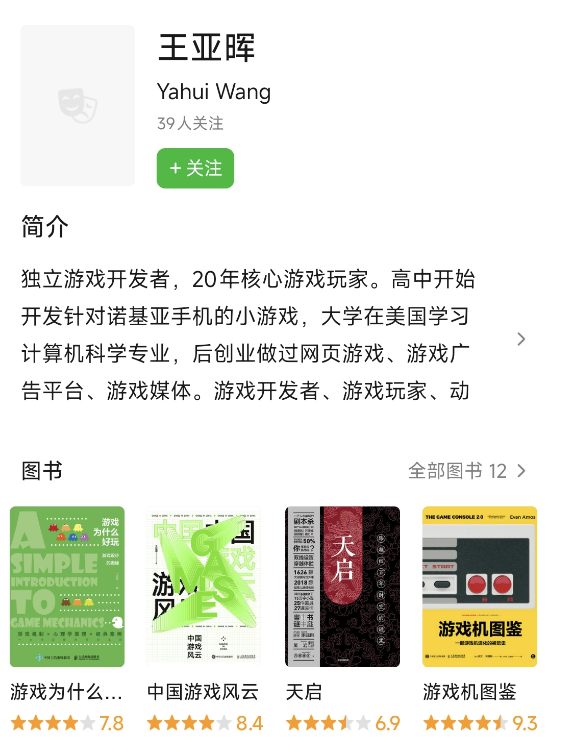
This is enough to make him seem like a prolific author in the eyes of others. But Wang Yahui says he rarely brings up the topic of his writing with friends—after all, someone who writes about games but has never worked at a game studio is unlikely to be seen as a core “insider.”When I asked him why he didn’t seek a job at a major studio, he replied that diving too deep into the industry and the grueling 996 work schedule would rob gaming of its joy. In fact, writing isn’t even Wang Yuhui’s main job or source of income; the nearly 10 million words he has published to date were mostly written casually in his spare time.
When faced with life’s decisions, people tend to weigh various factors against one another. Wang Yahui, however, almost always considers only “enjoyment”; he is accustomed to placing himself in a comfortable, unhurried position. His judgment of what constitutes enjoyment is intertwined with his personal ideals of how the world should be, as well as his subjective likes and dislikes.
Over the course of more than a decade, this personality gradually shaped his nomadic life—unpredictable, chaotic, yet extraordinary.
01
Startup
Shortly after leaving college and entering the workforce, Wang Yahui launched his first startup. In his Zhihu profile, he described himself as a computer science major at a U.S. diploma mill (though it was actually a decent public university). Around 2012, he secured funding, graduated, returned to China, and founded a company.
He felt a touch of nostalgia for those days—an era of mass entrepreneurship and innovation, when starting a business was simpler and more straightforward. A flood of hot money was surging through the market in search of opportunities. As long as you had a decent business idea, a single phone call or WeChat message was often all it took to secure funding.
For their first startup, he and his partner decided to launch businesses in both the B2C and B2B sectors. They hoped to build a mobile game advertising platform for the B2B side, while the B2C side would be a community called “Mengua Ai Youxi.”In an era when developers were focused on user acquisition and distributors demanded commission rebates, “Mengua Ai Youxi” had a grand, idealistic vision: they planned to attract a large community of dedicated gamers in the early stages through high-quality game news and other content, and later monetize the platform through low-cost game publishing and community management.
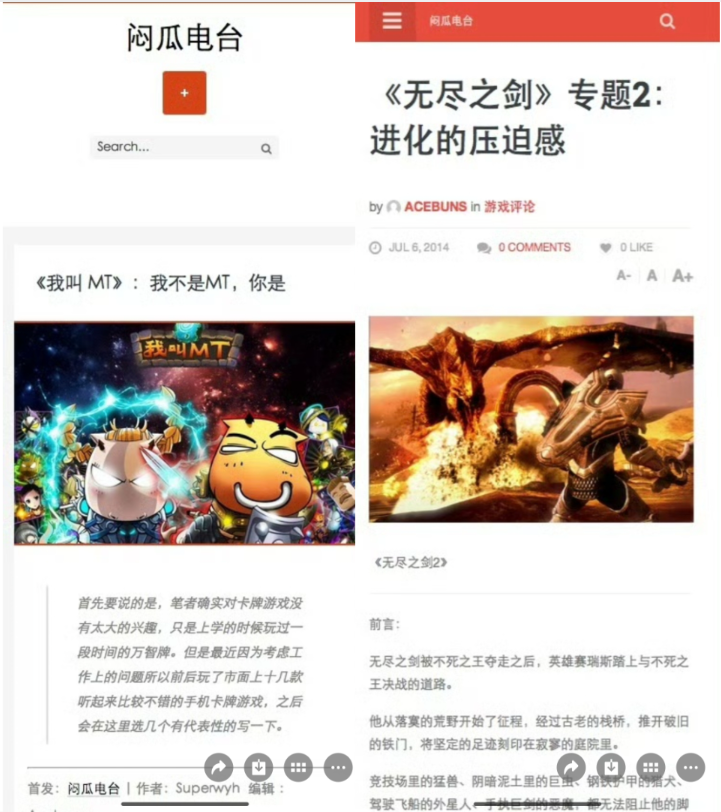
Mengua Loves Games
But after about two years, the venture came to an end. The advertising platform initiative stalled due to a lack of business—Wang Yahui and his partners weren’t particularly skilled at negotiating with companies like seasoned salespeople. Meanwhile, in terms of promotion, he found that “Men Gua Ai Youxi” was struggling to grow—players weren’t flocking to the game as quickly as expected.
This isn’t necessarily a problem at the product vision level. At that time, mobile gaming was still in its infancy, and the domestic market was dominated by lightweight gacha games like *I Am MT*. Players of these games didn’t have much need for community discussions. Moreover, the quality and quantity of domestic games were still insufficient to sustain dedicated discussion communities.
“Eventually, everyone will gravitate toward large, all-encompassing communities, where they can discuss whatever they want in a corner,” Wang Yahui reflected later. Compounded by the fact that another partner was based in the United States and too busy with his marriage and family to attend to company affairs, the partnership between the two grew increasingly strained. Finally, one day, they made the decisive decision to shut down the company and part ways.
But Wang Yuhui did not succumb to regret and anxiety like most entrepreneurs; instead, he felt “as if a weight had been lifted from his shoulders.” Judged by today’s investor standards, Wang Yuhui is not the ideal entrepreneur: he lacks boundless ambition, a bloodthirsty hunger for success, and the “do-or-die” determination, among other qualities.
For example, the year after “Mengua Ai Youxi” shut down, Xindong officially launched TapTap—Wang Yuhui felt that TapTap was virtually the embodiment of his vision for a gaming community. But as for himself, he didn’t stick it out until the day when the landscape of China’s gaming industry shifted and the public’s demand for gaming community platforms began to emerge. He also couldn’t quite understand why some of his peers who had started their ventures around the same time were able to persevere for over a decade in an environment where the future seemed completely uncertain.
He lacks the “desperation” required to embrace risk and subconsciously leaves himself an escape route. He has not signed any performance-based agreements with investors, which is why he was able to walk away with a clean slate after his startup failed—though, for an individual, risk aversion is not necessarily a negative trait.
Even as a boss, Wang Yahui doesn’t possess much of the “thick-skinned and ruthless” attitude typical of managers. He believes that a boss can be friends with his employees. Although his forthright nature sometimes leads him to scold employees to their faces, almost every time afterward, he takes the initiative to buy them a gift and apologize. “It’s always about the issue, not the person,” he says.
His second job came shortly after, when he joined an online education company that “later became infamous” as its CTO; he left after six months due to a clash of philosophies with the boss—though, reportedly, that boss and other members of the executive team were later wanted or arrested for their involvement in a “fundraising scam” a few years later.
In 2016, he joined a comic startup called Zongmanxian as a partner in China, focusing on the import and export of comics and the trading of American comic book copyrights. As a longtime comic book fan, he felt right at home at the company. He doesn’t recall many moments of anxiety about running the business, but he was delighted to meet friends from various corners of the comic book community through his work.
The company enjoyed six years of success, having once partnered with DC and gained a modest following in the American comic book community; however, it was unable to withstand the challenges of a harsh external environment and ultimately fell victim to the severe impact of the pandemic and the tense international political climate.
Wang Yahui feels that every time a company goes bankrupt, it has a profound impact on him. However, he doesn’t shy away from discussing his past entrepreneurial failures with others. “It’s more like leveling up in a video game—it’s just one of the challenges I’ve overcome.”
He paused for a moment. “Returning to China to start my own business back then was an impulsive decision. Rationally speaking, joining an internet company would have been a better career path for me. But if I were to go back to that moment in time, I would still choose to start my own business—and I would still fail.”
More than a decade later, having lost that initial drive, he decided to follow his heart more wholeheartedly and “do what he loves.” “Wang Yuhui the boss” stepped down from the stage, and “Wang Yuhui the creator” chose to embrace his true self—which may well have been the better outcome.
02
Contradiction
Wang Yahui is more of a creator; like many creators, he is complex and full of inner contradictions.
For example, despite his background as a programmer, he still writes code and keeps up with the latest developments in AI technology. He says that people should look to the future rather than dwell on the past, and he occasionally deletes all his posts and content on social media; yet at the same time, he has written several books on history.
He often describes himself as a science major, yet every few years he picks up a new hobby related to the humanities—in addition to his research on video games, he has spent many years studying Mediterranean history and folklore, having read nearly every specialized book on the subject available on the market. Half of the books Wang Yahui has published himself are on topics related to video games. In addition, he has written popular science books on mathematics, computer science, and other fields, as well as his own puzzle books and novels.

Wang Yahui's reading history on Moments

Even today, he occasionally takes on the role of a sociologist, striking up conversations with people on the streets and online—such as former employees of 1980s domestic video game console factories, internet café owners, and “internet-addicted teenagers”—and then turns his observations into essays published on platforms like *DuKu*.
When I asked him what motivated him to write, he replied, “To cultivate my character and nurture my spirit.” He explained that if he weren’t writing books, he would spend that time posting on Weibo and Zhihu and arguing with netizens; by channeling that time into writing books instead, he feels no pressure—it’s actually a meaningful endeavor—so he’s been able to stick with it.
This somewhat unexpected answer brings to mind Haruki Murakami’s self-reflection in *What It Means to Be a Professional Novelist*, where he describes getting up early every day to go for a run and write ten pages of manuscript.“Writing is a private matter”—this is a belief shared by both Haruki Murakami and Wang Yahui. Among the more than ten books Wang Yahui has published, some were his own ideas, while others were commissioned by publishers. “But even when it comes to commissioned work, I absolutely refuse to write anything I don’t like.”
If you look at the publication dates of his books, you’ll see that Wang Yuhui wrote the vast majority of them while he was simultaneously running his business and working. Moreover, he wrote almost all of them purely out of personal interest.
*The Rise and Fall of China's Gaming Industry* is his first officially published book; in fact, it originated from a gaming culture column that Wang Yahui serialized on "Mengua Ai Youxi" years ago. He later reorganized and compiled the material into this substantial volume.
In the preface to the second edition, he recounted the following story: The editor at the first publishing house he approached told Wang Yahui, “You have no writing experience; you can’t handle a project of this scale.” Later, after finalizing a deal with another publisher, he would repeat those words to himself every day before putting pen to paper, and then use his passion to push through the doubt.
His daily writing routine generally goes like this: he works during the day until dinnertime, then begins writing after dinner; he writes for two or three hours each day, setting a weekly goal of 20,000 to 30,000 words. If a project involves a large amount of research material, he spends two or three months organizing all the information and compiling it into index cards, then writes the entire book in one go. He repeats this process day after day.Wang Yuhui says that for the dozen or so books he has written so far, each one has been completed on schedule according to this predetermined plan, without a single delay.
This contradiction is once again evident in Wang Yahuai. At first glance, it is difficult to discern any clear sense of purpose in Wang Yahuai’s life. As an author, he does not write out of “obsession” or a specific sense of historical responsibility or purpose; he does not even write for money—Wang Yahuai says that the royalties he received for *The Rise and Fall of China’s Gaming Industry* were likely barely enough to cover the cost of the reference materials he used to write the book.After *The Rise and Fall of China’s Gaming Industry* was published, he simply felt “it was a thrill to finish a book like this,” and then set out to write a second and a third.
Yet amid this apparent chaos, once he identifies something that piques his interest, he displays a surprisingly disciplined self-control and sees it through to the end. In the terms of the popular MBTI personality test, he embodies both “P” and “J” traits, switching between them on different levels. It is precisely this version of Wang Yuhui who has achieved what no one else in China’s gaming industry has ever accomplished.
03
Home
In less than a month, Wang Yahui’s indie game *The Invisible Room* will launch on Steam. This marks the first time he has officially taken on the new identity of “indie game developer”; his life’s journey has once again led him to uncharted territory, and this is yet another transition that is quintessentially Wang Yahui.
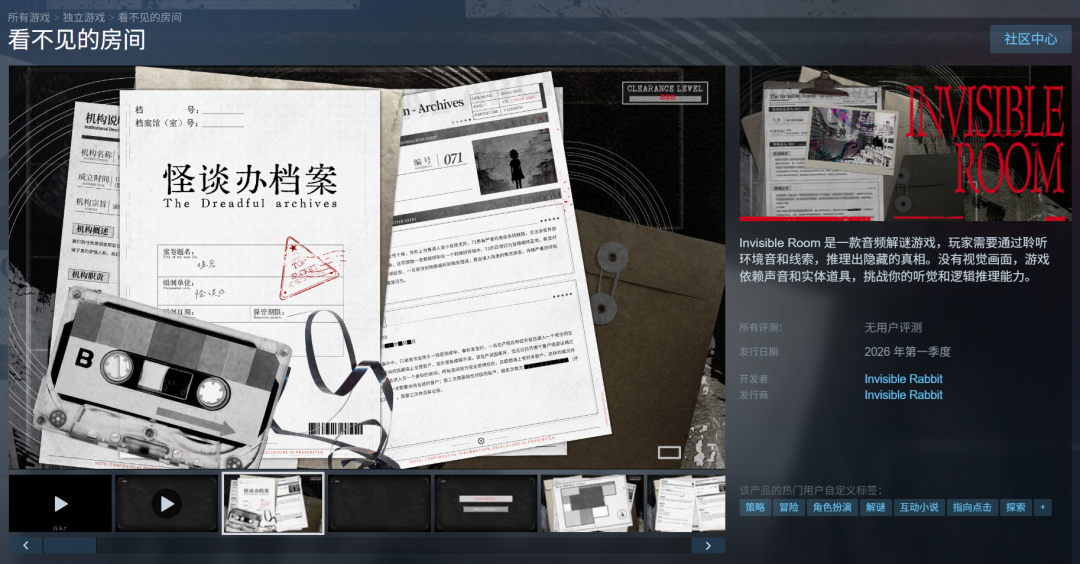
He felt that after two failed startups, he had come to realize one thing: people should follow their hearts more wholeheartedly. Making games had always been a dream deep in his heart that he had yet to pursue. Wang Yuhui told me that he had a list of life goals, and most of the items on it—such as starting a company or writing a book—had already been accomplished by the time he was in his twenties.
At the bottom of the list is a goal: to develop his own AAA game. Wang Yuhui feels that achieving this goal in his lifetime is now very difficult. But by making indie games, he has at least taken a step in that direction.
So he founded a studio called Invisible Rabbit—though “studio” is perhaps a bit of a stretch, since aside from a few friends who pitched in, he was the only core member, which perfectly fits the definition of an indie game. He handled the programming and writing, while his friends helped with sound design and art. Wang Yahui established one guiding principle for this “studio”: to create gameplay that would absolutely surprise players. And *The Invisible Room* certainly delivered on that promise.
I got to try out a demo of this game at last year’s Jike “Unfold and Play” expo. After I took my seat, Wang Yahui first handed me a pen and a folder containing pre-printed documents and a floor plan.With a touch of surprise, I looked at the screen, which displayed only a simple UI—this is a game that relies entirely on audio to progress. There is no visual information on the screen; you move through a dark room, gathering information from your surroundings through your ears, jotting down notes on the floor plan in your hand to figure out where you are, and then finding a way to advance the story. The experience is somewhat reminiscent of a highly deductive murder mystery game.
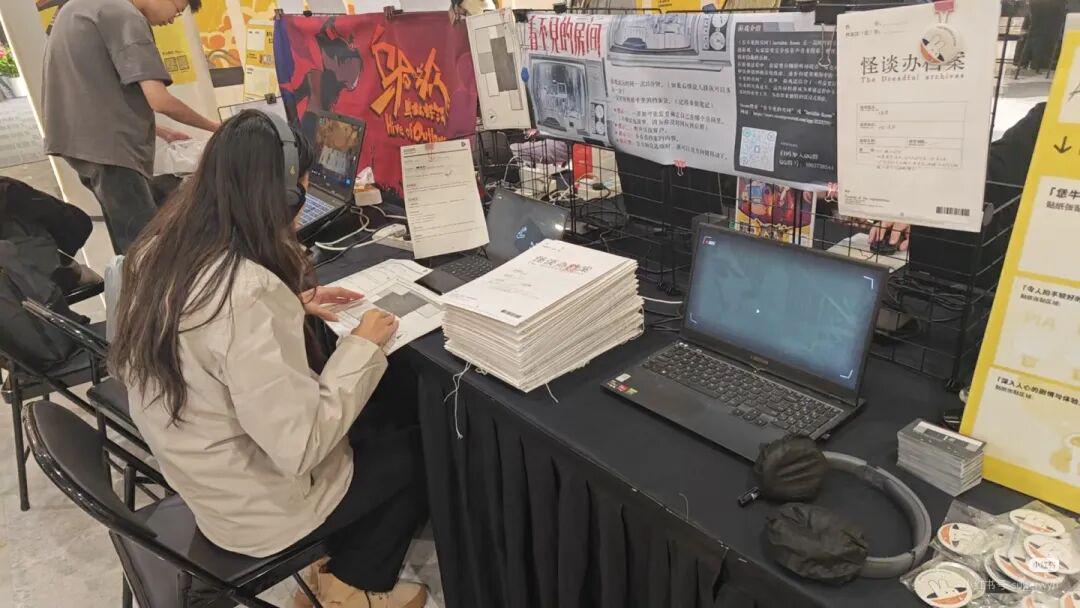

It’s quite simple, yet ingenious.One phenomenon underscores the uniqueness of *The Invisible Room*: by the end of the two-day Jikexue Expo, players had covered the game’s display board with a dense layer of voting stickers. Based on the tally, Jikexue awarded *The Invisible Room* three prizes, meaning it received the highest number of votes and was one of the most talked-about titles at the event.
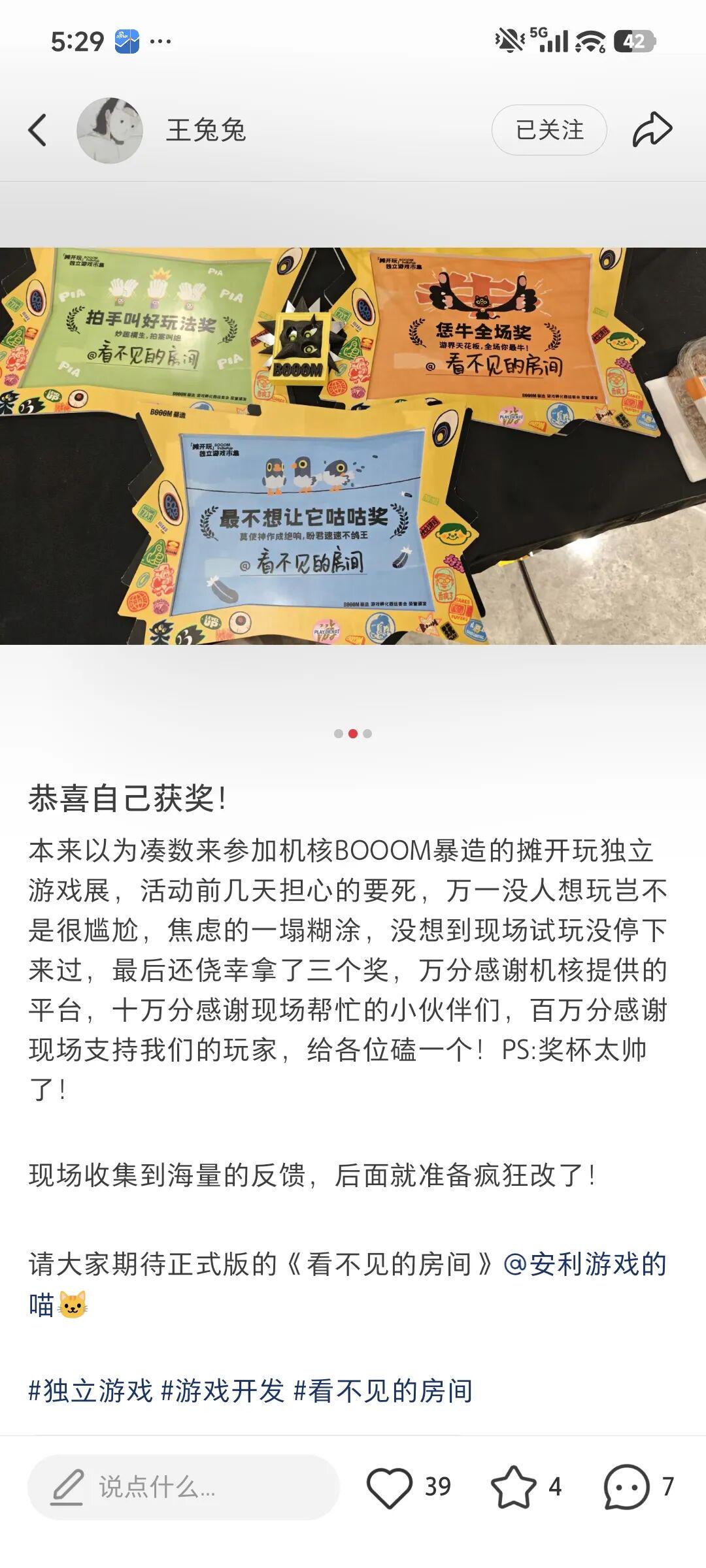
Some players voluntarily shared Wang Yahui’s Xiaohongshu posts, which garnered hundreds of likes, while videos on Bilibili racked up tens of thousands of views—for a game with virtually no “graphics” to speak of, these figures demonstrate the product’s potential. According to modern best practices for professional indie game publishing, the developer should now focus on promoting the game through KOLs, building private communities such as QQ groups, and conducting proactive marketing campaigns… all of which will help maximize the game’s sales.
But Wang Yahui didn’t do that—or rather, he once again took the initiative to rule out certain options based on his own judgment. When I asked him about it, I learned that participating in the Jike Expo was practically the only promotional effort he had made for *The Invisible Room*—simply because Jike happened to offer him a chance to exhibit without paying a booth fee.
His response was that, first, he didn’t know how to market the game, and second, he had a “physiological fear”—he worried that this rather experimental approach would draw criticism from players who weren’t open to new gameplay styles. “Ideally, I’d be able to precisely target players who are open to this kind of fresh approach, but that’s very difficult to achieve.” He rarely speaks publicly and doesn’t even interact much with other indie developers. “They never get past three sentences before they start talking about funding.”
He prefers more niche international game conferences; he attends BitSummit every year, where he can talk face-to-face with developers and focus solely on game design. However, he also acknowledges that securing funding is an entirely legitimate need for most developers; it’s just that, from a personal perspective, he’s more drawn to “indie games.”
Consequently, he has no expectations or goals regarding sales. During our conversation, he mentioned that he hadn’t checked the game’s wishlist count in a long time—it’s probably close to 10,000.What Wang Yahui cares about are the future development goals he has set for Invisible Rabbit: to develop two small-to-medium-sized games each year and tackle one “big project” every two years. At the same time, he is also conceptualizing an interactive film-game collaboration with friends, and a board game developed in partnership with the National Museum is currently in the process of being released.
He told me that, compared to his previous entrepreneurial ventures, he now sees indie gaming as his true calling. Yet he still holds onto the dream of creating a AAA game. He has a game design document he’s been working on since childhood; over the past twenty years, it has grown to hundreds of thousands of words. From the historical setting and world-building to the gameplay mechanics, he can rattle off countless details. But turning it into reality is bound to be a difficult journey.Wang Yuhui’s life path does not lead toward large teams or big companies. He has chosen to live a simple life; whether making games or writing books, his only real expenses are his basic living costs. This makes his life stable and secure.
He has written a guide to optimizing resumes and, as an entrepreneur, has provided career coaching to others. I asked Wang Yahui, “Would you recommend that others follow in your footsteps by writing books and making indie games?” He shook his head, but for most people, he almost always recommends that they lead a more “conventional” life—joining a major tech company and becoming part of a sufficiently large organization.
Over the past decade or so, China’s gaming industry has surged forward. Yet one man, who has chronicled the industry’s history, has refused to become part of it. Wang Yahui walks a narrow path of his own, but at least the scenery along the way is anything but dull.
原创文章,作者:游茶妹儿,禁止转载:https://youxichaguan.com/en/archives/195607