By 2026, China’s MMO gaming market had become a widely recognized red ocean, with most developers grappling with the same growth anxiety: skyrocketing customer acquisition costs, a steady exodus of existing users, and a path to growth that seemed to have been cut off.
However, an older title from NetEase has stirred up a stir in the somewhat quiet Chinese MMO market.
In 2025, *Tianxia*, which had been in operation for seventeen years, saw its PC game revenue reach a ten-year high, having maintained steady growth for nearly five years and sustaining a rare upward trajectory among games in the same genre.
On December 17 of last year, following its comprehensive upgrade to *Tianxia: Wanxiang*, the game reached its highest point in recent years. Not only did it top the App Store’s Role-Playing chart after pre-downloads opened, but it also climbed to third place on the iOS Free Games chart on the day of its open beta launch.

The game's popularity far exceeded the developers' expectations. Servers were consistently at full capacity, with character creation in Server 1 of the Classic Edition temporarily overwhelmed by demand. The number of players far outnumbered the monsters, to the point where players had to form groups just to fight them.
However, the notion that this resurgence was merely a “hype-driven surge of nostalgia” does not apply to the comprehensive revival of *Tianxia*. Following the launch of the cross-platform version, the game’s PCU (peak concurrent users) surged to its highest level in nearly a decade, with both the number of paying users and the payment rate also reaching record highs.

The massive lines after the server launch
This means that a substantial number of players have demonstrated extremely high levels of satisfaction with the game and a strong willingness to spend money—including not only newcomers just getting started, but also a significant number of returning veterans who are going all out to relive their youth.
To reassure this group of middle-aged players and encourage them to return to the game, *Tianxia: Wanxiang* has spared no effort. For instance, the development team recognized that, due to the pressures of life and work, these players have reservations about returning. While they are willing to pay for the memories of their youth, they are also more afraid than ever that their investment—whether in time or money—will become a “sunk cost” due to game updates or their own decision to quit midway.
Therefore, *Tianxia: Wanxiang* has introduced a risk-hedging mechanism: insurance.
Yes, *Tianxia: Wanxiang* is the first game where you can purchase insurance through the in-game system.
First, the game has introduced the "Game Peace of Mind Insurance" program. Players who log in for a total of 180 days within 365 days of purchasing a gift pack will receive a full refund of the purchase price.
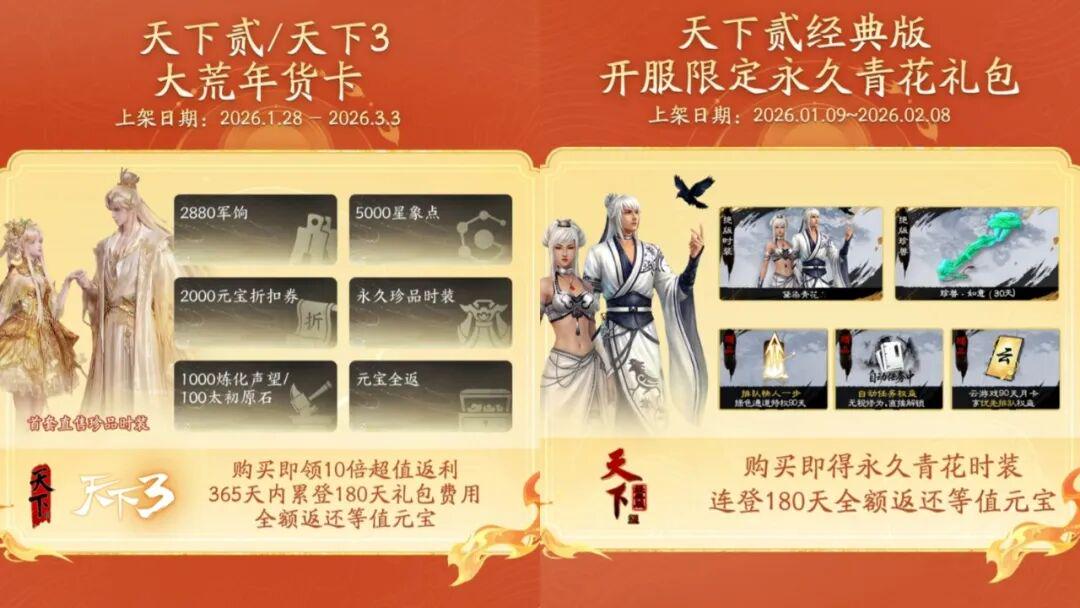
In addition, the game is giving away over 10,000 physical insurance policies to players for free during the Spring Festival. Players who log in during the holiday will have a chance to win one. These insurance services are provided by institutions such as Ping An Insurance, Pacific Insurance, and AIA, with policies offering coverage of up to 3 million yuan. They cover five key areas of daily life: medical expenses, Spring Festival travel, personal account security, household gas safety, and property safety.

During the Spring Festival, the game’s developers have prepared a heartfelt series of New Year’s events for veteran players of the Great Wasteland. Brand advertisements are now on display at major high-speed rail stations across the country. To ensure players are covered throughout their entire journey, *Tianxia II: Classic Edition* has partnered with Tongcheng Travel to offer customized flight packages, ensuring that every player returning home receives a blessing for a safe journey.

"Tianxia II: Classic Edition" even delivers blessings to high-speed rail stations, airports, and airplanes
In collaboration with over 100 Wanda Plazas nationwide, the event set up exclusive offline booths during the Spring Festival to distribute limited-edition Year of the Horse commemorative red envelopes free of charge. This allowed first-generation MMO enthusiasts to receive a grand and impressive Spring Festival greeting while traveling home or on family outings, bringing the spirit of the game into real life.


For middle-aged gamers, the considerations surrounding gaming are concrete and straightforward: login-reward mechanisms offset players’ anxiety about “wasted money” and sunk costs, transforming gaming from a potential drain on time and money into a manageable investment in the experience.
Not to mention the inclusion of physical insurance covering both family health and property, which directly addresses the real-world risks and liability concerns faced by middle-aged players.
In fact, very few games have ever shown this level of respect to returning players.
There’s a question on Zhihu with over a million views titled “What is life like for people who still play video games at age 40?”
In over 3,200 replies, middle-aged gamers opened up about their feelings.
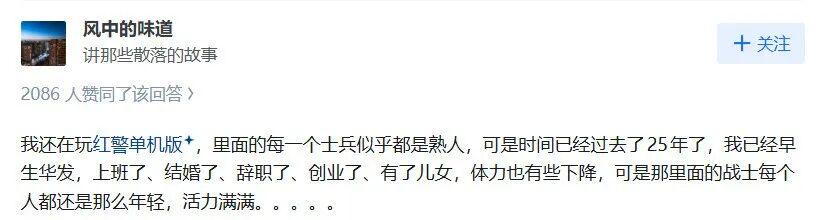
These veteran players, now entering middle age, are gradually drifting away from today’s gaming world due to the demands of physical stamina, careers, and family life; they often find themselves eager to play but unable to do so. As they grow older, their gaming habits have changed, intensifying their anxiety about falling behind and struggling to keep up; the rapid pace of game updates makes it difficult for them to stay current, and frequent system overhauls have erased the progress they once made.
But with investment cycles often spanning a decade, they have developed an unimaginable attachment to these older games. As a result, they place great importance on whether a game can offer them long-term, stable prospects.
At the same time, these players—who are generally over 30—represent a goldmine for MMOs. They possess both high spending power and a strong willingness to pay, and are willing to invest in long-term value; they have strong emotional attachments to classic IPs and are eager to relive their youth; they value community, and once bonds are formed, they demonstrate extremely high loyalty and lifetime value.
Therefore, for *Tianxia: Wanxiang*, a long-running MMO that has been in operation for seventeen years, providing excellent service to its middle-aged player base is the key to tapping into the deepest well of the existing market.
01
Bridging the gap between the needs of players of different generations
For domestic MMOs, especially those in the historical fantasy genre, any major changes are always a delicate matter.
The reason is simple: since MMOs often run for more than a decade, they tend to accumulate a large player base spanning multiple generations. Although they are all veteran players, there are actually generational differences in their aesthetic preferences, gaming experiences, and habits.
In many cases, catering to one group’s preference for “gradual progression and relaxed competition” inevitably results in long development cycles, high entry barriers, and slow feedback—which is not conducive to players who have limited time and seek fast-paced, thrilling combat. Conversely, the demands of another group—who want “instant gratification and combat-focused gameplay”—represent a significant mismatch in pace for veteran players accustomed to slow, steady progression and long-term management.
For most MMOs, this is the most difficult problem to solve; changes to game versions and mechanics ultimately boil down to a choice between a rock and a hard place.
In contrast, *Tianxia: Wanxiang* chose not to cater to either group. It abandoned the fantasy of creating a one-size-fits-all version and instead adopted an operational model based on server segmentation. Through a highly integrated yet distinct server ecosystem, it ensures that groups with different needs can each find their place in a dedicated environment.

For players seeking efficiency and craving immediate positive feedback—including many time-pressed middle-aged returning users—the game offers seasonal servers such as "Three Thousand Rivers of Weak Water" and "Securing the Mountains and Rivers."
"Weak Water 3000" is all about getting straight to the action. The traditional progression cycle, which typically takes 17 years to complete, has been drastically compressed so that players can catch up simply by purchasing a single level-up card. This allows players to quickly experience the core GvG (group vs. group) gameplay—featuring "1,000-player battles that start the moment you land"—and enjoy key resources provided for free by the game, such as Seasonal Soul Orbs, ensuring they get the most out of their limited playtime.

This directly led to the "Tianxia 3" seasonal server breaking the Guinness World Record for the largest single-game multiplayer battle—a record held by EVE for five years—in mid-2025.
In fact, to restore competitive gameplay as the game’s core focus, *Tianxia: Wanxiang* made a decision that went against its predecessors: it strictly limited the impact of in-game purchases, ensuring that spending money could not dictate a player’s experience. In the “Weak Water” update, the game removed all stat-boosting items from the store and capped monthly spending at less than 300 yuan, thereby keeping the advantage gained through spending within a limited range.

Strict economic mechanisms limit the extent to which spending power translates into combat advantages. As a result, the key to victory has returned to players’ individual skill, tactical strategy, and team coordination—a shift that upholds the values of older players, who believe that “time and skill investment should be protected.” The frustrating situation where no matter how hard you train, you’re destined to play second fiddle to the big spenders is now a thing of the past.
To accommodate these players’ busy schedules, *Tianxia: Wanxiang* has implemented several optimizations to reduce their daily workload. The game has first enabled cross-platform data synchronization across PC, mobile, and tablet devices, allowing players to seamlessly switch between platforms and maintain their progress during spare moments.
In addition, the game features a convenient one-click auto-play function that automatically completes a variety of high-frequency daily tasks. This feature can even be shared with the entire team, freeing players from repetitive tasks so they can focus their limited time on a more immersive gaming experience.
For another group of players, however, the game’s core appeal lies in the lengthy process of character progression. For these “purist” players—who spent their youth in the depths of the Great Wasteland, deeply identify with the classic 2008–2011 versions, and seek an immersive, slow-paced progression experience—*Tianxia: Wanxiang* also offers *Tianxia II: Classic Edition* servers.
This version is a remaster based on the original 2008–2011 edition.It places greater emphasis on a slow-paced experience and a traditional Chinese ink-wash art style. To prevent excessive power disparities from dampening player motivation, *Tianxia II: Classic Server* has created an environment with minimal power gaps. The cultivation mechanics and equipment system have been significantly streamlined, resulting in only a limited selection of gear, including World Sets, Battlefield Sets, Nine Heavens Weapons, the Dayu of the Celestial Realm, and Handcrafted Sets produced through life skills.

In addition, the economic system in *Tianxia II: Classic Edition* encourages free trading, production, and resource gathering among players, reviving the classic joy of progression that doesn’t rely on heavy microtransactions.
This is evident in the game’s community content, where a large number of enthusiastic players have directly revived the game’s exceptionally thriving economic ecosystem.For a long time, due to the decline of MMOs, low-threshold, stable-income “gold farming” opportunities had become rare. However, with the explosive popularity of *Tianxia: Wanxiang*, gold farming has made a spectacular comeback. Overnight, veteran players who have “worked hard, made money, and opened their eyes to wealth” have emerged across the vast wilderness of Dahuang.
As veteran players, a group of streamers from Xuxu Baobao Media were among the first to jump back into the game. Even Xuxu Baobao—the man who claims to suffer from 3D motion sickness—personally stepped in to farm gear. When these familiar faces gathered in front of the camera to tackle an MMO dungeon together, it left netizens wondering what era they had stepped back into:

Xu Xu Bao personally stepped in to clean the gear
To be honest, very few games in 2026 manage to create such a realistic, lifelike experience, let alone in the MMO genre.
This is precisely where the ingenuity of this “dual-track” strategy lies: rather than attempting to satisfy all the demands of different players at once, it allows players to make their own choices and find what suits them best. This not only significantly expands the product’s user base but also prevents the loss of existing users due to version updates, thereby maximizing coverage of the existing market.
02
Trust Built on Operations and Emotional Connection
In fact, for middle-aged gamers, there is another challenge that goes beyond the game itself. Because they find it difficult to use social media frequently or over the long term, their voice in public discourse and online communities is actually quite faint.
So, for game developers, simply making an effort to listen isn’t enough to gather feedback from players scattered across the far corners of the internet.
This is especially true for players who were once deeply involved but have since stepped back. They once proclaimed, “I have no regrets about joining Da Huang,” and poured their youth into the game. However, over the years, they have grown increasingly disappointed due to issues such as the game being “extremely time-consuming and pay-to-win,” “constant bugs,” and “a disconnect between marketing promises and the actual gameplay experience.”
They long to return to the game world that holds their memories and past experiences, yet they deeply resent being ignored; at the same time, they feel powerless to make their voices and opinions heard by the game developers.
For a long-running MMO, the trust of veteran players is a currency even more valuable than traffic. Therefore, the ability to rebuild that trust and provide emotional value that goes beyond mere transactions is key to determining whether they stay or leave.
In response to this, *Tianxia: Wanxiang* has proactively extended its operational support to players’ real lives and systematically rebuilt emotional bonds with long-time players through institutionalized, ritualized initiatives. Since 2024, the team has hosted over 90 player-focused livestreams and meet-and-greets annually, at a frequency of three to four times per week—a level of communication that is extremely rare in the industry.

During the development of *Tianxia II: Classic Edition*, the project team recruited over 10,000 core players to participate deeply as “investors.” They submitted a total of more than 500,000 words of specific suggestions covering gameplay, the in-game economy, and even the business model. The project team established a document tracking system and publicly responded to each of the 63 most frequently raised issues.

In response to player dissatisfaction, game producer Xing Yi bowed deeply at a preview event on December 3, 2025, to apologize for past issues, stating that he would “draw upon everything accumulated over more than a decade at NetEase” to restore the game’s former glory.

Behind this attitude of extreme candor lies a deep respect for players’ trust and their voices, as well as a strong desire for open communication and collaborative development.
In meeting players’ need for emotional connection and nostalgic resonance, the game has shown the utmost respect for the youth of players who lived through the 2000s.For example, they invited Han Geng, the 41-year-old original spokesperson, to return after a 15-year hiatus as a “veteran of the Great Wasteland.” As a long-standing Chinese idol, Han Geng’s career overlaps with the memories of many middle-aged players. In fact, a significant number of players in the community were drawn to the game because of Han Geng, and he himself was once an NPC within the game.

Not long ago, the game also invited "The Curator," a well-known influencer from Taiwan, to visit. Not only is he a middle-aged gamer himself, but his outspoken, down-to-earth nature—and his aversion to excessive hype—also resonates deeply with middle-aged gamers.
Throughout the tour, players see—through the curator’s eyes—the “sense of security” that comes from substantial technical investments. The curator witnessed cutting-edge technologies firsthand, such as the motion capture studio equipped with 94 high-speed cameras and high-precision modeling scanners. He was also amazed that a game that has been in operation for 17 years still receives such significant ongoing investment, proving that the world where longtime players spent their youth is still being cherished.

During a visit to NetEase's Shangri-La Studio, the director of the museum reflected on the development of *Tianxia*
In contrast, the director views Taiwan as a market dominated by “disposable games” (those with short lifespans designed for quick profits), whereas NetEase games—such as *Tianxia: Wanxiang*—have consistently adhered to a long-term operational strategy, providing middle-aged players—who lead busy lives and cannot switch games frequently—with a stable, predictable digital home.
It can be said that it is precisely this shared memory that transcends time and space that marks the greatest difference between middle-aged and younger gamers. Rather than seeking novelty and visual spectacle, what middle-aged gamers crave most in games is respect, meaningful communication, and a sense of belonging.
In this sense, what they need is not just an entertainment product, but a partner who understands their circumstances, respects their commitment, and is willing to engage with them as equals.
After all, for them, that ritualistic way of life has already left an indelible mark on their youth.
Conclusion
"Tianxia: Wanxiang" has proven through its own success that the depth of the existing market is far greater than anyone could have imagined.
This is an answer that isn’t really an answer, because at its core, it isn’t a set of technical or operational methodologies, but rather the game’s systematic respect for its players: using technology to respect players’ time, ensuring that middle-aged players no longer feel intimidated or unable to play, while acknowledging and embracing the differing aesthetics and preferences that have emerged from generational shifts over the past seventeen years; and using operations to respect nostalgia and memories, returning the power of choice to the players.
This also illustrates the more efficient and solid path that a mature IP takes when looking to the future: rather than stubbornly trying to attract a fickle, young audience in a crowded market, it’s better to shift focus and provide in-depth service to that group of loyal, long-time fans—who are more than capable of helping an established game return to a growth trajectory in its seventeenth year.
原创文章,作者:游茶妹儿,禁止转载:https://youxichaguan.com/en/archives/195548