On February 5, NetEase Games’ Joker Division launched the “Wandering Ship Test” for its new title, *The Forgotten Sea*.
While there are plenty of major releases kicking off 2026, NetEase continues to command significant attention. The topic of the "Sea of Forgetfulness" beta test surged into Douyin’s trending list, attracting nearly 10 million views. The in-game trailer released by the development team in early January quickly surpassed 10 million views on Bilibili.


This buzz has been driven primarily by the game’s impressive in-game footage—its bright, fantastical cartoon puppet style, its humorous and playful tone, the exploration of a vast world filled with diverse elements, and the numerous mini-games… This fresh combination of features and content instantly captured players’ attention. Of course, some skepticism was inevitable: “Isn’t this just making empty promises?”
Since the beta began a few days ago, I’ve been wandering through *Sea of Forgetfulness*.As I played, I couldn’t help but marvel: this isn’t just a teaser—it’s like getting a slice of a multi-layered cake to sample. I’ve hunted giant roosters in Otopia, bombarded massive tentacled monsters at sea, and solved puzzles in the White Sand Sea to help the hamster deity collect delicacies… Just as the trailer suggested, it feels like I’ll never be able to uncover all the gameplay mechanics and secrets hidden within *The Sea of Forgetfulness*.
While playing *The Forgotten Sea*, a thought often crossed my mind: As we all know, major game studios are currently locked in a fierce battle over the open-world genre. However, NetEase’s ambition this time doesn’t stop at simply setting a new standard in the existing direction. Rather, it seems to be an attempt to redefine the rules of open-world design through a content evolution that shifts from quantitative to qualitative change.
01
A series of endless adventures
Why do I say that? Let’s take a look at the open-world exploration experience in *Sea of Forgetfulness*. “Rich in content” is likely to be the first impression many players have once they step into the vast world to explore.
At the beginning of the story, the protagonist—the "Traveler"—is swept into the Sea of Oblivion by mysterious events. Although he is fortunately rescued by the locals of Otopia, he has lost all his memories. Later, during a clash with a local gang at a bar in Otopia, the protagonist meets the barmaid, Ais. The two then set out on a journey to discover his true identity, which also marks the beginning of their exploration of the wider world.
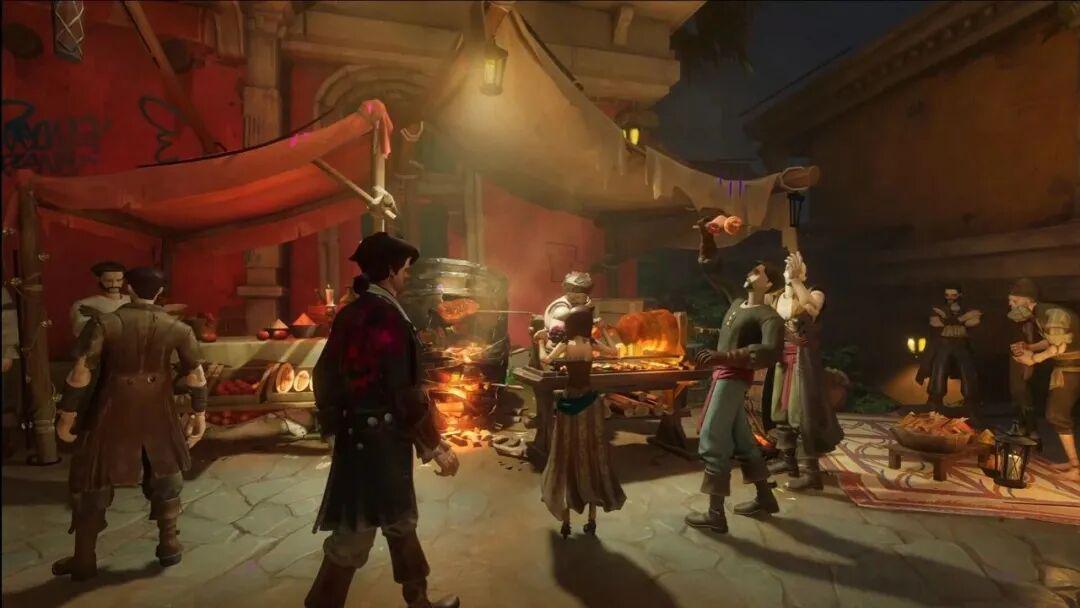
The story begins in the coastal town of Otopia—a bustling little town teeming with hundreds of local residents coming and going. The first thing you’ll notice is that none of them are merely static background models. Every resident is interactive; they each have their own unique personalities and backstories, as well as their own routines and rhythms of life.

You can approach them at any time to chat, stop people watching the fire-breathing show, and ask them about their experiences in the city. As you gradually get to know the town, you’ll discover more of its local customs and culture.Help the locals catch a runaway rooster, join the Golden Money Merchants’ Guild at the warm invitation of Merchant Jin, and get to know the owners of local stalls by cheering them on with quirky mini-games. As your reputation in the area grows, one day you might even open your own little shop here, giving you a place to call home in this unfamiliar land.

All over the city, you’ll find not only collectible treasure chests and various merchant stalls, but also unassuming holes in walls along the streets—interacting with them might reveal a character with a story hidden inside. If you give them gifts, play games with them, and build up your affinity just like in *Gala Ge Mu*, you can unlock exclusive storylines.They will guide you in exploring the secrets of this world, and your choices may steer their fate in different directions. As the protagonist, I could feel myself gradually immersing in the local culture and social networks—transforming from an outsider in Otopia to an accepted local, and eventually becoming a “jack-of-all-trades” navigating the complex web of rival factions.

There are also mini-game challenges you can play with passersby on the street—the people of Otopia really know how to have a good time.A rough count shows that during this test period alone, we were able to play at least a dozen different mini-games. Go-Go Chess, Ring Toss, a Gluttony Contest, and combat sparring; drinking octopus broth with a female sailor until we were tipsy, and playing a game of “Superpower Mahjong” with the indigenous people—most of these games perfectly balance the fun and depth of being “easy to pick up but hard to master.”

Given its high density of gameplay and content, *The Forgotten Sea* features an “onion-like” open-world structure—its approach to open-world design isn’t merely a matter of piling one element on top of another. It doesn’t list a dense grid of question-mark side quests on the map like a checklist-style open world, nor does it reduce gameplay to a “collection marathon” where you simply run around searching for collectibles.Instead, the developers have scattered vast amounts of content throughout every corner of the game’s universe, allowing you to uncover it as you explore and enveloping you in layer upon layer of surprises. This self-consistent structure gives *The Forgotten Sea* a remarkably natural and deeply immersive experience.
And the town of Utopia is actually just a small part of the entire game map—the world is structured in three layers: Utopia, the open sea, and the islands. Once you set sail on your oceanic adventure, you’ll find yourself in a much richer and vaster world.
As I sail across the ocean, a giant shark suddenly emerges from the depths, and I do my best to defeat it with my cannons. You may also discover reward islands where you can complete various challenges to earn rewards. Once you set foot on an island, an even more expansive open-world environment awaits you.

In many games, open-world environments can easily end up feeling “big but empty” if not handled carefully. However, thanks to the “onion-layered” structure mentioned earlier, exploring the islands in *Sea of Forgotten* is an experience full of surprises at every turn.While exploring the island, you’ll encounter some kind of interactive element almost every few steps—fruits to harvest for cooking, environmental puzzles, special hamster treats obtained through solving puzzles, and map bosses, among other things.

Don’t worry about going the wrong way—even if you accidentally get lost in a mountain ravine, you might stumble upon a prank door. Step through it, and you might find yourself in a completely different space, where you can embark on a side-scrolling parkour challenge—much like in *It Takes Two*—for a delightful surprise. Meanwhile, the main story levels feature level designs reminiscent of “temples.”Within the open-world framework, various large-scale sandbox and small-scale level mechanics coexist harmoniously in *Sea of Forgetfulness*.


"Grand yet not hollow, rich yet not chaotic"—that’s how Tea House Guy describes the world of *Sea of Forgetfulness*. As the history of gaming has unfolded, we’ve come to have high expectations for what an open-world game should offer: unique regional ecosystems, NPCs going about their daily lives, dynamic environmental and weather changes, plenty of collectibles, a rich narrative, and emergent gameplay fun…
In most open-world games, excelling in just two or three of these areas is enough to make it a standout title. Yet the vibrant, surprise-filled Otopia we encounter in *Sea of Forgetfulness* may well be the most complete embodiment of the “sense of freedom” found in open-world games currently on the market.
02
A system full of surprises
If the evolution of the open-world formula demonstrates *The Forgotten Sea*’s approach to “content,” then in my opinion, NetEase has also used this game to showcase many of its unique ideas regarding “gameplay.”
For example, in terms of gameplay loops, *The Forgotten Sea* uses a framework of “sailing, exploring, fighting, and retreating” to connect the three-tiered map structure mentioned earlier—Autopia serves as a non-combat “main city” where players engage in character development and rest outside of battles; once they set sail, it’s as if they’re embarking on a new adventure.The player’s core objective is to defeat high-difficulty bosses in-game, acquire valuable treasures, and then transport them back to Autopia via a “Treasure Shipping” system—similar to a safe deposit box mechanism—after which they can be invested in character development—the game’s primary resource expenditure.

The integration of "Search, Fight, and Retreat" is quite ingenious—it adds a thrilling element to what would otherwise be a simple open-world adventure: "Search, Fight, and Retreat" represents a balance between risk and reward, which aligns perfectly with the spirit of seafaring.In implementing this framework, *Sea of Forgetfulness* downplays the emphasis on “retreat.” For instance, the game features no designated evacuation points, and players only drop all their collected items after dying 30 times.
*Sea of Forgetfulness* clearly aims to be innovative. This is also evident in the design of its in-game combat. Rather than settling for a conventional turn-based combat system—character skills, ultimate energy, action bars, and party-based combat—the game introduces a CRPG-style dice roll system.When a character acts, each additional die rolled provides a bonus to their attack. Based on the number of dice and their total roll, a check is then made against an enemy who has left themselves open. A successful check triggers an extra turn called “Rougeluck.”

By managing resources through the number of dice, this element of controlled randomness clearly adds another layer of strategic depth to conventional turn-based combat. These extra action turns often create synergies with the characters’ own mechanics, such as cooperative attacks and sustained damage.Much like the “god-tier moments” in roguelikes, the highlight of *Sea of Forgetfulness*’s turn-based combat lies in dealing massive damage through strategic turn management, delivering a thrilling sense of satisfaction.
Using randomness to break away from conventional design and introduce new strategic depth is clearly a consistent theme in *Sea of Forgetfulness*, one that manifests in many ways.

For example, the game does not feature a permanent equipment system. By defeating powerful enemies in battle, players can randomly obtain single-match equipment with specific stats and passive abilities. As characters level up and develop, they also face a choice of three random talent points; the combination of these traits determines the direction in which the character’s class can evolve. This adds an extra layer of strategic depth—both in and out of matches—beyond the character’s base stats.


Imagine this: depending on the characteristics of different bosses, players can choose different equipment setups to devise counter-strategies. And if you select different classes for the same character, it might take on different roles, opening up the possibility of “finding a place” in various party compositions.In traditional turn-based games, factors like a team’s level, strength, and stats are critical limitations. In *The Forgotten Sea*, however, these can often be overcome through strategic play. Through clever gameplay integration, *The Forgotten Sea* brings new possibilities to the established framework of turn-based combat.
03
A Bold Reconstruction
Having said all this, I believe the points raised earlier are more than enough to give you a sense of the ambition behind this product.At past earnings briefings, NetEase executives and Ding Lei have repeatedly expressed their confidence in *Sea of Forgetfulness*. Having participated in this latest test, we finally understand the source of NetEase’s confidence. We’ve also seen many players remark after experiencing *Sea of Forgetfulness*, “How has NetEase Games gotten better and better over the years?”

*The Forgotten Sea* is a complex yet cohesive game. It features an enormous volume of content and innovative, diverse gameplay mechanics, all woven together by a grand maritime world setting. The aesthetic that defines this world has been refined by the Joker Division since *Identity V* and has been thoroughly validated by the market over time.Its current framework is already showing signs of pushing the boundaries of existing open-world titles. Moreover, with long-term operation, this world possesses nearly limitless expandability. Against the backdrop of a flurry of domestic open-world games entering the market, *The Forgotten Sea*, with its combination of industrial capabilities and creative highlights, has demonstrated significant potential to stand out from the crowd.
Perhaps the only potential risk lies in the fact that this extremely broad content framework will inevitably require an extremely high level of production capacity to sustain it in the future. However, given the Joker Division’s track record of long-term operation of *Identity V* and NetEase’s overall R&D expertise, I am confident that they have the capability to overcome and break through this bottleneck, thereby “reaching for the stars” and pursuing even more challenging innovative ideas. This is the “dignity of a leader” that sets the pace for the industry.
It’s time to redefine our expectations of NetEase Games.
原创文章,作者:游茶妹儿,禁止转载:https://youxichaguan.com/en/archives/195538