The craze for *Goose or Duck* that swept the nation at the start of the year still baffles many people.
Since its open beta launch on January 7, *Goose Duck Kill* has racked up 146 trending topics across major platforms such as Douyin, Weibo, and Xiaohongshu in just two weeks, and this craze shows no signs of slowing down, constantly reinforcing its presence in the public eye.One noteworthy trend is that since its launch, *Goose Duck Kill* has consistently held a spot in the top two of the iOS Free Games chart. This indicates that even after a full month, a steady stream of new players continues to pour into the game, with no signs of slowing down.
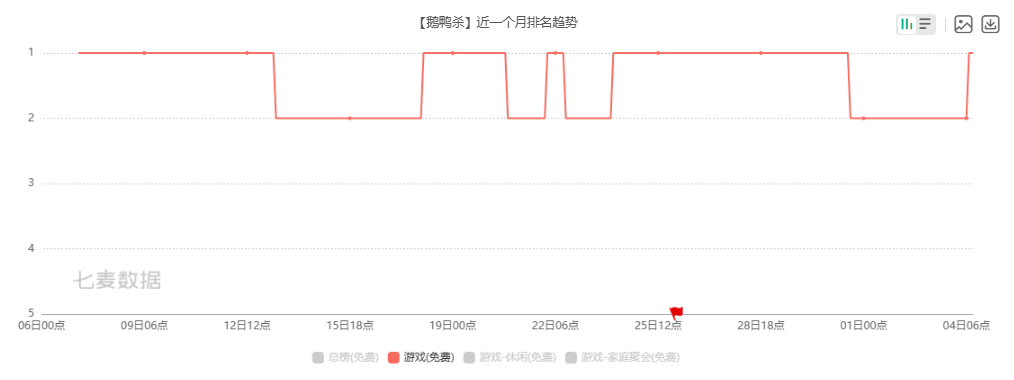
"Goose Duck Kill" Free App Chart Trends Over the Past Month
What’s puzzling is that, based on conventional wisdom regarding user acquisition for new games, how high a title climbs on the free charts is largely a test of how effective its user acquisition efforts are. However, third-party platform data paints a different picture: aside from a small boost from user acquisition campaigns around the time of the open beta, *Kill or Be Killed* is currently not running a heavy advertising campaign. This stands in stark contrast to the “big spenders” at the top of the charts, who routinely spend tens of millions of yuan daily on user acquisition.

Currently, "Goose Duck Kill" is running only five ad campaigns. Source: AppGrowing
Even taking into account the fact that *Goose or Duck* is a well-established IP, that alone is hardly enough to explain how the game reached over 10 million users within six days of its open beta, surpassed the historical peak concurrent users of PC games, and maintained its appeal for an entire month. What exactly is *Goose or Duck*’s secret?
Last week, I met with Chen Peng, COO of Huya, in Shenzhen. As a co-publisher of *Kill the Goose and the Duck*, he told me that the answer to this mystery lies in every viral meme, every popular livestream, and every dramatic highlight created by players.

Chen Peng, Chief Operating Officer of Huya
Through this collaboration with *Goose Duck Kill*, Huya has taken on a brand-new role: publisher. This marks their first systematic foray into game publishing and serves as the starting point for a series of upcoming publishing initiatives. Rather than playing by the book and acting like a "model student" in the traditional game publishing industry, Huya is aiming to shake things up.They are attempting to pioneer a completely new approach to publishing: using game content as the spearhead to drive new games beyond their niche and into the mainstream.
If you ask whether it’s risky, the answer is definitely yes. According to AppsFlyer’s *2026 State of Mobile Gaming Marketing Report*, China’s gaming industry saw a 22% year-over-year increase in user acquisition spending last year. The topic of “intense competition in user acquisition” has been discussed for years, but in this cutthroat battle for attention, the necessary user acquisition must still be done. Yet *Kill or Be Killed* has chosen to go against the grain.
Many who haven’t followed this platform’s developments in recent years might be surprised: how could Huya, a live-streaming platform, possibly have the clout to break out of its niche? But in reality, over the past few years, this major player has undergone a transformation, quietly extending its reach and evolving from a live-streaming app into a content powerhouse spanning all online platforms.This time, they spearheaded the content marketing campaign for *Goose Duck Kill* across the entire internet, ranging from original variety shows and collaborations with streamers to cross-industry partnerships. Just a few days ago, they brought the cast of the hit series *Youthful Ambition* onto *Goose Duck Kill* for a live-streamed team-building session, where they played together.

Throughout his conversation with Tea House, Chen Peng remained visibly excited. This “strong start” meant a great deal to them; not only did it deliver results for Huya that exceeded both internal and external expectations, but it also reinforced Huya’s conviction that the “gaming content” expertise they had been honing over the past few years is precisely the next key factor that will break the deadlock in the game publishing market.
01
Back to Square One: Finding New Opportunities Amid the Chaos of Game Distribution
Q: The outside world may not be fully aware of it, but Huya seems to have undergone quite a few changes in recent years.
Chen Peng: That’s right. In early 2023, Huya was still a very traditional live-streaming app. At the time, we faced some very clear challenges: First, the live-streaming industry was no longer limited to standalone apps. Cross-platform services—including many gaming platforms themselves—were all building their own live-streaming ecosystems. Second, Huya at the time was still heavily reliant on revenue from viewer donations. Due to various factors, the growth ceiling for this business was gradually shrinking.
Since joining Huya two years ago, we have been continuously upgrading the platform’s overall business model. The first step was the transformation outlined in our “Three-Year Plan”: strengthening our ties with the gaming industry and expanding into areas such as game distribution and co-publishing, in-game item sales, and game advertising.
Secondly, in addition to our own platform, the Huya app, we have built a gaming content ecosystem that spans the entire internet over the past few years, establishing ourselves as a leading gaming MCN on platforms such as Douyin and Video Account. Our approach to content is constantly evolving, and we are actively incubating a large number of short-video and text-based creators across the web. This is because our internal data indicates that the ratio of users consuming live streams to short videos is likely between 1:2 and 1:3.
It’s fair to say that over the past two years, we’ve put in a tremendous amount of work, resulting in a significant upgrade and transformation of Huya’s overall positioning. We are no longer just a gaming livestreaming platform, but a comprehensive gaming service provider driven by gaming content that spans the entire internet, and a partner to a wide range of game developers. This is also the new image we hope to project to the outside world.
Q: With *Goose or Duck*, you’ve taken on a new role. This is likely your first time systematically participating in game publishing as a publisher. What opportunities did you see? In 2026, where do you think the bottlenecks lie in the game publishing market?
Chen Peng: Following up on what I just said, we are continuing to upgrade Huya.Previously, when Huya was engaged in game marketing, we primarily relied on an advertising model: when a new game launched, we would reach out to top streamers for promotion and sell ads based on the Huya app and our top streamer resources. Today, Huya has the potential to promote a new game across the entire internet through short videos, live streaming, and community operations. Building on this foundation, we believe Huya now has the opportunity to launch exclusive game publishing.
This brings us to our next topic: changes in the overall landscape of the mobile game publishing industry. I’m sure many of you are familiar with these issues. In the earliest 1.0 phase, we used to say that “app store channels were king,” and back then, those channels held significant sway. In the subsequent 2.0 era, with the rise of platforms like Douyin and Kuaishou, performance-based user acquisition models began to dominate the publishing landscape.
The problem with the 1.0 model is that the dominance of app stores is waning; not every user downloads games through app stores anymore. The advantage of the 2.0 user acquisition model is that it allows for very precise control over ROI, but the downside is that the user acquisition market has become extremely competitive, making it difficult to achieve a high ROI.
We are now introducing the concept of "Phase 3.0" in game publishing, which uses content marketing to drive game publishing. In line with the direction of Huya’s transformation that I just outlined, we are adopting this as the underlying theoretical foundation for Huya’s game publishing business.
Q: What specific aspects does your understanding of content marketing encompass?
Chen Peng: Simply put, it involves creating a comprehensive content and community ecosystem for a game through various forms of content planning, including text and images, short videos, live streams, esports, and UGC from variety shows. In fact, many people are already working on content ecosystems, and everyone has a different understanding of the concept. With more traditional approaches, such as hiring celebrities or brand ambassadors, it’s difficult to assess the cost-effectiveness of this model.
Our approach is to achieve sustained marketing results by cultivating a long-term content ecosystem. First, we establish a content foundation, which we then gradually amplify through the ecosystem. Users are constantly exposed to content through live streams and videos. Game content, delivered through streamer playthroughs and player shares, fosters interaction and creates an immersive experience for users. This goes beyond mere advertising exposure to deliver engaging content that drives better conversion rates.

Season 2 of the Original Variety Show "Goose斯卡 Night" from "Goose or Duck"
In the past, most of the focus on game content was on the in-game “gameplay” aspect. Now, some are gradually building content ecosystems outside of the games themselves, but to be honest, Huya’s advantage in this area is likely more pronounced. We have a massive pool of streamers who can produce a wealth of short-form video content, which we then distribute across the entire internet. In terms of sheer scale alone, Huya reaches over 200 million users every month.
Q: You’ve mentioned Huya’s reserves and strengths several times. In what specific areas are these reflected? What is Huya’s current external resource strategy?
Chen Peng: Since we’re no longer just an app, we can leverage content and traffic across the entire internet. We have two MCNs, Hushi and Huxiao, and currently, nearly half of all the top streamers online are under our umbrella.On Douyin, we rank among the top in many categories, and within the gaming MCN sector as a whole, Huya ranks at least in the top three. On Tencent’s Video Account platform, we are the largest gaming MCN. We are also actively signing and incubating creators on platforms like Bilibili and Xiaohongshu. At present, we have essentially achieved comprehensive coverage across the entire internet.
There’s a statistic I may not have mentioned earlier: *Kill the Goose and the Duck* has been live for three weeks now, and the majority of its daily new users aren’t acquired through paid user acquisition. Instead, most users come from short videos, live streams, or community engagement.
Q: This is actually why many companies are hesitant to venture into content marketing. Even if they generate traffic, it’s difficult to attribute it to specific actions, making it hard to assess the actual number of conversions and ROI.
Chen Peng: You’re absolutely right. Why is Huya pursuing exclusive agency agreements? Because this is the only model that can best quantify the value of content marketing. In the past, with brand advertising, we could only tell you that a certain streamer had a huge following and could reach a certain number of viewers, but we couldn’t specify exactly how many orders they generated.If a project manager asks you, “We’ve spent marketing funds here—how many new users did that bring in?” it’s actually very difficult to answer clearly. That’s because the traffic generated by a streamer gets mixed in with channel traffic and performance metrics.
Under the exclusive distribution model, every download across the entire network is generated by us, making the effectiveness of this model immediately apparent. Take *Goose or Duck* as an example: our download numbers have consistently ranked in the top two on the Apple App Store, and we’ve rarely fallen behind.
Q: Actually, many platforms are currently experimenting with original content. Given this, what are Huya’s competitive advantages?
Chen Peng: We’re able to integrate multiple platforms. As you can see from the launch of *Goose Duck Kill*, we frequently organize cross-platform “team-up” events.For example, during a single livestream, you might see two Douyin streamers, one Bilibili streamer, one Xiaohongshu streamer, and five Huya streamers all collaborating to play the game together. This effectively creates a livestreaming event that takes off simultaneously across four platforms, generating significant exposure and traffic on each platform without violating any of their respective rules. This is a major advantage for us.
02
By changing the "i" in "i-generation" to an "e," just how much more potential can mobile games tap into?
Q: Let’s talk about this using the example of *Goose Duck Kill*. What exactly did you do when you first launched the game using the “3.0 model”?
Chen Peng: I think the most important factor is that, during the six-month preparation phase leading up to this project, we were constantly building out its content ecosystem across the entire internet. We signed contracts with a large number of streamers and established partnerships with short-video creators. It was precisely because of this six-month accumulation of content that, on the very first day of our launch, we were immediately able to release a massive amount of content, which subsequently propelled us to the top of the trending lists on various platforms.
To be more specific, on the evening of the open beta launch, the second season of our original variety show IP, *Goose Oscar Night*, officially premiered across all major platforms, including Huya and Douyin. Da Sima led an all-star lineup of streamers in forming teams to participate in a family-friendly round of *Goose Duck Kill*.We also organized streamers like Lü Dehua and Jiran to host cross-platform live-streaming collaborations across Huya, Douyin, and other platforms. Combined with influencer promotions and top streamers going live, we amplified the buzz surrounding the server launch. On Douyin alone, we received over 4,000 user-submitted videos within the first 24 hours, with total video views exceeding 100 million.


On Bilibili, we collaborated with top content creators Lao Fanqie and Du Haihuang to produce custom content, which peaked at third place in the platform’s overall popularity rankings. At the same time, we partnered with MCN agencies to connect with top and mid-tier creators, inviting them to host weekly “team-building” livestreams that spanned multiple verticals, including virtual streamers, retro gaming, and PC single-player games.On Xiaohongshu, we also developed themes aligned with the platform’s tone to guide user discussions and post-sharing, sparking an explosion of UGC. On the first day alone, 14,000 notes were generated.
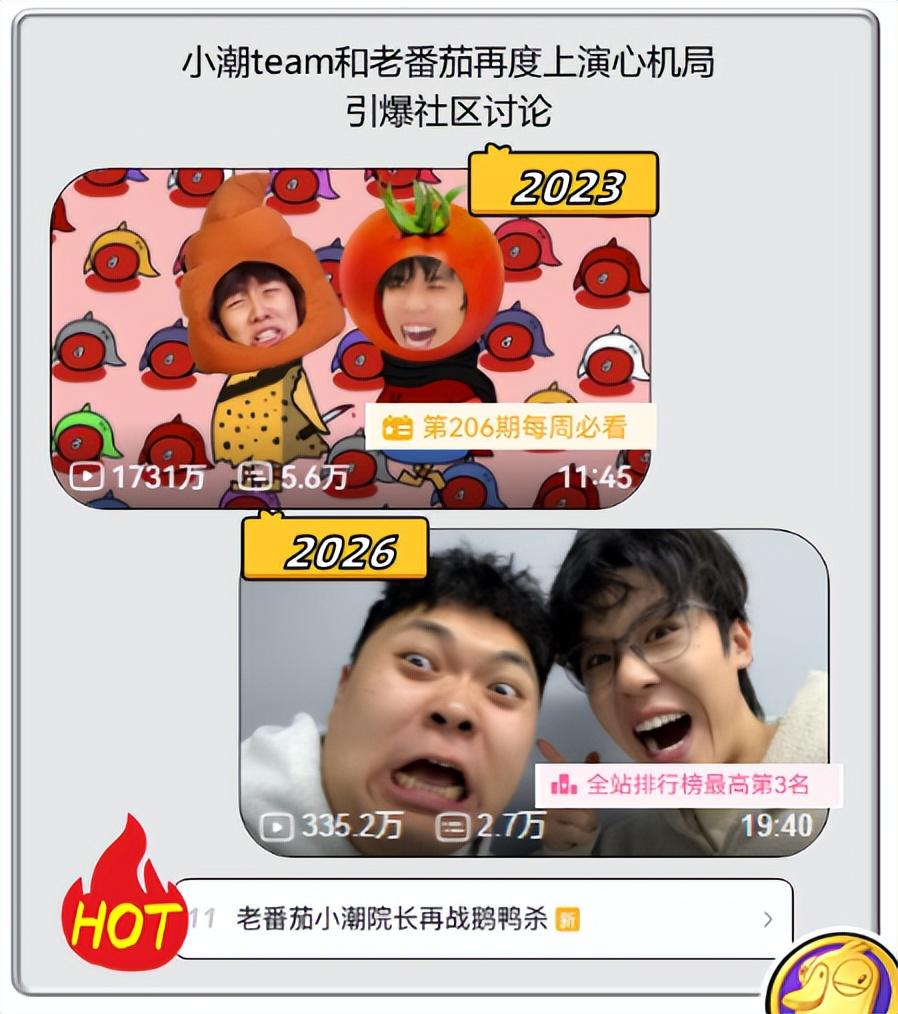
We did the math: in the first two weeks after its launch, *Kill the Goose and the Duck* appeared on the trending lists across major platforms a total of 146 times. I believe Huya’s greatest contribution during this process was its thorough execution of leveraging the content ecosystem to generate marketing value. It was a very successful endeavor.
Q: How do you view the IP value inherent in *Goose or Duck*? — Some might say that the game’s popularity in China is entirely due to its IP.
Chen Peng: To be honest, there’s no denying that the IP has had a very positive impact on the game’s performance. But I believe the key factor is that, through content marketing, we’ve effectively communicated the game’s gameplay mechanics. Take *Goose Duck Kill* as an example: we have over 3,000 streamers broadcasting daily, plus 4,000 to 5,000 short-video creators posting content across the web. Systematic content marketing acts as a powerful amplifier, fostering a vibrant social atmosphere.The value of the IP itself, the game’s social gameplay, and our marketing efforts—the final results are the combined outcome of these three factors.
For example, when *Goose Duck Kill* was released in China, many of the ideas regarding the game’s content differed somewhat from those of the original team.
Q: With all this content you’ve produced, aren’t the costs going to be high?
Chen Peng: We’ve run the numbers on this. Based on our growth metrics, our content investment offers excellent value for money—it’s far more cost-effective than user acquisition. In short, content marketing is bound to deliver a high ROI. That’s because it doesn’t follow the logic of user acquisition; instead, it’s about nurturing and cultivating an audience.
Many traditional games rely on spending heavily to hire brand ambassadors or launch major updates at key times to attract returning players. Content marketing is a relatively slow and long-term process, but during events like the Spring Festival, if a game can introduce a content-driven topic that engages players, it will naturally generate a surge in new users and in-app purchases. This doesn’t even require developers to invest a significant amount of money; instead, it grows organically around the user base.
Q: With *Goose and Duck Kill* trending so much, what player behaviors have left a particularly strong impression on you?
Chen Peng: We always say that a hit isn’t designed—it’s created by users. Take the incident on the first day of the open beta, when players scrambled to snag usernames; that really caught us off guard. We knew there would be a rush to register IDs for a new game, but we never imagined people would get so creative with their usernames and numbers. It wasn’t just users—even many companies jumped on the bandwagon and turned the ID scramble into a running joke.

This includes the “Goose and Duck Kill: The Art of Playing It Cool” trend that recently went viral—it’s quite interesting, and there are many examples like this. We’re incredibly grateful to our users for their incredible creativity. Another distinctive feature of *Goose and Duck Kill* is that a high percentage of its users—at least half—are women, and they’re quite active. That’s why the game has become so popular on Xiaohongshu.

In addition, many users have designed merchandise for us. In fact, even before we’ve officially launched our merchandise, users have already come up with a lot of interesting designs. I’ve also seen many posts where people have started organizing in-person meetups in their local areas after playing *Goose Duck Kill*.
These developments make me very happy, because players now view *Goose Duck Kill* as more than just a game; they truly see it as a social tool and platform. Here, we have our own unique avatars and identities, along with a wealth of social gameplay features. Ultimately, players become friends in real life, which truly creates social value.
Q: This part has actually gone far beyond what was originally envisioned for the PC version of the game.
Chen Peng: Exactly. I don’t think the original PC game team really considered this aspect. They provided a solid foundation of core deduction gameplay, which is their strength, but we need to think about how to make *Goose or Duck* a bigger hit in China. If there’s only a single gameplay mode, players will get bored easily, whereas social interaction offers greater longevity.
To be honest, today’s young people need this new way of socializing. Many users may be introverted in real life and don’t usually dare to express themselves openly, but once they take on the form of a goose in the game, they can actually express themselves boldly. This allows for a deeper fulfillment of their social needs.

Our current version already includes many social features not found in the original PC game—for example, you can play pool with friends in the lobby. Tap “Create Game,” and you’ll see that each of us has our own private island where we can invite friends to visit. This island is still in its early stages, but we have a series of exciting social-focused features planned for the future.
Q: How important is developing social features to you?
Chen Peng: In my personal assessment, more than half of our future workload will likely be devoted to developing social gameplay features.We already have a wealth of ideas in the pipeline; we just need to roll them out incrementally with each new update. For example, in the future, players will be able to decorate their own private islands and invite friends over for more intimate interactions. In the game’s main plaza, we’ll introduce more group-based activities, such as watching movies with friends, going clubbing together, or attending weddings.

In the future, we plan to introduce some editor-style features. At this point, *Goose Duck Kill* is no longer positioned as a purely gaming platform, but rather as a social platform—and this will be the focus of our future updates.
Q: You just said that viral content can’t be planned, but as a publisher, you certainly still need to guide players to generate more organic engagement. How do you go about doing that?
Chen Peng: On the one hand, of course, it’s about building a thriving ecosystem. We’ve become quite skilled at fostering a creator ecosystem. For example, we offer incentive programs and special in-game titles to creators who produce high-quality content.
Second, compared to the traditional PGC ecosystem driven by creators, we’ve observed a significant amount of UGC content being generated by ordinary players on social media platforms. On Xiaohongshu in particular, there are many distinctive female users who use their posts to promote new ways to play. Even though they aren’t creators and don’t receive incentive bonuses, they come up with a lot of really interesting gameplay ideas.Every day, we review all user posts on Xiaohongshu and highlight the ones we find interesting to help them reach a wider audience.
Q: This release of *Goose Duck Kill* also marks the first test of Huya’s proposed 3.0 distribution model. Have there been any unexpected benefits so far that have exceeded your expectations?
Chen Peng: I think, in general, things haven’t deviated much from our earlier projections. When it comes to maintaining the creator ecosystem, for example, we’re already quite experienced in that area.
However, the UGC aspect has far exceeded my expectations. These users aren’t professional creators, but they’re a far more active group than I ever imagined. Their creativity often surpasses expectations, and they’re active in various group chats on QQ, WeChat, Douyin, and Xiaohongshu. Figuring out how to effectively manage this UGC community has been a key lesson we’ve learned.
Q: The domestic party game market has already produced several titles with high daily active user (DAU) numbers. How high do you think the ceiling is for this market?
Chen Peng: I don’t think we’ve even come close to reaching our limit yet. I always say that today’s young people are truly lonely, but they’re also incredibly talented and creative. To be honest, I was a bit worried at first that many users wouldn’t be able to figure out how to play *Goose Duck Kill*—the game does have a bit of a learning curve and really tests your logical thinking. But the players have turned out to be much more resourceful than we imagined.

Source: Douyin user @EarthOnline
In terms of numbers, I don’t think there are already many blockbuster social games in China. The reason so few people are entering this market is largely because it’s not a quick way to make money. It’s characterized by potentially low ARPU, which actually requires sustained investment from developers. That’s why the only companies you see in this space are major players like Tencent, NetEase, and Giant.
I don’t think online social networking will ever go out of style in China; it just needs more high-quality products to carry the torch. We’re quite optimistic about this sector, and we’re constantly on the lookout for new products that might emerge in the future.
Q: ARPU has indeed been a long-standing challenge. Can content marketing help Party Games increase its ARPU?
Chen Peng: I believe the core of content marketing lies in helping you grow your DAU. After all, party games aren’t stat-driven products, and ARPU largely follows DAU. If I purchase a skin, the more people who see it, the greater my sense of accomplishment. Therefore, for party games, the higher the DAU, the higher the ARPU can climb.
03
Looking Ahead: Long-Term Operations, New Game Plans, and Our Ultimate Vision for Publishing with Huya
Q: What are your thoughts on the future prospects of *Goose and Duck Kill*?
Chen Peng: So far, *Goose Duck Kill* has definitely maintained a steady upward trend. The upcoming Spring Festival is a particularly important milestone, as we’ll likely be playing with the people around us—whether that’s our partners, classmates, or even our parents. So this Spring Festival, we’ll be emphasizing the theme of “playing together with the people around you.” Throughout the Spring Festival period, we’ll also continue to roll out marketing ideas and campaigns. We remain confident that we can keep this upward momentum going.

"Golden Pheasant" is giving out New Year red envelopes to players
Q: Looking at it this way, if you incorporate various holidays, doesn’t the content marketing model seem like a good fit for supporting long-term product operations?
Chen Peng: That’s right. But there’s also a downside: long-term content marketing is a grueling process that requires constant investment. Traditional game marketing models tend to be more of a “one-off” approach—marketing campaigns might run for two or three months after launch, after which they’re scaled back, and operations are maintained solely through in-game updates and new content. We, on the other hand, are committed to a long-term strategy. We’ll continue to roll out marketing content for various occasions, such as April Fools’ Day and Labor Day, and follow up on a quarterly and monthly basis.
Few companies in China have been building a content ecosystem as consistently as we have, but Huya has been developing ecosystems for games like *League of Legends* and *Honor of Kings* for many years. We’ve long been accustomed to signing a large number of creators at once and handling the day-to-day tasks of incubation, training, and communication. Traditional game publishers rarely have that kind of patience.
Q: Given the intense pressure to produce content, do you have the capacity to launch multiple products simultaneously?
Chen Peng: Actually, it doesn’t really affect us much; this is how Huya has operated all these years. Currently, there are already more than 40 key products in our ecosystem, including high-volume games like *Honor of Kings*, and our total game catalog spans two to three hundred titles.As we’ve repeatedly emphasized, this is a capability that traditional publishing companies lack, but Huya has already established a solid foundation in managing a game portfolio ecosystem. Handling the nitty-gritty details, managing creators, and helping them monetize—these are our strengths.
Q: Is it possible to consistently produce high-quality content for marketing purposes? According to many people’s understanding of content, content creation relies heavily on inspiration.
Chen Peng: The gaming content sector has actually been around for many years, so there is certainly no shortage of talent in this area. Major games with high daily active users (DAU)—such as *Honor of Kings*, *Peacekeeper Elite*, and *League of Legends*—have all significantly boosted the entire content ecosystem. Today, every platform in China is home to a large number of talented creators. The groundwork for producing excellent content is already in place; what we need to focus on is how to effectively organize these creators to achieve specific business objectives.
Q: With *Goose and Duck Kill* as your starting point, what are your plans for the next step?
Chen Peng: We will continue to explore Huya’s “Publishing 3.0” model, building a game content ecosystem across the entire internet, and we must continue to focus on exclusive distribution. Only in this way can our investment in content truly align with our ultimate user acquisition goals. Within this year, we expect to launch seven to eight games, including mini-games and mobile games.
We are still reviewing a large number of products, and we would like to take this opportunity to share this information with more R&D teams.
Q: What kinds of products do you prefer to feature?
Chen Peng: We will focus on publishing games that feature strong content, highly engaging gameplay, and the potential to integrate with esports or variety shows. To be honest, we do have a selection process for our products; traditional stat-based games, for example, may not be the best fit for us.
When it comes to team size, we’re open to working with both large and small teams. In fact, we believe that many great ideas on Steam are currently in the hands of small teams but haven’t received much attention. In addition to publishing, we also engage in investment and incubation. Ultimately, what matters most to us is the team itself and their understanding of gameplay.
Another point is that, in addition to publishing, we are also open to long-term partnerships within our content ecosystem. Whether it’s an existing game or a new title with long-term operational goals, it can leverage Huya’s years of content expertise and capabilities to effectively carry out tasks such as creator incubation, ecosystem development, and creator monetization.
Q: Finally, I’d like to ask: What are the long-term goals for Huya’s game publishing business?
Chen Peng: Under this new marketing model driven by content marketing, our goal is to become the largest “third-party publisher” in China, and we are fully confident in achieving this. In addition to establishing a firm foothold in the domestic market, we aim to become the leading global game marketing and publishing company. We may launch a series of pilot initiatives to test the waters of the global market later this year.
原创文章,作者:游茶妹儿,禁止转载:https://youxichaguan.com/en/archives/195451