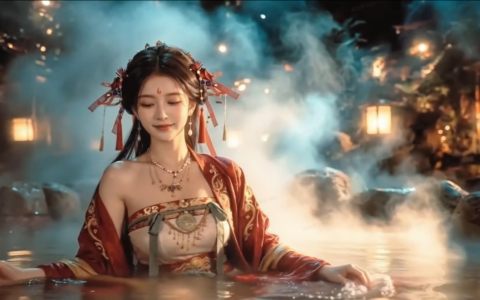
At the recent Gamescom in Cologne, miHoYo unveiled *The Origin’s Knot*, a title that feels very “un-miHoYo-like.” After our colleagues on the ground had a chance to try it out, they were pleasantly surprised by the level of detail in its realistic visuals and the cooperative PVE design, which conveyed a distinct vibe different from miHoYo’s usual style.
At the same time, other new products that lean more toward the “2D” spectrum—such as NetEase’s *Infinite* andManju’s *Blue Starfield*, Le Element’s *City of Silver*, and Xiao Zhi Games’ *Sleepless Wilderness*, which was unveiled just two days ago, have all demonstrated the distinct “gameplay-oriented” characteristics of the next generation of anime-style games.
All of this has made Teahouse realize that our previous description of this category as “anime-inspired, casual gameplay” may no longer apply to its future.
Looking back over the past nearly six years, anime-style products—led by *Genshin Impact*—have established a clear “anime-style” paradigm: characters serve as the core vehicle for content and the primary means of monetization; consistent, high-quality content updates form the foundation of user retention; and emotional and statistical consumption centered on characters are seamlessly integrated within the gacha system.
“Anime-style games” are practically synonymous with “creating content and selling characters.”
But every paradigm has its limits,Today, the cost of content production continues to rise with each new release, the supply of characters is nearing the tipping point of aesthetic fatigue, and increased investment in content no longer automatically translates to better commercial returns. As these various signals converge, finding a new strategic foothold for anime and manga products is no longer merely a strategic choice for individual companies—it has become a challenge that any company entering this category must inevitably face.
As manufacturers begin to pivot and new products undergo a transformation, in this roundtable we spoke with industry professionals: Has the “content” cycle in the anime and manga sector come to an end? Will the growing importance of gameplay mechanics save the anime and manga category?
Will the anime world be okay?
▍Chizuru Suwon is a good girl! @Laohe
I think that’s right—there will never be another successful product like Genshin Impact or Mingchao again.
But I think it’s important to clarify that just because this cycle is coming to an end doesn’t mean that anime-style content—or, more specifically, the anime art style, or even character-driven game design—will disappear from here on out.
We should realize that what has actually come to an end is a specific business assumption—namely, the fantasy that “as long as the art style is sufficiently anime-inspired, the characters are sufficiently powerful, and the content volume is substantial enough, we can replicate Genshin Impact’s commercial success.”
This assumption was the subject of massive speculation in 2021, but it wasn’t until recent years that it was disproved.
That’s why I’ve always believed that you shouldn’t treat the “2D world” as just another genre to follow, but rather as a way to build up your content literacy.
In my view, miHoYo’s *The Origin’s Knot* remains a “content-driven product”—a content-based game that doesn’t rely on a specific aesthetic niche and is aimed at a broader global player base. Who says gameplay isn’t content?
▍Lupin the 9th
First ask if it’s true, then ask why.
As I understand it, “content” is actually a methodology—starting with character design → plot and presentation → promotional videos to build anticipation → monetization through gacha releases → and maintaining engagement until the next character is introduced. Based on this methodology, the entire team structure, production schedule, user expectation management, and business model of previous anime-style products were all built around this cycle.
Whether you admit it or not, it was miHoYo that established this cycle; subsequent products have either optimized or scaled back within this framework.
Now, assuming for the sake of argument that what you refer to as the “gameplay cycle” is the methodology of “gameplay-driven design,” and assuming that it is indeed on the horizon, what can it change? It changes the underlying logic of user retention.
Content-driven retention is essentially about “keeping up with the latest updates”—players look forward to the next chapter of the story or the next character; gameplay-driven retention, on the other hand, is essentially about “addiction”—if the mechanics themselves are engaging enough, users will actively return to explore them.
The advantage of the latter approach is that, once the core mechanics are in place, the production costs for subsequent content can be kept relatively under control. This is also one of the reasons why investors and management are beginning to shift their focus toward gameplay—not solely because a “gameplay-oriented approach is better,” but also because it offers a healthier cost structure.
However, one of the core desires of anime and manga fans is emotional projection—projection onto characters, the fictional universe, and the community.
This isn’t something that can be replaced simply by having “good gameplay.”
You can create an open world with incredibly engaging physical interactions, but if users can’t find an emotional connection within it, they might find it fun but won’t regard the product as a “spiritual home”—and that “spiritual home” is precisely what sets anime-style products apart from other genres.
For most other “high DAU” games focused on gameplay, emotional investment comes from other players.
So my assessment is that in the coming years, we’ll see a wave of hybrid products where “gameplay is the backbone and content is the flesh”—it won’t be a one-sided affair.
Whether it’s “The Primordial Knot” or “Infinity,” rather than abandoning content, it’s more accurate to say they’re rebalancing the ratio between content and gameplay. Similar trends can be seen in newer titles with a stronger anime-style aesthetic, such as “Blue Starfield,” “Silver City,” and “Sleepless Wilderness”—characters remain important, but they are no longer the sole pillar of the game.
As for whether the new formula can succeed commercially, everyone is taking a gamble right now—including miHoYo.
▍Hachiman Yukinoshita
“The ‘content model’ was actually unsuitable for most people from the very beginning.”
When people discuss whether the anime and manga boom has come to an end, they’re actually sidestepping a more fundamental question: How many companies in this industry have actually made money?
The core contradiction of the content model lies in the fact that it requires an extremely high upfront investment to build content barriers, yet its monetization model—namely, character-based payments—is inherently limited by the size of the core anime and manga user base. You might spend a fortune creating a top-tier open world, but the pool of players willing to pay for characters may be quite small.
Companies like Mihoyo and Eagle Corner have succeeded because they’ve built up a user base, content capabilities, and technical infrastructure in this genre—things that money can’t buy. Many latecomers attempt to achieve the same results through rapid capital investment, which is, in itself, a misjudgment.
It’s a good thing that this distorted production model has come to an end.
▍Mafuti
I think the notion of the “end of the content cycle” is a misjudgment.
It’s not “content-driven” that’s coming to an end—it’s “lazy content-driven” approaches.
The problem facing anime and manga products today isn’t the content itself, but rather a stagnation in content innovation. With so many products on the market, playing one is practically the same as playing ten—there’s no differentiated experience.
To take it a step further, with everyone suddenly jumping on the “gameplay-driven” bandwagon, how many of them have truly figured out how to design gameplay?Or is it simply because—to put it bluntly—creating quality content is too difficult, requiring a constant supply of creativity and creators with genuine artistic sensibilities, whereas developing gameplay systems, at least initially, seems more “engineering-oriented,” more controllable, and more impressive?
Don’t confuse “addressing shortcomings in gameplay” with “giving up content advantages”—these are two completely different things.
▍Gazi
Every two years, the industry comes up with a new narrative to explain why the previous generation of products failed.
The year before last saw user acquisition reach its peak; last year saw a shakeout in the anime and manga sector; and this year, it’s the “end of the content cycle” all over again. In another two years, once this batch of new games—touting “gameplay-driven” approaches—launches and flops spectacularly, there will likely be yet another buzzword.
It is never a cycle that truly comes to an end.
The window of opportunity—when “no matter how mediocre your work was, slapping an ‘anime’ label on it was enough to rake in money, attract people, and capture users’ time”—has come to an end. Why is this changing now? It’s simply because users aren’t so easily fooled anymore, the market has peaked, and it’s no longer easy to make money.
I think everyone needs to understand this: Products with great content are still profitable today, while products with poor gameplay will still fail in the future.
Instead of agonizing over whether to focus on content or gameplay, it’s better to start by answering a more fundamental question: Is what you’re creating actually any good?
▍Heart Under the Blade
This is due to changes in the overall market; let’s take a broader view.
The transformation of anime-oriented companies and their products is actually a subset of a larger trend: Chinese game companies are undergoing an overall shift from “serving anime fans” to “competing in the global gaming market.”
The evaluation criteria in the global market are not “anime-style vs. non-anime-style”; in fact, the concept of “anime-style games” doesn’t even exist overseas—there are only “gacha games.” “Anime-style” is a local term to begin with; what overseas players care about is “fun vs. not fun.”
There is one issue we must face head-on: globally successful gameplay-driven games almost never use the F2P model; the mainstream models are buy-to-play or a one-time payment plus DLC. Yet what Chinese teams excel at most is precisely the long-term operation of F2P games.
This is where the next generation of anime and manga-inspired products will truly be put to the test—not whether they can create engaging gameplay, but whether they can develop a sustainable business model based on that gameplay while moving away from the “Gach” model.
I’ll say this: just as Genshin Impact defined an era, whoever solves this problem first will define the next era.
▍Yoshiki Nukumizu
I got into this industry because I love anime and manga.
What I want to say is that no matter how the industry changes, the anime and manga community’s demand for great characters and stories will never fade. As long as game developers still have that desire to move people—whether through the story or the gameplay—anime-style games will definitely keep getting better.
Let’s hope so.
原创文章,作者:gameteahouse,禁止转载:https://youxichaguan.com/en/archives/207960