“When writing game copy, writing style isn’t the most important thing.”
This quote comes from an AVG (adventure game) developer I interviewed previously. In essence, he said: “In reality, understanding the market, the audience, and the characters is more important than writing skills. The key is being able to create characters that people love. The plot structure needs to be logical; writing skills, on the other hand, are something you can refine over time.”
When I first heard this idea, I was a little surprised: in a game that focuses on text-based storytelling, how could writing not be important?
Many industry professionals also admit that in commercial mobile games, the storyline is not the main focus to begin with. And telling a compelling story in a commercial game has never been an easy task. Take domestic otome games, for example: while they appear to be story-driven, their true core selling point has long since shifted away from the text and the story itself.
Since the advent of AI, as long as it is fed sufficient data, it can simulate virtually any writing style or narrative tone. As a result, there are frequent claims in online discussions that game copywriters will be replaced.

Is that really the case? What are some common misconceptions about copywriting, both within and outside the industry? Is storytelling necessary in business games? Is effective storytelling a false premise in service-based (long-term operation) games? In the age of AI, does copywriting still hold irreplaceable value?
Is that really the case? If writing style and plot aren’t that important, is game copywriting still important? What are some common misconceptions about copywriting? Do commercial games need to tell good stories? Is telling a good story a non-issue in service-based (long-term operation) games? In the age of AI, is copywriting still important?
In this episode of “Game & Tea Roundtable,” we spoke with industry professionals about: “What are some common misconceptions about game copywriting?”
▍Copywriting and Planning for a Commercial Mobile Game | Yu Ban🍥
When it comes to common misconceptions about copywriting strategy, I personally believe it’s best to break down the general public into smaller groups for a better understanding.
From the player’s perspective, casual gamers may be largely unaware of the existence of copywriters; the text itself is not a central part of their gaming experience. Instead, it is the concept art, scenes, and other visual elements derived from that text that matter to them. Since players are unaware of—and have no need to know—the production process, copywriters remain invisible to them.
On the other hand, players who focus on content often assume that 90% to 100% of a copywriter’s job consists of writing storylines and product descriptions, without realizing the role’s strategic nature; they believe copywriters are not involved in anything beyond the plot.In project teams where the copywriter holds a relatively high-level position, the copywriter can play a crucial role in final decisions during meetings regarding resource allocation, visual design, and other story-related matters. Ironically, any errors that arise during the copywriting process are not perceived by players as the copywriter’s responsibility…
Colleagues in non-copywriting roles often have misconceptions about copywriters. I don’t believe this stems from a single, fixed misunderstanding. The root cause lies in the fact that every copywriter has a unique approach to storytelling and a different starting point. Everyone’s creative background before entering the industry varies as well—some come from the film and television industry, some are freelance writers, and others are creators in online literature or publishing.Relying solely on standard workflows makes it difficult to predict how a copywriter will collaborate with other roles. This leads to colleagues struggling to grasp the direction of a copywriter’s narrative planning. Over time, various misunderstandings naturally arise regarding different copywriters. Many eventually find it difficult to communicate with copywriters and feel they have no choice but to compromise, resulting in frequent conflicts between both parties.
Do commercial games need to tell good stories? Personally, I believe that precisely because they are commercial games, they must tell good stories. However, it is also precisely because they are commercial games that the standard for a good story is no longer purely an aesthetic experience—our job title is usually “copywriter” rather than “screenwriter,” implying that there are greater commercial expectations for this profession.For example, copywriting for gacha mobile games inevitably carries advertising elements. Suppose, in a gacha game, the game designer wants the storyline to give players a positive trial experience with a character, the operations team wants the character to spark positive community discussion, and the art team wants to showcase the character’s visual appeal.
So, is a story that achieves the aforementioned goals but offers a rather mediocre—or even somewhat trite—aesthetic experience still a good story? Personally, I believe it is still a good story, albeit one that is good from a commercial perspective. However, on another level, just as game designers, operations teams, and art directors can set requirements for the story, the writers should certainly be able to do the same.However, compared to the “author-audience” relationship, where the focus is entirely on the aesthetic experience, storytelling in commercial games is more akin to a “merchant-consumer” relationship—it’s simply an effort to look up at the moon while still picking up the sixpence.I suspect that often, a writer’s vision for this approach may be as elegant as a discus thrower’s form, but the actual execution ends up resembling the stretching exercises in a mass calisthenics routine—resulting in quite a few comical mishaps.That said, scriptwriters are usually the gamers on a project team most willing to pay for a good story. I believe their own creative needs also represent a genuine segment of the market demand.
Finally, is copywriting still important in the age of AI? Personally, I believe it remains important, though there may be higher expectations for originality in copywriting.The mass production of aesthetic experiences leads to the rapid devaluation of existing aesthetic paradigms. For example, the Korean variety show industry has actually caused a massive devaluation of a certain genre of variety shows, prompting the remaining shows to immediately engage in a race to the bottom—until production capacity is stretched so thin that the cost-benefit ratio becomes unviable…This then gives rise to new paradigms such as so-called “slow variety shows” and low-budget variety shows.
AI has accelerated this process of paradigm shifts, as well as the rate at which “blue ocean” themes turn into “red oceans,” until the risk of investors jumping on the bandwagon outweighs the creative risk.at which point investors will become more wary of the popular trends AI can generate. Consequently, copywriters must anticipate as much as possible and then steer clear of or deconstruct existing creative paradigms to prevent the rapid depreciation of aesthetic value.This is a departure from the past, when creatives could still reap some rewards by quickly jumping on a major trend even as it began to fade. This shift is simply because the shelf life of creative ideas is also rapidly diminishing. Copywriters who excel at imitation may gradually fade away, while those with a knack for original ideas may rise to prominence.In truth, any creative professional is much like an animal living in the natural world. As long as the environment does not undergo drastic changes, the species will continue to exist. However, this does not mean that individual members will not die; rather, through the process of survival of the fittest, some are weeded out while new ones are absorbed.
▍Zhihu contributor Ye Lanzhou
I started out in this industry as a copywriter, but over the past decade or so, I’ve worked on game systems, served as lead designer, and worked as a producer. Now that I’m developing my own indie game, I still have to rely on my copywriting skills to take on freelance gigs to make ends meet. It really does come full circle. So when it comes to this question, I feel I have a few things to say.
Looking back, the following are probably the most common misconceptions about copywriting—
“All a copywriter needs is to know how to write.”
This is by far the most common misconception. It’s just as absurd as saying that an architect only needs to know how to lay bricks. Although the title is “Copywriter,” we are first and foremost “planners,” and only then “copywriters.”Copywriters also create mind maps, participate in designing task workflows, and even have some connection to numerical design.
A seasoned writer must understand the trigger conditions for every quest, the behavioral logic of every NPC, and the player’s progression path—or, more precisely, must know exactly what role every piece of text and every aspect of the game’s world-building plays within the game. That is the core value of a writer.
Of course, many domestic teams used to pay absolutely no attention to this aspect. “Players don’t read the text anyway, so we can just throw something together.” But in reality, with just a little care, the text, the game’s lore, and the gameplay should all be closely intertwined.
“All a copywriter needs is good writing skills.”
All right, all right—we know that copywriters have to handle a lot of miscellaneous tasks. But let’s get back to the core of a copywriter’s job: when it comes to writing, is having a good writing style enough? That’s another common misconception.
In many cases, designs that exist only on paper are indeed more likely to be overlooked by players, because players see with their own eyes and play with their own hands.
Therefore, a great modern game doesn’t simply rely on text to convey its message; instead, it uses elements such as environments, monsters, quests, and costumes to fully bring the story to life.
For this very reason, a skilled copywriter must be a “jack-of-all-trades.” The depth of their knowledge determines how solid the foundation of the world they create is. They must not only understand storytelling, but ideally also have a grasp of history, politics, sociology, and even architecture and art history.In a truly believable world, every element of expression—from a character’s catchphrase to a poster on the wall—must be rooted in the same cultural matrix. And to create this matrix, designers often need to seek inspiration from the real world, which requires a wealth of accumulated knowledge.
▍Zhihu Answerer Uncle Harry
Game copywriting should really be considered a STEM field. In computer graphics, there is a specialized field of study called “Narrative Worlds” (which I prefer to call “computational narrative”).
Currently, educational institutions and employers generally view game storytelling as a liberal arts discipline. In reality, however, screenwriters have never relied on liberal arts thinking—such as intuition, memory, and emotion—but rather on scientific thinking, including logic, reasoning, and rationality.In reality, liberal arts thinking serves as the “flesh and blood” of game narrative, responsible for filling in emotional details and textual texture, while scientific thinking acts as the “skeleton” that supports it, determining the narrative’s completeness, internal consistency, and interactivity.
Later, while attending a continuing education program at the Department of Literature at the Beijing Film Academy, I discovered that the way some experienced screenwriters and directors approach the analysis, deconstruction, and production of a workis actually very similar to that used in architecture and programming—a highly symbolic, logical, and top-down deconstruction method that consciously incorporates parallelism, systems of rules, and logical loops within the work.
Game narrative design, however, requires consideration of multiple possibilities, and the storytelling across various parallel universes must be logically airtight—much like the algorithmic logic designed by programmers. It demands precise calculation of the trigger conditions, scope of impact, and chain reactions of different actions, which is the ultimate embodiment of the “scientific core” of game narrative.In fact, game producers with a background in science and engineering have a distinct advantage when crafting game narratives: the screenwriter for *Beautiful World* holds dual degrees from Tsinghua University’s School of Software and Academy of Arts & Design; the screenwriter for *The Invisible Guardian*—based on the original novel *The Hidden Path*—is a doctoral student in automation at Tsinghua University.
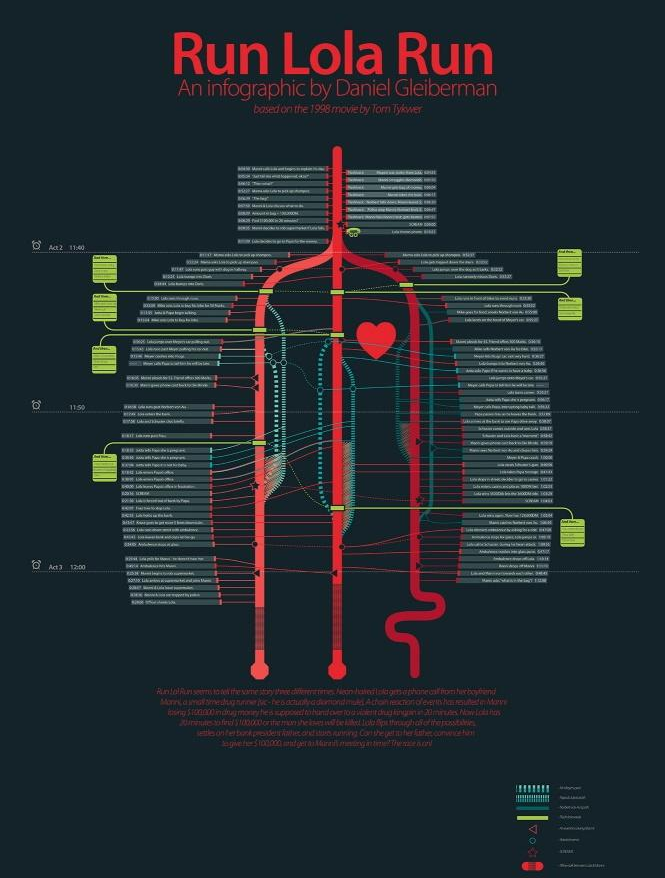
This is an infographic for the film *Lola Runs*. It uses similar shapes and colors to connect events across the film’s three timelines. The poster is also designed to resemble the shape of a lung, symbolizing the film’s theme of running.In fact, *Run Lola Run* features a tree-like narrative structure, whereas video games tend to employ a networked narrative structure. The latter not only includes independent storylines with clear directions but also narrative nodes that can converge and interact, requiring screenwriters to possess a more scientific mindset.
Actually, in my view, just as China’s current film market lacks good screenwriters, the country’s gaming market is actually short on game writers who can tell compelling stories. Many of today’s game writers come from the film and television industry, and they tend to: 1. Lack the ability to integrate game narrative with gameplay;2. They write overly long scripts with shallow dialogue, as if they were being paid by the word or by the minute, resulting in gameplay that feels extremely sluggish; 3. The plot and story elements are highly recognizable repetitions of current popular culture, offering no sense of novelty or freshness to the audience.
When I talk about “telling a good story,” I’m not referring to mindless “feel-good” novels, short videos, or period-themed games that merely pander to users’ desires for instant gratification. Rather, I’m talking about games that stand up to scrutiny and the test of time—games that, even years later, when people’s tastes, trends, and social issues have changed, still manage to move and resonate with players.Works designed purely for thrills can achieve decent market success through packaging and marketing. However, because money comes so quickly through this approach, developers gradually stop exploring the essential ways in which games—as a medium—can be used for expression, relying instead on superficial packaging and marketing tactics. This actually hinders the further development of the game culture industry.
In fact, just as a good screenwriter can turn something ordinary into something extraordinary, as long as the story is deep and compelling, it’s possible to create a great work even with very basic equipment and inexperienced actors. A good game writer is truly the soul of a low-budget indie game studio.I have always believed that our domestic game industry possesses sufficient technical and implementation capabilities. The bottleneck in our game production capacity actually lies in our inability to tell a good, in-depth story effectively (compared to competitors, Cai Haoyu and Feng Ji’s greatest strengths lie precisely in their ability to tell a complete story, which is why they stood out).Even in AI-driven games, the system relies on a “narrative rule library” pre-established by the screenwriter.
However, methods for game storytelling have not yet been incorporated into any higher education system. I believe this is a significant gap in China’s game industry, so I have set myself the goal of using current technology to create a narrative masterpiece on par with the JRPGs of the 1990s.I am currently studying *Xianjian 98: The Tender Edition*, the *Wind Fantasy* series, and the *Legend of Heroes* series.I believe that once the future game industry becomes highly developed, major game studios will resemble today’s major film studios, where every step of film production can be industrialized. However, the only challenge—and one of the most important motivations for humans to read novels, watch movies, and play games—is that “stories” must always be kept fresh (there is always a need for new, high-quality content).
In the words of Professor Mei Feng: “Creative films prove their own worth. Only films that contribute to the aesthetics of Chinese cinema are worth discussing.” If we replace the word “films” in this quote with “games,” that sums up my view on domestic games. We still have a long way to go in terms of training in game copywriting and planning.
▍Game Producer: Ariane
A common misconception about content writers is that their job is simply about writing. In reality, content writers in most content-driven game development teams—especially those in mid-to-senior-level roles—need to have a solid understanding of and some control over plot structure, system implementation, basic presentation techniques, and visual design.In many content-driven projects, content writers are the individuals who understand the game’s world-building and lore best; they serve as the central hub of the entire project, making this a critically important role.
From an idealist’s perspective, telling a good story is certainly important in commercial games. But everyone has a different definition of what constitutes a “good” story. In reality, when it comes to game development, content that resonates with the audience is what truly matters.
I don’t think AI can ever replace copywriters, haha! I still firmly believe that AI is merely a tool and an aid. Content-driven games will always thrive in a diverse landscape. While AI can help with the practical aspects of copywriting, it can never provide entirely new perspectives or insights—that’s something only humans can do.
▍Story Designer at a Major Game Developer
In our project team, there aren’t really any misconceptions about copywriting and storytelling. As for whether commercial games need to tell a good story, I think they do—but on one condition: the game actually needs a story to begin with.”Telling a good story” isn’t a necessity for every game; it’s a design choice. Some games have no narrative at all, and that doesn’t detract from the player experience. But once you choose to tell a story, wherever text appears—even if only one player cares—it needs to be done well.
For long-term games, content must be produced continuously, and the narrative pace must align with the release schedule. The direction of the plot is often influenced by operational data, monetization strategies, and even player sentiment. Under these circumstances, it is actually very difficult to fully guarantee the integrity, pacing, and emotional build-up of a “good story.”So I don’t think it’s a false proposition; rather, the demands on storytelling are simply different from those of single-player games. What underpins the narrative of a long-term game isn’t a single “good story,” but a system and workflow capable of continuously producing “good enough stories.”
Today’s AI is quite sophisticated; when given well-crafted prompts, it can generate high-quality text snippets and effectively assist in writing highly repetitive content with fixed formats. However, current AI is still unable to consistently grasp the “overall feel” of a game.Game copywriters must constantly collaborate with various teams—such as combat, art, and systems—and as a project progresses, many elements are constantly changing. The final story may end up being completely different from the initial plan, and current AI is not yet capable of participating in this process of coordination and collaboration as effectively as humans.Furthermore, like all creative work, game writing relies heavily on “inspiration.” Therefore, at least until AI can replace all functions of the human brain, the role of a game writer remains quite important.
▍Copywriting by Mu Xue, “The Universe at Your Fingertips”
When it comes to copywriting, many professionals still believe that “copywriting is just about writing.” In fact, this perception was accurate in the early days. However, as the variety of games has expanded in recent years and content-driven games have come into their own, the work of a copywriter is no longer as simple as “just writing.”
Based on the overall workflow and scope of work, copywriting and planning tasks can generally be divided into the following five categories:
- World-building: As the name suggests, this refers to the person responsible for defining the nature of the world in which players find themselves. However, this task is typically handled by lead writers or higher-ranking staff members; since I am not at that level, I will not elaborate further.
- Story Planner: Generally speaking, this refers to someone who “writes things”; their responsibilities include developing story outlines, writing scripts, and providing creative requirements.
- Game Writer: A professional who bridges the gap between story and presentation, primarily responsible for the visual expression of the narrative. Their duties include script editing and storyboarding.
- Production Planner: The person responsible for translating the final script into a film or television production typically does not handle the scriptwriting aspect of the work. Their duties include creating storyboards and providing still and motion visuals.
- Quest Designer: A person responsible for breaking down the final script into components based on gameplay and user experience, and implementing them. Responsibilities include quest breakdown, implementation, feature design, and providing art requirements.
- Textual Packaging: All decorative text within a game can be considered part of this packaging. However, beyond mere decoration, the most important role of packaging is to integrate game design with the game’s world-building—and achieving this is no easy feat.
In a very small number of large companies or content-focused projects, these five roles are generally distinct from one another. Although they all belong to the copywriting team, each performs its own specific duties in an orderly manner.In the vast majority of companies, however, these roles are consolidated into a single position. This person has no other fancy title; they are simply a copywriter—and I am one of them.In summary, the role of copywriter has evolved over the past few short years from a state of “seeing the mountain as a mountain” to “seeing the mountain as still a mountain.” Today, the industry’s criteria for evaluating a qualified copywriter are no longer as simple as “just writing stuff.”
The vast majority of games need to tell a good story, unless they contain no narrative elements whatsoever. Stats provide players with a sense of achievement, gameplay offers a sense of control, and stories give players a sense of belonging.As stats inflate with each update and gameplay wears thin over time, the story becomes the sole driving force that keeps players coming back for more or returning in the future. It’s much like marriage: when the trivialities of daily life have eroded the romance, there’s always a warm light waiting for you at home.
Is telling a “good” story a non-issue in service-oriented games? Before answering that question, I’d like to pose another one: what exactly constitutes a “good” story? In my view, any story that touches the heart and resonates with the audience is a good story.As a fan of traditional wuxia, I’ll use *Sixteen Sounds of Yan Yun*—one of the most representative commercial games in the wuxia genre—as an example. Whether it’s main story chapters like “The Forge of Heaven and Earth” or side quests like “A Lifetime in a Single Leaf,”I believe my peers can all attest to its story quality, content depth, and production standards.
In the age of AI, is copywriting still important? In my view, copywriting will certainly be among the first jobs to be replaced by AI. However, it will also undoubtedly be among the jobs that survive once the wave of AI-driven disruption has passed. This journey will follow the same evolution described earlier regarding job responsibilities—moving from “seeing the mountain as a mountain” to “seeing the mountain as still a mountain.”As low-quality, formulaic, and mass-produced commercial copy vanishes in the course of natural selection, high-quality content—crafted with passion, authenticity, and the power to resonate—will one day emerge from the shadows and reveal its true form.
原创文章,作者:gallonwang,禁止转载:https://youxichaguan.com/en/archives/197954