I’m becoming increasingly convinced that the skill descriptions for new characters in the second game are designed to test players’ reading comprehension.
The new S-rank character “Nangong Yu,” added in Version 2.7 of *Zero Zone*, is incredibly endearing thanks to her persona as a genius teenage idol and her prankish personality. In particular, Nangong Yu is the final piece of the “Delusional Angel” faction, often taking on the crucial role of boosting burst damage and increasing damage output in battle. As is well known in the game’s combat system, the dynamic is almost always “support characters are constant, while main DPS rotate.” This means Nangong Yu is essentially a must-pull.
However, when I saw the official description of Nangong Yu’s skills, I was completely dumbfounded. In that lengthy essay of over 1,300 words, technical terms appeared as many as 46 times. I read it over and over again; it felt like I understood something, but at the same time, it felt like I didn’t understand a thing.
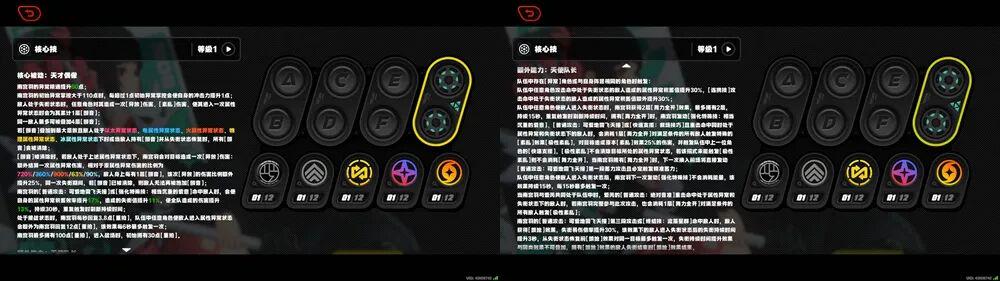
Nangong Yu Skill Description (1,343 characters)
Is Nangong Yu really that strong? And how should you use him? I have no idea. I guess I’ll just go ahead and open Bilibili and copy the answers from the *Absolute Zero* content creators.
It’s been a long-standing issue that skill descriptions in mobile games are complex and difficult to understand, and there seems to be a pattern where the stronger a character is, the more complex their skill descriptions become.
“Return to the Future: 1999,” which is currently celebrating its third anniversary, has introduced the limited-edition six-star character “Little Ryanon.” During a preview livestream, the development team hinted to players that Little Ryanon features a brand-new mechanic that can be adapted to multiple playstyles.
The subsequent skill description for Little Ryanon ran 743 words, with half of it devoted to explaining her passive skill. However, this copy—laced with “9-style” language and filled with nested technical terms—was a real headache for me.
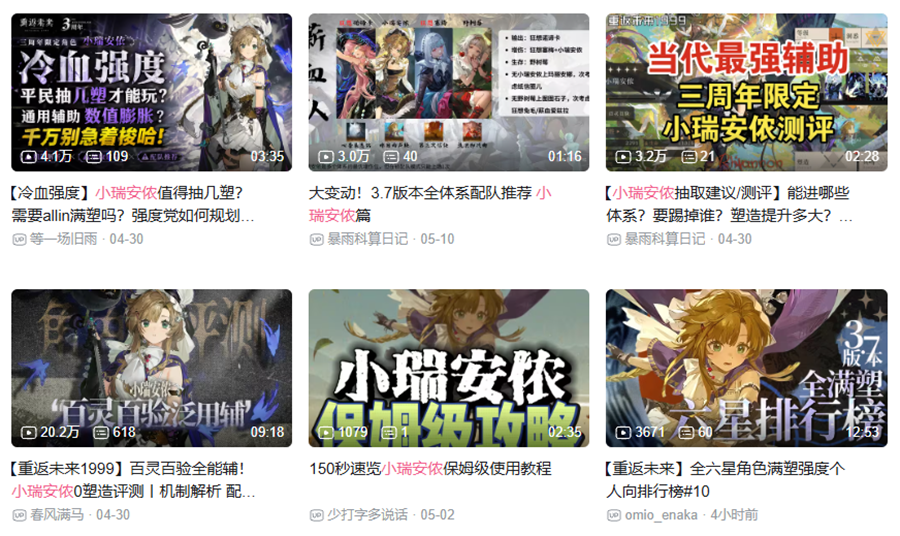
I’ll just watch the Chinese-to-Chinese translation by the content creator.
For example, to understand the purpose of Little Ryan’s “synchronized harmony,” I need to understand what “synaesthesia” and “telepathy” are. To understand the function of “telepathy,” I need to know what a “force field” effect is… It’s like playing with Russian nesting dolls—peel back one layer, and there’s another one underneath.

Proper nouns nested within proper nouns
In conversations with developers, I learned that this type of work—creating brand-specific terminology—is referred to as “copywriting.” As the term implies, it involves embellishing things to make them more appealing.
Clearly, the game’s art style is a bit over the top, making it hard for many players—myself included—to grasp. So why can’t the game’s copy be written in a way that’s easier to understand? Does this obscure copy also cause problems for the developers?
Facing the controversy head-on, here’s what the copywriters have to say:
▍Copywriting That Refuses to Take the Blame: Kang Xin
As a copywriter for content-based products myself, I feel I must set the record straight—or rather, offer a few words of defense.
Looking at the well-known mobile games currently on the market, while these issues certainly exist and the copywriting certainly bears some responsibility, from the perspective of overall project development, the impact of copywriting may actually be quite limited.
First, when it comes to in-game combat text, copywriters often find themselves working downstream from the requirements (combat designers create skills and descriptions, then hand them off to copywriters for polishing and implementation within the game). If the combat designers’ initial descriptions of mechanics, effects, and layers are already obscure and abstract, the descriptions themselves—even without the jargon—can be a real headache for copywriters.
Second, in most cases, these terms do not reflect the aesthetic preferences of the content creator (in this context, the copywriter) but rather those of the reviewers (team leaders, product owners, producers, or executives). Whether to include these seemingly abstract promotional texts, in what form, and where to place them—these decisions cannot be made or altered by a single copywriter acting on their own.
Similarly, when players complain that a boss design is terrible or a character’s key visual is ugly, it’s possible that the final result wasn’t what the designers or artists originally intended, but rather the outcome of thoroughly incorporating feedback from the reviewers.
Furthermore, are these abstract terms really completely useless? Why, despite being widely criticized, do project team members still show no intention of revamping them? The answer may lie in the context of “for example, mobile games.”
In addition to the issues of “skill descriptions” and “technical jargon” mentioned here, the game’s obsession with grand narratives and the script’s tendency to be overly cryptic are also common complaints among players of the second installment.
But perhaps it cannot be denied that the “er” in “er-you” also refers to the “er” in “chuunibyou”—the more mysterious, pretentious, and cringeworthy the content, the more it signifies, to a certain extent, an authentic “otaku vibe” and the corresponding subcultural atmosphere. In short, a significant portion of the audience must have a preference for this style of presentation, and the project’s tone has been validated by the market and commercial success…
All of the above may be precisely why my fellow copywriters readily embrace this kind of abstract branding. As for how these branded terms are conceived, everyone likely has their own “tricks of the trade,” so I won’t dwell on that here.
▍Copywriter with years of experience in packaging: Yu Ban
To be honest, doing “packaging” on a second-tier game project is a job with a very low return on investment.
Essentially, game interface design involves creating a special layout for in-game elements so that players can immediately understand their functions at a glance. However, functionality is gradually giving way to aesthetics; rather than spending time crafting clear explanatory text, developers are now focusing on making the interface look more appealing.
“Players will just skip the tutorial anyway” and “Players will figure it out as soon as they start playing” might be a true reflection of our mindset as developers.
In our workflow, very little time is allocated to packaging; it’s considered a minor task that doesn’t receive much attention. Even if someone wants to innovate, they usually give up because the return on investment isn’t worth it.
For example, in an SLG project team, the copywriter’s main job is branding—a role that’s pretty much on the sidelines. No project is going to reward a copywriter just because they did a good job with the branding, right?
At work, we package the various mechanics they design according to the planners’ requirements and the characters’ inherent traits—which is essentially like dancing with shackles on. On top of that, we have to avoid using proper nouns already in use in other games, which has made the packaging for our game sound increasingly nonsensical.
Of course, I’ve always emphasized the importance of clear and understandable dialogue, and I insist that the script align with the way Chinese people naturally express themselves—this is something I’m personally committed to.
▍Kaka, a veteran copywriter with a touch of teenage rebellion
Actually, I’m really enjoying it myself. Since you’re making a second game, you might as well go all out with the cheesiness.
A lot of people aren’t used to it, which goes to show that many of today’s fans are newcomers to the anime and manga scene. Didn’t we old-timers used to watch tons of anime and read tons of manga that were full of specialized terms? We all thought they were so cool—things like “Fantasy Killer” and “El Psy Congroo,” right?
(Sorry, I’m done with abstract talk.) To put it simply, copywriting is essentially the product’s packaging.
For example, if our combat designers create a mechanic that requires five prerequisites to fully explain, your job is to make sure it’s clearly communicated. Those overly dramatic, abstract, and mysterious-sounding terms are there to make it fit the game’s lore.
Although the intended meaning is likely that triggering Y in state X results in effect Z, you should follow a process of “elimination” when choosing terms. Factors such as the game’s world-building and existing terminology must all be taken into account; you can’t let players feel like they’re “taken out of the game.” You also need to consider multilingual localization (since the terms shouldn’t sound too awkward when spoken in Japanese or English voiceovers). Find a suitable term that meets all these criteria, and use it once you’ve found it.
Besides, making a character’s skill description sound completely different from the previous one is part of what makes copywriting so valuable, isn’t it? (Don’t hit me—I really do think it’s cool.)
Watching from the sidelines, other developers say:
▍Promotional copy is still copywriting—Fan Zhou
After a game has been running for a while, players start craving something fresh, including new mechanics, new gameplay features, and other innovative designs. However, the development team may have released the simplest, most straightforward, and most structured content right at launch, as this is the most cost-effective and safest approach.
Players want new experiences, so the development team has to come up with new designs. These new designs inevitably become more complex, making it difficult to explain them clearly to players. Take MMOs, for example: at launch, there’s usually just one pet-raising system, but later on, systems like jewelry and wing-raising are introduced, making the game increasingly complex.
So we need to explain complex new concepts to players in plain language.
I’ve noticed that popular games like *Teamfight Tactics* and *Genshin Impact* not only provide lengthy descriptions of new mechanics but also include a concise summary.
When we handle marketing and promotion, we tend to focus more on showcasing how cool the characters’ skills look and how impressive the effects are, rather than delving into detailed explanations of the mechanics. When it comes to analyzing skills, content creators are likely better suited for the task. They have their own unique way of communicating, allowing them to convey their insights to players.
▍Xiaoqi, a System Planner Who Doesn’t Write Copy
I think it’s a matter of striking a balance between creating an immersive, fantastical world and ensuring it remains accessible to the general public. Every game on the market has its own set of made-up abstract terminology—even the Chinese-style MMOs from years past are no exception.
The cultural backdrop of anime-style games is mostly rooted in Western or Japanese fantasy, so their vocabulary and phrasing naturally differ from those of mainstream cultural works. Take Sisyphus, for example—I suspect that seven or eight out of ten Chinese players don’t even know he’s a figure from Greek mythology, let alone the derivative culture created by the game itself. Just look at Japanese and Korean, both of which use phonetic scripts—aren’t they both absolutely packed with loanwords?
In my view, the reason skill descriptions keep getting longer is that it’s easy to add fluff but hard to trim the fat. Writing a long, convoluted explanation first—leaving players completely confused—and then having the community come up with a guide to clarify things is, in a way, a community management strategy in itself.
▍Xiao Wang, Combat Designer for Monster Battles
Since new characters are products, providing more detailed skill descriptions is just good business practice. Of course, I don’t really read the official skill descriptions either; I just go straight to the “Chinese-to-Chinese” breakdowns by guide authors, which are much clearer and more concise.
The official text for character skills is usually finalized only toward the end of development, so during the development process, the team may not have a clear sense of how readable the text is.
原创文章,作者:gallonwang,禁止转载:https://youxichaguan.com/en/archives/196444