
If we were to trace the history of anime-style games in China today, *Azur Lane* would undoubtedly be one of the titles we simply cannot overlook.
The reason is simple: since its official open beta in 2017, it has gone through the entire cycle of this genre’s evolution from a niche to a mainstream phenomenon, maintaining a steady operational pace and content output to this day, while consistently ranking among the top titles on the best-seller charts.
To put it simply, *Azur Lane* is considered a classic because it meets two criteria: it has been around for a long time and has been very successful.

Not even the data platform can display the complete sales curve
Many people view *Azur Lane* as the “gatekeeper to the top tier of mobile games.” This term implies that you must have at least played *Azur Lane* to be considered a contender for the top ranks. Longtime anime and manga fans will likely recognize that this role used to be referred to as the “Wall of Masterpieces” in the ACG industry.
However, when we look at the industry landscape in 2026, this term is no longer just a joke.
Logically speaking, a game like *Azur Lane*, which doesn’t follow the trend toward open-world settings or popular gameplay mechanics, should have been pushed to the margins long ago given the current competitive landscape of the industry. Yet, it has actually thrived, demonstrating remarkable vitality.
The key point is that it’s hard to attribute this success solely to *Azur Lane*’s early launch, because among the mobile games released in 2017, it is the only one that has survived to this day, maintaining healthy operations and even consistently ranking among the top titles on the sales charts multiple times a year.
What is the secret to the success of “Azur Lane”?
Although this issue has been analyzed from many angles before—such as artistic style and business models—essentially, these external factors can be said to be merely superficial.
More importantly, it is the game’s essence and core—and the resulting product design that diverges from the current industry trend—that matter most. In other words, given the prevailing industry belief that bigger is better, *Azur Lane* stands out as a “different” variable: it is sufficiently “lightweight.”

Just yesterday, on the evening of May 15, the live stream previewing the 9th anniversary celebration of the Chinese server of *Azur Lane*—an official event that unveiled a slew of exciting details about the anniversary festivities—provided us with a clear enough snapshot to understand the key factors that have enabled *Azur Lane* to weather the test of time, or, in other words, to decipher the “Azur Lane model.”
01
Making a Heavy Task Seem Easy
As a standard practice in the industry today, I’ve actually put together a brief summary of the criteria for evaluating preview livestreams for mobile games. Essentially, if a livestream can convey “exciting” content to existing users, generate community buzz to attract casual players, and strike a balance between information density and emotional engagement in its pacing, then it can be considered a high-quality preview livestream.
If you play *Azur Lane*, you know that anticipation for the game is always high, and yesterday’s two-hour-plus livestream was no exception. Of course, as is typical around major events, summary threads on NGA and Tieba quickly racked up thousands of replies, and the livestream’s viewership figures hit a new record high. Many players said they’d love to just sleep straight through until May 20th.
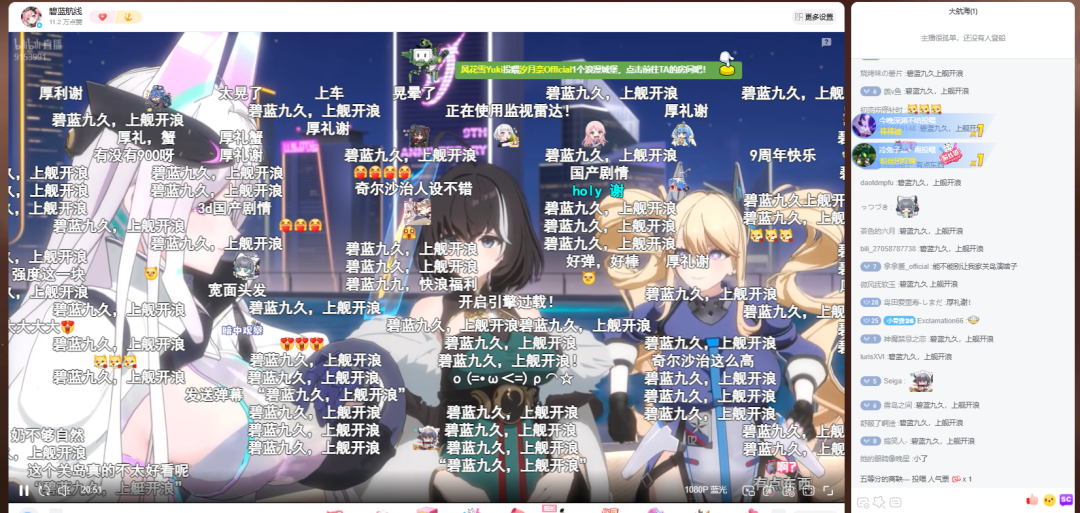
Given what was revealed during the live stream, it’s no wonder players are on the edge of their seats. For this 9th-anniversary update, the development plan continues to follow Blue Archive’s core “three-phase rollout” approach. A wealth of new characters, new L2D outfits, and new Oath outfits will be released in three phases over the coming weeks, along with numerous system-level optimizations and maintenance updates.
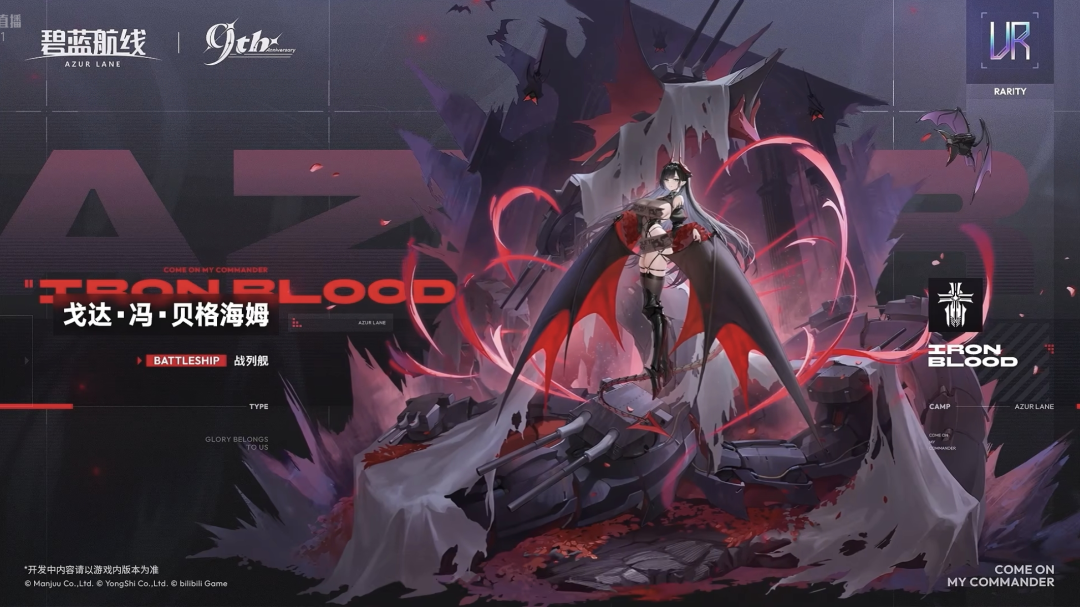
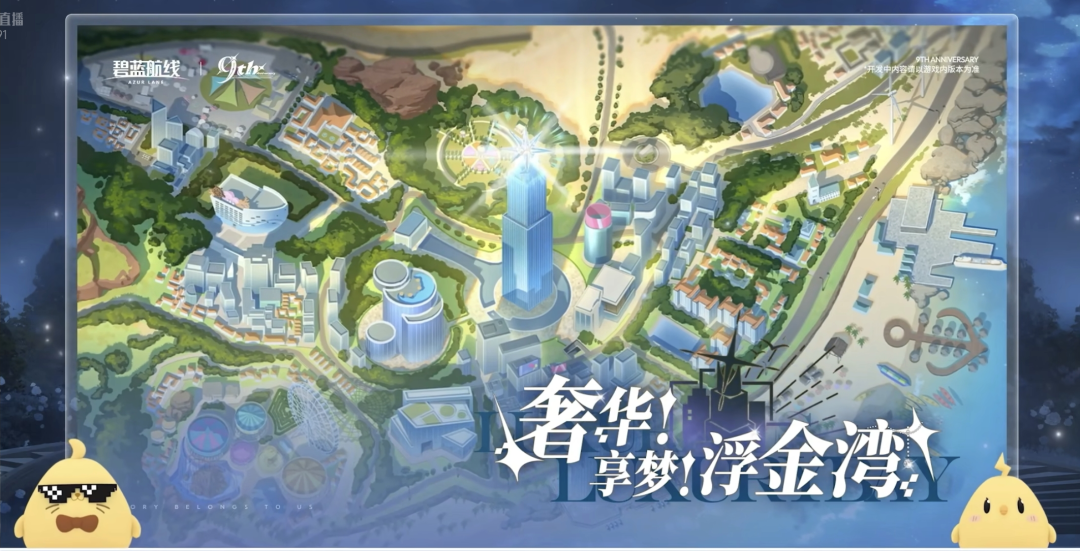
If you look at it purely in terms of size, you might say that this content is definitely not “lightweight” enough.
That’s true, but that’s precisely what makes *Azur Lane* so interesting. In terms of content, it’s just as substantial as other mobile games—there’s actually quite a lot of it—but the experience feels light and airy. Moreover, that “substantial content” is highly concentrated in the realm of “artwork.”
In other words, this product has chosen to devote the vast majority of its production capacity and technological resources to ensuring that “what players see is good enough.”
This is nothing new; everyone knows that Manjyu’s art is widely recognized as its absolute strength in the industry. Backed by years of positive player feedback, I’m sure I don’t need to say much more about its 2D art.
However, I once wrote an article stating that the era when mobile games were judged solely on their “artwork” is over. After all, there is no shortage of visually appealing games these days; many teams are capable of producing character designs that stand out at first glance or distinctive stylistic designs.
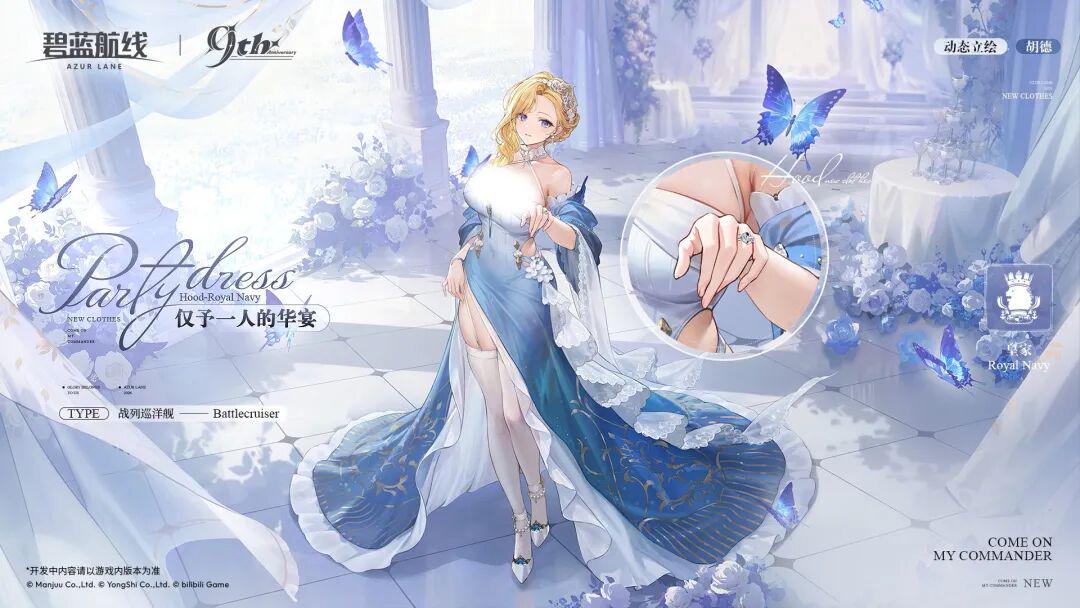
The real challenge lies in turning “good looks” into a consistent, industrial standard, maintaining that standard over a sufficiently long operational cycle, and continually pushing the boundaries of that unified aesthetic benchmark.
“Azur Lane,” or “Manju” as it’s often called, has managed to do just that.
If you take a look at the art produced by *Azur Lane* over the years—including the nearly 300 new outfits set to return in this update—you’ll notice that its visual style is both consistent and constantly evolving. With every update, the new art content makes players feel that the game has “just gotten even better.”
This ability to consistently produce high-quality work over the long term is often overlooked, but it undoubtedly represents a significant barrier to entry in the industry.
In the realm of 3D gaming, *Azur Lane* is also leveraging its artistic strengths to gradually expand gameplay features and possibilities. For example, since its launch in September 2024, the “Dormitory Project” has undergone frequent updates and iterations, with Manju continuously deepening the level of interaction, making this feature another major highlight of *Azur Lane*.
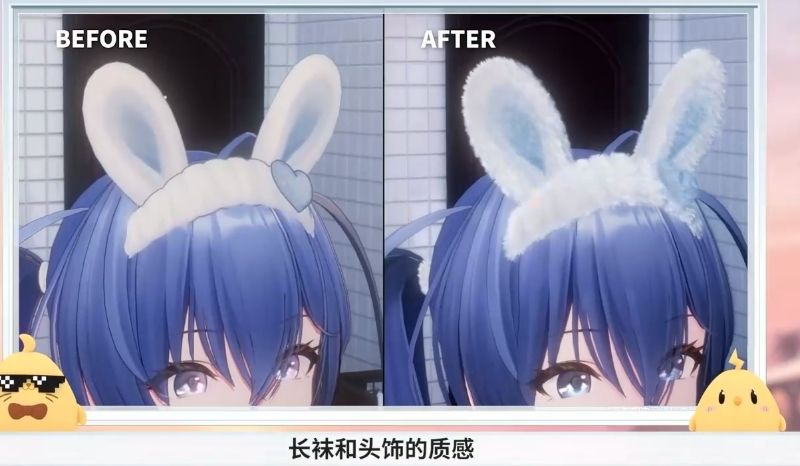
Material Evolution Over 25 Years
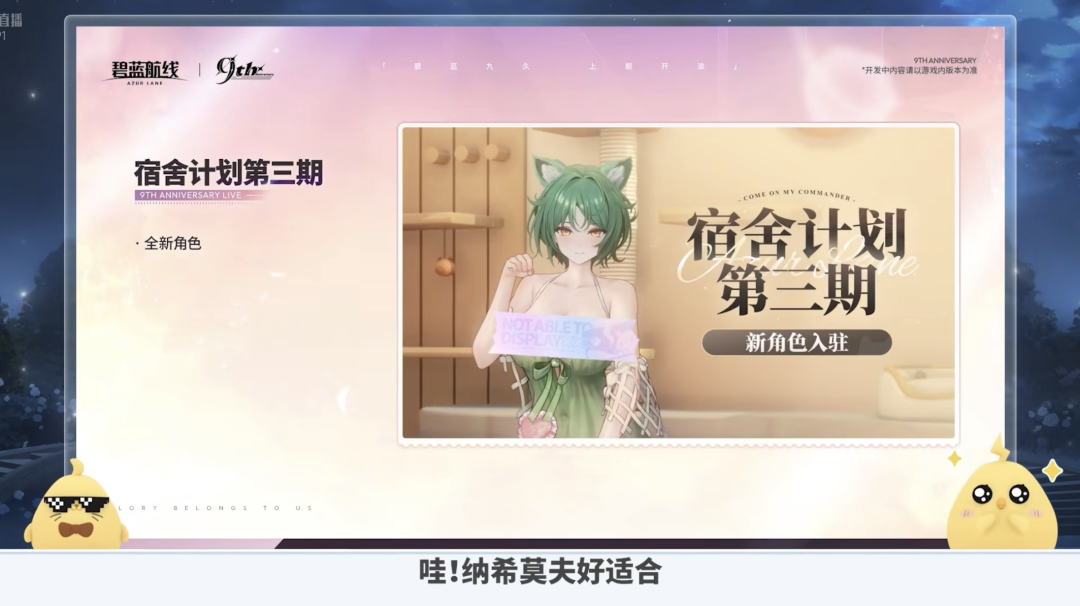
During this anniversary livestream, the project team announced that the popular character “Green-Headed Cat” Nakhimov will be joining the Dormitory Project. With this addition, the number of interactive characters in the dormitory has now reached seven. From the single character “Sirius” at launch to the increasingly lively dormitory area today, the Dormitory Project continues to expand its content at a steady pace.
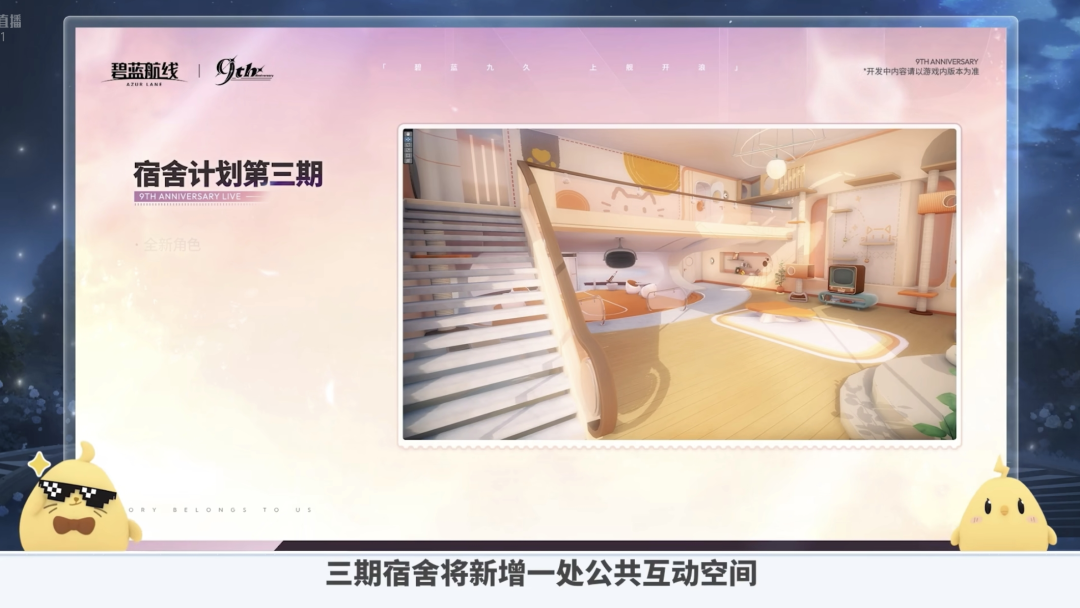
Beyond the technical breakthroughs achieved by Manjyu, the significance of this project lies in the fact that the 3D dormitory provides *Azur Lane* with an additional avenue for emotional expression: it creates a shared space where characters and players can interact.
As the roster of characters grows, this space begins to feel more and more like a source of daily companionship. For players who have built emotional bonds with these characters over the years, this serves as an additional layer that stirs their emotions—one that goes beyond the exquisite 2D visuals.
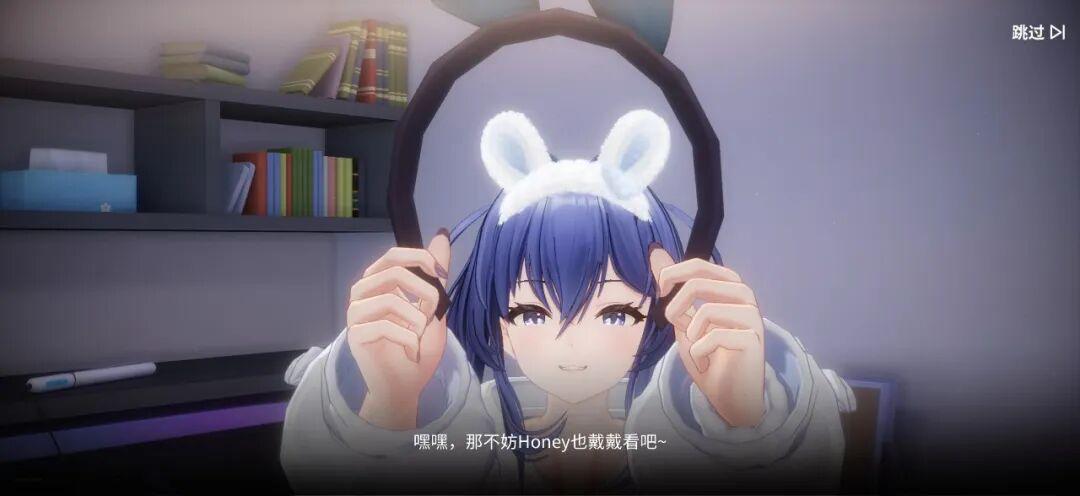
In an era where transitioning to 3D has become the default path for the 2D game genre, *Azur Lane* has a remarkably clear understanding of its core strengths. Rather than blindly shifting the game’s focus to 3D, the developers have instead leveraged it to enhance the existing emotional connections with players, filling in the gaps in the experience that 2D alone could not cover.
It can be said that it is precisely through this ongoing self-driven evolution of its 2D and 3D art standards that *Azur Lane* continues to push the boundaries of both 2D interaction and 3D companionship.
At the same time, however, the production-side complexity of *Azur Lane* does not detract from the “lighthearted” nature of the gameplay experience, as the visual content itself offers an immediate, frictionless experience; enjoying the costume changes and 3D dormitory scenes requires nothing more than your attention and emotional investment.
In a sense, the most substantial rewards in *Azur Lane* correspond precisely to the experiences that players can most easily access and enjoy, which forms the foundation of its “production-focused, experience-light” approach.
02
Moving at a “slow pace”
A series of system optimizations launched in conjunction with the 9th anniversary have extended this balance between simplicity and depth to the player experience.
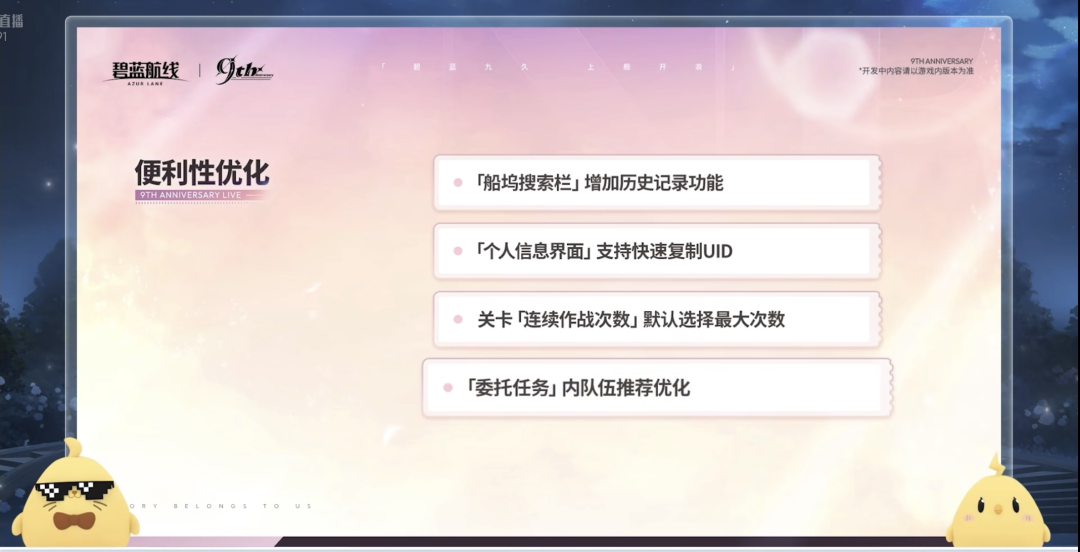
Optimizations such as adding a search history to the dock search bar, setting the default number of consecutive battles per stage to the maximum, prioritizing unmaxed ships in recommended squads for commissioned missions, enabling quick UID copying in the profile screen, and customizable cutscenes will be released in the 9th Anniversary update.
Of course, the most crucial thing—the highly anticipated Plymouth L2D+ skin pack that players have been clamoring for—is “in the works, in the works.”


Taken individually, these optimizations and content updates may not seem like much. But taken together, they send a clear message: Manjiao truly puts itself in the players’ shoes.
Most of these adjustments are aimed at eliminating friction in players’ daily gameplay. Features such as the optional ship retirement category (implemented earlier), the ability to automatically open the dismantling interface when opening equipment crates, reduced difficulty in event dungeons, and the weekly repeat mode are all designed to make the path to core content shorter and smoother for players.
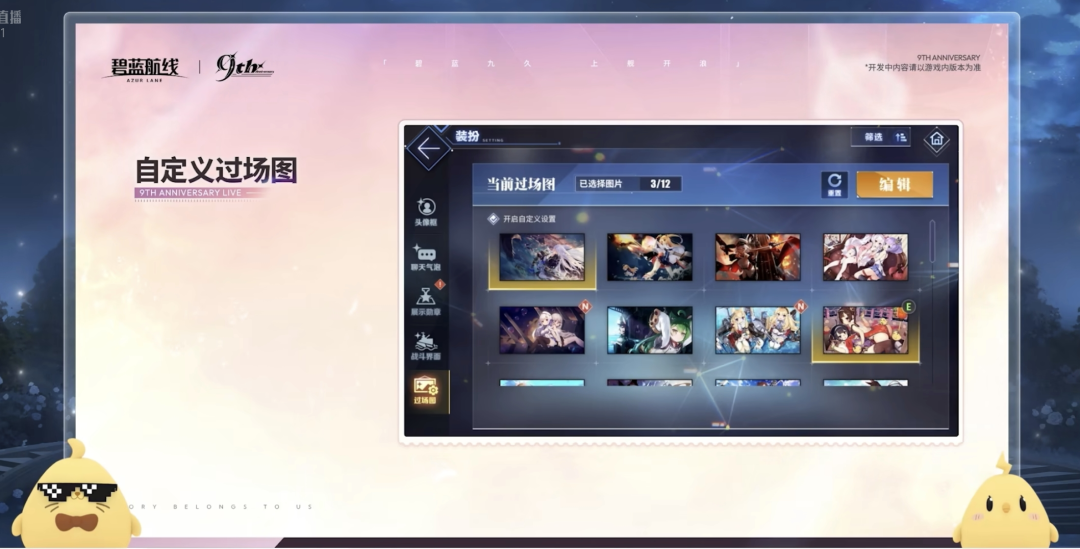
Manju’s core philosophy is that the system should not act as a barrier between players and content.
Upstream, we’re going all out to enhance the production standards and density of our art, while continuously delivering eye-catching content; downstream, we’re streamlining the experience to eliminate any barriers to gameplay, ensuring that every player returns to the Harbor District feeling relaxed and at ease.
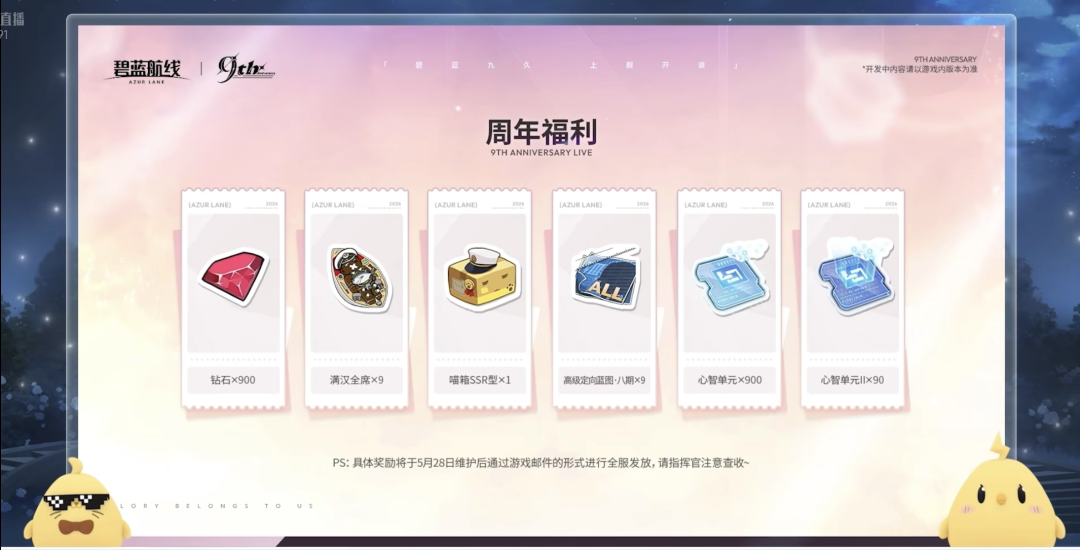
As for the rewards, we’ve ramped them up even further for our 9th anniversary, giving away 900 “Red Tips.”
It’s as if Manjyu is telling players: “You should spend your time seeing great things and enjoying great experiences.” So, while everything seems to move at a “sluggish” pace, the player experience feels like a gentle breeze caressing your face, making it hard to develop the sense of monotony often found in other games.
This is also the key to *Azur Lane*’s long-term success and enduring popularity: while its content is rich and substantial, the pathways to that content are light and accessible.
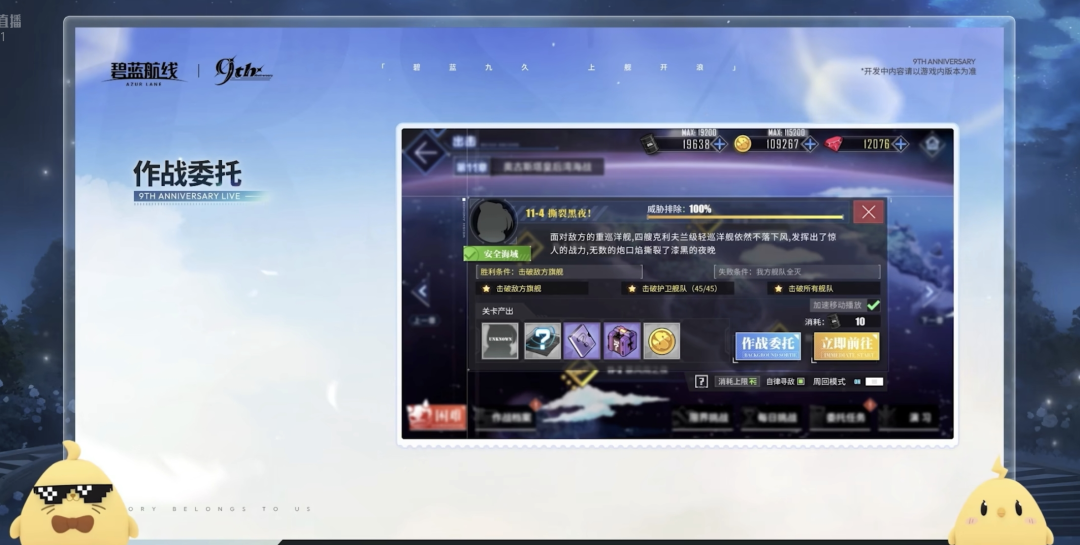
I would call the Battle Delegation the ultimate solution for reducing your workload
Beyond that, the business model that underpins this system creates a perfectly self-contained ecosystem. As many veteran players have pointed out in their guides for newcomers on social media, *Azur Lane* is free from gacha anxiety.

Unlike many so-called “gacha games” in the public imagination, the core monetization model of *Azur Lane* has long been decoupled from character progression or “character acquisition.” The resources needed to draw characters can generally be obtained for free through daily gameplay, and their acquisition is directly proportional to the amount of time spent playing. Combined with the game’s extensive character exchange system, players of *Azur Lane* rarely find themselves stuck without the characters they want.
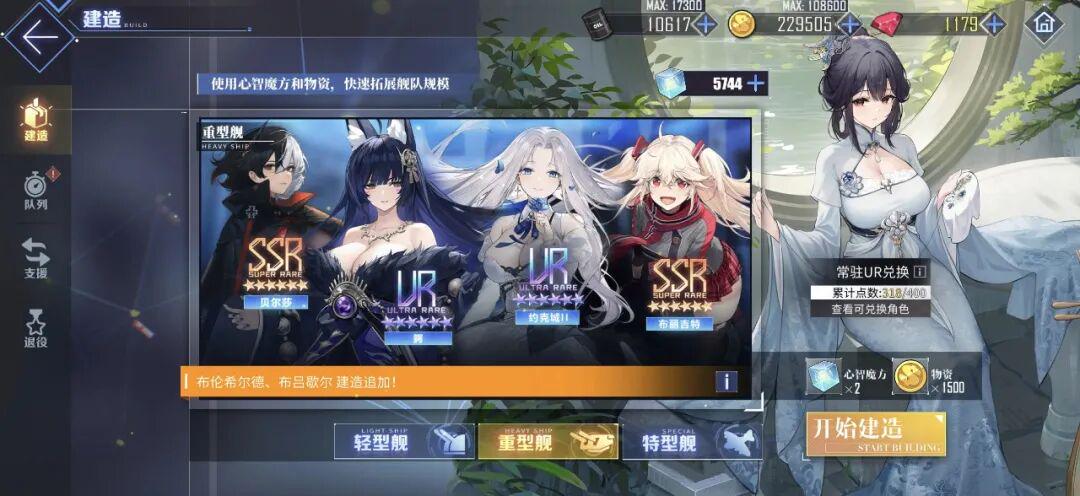
If you’ve been playing long enough, like me, you’ll never run out of card-drawing resources.
As a result, “Azur Lane” is one of the few mobile games where the community agrees that “the best time to start playing is when the game first launched—and right now.“
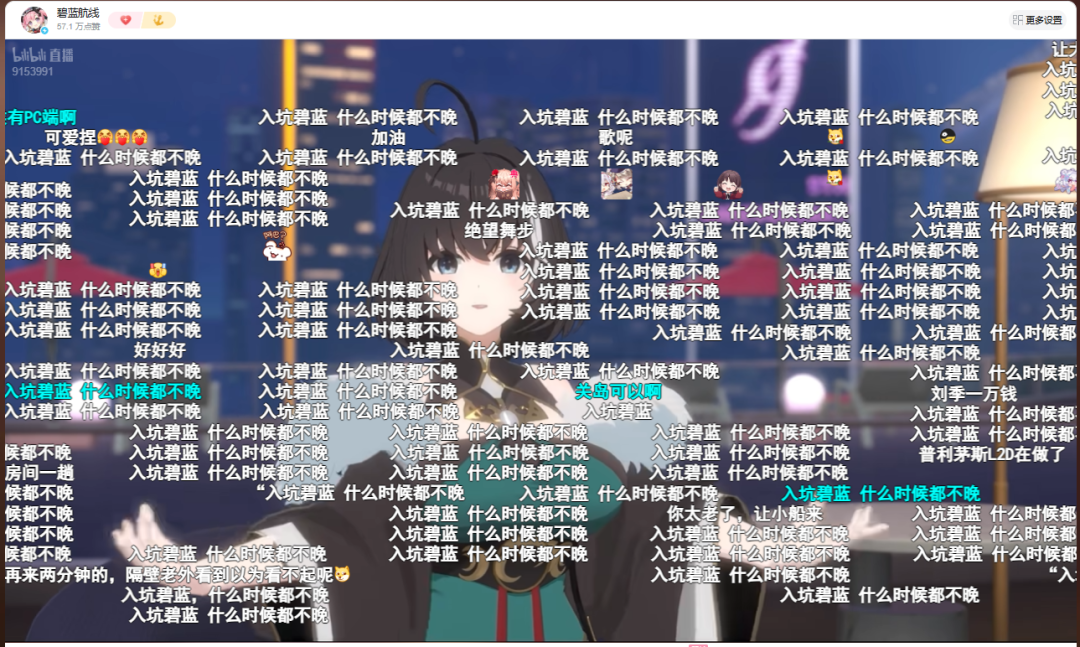



As a result, character customization has essentially become one of the core revenue streams for *Azur Lane*. As an emotionally driven form of aesthetic consumption, the underlying motivation for players to pay for customization boils down to a single word: “liking” it. This allows *Azur Lane* to naturally maintain an experience characterized by low payment pressure and low anxiety, eliminating the need to coerce spending through numerical pressure.


This was further corroborated by some of the annual statistics revealed during the livestream. According to *Azur Lane*, the “Dormitory Plan” received over 67 million gifts, and more than 50,000 commanders completed the “Training Plan.”
What’s interesting about these sets of numbers is that they track interactions between players and characters—which suggests that, at least in *Azur Lane*, the key metric for data analysis is the emotional connection between players and characters.


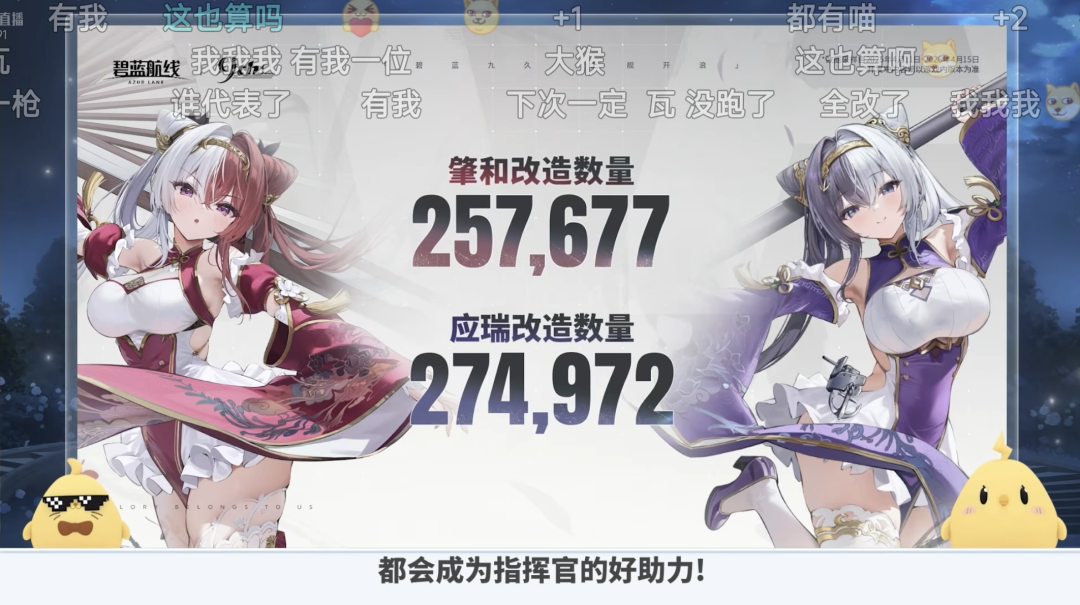
The data on upgrades and pledges provides a more intuitive overview. After receiving upgrades and enhancements earlier this year, Zhaohe and Yingrui have each been activated by commanders more than 200,000 times.
Furthermore, Cheshire, who ranks second on the Vow Leaderboard, has been available for nearly six years, yet players continue to choose to form vows with her.
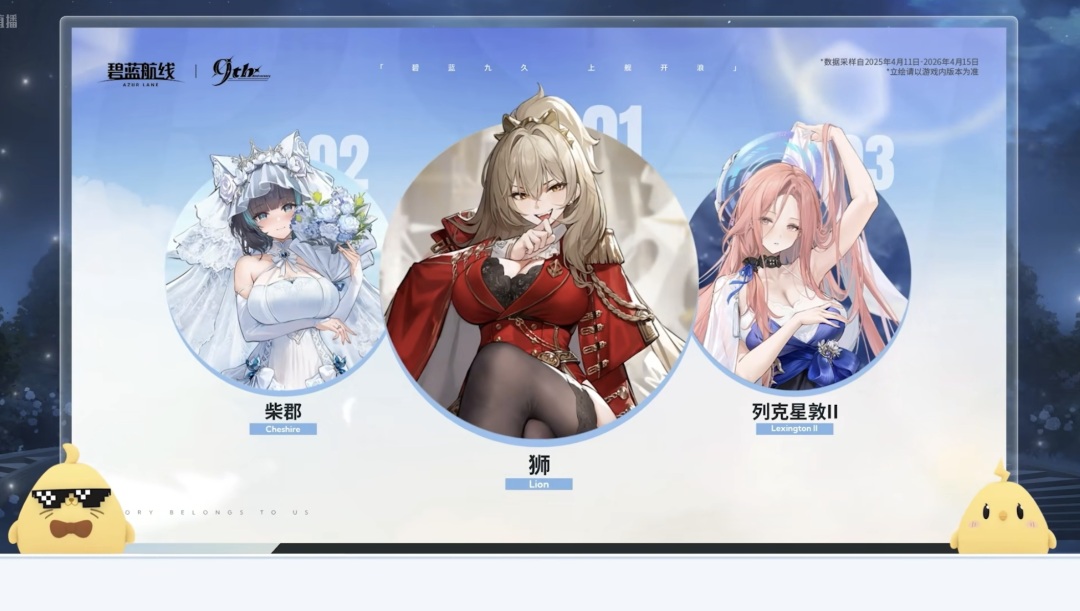
What drives this behavior has nothing to do with novelty; rather, after accompanying players through countless days and nights, they have become an emotional anchor in the Commander’s heart.
The fact is, when a product team presents and highlights certain data during its anniversary review, that data itself reveals the framework through which the team evaluates its player community.
These data points demonstrate that using time as a vessel for the relationship between players and characters is the core logic of *Azur Lane* at the product level.
03
Spillover effects
The previous two sections have examined how the “effortless” model of *Azur Lane* operates within the game itself—a model characterized by nine years of sustained growth in production capacity, a seamless user experience, and a positive synergy between the business model and player engagement. This model has also generated noteworthy “spillover effects”: the IP value of the product has begun to extend beyond the game and expand outward.
The series of in-game activities revealed during the 9th-anniversary preview livestream perfectly illustrates the scope and breadth of this expansion.
First up is the theme song. For this 9th-anniversary theme song, “Future Compass,” we’ve invited Xiao Mei (Mei Iriya) to perform. Both the Chinese and Japanese versions will be released worldwide on May 17 at 10:00 a.m. via our official accounts.

Mei Yiliya’s influence in the global anime music scene surely needs no introduction—she’s a talented singer with a powerful voice!

At the same time, *Azur Lane* invited Tang Guoqiang and Master Yin Liping, a national-level intangible cultural heritage inheritor, to co-produce a documentary on lacquerware. The game also released Hua Jia’s collaboration outfit, “Luster of Lacquer,” simultaneously (available on May 28; free to obtain).
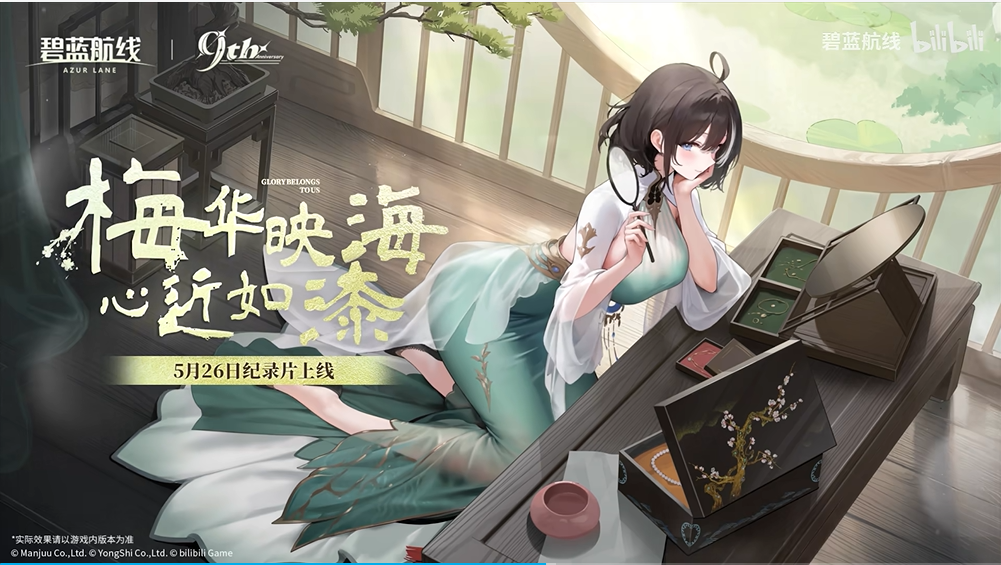
If you’ve been following *Azur Lane* for long enough, you’ll notice that this isn’t the first time it has ventured into the realm of intangible cultural heritage. For its 8th anniversary, the game collaborated with the intangible cultural heritage of Ru Ware; even earlier, a wide variety of traditional crafts and regional cultures—including Suzhou silk and West Lake Longjing tea—were reimagined in the game through anime-style storytelling.
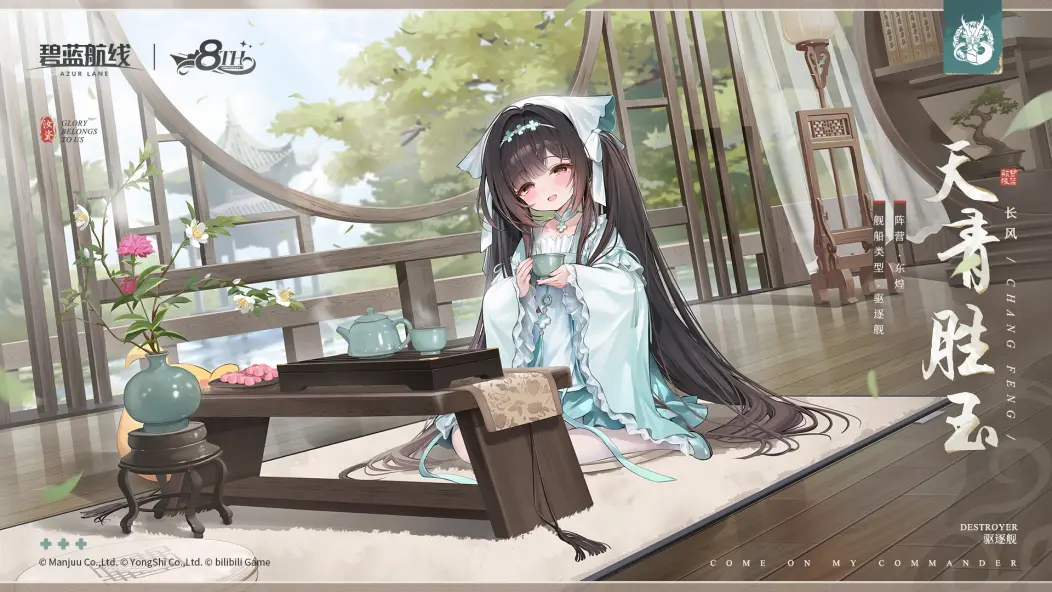
“Celestial Blue Jade” Collaboration Outfit for the 8th Anniversary
Over the past few years, traditional crafts have gained significant attention from younger generations through *Azur Lane*. Conversely, for *Azur Lane* itself, these magnificent traditional cultural elements have been reinterpreted within the game, enriching its art with deeper cultural significance. The two have thus formed a genuine symbiotic relationship.

Alongside the preservation of traditional culture is the philanthropic philosophy of *Azur Lane*.
You may not know that public welfare organizations such as the WWF (World Wildlife Fund), OPF (One Planet Foundation), and the China Environmental Protection Foundation have all collaborated with *Azur Lane*, which has also partnered with the Shanghai Blood Center to spread goodwill.Over the past nine years, Blue Archive has carried the kindness of countless Commanders out to the oceans, the Gobi Desert, and the skies—protecting coral reefs in the South China Sea and planting rows of saxual trees in Alashan.
Now, during its 9th-anniversary livestream, *Azur Lane* has turned its attention to conservation projects focused on mangrove forests and white-headed langurs. In collaboration with organizations such as Bilibili Charity and the SEE Foundation, the game has made direct donations to relevant organizations, continuing to carry forward *Azur Lane*’s commitment to social responsibility.

What’s worth noting is the way *Azur Lane* approaches these initiatives. As always, by participating in mangrove conservation projects, the game draws inspiration from them to design and release corresponding free limited-time outfits for Everson.

As part of the “All Creatures Coexist” environmental charity project, *Azur Lane* has invited renowned voice actor Ge Ping to serve as an “animal observer.” He will travel to the Chongzuo Nature Reserve in Guangxi to observe white-headed langurs and other wildlife, documenting the daily lives of these mountain creatures. This public service announcement will be officially released on June 5.

As you can see, nearly every charitable initiative in *Azur Lane* leverages the game’s exceptional content production capabilities. Within *Azur Lane*’s operational framework, charitable efforts are integrated into the same content production pipeline as collaborations on intangible cultural heritage and music, and are treated with the same level of rigor.
For a commercial game, the willingness to develop charitable content to this level of polish—with all charity-themed outfits available for free—and to maintain this commitment year after year reflects Manjiao’s approach to social responsibility as a game developer: it should involve substantial investment, be deeply integrated into the game’s content, and, above all, allow all players to participate and experience it without any barriers.

Looking back at these moves, Blue Archive’s approach to cross-media collaborations has gone beyond the basic premise of “style compatibility.” Its true value lies more in its ability to co-create high-quality content—specifically, in how Blue Archive is constantly bridging the gap between real-world culture and social issues through a more “Manju-style” anime aesthetic.
Each crossover has also served to enrich the content of *Azur Lane*, further enhancing the game’s brand equity.
Beyond that, the deeper point is that this cyclical mechanism—producing content for external audiences while providing feedback to users internally—is entirely consistent with the game’s core logic of “heavy production, light experience.”
In today’s industry, “IP value” is often tied to the duration of a product’s operation, as if it will naturally grow over time simply by surviving long enough. But time is merely a vessel for accumulation; what truly drives value is “trust.”
Over the past nine years, *Azur Lane* has consistently delivered new content while continuously raising the bar for quality. With every update, the emotional bond with its players has grown stronger, and the brand’s external appeal and ability to forge partnerships have grown year by year precisely because of this accumulated trust.
If you take a closer look, you’ll see that nothing Blue Archive does is particularly complicated, but maintaining that level of consistency over a nine-year span requires a long-term commitment to taking its users seriously.
Everything showcased during the *Azur Lane* 9th Anniversary livestream serves as a prime example of how a mature product can consistently deliver on and amplify its value over the long term. I believe this provides a practical reference point for industry professionals currently contemplating the long-term operation of mobile games.
Conclusion
“Azur Lane” has proven one thing: when the emotional bond between a product and its users is genuine and deep enough, time is no longer an enemy. From a business perspective, it actually becomes the key to strengthening user loyalty, because it fosters “trust.”
Last night, the *Azur Lane* team mentioned that they plan to explore more cross-IP collaborations in the future, such as with *NieR: Automata*. Additionally, the combat mission system and fleet optimization—both part of their long-term roadmap—are on the agenda.

So, this 9th-anniversary livestream also signifies that the bond of trust between *Azur Lane* and its Commanders will continue into the 10th and 20th years.
Finally, let’s return to the industry context we discussed at the beginning.
The current trend in the mobile gaming industry toward “heavy” games is essentially a manifestation of the category’s evolution, and existing products have indeed achieved impressive results in this direction. However, when everyone is accelerating down the same track, being “big” and “heavy” shifts from a competitive advantage to a basic requirement for entry.
The existence of *Azur Lane* offers the industry a different perspective: by focusing on optimizing the user experience and refining content, it is possible to generate significant commercial value—a “light” approach can also be a viable option.
In an industry where discussions about the “red ocean,” market shakeups, and cutthroat competition are a daily occurrence, the fact that *Azur Lane* has entered its tenth year of operation is significant in and of itself.
原创文章,作者:gallonwang,禁止转载:https://youxichaguan.com/en/archives/196450