Although he is not yet 24, Soldier is already a seasoned veteran in the *Minecraft* (MC) development community. Ever since he wrote his first line of Java plugin code in middle school, he has been deeply immersed in the game. Through a series of popular mods, he has earned enough to pay for his undergraduate tuition and even saved up enough to pursue a master’s degree in Macau.
Like Soldier, Walnut was originally a die-hard *Minecraft* player. He initially ventured into *Minecraft* development just out of curiosity, but never expected that after graduating from college, he would successfully join the MC Tribe and turn his hobby into his day job.
The stories of these two creators’ growth serve as a vivid snapshot of the *Minecraft* UGC ecosystem. As a sandbox game with a natural affinity for user-generated content, *Minecraft* has been continuously expanding its presence in the UGC space since its launch in the Chinese market in 2017. Through ongoing improvements to its creation tools and support policies, the game has cultivated a community of over 300,000 active developers and amassed more than 500,000 high-quality creative works.
Behind the impressive macroeconomic data, countless creators like Soldier and Walnut have brought their ideas to life and monetized their work here. Some have evolved from hobbyists into professional developers, while many others have formed teams and embarked on entrepreneurial journeys, turning their passions into sustainable careers.
01
A playground for 300,000 developers
Creativity stems from passion.Walnut, a member of the post-95 generation, told the Tea House that when he first encountered *Minecraft* in middle school, he was immediately captivated by its innovative sandbox gameplay: “Most of the games I played back then were based on linear levels and fixed storylines. A sandbox mode like this, where you could freely build and create your own content, was still quite rare.” And so, this block-based world where imagination could run wild became the place he was most fascinated by during his free time.
In 2019, Walnut graduated from the Computer Science Department. At that time, the Chinese version of *Minecraft* was just taking off and actively recruiting creators, so, driven by his passion, he passed the assessment and joined the MC Tribe, becoming a full-fledged *Minecraft* developer.
Soldier got an early start on his development journey; around 2015, he began experimenting with *Minecraft* development. As soon as the Chinese version launched, he immediately applied for a developer account and became one of the first developers: “I taught myself programming from a young age, and since I love this game so much, I’ve always looked forward to bringing my wildest ideas to life within the game.”
“Fortunately, Minecraft’s development tools are very easy to pick up,” Soldier recalled. The official website provides detailed development documentation and accompanying video tutorials. Using these publicly available resources, he started from scratch, learning as he went, and in less than a week, he created his first project, *Playing in the Dirt in Minecraft*.

Throughout the subsequent development process, the official developer community liaison frequently provided him with timely technical guidance and troubleshooting assistance, helping him grow rapidly along the way. Today, he is not only capable of handling development tasks independently but also often helps other new developers with their questions and concerns, earning a reputation as a reliable mentor.
Now that Walnut has joined the MC Tribe, he has a group of experienced peers to guide him. With their hands-on guidance and support, he went from being a complete novice to becoming well-versed in the process, gradually mastering the development workflow and refining the details of his work. It took him a month to complete his first project. “Looking back now, there are certainly many areas where that project could have been improved, but at the time, the sense of accomplishment from successfully completing the development was more than enough to make me feel truly satisfied.”
Over the next few years, as a programmer, he played a key role in the development of several hit mods, including the horror-exploration *Backroom* series, the post-apocalyptic survival *Cataclysm* series, and the casual game *Farmer’s Delight*, all of which bore the fruits of his hard work. Through hands-on experience on numerous projects, his development skills grew rapidly, and he developed a strong rapport with the team.

Before launching a project, the team first assesses market performance and player feedback to determine what players “want.” They then brainstorm and expand upon these needs to complete the design and development of the mod. After the mod is released, the team continues to listen to player feedback through in-game reviews and external social platforms such as Bilibili, using this input to formulate update plans and continuously refine and iterate the content.
Walnut told the tea house that throughout this process, the platform’s featured recommendations, promotional campaigns, and system-curated spots played a crucial role. By leveraging concentrated exposure resources, they enabled the modules to quickly reach a massive audience of players, ensuring that every piece of carefully crafted content had the opportunity to be seen and appreciated.

Leveraging its mature and efficient development and operations model, combined with the platform’s traffic, MC Tribe has successfully created over a hundred high-quality mods with diverse styles and excellent reputations within the Chinese version of *Minecraft*’s ecosystem. Some of these mods remain vibrant even years after their release, generating long-term revenue for the team.
Today, this seasoned development team—which has been deeply involved in the MC industry for many years—has officially established a company in Tianjin. Through years of dedication and hard work, their initial passion has evolved into a long-term endeavor that brings everyone together to strive for success.
Compared to the MC Tribe, a team of over a dozen people, Soldier’s team is much smaller. Currently, he has only one regular development partner. In their day-to-day work, he handles design and programming, while his friend focuses primarily on software development; for the art work—an area neither of them specializes in—they mostly rely on custom tools or AI software.
Given the team’s resources and strengths, Soldier did not follow the path of most creators by focusing on producing content mods with rich gameplay and diverse visuals; instead, they chose to concentrate on the niche market of utility mods.
He believes that gameplay mods typically require full-team collaboration, involving coordination across multiple roles such as art, game design, and development; whereas utility mods are more focused on programming logic, with a core architecture similar to conventional software development. These mods primarily address issues such as data structures, algorithm efficiency, and program stability, and can be completed with only minimal art and UX optimization, making them ideal for small, programmer-led teams to specialize in.
“Furthermore, utility-based mods are used more frequently in games and have more consistent demand; even if they don’t become blockbusters, they can still generate relatively substantial and stable revenue.”
Once he had settled on the utility mod niche, Soldier’s creative approach became very clear. Drawing inspiration from his own gaming experiences, he would first complete and release a mod, then continuously refine its features based on player feedback, or distill frequently requested user needs into an entirely new mod.
Thanks to this stable and efficient development workflow, he and his teammates have released a total of 87 mods, including highly practical and community-favorite tools such as "Server Workbench" and "Entity Editor."

The "Server Workbench" Function Menu
These creations have not only earned him recognition from gamers but have also brought him tangible financial rewards. According to Soldier, his monthly income once exceeded 20,000 yuan. Not only did he use the earnings from his creative work to pay off his entire undergraduate tuition, but thanks to the savings he accumulated over the years, he has now successfully enrolled in a graduate program in Macau. While easing the financial burden on his family and gaining greater independence in his life, he is also able to frequently buy small gifts for his loved ones, using his passion and hard work to show his appreciation to those closest to him.
In addition, years of development experience have further solidified his programming skills and honed his proficiency in using AI tools. In his view, with the rapid advancement of AI models, the industry has entered the era of Vibe Coding (intuitive programming). Coupled with the official Chinese version of *Minecraft*’s ongoing release of development documentation and creation tools, the productivity and technical proficiency of all developers are set to see a significant boost.
He said, “If this trend continues, anyone with ideas and creativity will be able to easily become a creator in the future.”
02
The era of premium products is just around the corner
When discussing their specific plans for the future, the two developers were full of enthusiasm—because the official Chinese version of *Minecraft* had just updated its *Developer Agreement*, introducing a completely revamped revenue-sharing model for developers.
According to reports, this restructuring of the revenue-sharing rules is not merely a simple policy adjustment, but rather an optimization plan that the platform developed after engaging deeply with the developer community, conducting months of surveys and gathering feedback, and compiling a vast amount of genuine input.
The two developers admitted that the previous revenue-sharing rules did indeed present quite a few challenges.
Under the old rules, revenue sharing was calculated based on a developer’s total revenue, with a tiered, decreasing rate structure: the higher the revenue, the lower the corresponding share. Furthermore, in addition to the revenue share, a technical service fee was deducted from the developer’s final earnings; the higher the revenue, the greater the deduction, further reducing the developer’s net income.
This means that once a developer’s revenue reaches a certain threshold, they must bear a higher combined rate for both types of fees, creating an unreasonable “reverse incentive”—the better they perform and the higher their revenue, the less profitable their actual take-home earnings become. To avoid the higher-tier commission rates, some developers even split their accounts and operate them separately, though this also leads to higher management and maintenance costs.
Furthermore, because revenue is tied to the developers’ total revenue, the value of hit mods is significantly diminished. Even if a particular mod achieves success and becomes popular, its revenue is affected by other works, so it cannot truly reflect its own true value. Over time, this leads to a loss of motivation for developers to dedicate themselves to crafting high-quality products.
Fortunately, the official team behind the Chinese version of *Minecraft* has consistently listened closely to developers’ feedback and responded promptly with concrete actions. In response to the pain points widely raised by the community, the official team has completely overhauled the revenue-sharing system in the new *Developer Agreement*, with the core adjustments focusing on the key areas of greatest concern to developers:
First, we will shift from “aggregate revenue accounting” to “individual project accounting,” calculating the revenue for each module separately so that the value of each project can be reflected independently;
Second, the "declining tiered" structure will be replaced with an "ascending tiered" structure, whereby the higher a single title's monthly revenue, the higher the revenue share developers receive—up to a maximum of 55%—truly embodying the principle of "rewarding quality and hard work."
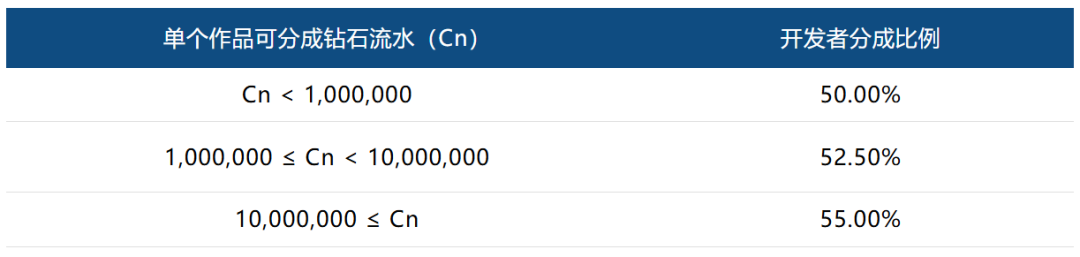
Third, we are eliminating technical service fees and simplifying the revenue structure, making the calculation process clearer and more transparent. Developers can now easily predict the actual revenue for each title and no longer have to deal with complicated deduction rules.
In addition, the platform will introduce targeted subsidy programs to build a more comprehensive support system across three key areas: growth incentives, quality rewards, and basic safeguards.

Under the new policy, the revenue-sharing calculation can be summarized as a simple formula: Developer revenue = (Diamond revenue per title × Revenue-sharing percentage) × Total + Official incentives (platform rewards, special subsidies, etc.).
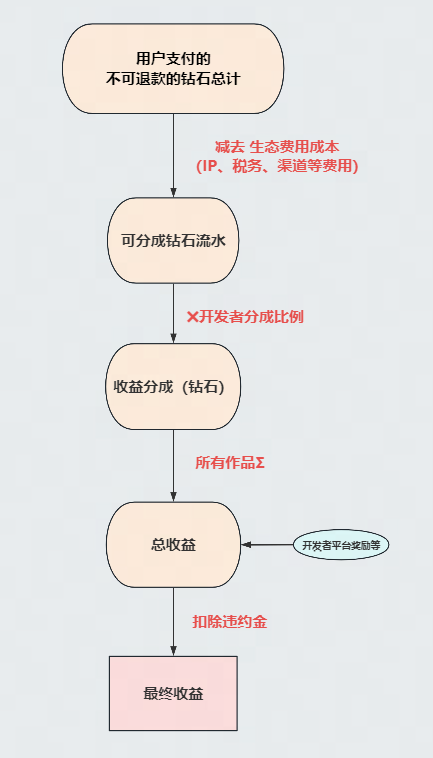
In their view, this update to the revenue-sharing policy is not merely a simple adjustment to the split; more importantly, it addresses long-standing concerns, ensuring that the investment in crafting high-quality content over the long term yields a reasonable return, and significantly alleviates the worries associated with content creation.
Walnut stated that following the changes to the revenue-sharing rules, the team now feels more confident in focusing on creating high-quality content and long-term operations. “We have made corresponding adjustments to our development schedule and will devote more energy to iterating and optimizing popular long-term modules, as well as developing new high-quality modules. We are committed to gameplay quality and user experience, and we will take the time to refine and perfect every single title.”
Soldier agrees with this as well. He believes these changes will encourage more developers to put greater effort into refining their work, and he plans to continue developing utility mods, taking advantage of the more favorable revenue environment to release more practical content.
Teahouse believes that this revenue-sharing policy—which rewards excellence and recognizes that "small yet exquisite" titles also have a place in the market—not only ensures that developers’ efforts are commensurate with their returns, stabilizes long-term revenue expectations for top-tier teams, and bolsters confidence in sustained creation, but also lowers the barrier to entry for small-to-medium-sized and new developers. This approach helps accelerate the formation of a healthy industry landscape where top-tier masterpieces lead the way, mid-tier content is deeply cultivated, and niche creativity flourishes.
03
A new era of opportunities has arrived
The stories of the two developers, Soldier and Walnut, prove that *Minecraft* is no longer just a game, but a dream-building space where creativity can take shape and passion can be turned into reality.
All of this stems first and foremost from the game’s unique DNA: the core strength of sandbox games lies in their extraordinary freedom, which provides fertile ground for all kinds of creative ideas to flourish. It is precisely this quality that has earned *Minecraft* a massive global following of die-hard fans.
Since entering the domestic market, the Chinese version has continued to cultivate its creator ecosystem. By developing the one-stop development tool MCStudio, introducing more user-friendly editors, and providing systematic educational resources and comprehensive operational support, it has further amplified the platform’s strengths.

Today, with the support of comprehensive official development tools and educational resources, creators can start from scratch—learning the fundamentals, mastering development skills, completing their projects, and successfully launching them. They can then iterate and update their work based on player feedback, gain platform traffic and policy support, and gradually build a complete growth cycle.Through continuous hands-on practice, creators not only build technical skills and project experience but also transform their creativity into tangible revenue, achieving a mutually beneficial relationship between personal fulfillment and ecosystem growth.
This is precisely why a large number of passionate creators, such as Soldier and Walnut, have chosen to make this their home. According to official data, the Chinese version of *Minecraft* has now attracted over 300,000 active developers, who have collectively created more than 500,000 pieces of high-quality content.In 2025, the number of hit titles on the platform nearly doubled year-over-year, with top-tier content growing by more than half and mid-tier content by one-third. Revenue growth for both top-tier and mid-tier works approached 50%, demonstrating that the ecosystem’s momentum remains exceptionally strong.
It is worth looking forward to the implementation of the new revenue-sharing policy in 2026, which is sure to further stimulate the growth of the ecosystem. The new revenue-sharing system ensures that high-quality content receives more appropriate compensation, thereby institutionally encouraging the creation of premium content and driving the ecosystem toward high-quality development. At the same time, as players’ payment habits continue to mature and their willingness to pay for high-quality mods continues to grow, developers will see even greater opportunities for revenue.
With a more dynamic creative environment, more transparent revenue-sharing rules, and more substantial earnings potential—all these benefits combined—it’s no exaggeration to say that “now is the best time to join the *Minecraft* China Edition developer ecosystem.”
As for who is suited to join the community, Soldier and Walnut offered the simplest and most sincere answers: Soldier believes that any player with ideas and creativity can find their place here; Walnut, meanwhile, firmly believes that anyone who truly loves Minecraft and is willing to keep creating will go far.
原创文章,作者:游茶妹儿,禁止转载:https://youxichaguan.com/en/archives/195544