A brand’s ability to master advertising is key to whether it can truly resonate with people. “Naobaijin,” which remains memorable even years later, filled the memories of an entire generation with its repeated slogan, “No gifts this holiday season”;Meanwhile, *Tianwan Blue Moon*, with its line “If you’re my brother, come and slash me,” turned a single line of dialogue into a treasure trove of memes across the internet. When advertising is taken to the extreme, the product naturally comes into the user’s field of vision.
Recently, another game developer has masterfully applied this logic. Only this time, it’s not a catchy slogan or a celebrity endorsement that’s capturing everyone’s attention, but rather an AI-generated image of a middle-aged man with a receding hairline and a beer belly, and his “seawater filter”—which he can never quite reach.
Over the past few months, if you’ve watched any short videos, chances are you haven’t been able to escape the barrage of *Crazy Water World*.“Fei Qiang,” a middle-aged man living in the worst room in a post-apocalyptic shelter, is harassed by middle-aged women doing square dancing, roasted by his neighbor’s air conditioner unit, refused rides by taxi drivers, and kicked out of restaurants. The root of all this humiliation points to one thing: he doesn’t have a seawater filter.After reaching his breaking point, he punched a hole in the white wall, jumped into a red bathtub, and shouted, “Crazy Water World, activate!”

This template was repeatedly copied and refined until it finally broke into the mainstream, becoming a new generation of internet meme. Netizens tagged it with “#ChineseAnimation” and “#WatchingSeries,” eagerly spreading the word whenever a new episode was released, and even flooded the comments section of the video where Xiao Pang finally managed to get his hands on the seawater filter with the phrase “The end of my youth.”“Seawater filter” has officially evolved from the name of a game item into an internet meme listed on Baidu Baike.
As the meme swept across the internet, *Crazy Water World*’s performance continued to soar: the mini-game version consistently ranked in the top 10 on WeChat’s top-grossing chart and in the top 3 on Douyin’s top-grossing chart;The mobile game version has also seen its rankings soar, climbing to No. 13 on the iOS Top Grossing chart more than half a year after its launch; after entering overseas markets, the game continued to leverage this strategy, breaking into the Top 15 on the iOS Top Grossing charts in regions such as Traditional Chinese-speaking markets and South Korea, achieving truly widespread success.
This isn’t an isolated case. Another idle card game with a dark “Journey to the West” theme, *Origin of the Eternal Night*, portrayed Tang Sanzang as a muscular tough guy in its ads and had him sing in the videos, racking up millions of views on Video Account.In the comments section, some users requested songs, others discussed his vocal tone, and still others left messages saying, “Stop making games—just make short videos. If you make short videos, I’ll definitely spend money on them.” Liu Yi, the game’s publishing director, remarked that in all his years of user acquisition, this was the first time he’d seen users actively seeking out ads to watch.

The massive popularity of related content on Video Account directly contributed nearly 30 percent of the game’s revenue; Liu Yi also revealed that this high-quality content directly drove a five- to six-fold increase in in-game spending.
While the paths to success for these two products aren’t exactly the same, their core strategies are surprisingly similar: both rely on AI-generated content to attract users. So why exactly do these AI-generated ad creatives hold such strong appeal? And what tangible changes is AI bringing to the mobile game user acquisition advertising market and its practitioners?
▍Liu Zun, Head of the DataEye Research Institute
This type of creative goes viral not because “AI makes ads look more like ads,” but precisely because it doesn’t look much like an ad—it shifts the creative’s purpose from “explaining the product” to “making people want to keep watching,” and AI has turned this capability into a production capacity that can be iterated on a daily basis.This isn’t a minor tweak to the creative style; it’s a complete restructuring of the ad campaign.
From the perspective of overall ad spend, AI-powered content-based creatives may have revolutionized the traditional approach to user acquisition. This can be explained in three specific ways:
First, the metrics have changed. In the past, content focused on “what it is, how to play, and what benefits it offers,” catering to audiences who could instantly identify the category—but this approach had a limited ceiling. Now, the priority is to answer “why should I watch for 3 more seconds?”—catering to general users within the content ecosystem.An interview with the producer of *Origin of the Eternal Night* offers a straightforward assessment: if you only showcase gameplay, your audience remains fixed; content-driven materials, on the other hand, first pique curiosity—and that’s what keeps people engaged.
Second, AI has turned hooks into mass-produced items. Using the same character profile and conflict template, it swaps out scene-specific terms, prop-related terms, and generational terms—churning out dozens of them daily. When one doesn’t perform well, it simply iterates the entire batch.
DataEye-ADX shows that over the past seven days, the number of ad placements for *Crazy Water World* has surpassed those for *Forever Blue Planet* and *Supernatural Task Force*, placing it at the top of the list.

The volume of ad creatives also surged starting in late September, peaking in early November, with daily ad creative volumes exceeding 30,000 sets.
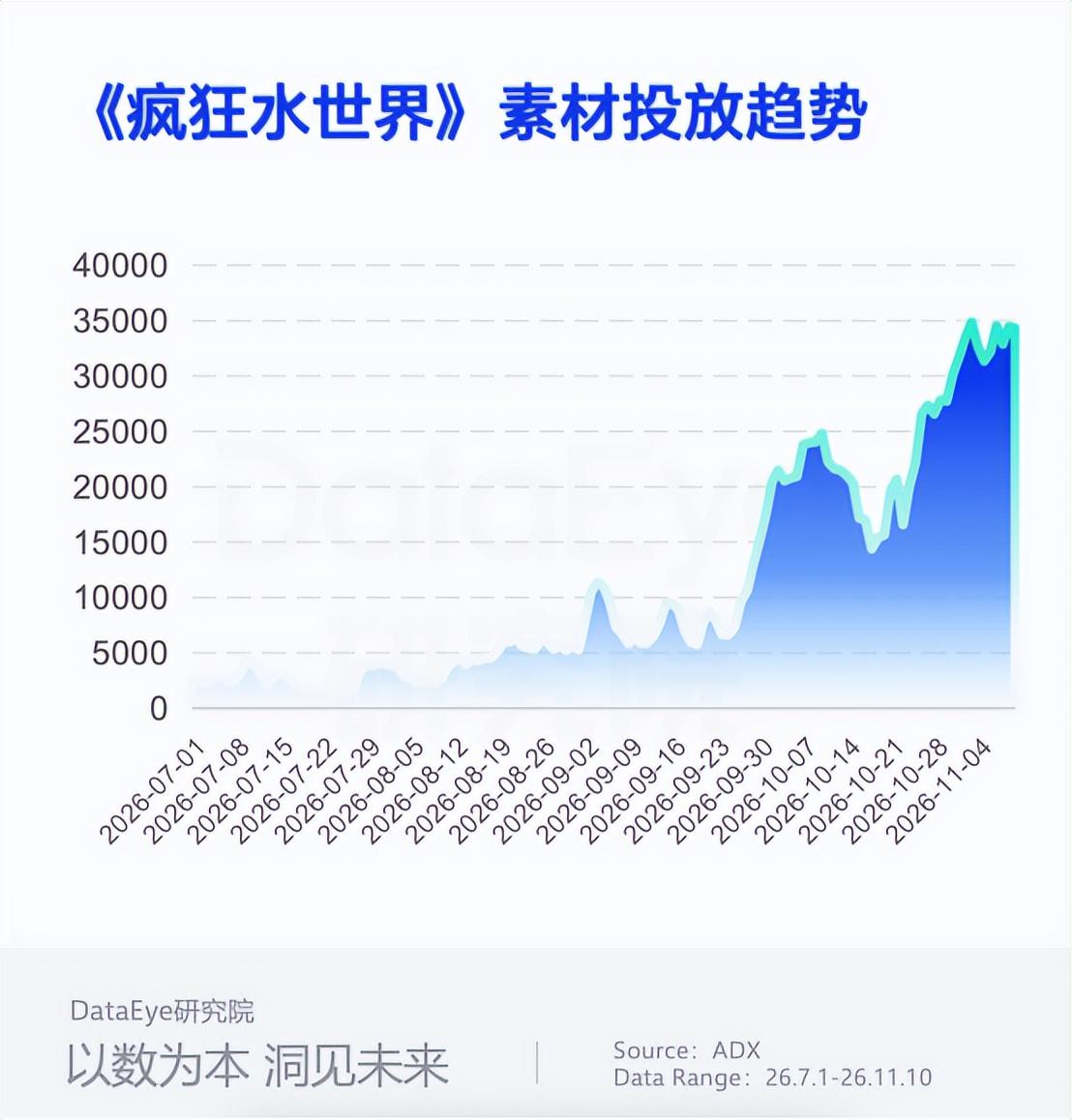
This case study effectively illustrates the strategy behind *Crazy Water World*: using official AI-generated content to feed back into the素材库, creating a semi-open ecosystem for content production, and then determining whether to aggressively promote related content in the next phase based on audience feedback on the素材.This is also why this case study has been frequently cited by teams in South China, where user acquisition strategies are well-established and AI-driven content production is already widespread.
Third, the creative assets are beginning to inform product development. Campaign data is fed back into R&D: based on which character assets perform well, the next batch of characters is designed in that direction.
An interview regarding *Eternal Night: Origins* mentioned: “We’ve seen players in other games’ comment sections asking, ‘What about Da Heitian from *Eternal Night: Origins*?’ Even in our own game’s comment section, many users have specifically requested that Da Heitian make an appearance. This character’s popularity has truly exceeded our expectations.”Following this, *Eternal Night: Origins* began rolling out a wide range of content featuring Da Heitian, further boosting the game’s popularity. In other words, the content was no longer merely external packaging but had become an integral part of the game itself.

Three Insights for the Industry from AI:
First, the content hook must stem from the product’s selling points. What can be reused isn’t a one-off joke, but the chain of “remembering the character and then wanting to own it”; once that chain is broken, the more aggressively you push sales, the more severe the mismatch between the product and the promise becomes.
Second, production capacity and content planning are two separate tracks. AI addresses supply efficiency, but the true barriers to entry lie in understanding the world-building, character development, and narrative pacing; content produced using template-based assembly lines may generate clicks in the short term, but fails to retain viewers in the long run.
Third, we need to change the metrics we track. In addition to consumption and ROI, we should also look at organic search, the buzz surrounding in-game roles, and first-day retention. Focusing solely on click-through costs will underestimate the value of content assets, while focusing solely on view counts will overestimate their contribution to gameplay.
Overall, in the few years since AI entered the user acquisition space, it has most often been viewed as a cost-cutting tool; however, these two cases suggest the exact opposite—AI’s true value lies in making “content” a standard component of the ad campaign workflow for the first time.Over the next year or two, the upper limit of user acquisition may no longer be determined by the experience of campaign managers, but rather by content planning capabilities and production line organization.
However, this doesn’t mean everyone should jump on the “Dark Journey to the West” or “Post-Apocalyptic Survival” bandwagon—that would likely repeat the pattern seen with last year’s “mild horror” genre: first, a flood of titles; then, a shakeout. Instead, developers need to tailor their approach based on the specific characteristics of their own products and incorporate player feedback.
▍Wang Lu, Head of the Design Department at Shanghai Luming (Chengdu Branch)
These viral ads all combine memes, creative twists, and the game’s own settings—an approach somewhat similar to the wildly popular “gorilla” and “eating” ads from years past.At their core, these ads really come down to creativity. Once you’ve mastered this formula, you can simply plug in content based on trending topics and memes, updating them continuously—much like filming a TV series—which keeps the marginal costs relatively low.
In this process, AI simply serves to lower the barrier to entry for creating content, making it accessible to anyone. That’s why, when AI first emerged, it was incredibly effective—by quickly replicating and tweaking other people’s viral hits, it was easy to generate a lot of traffic.
But things are different now—the lifespan of viral posts is getting shorter and shorter.In the past, it was normal for a good piece of content to perform steadily for a week or two, but now many lose steam after just two or three days—some even fade away on the very day they go viral. After all, users’ attention spans are limited, there are only 24 hours in a day, and the supply of content has suddenly increased dozens of times over—with a lot of homogenized, plagiarized junk mixed in—so competition has intensified overnight.
Furthermore, whether AI-generated content will be approved depends largely on platform policies and the industry you’re in—the “red lines” vary significantly across different categories.Take e-commerce, for example: in some product categories, virtual avatars are not allowed to demonstrate real-life usage experiences—the contact lens case mentioned earlier is a prime example. Platforms are now cracking down on low-quality AI content churned out in bulk; typically, this results in traffic restrictions, and in severe cases, accounts are suspended outright.
Moreover, from what I’ve observed, AI hasn’t actually reduced people’s work stress; on the contrary, competition has become even more intense. Often, one person has to handle the workload that used to be shared by three, and working overtime has become the norm.
At the same time, many jobs in the industry have already been affected by the widespread adoption of AI; a lot of repetitive manual work can now be handled through automation and AI. Among these, the first to be impacted are entry-level positions focused on basic execution, such as graphic designers and junior concept artists.The divide among professionals is also evident: those with experience who know how to use AI effectively have little to worry about for now; however, for newcomers with no prior experience looking to enter the field, the challenge is much greater than before. When we recruit new talent now, understanding and being able to use AI are already basic requirements.
Looking ahead, whether in game advertising or the advertising industry as a whole, the competition is no longer simply about who can produce creative content the fastest. What truly holds value is your ability to set the right direction for AI, maintain aesthetic control, create content that aligns with the product’s tone, and leverage the specialized knowledge you’ve accumulated through deep expertise in this field. In the future, those creating advertising materials will no longer need just basic execution skills; they’ll need to become well-rounded professionals with a director’s mindset, aesthetic judgment, creative ability, and a deep understanding of the product itself.
At the end of the day, AI is just a tool; in the end, the videos that consistently attract a steady stream of traffic are always the ones that are creative, tell a good story, and are of high quality.
▍Dongdong, an advertising agency in Guangzhou
In fact, the gaming industry has been exploring the path of content-based advertising all along.
From the user’s perspective, content-driven materials are fundamentally different from straightforward, hard-sell ads. Hard-sell ads directly promote products, which can easily provoke resistance; in contrast, content-driven materials that incorporate stories and evoke emotions rely primarily on plot, character development, and suspense to capture players’ attention, naturally sparking greater interest. This is alsothe underlying reason why content like *Crazy Water World* and *Origin of the Eternal Night* has gained widespread popularity.
In the past, creating this type of content involved a very high barrier to entry: writing scripts, developing storylines, casting actors, and filming—the entire process was labor-intensive, time-consuming, and yielded relatively slow results. The cost of trial and error was high, so many teams were reluctant to test content-driven creative ideas on a large scale and ultimately reverted to simple, straightforward traditional advertising.AI has stepped in at just the right moment to address these shortcomings, lowering the barrier to trial and error in content creation and enabling content-based ads to be rolled out and validated at scale.
Many people believe that AI can only quickly churn out low-quality, cookie-cutter junk content, but based on our experience, it’s also very valuable during the initial creative exploration phase.Tasks such as gathering trending topics, identifying popular memes, and adapting scripts—which used to rely almost entirely on manual brainstorming—are now supported by AI throughout the entire process, from capturing trending topics and adapting scripts to human optimization, review, and final production.
There’s a new hire at our company who, after just two months on the job, has produced several commercials with view counts exceeding 100,000 with the help of AI.
As a result, we are increasingly focusing on recruiting talent with these skills. In the first half of this year, we already incorporated AI application skills into our evaluation criteria; in the second half, we also included the practical implementation of AI in our team performance evaluations. Additionally, every other month, the company organizes internal sessions to review AI case studies and share best practices.
Our core objective is to meet customer needs and consistently deliver high-quality advertising services. This requires us to keep pace with market changes and make effective use of AI—something that has become an absolute necessity for us.
However, just because you have AI at your fingertips doesn’t mean everyone can create such viral videos. Objectively speaking, the true value of AI lies in improving efficiency and optimizing costs; however, market competition hinges on striking a balance among cost, efficiency, and quality—it’s not simply a matter of pursuing the fastest speed or the lowest cost at all costs.
AI can help us break free and experiment with more types of content while pushing the boundaries of creativity, but it is not, in and of itself, a surefire weapon.
▍Shanghai Viti Advertising & Media, Business Development Officer OO
High-quality content can indeed generate remarkable reach and conversion rates, and we now recommend that game developers set up AIGC accounts to acquire users.
However, at present, most game development teams use AI primarily to quickly produce large volumes of ad variations for testing and deployment. Their main priorities are production speed and cost-effectiveness, rather than exploring entirely new ad formats.
Furthermore, everyone remains relatively cautious about copyright and overseas compliance risks, so they generally avoid using AI-generated content directly in their campaigns; instead, they require it to be manually refined and verified before use.
When it comes to our staff, the ability to use AI tools is now a mandatory requirement. Whether they are new hires or veteran employees, we expect everyone to learn how to use AI to assist in content creation—rather than relying entirely on AI for content production.
AI has indeed significantly shortened the time it takes to produce first drafts, allowing us to quickly expand our pool of test materials. At the same time, however, the workload associated with verifying materials, retouching images, and correcting various AI errors has increased, placing greater demands on human judgment. Ultimately, it is still up to humans to control the selling points of the materials, the narrative pace, and the underlying logic of ad placement.
▍Wang Qi, the Advertiser
The clients we work with currently have no specific requirement to use AI to create ad creatives. For them, campaign performance is the top priority; as long as the metrics meet their targets, it doesn’t matter how the creatives are produced.
The company doesn’t offer dedicated AI training or token subsidies, nor does it require all employees to use AI, but we do encourage everyone to experiment on their own based on the nature of their roles.Artists and programmers are currently using AI to assist with their work, but they do not delegate all tasks to AI. Many artists combine both approaches, creating some content by hand while letting AI generate other parts, working in tandem.
It’s clear that the use of AI-generated content has increased significantly recently compared to July and August, and various tools have become much more sophisticated. Due to the efficiency gains brought about by AI, the company has raised the output KPIs set for everyone accordingly.
We’ve also developed a reliable workflow: we submit requests in the evening, and by early the next morning, the AI has already generated a batch of content. We then focus on reviewing, editing, and steering the creative direction.
Although our team hasn’t experienced any AI-related layoffs yet, we can see that art and technical positions have already been affected to some extent. The impact isn’t significant at this stage, but it’s still too early to say what the future will hold.
In my view, the advertising industry can hardly function without AI these days, and it will continue to evolve toward large-scale, mass production. It’s highly likely that creative production will eventually be fully automated by AI, at which point competition will hinge on creativity, production speed, and financial resources.
原创文章,作者:游茶妹儿,禁止转载:https://youxichaguan.com/en/archives/223977