During the 2026 National Day holiday, at the 2026 CICF×AGF Guangzhou Animation and Gaming Festival, a demo booth for *Jump Jump* was set up at the WeChat Mini Games exhibit.
This mini-game, which launched on December 28, 2017, has been around for nearly nine years. In the booth survey, under the category “Most Memorable Mini-Game,” *Jump Jump* continues to be mentioned time and again. Staff at the booth met a sophomore college student who was still in elementary school when this nationwide sensation first took the country by storm.
The perception that casual games can only be played for three months is changing, and similar stories are becoming more common. *Sheep Sheep* experienced a massive surge followed by a decline,and has now stabilized in the top three on various charts. *Piggy Pig* has been live for nearly three years, and third-party data shows its monthly active users remain in the tens of millions. Data indicates that *Lie Flat and Level Up*—which “over 100 million people have played”—continues to see its monthly active users grow at a rate of 53.8% in its fourth year since launch, with a consistently robust user base.
01
The market has changed.
The user demographics of WeChat Mini Games are changing.
According to information disclosed at the May 2026 WeChat Mini Games Developer Conference, the platform has over 500 million monthly active users and more than 500,000 developers. Over the past year, more than 80 mini games have exceeded 1 million daily active users, and more than 300 mini games have generated quarterly revenue exceeding 10 million yuan.In a post-conference interview, Li Qing, Product Director of WeChat Mini Games, also stated that the platform’s total daily active users have surpassed 100 million. In terms of developer composition, more than 80% are small and medium-sized teams with fewer than 30 members. Under the theme “From Connection to Longevity,” the conference emphasized enabling the sustained growth of mini games through product iteration and long-term operations.
The shift in the user base has been even more pronounced. Today, WeChat Mini Games are no longer limited to middle-aged and older adults playing card and board games; female users can enjoy match-three and simulation games, while male users can find role-playing and strategy games. Overall, the user demographic is clearly becoming younger.According to data disclosed at the WeChat Mini-Games Developer Conference in May 2026, men account for 53% of mini-game users and women account for 47%, representing a relatively balanced gender distribution.
External data corroborates the platform’s figures. According to the “2025 China Game Industry Report” jointly released by the Game Working Committee of the China Audio-Video and Digital Publishing Association and Gamma Data,in 2025, the domestic mini-program game market generated revenue of 53.535 billion yuan, a year-over-year increase of 34.39 percent, with in-app purchases accounting for 36.464 billion yuan and advertising revenue totaling 17.071 billion yuan.
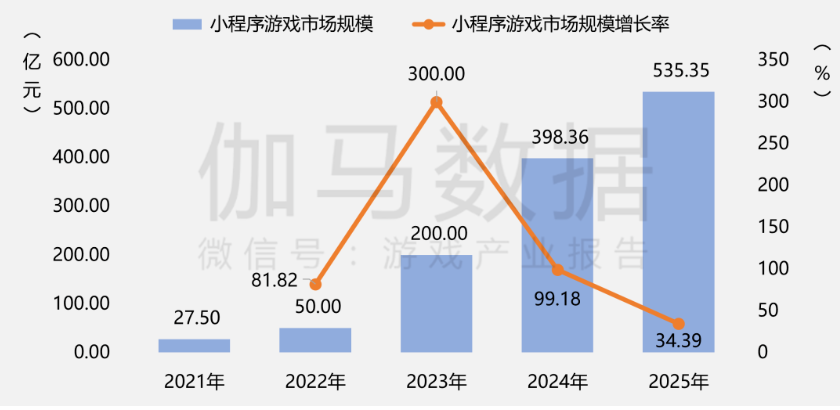
2025 Data: Mini-Game Market Size and Growth Rate (Gamma Data)
Lifecycle is the most critical metric in this round of changes.
In the early days of casual games, the industry aimed to recoup costs on the first day; this later shifted to 7 days and then 30 days. Today, casual games have extended their payback periods to half a year or even longer. This lengthening of the payback period indicates that developers have gained confidence in the product lifecycle, and user retention is also improving.
02
Three Years of a Product
“Piggy Pig” is a prime example of the “Evergreen” methodology. Developed by Tongqu Technology, this casual puzzle game was launched in 2023 and remained at the top of the mini-game popularity charts through 2026.
William, founder of Tongqu Technology, revealed that the company has a team of about 200 people, operates under an organizational structure combining a central platform with small projects, and has developed over a hundred products to date.
Contrary to outside expectations, “Piggy Pig” got off to a slow start; when it first launched, its ad ROI reached only 60 to 70 percent of projections.so the team shifted its focus from advertising to optimizing the game’s levels. They began by continuously analyzing user behavior data—observing which levels players got stuck on, at which points they dropped off, and how they responded to ad triggers—before conducting multiple rounds of A/B testing. Only after metrics such as average playtime per user and ad penetration rate were adjusted to the ideal range did they gradually scale up their operations.Throughout this process, the team accumulated extensive experience in level optimization, laying the foundation for their ongoing optimization, content iteration, and differentiated design tailored to different types of players.
The difficulty curve is the most critical aspect of this type of product, and William provided a detailed explanation: the beginner stage must be simple to help players build confidence, while the difficulty in the mid-game should increase gradually in steps to avoid a sudden, steep rise.When players get stuck, rewarded video ads are designed as an option for active assistance. Players can watch an ad to receive a hint or undo their last move, or they can simply retry—the choice is entirely up to the user.
The team monitors the number of retries and drop-off rates for each level. If the retry rate for a particular level is too high, they lower its difficulty. After several consecutive challenging levels, they also include bonus levels to give players a breather. As William puts it, “You can’t let players win all the time—they’ll get bored—but you can’t let them lose all the time either—they’ll quit.”A good difficulty curve makes players feel like they’re just a hair’s breadth away from passing, so they’re willing to try again.”
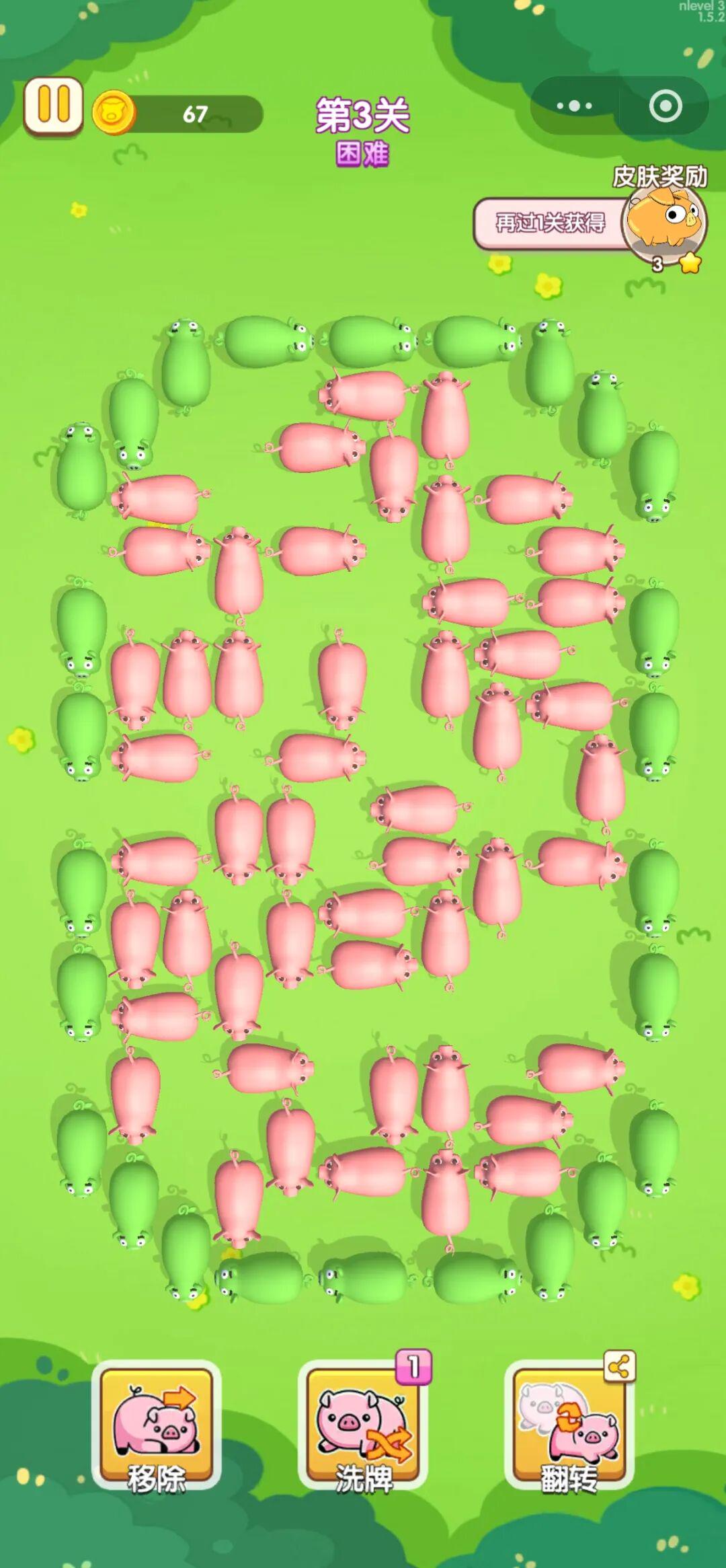
Simple, fun, and addictive
On the user acquisition side, paid user acquisition remains the foundation, but the bar for creativity has been redefined by short-video feeds. William noted that if players come across an ad and cannot understand the gameplay within three seconds, the conversion rate will naturally be low; products with such a high learning curve will directly lose the most fundamental basis for the spread of mini-games.
In terms of user retention, efforts to re-engage existing users are strictly segmented by tier; budget is allocated only for high-value users. Re-engaging casual, one-time players is costly and yields low conversion rates, so these efforts are typically abandoned.Reactivation efforts are also kept to a minimum, with outreach conducted only through platform-compliant channels during major version updates or the release of new large-scale level packs, complemented by return rewards to lower the barrier to re-engagement.At the same time, based on the historical activity patterns of returning users, we further refine segmentation and tailor the difficulty and pacing to each segment, continuously optimizing the gaming experience for returning users to enhance their long-term retention.
The team views the balance between advertising and user experience as a lifeline. William revealed that the company has strict internal rules: any changes to ad placements or frequency must be accompanied by simultaneous monitoring of ARPU and retention rates; if retention drops significantly, the changes are immediately reversed, and any changes aimed solely at short-term revenue growth are categorically rejected.
“Retention is the foundation of IAA products, while ad monetization is the result—we must not put the cart before the horse,” he said. He believes that some products increase ad impressions to boost ad revenue; while this leads to a short-term rise in revenue, retention eventually declines, causing overall LTV to drop instead. Many teams have miscalculated this balance.
03
What Makes a Casual Game a “Long-Running Hit”?
What exactly constitutes a timeless product? From the perspectives of the industry and manufacturers, the answer may vary slightly.
In terms of time, a mini-game must be in operation for two to three years or more—a lifespan comparable to that of a mobile game—to be considered an evergreen game. Of course, assessing the potential of a single title requires examining multiple factors, such as user base, user demographics, and operational metrics; each specific case must be analyzed on its own merits.
It’s worth noting that game mechanics follow cyclical patterns, and long-running products share a common trait: classic gameplay combined with subtle innovations.Whether it’s *Sheep Sheep*, *Pig Pig*, or the 2026 hit *Zhao Yun and A Dou*, all of these games build upon classic gameplay by introducing new mechanics or thematic elements, breathing new life into “old” games.Gameplay concepts long forgotten by history, though not currently popular, still have the opportunity to be reborn.
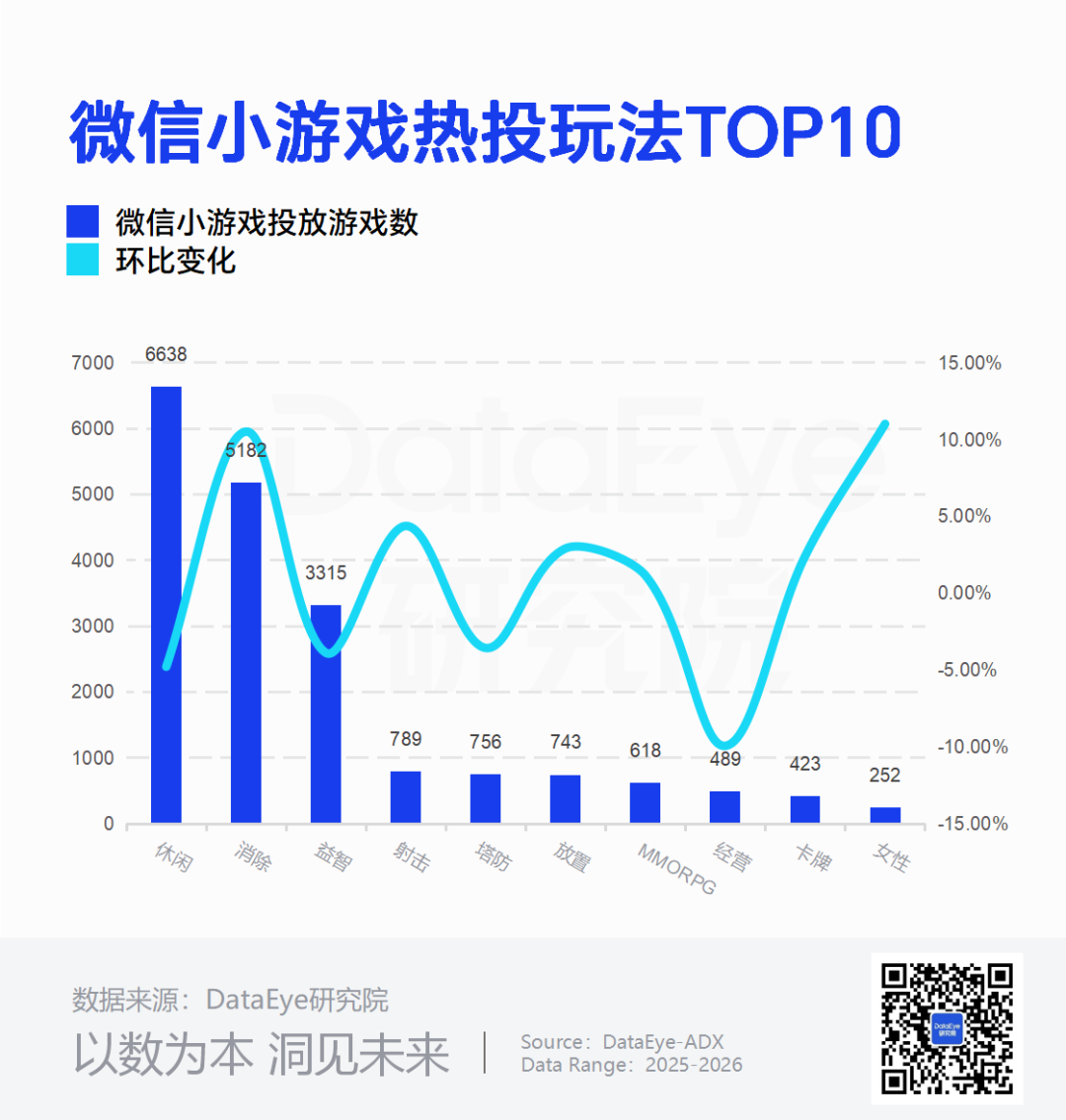
WeChat Mini-Game Advertising Landscape in the First Half of 2026
William’s analysis focuses more on data signals. He explained that the team looks for shifts in growth dynamics: when user acquisition no longer drives significant growth and revenue shifts toward repeat engagement from existing users, it signals that the product has entered its next phase. If new user retention continues to weaken over the long term, even if daily active users remain high, the product has effectively entered a period of decline.
Regarding failed products, Tongqu identified four common characteristics: gameplay that can’t be understood within three seconds; a core loop lacking immediate feedback; homogenized “skin-swap” designs with no memorable features; and gameplay that cannot be demonstrated through short videos.The criteria for discontinuing a product are equally clear: the core loop is disproved by data, the monetization model remains unsustainable over the long term, and there is no room for further iteration. Only when all three conditions are met will investment be halted, after which the product enters a maintenance phase involving server retention and the gradual shutdown of advertising campaigns. William added, “We won’t ax a product outright while there are still testable hypotheses remaining;and every time a product is shut down, the team must conduct a post-mortem.”
There are also some quiet long-distance runners in the industry.
For example, *Lie Flat and Level Up* is one such game. Launched in early 2022—even before *Sheep Sheep*—it has maintained its popularity long after its initial creative surge. With a user base primarily consisting of students and a low-key development team that rarely interacts with the media, it can truly be called a “hidden big boss.”
04
Policy Balance
The platform’s policies and capabilities form the other half of the environment in which Changqing Games thrives.
In August 2026, the platform rolled out a new round of upgrades to the IAA incentive program. For games where advertising is the primary revenue source, the duration requirement for users who registered or returned via Tencent Ads or external user acquisition channels was relaxed from “being active in the game for more than 5 minutes on the same day” to “having been active for a cumulative total of more than 3 minutes since registration.”
The platform explained that changing the metric from daily usage time to cumulative usage over time better reflects users’ actual activity patterns and helps bring more active users into the incentive program.
The duration of the long-term incentive program has been extended accordingly; the original “35% of ad revenue from days 1 to 90” has been adjusted to “35% of ad revenue from days 1 to 180.”Developers may choose between the “40% of ad revenue from days 1 to 30” light-to-moderate plan and the long-term plan. Products with longer lifecycles and stronger user retention capabilities will receive more substantial incentive support.
In addition, users who have been inactive for more than 45 days and return through eligible user acquisition scenarios—after reaching the required cumulative active time—are eligible for the same incentives as registered users. With lower time thresholds and a longer incentive period, the goal is to help developers refine high-quality products, strategically build long-term user retention, and achieve more stable returns.
At the same time, new tools and content formats are lowering the barriers to long-term success. This year, the platform launched a revenue diagnosis and optimization tool to help developers distinguish between the user acquisition distribution of core users, secondary core users, and casual users, and to provide industry benchmark data for comparison—enabling teams to determine whether the problem lies with the product itself or with their advertising strategy.
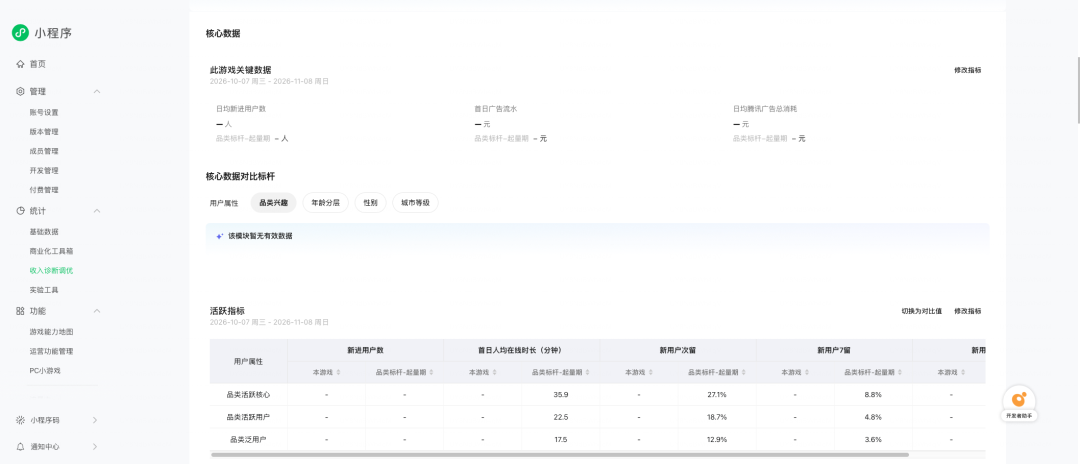
Mini-Game Revenue Diagnostic and Optimization Tool
On the content side, products such as *Eternal Night: Origins* are beginning to experiment with combining AI-generated animated series with mini-games, where the animated series is responsible for character development and attracting viewers, while the games handle conversion. This content strategy—which in the past only large companies had the resources to implement—is now spreading to small and medium-sized teams.
Of course, sharing via WeChat remains a long-term and effective way for WeChat Mini Games to acquire users. Today, developers are gradually shifting their focus from simply “setting up sharing entry points” to “designing the sharing experience,” ensuring that players are provided with content worth sharing at the exact moment they feel the urge to do so.In addition, the platform has introduced new social features such as head-to-head challenges and blue envelope gifting, using more interactive designs to boost sharing efficiency.
Recently, the show *The Ideal Life* leveraged a “platform social red envelope + sharing” mechanism, where both the sharer and their friends receive cash red envelopes. This approach ensures that sharing rewards drive genuine interaction. Compared to traditional user acquisition methods, the paid user penetration, new user acquisition, and retention rates among invited users are higher, resulting in better user quality and significantly improved ROI.
With Evergreen’s establishment, the next hurdle has already come into view.
“Sheep, Sheep” and “Catch the Goose” are prime examples of mini-games being turned into IPs; both titles have launched merchandise, participated in offline comic conventions, and have collaborated with JD.com.William revealed that Tongqu is already selling plush toys based on *Piggy Pig* and is exploring ways to integrate the game’s characters into animated series. He hopes that the Tencent ecosystem can provide more support in amplifying the IP’s reach.
Once the success of a few products—which was once a matter of luck—evolves into a proven, verifiable, and replicable model, the question of how to cultivate genuine IP and brand value will likely become an unavoidable challenge for mini-games as they enter this new phase.
原创文章,作者:游茶妹儿,禁止转载:https://youxichaguan.com/en/archives/223333