In *The Little People of Grain*, I experienced for the first time the joy of forming a band with strangers.
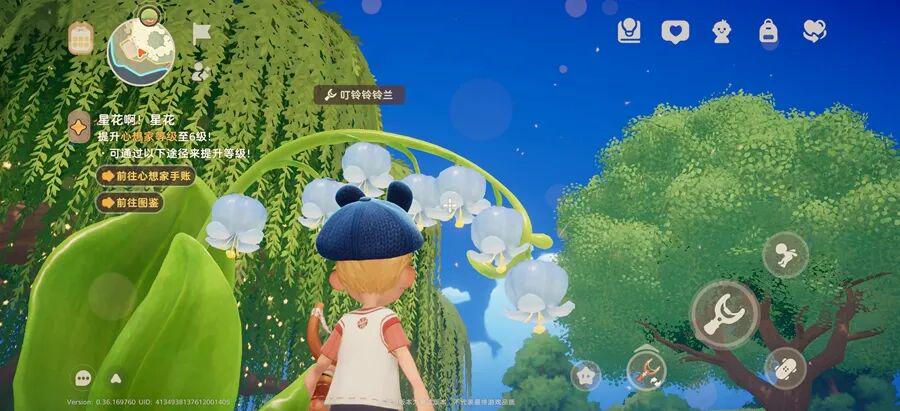
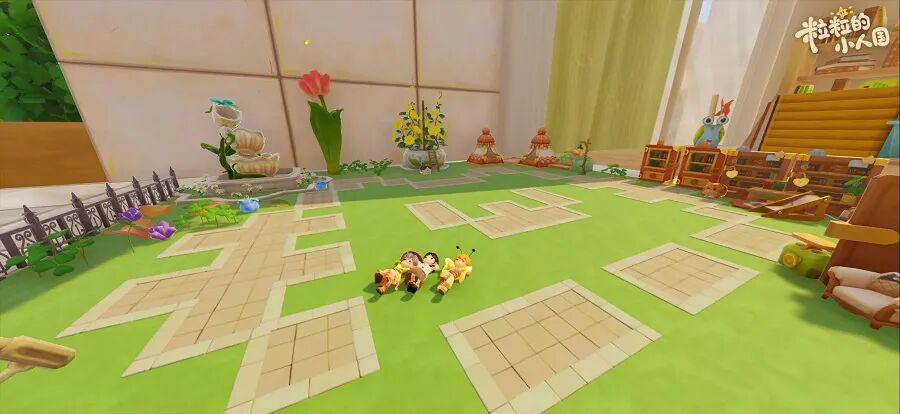
Completely by chance, near the flowerbeds at Starflower Square in the Great Upa Forest, I ran into a stranger who was happily playing the trumpet. My musical instincts kicked in instantly. So I greeted him warmly, took out my instrument, and motioned for him to join me. Without hesitation, he happily played along with me.
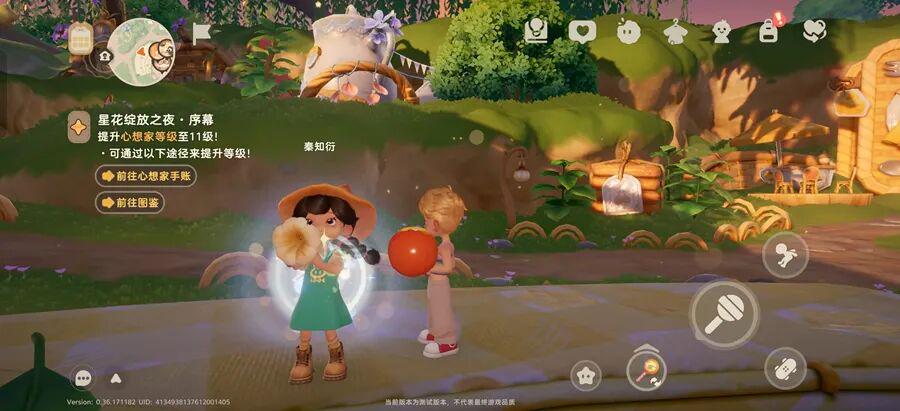

What’s even more interesting is that, just as we were having fun on our own, two more players passing by were drawn in by the joyful atmosphere. One after another, they picked up instruments and joined our “concert.”Guitar, accordion, and even a trumpet—with no sheet music and each playing to their own beat—it actually sounded pretty good. For those few minutes, I almost forgot that this was a game that had only been in beta for a few days.
It suddenly occurred to me that in the band anime *Lost Son*, Mutsumi Wakaba made that famous line: “I’ve never found forming a band to be fun.” It seems the key to forming a band really comes down to your mindset and the kind of people you collaborate with.
To me, this scene from *The Little People of Grain* feels more like a weekend afternoon when you’re walking through a park and happen to stumble upon a group of passersby playing music spontaneously—you stop to listen for quite a while, your heart filled with the joy of an unexpected encounter.
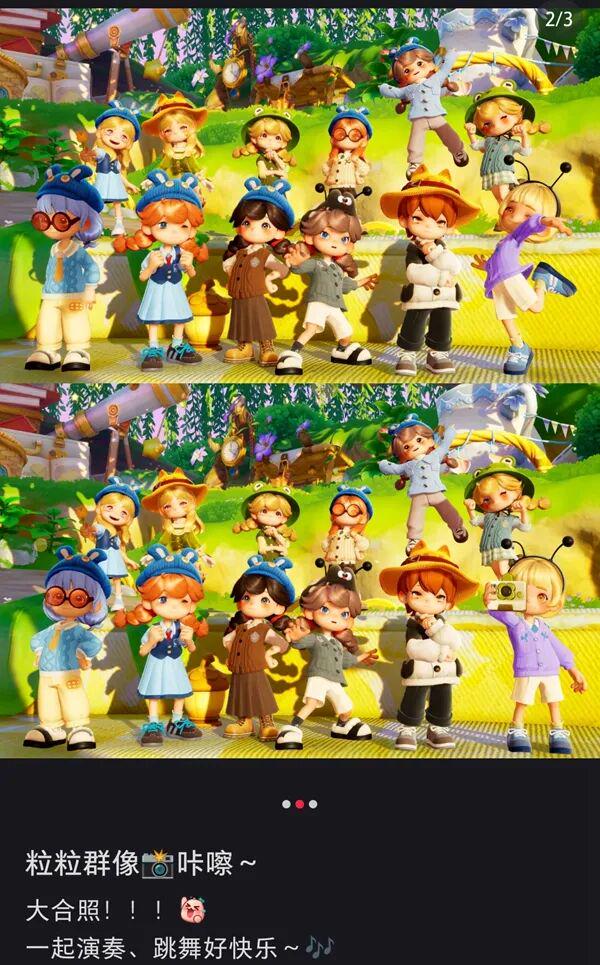
Other players also enjoy these chance encounters.
On September 22, the “Freeze-Frame Test” (Second Beta) for *Lili’s Lilliput* began. I qualified for the first time and finally got to try out the game that had piqued my interest when I saw the first teaser trailer. I’m really curious to see what kind of unique experience this miniature life simulation world has to offer.
01
Creating a Miniature World That Evokes the Feel of Everyday Life
To answer the question posed above, we must first return to the beginning of *The Little People of Grain*.
According to the development team, the game originated from a very ordinary dream. One day, a team member was catching up on some sleep at their desk when they dreamed that their body had shrunk and they had returned to that same office in real life.
This dream sequence was brought up during the project team’s brainstorming session: If we were to shrink down and look at the world, what would the familiar things in our lives look like?As the discussion went on, everyone grew more and more excited, coming up with many ideas—such as dandelions serving as flying machines or rulers turning into musical instruments. But what truly moved them was the idea of rediscovering the real world through the eyes of a smaller being: the beauty in things that were once overlooked suddenly took on greater significance.
The development team's unique creativity is best exemplified in the "Star-Lined Haven" map.
My ordinary desk, when laid out, becomes an amusement park;The bookends I’d casually set aside formed a high wall, with a roll of tape lying across the center, like a small mountain looming before me; even the keyboard and mouse were so huge that I had to look up to see them, and I had to maneuver and jump between the grooves of the keys just to get the job done.
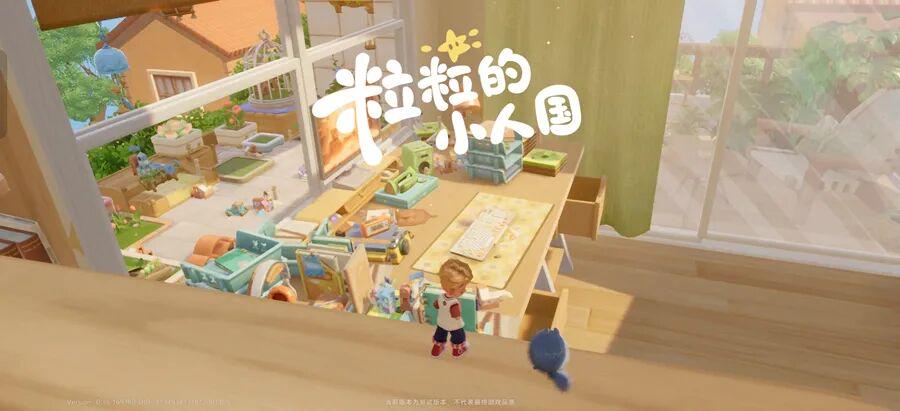
In most games of this genre, players are typically required to “build” structures, add furniture, and craft workbenches. In *Grain’s Little World*, however, players are instead asked to “arrange” items—a process that more closely resembles everyday housework, such as tidying up items scattered across a table and putting them away neatly. This in itself is quite stress-relieving.
The issue of item placement—which was a common point of feedback from players during the “Settling In” beta (Beta 1)—has been optimized in Beta 2. When items are placed near their target location, they will automatically snap into place, eliminating the hassle of aligning them precisely.
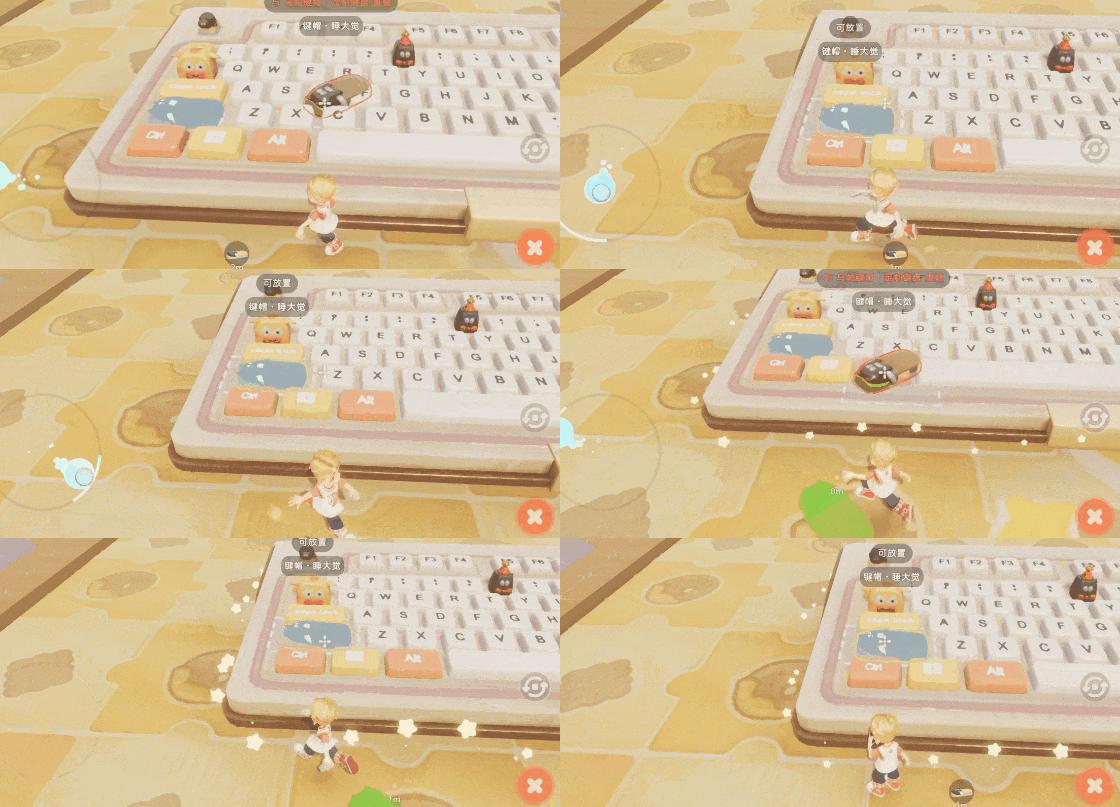
Automatic Adhesion
Once I had tidied up the desktop and set up the stage for the party, the NPC moved into the newly built cottage at my warm invitation. With such a heartwarming and fulfilling scene, how could we possibly skip a group photo?

The camera feature in *Grain by Grain: Lilliput* truly offers a wealth of customization options, helping me capture and save every scene I find worth preserving. The development team has hidden numerous photo spots throughout the game, and players have been discovering and sharing them on social media one after another.
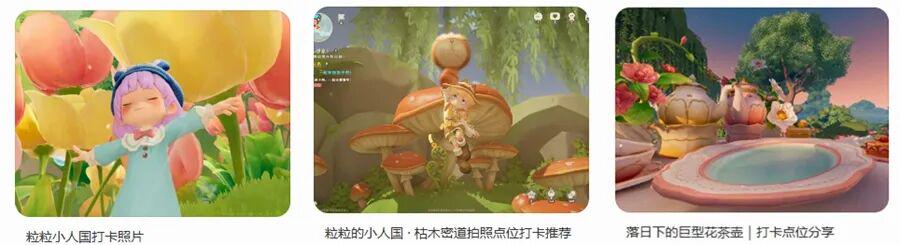
Guide to Photo Spots
In the miniature world, the fascinating scale between people and the scenery adds a lot of fun to photography.
So in the game, I don’t always follow the quest progression; instead, just like visiting popular tourist spots in real life, I go to photo spots in the game to check in and take pictures, saving each fun journey to my photo album.
But for that “sense of everyday life” to come across, the setting alone isn’t enough—what truly brings this world to life are the NPCs who live there, as well as all of you who call it home.
02
Fine bran without the pressure of numerical targets
Whether it’s Lili (an NPC) from *Lili’s Lilliput* or the players themselves, everyone plays the role of a living, breathing character in the game. This sense of vitality further reinforces the game’s atmosphere of everyday life.
The “casual player jam session” I experienced firsthand at the beginning of this article is actually not uncommon in games.
At the Gamescom in Cologne, the development team shared that during the first beta test, there was a player who would log in at the same time almost every day to play music freely by the village fountain, and more and more people would make a point of coming to listen. Later, whenever this player appeared, the world chat would be flooded with messages saying, “The master is playing again.”
After playing for a little while, I realized that the Li Li characters in the game have their own daily routines, personalities, and memories. The impatient Li Li walks with a spring in her step; the lazy Li Li always finds a spot to bask in the sun; and the night owl Li Li can only be found at night.
What's even more interesting is that if you tell an NPC, "The crops are ready—I'll treat you to some," they'll actually bring it up the next time you meet; there's also a shy NPC who remembers each companion's little quirks.

During testing, all sorts of "Grains" would drop by, exchange gifts, and just zone out together. For a moment there, I really felt like the three-headed "Grains" in the game were my friends…
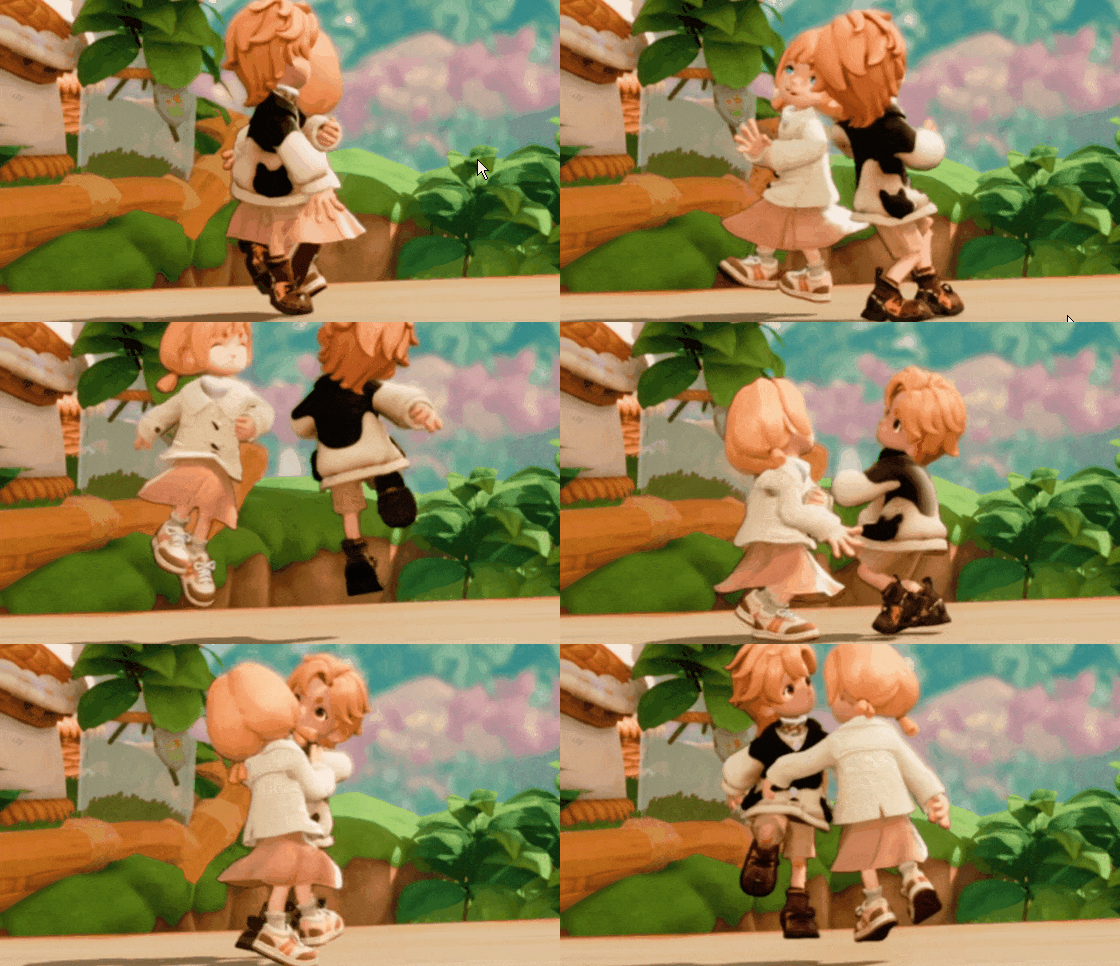
Players aren't burdened by any stats; they can simply focus on farming, building, visiting other players, and changing outfits to create a game world that reflects their own unique style. They can also meet up with other players across the vast open world and take part in fun activities—it's a truly relaxing experience.
The sense of real life within the game has spread beyond the game itself through social media.
Some players have written guides on farming in the game, sharing their carefree, “leisurely gazing at the southern mountains” lifestyle; others have shared outfit combinations that are so “cute” they practically leap off the screen; and still others have posted videos of themselves performing pop songs in-game, which adds a whole new level of fun.
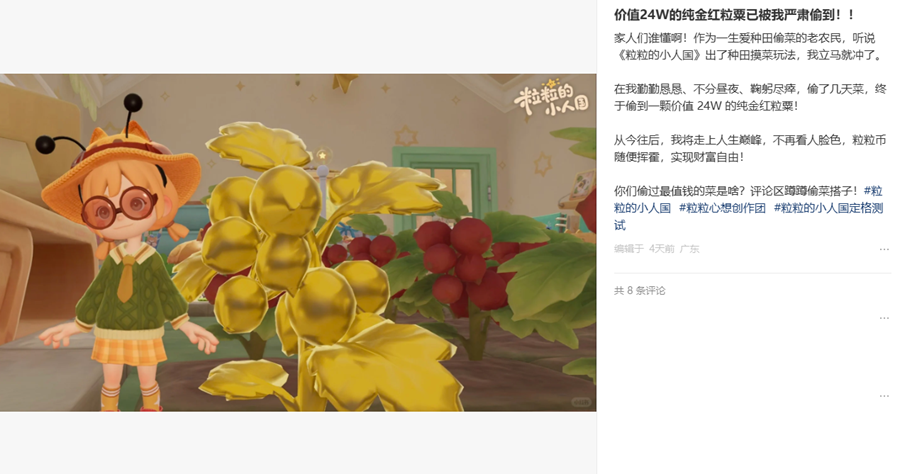
Withdrawal processed!
So much so that I can't find many serious strategy guides—it seems everyone is completely immersed in the game world.
After spending too much time tackling high-difficulty dungeons in mobile games, I realized I’d developed “stat anxiety.” Getting stuck on those challenging dungeons felt like a bone stuck in my throat, which was somewhat at odds with the original intention of playing for fun. The laid-back atmosphere of *Grain’s Little People’s Kingdom* has helped me rediscover that sense of ease—I can play however I want.
03
I regret choosing the mobile version
While playing such a soothing game, I shed tears of “regret” for choosing to play on my mobile device.
In my opinion, the graphics on mobile are still impressive, and the game runs very smoothly. Details such as character modeling, environmental lighting, and texture quality are all on par with the top-tier games currently available. Compared to the game’s first beta test, the level of detail in the characters’ hair is even better than it was back then.
However, the user experience on mobile devices is indeed not yet up to par.
When I control the camera view on my phone, I always accidentally tap the information on the right side of the screen, and what should be smooth running becomes choppy because of these accidental taps. I imagine this is one of the reasons why so many players complain that the controls feel “clunky.” Many players feel that the virtual joystick is too large and can’t be customized.
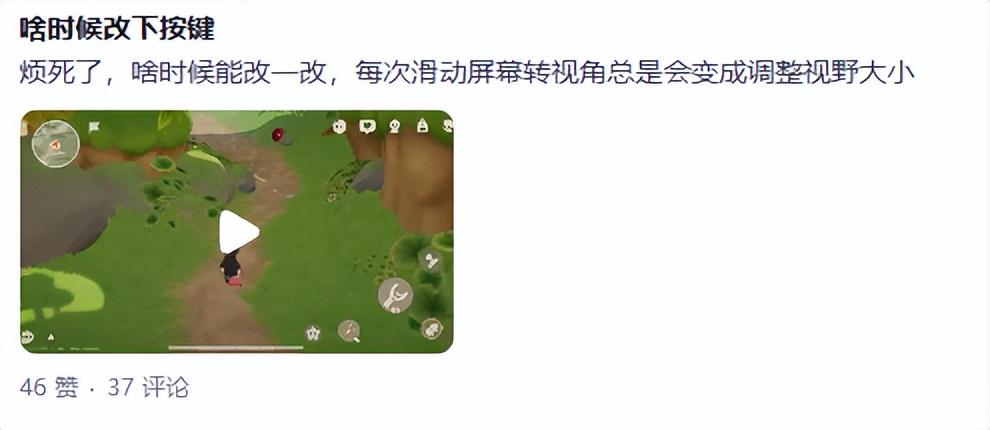
Some players also find the controls on mobile devices awkward.
In fact, the development team is already aware of this issue. In an interview in Cologne, the technical lead admitted that inaccuracies in touchscreen controls “remain a challenge.” He also mentioned that the team has added features such as auto-alignment, snap-to-grid, and guide lines to help players place objects where they want them more easily. They expect to make further adjustments based on player feedback following this test.
There are also some issues with the game's tutorial. After accepting many quests, I didn't know how to complete them. I tried different approaches back and forth, and ultimately relied on the community to finish the quests.
Of course, these are all common issues that arise during the game development cycle and do not reflect the quality of the final product. *Grain of a Little People’s World* was released on mobile platforms right from the start of its first beta test, allowing players to evaluate it early on; identifying issues early isn’t a bad thing.
For a new game that emphasizes a soothing, therapeutic experience and a relaxed pace, its performance on mobile devices is certainly a top priority for the development team.
04
Competition in the hottest sectors is really intense
Life simulation games have undoubtedly been the hottest genre over the past two years. Whenever I open social media, I come across announcements about new games or the start of beta tests every few days. Many of these new titles stand out either for their visual style or their innovative gameplay, always leaving me looking forward to the next surprise.
However, on this bustling market, competition is inevitable.With *Heartwarming Town* having led the pack for quite some time, titles like *Star Cuckoo Valley* and *Star-Painted Friends: Sunny Days* are lining up to enter the fray. Since everyone is focusing on gameplay elements like farming, building, dress-up, and social interaction, it’s not easy to create a truly unique experience.
And *Grain of a Little People’s World* is undoubtedly a top contender in this genre. Not to mention the unique perspective created by the miniaturized setting, which, combined with a relaxed, everyday atmosphere, makes the game’s “life simulation” features particularly stand out.Its early project name was “Code Name: Life,” and as the development team explained in an interview, the game “focuses more on life simulation itself rather than management.” Consequently, quests and numerical pressure have been removed, and building has been simplified to a “tidy-up-your-desk” style of arrangement.

Let’s return to the scene at the beginning of this article. A group of strangers spontaneously coming together for an impromptu jam session at Starflower Square—without any in-game rewards to drive them—is, in itself, a very down-to-earth moment.This is likely what *Grain of a Little People’s World* aims to capture: creating a fairy-tale-like little world that takes you back to those childhood days when you’d rest your head on your desk and let your imagination run wild.
原创文章,作者:游茶妹儿,禁止转载:https://youxichaguan.com/en/archives/221138