To save his sister, who had been poisoned, the young boy Ya Qing arrived at the mysterious Hidden Town.
After the opening cutscene ended, I took control of the boy and, as is common in most role-playing games, ran errands for the townspeople. Based on past experience, I should have been carrying quest items from one NPC to another, constantly collecting rewards, accepting follow-up quests, and checking items off my quest list one by one.
But in *Mist Hide*, things are a little different: the villagers’ side quests can only be completed once a day, and the story can only progress once “tomorrow” arrives in-game. It also takes time to see where the choices players make will lead.The traditional “save-and-load” method isn’t much use here—there’s no way to experiment and learn from mistakes on the spot—so I can only continue wandering around town with a sense of uncertainty.
This experience of being forced to slow down has resonated with players in the Steam demo’s review section. One player wrote that they were “first drawn in by the art style and the theme,” adding, “The leisurely storytelling and exploration of the backstories behind every NPC, along with a gameplay style that doesn’t rely on constant fighting, really spoke to me.”
The producer of this game is Langyan Wuyan. She says it’s a game that you have to “be on the same wavelength” with to appreciate, and her studio, Langyan Animation, was last brought to the public’s attention for the hidden ending animation “Unfinished” in *Black Myth: Wukong*.
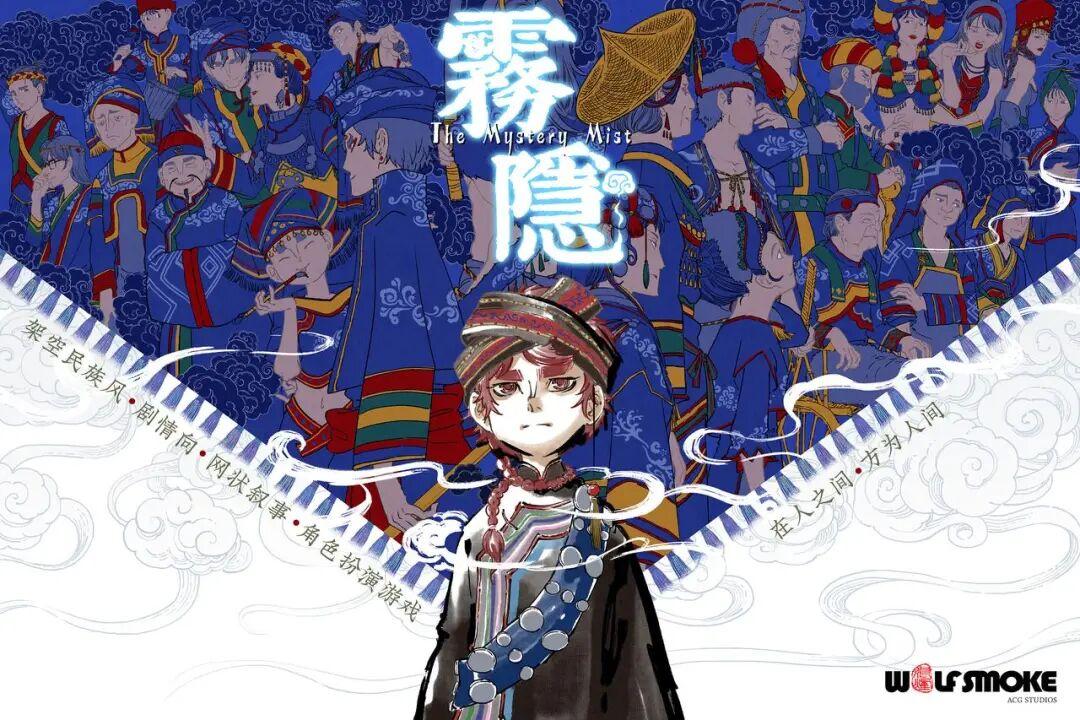
“Hidden in the Mist” is a project that Langyan Wuyan and his team have been working on for nearly six years.
01
A creator active in animation, comics, and video games
It’s difficult to sum up Langyan’s career with a single title. She graduated from the Communication University of China with a degree in Animation Art, comes from a family of traditional Chinese painters, and worked for over a decade as an art director and project manager at EA’s Shanghai office. Earlier in her career, she serialized the comic series *Masters of the Mountains and Seas* and *Frank the Bloodhand*.In 2006, she and animator Ren Lang each took a character from their names to found Langyan Animation.
For the first year or two after its founding, the company had absolutely no revenue, so the two founders decided to go all in on original content and made a name for themselves with short films like *Kung Fu Chef*.In 2012, they were commissioned by Warner Bros. to produce *Shanghai Batman*, and in 2016, *White Bird Valley*, a collaboration with director Bu Sifan, was shortlisted for the Academy Award for Best Animated Short Film and won an award at that year’s Annecy International Animation Film Festival in France.
In 2024, the hidden ending animation for *Black Myth: Wukong* went viral on social media upon the game’s release. Many players only realized who had created the short film that moved them to tears when they first saw the words “Langyan Animation” in the credits.
In 2021, Langyan Wuyan released its debut game, *The Fifth Relic*, a text-based adventure game in the ukiyo-e style.Within a week of its release, it achieved a 96% “Positive” rating on Steam and a 9.9 score on TapTap, and received two nominations at that year’s indiePlay China Independent Game Competition. A review by Jike described it as “horrifying but not grotesque, suspenseful but not gory.”

“The Fifth Relic,” the debut game from Wolf Smoke
Reflecting on her three career paths—comics, working at a major studio, and animation—she recalled that when drawing comics, she was constrained by update schedules and her artistic skill level; as an art director, she didn’t have full control over projects and had to devote energy to coordinating relationships between departments; and in animation, she had to deal with client demands and make compromises inherent to the projects themselves.“It was only when I worked on games that I truly felt a sense of ‘freedom’ in my creative work.”
Lang Yan added that this kind of freedom does not mean doing whatever one pleases: “It’s precisely because, over the years, I’ve come to understand very clearly the limits of my abilities—where my strengths and weaknesses lie—that I can, within the boundaries of what I know I can definitely accomplish, give full rein to my imagination and creativity.”
*Hidden in the Mist* is the second work she has created during this period of creative freedom. The protagonist, Ya Qing, travels to a remote frontier town where insects are used as medicine to study medicine under a master in order to save her sister, who has been poisoned by the mist. Step by step, she becomes entangled in a feud between two clans that has spanned generations.The official text count is 400,000 characters, with over 120 interactive NPCs, three main story endings, and more than twenty side story endings.
02
A “Slow” Game
The design that renders the “S/L method” ineffective—that was the first question I posed to her.
“The core concept of ‘events unfolding over time’ was the result of extensive deliberation and repeated discussions,” explained Langyan Wuyan. There were two reasons for this approach. First, *Mist Hide* places the story at the absolute center of the experience, and the day-based system makes it easier to control the pace of the plot, giving players clear objectives to complete each day.“We didn’t want it to be like some open-world games that bombard players with a barrage of question marks right from the start, leaving them lost in a sea of side quests and even forgetting to tackle the main story.”
Secondly, it’s about the weight of choices. “Many of our side quests involve a ‘cause-and-effect’ dynamic: the choices you make for an NPC today won’t show immediate results; instead, you won’t see the outcome until the next in-game day—or even several days later,”” She explained that this makes it difficult for players to review their choices by checking their save data. “This also imbues every choice with a sense of uncertainty and irreversibility, so players are likely to approach each decision with caution. This precisely mirrors real-life situations.”
This mechanism is inextricably linked to the game’s narrative. *Smoke Without Words* breaks down the themes of *Hidden in the Mist* into three layers. The first layer consists of the villagers’ everyday lives: an elderly man complaining that his son has abandoned him in a nursing home to die; an old woman weeping over the loss of her beloved kitten; and a mother who, after her divorce, is seeking help everywhere because she can’t see her child. ““Behind each of these storylines lies a reflection of some conflict found in real life.”

A variety of entertaining in-game quests
The second layer is the conflict between the two races in the main storyline—two groups with vastly different economic levels, cultural backgrounds, and lifestyles who are forced to coexist for the sake of survival. In her words, “These conflicts are constantly occurring in real life as well.”The third layer is more deeply hidden: the conflict between humanity and the Zerg, concealed in the details and corners of the story. As *Warfire* silently conveys, this reflects “a reflection on humanity’s excessive expansion and insatiable greed.”
“The title *Hidden in the Mist* comes from this as well,” she said. “The arrogance, greed, and various contradictions of the human heart are all hidden behind the mist.”
As for evaluating these choices, Langyan Wuyan declined to provide a definitive answer: “Personally, I’m not a fan of using works to directly convey simplistic notions of ‘good’ and ‘evil’ or ‘right’ and ‘wrong.’I’m more inclined toward a plain, unadorned depiction of reality and a portrayal of the ‘chaotic’ state of ordinary people’s lives.” The line in the official description—“Good intentions do not necessarily lead to good outcomes”—is also a result of this very chaos.
When the demo was released, one news report used this headline: “Studying medicine can cure diseases, but it cannot cure prejudice and stubbornness.”
03
The possibility of a “big hit” falling through
The term “radio waves” was coined by Langyan Wuyan himself, based on player feedback regarding *The Fifth Relic*.
She admitted that reviews of that game were quite polarized: “Some people really loved it, saying it was incredibly immersive and that they couldn’t stop playing it for a whole week, while those who didn’t like it would say it was just some trashy, low-budget game (laughs).”Since then, she has gradually clarified her direction: “Creating narrative-driven games is, in itself, a process of constantly searching for players who are ‘on the same wavelength.’”
The current environment isn’t exactly friendly to games that take time to grow on you; during this October’s Steam New Releases Sale, there were roughly 8,000 demo versions competing for attention.Around the same time, an article discussing “low-effort narrative enthusiasts” circulated in the gaming community. Its observation was straightforward: when determining whether a narrative game is “engaging,” a trailer won’t provide the answer—only a demo can.
Lang Yanwu didn’t shy away from this situation. She noted that games that take time to gain traction lack quick highlights, putting them at a disadvantage during the New Releases Festival and other promotional events. “I was mentally prepared for all of this even before the project launched.” Her approach sounds almost stubborn.“Since it’s inevitable that the game won’t be ‘fast-paced,’ we’ll just ‘take our time and do it right.’ This is, in fact, a two-way screening process in itself. Players who prefer quick feedback may move on, while those who can immerse themselves in the story may stick around.”
She is also well aware of the cost of this selection process: “We’re giving up the possibility of the game becoming an instant hit upon release, but in return, the game’s creators will receive a reward.”” In her words, this reward lies in the players who stay becoming “immersed” in the world the game weaves, empathizing with the characters, and worrying about the ups and downs of their fates—“allowing the game’s afterglow to linger a little longer.”
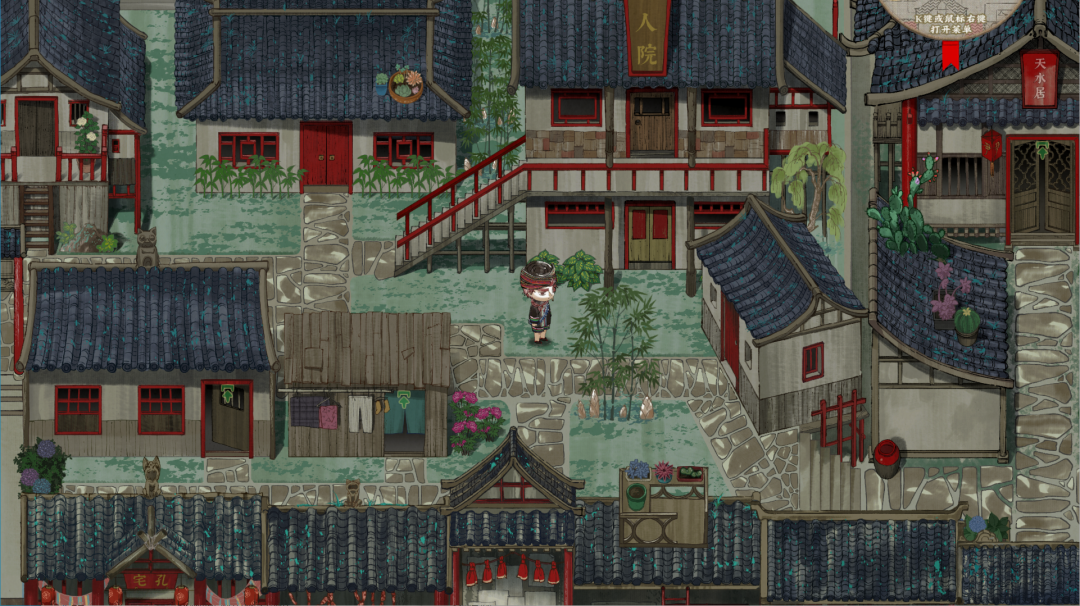
The unique art style, combined with the story, creates an even more captivating atmosphere.
Looking further ahead, she’s betting on “people.” Langyan Wuyan believes that the entry of AI will continue to lower the barriers to production,the number of entries in the New Game Festival will continue to break records. Since developers of narrative games rely more heavily on building a player fanbase than developers of other genres, “in the future, players may be more inclined to recognize the ‘creator’ as a brand in and of itself.” She believes that ensuring the quality of every game and building a strong reputation and fanbase is the only viable path forward.
Changes in the environment have also directly reshaped her creative path. Langyan Wuyan has observed that, in recent years, people’s reading habits have been reshaped by the rise of short-form content and fragmented consumption. When it comes to games with purely text-based narratives, “unless they feature exceptionally outstanding art, or an extremely compelling theme or storyline, they are easily lost in the vast sea of games.”
This explains why *Hidden in the Mist* shifted from the text-only visual novel format of *The Fifth Relic* to a narrative-driven RPG. Reading large amounts of text is a challenge in itself for today’s players, and adding interactive elements—such as controlling movement, exploring, collecting items, and completing quests—can alleviate the monotony of pure text reading while also attracting a broader player base.She believes this entails greater development complexity, a heavier workload, and higher costs, “but this is also the effort I’m making to reach more players who resonate with the idea of ‘enjoying stories.’”
As for the quality of the plot itself, Langyan Wuyan believes that a deep and meaningful story naturally requires foreshadowing, interactions, choices, plot twists, and conflicts to come together—all of which need sufficient runtime and content to support them.
04
60 voice actors, 120 NPCs, 400,000 characters of text
On the day the demo was released, Langyan Wuyan reflected on Weibo, “It’s been almost six years since we started working on this in early 2021.”
She attributed her decision to extend the game’s length to ambition: “Maybe the positive reception *The Fifth Relic* received on Tap gave me a false sense of confidence, causing my ambition to get way out of hand? Multiple storylines—add them! Multiple endings—add them! NPCs—up to 120! A gathering system—add that too!”
This expansion has resulted in a substantial volume: while the store page lists the text count at 350,000 characters, Langyan Wuyan revealed to Game Teahouse that the total word count after the script was completed had actually surpassed 400,000 characters, “and the vast majority of this is dialogue, with narrative text making up only a small portion.”One reason for the increase in word count was the “Neighborhood Dialogue” system she added midway through development. As players’ affinity with NPCs rises, the NPCs will share gossip about other NPCs and stories from their past.


NPCs with Distinct Personalities
The interwoven narrative involving 120 NPCs is primarily managed through grouping. Langyan Wuyan explained that he wanted to create a sense of a “community of acquaintances” in the game’s villages and towns, where NPCs know and are connected to one another. However, if every character had an independent storyline, the network would become extremely complex and could easily lead to various problems later on.
“Most NPCs are designed in advance as groups based on families or story units. Each group of NPCs—for example, a family of four—has a relatively independent side quest, so when I’m writing, I only need to focus on the plot of that specific side quest.”In her plan, some characters will appear in other characters’ stories, but only as supporting characters, without spawning additional ending branches, “to avoid making the side plots too convoluted.”
Voice acting is another key component; nearly every major character in the demo has a voice actor, with the full cast featuring over 60 professional voice actors, produced by Ling Sheng Voice Acting Studio. Lang Yan Wuyan joked on Weibo, “It’s probably rare to find an indie game with a voice cast longer than that of most AAA titles.”
Regarding the associated cost issues, Langyan Wuyan also offered an explanation, stating that Ling Sheng and the team have a “collaborative development” relationship, similar to “equity in exchange for technology.” “If we really had to hire so many big-name voice actors at commercial game voice-over rates, the studio would probably go bankrupt before the game even launched,” she said.She believes that voice acting is of great significance to narrative-driven games, and Ling Sheng’s exceptional performances “breathe life into every character.”
The Miao-style artwork is the result of long-term accumulation; Wolf Smoke Studio rarely repeats a single artistic style. The ukiyo-e style in *The Fifth Relic* stemmed from Wolf Smoke Wuyan’s fascination with that illustration style at the time, while ethnic minority themes were a direction he had wanted to explore for a long time.“We’ve traveled to ethnic minority communities in Southwest China many times, and we have a collection at home of Miao festival attire and Uyghur accessories—we’ve also bought many books on the subject.”
“Wolf Smoke” specifically emphasizes that the game features a fictional ethnic minority style and does not depict any specific ethnic group, thereby avoiding potential real-world issues.
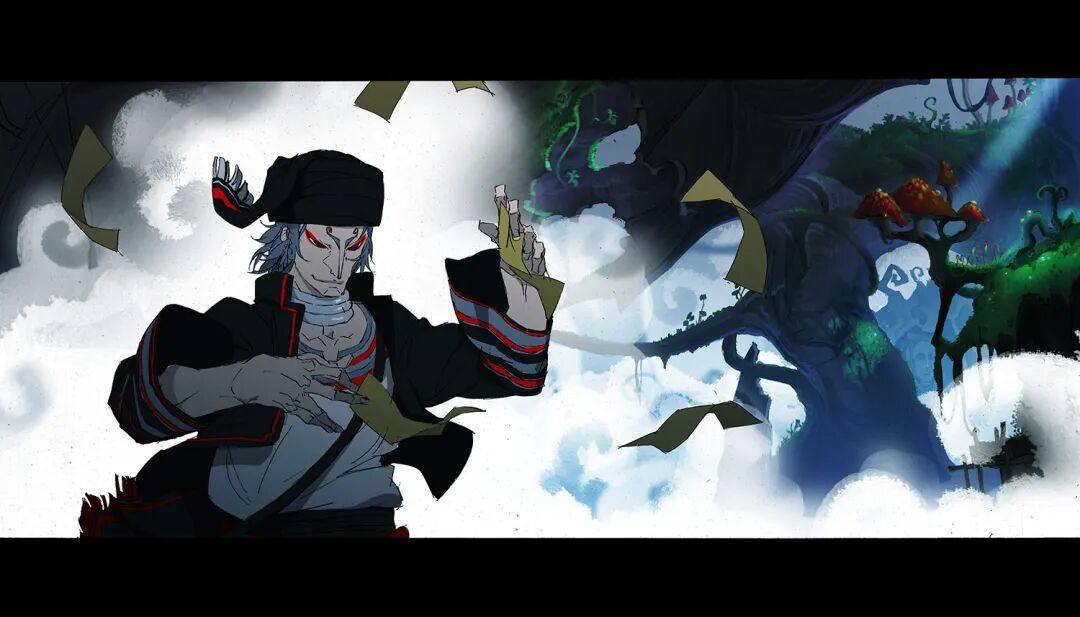
Early Concept Art by Yin Tianshui
The concept of the Insect Healer in the game has even older roots; the initial idea for *Mist Hide* was conceived more than a decade ago. At the time, the plan was to turn it into a short animated film, and Yin Tianshui was already cast as the Insect Healer in that project. The short film’s plot centered on a simple story of him battling zombies in a toxic fog and using his Insect Healer abilities to heal people.
This project had been shelved for many years for various reasons, and it wasn’t until Langyan Wuyan finished *The Fifth Relic* that this old concept was dusted off and used as a “framework.” Step by step, the story was fleshed out—explaining why the toxic mist exists, how the medicinal dishes are prepared and used, and how the insect doctors practice medicine—and then we stuffed the story we wanted to tell into it as the “filling.”
05
Six Years to Tell a Story
It’s not as if there were no compromises over the past six years.
Wolf Smoke told Game Teahouse that an entire side quest had been cut from the script: “There were some themes and characters we really wanted to write about, but once we wrote them, we felt they weren’t interesting or profound enough, so we deleted the entire storyline.” Even some mini-games in certain sections of the game were scrapped.In the latter part of the story, there was a subplot involving a blind girl. It was originally designed to include a segment where players would navigate and dodge obstacles in the dark, intended to give players a sense of the challenges faced by the visually impaired in daily life. However, as development progressed, the feature became too complex for such a small team. Since this type of content is time-consuming and, if not executed well, could actually detract from the experience, they had no choice but to replace it with an animated cutscene.
Fortunately, *Mist Hide* follows a structure where the main storyline is accompanied by side quests, with each side quest forming its own self-contained chapter, much like a anthology series; removing some of the side quests does not affect the overall structure.
As for projects like *Black Myth: Wukong* that were interspersed over the past six years, Langyan Wuyan candidly admitted that they relied on a division of labor: the animation was handled by the Renlang director, while she provided support on the art side, which helped ensure the development progress of *Fog Hide* remained on track.Currently, the studio’s focus has shifted from taking on outsourcing projects to concentrating on original content, and they have politely declined most offers. However, their past works have brought some benefits: “There might be a small number of players who pay a little more attention to our games because of this, and that alone is already very helpful.”
When comparing games and animation, Langyan Wuyan noted that watching animation is a one-way reception of information, where the viewer has no influence on the plot. Games, on the other hand, give players a sense of control—making them feel like “they are part of the story”—and open up more possibilities for the narrative. The main storyline can take several completely different paths, and the endings of side quests may be unexpected.
In addition, there is a difference in narrative efficiency between the two media. “Although we’ve been making animation for twenty years, most of it has been short films, because animation requires such a huge investment—a high-quality ten-minute film can easily cost tens or even hundreds of thousands.” If the same budget were allocated to a video game, it could tell a much more extensive story by having players actively control characters and incorporating cutscenes.
As a creator, Langyan Wuyan has previously spoken about her anxiety regarding generative AI; now, when discussing the topic again, she says her perspective has changed.

The OP interface is full of artistic flair.
“I might have felt anxious at first, but that was during the early stages of AI development, when many things were still up in the air. Now that AI has come this far and I have a clearer picture of where it’s headed, I’m actually not anxious at all.” She believes that when faced with something that is undoubtedly going to happen, one can only accept reality; excessive worry and anxiety are both useless and harmful.
Langyan Wuyan believes that AI will free people from some repetitive and tedious tasks, but there are certain jobs that are difficult to replace—namely, “the exploration and expression of emotions.”She noted an observation: in recent years, the term “emotional value” has appeared frequently, and when people scroll through social media, they habitually open the comments section to look for posts that reflect their own thoughts. “This is all because we increasingly want our emotions, thoughts, and views to be seen and acknowledged.”
Her view on AI stems from this: “Until AI possesses full self-awareness and emotions, ‘emotions’ will remain something that humans cannot be replaced by—and something that will become even more precious amid the explosion of homogenized information.”
A game that renders the “S/L method” obsolete, a script of over 400,000 characters consisting almost entirely of dialogue, hand-drawn artwork, and a star-studded voice cast—when combined, these elements take on a stance of their own.
Langyan silently revealed that the official version of *Fog Hidden* is scheduled for release in the first quarter of 2027. The studio is working hard to ensure that players can enjoy the game during the Spring Festival and explore the mysterious and captivating Hidden Town together.
原创文章,作者:游茶妹儿,禁止转载:https://youxichaguan.com/en/archives/224326