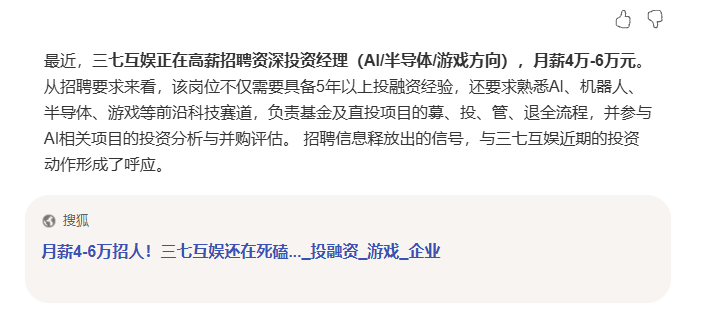
In late July, 37 Interactive Entertainment posted a job opening offering a monthly salary of up to 60,000 yuan for a “Senior Investment Manager” specializing in AI and semiconductors. The position requires familiarity with cutting-edge sectors such as robotics and computing power, and the candidate will be responsible for the entire investment lifecycle—from fundraising to investment, management, and exit—for both fund investments and direct investments.A company that got its start in gaming is now offering high salaries to recruit professionals who can help it invest in the AI industry chain.
Many game companies are actively capitalizing on opportunities in the AI industry chain. On August 28, Giant Network invested 100 million yuan to subscribe to “Shixi Zhaoyi No. 1,” an industry fund focused on emerging technology sectors. The fund’s manager has very close ties to Zhaoyi Innovation, a leading manufacturer of memory chips.
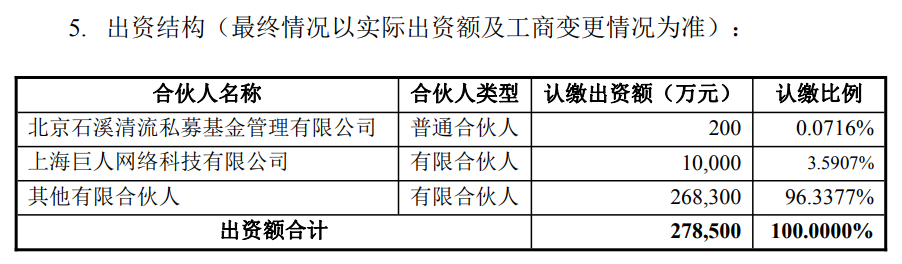
Giants Invests 100 Million Yuan in a Semiconductor Industry Fund
From 37 Interactive Entertainment’s job postings to Giant Network’s massive investment in a fund, gaming companies are channeling their surplus cash into AI, semiconductors, robotics, and computing power in search of new opportunities.
01
A gaming company has pivoted to become an AI limited partner (LP)
Game companies are not short on cash, so being able to capitalize on the industry’s growth, achieve the goal of preserving and increasing the value of their assets, and even add an “AI” angle to their brand is the best possible outcome.
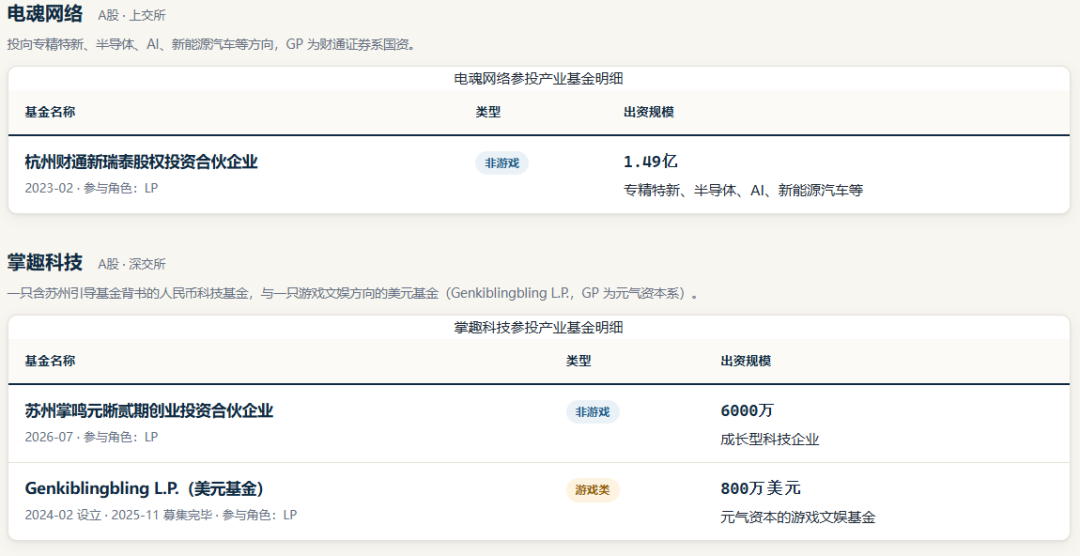
Since the beginning of 2023, gaming companies listed on the Shanghai, Shenzhen, and Hong Kong stock exchanges have participated in more than 60 industry funds as limited partners (LPs) or sponsors, with more than 60 percent of these funds targeting hard technology sectors such as AI, semiconductors, computing power, and robotics. These sectors currently have a relatively weak connection to the companies’ core gaming businesses.
Game Teahouse also found that nearly half (48.1%) of these industry funds are backed by local state-owned capital or government-guided funds. It appears that many game developers have been brought in by local state-owned capital to lend their support.
37 Interactive Entertainment has been the most active investor. This Guangzhou-based company, which got its start in MMOs, has participated in 14 industry funds over the past three years, 12 of which were invested in sectors outside the gaming industry.In the first half of 2026 alone, 37 Interactive Entertainment announced its participation in five new funds—ranging from Benyuan Quantum in quantum computing to Di’ao Weihuashan in the semiconductor industry, and Li Jing Innovation in optical cameras—effectively sweeping up investments across the entire spectrum of hard tech sectors.
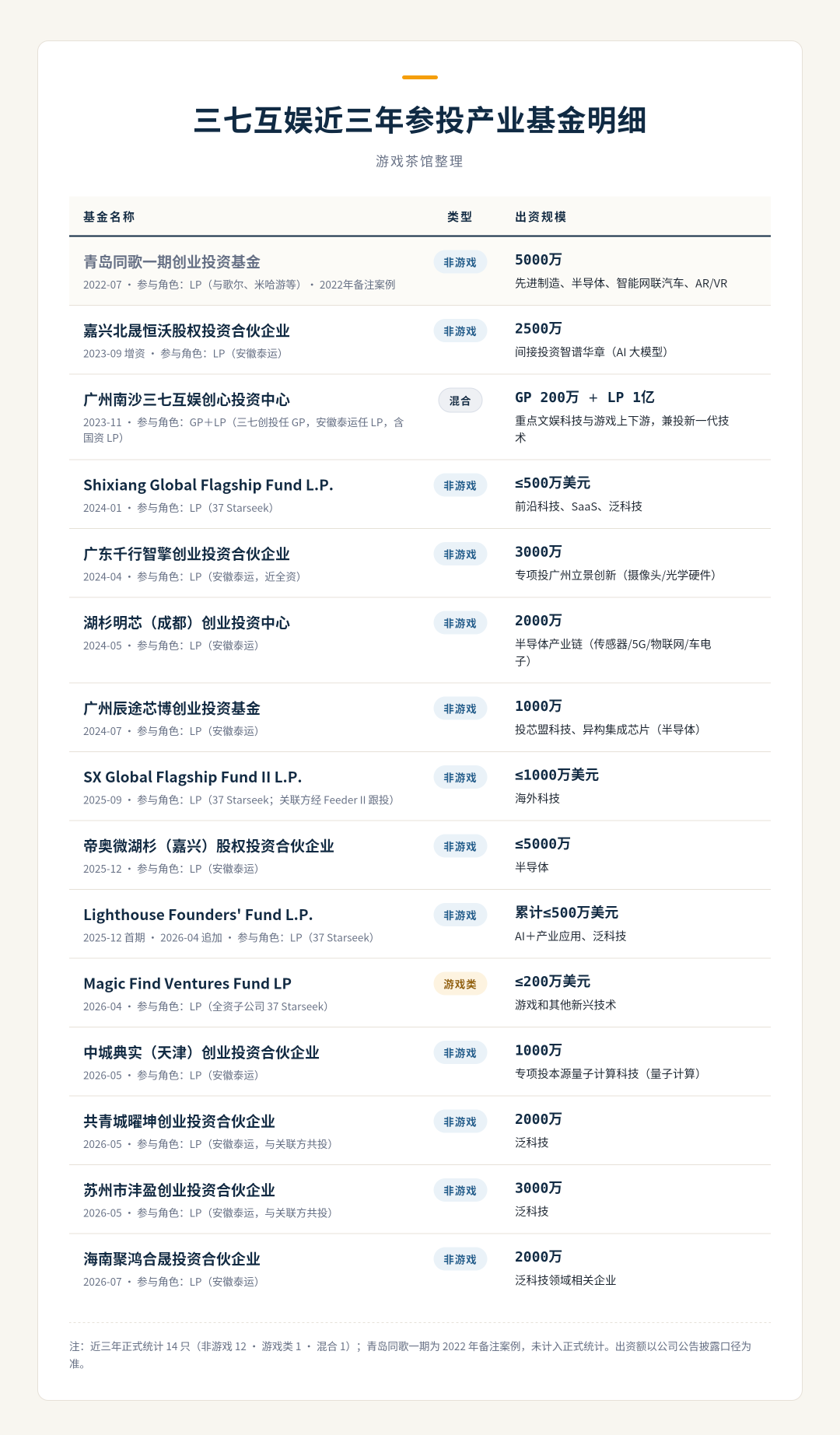
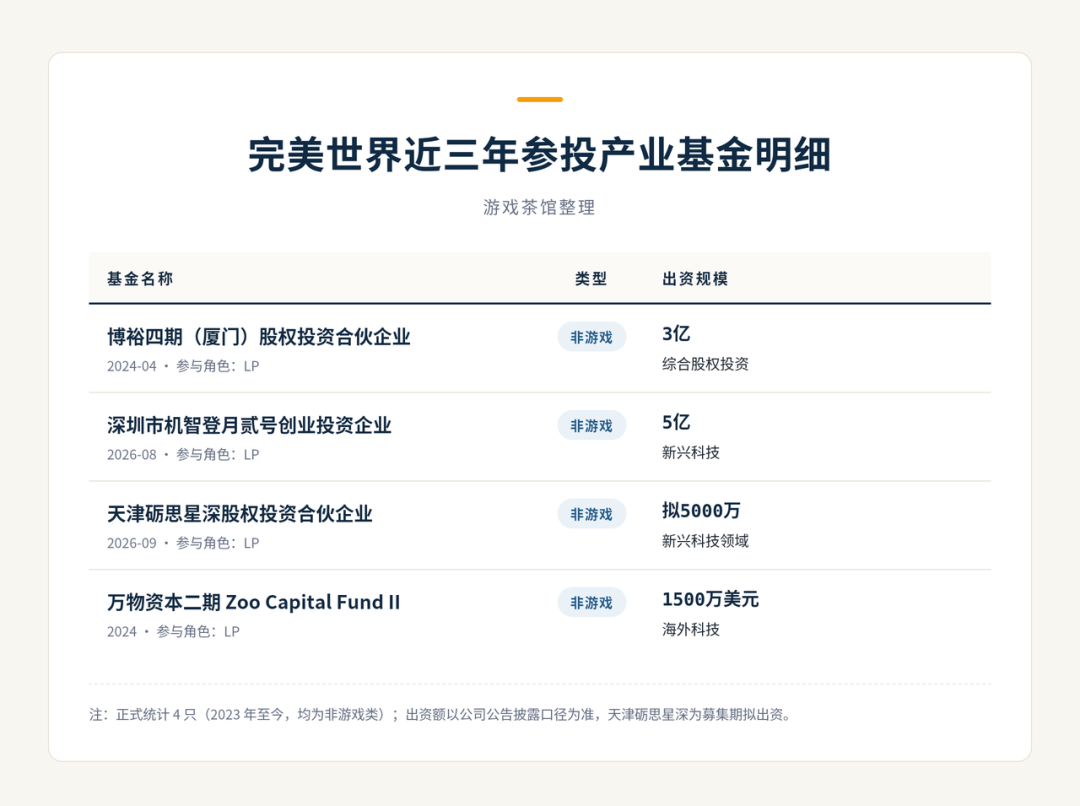
Kunlun Wanwei, whose gaming business has long been marginalized, has taken an even more aggressive approach: its investment arm, Kunlun Capital, has expanded its reach into quantum computing, nuclear fusion, and brain-computer interfaces, making direct investments without relying on funds.
However, it should also be noted that game companies typically participate in fund investments as limited partners (LPs); while they contribute capital, they do not have much say in investment decisions. Professional matters require professionals to handle them, and most fund managers have extensive backgrounds in the AI industry.
Tianjin Lisi Xingque, in which Century Huatong has invested, is managed by Lisi Capital. Founded by Cao Xi, a former partner at Sequoia China, Lisi Capital has invested in leading domestic AI large-model companies such as DeepSeek and Dark Side of the Moon.Lisi Capital is also a familiar name in the gaming industry, having backed startups founded by star producers such as Wu Meng and Xuanzi, as well as the new company formed by the original team behind *Full Moon Night*.
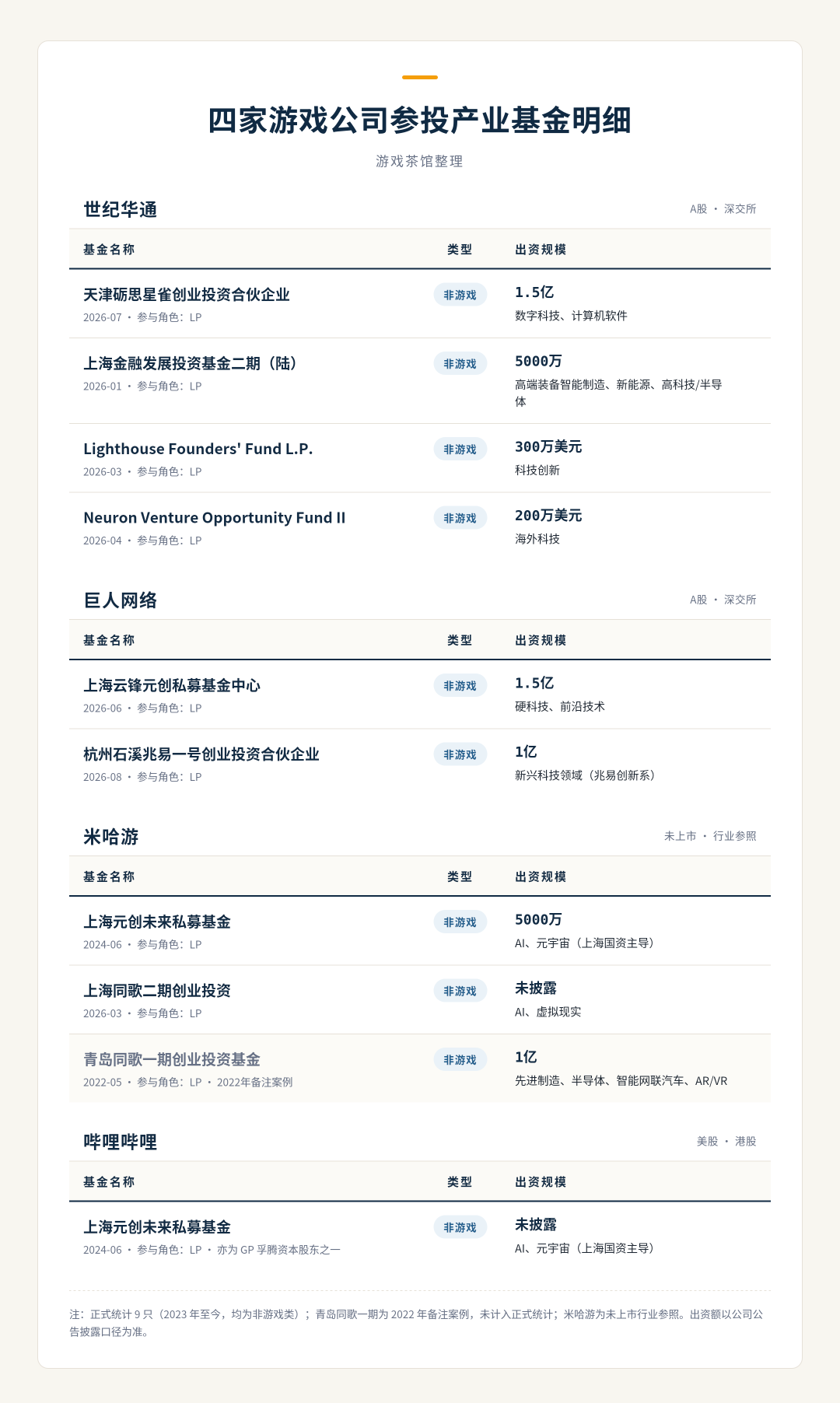
Some of the spare capital invested by gaming companies has already begun to pay off, with the successful bets all targeting some of the most sought-after companies in China’s AI industry chain.
At the end of 2021, miHoYo made an angel round investment in the large-model company MiniMax, holding approximately 6.4% of its shares prior to the IPO. In January of this year, MiniMax successfully went public, and the paper gain on this investment at one point exceeded 10 billion Hong Kong dollars.
37 Interactive Entertainment has adopted a broad-based investment strategy, indirectly holding approximately 0.27% of Zhipu AI through its affiliated funds. Following Zhipu’s IPO, 37 Interactive Entertainment’s investment income in the first half of the year reached 1.016 billion yuan, accounting for 45% of its total profit.
Century Huatong, for its part, had indirectly acquired a stake in Moore Threads, a domestic GPU company, through an industrial fund several years ago. Although its effective ownership stake amounted to only 0.36%, Moore Threads’ IPO last December resulted in a one-time gain of approximately 640 million yuan for Century Huatong.
Overall, this round of investment by gaming companies in the AI industry chain has been highly efficient, with rapid returns following the investment. As of this writing, lock-up periods for shares held by several of these publicly traded companies have expired, and the gaming companies can cash out at any time.
Compared to the gaming industry, where investments lack exit strategies, the cost-effectiveness of game developers investing in the AI industry chain is far greater.
02
In the last round, the gaming company actually bought games.
I still remember that during the last period of industry expansion, the gaming industry itself was the primary outlet for game developers’ excess cash.
In 2019, the issuance of game publication licenses—which had been suspended for nearly a year—resumed. Combined with the sudden boom in the “stay-at-home economy” in 2020, the gaming industry experienced a period of prosperity. Profits began to spill over from gaming companies’ balance sheets, and the speculative capital from that time eventually flowed into both upstream and downstream sectors of the gaming industry.
Tencent has been the most aggressive. In the first half of 2021 alone, it invested in 27 gaming companies—an average of one every seven days. Observers have dubbed this series of moves a “defensive offensive,” aimed at recruiting promising startup gaming teams early on to prevent ByteDance, a new entrant to the market, from gaining a foothold.
ByteDance, meanwhile, spent approximately $4 billion in 2021 to acquire Mutoon Technology. Alibaba acted even earlier, purchasing JianYue Technology for about 1 billion yuan in 2017; the company was later renamed Lingxi Interactive Entertainment, marking the beginning of a legendary journey.
While industry giants are on a buying spree, other companies aren’t sitting idle either. Take Gigabit, for example: it has partnered with several gaming companies—including Qingci, Yongshi, and Taojin—to establish a series of funds, and has also brought in investment from Xiamen State-owned Assets. The investment targets of this series of funds span the cultural and entertainment industries, ranging from gaming and animation to film, television, and new media.
It’s just that the bubble burst, and the investments failed to yield positive returns. Few of the game companies acquired by speculative capital during the last boom have truly grown into leading development studios; many have even disappeared from the scene, with their book value now at zero.
The most telling example is the industry giants themselves: game assets they acquired at high prices years ago have, in the blink of an eye, been sidelined as non-core businesses.
In March of this year, ByteDance sold Mutoon to Saudi capital for over $6 billion. In August, Alibaba sold its nine-year-old gaming business in its entirety to an M&A fund affiliated with CITIC, recouping approximately 10.1 billion yuan in cash.During the same period, Alibaba also completed a private placement of 80 billion Hong Kong dollars, with all proceeds directed toward AI infrastructure.
It is clear that, in the eyes of the internet giants, the gaming business has quietly retreated from its strategic high ground to provide fuel for the development of AI.
03
Game developers have not strayed from their core business either.
A lot of money is flowing into AI, but game companies haven’t strayed from their core business. They’ve simply shifted their investment strategy—moving from the bold moves of the past to a much more cautious approach, focusing primarily on investing in star producers.
The current wave of celebrity producers launching startups this year would not be possible without financial support from game developers.
Weixiao Technology, founded by Li Kaiming, the former producer of *Rateshu Zhibin*, has secured investment from miHoYo and IDG; it is rumored that its post-investment valuation exceeds $100 million;Jiezhi Games, founded by Jin Tao, the former producer of *Onmyoji*, has secured investment from IDG and Lilith, with a valuation exceeding 1 billion yuan, and has also obtained a license for the *Onmyoji* IP from its former employer, NetEase……
On the other hand, the managers of the gaming industry funds in which game developers have invested were also once high-profile industry figures.
Take Magic Find, for example, in which 37 Interactive Entertainment has invested—this fund is led by Shao Yun, a former senior vice president at NetEase. Money from 37 Interactive Entertainment flowed through Shao Yun’s fund and then into Jin Tao’s Jiezi Games. After going full circle, the money has remained within the gaming industry.

Onmyoji: Concept Art for “Cloud Map”
Another similar example is Yuan Jing, the former CEO of Mutong Technology, who founded the Pilot Fund after leaving the company in 2024 and has since been engaged in investment and incubation while also developing and publishing games in-house. Interestingly, Yuan Jing is also one of the limited partners (LPs) in Shao Yun’s Magic Find.
Industry leaders continue to set investment records.In April of this year, Tencent acquired a 12.5% stake in Huowa Games, the developer of *Battles and Homefront*; NetEase invested in the developer of *Shadow Rush: Crimson Moon Kill*, taking a 10% stake—marking NetEase’s first investment in a domestic game development team in many years.
Ultimately, none of these moves by game companies have strayed from their core business. The investors are game industry professionals, the investment targets are still games, and the fund managers are also from within the gaming industry.
04
Actually, investing doesn’t affect my main job.
Once game developers make a profit, they need an outlet for the excess profits. They cannot reinvest all of their profits into game development. After all, game projects are constrained by various factors—such as licensing approvals and creative considerations—and the returns on investment diminish as more is invested.
It therefore makes sense for the capital from game developers to flow into the upstream and downstream segments of the AI industry chain.
However, it should also be noted that investments have a relatively minor impact on the financial performance of game companies. Take 37 Interactive Entertainment—which makes investments most frequently—as an example: even after excluding investment income, its non-recurring net profit still stood at 1.016 billion yuan.
Even when the industry is in a downturn, investment losses do not undermine the company’s financial health. From 2022 to 2024, GigaBit recorded cumulative impairment losses of 355 million yuan on its investment portfolio, yet its annual net profit remained above 1 billion yuan during the same period—the total impairment losses over the three years did not even equal one year’s profit.
For most publicly traded game companies, fund commitments ranging from several million to several hundred million are merely a reallocation of cash on hand and do not affect the day-to-day operations of their core businesses. This should not be interpreted as a sign that the gaming industry itself is cooling off.
原创文章,作者:gallonlabs,禁止转载:https://youxichaguan.com/en/archives/207677