
In the first half of 2026, total revenue from casual games remained largely unchanged compared to the same period last year. Among these, puzzle games continued to lead the market, generating $4.9 billion in revenue and accounting for over 44% of the total market share. Based solely on the data disclosed by AppMagic, puzzle games appear to be the category with the greatest potential for growth.
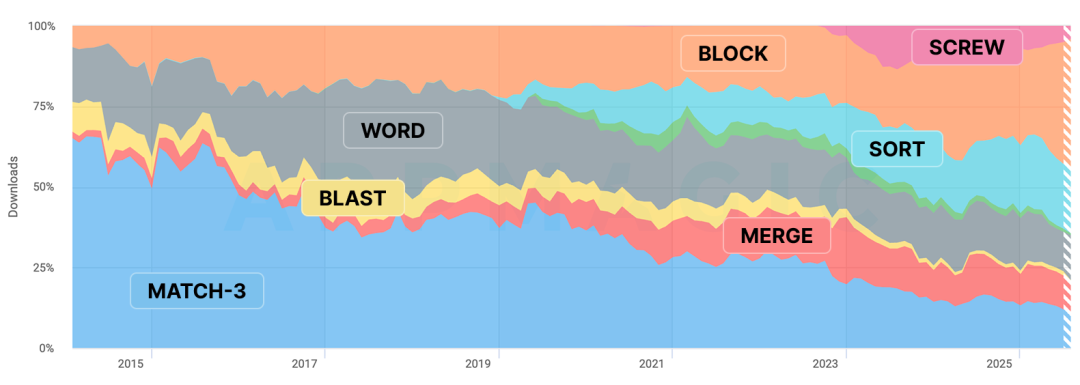
Download data for the “Puzzle” subcategory; Source: AppMagic
However, market growth does not necessarily translate into widespread benefits. The same report shows that match-3 games, which account for more than half of the market share, are also one of the most difficult categories to break into.In the first half of 2026, only one out of 120 new games generated over $100,000 in monthly in-app revenue, and that game was the Vietnamese version of *Gardenscapes*. Even in the match-2 genre, which posted impressive year-over-year growth, success—as evidenced by the performance of new games in the first half of the year—remained concentrated among a small number of established players.
This is similar to the assessment made by Ronny, CEO of Leyou Tongchuang: competition is intensifying year by year, and there are no longer universal opportunities available to everyone. Unless a team possesses strong competitive advantages, it will be difficult to achieve success in this field.
Founded in Chengdu, Leyou Tongchuang specializes in the development of high-quality casual games for overseas markets. The company has a portfolio of established puzzle games and has focused on the pinball genre for seven years, with its global pinball titles accumulating over 20 million downloads. This success stems from the team’s deep expertise in the match-3 genre and its commitment to innovation.
Leyou Tongchuang doesn’t aim to release dozens of products a year or follow trends blindly; instead, it prefers to continuously refine its offerings within its core categories.In 2021, the team introduced its first innovation to the classic pinball gameplay by creatively integrating the logic of special obstacles from match-3 games into traditional physics-based launch mechanics, designing over 50 original obstacles.This innovation achieved its first success in *Bricks Royale*, released in 2022. Subsequently, *Bricks Legend*, launched in 2025, ranked first in downloads on both platforms in the U.S. and second globally.
Innovation in game genres continues unabated,In October 2026, the team independently developed a brand-new “bouncing ball roguelike tower defense” game. While retaining the core physics-based launching mechanics, the game incorporates innovative gameplay elements that blend roguelike tower defense with skill-based mechanics. Titled *Code Name: Bricks*, the game has completed its first beta test and is scheduled to officially launch in the near future.
In addition, Leyou Tongchuang has introduced innovative gameplay designs in other games and genres, such as *I Love Unscrewing* and *Wool Saga 3D*, and has ranked among the top titles in their respective categories.As its product lineup and R&D focus continue to expand, Leyou Tongchuang is currently recruiting new team members and hopes to welcome more talented individuals to join the team and participate in future innovation initiatives.
The shake-up is currently underway, but Ronny believes these changes were within the team’s expectations; in fact, he says this wave of “returning to the product” will present a rare opportunity for growth. Therefore, the team is expanding to ensure it’s ready to seize this opportunity.
Game Teahouse sat down with Ronny to discuss this topic, hoping to gain a deeper understanding of how this company has been able to consistently produce hit games in a highly polarized industry.
01
The Myth of User Acquisition Is Debunked; Competition Returns to “Product First”
From Ronny’s perspective on Puzzle’s timeline, 2024 is a pivotal year. New market opportunities have attracted significant investment and drawn in numerous teams, leading to iterative improvements in each team’s capabilities and driving a wave of explosive growth in 2025.
But last year could still be considered a window of opportunity; this year, there is no such window.
“One of the defining features of Puzzle is its relatively low barrier to entry. Seeing the market grow, some teams might think, ‘Maybe I should give this a try?’ But just because the market is expanding doesn’t mean every new entrant will have a chance. Anyone entering this space now needs to proceed with great caution.”
The cause-and-effect relationship here is easy to summarize. The current situation is that “the traditional match-3 genre is relatively saturated, while match-2 games still show growth momentum.” Puzzle games may continue to grow in the short term, but the influx of a large number of development teams will lead to two outcomes: first, an increasing number of homogeneous products; and second, a rapid rise in the cost per user.
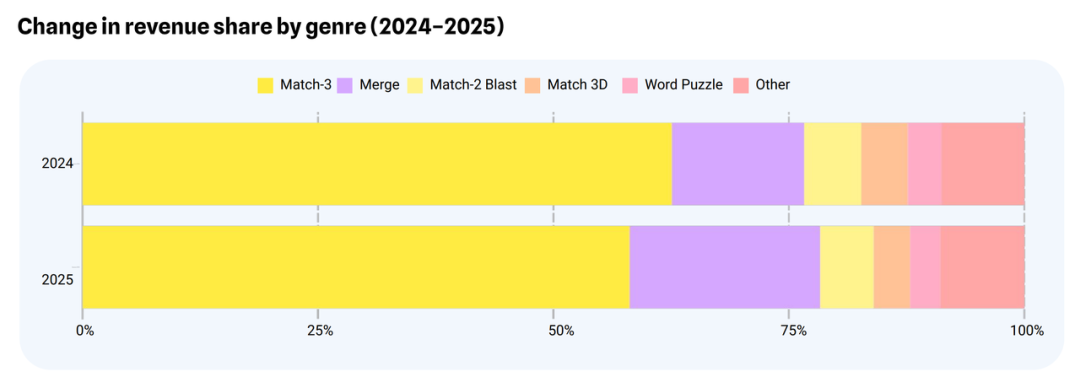
Changes in Revenue Share by Puzzle Subcategory, 2024–2025; Source: AppMagic
User acquisition costs have been a recurring topic of discussion over the past two years. According to a report by Adjust, the global gaming industry’s average cost per install (CPI) is projected to rise 30% year-over-year to $0.56 in 2025, while the cost per thousand impressions (CPM) is expected to increase 20% year-over-year to $4.34.
In addition to bidding driving up costs, advertising platform algorithms are also evolving at an extraordinary pace. From campaign setup to the integration of AI, the entire process is becoming increasingly automated, and many teams are now using AI for user acquisition and ad placement.
User acquisition is essentially about amplifying a product’s revenue when the product itself is good enough. For this reason, Ronny believes that continuing to focus on user acquisition at this point no longer makes much sense.To maximize profits in this environment, the focus must return to product innovation. Only by creating new gameplay experiences that have never been seen on the market can user acquisition materials and the product itself offer users a sense of novelty—and only then will there be an opportunity to achieve lower user acquisition costs and capture a larger market share.
“If you just follow in the footsteps of others’ products, by the time you launch, there may already be a flood of similar ad creatives and products on the market. The profit margin for doing it this way is very limited these days—you might not even be able to recoup your costs,” Ronny said.

Source: Dream Games Official Website
This also ties into another of his market observations: leading overseas puzzle game developers have significantly stepped up their protection of their own IP in the past two years. Take Dream Games, for example—the company’s crackdown on “copycat products” is no longer limited to filing complaints with platforms; it now generally proceeds directly to legal action.
Ronny predicts that the entire puzzle game market may undergo a new round of consolidation after the end of next year. The era of unchecked growth is over; for the puzzle game category—and the casual gaming sector as a whole—focusing on innovation and developing original IPs is virtually the only viable option.
02
There is a general methodology for innovation, but the key lies in the team’s understanding.
Puzzle games are a genre that is entirely driven by gameplay. Compared to genres like SLG and RPG, which may rely more heavily on themes and art style, players are generally willing to accept games with the same core mechanics but different presentations—such as games that wrap the core gameplay in themes like the Three Kingdoms, Western fantasy, or post-apocalyptic survival.
However, the appeal of puzzle games lies in the player’s actions and the process of solving puzzles. Take match-three games, for example: their underlying mechanism is matching three in a row to clear them, so innovation primarily revolves around element combinations and elimination patterns. Just like “Screwdriver” (which became popular in 2024) and “Unravel” (which took off in 2025), both are variations on the match-three logic.

Therefore, the innovation we’re discussing here essentially involves presenting gameplay mechanics in a different way.
“Of course, there are general methodological approaches. For example, the fluctuations in flow during Puzzle levels, the length of the levels, and even the ease of controls—but these are actually just basic metrics,” Ronny believes. “Team awareness” is what truly sets them apart.
A wealth of third-party data, as well as various open and transparent studies, can provide an overview of the situation. However, since games are essentially a form of content and entertainment, the development team’s understanding of user needs and the product itself is more like a “feel” that is gradually honed through hands-on experience.
Take filmmaking as an example: there are many professional techniques involved in camera work, color grading, and shooting—all of which are fundamental for a good director and crew. However, works that truly resonate with audiences and leave a lasting impression aren’t created solely based on data. The same goes for video games.
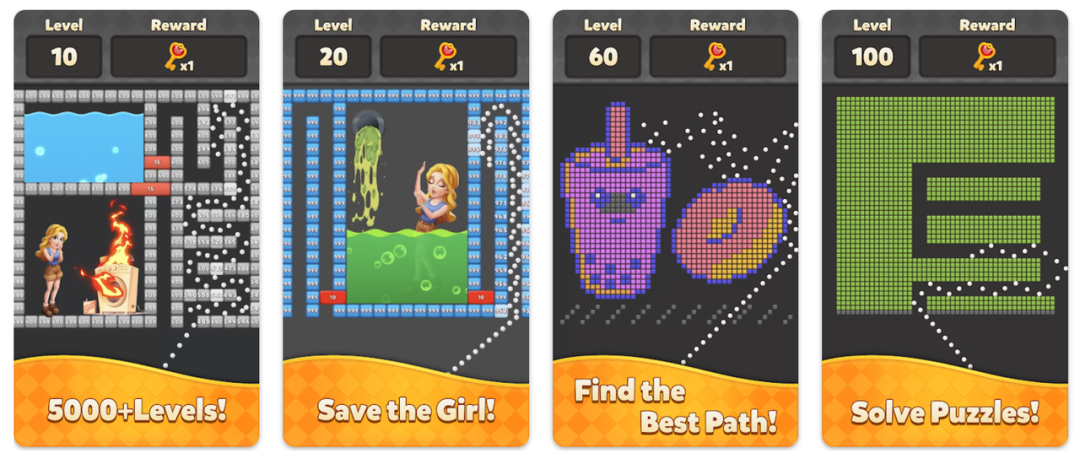
Ronny shared some specific examples with us. While conducting competitive research on the pinball category, the team discovered that most products on the market were simply “mobile ports” of traditional physical pinball games, and these products generally had poor long-term retention rates. In terms of long-term user experience, the gameplay mechanics lacked rich and varied design, which caused players to lose interest in the product quickly.
To address the widespread issue of poor long-term retention across the category, the team decided to incorporate more unique obstacles into the design, making the overall gameplay more varied and strategic. It was precisely this design that led to a 15%–20% overall improvement in the product’s long-term retention compared to pinball games released during the same period.
However, this is a competitive environment where standing still means falling behind. Over the past year or two, the design of special obstacles has become “standard” in various puzzle game mechanics, and players have come to expect increasingly sophisticated designs that ensure long-term enjoyment.
After years of deep exploration in the pinball genre, Leyou Tongchuang launched a project in early 2026 titled *Code Name: Bricks*, a pinball-style roguelike tower defense game. Unlike other similar titles on the market, this game incorporates a skill-fusion design while also featuring in-depth roguelike gameplay mechanics for each individual skill.Currently, this title not only builds on the team’s years of experience in creating pinball games—which have resulted in excellent gameplay feel—but also offers a gameplay experience that stands out from other titles on the market. The game has completed its first beta test and is scheduled for official release in the near future.
Based on Leyou Tongchuang’s experience, if a game is fun enough to attract a large user base, monetization should follow naturally. After all, if the focus were purely on monetization, there are countless games to choose from in the current market—and games aren’t even the only option for users seeking entertainment and leisure.
“In recent years, the industry has been returning to the essence of gaming. Ten years ago, there were probably many games that could succeed purely by buying user traffic, but now the focus is increasingly shifting back to gameplay itself and user-oriented product development.”
A commitment to independent innovation, combined with years of accumulated experience, has established Leyou Tongchuang’s competitive advantage. Ronny also noted that the team’s understanding of both the product and the users stems from continuous reflection and the benefits derived from ongoing innovation. If you simply copy others’ products, you actually have no real understanding of or insight into your users.
Innovation leads to practical application and feedback; through this process, relevant insights are gained, and these insights in turn drive the next round of innovation. Game development teams lacking this virtuous cycle will find it difficult to survive the current period of rigorous selection.
03
First, assess your own capabilities; then evaluate the market potential.
As mentioned earlier, as competition intensifies, even business models that initially seemed promising need to be reevaluated.In 2024–2025, many people saw Puzzle as a good business opportunity—with low barriers to entry, relatively small investment requirements, and decent returns—so a large number of teams entered the market, only to discover that the reality fell short of expectations. Therefore, we also discussed insights into the competitive landscape and the choices involved.
“First, choose a field that matches your abilities. With that in mind, try to select a sector with a high ceiling and room for growth.”
Looking at the global market, Turkish companies have become the focus of research for many institutions in recent years due to their outstanding performance in the casual gaming sector.According to AppMagic, while the global gaming market has seen near-stagnant growth, the Turkish gaming market has achieved an annual growth rate of 6%. Meanwhile, puzzle games are the genre in which Turkish developers hold the greatest competitive advantage, accounting for approximately 97% of their global game revenue.
This brings up an interesting topic. Ronny told us that the objective factors behind Turkey’s development are worth paying attention to.
Turkey offers certain industry conditions that are difficult for domestic practitioners to access or replicate. Coupled with a pool of experienced casual game development teams—which have nurtured even more talented new teams—the exchange and competition among these teams have fueled the rapid growth of Turkey’s casual game industry.At the same time, according to his understanding, some of the Turkish government’s subsidy policies are exceptionally generous by global standards.
“But domestic professionals have one major advantage: we have access to both overseas markets and China’s vast domestic market. As long as we identify the right product direction and focus on our areas of expertise, we have a much bigger stage to play on when it comes to globalization.”
Take Leyou Tongchuang itself as an example: in recent years, it has focused primarily on expanding overseas, but now it is also launching several products in the domestic market one after another. Its newly developed pinball tower defense game has just completed its first round of testing, and the official launch is scheduled for the near future. As long as a company has sufficient core capabilities, its strategic approach can be very flexible.The market environment and landscape are constantly changing, so teams should not limit themselves to a single market strategy.
We ended our conversation by discussing our expectations for the industry’s future, and Ronny was generally optimistic.
Gaming is an irreplaceable part of many people’s lives, and it won’t fade from people’s lives just because of short dramas, short videos, or other new forms of entertainment that may emerge in the future. As long as the industry continues to introduce better gameplay, higher-quality products, and more immersive experiences, users will continue to generate new demands.
原创文章,作者:游茶妹儿,禁止转载:https://youxichaguan.com/en/archives/224911